

The broad B2B information services market is estimated at $118.35 billion, but high-ticket buyers usually need a much narrower subset focused on commercial intelligence, buying signals, and decision-makers. The strategic question isn't how much data exists, but whether the data is fresh enough and connected enough to explain which account is moving toward a purchase.
That distinction changes how a consultancy or B2B software company should evaluate information services. A large database can provide reach, but reach alone doesn't reveal whether the right people are involved, whether their records are current, or whether several stakeholders are converging around the same business problem.
For a marketing director accountable for pipeline, B2B data should be treated as an operating asset. Its value depends on the quality of the account model, the reliability of each record, the transparency of intent signals, and the ability to connect research activity with qualified commercial conversations.
Table of Contents
- The Scope and Scale of B2B Information Services
- From Static Directories to Dynamic Intelligence Platforms
- Analyzing the Modern B2B Buying Group
- Managing Data Quality and Technical Decay
- Distinguishing Genuine Buying Interest from Passive Consumption
- Measuring the Commercial Value of Trusted Expertise
- Practical Applications for High-Ticket Consulting Sales
The Scope and Scale of B2B Information Services
B2B information services aren't one market with one standard definition. They include business directories, company databases, credit information, financial data, market research, compliance services, risk intelligence, and online information platforms. Sales intelligence is only one part of that wider category.
That breadth explains why market estimates can appear contradictory. One broad estimate places the global market at approximately $118.35 billion in 2024, while narrower definitions produce figures below $1 billion (market scope estimates for B2B data). These figures shouldn't be compared until the buyer knows which services each estimate includes.
For a consulting firm, technology services provider, HR consultancy, or B2B software company, the relevant category is usually commercial intelligence. That means information used to identify suitable organizations, map decision-makers, understand business needs, recognize buying signals, and prioritize accounts. Credit reporting or regulatory data may matter to a financial services company, but it won't necessarily improve a long, relationship-led consulting sale.
Define the information layer before comparing vendors
A useful evaluation starts by separating four layers:
- Identity data: Company names, domains, locations, subsidiaries, and organizational relationships.
- Firmographic data: Industry, size, business model, geography, and other attributes used for account fit.
- Contact data: People, roles, seniority, responsibilities, and current contactability.
- Behavioral data: Website activity, content engagement, public activity, job changes, and other evidence of possible business interest.
These layers serve different decisions. Identity data helps resolve an account. Firmographics determine whether the account belongs in the target market. Contact data supports stakeholder mapping. Behavioral data helps determine timing, but it shouldn't be treated as proof of purchase readiness without context.
The same discipline applies to SEO and demand generation. A practical guide to B2B SEO from Outrank is useful when content needs to attract the right commercial audience rather than maximize undifferentiated traffic. The connection is strategic: content creates observable research activity, while information services help interpret that activity at the account level.
The right market figure is the one that matches the sales problem
A vendor's impressive coverage figure may describe a category that has little relevance to your sales cycle. Before procurement, document the accounts you need to recognize, the stakeholders you need to reach, the fields that must be current, and the signals that should influence prioritization.
That prevents a common purchasing error: paying for a broad information universe when the commercial team needs a narrow, verified view of a defined account set. The asset isn't the volume of records. It's the quality of the decisions those records support.
From Static Directories to Dynamic Intelligence Platforms
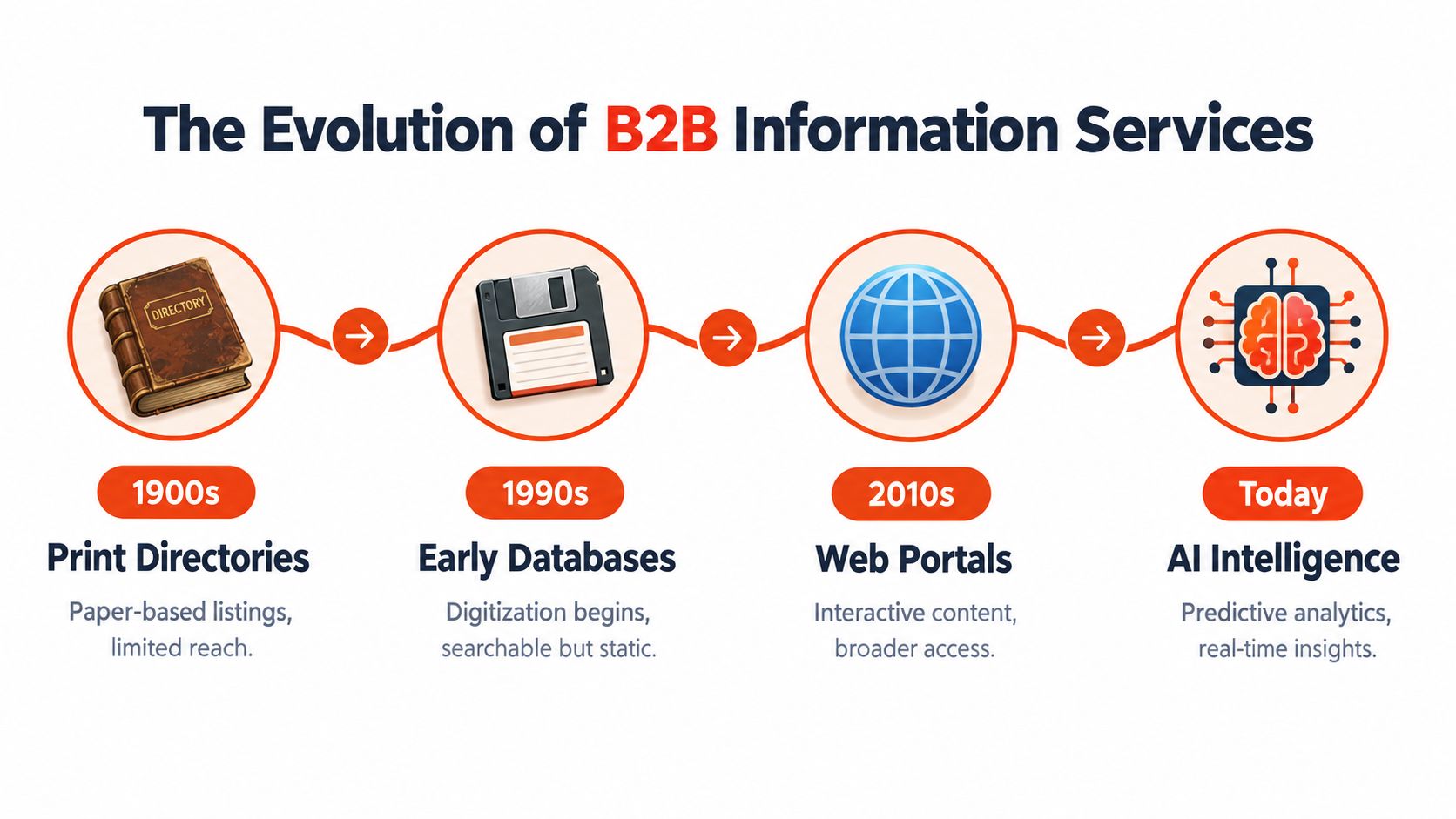
By 1996, American Business Information's Big Business Database covered 100,000 U.S. companies, showing how quickly B2B information moved from printed reference material toward searchable digital infrastructure. The shift changed access speed, but it did not remove the underlying problem: commercial decisions depend on whether records remain accurate as organizations, roles, and relationships change.
The history of B2B information services is therefore a shift from reference material to decision infrastructure. Printed directories helped buyers locate and classify companies, but users searched manually and worked with information that changed slowly. Electronic databases made those records continuously available, reducing the distance between a market question and a prospect list.
American Business Information illustrates that progression. Founded in 1972, it published its first state business directory in Nebraska in 1981, followed by a national directory. The directories used the U.S. government's four-digit Standard Industrial Classification codes to organize companies by industry. In 1984, the company introduced On-Line Business Link, a database customers could access for a fee. By 1996, its Big Business Database covered 100,000 U.S. companies. Earlier directories contained data on 120,000 major businesses, while a public-company directory covered 9,000 listed firms (the history of American Business Information).
What changed, and what didn't
A printed directory and a dynamic platform address the same foundational question: which organizations exist, and how can users distinguish among them? Their operating models differ:
| Static directory | Dynamic intelligence platform |
|---|---|
| Publishes a fixed reference point | Maintains records through ongoing updates |
| Organizes companies into broad categories | Connects companies, people, events, and behaviors |
| Supports manual research | Supports search, enrichment, scoring, and workflow activation |
| Describes market presence | Helps prioritize accounts and timing |
The historical progression matters because B2B information has never been only a contact-list business. Its value comes from making commercial reality easier to search, classify, and act on. Modern platforms extend that function through identity resolution, integrations, public signals, and workflow automation. Their strategic value depends on data quality, because stale records can misclassify an account or send attention toward the wrong stakeholder.
Teams evaluating company directory datasets should test whether the data supports their actual decisions. Market mapping may require company names, industries, and locations. High-ticket sales may also require current roles, account relationships, signal provenance, and CRM synchronization.
For a broader view of how market information supports commercial planning, see Ploot's market intelligence perspective. A list identifies organizations that might matter. An intelligence system helps determine which records remain trustworthy and which accounts deserve attention now.
Analyzing the Modern B2B Buying Group
A single lead is an incomplete representation of a B2B opportunity. Research covering more than 1,000 B2B practitioners and buyers found that a typical purchase involves an average buying group of 10 individuals, while 72% of marketers report recognizing and prioritizing accounts showing activity from multiple leads (B2B buyer identification benchmarks).
That evidence changes the unit of analysis. The question isn't whether one person downloaded a report or visited a pricing page. It's whether several people at the same organization are displaying related activity, whether those people represent different roles, and whether their behavior is recent enough to affect sales timing.
Build signals around the account
An account-level signal architecture should combine several dimensions:
- Resolve identity first. Connect domains, subsidiaries, business units, and contact records so activity isn't split across duplicate accounts.
- Aggregate activity. Group content consumption, high-intent page visits, event participation, and relevant public activity by company.
- Weight stakeholder context. A senior commercial sponsor, technical evaluator, finance stakeholder, and HR leader may contribute different evidence to the same buying process.
- Check recency. A recent cluster of activity deserves more attention than an isolated historical interaction.
- Require corroboration. Don't trigger an aggressive sales motion from a single ambiguous event.
This model reduces the risk of confusing curiosity with commercial movement. One employee may be researching a general topic for professional development. Several employees from different functions exploring related material can indicate that the topic has entered internal discussion, although it still doesn't prove that a project has been approved.
Practical rule: Treat account intent as a confidence assessment, not a verdict. The system should show why an account was prioritized and what remains unconfirmed.
Measure buying-group progress, not individual response
For high-ticket consulting and technology services, useful measures include activated-profile reach by target account, unique engaged stakeholders, signal recency, and meetings generated. These measures connect audience activity to the commercial object that sales teams ultimately pursue.
The CRM should preserve the relationship between account, contact, role, signal, timestamp, and outcome. That makes it possible to distinguish an account with broad but shallow engagement from one where several relevant stakeholders are progressing toward a conversation.
The deeper conclusion is that B2B information services should help sales teams understand organizational momentum. A lead database answers who can be contacted. A buying-group model answers whether the organization is moving, who may be involved, and what evidence supports the next action.
Managing Data Quality and Technical Decay
A B2B record can become unreliable long before it looks incomplete. Data quality sets the limits of what an information service can responsibly recommend to a sales team, particularly when several stakeholders are involved in one buying process.
Available benchmark summaries report annual B2B data decay ranging from roughly 22.5% to 70%, depending on the field and industry, with email addresses among the faster-changing data types (B2B data decay benchmarks). A record may still contain a name, title, and company while its role, email address, account association, or firmographic details have changed.
The risk is greatest when stale data is connected to intent signals. A platform may identify genuine interest, then assign it to the wrong person or account. The resulting recommendation can waste outreach and weaken trust, especially when a message assumes responsibilities the recipient no longer holds. In a multi-person buying group, one incorrect identity can also distort the apparent distribution of interest across functions.
Treat verification as a decision process
List acquisition and intent detection require different controls. A company record can remain useful for segmentation even when an individual contact requires immediate review. The workflow should establish account identity first, then test whether the person and the proposed channel still support a credible conversation.
A practical sequence is:
- Resolve the company: Confirm the organization, domain, location, subsidiaries, and account ownership.
- Enrich the person: Identify the relevant stakeholder and connect that person to the correct account.
- Validate the current role: Check whether the title and responsibilities still fit the intended outreach.
- Assess contactability: Confirm that the available channel is suitable for a professional conversation.
- Stop at the confidence threshold: Do not add fields merely because more fields are available.
Each record should carry a verification timestamp, source provenance, field-level confidence, and revalidation interval. These controls make quality inspectable. They also allow sales and marketing teams to distinguish a verified signal from an assumption based on an old profile.
Measure freshness where it affects decisions
A single blended accuracy score hides the fields and segments creating risk. Review results by geography, industry, role, and field. Titles and direct-dial numbers generally need tighter recency controls than more stable firmographic attributes.
CRM synchronization should preserve each enrichment event, record conflicts between sources, and expose stale fields to the people using them. A structured CRM integration workflow makes those checks part of data governance rather than a one-time export or convenience feature.
Data control: A verified account with fewer fields is more useful than an apparently complete account whose critical fields lack provenance or a freshness signal.
Set pilot criteria around operating outcomes: verified-account coverage, current-title rate, hard-bounce rate, and qualified meetings per activated profile. Collected-record volume matters only when records survive verification and improve decisions about which stakeholders to approach.
Distinguishing Genuine Buying Interest from Passive Consumption
A visible interaction rarely proves an active buying project. Someone may read an article, compare vendors, research a category for a colleague, or use generative AI to frame an internal question without having authority, budget, or a defined timeline.
B2B buyers use an average of seven information sources, and 45% reported using generative AI during research. At the same time, 51% said AI makes misleading information more likely (buyer research on AI-assisted research and validation). The result is a larger pool of observable activity and a greater risk of misreading it. Data has strategic value only when teams can separate useful evidence from passive consumption.

Grade signals by evidence quality
A usable signal record should answer four questions:
- What happened? Classify the event as a page visit, content interaction, public comment, role change, or direct conversation.
- What does it relate to? Capture the account, topic, function, and commercial problem connected to the activity.
- How recent is it? Record when the event occurred and whether related activity followed.
- How confident is the interpretation? State how strongly the evidence supports a sales hypothesis.
A visit to a high-intent page deserves more attention when several relevant stakeholders from the same account show related activity. A senior executive's public comment can justify investigation, while still leaving budget, authority, and timing unresolved. Signals gain meaning through the buying group, whose members may research independently and contribute different forms of evidence.
The system should preserve that uncertainty. Rather than labeling an account ready to buy, it can recommend validating a stated business priority with a low-friction message. This approach gives sales a reason to act without turning an incomplete profile into a premature pitch.
Put human judgment at the decision point
Human review converts a probabilistic signal into a responsible commercial action. A marketer can check whether the topic fits the account, whether the stakeholders plausibly influence the decision, and whether the proposed message matches the available evidence.
An effective lead scoring approach for HubSpot should connect score components to observable activity and expose the reasoning behind the total. The video below offers a prompt for assessing funnel progression. Each stage should represent a meaningful change in evidence, rather than another interaction counted for its own sake.
The practical test is conversational. If a sales representative cannot explain why the account was selected, what remains uncertain, and which question should come next, the score is replacing judgment instead of supporting it.
Measuring the Commercial Value of Trusted Expertise
Forrester's 2025 research reports that 82% of B2B buyers trust coworkers and management, 79% trust current vendors, and 66% to 72% trust independent experts, analysts, vendor executives, and customers (B2B buyer trust sources). The commercial implication is clear: expertise works through a network of people, not a single branded channel. A company executive may shape the business case, a technical specialist may test feasibility, and a customer or peer may reduce perceived risk.
Reach remains easy to count. Influence is harder to observe because important interactions may occur in private discussion, forwarded content, or a later sales conversation that standard attribution cannot connect to the original source.
A trusted voice therefore becomes a strategic asset only when the organization can relate it to account evidence. Generic impressions are a weak proxy. A post may attract broad attention without reaching a relevant account, while a smaller interaction with a senior stakeholder may affect an opportunity months later. Data quality matters here: as records age and stakeholder roles change, the apparent connection between expertise and commercial activity can decay.
Trace contribution across the buying group
The measurement model should preserve several distinctions. Which voices matter identifies partners, directors, subject-matter experts, customers, and other credible people with relevance to the target market. Which accounts they reach connects those voices to the companies represented among their audience and engaged stakeholders. Which topics create movement links attention to business problems, strategic changes, and operational concerns that appear in later conversations. Which interactions assist pipeline records activity that precedes direct contact, meeting creation, account progression, or opportunity development.
This record should describe contribution rather than assign false precision. A target account may engage with trusted expertise, show additional research activity, and later enter a qualified conversation. That sequence provides useful commercial evidence even when no single post or person can claim full credit.
Measurement principle: Ask which sequence of evidence made the account more understandable and the next action more defensible, rather than which touchpoint deserves all the credit.
A report built on trusted-person engagement, account-level research, direct conversations, and opportunity progression answers four separate questions. Engagement shows that the account encountered a relevant voice. Research activity indicates exploration inside the organization. A direct conversation tests whether the need is real. Opportunity progression shows whether the interaction produced a commercial consequence.
Senior leaders can then assess authority-building with more discipline. The relevant questions are whether the right accounts became more visible, whether relevant stakeholders became identifiable, and whether sales conversations became better timed and better informed.
Practical Applications for High-Ticket Consulting Sales
Consider a Spanish technology consultancy selling a complex transformation programme. Its potential buyers may include a managing director, a technology leader, a finance stakeholder, and operational owners. A single contact requesting information gives the team a starting point, but it doesn't explain whether the organization has an active initiative or whether the person can influence the purchase.
A strategic B2B information workflow begins earlier. The consultancy defines target accounts by sector, business model, geography, and service fit. It then maps relevant stakeholders, monitors account activity, validates records before activation, and gives sales a reason for each recommended conversation.
Turn scattered activity into an account decision
The marketing team might review an account through a compact evidence record:
- Account fit: Does the organization match the consultancy's target profile?
- Stakeholder coverage: Are several relevant functions represented, or is the activity isolated?
- Signal recency: Did the activity occur recently enough to justify attention?
- Topic alignment: Does the activity relate to the consultancy's actual service proposition?
- Human validation: Can the team explain what it knows and what it still needs to confirm?
This structure avoids a common failure mode. A campaign can generate many individual responses while leaving the sales team unsure which accounts deserve a senior, personalized approach. Account-level reporting reverses that priority. The team starts with the commercial opportunity, then uses individual engagement to understand the people involved.
For a B2B software company, the same logic can support expansion into a new segment. Marketing can compare activated-profile reach across target accounts, unique engaged stakeholders, signal recency, and meetings generated. Sales can then review whether the conversations came from the intended functions and whether the original signal accurately described the business context.
Define a pilot around decisions and outcomes
A sensible pilot shouldn't begin with a promise of maximum database coverage. It should establish agreed success criteria tied to the operating model:
- Verified-account coverage: Can the system identify and validate the organizations that matter?
- Current stakeholder coverage: Can it connect relevant people to those accounts with acceptable confidence?
- Signal quality: Can the team distinguish isolated consumption from corroborated account activity?
- Activation discipline: Does outreach happen only when the evidence supports a relevant message?
- Commercial outcome: Do activated profiles contribute to qualified meetings?
A three-month pilot can be structured around these criteria, with the review focused on evidence quality and meeting generation rather than raw activity. That gives a marketing director a defensible way to compare a signal-led approach with event-heavy or impression-led programmes.
The strategic asset isn't a bigger contact list. It's a living account model that links data freshness, stakeholder context, trusted expertise, and timely human action. When those components work together, information services become part of revenue planning rather than a procurement line item.
Ploot builds LinkedIn audiences for partners, directors, and senior managers, detects buying signals among those audiences, and helps teams contact relevant prospects at the right moment. If your B2B company sells consulting, technology services, HR consulting, or software through a long sales cycle, visit Ploot to explore a pilot with agreed success criteria.