
64% of B2B buyers prefer a completely digital purchasing process, but buyers are 1.8 times more likely to complete a high-quality deal when digital tools are used together with a sales representative. For high-ticket SaaS, the practical answer is employee-led content connected to intent-triggered outreach, not cold automation or passive audience building alone.
That combination matters because attention and pipeline are different operating problems. A post can reach the right market without revealing who has a live business need. A form can identify a person without proving that the account fits, the timing is real, or the meeting will be useful. B2B lead generation for SaaS works when content creates confidence, measurement detects meaningful activity, and sales follows up at the moment validation becomes valuable.
Table of Contents
- Why Traditional Lead Generation Fails for High-Ticket B2B SaaS
- Building Your B2B Lead Qualification Waterfall
- Employee-Led Demand Generation vs Traditional ABM
- Measuring Intent in Long Sales Cycles
- Multi-Touch Nurturing with Intent Triggers
- Your 90-Day B2B Lead Generation Implementation Roadmap
Why Traditional Lead Generation Fails for High-Ticket B2B SaaS
High-ticket B2B SaaS does not fail because marketing lacks activity. It fails when activity is mistaken for pipeline. A strong traffic graph, a growing LinkedIn audience, and a full calendar of gated assets can coexist with too few qualified meetings.
A form submission confirms an exchange of contact information. It does not confirm ICP fit, buying influence, authority, an active business problem, or a credible path to purchase. Treating every download as a sales opportunity makes representatives spend time separating curiosity from commercial intent.

The buyer no longer waits for your funnel
Gartner reports that 75% of B2B buyers prefer a rep-free buying experience, while buyers familiar with a product or service show an even stronger preference, with 64% favoring a completely digital purchasing process (Gartner's research on the B2B buying journey). Buyers research through search, peer recommendations, executive content, communities, product pages, and private conversations before agreeing to speak with a seller.
The path is rarely linear. A buying group may define a business problem, compare vendors, revisit internal requirements, and reopen the original question after another stakeholder raises a concern. Traditional CRM stages compress those movements into one contact record and a few conversion events, hiding the difference between attention and buying progress.
McKinsey's B2B Pulse research describes a buying journey involving an average of 10.2 interaction channels, compared with approximately 5 channels in 2016 (the B2B channel research summary). A buyer may read an expert post from a partner, visit a services page, watch a product explanation, ask a colleague for an opinion, and then submit a form. The form is the visible event, not necessarily the point when demand started.
Practical rule: A lead form should start qualification, not end it.
Why high-ticket deals expose the weakness
High-ticket consulting and software purchases carry operational, financial, and reputational risk. Buyers need evidence that a vendor understands their environment, can deliver the expected outcome, and will remain credible when procurement, finance, legal, or technical stakeholders join the process.
Digital content builds confidence during early research. Human engagement becomes more useful when the buying group needs validation, internal consensus, or risk reduction. In practice, the deals that close are often the ones where a representative enters while the buyer is still validating the problem and the proposed solution.
Two weak strategies create the same gap. Cold outreach without context asks for attention before trust exists. Content without a response mechanism earns attention but leaves buying signals unattended. A stronger operating model connects authoritative employee content with account-level activity, behavioral qualification, and timely seller follow-up. The distinction between creating interest and capturing it is also central to demand capture versus demand generation.
Building Your B2B Lead Qualification Waterfall
High-ticket SaaS requires a qualification waterfall, not a contest to collect the most leads. The process should answer four questions in sequence: Does the account fit? Is the person relevant? Is there meaningful behavior? Can sales act on the signal now? This separates attention from qualified pipeline, which matters when a single poor-fit meeting can consume weeks of seller and specialist time.
Start with the ideal customer profile. Document the firmographic traits that matter, the buying roles involved, the account's potential value, its technology environment, and the trigger events that make your solution relevant. A useful ICP isn't a broad industry label. It defines the conditions under which your team can solve an expensive problem and reach a credible buying group. For a deeper walkthrough of qualification criteria, see this lead qualification guide.
Separate account fit from contact fit
Score the account and the contact independently. An account may match your market while the individual has little influence over the purchase. A senior stakeholder may also be relevant at a company that cannot support your commercial model.
Use account scoring for factors such as:
- Firmographic fit: Industry, operating model, geography, and organizational complexity.
- Commercial fit: ACV potential, buying capacity, and service requirements.
- Technology fit: Existing systems, integrations, and technical environment.
- Trigger fit: Leadership changes, hiring activity, expansion, transformation projects, or visible operational pressure.
Use contact scoring for role, seniority, likely influence, engagement depth, and relationship context. A relevant title alone should not route someone to sales. Record why the person matters and which account condition supports the handoff.
Require two kinds of evidence
The routing rule should require at least one fit signal and one behavioral signal before an MQL reaches sales. A fit signal might be a suitable account tier or participation in the buying committee. A behavioral signal could be repeated engagement with expert content, a pricing-page visit, a case-study visit, or a direct response to an employee profile.
Likes and impressions indicate distribution, not intent. Pair repeated engagement with a higher-value action, then ask sales to accept or reject the opportunity using a consistent definition. Teams that need more process detail can use this B2B lead qualification process as a reference.
The benchmark math explains why this discipline matters. Average B2B SaaS visitor-to-lead conversion sits around 1.5–2.5%, while enterprise segments are typically closer to 1–2% because evaluation cycles take longer (B2B SaaS conversion benchmarks).
| Stage | Conversion Rate | Key Metric |
|---|---|---|
| Visitor to lead | 1.5–2.5% | Qualified lead volume |
| Net-new lead to MQL | 35–40% | MQL quality and fit |
| MQL to SQL | About 13% | Sales-accepted qualification |
| 10,000 visitors to SQL | 7–13 SQLs | Qualified pipeline potential |
At those average rates, a 10,000-visitor program produces roughly 150–250 leads, 53–100 MQLs, and only 7–13 SQLs. Report weekly cohorts by source, profile, account tier, intent event, meeting held, opportunity created, and revenue. Optimize for qualified pipeline per activated profile, rather than reach or connection volume. Review the fit-plus-behavior rule quarterly against won-deal profiles, and adjust scoring when the customers who close differ from the customers who merely engage.
Employee-Led Demand Generation vs Traditional ABM
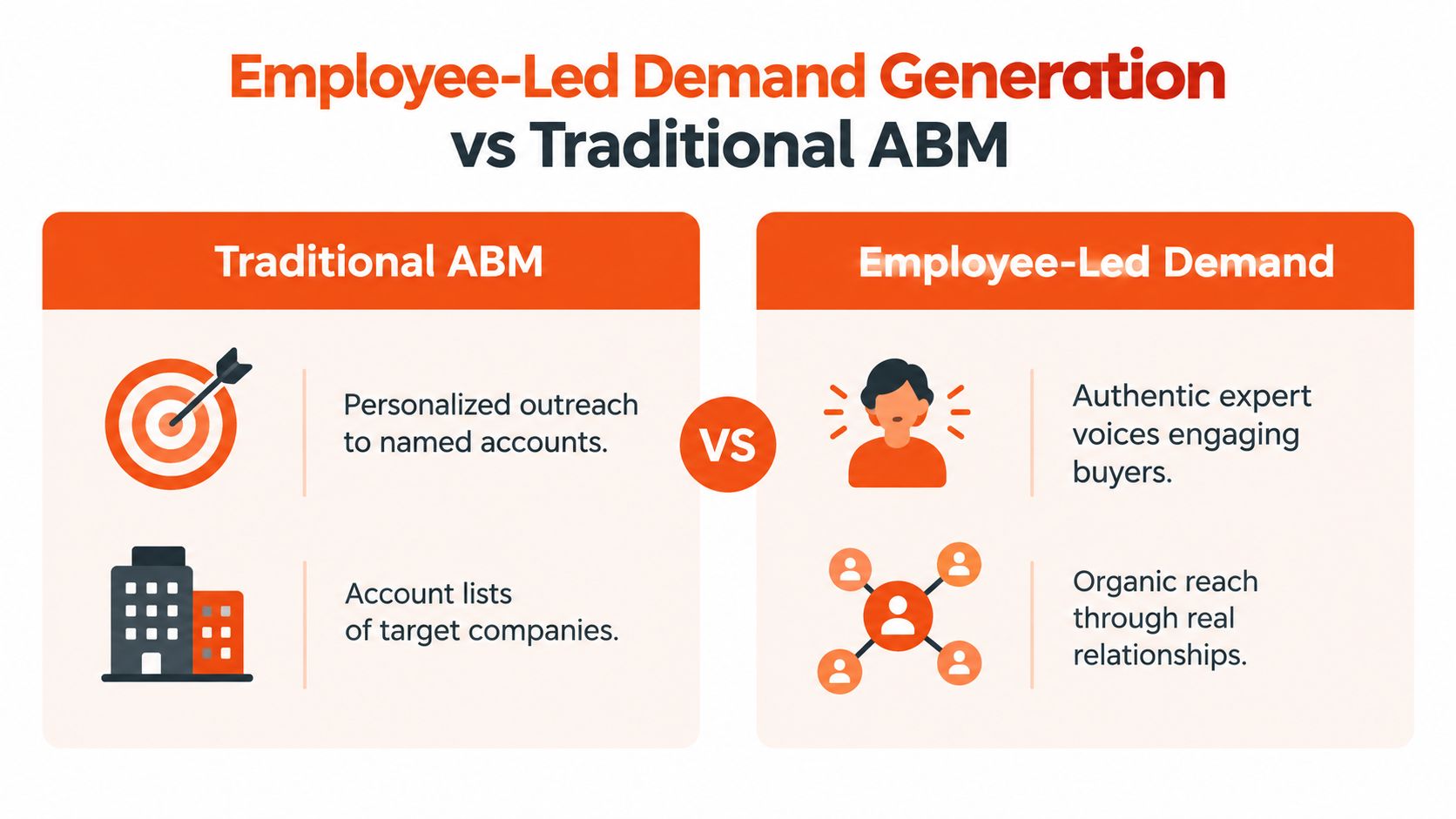
Traditional ABM starts with a named account list. Marketing and sales select target companies, tailor campaigns, and coordinate outreach to known stakeholders. Employee-led demand generation starts with credible people, then uses their authority and audience relationships to surface interest from stakeholders the CRM may not contain.
Neither approach replaces the other. Traditional ABM works well when the account list is reliable, the buying committee is known, and the team can personalize around a clear business initiative. Employee-led demand generation is more useful when trust, expertise, and early problem recognition shape the purchase before the buying group identifies a vendor.
The hidden committee problem
A high-value SaaS or consulting purchase rarely belongs to one person. Finance may test the commercial case. Operations may assess implementation. Procurement may negotiate terms. Legal may evaluate risk. A technical leader may reject the solution if the integration path looks weak. Several of these people may never complete a form.
Edelman and LinkedIn's 2025 study found that hidden decision-makers use thought leadership during vendor vetting and trust it more than marketing materials and product sheets when assessing capabilities. The report says 91% consider high-quality thought leadership essential for uncovering needs they hadn't previously recognized (the Edelman and LinkedIn B2B Thought Leadership Impact Report).
That creates a specific advantage for employee-led programs. A partner discussing delivery risk, a director explaining an industry constraint, or a senior manager sharing an implementation lesson can reach people who aren't searching for a product yet. The content earns permission to continue the conversation without pretending that passive reach equals intent.
Compare the operating models
| Traditional ABM | Employee-led demand generation |
|---|---|
| Begins with named target accounts | Begins with credible expert profiles and relevant audiences |
| Personalizes outreach to known stakeholders | Surfaces stakeholders who may not be in the CRM |
| Depends heavily on account-list quality | Depends on authority, consistency, and signal interpretation |
| Often measures account engagement | Connects engagement to intent-triggered conversations |
| Strong for coordinated late-stage account plays | Strong for trust building and early committee discovery |
The risk is fragmentation. If several employees publish the same message or contact the same person independently, the company looks uncoordinated. Create a shared account and stakeholder view, assign ownership by business problem, and use suppression rules across profiles. One person might lead with an operations challenge while another addresses executive risk, but neither should repeat the same invitation to the same contact.
The employee profile creates the trust. The qualification layer decides whether the trust has become buying activity.
Use content signals to distinguish passive reach from account-level interest. A single impression is distribution. Repeated engagement from a relevant account, followed by a visit to a pricing, services, case-study, or hiring page, is stronger evidence. A reply that describes a business problem is stronger still. The next step should be permission-based outreach from the most credible profile, not an automatic pitch from an anonymous sequence.
For practical guidance on activating senior voices without turning their profiles into ad channels, see employee advocacy on LinkedIn.
Measuring Intent in Long Sales Cycles
Attention does not equal pipeline. In high-ticket SaaS and consulting, a buyer may see an employee post months before a qualified conversation, while several stakeholders research the company anonymously. Last-touch attribution gives the final interaction too much credit and hides the signals that created access.
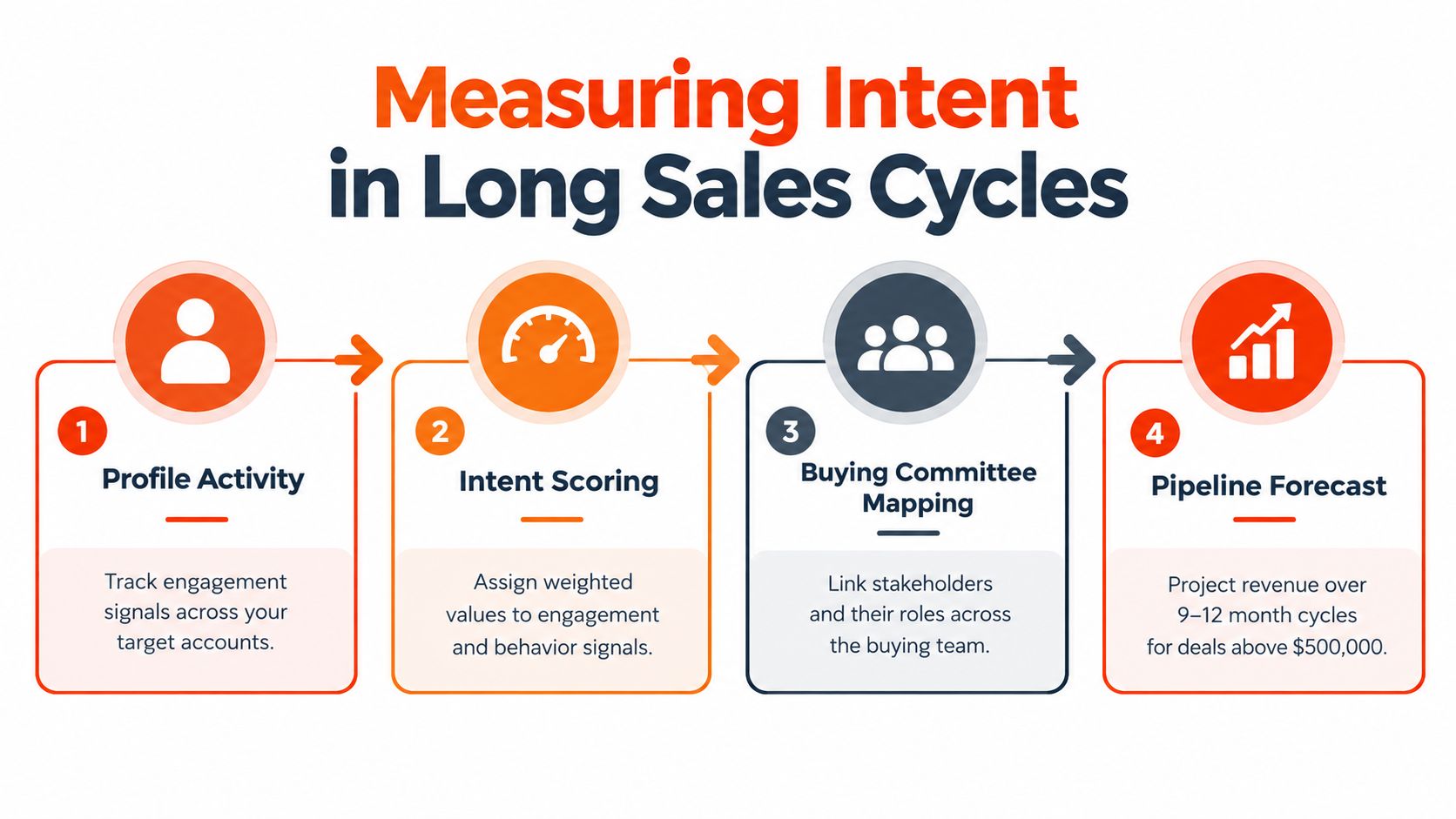
Norwest's 2025 B2B benchmark reports sales cycles averaging roughly 9–12 months for deals above $500,000 in annual contract value. It also reports that 70% of companies with sales cycles longer than six months don't know their customer-acquisition cost (Norwest's 2025 B2B Benchmark Report). Measurement must therefore show whether an account is progressing before revenue appears.
Build a three-month pilot baseline
Use a three-month pilot to establish a working baseline, not to promise complete revenue attribution. Before launch, agree on the ICP, activated profiles, target accounts, signal definitions, routing rules, response-time expectation, and sales acceptance criteria.
Track movement from profile activity to account engagement, buying-committee participation, qualified conversation, opportunity creation, and pipeline progression. Keep audience growth separate from buying intent. Relevant followers, content reach, and profile visits measure distribution. Repeated activity from a suitable account, high-value page visits, direct replies, or engagement from several likely stakeholders provide stronger evidence of intent.
Assign every opportunity an attribution confidence level:
- Attributed: The prospect directly identified the employee-led interaction as a reason for engaging.
- Influenced: The program helped build familiarity or access, while other channels also contributed.
- Observed: Account activity is visible, but causality remains unproven.
This framework lets marketing report assisted pipeline without claiming that one post created every meeting.
Measure the handoff, not only the signal
Intent has commercial value only when the next action is useful. LeadSpot reports that nurtured leads generate 20% more sales opportunities than non-nurtured leads, while strong nurturing can produce 50% more sales-ready leads at 33% lower cost (B2B lead nurturing benchmarks).
Set the response-time agreement before collecting signals. The seller should receive the account fit, likely business problem, relevant content interaction, and suggested opening question, rather than only a name and score. Review whether the response produced a substantive conversation, a clear next step, or no buying evidence.
Mark suppression only at attribution time. Never delete the underlying activity record, or the baseline loses historical context. The weekly review should ask whether each signal predicted a useful conversation and pipeline movement, not whether the dashboard displayed more activity.
Multi-Touch Nurturing with Intent Triggers
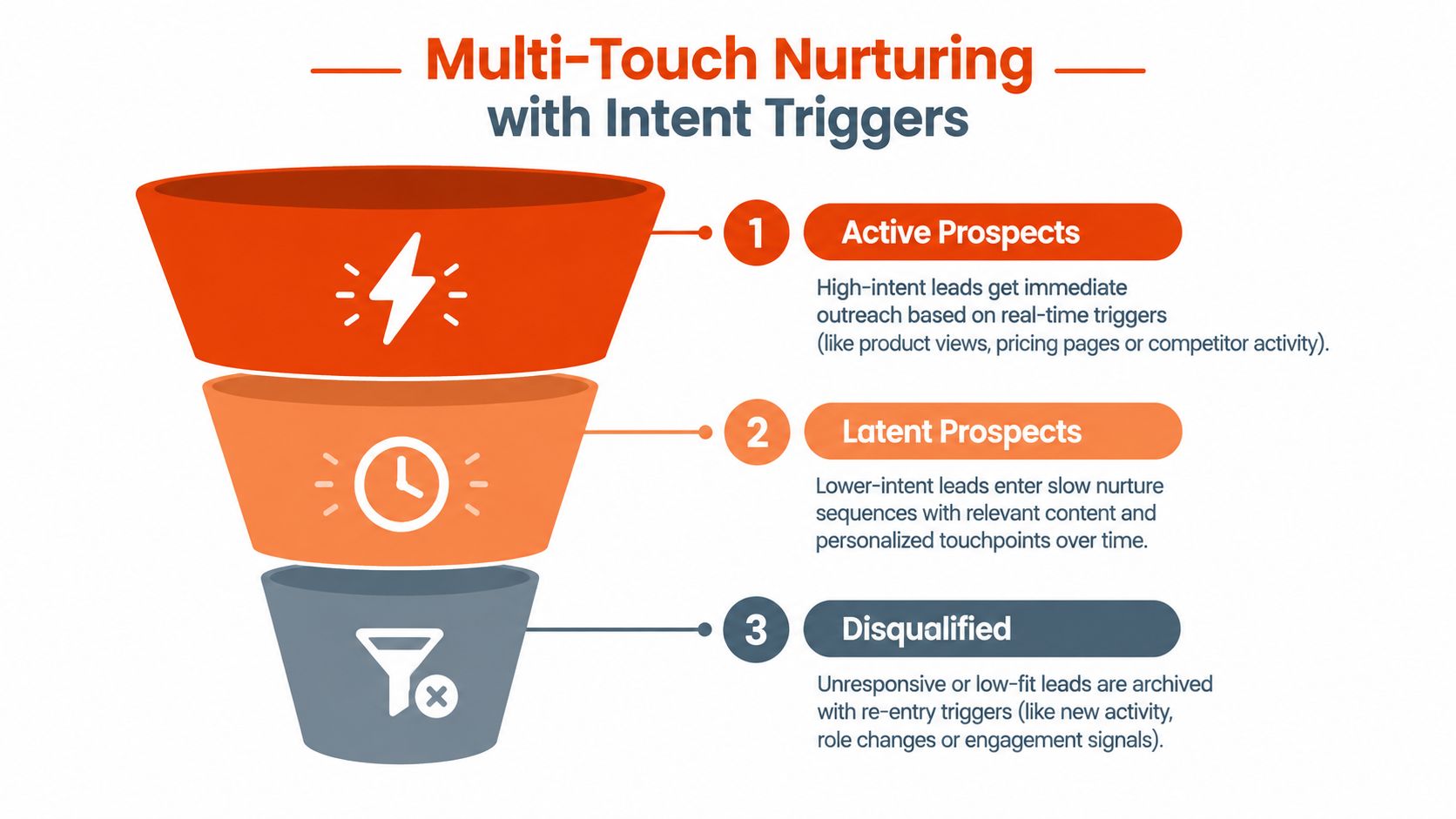
Attention does not become qualified pipeline without a deliberate follow-up path. A reply about an active transformation project should not enter the same sequence as occasional educational-content consumption. Segment the database into active, latent, and disqualified states, then define the evidence required to move between them. This keeps high-ticket consulting and software sales focused on meeting quality rather than impression volume.
Active prospects need context and speed
For an active account, verify the trigger before contacting the buyer. A relevant job change, pricing-page visit, new decision-maker, unused trial, or direct response can create a reason to engage, but the signal still needs interpretation. Check whether the activity connects to a business problem, buying role, or identifiable project.
Map the likely buying committee and tailor the message to that problem. The seller should qualify authority, need, timing, and next step instead of opening with a generic product pitch. If the prospect replies, route the conversation to someone who can discuss the operational issue credibly.
Shorter sales motions can use a controlled 30–45-day sequence with 5–7 touches, while enterprise motions can use 60–90 days with 8–12 touches. Treat those cadence benchmarks as governed playbook rules, not automatic permission to keep sending. Stop the sequence when the prospect replies, asks not to be contacted, enters an opportunity, or fails the qualification criteria.
Latent prospects need useful reasons to return
Latent prospects have not shown enough evidence for direct sales treatment. Keep them in a slower sequence organized around the problem, not the feature list. Send practical analysis, implementation guidance, comparison material, or a relevant perspective from an authoritative employee profile. Problem-specific content gives a passive buyer a reason to return. Feature-led sequences usually create disengagement without improving meeting quality.
Connect email, search content, employee publishing, website behavior, remote conversations, and sales follow-up so the nurture program reflects how buyers research. Use each channel for a clear role: education can establish relevance, employee content can build trust, and a direct response can justify sales contact. Email should coordinate the journey, not carry it alone.
Disqualified doesn't mean forgotten
Disqualify contacts that lack ICP fit, represent competitors, duplicate an existing record, or have no credible business need. Archive each record with a reason and define re-entry triggers, such as a new role, a relevant account change, or fresh engagement with a high-value resource.
Use holdout groups to test whether intent-triggered outreach creates incremental performance. Compare it with profile-only or generic outbound cohorts, then track positive-reply rate, meetings held, opportunity rate, pipeline value, and time-to-opportunity. Judge the program by sales-accepted meetings and qualified opportunities. Impressions can show reach, but they cannot confirm that a high-ticket buying conversation is developing.
Your 90-Day B2B Lead Generation Implementation Roadmap
A practical rollout starts with measurement rules, not automation. The team needs a shared definition of fit, intent, acceptance, and opportunity before employee profiles begin generating more activity.
Days 1 through 14 define the commercial system
Document the ICP using firmographics, buying role, ACV potential, technology environment, and trigger events. Select the employee profiles that can credibly discuss the target problems, then map their audiences and existing relationships.
Create separate account and contact scoring. Define the fit-plus-behavior rule for MQL routing, suppression conditions, outreach frequency limits, and the sales response SLA. Agree on the pilot baseline and the fields required for source, profile, account tier, intent event, meeting held, opportunity created, and revenue.
Days 15 through 30 activate authority and signals
Build a content calendar around real buying problems, implementation risk, executive concerns, and proof of expertise. Each profile should have a distinct role. A partner can address strategic outcomes, a director can explain delivery realities, and a senior manager can share practical operating detail.
Set up monitoring for meaningful account activity. Don't treat every engagement as intent. Mark an account for review when repeated relevant activity combines with a high-value action or a direct response.
Teams refining their outbound layer can use this overview of SaaS outbound strategies in 2026 for additional planning context, while keeping the central measurement focus on qualified pipeline.
Days 31 through 60 launch controlled nurture
Create active, latent, and disqualified states. Draft the shorter 30–45-day sequence and the longer 60–90-day enterprise sequence, then add stop conditions and human handoff rules.
Route replies with enough context for a seller to respond intelligently. Run a holdout group so the team can compare intent-triggered outreach against profile-only or generic cohorts. Review response quality weekly, not just delivery or engagement.
Days 61 through 90 inspect pipeline quality
Review weekly cohorts by source, profile, account tier, intent event, meetings held, opportunities created, and revenue. Check whether sales accepts the meetings and whether accepted meetings progress to qualified opportunities.
The pilot succeeds when it produces sales-accepted meetings, qualified opportunities, pipeline created, and cost per opportunity against the agreed baseline. It doesn't succeed because profiles gained visibility or because the campaign generated connection volume. A disciplined program also removes duplicates, existing opportunities, competitors, employees, and contacts without fit from attribution.
Ploot turns the LinkedIn audiences of partners, directors, and senior managers into a measurable sales channel by detecting buying intent and supporting timely outreach for qualified meetings. Visit Ploot to explore a three-month pilot built around agreed pipeline success criteria, not impression targets.