

The pilot review is tomorrow. Marketing has a slide full of engagement, sales has a handful of promising conversations, and the partner sponsoring the initiative wants to expand it. Nobody can quite agree on what would justify spending more.
That's when go no go decision criteria become useful, provided you set them before seeing the results. A defensible decision connects buyer evidence, delivery readiness and economics to a specific resource commitment. It also asks a harder question: can the customer's buying group approve a purchase, or have you only found someone willing to talk?
Table of Contents
- Five Criteria Every Go or No-Go Call Needs
- Why Each Gate Deserves Fresh Evidence
- How to Set Thresholds Before the Pilot Starts
- Must-Pass Conditions and Maturity Evidence
- Testing Whether the Buying Group Can Say Yes
- A Worked Pilot Decision From Start to Finish
- Confirm Your Go or No-Go Call Before You Commit
Five Criteria Every Go or No-Go Call Needs
Use this working checklist to separate an attractive campaign from an investable sales channel.
Core go/no-go criteria, timing and pilot evidence
| Criterion | Question It Answers | Peak Relevance | B2B Pilot Evidence |
|---|---|---|---|
| Strategic fit | Does this support our growth target? | Concept approval | Pilot tied to a named pipeline goal |
| Technical feasibility | Can the system deliver it reliably? | Concept and prototype approval | Intent signals detected correctly |
| Customer acceptance | Do target buyers respond to it? | Development through launch | Qualified meetings from target accounts |
| Market opportunity | Is the addressable pool large enough? | Concept approval and market maintenance | Enough target accounts showing active intent |
| Financial performance | Do the economics hold at scale? | Near production and commercialization | Cost per qualified meeting within the agreed limit |
A study of 77 highly innovative products published in Industrial Marketing Management identified these five recurring dimensions, with their importance changing across development stages. That's a useful starting point for a B2B pilot, not a claim that product-development findings establish universal marketing benchmarks.
The Stage-Gate approach separates work into stages, with explicit decisions between them. Decision-makers can continue, redirect, pause or terminate instead of assuming that completion of an activity earns approval for the next.
Weight the criteria against the commitment
At concept approval, ask whether the initiative serves your strategy and addresses a credible opportunity. A channel aimed at junior practitioners may generate interest while missing the senior buyers your consulting business needs.
During testing, put more pressure on feasibility and customer acceptance. Can the team distinguish buying intent from professional curiosity? Will sales accept the resulting conversations?
Near scale, demand stronger economic evidence. A manually rescued pilot might demonstrate buyer interest without demonstrating a viable operating model. Learning that buyers respond isn't the same as proving you can serve them economically.
The diagram offers a compact view of the decision, including the risk check that should sit across your criteria.
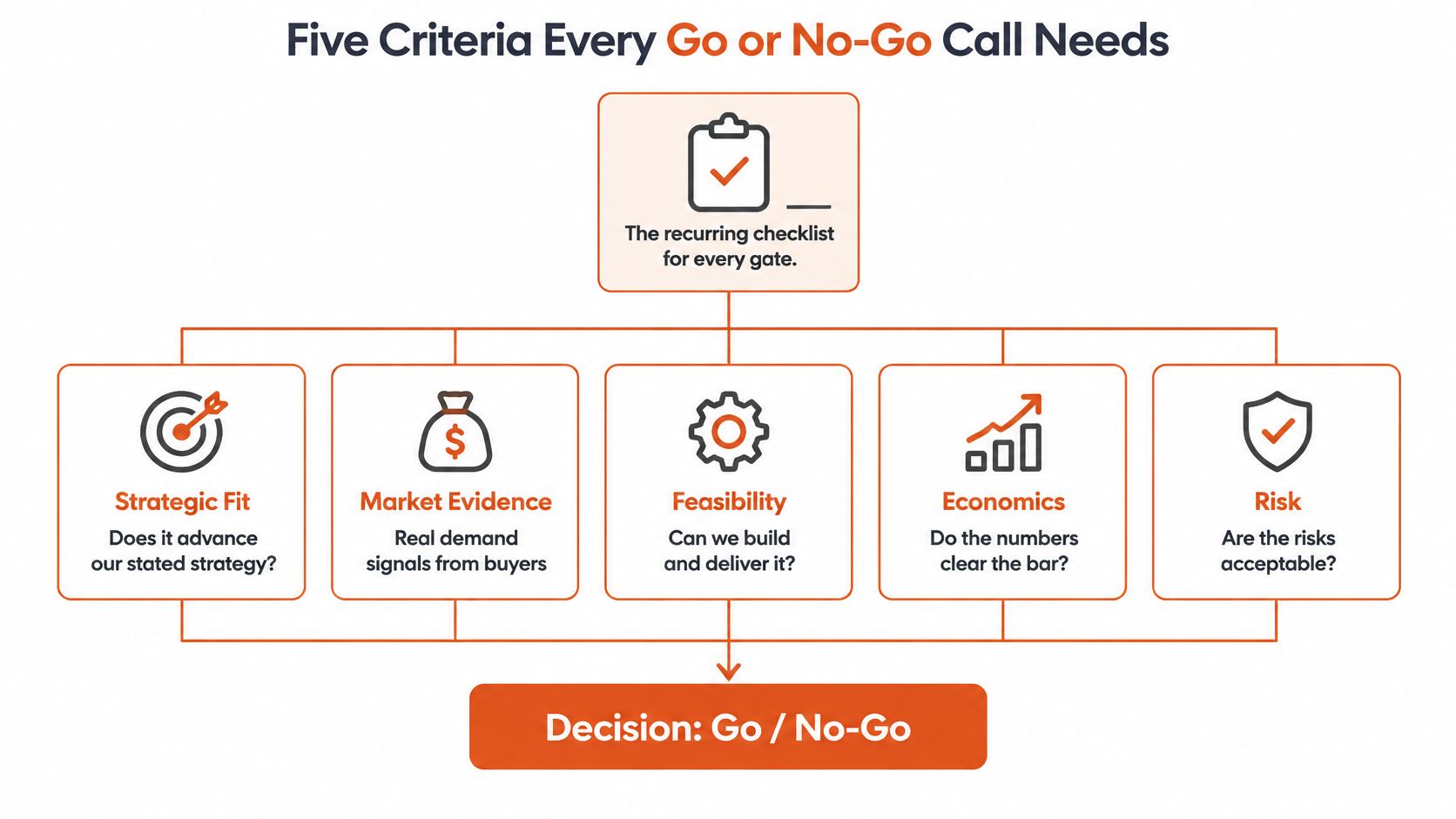
Don't let the strongest result cancel unrelated weaknesses. Plenty of qualified meetings won't solve a limited addressable market, and low acquisition cost won't compensate for prospects who don't need your service.
Choose the criteria relevant to your next commitment and write down the evidence each requires. Keep the checklist short enough to use, but broad enough that a headline metric can't decide the outcome alone.
Why Each Gate Deserves Fresh Evidence
A go decision is a ticket for one leg of a journey, not a season pass. Approval to test a channel doesn't imply approval to expand it, hire around it or make it a permanent budget line.
An experimental study published in the Journal of Product Innovation Management found that participants who initially made a go decision reported average confidence of 64.20 on a 0–100 scale, while their confidence in that earlier decision averaged 45.89 at the subsequent gate, a statistically significant decline. The practical lesson isn't to distrust every early decision. It's to allow later evidence to change your judgement.
Each gate is a fresh investment decision, not an automatic confirmation of the last one.
Separate sponsorship from evaluation
The sponsor should explain the original rationale and what the team learned. Someone who didn't sponsor the initiative should challenge the case for additional investment.
That separation matters because people can confuse protecting a project with protecting their credibility. A partner's enthusiasm, money already spent and an impressive audience chart can all distract reviewers from weak commercial results.
Bring the team together around the next commitment, rather than a retrospective celebration of completed work.

Use a measurement pack that distinguishes buying-intent quality, meeting conversion, sales-accepted pipeline and cost per opportunity. Ploot's guide to account-based marketing KPIs provides a useful framework for choosing commercial measures rather than stopping at audience growth.
Write the kill or redesign rule while everyone still has permission to be dispassionate. Specify what would invalidate the channel, what would justify a narrower experiment, and what evidence would support further funding.
Don't treat a redesign as an automatic extension. It needs a testable explanation, a bounded commitment and a reason to believe the proposed change will resolve the failure.
Ask yourself at every review: am I defending the last decision or judging the current evidence?
How to Set Thresholds Before the Pilot Starts
Set thresholds from your commercial model and sales process, not from a provider's most flattering case study. A high meeting count can hide poor fit; a modest count can still be promising when buyers have long approval paths and sales accepts the conversations.
Demandbase's 2025 State of the B2B Buyer report identifies alignment across 7–10 stakeholders and proof of integration value as buying barriers. Your pilot therefore needs to test stakeholder participation and operational value, not just whether someone books a call.
Write the measurement agreement
State the decision and commitment. Write whether you're funding a pilot, expanding delivery, holding or stopping. Name the budget and team time that approval would release.
Identify leading indicators. Track qualified accounts showing relevant intent, sales-accepted meetings and participation from priority roles. These indicate whether the intended commercial process is starting to work.
Separate lagging outcomes. Record sales-qualified opportunities, pipeline created and progress toward revenue. Don't relabel engagement as pipeline because the review arrives before opportunities mature.
Complete each metric's specification. Give it a baseline, target, owner, measurement method and stop, continue or expand rule. If reviewers can calculate it differently, the specification isn't finished.
Fix the measurement boundaries. Define conversion denominators, qualification requirements and the observation window for delayed opportunities. Normalize results by activated profile and audience size so distribution differences don't disappear inside totals.
Set the fully loaded cost ceiling. Include content production, profile activation, qualification and sales follow-up. To test how changing delivery costs or conversion assumptions affects affordability, use AmbitionCFO's guidance to build a decision-testing budget model.
Pilot metrics and their decision rules
| Metric | Type | Stop, Continue or Expand Rule |
|---|---|---|
| Qualified accounts showing intent | Leading | Continue when the agreed floor is sustained across scheduled reviews |
| Meetings accepted by sales | Leading | Redesign when acceptance remains below the agreed minimum after initial review |
| Participation from priority roles | Leading | Redesign when key decision roles remain unengaged past the midpoint |
| Sales-qualified opportunities | Lagging | Expand only when the count meets the pre-registered target |
| Pipeline created | Lagging | Judge at the end of the observation window, not earlier |
| Cost per qualified meeting | Economic | No-go when it exceeds the agreed ceiling after all costs are included |
These are decision-rule templates, not universal benchmarks. Replace the agreed floors and ceilings with values your finance and sales owners can defend before launch.
Use the threshold-setting sequence to make that agreement explicit.
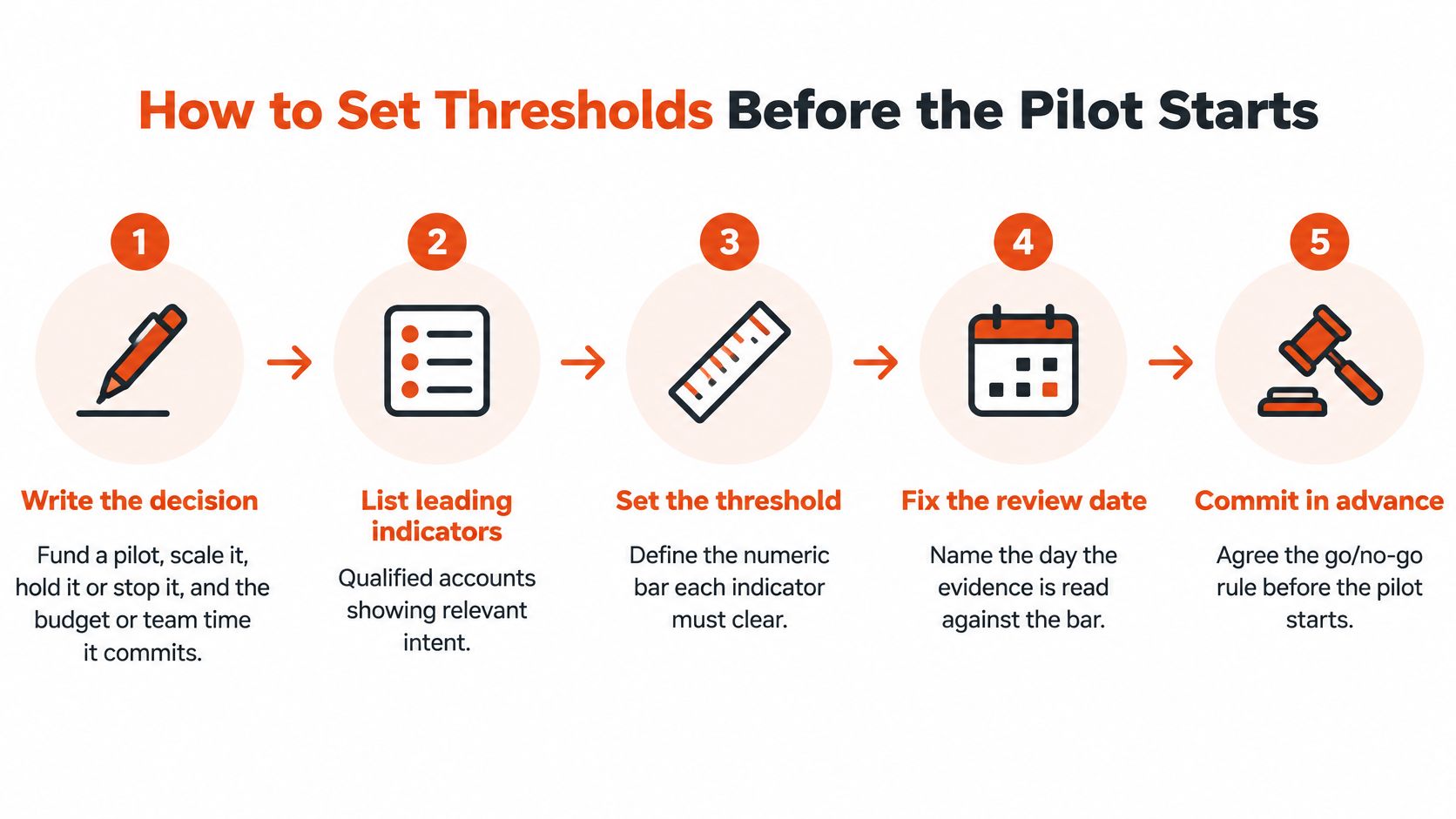
A go requires outcome attainment and operational readiness. If sales can't follow up, or delivery requires disproportionate manual work, reaching the meeting target isn't sufficient grounds to expand.
Must-Pass Conditions and Maturity Evidence
A weighted scorecard can approve the wrong initiative. Strong engagement and strategic fit might lift the total even when attribution is broken or the team can't distinguish genuine intent from irrelevant activity.
Must-pass conditions prevent that trade-off. They identify failures that other strengths cannot compensate for.
NASA's technology decision-gate framework associates development gates with Technology Readiness Levels 3–4 and application gates with TRLs 5–6. The transferable principle is to match evidence to maturity, not to assign aerospace readiness credentials to a marketing program.
Evidence required at each maturity gate
| Gate Type | TRL Range | Evidence Required Before Go |
|---|---|---|
| Development gate | TRL 3–4 | B2B analogy: reproducible signal that target buyers engage with partner-led content |
| Application gate | TRL 5–6 | Demonstrated performance in a realistic operating environment |
| Scale-up decision | Business gate, no TRL assigned | Repeatable results across multiple activated profiles |
Require proof of the operating conditions
An early experiment can establish that relevant buyers respond to a proposition. A scale decision needs evidence that the workflow operates with normal staffing, routine handoffs and realistic follow-up demands.
Say a consulting partner personally checks every contact and rewrites every message during the pilot. That can help diagnose what works, but it doesn't prove the same output is achievable when more profiles are activated. Record that intervention as a dependency and test whether the operating team can replace it.
The distinction applies beyond digital channels. For a facilities-services firm, BidFunnels' guide on how to price janitorial contracts is a relevant companion to commercial qualification: pricing work and delivery assumptions belong in the readiness assessment, not after approval.
Practical rule: Don't average away a failure that would invalidate the business case.
Before scoring, define the tests that cannot be waived:
- Intent detection: Review the underlying interaction and confirm that the classification follows the agreed qualification rules.
- Auditable attribution: Trace profile activation through contact qualification to the accepted meeting, without filling gaps with assumptions.
- Data handling: Have the responsible owner confirm that the actual workflow meets the organization's approved governance requirements.
- Repeatability: Demonstrate results across activated profiles rather than relying on an exceptional executive's audience or personal intervention.
A failed critical test calls for a hold, redirect or no-go. Label every criterion must-pass or scored before scoring begins, and identify who has authority to confirm each pass.
Testing Whether the Buying Group Can Say Yes
A May 2025 Gartner survey of 632 B2B buyers, described in a buying-committee report announcement published by Business Insider Markets, found that 74% of buying teams experienced unhealthy conflict, while groups reaching consensus were 2.5 times more likely to report a high-quality decision. An enthusiastic contact is therefore a starting point, not evidence that the organization can buy.
The discussion needs to include the people who will approve, operate and challenge the purchase.

Apply a consensus-readiness test
Before investing heavily in a proposal, verify:
- Shared business case. Document agreement on the problem, urgency, success metric and approval path. A champion's summary shouldn't substitute for confirmation from the other functions.
- Named decision roles. Identify the economic buyer, operational champion, technical evaluator, procurement and likely blockers.
- Scheduled decision date. Establish when the group intends to decide and what evidence it needs beforehand.
- No hidden veto. Confirm that an unengaged function cannot reject the purchase after the team has completed its evaluation.
At Ploot, we check each person who interacts against the client's ICP and the signal they gave. Many contacts don't pass that filter. That discipline separates relevant interest from general engagement, but qualification still doesn't prove internal agreement.
Marketing and sales should distinguish contact qualification from account readiness in their handoff. The practical work of B2B marketing and sales alignment includes agreeing who will uncover missing decision roles and resolve conflicting success definitions.
Use the video as a discussion prompt before mapping the approval path.
More personalization isn't necessarily the solution. Separate messages can reinforce each stakeholder's preferred outcome without helping them agree on a shared one.
Ask in the buying-group meeting: can each decision role state the success metric and decision date in their own words? If the answers conflict, invest in alignment before expanding the proposal effort.
A Worked Pilot Decision From Start to Finish
Consider an illustrative B2B consulting firm testing partner-led demand generation. Before launch, marketing, sales and finance agree on targets for qualified accounts, meeting acceptance, priority-role participation and fully loaded cost per qualified meeting.
They also define the evidence trail. Each record must show the originating interaction, qualification decision, meeting outcome and opportunity status. The following are alternative hypothetical outcomes, not reported client results.
Strong volume, no approval to scale
At the review, the meeting total looks encouraging. Inspection shows that most meetings came from an unusually active executive profile, attribution is incomplete and cost exceeds the ceiling once content production and sales follow-up are included.
Sales can identify worthwhile conversations, but the team can't demonstrate a repeatable channel. The decision is no-go for scaling, with a bounded redesign to test distribution across profiles and repair the attribution workflow.
The redesign approval specifies the work allowed, who owns it and what evidence would justify another review. It doesn't authorize continued expansion while the team investigates.
Moderate volume, approval for the next stage
In the alternative outcome, meeting volume is less impressive, but sales accepts the meetings and priority buying roles participate. Results are distributed across activated profiles, the observation window is respected and fully loaded cost remains within the agreed ceiling.
The decision is go for the next defined stage, not unrestricted rollout. Finance can use the Ploot ROI calculator to examine commercial assumptions alongside the pilot's measured costs and outcomes.
| Review question | Strong-volume version | Moderate-volume version |
|---|---|---|
| Can the team explain where meetings came from? | Attribution gaps remain | Contact histories are traceable |
| Does delivery rely on an exceptional profile? | Yes | Results extend across profiles |
| Do the economics meet the agreement? | Cost ceiling missed | Cost ceiling met |
| What is authorized? | Redesign only | Next investment stage |
At Ploot, qualified prospects move on to qualified meetings, while people who reply that the timing isn't right return to campaigns. Keep those statuses separate so deferred interest doesn't inflate current opportunity creation.
The decision follows the pre-agreed evidence, not the most recent headline number.
Confirm Your Go or No-Go Call Before You Commit
Bring the criteria table and completed metric thresholds to your next review. Don't ask whether everyone feels positive about the pilot. Ask what commitment the evidence supports today.
Before the meeting, the decision owner should confirm that the review pack is complete. Missing information should be visible as missing, not interpreted as a pass.
Make the authorization explicit
Check the essentials:
- Decision boundaries: Every must-pass condition, cost ceiling and observation window is written down.
- Buying-group readiness: Decision roles are named, the decision date is scheduled and no veto holder is absent.
- Evidence ownership: The people responsible for qualification, attribution and costs have confirmed their inputs.
- Resource availability: Sales and delivery owners can support the activity being authorized.
Then choose an outcome with operational meaning. Go releases a defined commitment. Hold identifies missing evidence and the conditions for returning to review. No-go stops the proposed commitment and states whether any narrower redesign is permitted.
Umbrex's stage-gate architecture guidance supports tying criteria to the next resource commitment and distinguishing quantitative thresholds from must-pass conditions. That distinction should remain visible in the decision record, rather than disappearing into an overall score.
Leave a record someone else can use
Write down what was approved, the evidence supporting it, unresolved assumptions and the trigger for another decision. Assign an owner to any corrective action and make clear whether work may continue while it's unresolved.
If criteria change because the business situation changes, record the reason and its effect on comparability. Don't rewrite a failed threshold to make the pilot successful.
Where a pilot hasn't yet been arranged, choose a bounded test rather than committing immediately to a permanent program. The route matters less than having a fair opportunity to disprove the commercial case.
Close the review with a direct question: would we authorize this next investment today if we weren't already involved? Record the answer and the evidence behind it.
Ploot turns your team's LinkedIn presence into a sales channel and offers a three-month pilot with agreed success criteria. Visit Ploot to discuss a test built around qualified meetings, a credible path to pipeline and an explicit scale, adjust or stop decision.