
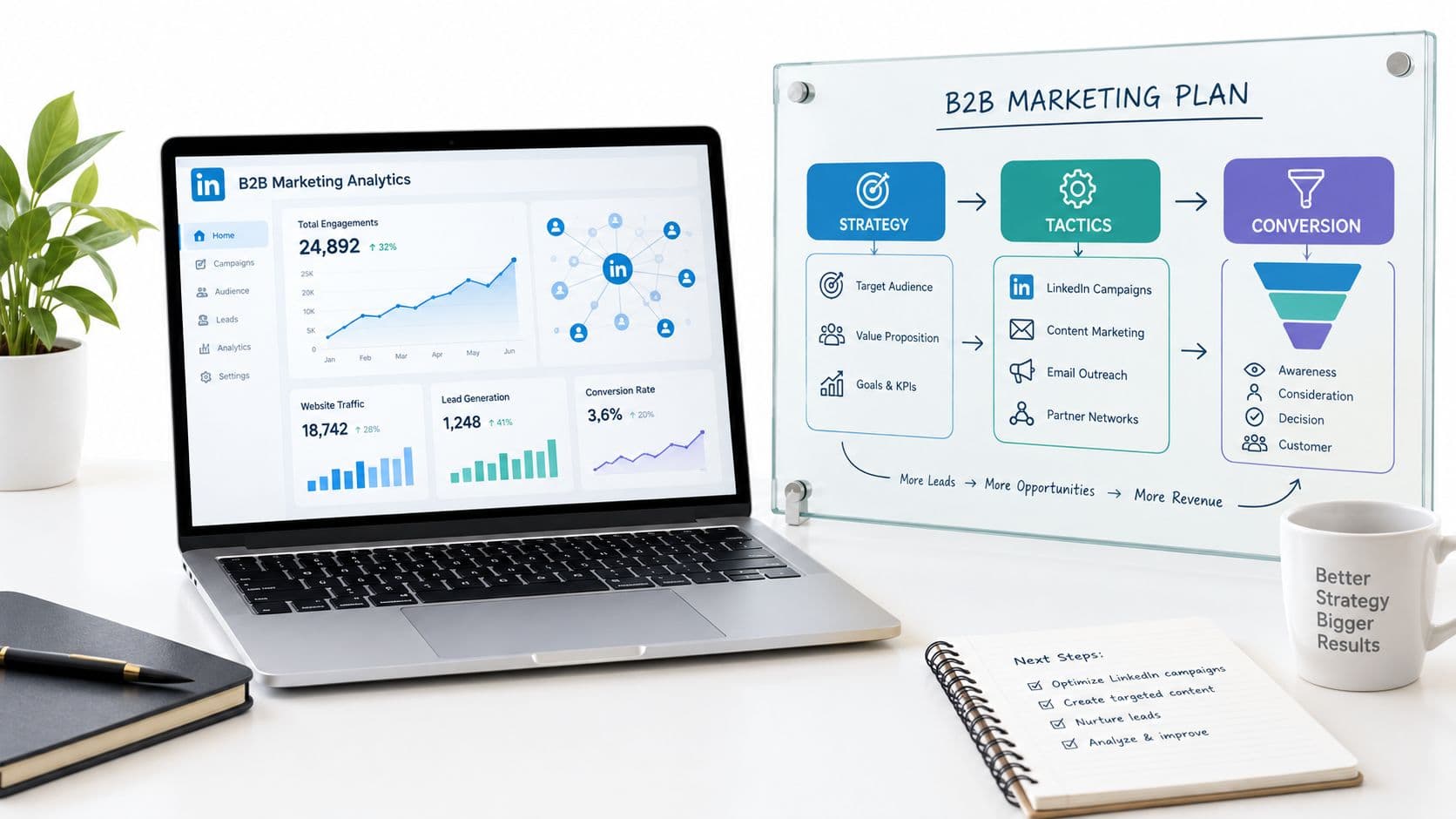
Strong LinkedIn performance doesn't mean a post generated qualified demand. A crowded comment section can still produce no sales conversation, while a smaller audience may contain the exact buying committee for a high-value consulting engagement. Useful LinkedIn B2B marketing examples therefore need more than reach. They need a defined audience, a credible source, a meaningful buying signal, a repeatable content structure, and a measurable next step.
The eight examples below treat LinkedIn as a pipeline system rather than a publishing calendar. They cover account-based marketing, executive thought leadership, employee advocacy, native lead capture, personalized outreach, events, paid distribution, and community-led demand generation. Each playbook identifies the signal to watch, the content or campaign structure, the metric that matters, the conversion path, and the trade-off a consultative B2B company needs to manage.
LinkedIn has the scale to support that approach. The platform says it has 1.2 billion members and more than 130 million decision-makers, while its marketing guidance reports that posting activity has risen 41% over the past three years and CEO posting has increased 52% over the past two years. LinkedIn's marketing guidance also positions the network as a professional environment where people share attention around companies, careers, and industry issues. For Ploot, that creates a relevant operating space: the LinkedIn audiences of partners, directors, and senior managers can become a source of qualified conversations without turning every post into a product pitch.
Table of Contents
- 1. Account-Based Marketing with LinkedIn Sales Navigator
- 2. Thought Leadership Content Strategy
- 3. Employee Advocacy Programs
- 4. LinkedIn Lead Generation Campaigns with Lead Gen Forms
- 5. LinkedIn Messaging and Personalized Outreach
- 6. LinkedIn Event Marketing and Webinar Promotion
- 7. Targeted LinkedIn Advertising with Sponsored Content and InMail
- 8. Community Building and LinkedIn Groups Strategy
- LinkedIn B2B Marketing Strategies: 8-Point Comparison Guide
- Build a LinkedIn System, Not a Content Calendar
1. Account-Based Marketing with LinkedIn Sales Navigator
Account-based marketing works when sales and marketing agree on which accounts matter, which roles influence the purchase, and what evidence would justify contact. LinkedIn Sales Navigator gives the team a practical research layer. You can identify decision-makers, monitor job changes and account activity, map several stakeholders, and coordinate messaging around a named account instead of broadcasting a generic offer.
A consulting firm might select a group of target companies in a specific sector, then map the managing director, operations leader, technology owner, and procurement contact. Marketing can publish an insight about a shared operational problem, while sales follows relevant engagement from people inside those accounts. The audience signal isn't just a reaction. It's a combination of role, account fit, topic engagement, and timing.
For teams learning how to find people on LinkedIn, the important discipline is to connect research with a next action. Record the account, person, business issue, observed signal, and appropriate follow-up. Don't ask a senior buyer for a meeting merely because they viewed a profile. Use the signal to make a relevant observation or offer a useful resource.
The repeatable pipeline playbook
- Define the account: Choose companies where the problem, buying capacity, and strategic fit are clear.
- Map the committee: Include economic buyers, operational owners, technical evaluators, and internal champions.
- Create account-relevant content: Address the business issue without naming or exposing the prospect.
- Track meaningful activity: Prioritize repeated engagement, role changes, event participation, and direct responses.
- Coordinate contact: Let the person with the strongest relationship or authority make the approach.
The trade-off is focus. ABM reduces wasted attention, but it also limits volume and requires better data hygiene. It fails when teams label every interaction as intent or personalize messages with facts that have no connection to the buying problem.
Practical rule: Treat Sales Navigator as an account intelligence layer, not as permission to automate generic outreach.
For long sales cycles, measure qualified conversations, meetings with target accounts, opportunity creation, and pipeline contribution. Those measures reveal whether the account strategy is changing commercial progress, not merely increasing activity.
2. Thought Leadership Content Strategy
A senior executive's LinkedIn post can do more than announce company news. It can give a buying committee language for a problem it hasn't fully defined. That's the strength of thought leadership when it's specific, opinionated, and grounded in experience.
The best structure starts with a tension that a relevant audience recognizes. A technology consultancy might explain why transformation programmes stall after leadership approval. A talent consultancy might challenge a common assumption about hiring senior specialists. A B2B software executive might publish a clear view on the operational cost of fragmented systems. The post should then support the position with an example, explain the practical implication, and invite a focused response.
LinkedIn's own guidance argues for outcome-based measurement, including qualified conversations, sales meetings booked, and revenue attributed to content, rather than relying on impressions or engagement rate. LinkedIn's measurement guidance makes the commercial distinction explicit. A post earns strategic value when it helps a relevant buyer recognize a problem, remember the author, or start a useful conversation.
Build authority around a point of view
Avoid asking an executive to publish broad motivational content one day and a product announcement the next. Create a small set of durable themes:
- A market tension: Explain what has changed and why common responses no longer work.
- A practitioner observation: Share a pattern from client work without revealing confidential information.
- A decision framework: Help buyers compare options, risks, or implementation paths.
- A considered disagreement: Challenge popular advice and explain the conditions where it fails.
A company page can distribute the material, but the executive voice should carry the central argument. Employee comments should add experience, not repeat the same promotional sentence.
The trade-off is patience and governance. Thought leadership takes time to establish, and compliance teams may try to remove the useful edge from every opinion. Over-editing creates polished content that sounds interchangeable. Under-reviewing can expose client information or make unsupported claims.
Use content-assisted signals to guide follow-up. A relevant director who comments on the operational consequence of an issue is more valuable than a large number of passive reactions. Route that person to a human conversation, a focused event, or a diagnostic resource that matches the topic they engaged with.
3. Employee Advocacy Programs
Employee advocacy is not a request for everyone to copy the company page. It's a way to distribute credible expertise through people who already understand the customer's context. In a consulting firm, a partner may speak to commercial risk, a project lead may explain implementation friction, and a specialist may answer technical questions. Those perspectives make the company easier to trust than a sequence of identical corporate announcements.
The programme needs editorial boundaries, not scripts. Give participants a small set of topics, approved facts, examples they can adapt, and a clear process for review when necessary. Then let them write in their own voice. A central content team can provide source material, but employees should add an observation, interpretation, or experience that makes the post worth reading.
A useful employee advocacy post often follows this pattern:
- Start with a client-relevant situation.
- Add the employee's interpretation or lesson.
- Explain what leaders should consider next.
- Invite a specific response, not a vague request to “get in touch.”
The employee's audience signal includes more than reactions. Look for profile visits from relevant roles, comments that describe an active business problem, direct messages, and engagement from people at target accounts. Those signals can inform account research and follow-up.
Protect trust while expanding distribution
The employee advocacy approach described by Ploot is particularly relevant to firms whose senior people already have sector relationships. Activating several authoritative profiles can create a wider and more credible presence than relying on one company account.
The trade-off is coordination. A programme becomes noisy when employees publish the same asset with identical wording, or when participation feels compulsory. It also becomes risky when the business measures success by total employee activity rather than the quality of conversations created.
Use a shared content bank, but avoid a shared script bank. Ask each contributor to choose the topic that matches their role and audience. Then connect high-quality responses to a next step, such as a private discussion, an event invitation, or a relevant diagnostic conversation.

4. LinkedIn Lead Generation Campaigns with Lead Gen Forms
Lead Gen Forms work best when the offer already signals buying relevance. They let a prospect respond within LinkedIn instead of visiting a landing page and completing another form, reducing friction without creating intent on its own.
A B2B consulting firm could promote a sector briefing, workshop invitation, or assessment focused on a defined operational problem. The audience, issue, and next step should be explicit. “Download our guide to digital transformation” attracts broad interest. “Briefing for operations leaders evaluating fragmented delivery systems” gives the prospect a clearer reason to respond and gives sales a more useful signal.
Build the conversion path before launching the ad. Someone requesting a briefing should receive it quickly, with an optional conversation related to that topic. A workshop registrant may need event details and a post-event follow-up. Sending every submission into the same sales sequence wastes context and can damage trust.
Use four signals to decide whether a lead deserves sales attention:
- Role fit: Is the person involved in the relevant business decision?
- Account fit: Does the company match the target market?
- Topic fit: Does the asset address a current challenge?
- Action quality: Did the person request a conversation, attend an event, or only download an introductory asset?
The LinkedIn lead generation guide offers context on combining native forms with outbound activity. Apply those mechanics, then evaluate what happens after submission.
The operating trade-off is response volume versus qualification. A short form can increase completions while attracting people with limited authority or urgency. Narrow targeting, specific creative, and an offer tied to a live business problem can improve lead quality. Judge the campaign by sales acceptance, qualified conversations, and meeting quality, not form submissions alone.
A LinkedIn-published case study reports that 94% of leads generated through LinkedIn were accepted by sales, alongside a 2x increase in CTR. LinkedIn's case-study material presents the result as evidence that downstream qualification matters alongside click efficiency. For a consultative B2B team, the repeatable playbook is clear: match the offer to a defined audience signal, capture only useful information, respond according to the offer, and measure the route from form completion to accepted opportunity.
5. LinkedIn Messaging and Personalized Outreach
A personalized message earns attention by connecting a real business signal to a relevant question. A salesperson who copies the prospect's job title into a template and adds a generic compliment will not earn a reply.
Start with a trigger tied to the buyer's situation: a new senior appointment, a public strategic initiative, an event interaction, or a considered comment. Open with a useful observation and an easy question. This creates room to learn before proposing a meeting.
Consider an IT consultancy partner contacting an operations director who has discussed service delivery complexity. The message might acknowledge that issue, share a concise lesson from similar work, and ask whether it is a current priority. A positive answer supports a short conversation. A negative answer leaves the relationship intact without pressure.
Use authority without impersonation
The sender affects credibility in high-ticket sales. A relevant partner, director, or senior specialist can make the message more credible than a generic company account, provided the wording sounds personal rather than automated.
Use this operating sequence:
- Research before writing: Refer to a real business context, not a superficial profile detail.
- Lead with relevance: Explain why the message may matter to the recipient.
- Keep the first step small: Ask for a view, not a commitment to a sales process.
- Use a clear handoff: If another specialist should join, explain why.
- Stop when interest is absent: Repeated follow-up can weaken the authority you are building.
The LinkedIn messaging best-practice guidance from Ploot can help teams structure this process. For paid message campaigns, CrowdTamers LinkedIn ad tips address message-based distribution.
Personalization creates a scalability trade-off. Detailed research limits activity, while automation increases volume at the risk of lower relevance. Consultative B2B teams should prioritize conversations with strong account and role fit, then measure positive replies, qualified conversations, meetings held, and opportunities created. A large reply count has little value if respondents cannot influence the purchase. The conversion path should run from a verified trigger to a useful exchange, a qualified conversation, and a sales opportunity.

6. LinkedIn Event Marketing and Webinar Promotion
A webinar can generate more useful buying context than a standalone post because attendance reveals a stronger action. It also gives a consulting company a reason to bring several experts, customers, or partners into one conversation without starting with a sales pitch.
The event topic should be narrower than the company's service catalogue. A session about “business growth” is difficult to target and easy to ignore. A discussion about managing a specific transformation risk, preparing for a regulatory change, or evaluating a defined technology decision gives the audience a clearer reason to register.
Build the campaign in stages. An executive can introduce the question organically, the company page can publish the agenda, speakers can share their own perspective, and paid promotion can reach selected roles or accounts. After the event, turn the discussion into short insight posts, a follow-up briefing, and targeted conversations with attendees who raised relevant questions.
Treat attendance as context, not consent
The useful event signal combines registration, attendance, questions, poll responses, replay activity, and account fit. Someone from a target company who asks about implementation constraints deserves a different follow-up from someone who registered but never attended.
Strong event campaigns create a reason to continue the conversation after the calendar invitation ends.
The conversion path should be explicit. Offer a working session, a review of the attendee's current approach, or a private discussion with the relevant specialist. The invitation must match the event's promise. Don't use an educational session as a pretext for an unrelated product demonstration.
The trade-off is production effort. Events require speakers, moderation, promotion, technical preparation, and follow-up. They can also attract an audience that wants education but isn't ready to buy. Narrow positioning and account-aware promotion improve the commercial value, while a useful recording or summary extends the content's life.
Track qualified attendees, target-account participation, meaningful questions, meetings booked, and opportunities influenced. LinkedIn's broader B2B trend guidance reports that buyers are engaging vendors earlier and can be well advanced in their decision process before first contact. The cited benchmark summary supports using events to earn trust before a sales conversation, not merely to collect names.
7. Targeted LinkedIn Advertising with Sponsored Content and InMail
Paid LinkedIn campaigns work best when they move a defined account audience toward a specific next action. Targeting can use companies, roles, skills, and professional characteristics. That precision helps consultative firms reach a limited buying group, but it cannot compensate for an unclear problem, weak proof, or an offer that asks for too much commitment.
Start with the audience signal, then build the campaign around it. A technology leader researching implementation risk may respond to an executive briefing. An operations team comparing approaches may prefer a diagnostic workshop. A marketing director evaluating vendors may engage with a customer-led discussion. Each sponsored post should make the business problem clear, give the reader a credible reason to trust the offer, and set a next step suited to their buying stage.
Optimize for account movement
Treat sponsored content and InMail as connected steps in an account journey, not isolated placements. The ad earns attention, the landing page develops the argument, and the follow-up gives the prospect a relevant reason to continue. Keep the executive profile, employee content, offer, and sales message consistent. A prospect who checks the sender after seeing an ad should find evidence that supports the same point of view.
LinkedIn's 2025 B2B decision-maker report cites Dreamdata findings that LinkedIn influenced 35% of new B2B deals, compared with 3% for Meta, while B2B companies increased LinkedIn's share of total ad budget from 31% to 39%. The same LinkedIn report says LinkedIn was 31% cheaper than Meta on cost per company influenced and that 75% of marketers were sending pipeline data back through LinkedIn CAPI. These figures provide context, not a forecast. Compare them with account engagement, qualified meetings, opportunity creation, and pipeline from your own campaigns.
Use the campaign objective to set the conversion path:
- Awareness: Present a focused point of view to a defined buying audience.
- Consideration: Provide evidence, a workshop, or a practical comparison.
- Conversion: Invite a qualified prospect to a relevant conversation.
InMail can create a direct route to a conversation, but it also carries a higher interruption risk. Use it when the recipient's role and current business need clearly fit the message. Narrow targeting limits reach, while broad targeting may produce inexpensive attention from accounts with no buying potential. Scéaled's LinkedIn strategy guide offers another reference for campaign design.
Judge success by company influence, qualified meetings, opportunity creation, and pipeline. Clicks explain interest. Account movement shows commercial value.
8. Community Building and LinkedIn Groups Strategy
Community-led demand generation is slower and less controllable than paid distribution, but it can create a stronger understanding of buyer concerns. A useful community gives professionals a place to compare experiences, ask difficult questions, and learn from peers. The company earns authority by improving those exchanges, not by placing a sales message in every discussion.
LinkedIn Groups have less visibility than the main feed, so a group needs a specific reason to exist. “Business leaders” is too broad. A community for operations executives dealing with a defined transformation challenge has a clearer purpose. The same principle applies to newer LinkedIn community activity, private roundtables, and event-based discussion spaces.
The company's role should be facilitation. Publish a discussion prompt, invite practitioners with different perspectives, summarize useful contributions, and identify recurring questions that deserve deeper content. A partner might host a private conversation, while a specialist answers a technical question without turning the exchange into a pitch.
Turn conversation into responsible follow-up
Monitor signals such as repeated participation, detailed questions, peer recommendations, requests for examples, and movement from public discussion to private inquiry. A member who consistently discusses the problem may be a strong candidate for a relevant briefing, event, or diagnostic conversation. That doesn't mean the company should export every active member into an outreach list.
A community is a trust environment first and a demand channel second.
The trade-off is operational commitment. Communities need moderation, clear standards, useful programming, and consistent participation. They can also attract competitors, anonymous observers, or professionals who have no buying role. Hard selling will reduce the quality of discussion and make the community feel like a disguised lead form.
Use community insight to improve the rest of the system. Recurring questions can shape thought leadership. Active members can become event contributors. Account and role patterns can improve ABM research. Measure qualified conversations and opportunity influence, but also track the quality of questions and the strength of relationships being formed.

LinkedIn B2B Marketing Strategies: 8-Point Comparison Guide
| Example | Implementation Complexity 🔄 | Resource Requirements | Expected Outcomes 📊 | Ideal Use Cases 💡 | Key Advantages |
|---|---|---|---|---|---|
| Account-Based Marketing with LinkedIn Sales Navigator | High 🔄, Requires sales-marketing alignment, account research, monitoring, and personalization | Sales Navigator, CRM integration, coordinated sales and marketing teams | ⭐ Higher-quality opportunities, stronger account engagement, and improved conversion potential | High-value B2B accounts, consulting firms, and long sales cycles | Precise targeting, personalized outreach, and efficient resource allocation ⚡ |
| Thought Leadership Content Strategy | Medium 🔄, Requires ongoing research, content creation, publishing, and engagement | Subject-matter experts, editorial resources, and consistent publishing capacity | 📊 Increased credibility, organic visibility, and inbound lead generation | Consulting firms building authority in specialized niches | Builds trust, differentiates expertise, and supports long-term demand generation |
| Employee Advocacy Programs | Medium 🔄, Requires training, content coordination, participation guidelines, and measurement | Employee participants, shareable content, advocacy tools, and program management | 📊 Expanded organic reach, higher engagement, and more authentic brand exposure | Firms with well-connected employees and active professional networks | Scales distribution, increases authenticity, and leverages employees' existing relationships |
| LinkedIn Lead Generation Campaigns | Medium 🔄, Requires campaign setup, audience targeting, creative development, and lead follow-up | LinkedIn advertising budget, campaign manager, CRM, and sales response process | ⭐ Faster lead capture, improved form completion, and higher-quality prospect data | B2B campaigns promoting consultations, reports, webinars, or gated resources | Reduces conversion friction, pre-fills user data, and keeps prospects on LinkedIn ⚡ |
| LinkedIn Messaging and Personalized Outreach | Low to medium 🔄, Requires prospect research, message personalization, and consistent follow-up | Sales or business development staff, prospecting tools, and messaging workflows | 📊 More relevant conversations, improved response rates, and relationship development | High-ticket B2B sales and targeted prospecting | Personal, flexible, and cost-efficient; supports warm digital introductions |
| LinkedIn Event Marketing and Webinar Promotion | Medium 🔄, Requires event planning, promotion, audience targeting, and post-event follow-up | Event platform, LinkedIn event tools, promotional budget, and hosting team | 📊 Increased registrations, attendance, engagement, and pipeline opportunities | Webinars, virtual conferences, executive briefings, and industry events | Combines promotion with RSVP tracking and measurable event performance |
| Targeted LinkedIn Advertising | Medium to high 🔄, Requires audience segmentation, creative testing, bidding, optimization, and reporting | Advertising budget, campaign specialists, creative assets, and analytics | ⭐ Scalable reach, qualified traffic, lead generation, and pipeline growth | Reaching decision-makers by company, role, industry, skills, or behavior | Detailed targeting, scalable distribution, and measurable campaign control ⚡ |
| Community Building and LinkedIn Groups Strategy | High 🔄, Requires moderation, regular programming, relationship management, and value-driven participation | Community manager, expert contributors, discussion content, and monitoring tools | 📊 Stronger relationships, sustained engagement, and gradual lead generation | Niche industries, professional communities, and long-term thought leadership | Encourages peer interaction, builds trust, and creates an owned engagement environment |
Build a LinkedIn System, Not a Content Calendar
The eight examples work best as connected operating choices. Start by defining target accounts, relevant roles, and the business problems that justify a conversation. Then earn attention through credible executive and employee voices. Capture intent with a useful offer or event, and route meaningful signals into personalized follow-up from someone with authority.
The right starting point depends on the constraint.
- Authority is the constraint: Begin with thought leadership and employee advocacy. Give senior people a clear point of view, then distribute that expertise through practitioners who understand the market.
- Account focus is the constraint: Add ABM and targeted advertising. Define the companies and buying roles before you create campaigns.
- Conversion is the constraint: Use Lead Gen Forms, events, or personalized outreach. Make the next step specific and connect it to the topic that created interest.
- Commercial visibility is the constraint: Connect LinkedIn activity with CRM stages, meeting records, opportunity creation, and revenue attribution.
This model prevents a common reporting error. A post can create awareness, an employee comment can deepen trust, and an event registration can reveal intent, but none of those actions automatically equals pipeline. The team needs a clear path from audience signal to human conversation, then from conversation to an opportunity that sales accepts.
LinkedIn's own B2B guidance is moving marketers away from lead-volume thinking toward relevance, trust, and intent. Its advertising resources also describe measurement tools such as CAPI and Revenue Attribution Report as ways to connect activity with pipeline and revenue. LinkedIn's marketing research resource reports that 78% of B2B marketers use video and that more than 50% plan further investment, which reinforces a practical point: format choices matter, but the business question is whether the format creates qualified engagement and useful follow-up.
For a marketing director, the reporting hierarchy should be straightforward:
- Qualified conversations: Did the right people respond to a relevant topic?
- Meeting quality: Did the meeting include an appropriate role and a real business issue?
- Opportunity creation: Did sales identify a genuine commercial path?
- Pipeline contribution: Did LinkedIn activity influence progress toward revenue?
Ploot is designed for B2B teams that want to activate the LinkedIn audiences of partners, directors, and senior managers, identify people showing buying intent, and contact interested prospects at the right moment. It can support content creation for team profiles, audience activation, buying-signal detection, and LinkedIn and email campaigns that aim to book qualified meetings. Learn more at Ploot's product website.
The practical objective isn't to publish more. It's to make every credible signal easier to recognize, interpret, and route into a relevant conversation. That's how LinkedIn becomes a repeatable pipeline channel instead of another source of impressive but inconclusive engagement reports.
Ploot helps B2B teams turn the LinkedIn audiences of partners, directors, and senior managers into qualified sales conversations by creating relevant content, detecting buying intent, and supporting timely outreach. If your team sells through long, high-value cycles and needs to show pipeline rather than impressions, visit Ploot to explore how the approach fits your LinkedIn strategy.