

The marketing director has a familiar problem. The dashboard is full of impressions, form fills, and event scans, but the CRO still asks the only question that matters: how much qualified pipeline will help us reach quota? The team can't answer confidently because no one owns the handoff from buying signal to sales conversation.
A useful pipeline generation plan fixes that gap. It connects revenue targets to a deliberately small channel mix, defines which accounts qualify, routes intent to a named seller, and gives the team a weekly mechanism for cutting weak activity. The result isn't another strategy deck. It's an operating document that can be tested, inspected, and stopped when the evidence says it should stop.
Table of Contents
- The Pipeline Generation Plan Marketing Directors Need
- Set Revenue-Linked Objectives Before Picking Any Channel
- Segment the Buying Audience Into Inspectable Tiers
- Choose One or Two Channels That Earn Pipeline Coverage
- Build the Workflow From Signal to Booked Meeting
- Assign Ownership and Run a Weekly Pipeline Inspection
- The 90-Day Pilot Blueprint With Clear Go or Kill Criteria
The Pipeline Generation Plan Marketing Directors Need
A Spanish B2B consultancy can fill a planning meeting with impressions, form submissions, and event scans, then still struggle to explain which accounts are ready for contact. The operational gap appears when a buying signal has no routing rule, no response owner, or no recorded outcome.
A useful plan assigns those decisions before launch. It limits the pilot to a defined audience and focused channels, then measures the path from signal to outreach attempt to booked meeting. The trade-off is deliberate: fewer activities create less reporting noise, but they also make source quality and seller follow-up easier to inspect.
Four commitments keep the plan usable:
- Revenue connection: Tie each activity to a quota, coverage target, opportunity stage, or progression metric.
- Channel discipline: Select one or two channels for the pilot rather than dividing budget across every available tactic.
- Routing visibility: Record the signal, qualification status, assigned seller, outreach attempt, and meeting outcome in the CRM.
- Named inspection: Give one person responsibility for a weekly review of source contribution, ageing, and ownership. A practical format is a 30-minute table review, with every open opportunity showing its source, current stage, next step, and responsible owner.
Demand-generation guidance increasingly focuses on pipeline contribution, pipeline velocity, cost per opportunity, and pipeline coverage, rather than impressions and raw lead counts. ZoomInfo's demand generation guidance defines pipeline contribution as the pipeline value attributed to demand-generation activity and pipeline velocity as the speed at which opportunities progress through stages.

The plan below is a 90-day pilot, not an annual roadmap. It puts accounts into inspectable tiers, tests a narrow channel pair, and sets ownership rules before launch. Teams reviewing a sales pipeline built for conversion should keep one distinction in view: activity is not pipeline. A qualified opportunity needs a recorded next step and a named owner.
Set Revenue-Linked Objectives Before Picking Any Channel
Start with commercial reality, not channel preference. A pipeline generation plan should define four inputs before anyone proposes LinkedIn, events, SEO, outbound, or paid search.
The four inputs that control the plan
Quota is the revenue target the plan must support. Use the target assigned to the relevant segment, territory, or sales team, not a broad company ambition that nobody can operationalise.
Average contract value translates revenue into wins. A consultancy selling strategic projects and a software company selling annual subscriptions may have the same target but require very different opportunity counts.
Win rate converts required wins into qualified opportunities. Use the historical rate for the same segment and stage definition whenever possible. If the data is weak, label the assumption clearly and treat the pilot as a measurement exercise, not as proof of a forecast.
Pipeline coverage protects the plan from assuming every opportunity will close. A commonly used planning range is roughly 3x to 4x the pipeline needed to hit quota, as described in Tomba's overview of demand generation metrics. The correct multiple depends on win rate, sales-cycle length, deal quality, and how early in the funnel the value is being counted.
Consider this worked example. The commercial target is €4 million, the average contract value is €40,000, and the assumed win rate is 25%. At 3x coverage, the plan needs €12 million in qualified pipeline. The target is 100 wins, 400 qualified opportunities, and, if historical qualification suggests four early conversations are needed for each sourced opportunity, roughly 1,600 early conversations. That final conversion assumption must be validated internally, so it should never be presented as a universal benchmark.
| Input | Value | Resulting Target |
|---|---|---|
| Annual quota | €4M | Revenue to support |
| Average contract value | €40K | 100 wins required |
| Win rate | 25% | 400 qualified opportunities |
| Pipeline coverage | 3x | €12M qualified pipeline |
| Early-conversation assumption | 4 conversations per opportunity | 1,600 early conversations |
Keep activity metrics subordinate
MQLs, demo requests, downloads, and event scans can help diagnose the system, but they shouldn't become the objective. A large number of low-fit leads can make marketing look productive while increasing SDR workload and weakening sales confidence.
Track cost per qualified meeting alongside source, stage, and progression. Teams evaluating meeting economics can use this cost-per-meeting resource as a practical reference, then replace generic assumptions with their own accepted-opportunity data.
Segment the Buying Audience Into Inspectable Tiers
A broad persona such as “decision-makers in technology companies” isn't a usable segment. It doesn't tell a marketer which account to prioritise, an SDR what to say, or a RevOps analyst why one lead entered the routing queue.
Use three named tiers. The tiers should be simple enough to defend in a ten-minute review and precise enough to change the next action.
Tier 1 is fit plus active urgency
Tier 1 contains accounts that match the commercial profile and show a credible buying signal. The signal might include a relevant search pattern, repeated engagement with a problem-specific asset, a job change into a buying role, a new technology requirement, or another trigger that the team can record in the CRM.
Tier 2 contains accounts with strong fit but weaker or unconfirmed intent. These accounts deserve an inbound amplifier, useful education, and monitoring, but not the same immediate seller effort as Tier 1.
Tier 3 is the nurture pool. It includes accounts that may become valuable later but currently lack urgency, role evidence, or a clear trigger. They shouldn't consume the same SDR capacity as an active buying account.
A practical persona model should connect firmographics, technographics, role, intent, and trigger events. Teams that need a starting framework can review this guide to building B2B buyer personas, then adapt the criteria to their own win and loss history.
| Tier | Definition | Qualification Criteria | Disqualifier |
|---|---|---|---|
| Tier 1 | High-fit account with active buying signal | ICP fit, relevant buying role, current problem signal, credible trigger event | No role fit, no trigger, or no evidence of buying authority |
| Tier 2 | High-fit account without confirmed urgency | ICP fit, relevant technology or business context, identifiable audience | Poor fit, no reachable role, or evidence that the problem isn't active |
| Tier 3 | Long-cycle education pool | Possible future fit, useful market context, no active signal | Outside ICP, incompatible use case, or no plausible buying path |
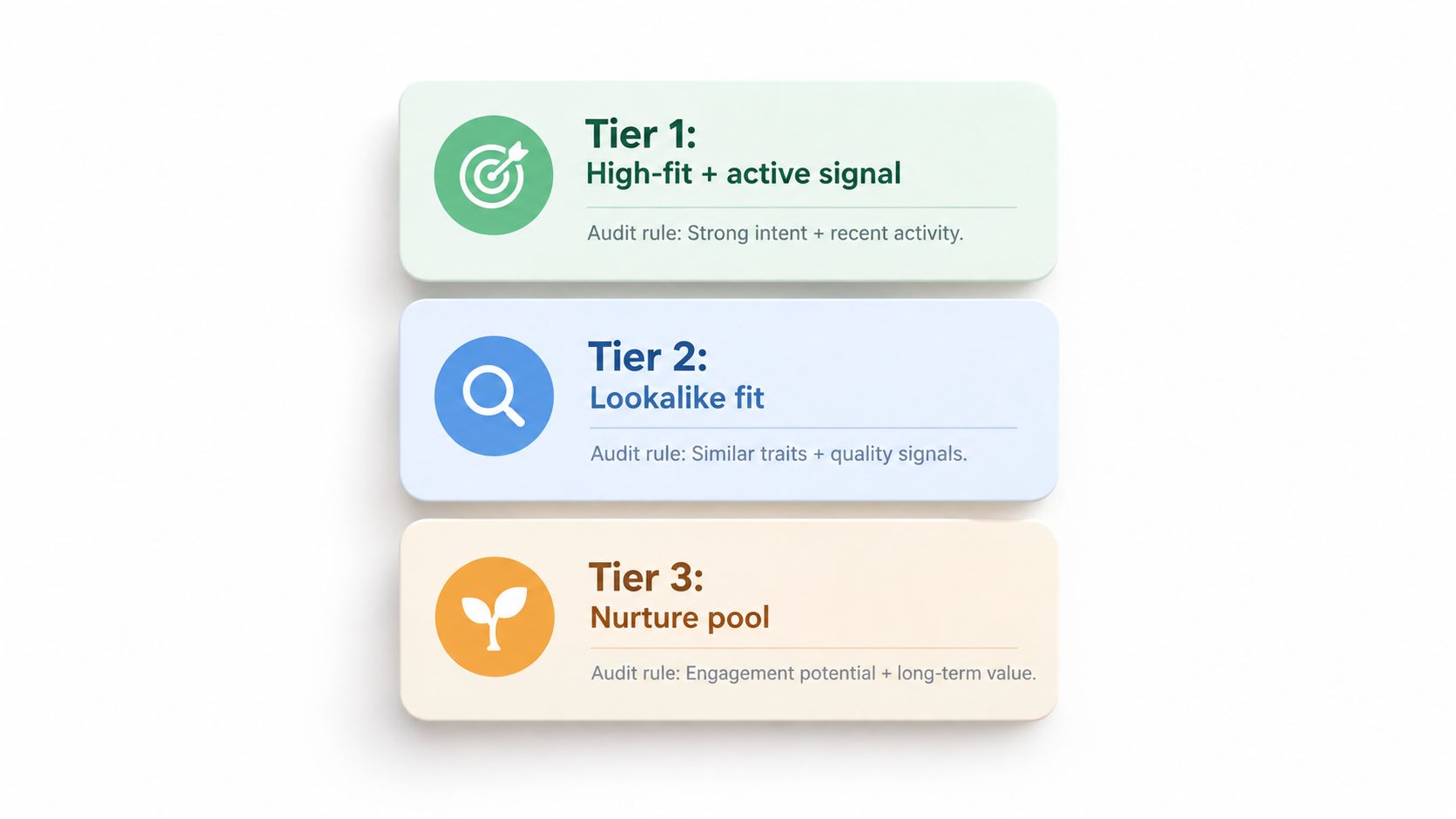
Every tier needs a downgrade rule. If a Tier 1 account loses its trigger, it moves to Tier 2. If a Tier 2 account fails the fit test, it moves to Tier 3 or out of the programme. This prevents optimism from becoming a qualification policy.
Choose One or Two Channels That Earn Pipeline Coverage
Channel selection should follow segment behaviour and operating capacity. It shouldn't begin with a list of everything the marketing team could run.
Four channels deserve comparison for B2B services and software:
- 1:1 outbound: Fast to launch and controllable at account level, but it scales linearly with seller or SDR capacity.
- ABM-style content syndication: Efficient for reaching a defined account group, but the signal often has less precision than a direct buying trigger.
- Niche communities: Strong for trust and credibility, especially in specialist markets, but cultivation takes time and participation can't be faked.
- Partner co-sell: Extends reach through trusted relationships, but attribution and source ownership become harder to control.
Independent research found that 70% of marketing-sourced pipeline comes from four channels, SEO, events, social media, and paid search, which supports a narrower inspection model rather than endless channel expansion. Insight Partners' pipeline generation survey also reports that 86.1% of sellers have higher pipeline quotas year over year and 39.6% say their current pipeline is weaker than last year. Those figures make precision more valuable than broad reach.
The matrix below uses illustrative ratings, not universal performance data. Replace them with your own baseline during the first weeks of the pilot.
| Channel | Best-fit tier | Meeting rate (illustrative) | Cost per qualified meeting | Time-to-first-revenue | Pilot verdict |
|---|---|---|---|---|---|
| 1:1 outbound | Tier 1 | Measure by accepted meetings | Calculate from fully loaded cost | Usually faster to test | Choose for active accounts |
| Content syndication | Tier 2 | Measure by qualified account response | Calculate by accepted meeting | Moderate | Use only with strict account filters |
| Niche communities | Tier 2 or Tier 3 | Measure by conversation quality | Include participation cost | Longer | Defer unless trust is the bottleneck |
| Partner co-sell | Tier 1 or Tier 2 | Measure by accepted introductions | Include partner effort | Depends on partner motion | Choose when ownership is explicit |
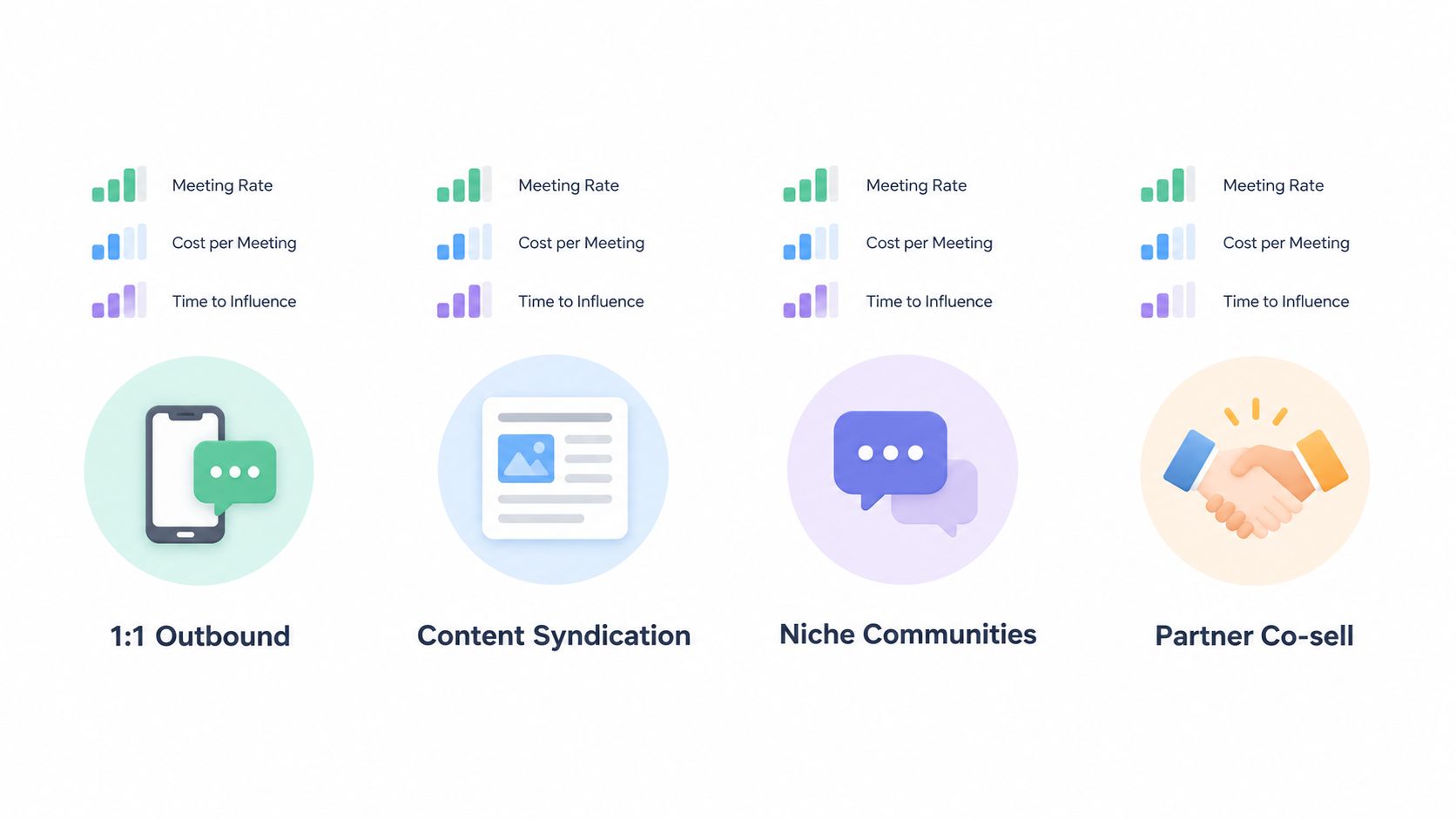
For a 90-day pilot, choose one outbound motion for Tier 1 and one inbound amplifier for Tier 2. Stop the rest temporarily. The team needs enough repetition to identify message, audience, and routing problems. Six half-funded programmes create six explanations for weak results and no clear learning loop.
Build the Workflow From Signal to Booked Meeting
A signal has no commercial value until someone acts on it. The workflow should show exactly what happens after the first meaningful behaviour appears, including the owner, required fields, response deadline, and fallback sequence.
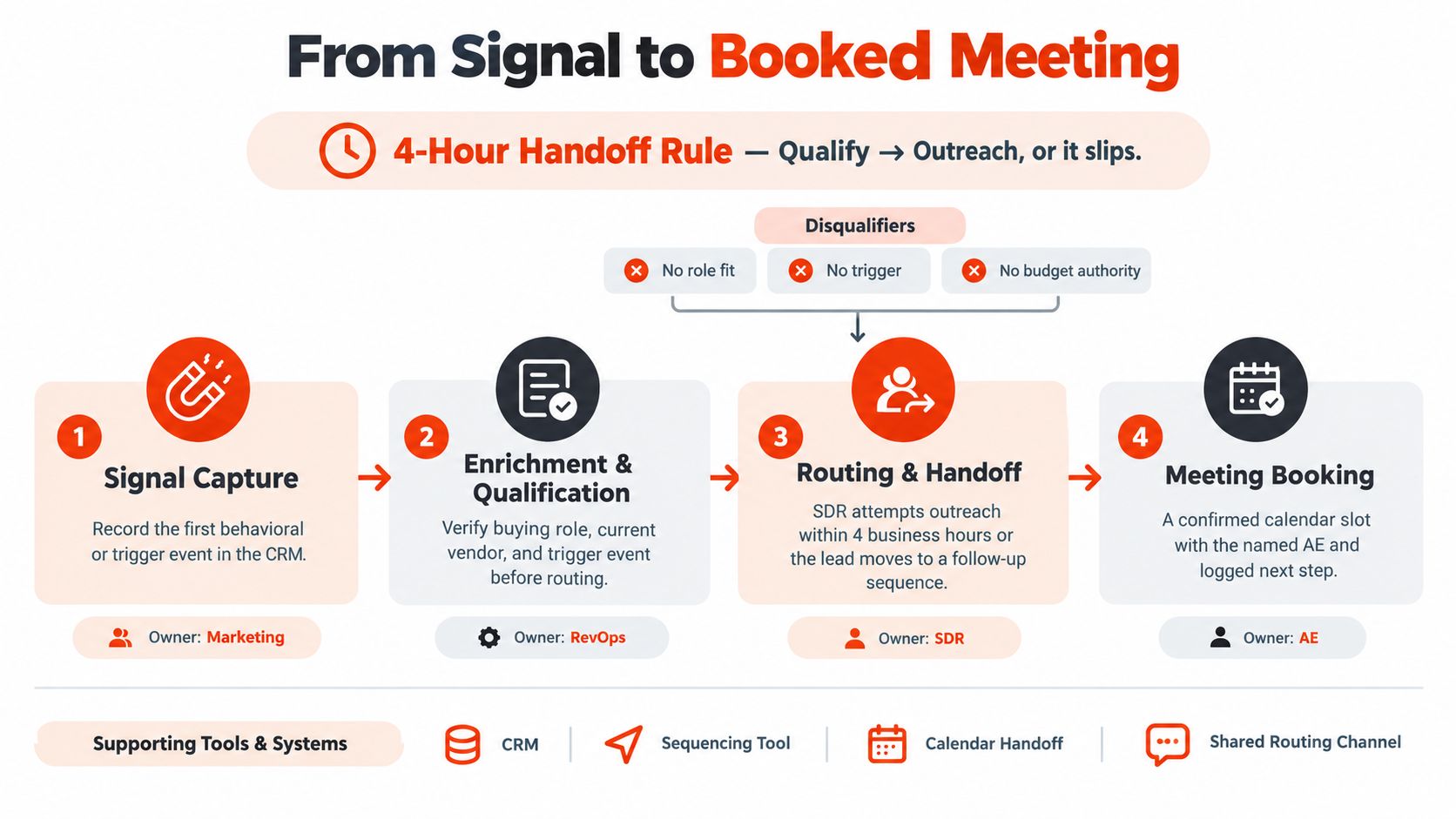
Define four operational nodes
Signal capture records the event in the CRM. Marketing owns the source and timestamp, whether the trigger is content engagement, a job change, a technology shift, search intent, or a response to outbound.
Enrichment and qualification adds the information a seller needs before contacting the account. At minimum, record the buying role, current vendor or operating approach, trigger event, account fit, and evidence of authority. RevOps should make the required fields impossible to skip.
Routing assigns the qualified signal to one SDR or seller. It shouldn't go to a shared queue without a named person. The owner confirms acceptance, rejects it with a reason, or places it into the defined follow-up path.
Meeting booking belongs to the AE or the assigned seller. The calendar record needs the account, attendees, qualification notes, meeting purpose, and next-step owner.
Routing rule: Once a Tier 1 or Tier 2 signal is qualified, the SDR attempts outreach within about 4 hours, following the guidance in OneAway's demand generation strategy. If the attempt doesn't happen in that window, the record moves to a follow-up sequence and the delay is logged.
The rule matters because sellers report operational friction, with 46.5% constrained by too much manual work and 55.4% saying buyers don't want to talk to sales representatives, according to the same source. Fast, relevant outreach can't solve every objection, but slow and generic outreach adds avoidable friction.
Keep the stack deliberately small
Use the CRM as the source of truth, one sequencing tool for follow-up, one calendar handoff, and one shared Slack channel for midday routing decisions. Avoid adding an intent platform, enrichment database, workflow tool, and dashboard before the team has agreed on definitions.
Document the process on one page and rehearse it before launch. Teams reviewing system handoffs can use this guide to integrate pipeline activity with a CRM, but the operating principle remains simple: every signal needs a record, an owner, a next action, and an expiry rule.
Assign Ownership and Run a Weekly Pipeline Inspection
A pipeline generation plan fails when accountability is distributed across a committee. Assign one accountable person to each stage, even when several people contribute.
Marketing owns signal generation, audience content, and content velocity. SDRs own qualification, routing, and the first response. AEs own meeting conversion, discovery quality, and stage progression. RevOps owns field completeness, source attribution, definitions, and the inspection dashboard. For partner-sourced work, a named partner lead owns the relationship and the source record.
Use a practical RACI
| Activity | Accountable owner | Required contributors |
|---|---|---|
| Signal creation | Marketing lead | Content, demand generation, sales |
| Qualification rules | RevOps lead | Marketing, SDR manager, AE |
| Signal acceptance and routing | SDR manager | Assigned SDR, RevOps |
| Meeting conversion | AE manager | AEs, SDRs |
| Opportunity progression | AE | Buyer champion, sales manager |
| Source integrity | RevOps | Every record owner |
| Partner-sourced opportunity | Partner lead | Partner, SDR, AE |
Run a fixed 30-minute weekly pipeline inspection. Start with coverage against the segment target, then review pipeline contribution by channel, stuck opportunities, and one experiment. The meeting should end with named decisions, not a recap of dashboard activity.
Use two rules to keep the discussion honest:
- Stale-deal rule: Any opportunity without a next step and older than 14 days receives a kill-or-rescue decision.
- Channel-failure rule: Any channel below 50% of its pro-rata target for two consecutive weeks triggers a forced reforecast.
A forced reforecast isn't a punishment. It prevents the team from protecting a weak channel with optimistic commentary. Marketing may change the audience or message, sales may change the qualification threshold, or the team may stop the channel. What matters is that the plan reflects observed pipeline economics.
The 90-Day Pilot Blueprint With Clear Go or Kill Criteria
A useful pilot has enough time to expose routing, message, and opportunity-quality problems, but it doesn't receive unlimited patience. Build the schedule around three phases and agree on the decisions before launch.
Days 1 to 30 establish the instrumented baseline
Validate the three tiers against recent wins and losses. Finalise required CRM fields, connect the chosen channels, test routing on one segment, and make the four-hour response rule visible to every SDR and manager.
Track qualified meetings, accepted opportunities, cost per qualified meeting, source completeness, and coverage against the segment target. Don't optimise for volume until the team can explain where every qualified signal came from.
Days 31 to 60 test the second motion
Add the inbound amplifier for Tier 2 only after the Tier 1 routing path works. Test messaging against a clear buyer problem, not against superficial engagement. Calibrate the SQL definition with win-loss feedback, because a meeting that sales accepts isn't necessarily an opportunity that advances.
Days 61 to 90 make the operating decision
Increase investment in the channel that produces acceptable opportunity quality and progression. Retire the weaker channel if the team can't repair its audience, economics, or handoff. Lock the RACI, dashboard, qualification fields, and weekly inspection agenda before moving the motion into steady-state operations.
The thresholds below are pilot controls, not external benchmarks. Set the actual SQL count, cost ceiling, and segment target with the CRO and sales leader before the first day.
| Phase | Days | Success Criteria | Go / Fix / Kill Trigger |
|---|---|---|---|
| Instrument and validate | 1 to 30 | Required fields complete, one segment routed, minimum SQL target agreed, cost ceiling defined, coverage tracked against target | Go if routing is reliable, fix data or qualification if not |
| Test and calibrate | 31 to 60 | Second channel active, messaging test completed, SQL definition reviewed against win-loss evidence, coverage reaches the agreed target | Go if quality and economics hold, fix message or segment if one fails |
| Decide and operationalise | 61 to 90 | Winning channel receives increased focus, losing channel receives a decision, ownership and inspection are documented | Scale if all cutoff questions pass, fix one constraint if isolated, kill if economics and ownership fail together |
Use three final questions:
- Do SQLs convert to second meetings in at least 70% of cases? If yes, scale the motion. If not, fix qualification or meeting quality before adding volume.
- Can the channel scale without CAC inflation above 20%? If yes, increase focus. If not, repair targeting, message, or capacity. If the economics remain weak, kill the channel.
- Does sales accept ownership without escalation? If yes, move to steady-state operations. If not, fix the SLA, fields, or acceptance criteria. A channel that produces activity nobody owns isn't ready to scale.
Ploot helps B2B teams in Spain build a LinkedIn audience through partners, directors, and senior managers, detect buying signals, and contact interested prospects to book qualified meetings. If that fits your pipeline generation plan, review the approach and start a defined pilot with Ploot.