

Revenue is often treated as the cleanest proof that a B2B company is winning. More bookings, more logos, more pipeline, more applause in the quarterly review. That advice is incomplete. Revenue only creates value when enough of it survives delivery costs, acquisition costs, discounting, and operational overhead.
A marketing team can generate impressive demand and still make the business weaker if the resulting deals require excessive customization, prolonged sales support, or discounts that leave little gross profit behind. The better question isn't “How much revenue did we create?” It's “How much economically useful revenue did we create, and how efficiently can the company deliver it?”
Table of Contents
- The Top-Line Illusion in Modern B2B
- Defining the Spread Between Revenue and Profit
- How Margin Dictates Pipeline Strategy
- Reading Gross Margin Trajectory as a Health Signal
- Aligning Demand Generation with Profitability
- Building a Margin-First Revenue Engine
The Top-Line Illusion in Modern B2B
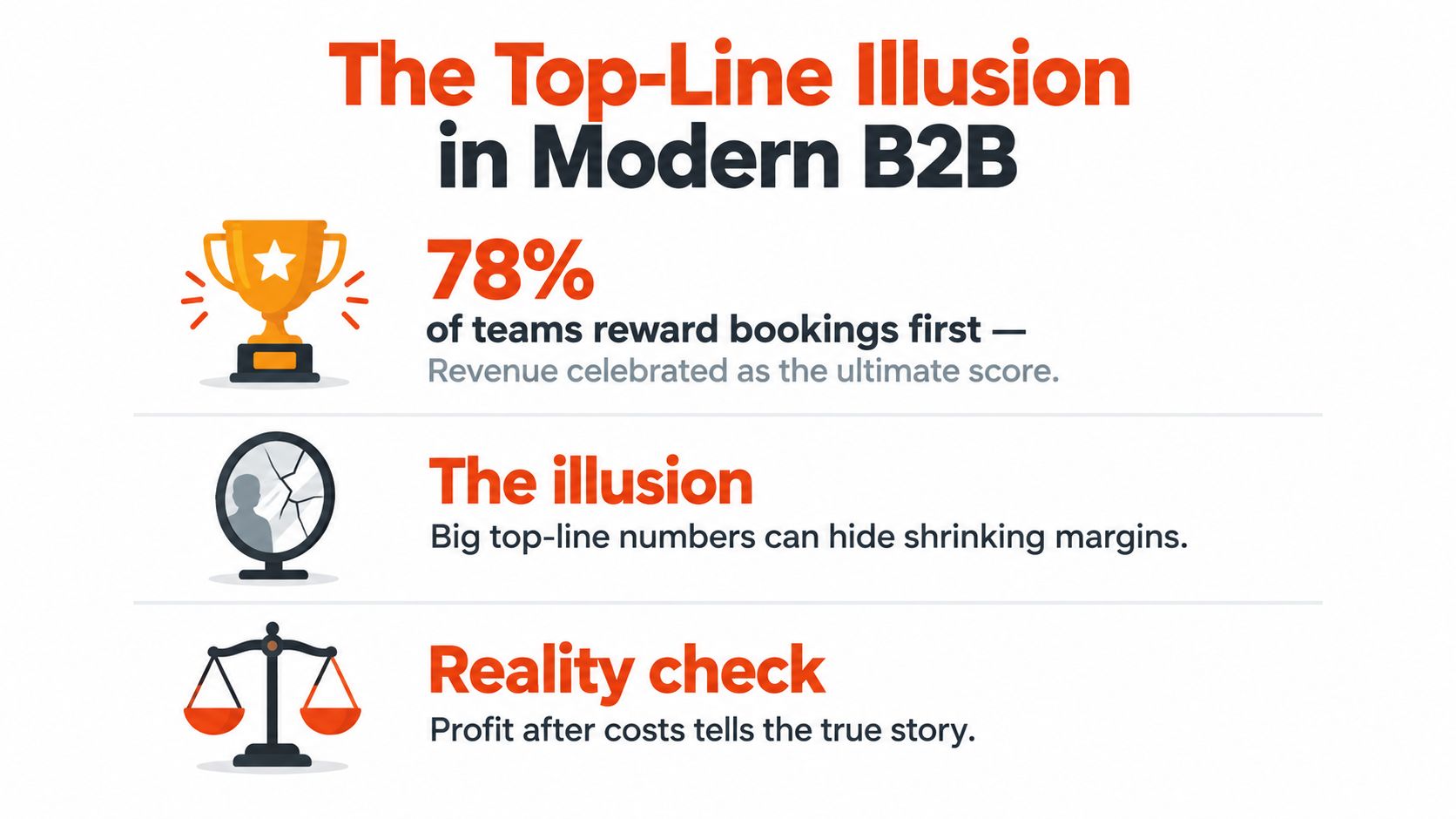
B2B teams often reward the easiest number to celebrate: total bookings. Revenue is visible, familiar, and closely tied to sales activity. Profit is slower to calculate and depends on information spread across finance, delivery, sales compensation, customer success, and marketing costs.
That convenience creates a dangerous habit. A large contract gets treated as a success before anyone asks whether the account can be served at the promised price, whether the customer will renew, or whether the acquisition effort consumed most of the available margin.
The scale of global business shows why revenue alone can't carry the argument. The 2,000 companies in the Forbes Global 2000 analysis generated $52.9 trillion in annual sales in 2025, compared with $21.9 trillion in 2005, an increase of more than 140% over two decades. Their combined profit also rose from $1.3 trillion to $4.9 trillion over the same period. The figures demonstrate immense corporate expansion, but they also show that revenue and profit are different measurements of business health.
Why more bookings can weaken the business
A contract can add revenue while creating new obligations that absorb the very resources needed for profitable growth. Professional services firms may win work that needs senior specialists on every account. Software companies may sell a heavily customized implementation that pulls product and engineering teams away from repeatable improvements. Marketing teams may generate demand through channels whose cost is disproportionate to the margin available from the resulting customers.
The problem usually appears first in the quality of the pipeline. A forecast that contains large opportunities but ignores delivery effort, discount levels, buying friction, and expected acquisition cost is a forecast of activity, not business value.
Practical rule: Treat every opportunity as a contribution decision, not just a booking decision.
Revenue still matters. Without it, a company can't fund payroll, product development, customer support, or future demand generation. But the commercial team should distinguish between revenue that expands capacity and revenue that consumes capacity without leaving enough return to support the next growth cycle.
Replace the celebration with a better question
At the deal level, ask what must be true for the opportunity to create value:
- Price quality: Is the commercial team holding a price that reflects the value and the cost to serve?
- Delivery quality: Can the company fulfill the promise through a repeatable process?
- Acquisition quality: Did the channel produce a buyer with enough intent to justify the cost of winning the account?
- Expansion quality: Is there a credible path to renewal, cross-sell, or wider adoption without restarting the entire acquisition effort?
Closing the right deals is more demanding than closing more deals. It requires marketing and sales leaders to connect their reporting to gross margin, cost to acquire, sales efficiency, and the actual work required after signature.
Defining the Spread Between Revenue and Profit
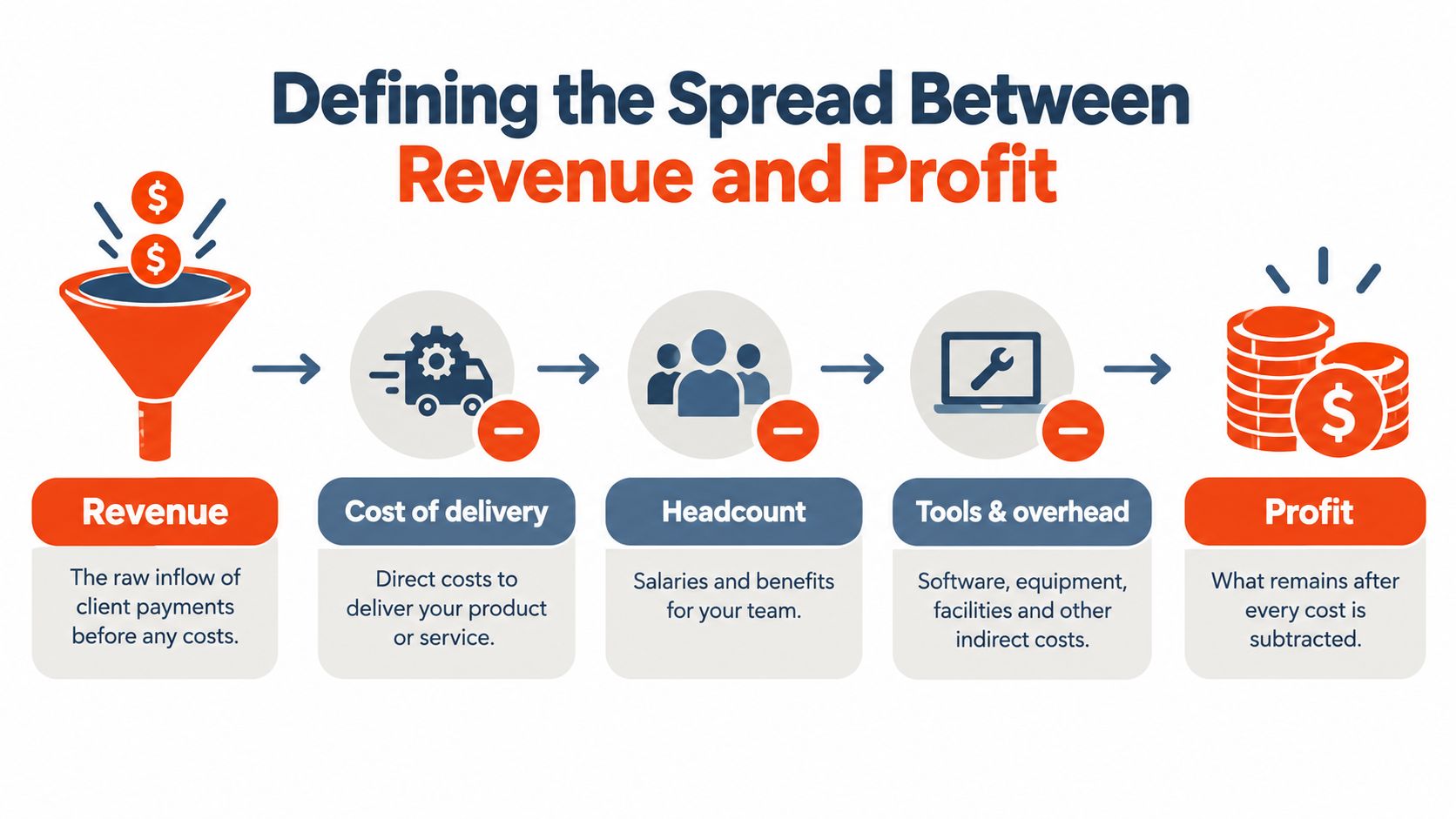
Revenue is the money a company earns from selling its products or services before the relevant costs are deducted. Profit is what remains after those costs have been accounted for. That distinction sounds basic, but B2B teams routinely collapse the two when they report campaign success.
A consulting firm may record a substantial contract value, yet the economic result depends on consultant utilization, subcontractor costs, travel, project management, rework, and the amount of senior attention required. A software company may collect subscription revenue while carrying implementation, infrastructure, support, customer success, and sales costs that determine how much of that revenue becomes profit.
The useful operating question is therefore not just whether revenue is rising. It is whether the spread between revenue and direct delivery cost is strong enough to support the rest of the company.
The layers that matter
Start with the commercial amount, then move through the cost structure rather than jumping straight to net profit.
| Layer | What it helps you understand |
|---|---|
| Revenue | The total value billed or earned from customers |
| Gross profit | What remains after direct delivery costs |
| Operating profit | What remains after operating expenses such as sales, marketing, administration, and product investment |
| Net profit | The result after the broader financial costs and obligations included in the company's reporting |
For consulting and adjacent B2B services, available consulting margin benchmarks often place gross margin around 50% to 75% and operating margin around 15% to 35%. Those ranges aren't a target for every company, but they illustrate why small improvements in utilization, realization, or pricing can have an outsized effect. Much of the fixed overhead is already in place, so additional revenue can contribute meaningfully when delivery capacity and pricing remain disciplined.
Why the spread changes commercial decisions
Suppose two opportunities have similar contract values. One uses a standardized offer, a short implementation, and a channel that produces informed buyers. The other requires extensive presales work, bespoke delivery, repeated legal negotiation, and a discount to overcome weak urgency. Their revenue may look comparable in the CRM. Their contribution to the business won't be.
Finance and revenue operations need a shared deal model. Marketing should be able to see whether a channel tends to produce opportunities with healthy expected margin. Sales should know how discounting affects contribution. Delivery leaders should flag offers that look attractive in a forecast but create recurring exceptions in execution.
The model doesn't need false precision. An informed estimate is more useful than a revenue report that ignores cost entirely. Track the assumptions, update them after delivery, and use the variance to improve qualification and pricing.
A 10-point improvement in utilization, realization, or pricing can flow disproportionately into profit when fixed overhead doesn't rise in proportion to revenue, as the consulting margin analysis explains. That makes pricing discipline and delivery design marketing concerns too, not just finance concerns. The campaigns that attract customers the company can serve repeatedly are often more valuable than campaigns that produce a larger but less manageable volume of demand.
How Margin Dictates Pipeline Strategy
Pipeline value should be measured after the commercial team considers the cost of creating and closing it. A large opportunity with weak urgency, heavy presales requirements, and a likely discount may be less valuable than a smaller opportunity with a clear business problem, strong executive sponsorship, and a delivery model the company already knows well.
This changes how marketing directors assess channels. Impressions can indicate reach, but they don't reveal whether buyers are suitable, whether sales can progress them efficiently, or whether the eventual deal will carry enough margin to justify the effort. Bookings are closer to the outcome, but they still conceal the cost of acquisition and fulfillment.
The buying question is simple: At what point does top-line growth stop creating value?
Build a margin-adjusted view of pipeline
A practical pipeline review should add commercial context to every material opportunity:
- Expected revenue: What amount is realistically closeable, rather than merely proposed?
- Expected gross margin: What portion should remain after direct delivery and implementation costs?
- Acquisition effort: How much paid media, event spend, partner effort, presales time, and sales capacity went into creating the opportunity?
- Delivery risk: Does the account require unusual integration, customization, service levels, or senior involvement?
- Time to value: How quickly can the customer reach a successful outcome and become a credible expansion or referral source?
This isn't an argument for rejecting every complex deal. Strategic accounts can justify extra effort. The point is to make the trade-off explicit instead of allowing the CRM to present every opportunity as equally attractive.
A pipeline generation plan should therefore define qualification criteria that include buying intent, fit, cost to serve, and commercial readiness. A channel that produces fewer meetings but a higher proportion of qualified opportunities may protect profit better than a channel that fills calendars with buyers who need extensive education before they can act.
Use the channel mix as a financial lever
Expensive events, broad advertising, and high-volume outbound can all have a place in the mix. They become problematic when the business treats volume as proof of efficiency and never connects channel costs to margin-adjusted outcomes.
A channel review should compare:
| Question | Weak measurement | Stronger measurement |
|---|---|---|
| Demand creation | Impressions and raw leads | Qualified opportunities with a defined commercial problem |
| Sales progression | Meetings booked | Opportunities advancing without excessive presales effort |
| Deal economics | Contract value | Expected contribution after direct costs and acquisition effort |
| Growth quality | New logos | Customers with viable retention and expansion economics |
The Gap financial data offers a useful public-company reminder. Gap reported about $15.4 billion in annual revenue and $816 million in annual net profit, while quarterly revenue declined 2% year over year even as margins remained meaningful. The figures don't provide a B2B playbook by themselves, but they illustrate the central point: scale and profit durability aren't interchangeable.
For B2B leaders, pipeline quality dictates survival because every low-quality opportunity consumes scarce human capacity. Marketing and sales should stop asking only which channel produces the most pipeline and start asking which channel produces pipeline the company can win, deliver, and renew at an economically sensible return.
Reading Gross Margin Trajectory as a Health Signal
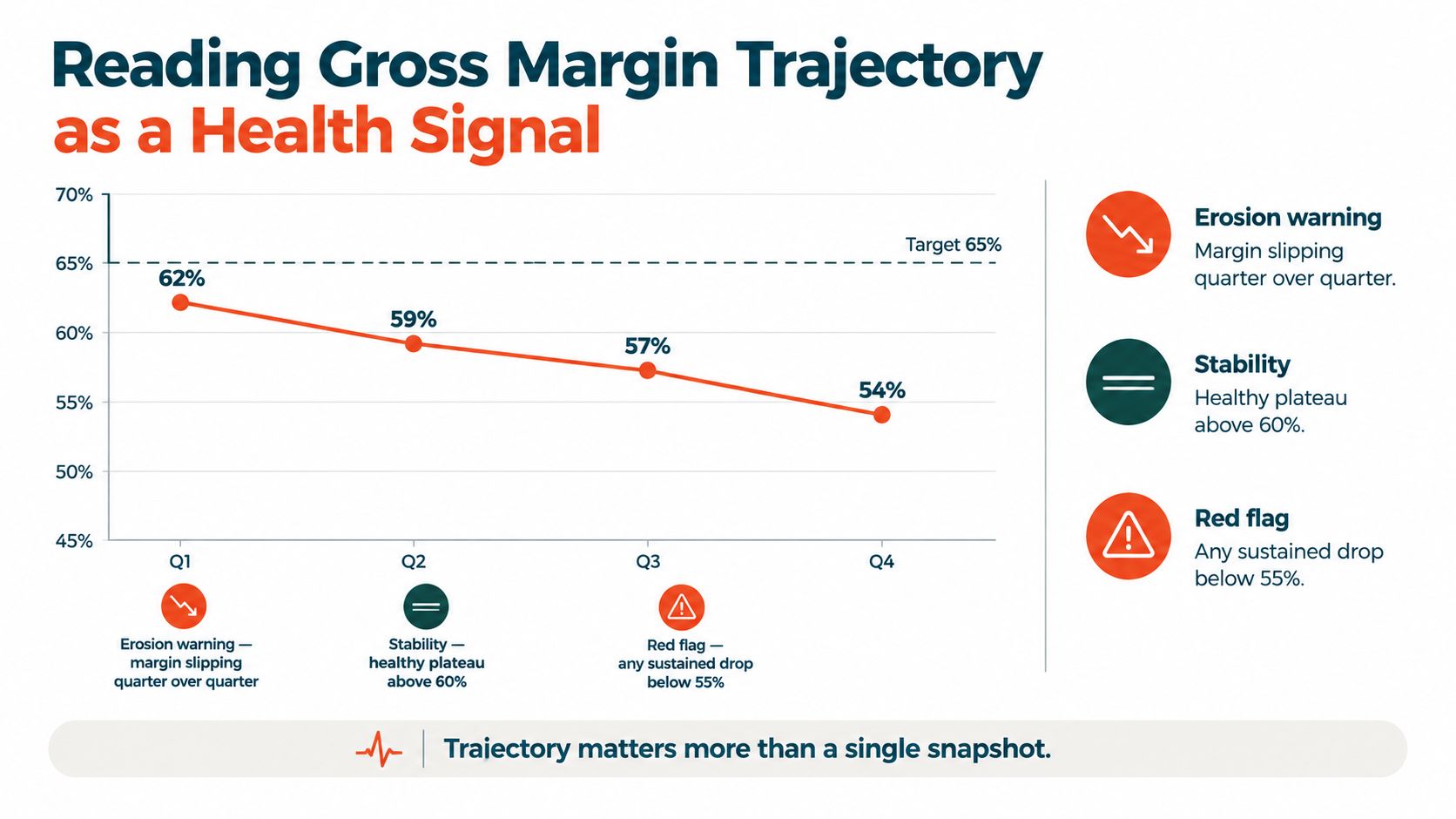
A single margin snapshot can conceal deterioration. The more useful signal is the direction of gross margin over time and the reason behind the movement.
If revenue rises while gross margin compresses, the company may be buying growth through discounts, absorbing higher delivery costs, or selling a weaker product mix. The result is less revenue available to fund operating expenses, product development, sales capacity, and future demand generation. This analysis of revenue growth and earnings quality identifies gross margin trajectory as a stronger revenue-quality signal than top-line growth alone.
Diagnose the cause before changing the target
When margin falls, don't immediately tell sales to sell more. First separate the possible causes.
- Pricing pressure: Sales may be discounting to overcome weak differentiation or late-stage procurement objections.
- Delivery inflation: Labor, subcontracting, infrastructure, or support costs may be rising faster than prices.
- Mix deterioration: New business may be shifting toward customers, products, or services that require more effort for less contribution.
- Promise expansion: Sales may be adding unpriced implementation, integration, or service commitments to secure signature.
Each cause needs a different response. Pricing pressure may require stronger packaging and proof of value. Delivery inflation may require standardized implementation or a revised cost model. Mix deterioration may call for stricter qualification. Unpriced promises require better approval controls before the deal reaches the forecast.
Audit recent wins, not just lost deals
Teams study lost opportunities for messaging and competitive lessons. Margin analysis adds another review: inspect the deals that closed and compare the expected economics with the actual delivery experience.
Look for patterns in the following questions:
- Did the customer buy the standard offer or a heavily modified version?
- Did the sales cycle demand unusual executive or technical involvement?
- Did implementation consume more capacity than the commercial model assumed?
- Did the customer need a discount to proceed?
- Did the original business case survive contact with delivery?
A finance leader's explanation of reading profitability like a CEO can help teams distinguish gross profit from operating profit when they review these results. Marketing leaders should then connect that distinction to campaign and segment decisions, using advanced analytics for revenue teams to identify which sources and customer profiles produce healthy economics rather than only high conversion.
Diagnostic rule: Rising revenue with falling gross margin is a request for investigation, not automatic evidence of successful growth.
Aligning Demand Generation with Profitability
Demand generation channels don't carry the same economic burden. A large event may create valuable executive relationships, but it also requires substantial planning and staff time. Broad paid media can increase awareness, yet it may attract buyers outside the ideal service profile. High-volume cold outreach can create activity while forcing sales development and account executives to spend time filtering weak intent.
Targeted, trust-based channels have a different trade-off. They may take longer to build, and their output can be harder to standardize at first. But when buyers arrive with context, relevant authority, and a visible business problem, sales often spends less time creating urgency from scratch.
The commercial test isn't whether a channel looks modern or familiar. It's whether the channel produces qualified demand at a cost and margin profile the business can sustain.
Compare channels by hidden cost
Use a channel scorecard that includes the costs people usually leave out:
| Channel pattern | Potential strength | Risk to profitability |
|---|---|---|
| Large industry events | Concentrated access to relevant decision-makers | Staff time, sponsorship expense, and follow-up capacity can be heavy |
| Broad paid acquisition | Fast reach and measurable traffic | Low-fit demand can consume qualification and sales resources |
| Cold outbound at scale | Direct targeting and controllable activity | Weak intent can lengthen cycles and increase the human cost of conversion |
| Partner advocacy | Borrowed trust and access to relevant accounts | Requires partner enablement and clear attribution |
| Employee-led social selling | Authority from people buyers recognize in the category | Needs consistent expertise, governance, and patience |
| Intent-based engagement | Focus on prospects displaying relevant interest | Requires reliable signals and disciplined timing |
Employee-led activity works best when it isn't treated as a publishing contest. Partners, directors, and subject-matter experts should share useful points of view tied to the problems their buyers already face. The commercial team can then identify meaningful engagement and decide whether a timely conversation is appropriate.
Protect margin before the opportunity reaches sales
Marketing can improve profit quality upstream by narrowing the audience, clarifying the offer, and excluding use cases that repeatedly require custom delivery. A campaign that attracts every possible buyer may look efficient on a cost-per-lead report while creating a costly qualification queue.
The 2026 margin discussion also shows why labor economics matter. A recent market note on S&P 500 margins estimated net profit margins at 14.2% in Q2 2026, with revenue growth of 12.3% and earnings growth of 23.1%, attributing much of the difference to labor costs. Those figures are market-level observations, not a benchmark for every B2B company, but the commercial implication is direct: expert time and headcount can determine whether growth scales.
Set channel thresholds around the economics of the business. Track cost per qualified opportunity, sales effort by source, expected gross profit, discount frequency, and delivery complexity. A channel that creates fewer opportunities can deserve more investment if its buyers move faster, require less persuasion, and purchase offers the company can deliver repeatedly.
Building a Margin-First Revenue Engine
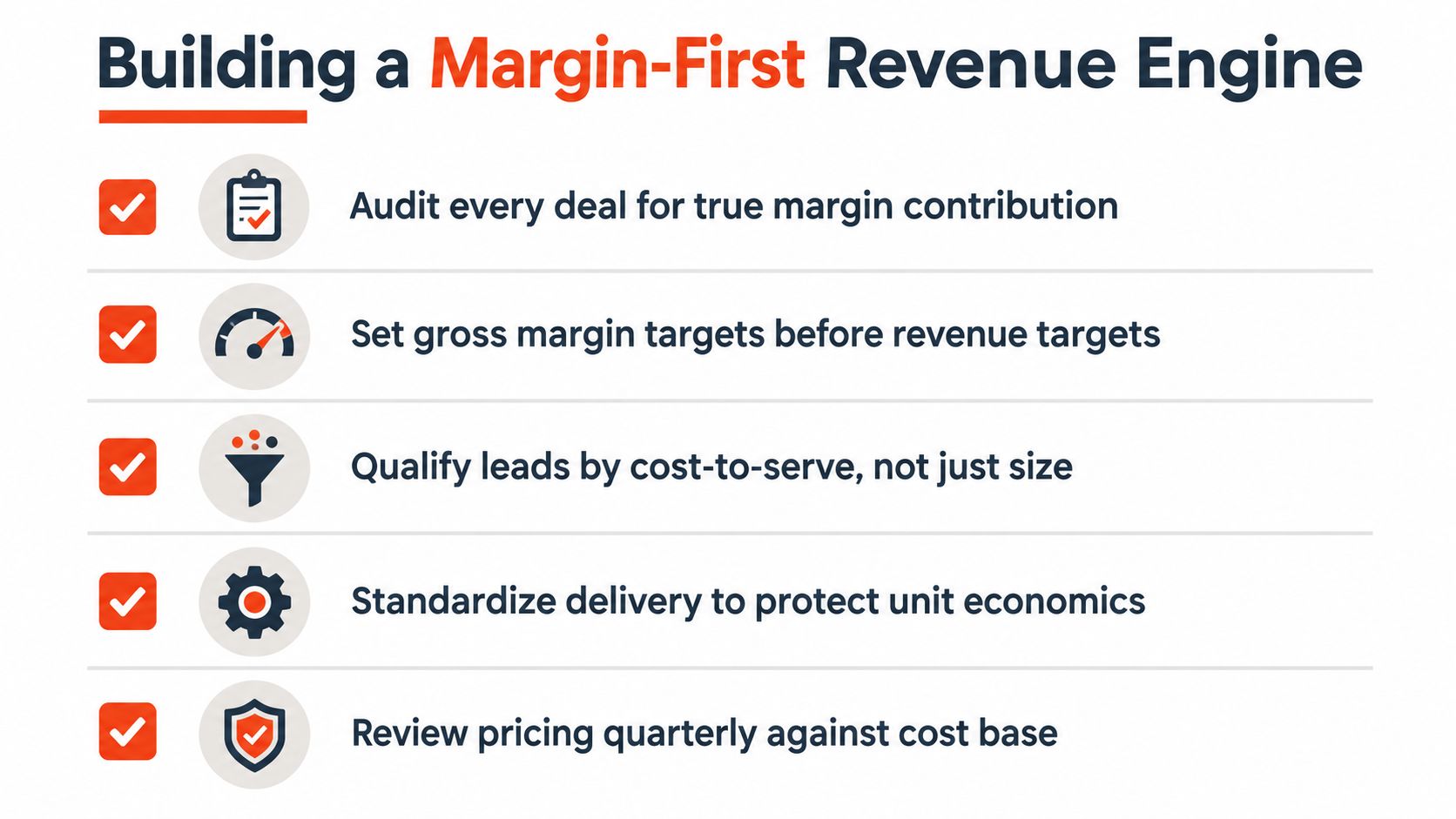
A margin-first revenue engine doesn't reject growth. It defines growth more carefully. Marketing, sales, finance, and delivery agree that the company needs revenue with enough contribution to fund the next stage of expansion.
The historical context supports that discipline. McKinsey found that global net profits increased from about $2 trillion in 1980 to $7.2 trillion in 2013, while corporate after-tax operating profits grew 30% faster than global GDP and reached about 9.8% of global GDP, up from 7.6% in 1980, according to its research on global corporate profits. The lesson for B2B leaders isn't to copy a global benchmark. It's to recognize that profit capture determines how much growth a company can reinvest.
Change the operating rules
Start with the deal, not the dashboard. Build a shared commercial view that gives each function a responsibility:
- Marketing: Report qualified pipeline alongside expected margin, source cost, and fit.
- Sales: Make discounting, delivery risk, and non-standard commitments visible before approval.
- Finance: Provide usable contribution assumptions instead of a margin number nobody can apply.
- Delivery: Feed actual cost and capacity information back into qualification and pricing.
- Leadership: Reward sustainable contribution, not just the largest signed contract.
Compensation deserves particular care. A revenue-only incentive can encourage discounting or the sale of work that delivery teams can't execute efficiently. A margin-based component can improve alignment, but it needs transparent definitions and reliable cost data. In practice, the right model depends on how much control sellers have over price, scope, and customer selection.
Make quality visible in weekly reviews
Replace “How much pipeline do we have?” with a small set of harder questions:
- Which opportunities have credible buying intent?
- Which ones fit a repeatable offer?
- Which ones can the company deliver at the assumed margin?
- Which channels produce the cleanest path from attention to qualified conversation?
- Where did forecast economics differ from the result after delivery?
Teams evaluating subscription businesses can use a SaaS revenue optimization framework as an additional reference for thinking about the relationship between acquisition, retention, pricing, and revenue quality. For broader B2B planning, revenue growth analysis should connect commercial expansion with the cost and capacity required to support it.
The strongest revenue engine doesn't maximize every possible opportunity. It filters for customers the business can win, serve, retain, and expand without weakening its economics. That is how marketing earns a seat in financial decisions, by showing that demand generation creates profitable pipeline, not just visible activity.
Ploot helps B2B teams turn the LinkedIn audiences of partners, directors, and senior managers into qualified sales conversations by identifying buying intent and contacting interested prospects at the right moment. If you need to defend demand-generation spend through pipeline quality and revenue economics rather than impressions, visit Ploot to explore the approach.