
About 98% of employee advocacy posts happen on LinkedIn, according to an independent 2026 roundup, while LinkedIn says employees collectively have roughly 10 times more connections than their company's follower base. Those figures reframe the channel. Employee advocacy on LinkedIn isn't a way to get more people to reshare a company post. It's a distribution system that can place useful ideas in overlapping personal networks, where buyers already research vendors and learn from practitioners. (LinkedIn employee advocacy statistics)
A familiar B2B pattern sits behind the numbers. A company publishes a carefully written update, sees limited interaction, and concludes that the topic or format failed. Then a director, consultant, salesperson, or technical specialist shares a related insight in their own voice, and the post reaches people the company page never touched. The commercial opportunity begins when the team connects that attention to a real buying signal, rather than stopping at impressions.
This guide is for marketing, demand generation, sales, and consulting leaders who need pipeline from LinkedIn, not a busier content calendar. It shows how to build broad participation, protect distribution when a prominent employee changes roles, and connect personal-profile activity with intent, conversations, and meetings.
Table of Contents
- Why Employee Advocacy on LinkedIn Matters Now
- What Employee Advocacy on LinkedIn Really Means
- Business and Brand Benefits That Go Beyond Reach
- How to Build an Activation Model That Scales
- Metrics That Connect Advocacy to Pipeline
- Real World Examples of Advocacy Done Right
- Your Next Steps to Turn Advocacy Into Meetings
Why Employee Advocacy on LinkedIn Matters Now
LinkedIn's business blog reports that 81% of B2B buyers value LinkedIn as a significant research source before purchase. That makes employee advocacy more than a reach tactic. It creates a durable distribution system in which useful ideas can continue reaching buyers through several personal profiles, even as team members change roles. (Employee advocacy benchmarks for 2026)
A company page still has a clear role. It gives buyers a formal place to verify the brand, understand its offer, and find published resources. Personal profiles add the surrounding context, much like knowledgeable guides helping visitors interpret what they find in a library.
Consider a consulting firm that publishes a polished post about digital transformation. The topic may be relevant, yet the update competes with every other corporate message in a buyer's feed. A senior consultant can explain what clients commonly misunderstand. A salesperson can share a practical lesson from discovery calls. The subject stays consistent, while the point of view changes to match the person's experience.
That distinction affects how buyers respond. A single post may create awareness without prompting action. Repeated exposure to useful perspectives can make later outreach feel relevant rather than completely cold. The commercial value appears when the team connects that engagement with account context, intent, conversations, and meetings, not when it stops at impressions.
Practical rule: Treat the company page as the library and employee profiles as the guided tour.
A workable program gives employees a manageable way to share what they already know. Marketing supplies themes and source material. Subject-matter experts add interpretation. Sales connects engagement with account context. Structure protects quality, while personal judgment keeps posts credible.
This approach addresses distribution and credibility together. It also reduces concentration risk. Analysis of LinkedIn advocacy data found that 70% to 96% of advocacy reach at several major companies came from one person, showing why a program centered on one founder or executive can weaken sharply when that person stops posting. (LinkedIn employee advocacy statistics)
The result is a multi-profile system that can preserve distribution through team changes and give marketing a clearer path from useful posts to qualified conversations.
What Employee Advocacy on LinkedIn Really Means
Employee advocacy on LinkedIn is an organized way to help employees share relevant company, industry, customer, and professional content through their personal profiles. The goal is to provide direction without turning people into automatic reposting mechanisms. Employees contribute judgment, experience, and language that fit their audiences.
A company page works like one broadcast tower. It sends messages through one account and one audience. Employee profiles create a connected distribution grid, with overlapping networks and different routes into buyer groups. Each person brings distinct connections, professional experience, vocabulary, and credibility.
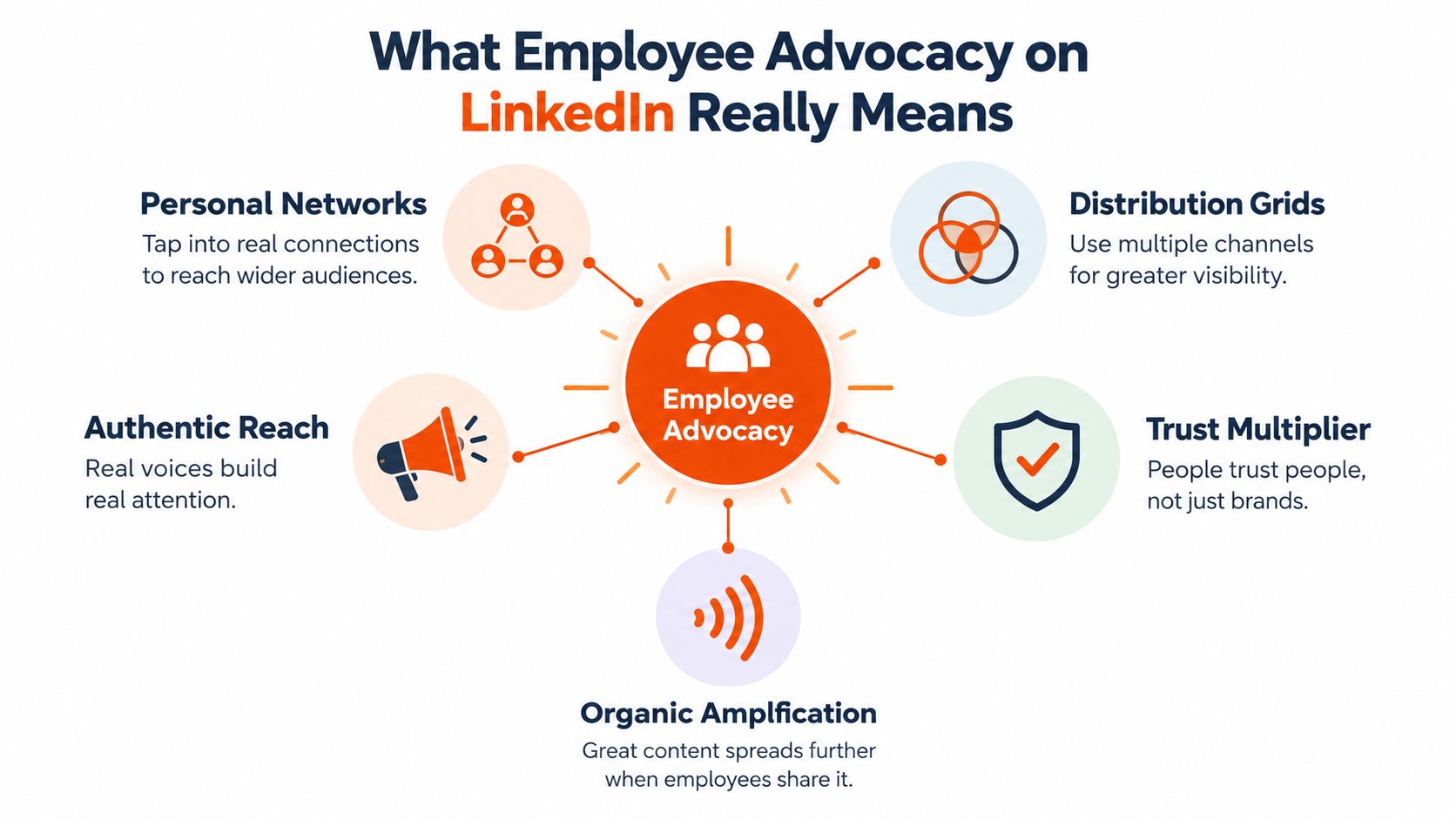
The distribution grid analogy
A software company might involve a product marketer, implementation consultant, account executive, and customer success leader. Their networks overlap, but they are not identical. One may connect with operations leaders, another with IT specialists, another with finance stakeholders, and another with existing customers.
Marketing can supply one central idea, such as a guide to evaluating a complex implementation. Each participant then frames that idea through a different professional lens. The result is a group of related conversations entering several buyer environments, rather than four copies of one post.
People often respond more readily to a person's perspective than to a company announcement. LinkedIn guidance describes employee-shared content as 8 times more authentic and 7 times more likely to generate positive action than company-shared content. LinkedIn employee advocacy statistics Those figures explain why employee interpretation matters. They do not justify distributing identical copy through every profile.
Advocacy versus random sharing
Random sharing starts with a link and a request to post it. A structured system gives participants clear choices:
- Who participates: Select volunteers whose roles provide useful perspectives and relevant audiences.
- What they receive: Provide source material, prompts, examples, and context, not only finished captions.
- How they personalize: Let each person add an observation, opinion, client-safe lesson, or question.
- What happens after publishing: Encourage thoughtful replies and connect relevant engagement with follow-up.
This model turns advocacy into a durable multi-profile distribution system. Marketing maintains the central message, while employees adapt it for real conversations. Because participation is distributed across roles, the system can continue through team changes instead of depending on one prominent voice. The operational goal is a clear path from useful posts to account context, intent, and meetings, not impressions alone.
Business and Brand Benefits That Go Beyond Reach
Reach is the entry point, not the business case. A marketing director may report that employee posts received attention, but leadership will eventually ask whether that attention improved credibility, created conversations, or influenced opportunities.
LinkedIn's own cited statistics say employee-shared content generates about 8 times the engagement of the same content on a company page. (Changing trends and expectations in employee advocacy) Another analysis reports roughly 561% greater reach for employee-shared content compared with brand channels. (Employee advocacy LinkedIn statistics) The useful interpretation isn't that every post will perform identically. It's that personal distribution gives a B2B team more opportunities to reach relevant people than relying on one corporate audience.
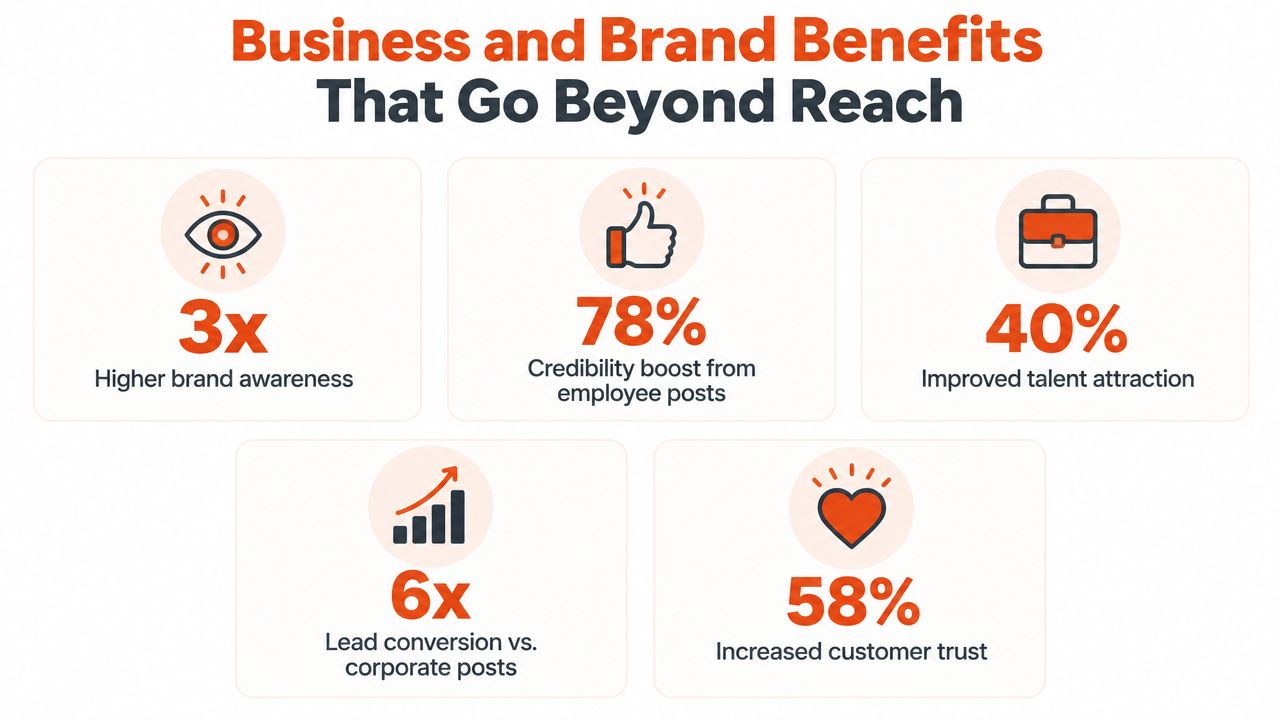
Credibility compounds through repeated exposure
A buyer evaluating an expensive service rarely moves from first impression to signed contract immediately. They encounter a company through several moments: an industry opinion, a practical explanation, a webinar contribution, a colleague's comment, or a salesperson's outreach.
Employee advocacy gives those moments more human variety. A technical leader can explain implementation risk. A partner can discuss strategic trade-offs. A consultant can describe a recurring operational challenge without naming a client. Those perspectives help buyers decide whether the organization understands their world.
The channel can also support employer brand and internal pride, but those outcomes shouldn't distract from commercial measurement. A post that attracts a potential hire may be valuable. A post that prompts a target account to ask a specific question is a stronger demand signal.
Why brand-page metrics can mislead
Company-page impressions tell you that distribution occurred. They don't tell you whether the people reached were relevant, whether they remembered the point, or whether anyone was ready to discuss a problem.
Employee advocacy becomes more defensible when teams compare:
| Brand channel | Employee channel |
|---|---|
| One official voice | Several credible perspectives |
| Audience owned by the company page | Overlapping personal networks |
| Content often reads as an announcement | Content can include experience and interpretation |
| Measurement may stop at reach | Measurement can continue toward intent and meetings |
Teams that want to strengthen the company channel can also use this practical resource on how to grow on LinkedIn as a B2B company. The broader lesson is to combine a reliable brand presence with employee-led distribution, rather than treating them as competing channels.
For long sales cycles, this blend is especially useful. Employee posts can create familiarity before a sales conversation, while the company page provides the formal proof layer buyers expect to find.
How to Build an Activation Model That Scales
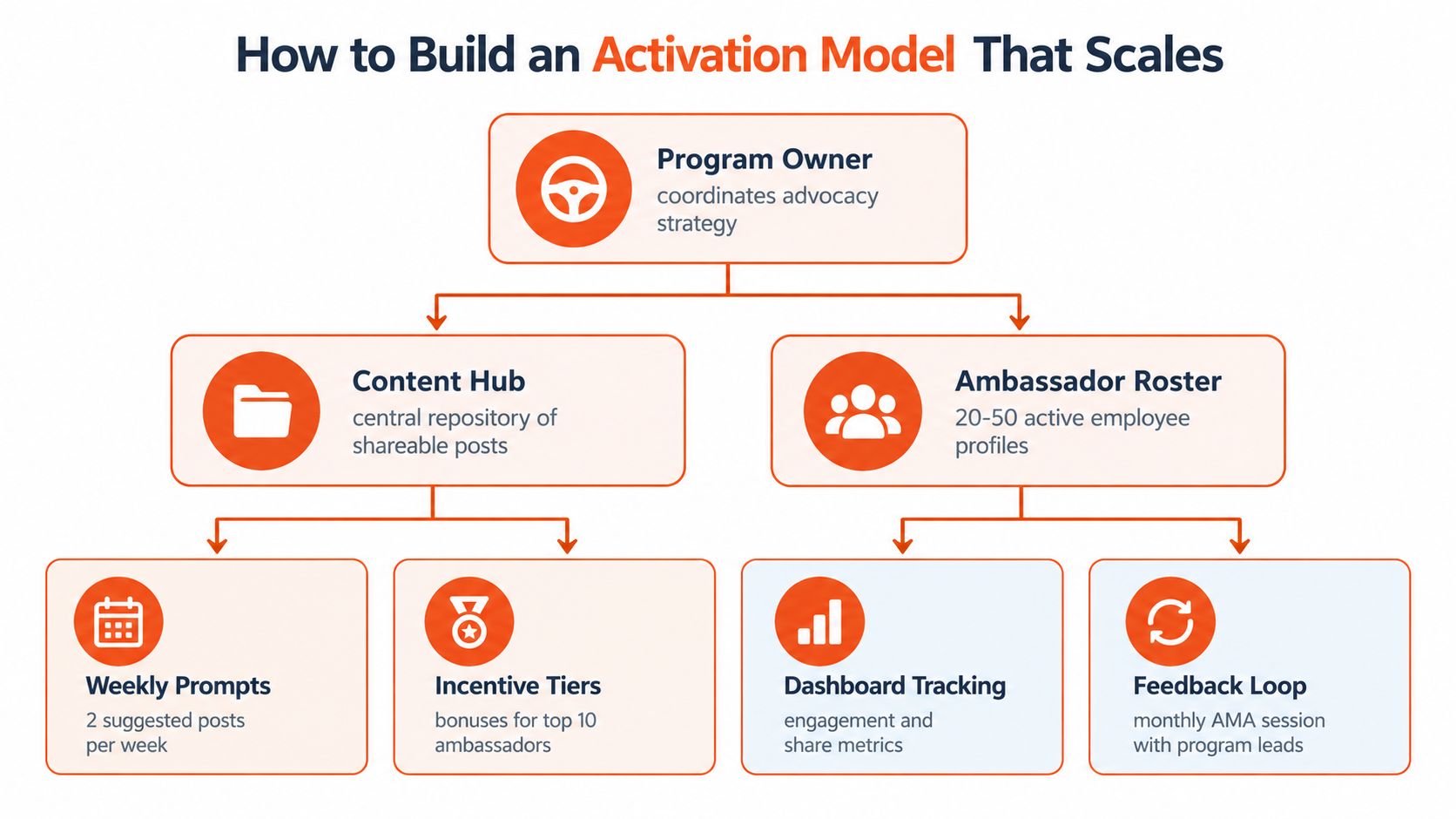
A durable program has an operating model, not just a shared folder of captions. Assign ownership first. A marketing or demand-generation lead can coordinate the program, but subject-matter leaders, sales managers, communications, and legal or compliance partners each need a clear role.
Start with a balanced roster
Don't activate only the founder or chief executive. Begin with people who have genuine expertise and a reason to participate:
- Senior leaders: Share market points of view and strategic lessons.
- Practitioners: Explain how work gets done and what buyers should consider.
- Sales professionals: Translate recurring buyer questions into useful education.
- Customer-facing teams: Surface patterns from implementation, support, and success.
- Recruiting and people leaders: Add credible culture and career perspectives.
The objective is multi-profile distribution. A roster should continue producing useful perspectives if one prominent voice becomes unavailable.
Create a content flow people can actually use
The content hub should contain source material, suggested angles, customer-safe examples, and prompts. Employees need to know why a topic matters and how it connects to their role. They should be able to choose a prompt, adapt it, and publish without waiting for a long approval cycle.
A simple flow looks like this:
- Marketing curates the source: Select a report, webinar, customer lesson, or internal insight.
- A subject expert adds context: Identify the practical implication for a specific audience.
- Employees personalize the draft: Replace generic language with their own perspective.
- The owner checks risk: Review claims, confidentiality, and compliance where required.
- The team supports conversation: Monitor comments and route relevant signals to sales.
Use templates as scaffolding, not scripts. A useful prompt might ask, “What do buyers usually underestimate about this problem?” That produces more authentic content than asking someone to paste a headline and a link.
Teams exploring ambassador structures can also review PostSyncer's ambassador program tips, particularly for guidance on participation, enablement, and sustained engagement.
Make participation voluntary and predictable
Employees shouldn't feel that their personal profiles belong to the company. Participation works better when people can select topics, decline prompts, and write in their own voice. Consistency comes from a dependable rhythm, such as a recurring editorial session, a weekly prompt, and a lightweight feedback loop.
Recognition can help, but public rankings can also make participation feel performative. Celebrate useful contributions, thoughtful comments, and conversations that help buyers. Keep incentives secondary to professional value, such as better visibility for expertise, access to ideas, and support with writing.
A shared calendar, editorial workflow, approval path, and analytics layer can prevent advocacy from becoming another fragmented task. For teams evaluating operating support, Ploot's activation dynamics for employee advocacy offers a related framework for coordinating participation and content.
Metrics That Connect Advocacy to Pipeline
The measurement mistake is easy to make. Teams count posts, likes, and impressions because those metrics appear quickly. Buyers, however, reveal commercial interest through a sequence of stronger signals.
Start with activation. Track which profiles are participating, which roles are represented, and whether distribution is concentrated in one person. Participation quality matters more than a large roster of inactive employees.
Then examine distribution quality. Ask whether posts reach the audiences the business sells to, whether several profiles contribute, and whether different roles introduce the company to distinct networks. A smaller but relevant audience can be more useful than broad exposure with no account connection.
Use a metric hierarchy
| Metric Layer | What to Measure | Why It Matters |
|---|---|---|
| Activation | Active profiles, role coverage, repeat participation | Shows whether the system can survive beyond one voice |
| Distribution | Relevant audience, profile mix, post reach | Tests the quality and resilience of amplification |
| Engagement | Comments, saves, profile visits, meaningful replies | Indicates whether content creates interest |
| Intent | Target-account interaction, resource visits, direct questions | Connects attention with possible buying activity |
| Conversion | Meetings, qualified opportunities, influenced pipeline | Demonstrates commercial value |
LinkedIn's analytics guidance emphasizes outcomes such as leads, meetings, and conversions, rather than impressions alone. (Employee advocacy statistics) That principle should shape the reporting dashboard from the beginning.
Attribute influence without pretending certainty
Long B2B journeys rarely follow one clean path. Use tagged links for measurable visits, connect form fills to campaign context, and record when a prospect mentions an employee post during a call. Sales representatives should have a simple field or note type for advocacy-influenced conversations.
Separate direct and influenced outcomes. Direct attribution means a person clicked a tracked post and completed a conversion. Influenced attribution means the account engaged with advocacy content before entering a sales process. Both matter, but they shouldn't be presented as the same type of evidence.
Review the signals regularly and adjust topics, profiles, and follow-up. A practical guide to measurable results from LinkedIn activation can help teams organize that reporting around business outcomes instead of surface activity.
Real World Examples of Advocacy Done Right
A professional services firm often starts with a founder-led pattern. The founder posts consistently, and the company receives attention, but every conversation depends on one person. The better model distributes the founder's point of view across partners, practice leaders, and consultants.
One partner might discuss a strategic decision buyers face. A practice leader can explain delivery risks. A consultant can share a framework from repeated project experience. Marketing turns those themes into source material, while each expert supplies the interpretation. The firm gains a broader set of entry points for prospects without forcing everyone to sound like the founder.

A software company connects content with account context
A B2B software team may have plenty of product content but little evidence that it creates buying conversations. Its marketing team can ask implementation specialists and account executives to turn common customer questions into educational posts.
The important change happens after publishing. When a target account comments, visits a profile, or engages with a related resource, sales doesn't immediately send an aggressive pitch. The representative checks the account context and uses the topic as a reason for a relevant conversation.
For example, a post about integration planning can lead to a message asking which part of the process creates the most friction. The post didn't replace sales. It gave sales a credible reason to begin.
A consulting team protects distribution during change
Employee turnover exposes weak programs. If one executive produces most of the reach, the company loses its primary distribution path when that person leaves. A resilient team documents content themes, develops several visible specialists, and keeps the editorial process independent of any single profile.
That means the program owner tracks participation by role, not only total activity. It also means managers coach new contributors before the organization needs them. Teams looking for more examples of structured B2B activation can explore LinkedIn success cases, then translate the patterns into their own sector and compliance requirements.
The shared lesson is simple: advocacy works best when people contribute distinct expertise and the company captures intent from the resulting conversations.
Your Next Steps to Turn Advocacy Into Meetings
Begin with a distribution audit. List the employees who already have relevant expertise, identify where participation depends on one or two profiles, and map those profiles to the buyer groups you want to reach.
Next, choose a commercial theme. Don't launch with every service, product, and audience at once. Select a problem that appears in sales conversations, create adaptable prompts, and invite a small group of willing contributors to test the workflow.
Set success criteria before publishing. Track profile participation, audience relevance, meaningful engagement, target-account signals, and meetings influenced by advocacy. Review the results often enough to remove friction, but don't optimize for posting volume at the expense of useful perspective.
After the pilot, decide what deserves more support. If employees have ideas but lack time, improve the content workflow. If posts receive attention but no sales response, strengthen intent detection and follow-up. If one person still dominates distribution, recruit credible contributors from other functions.
Ploot offers an employee-advocacy workflow with editorial structure, shared calendars, approval flows, and analytics for LinkedIn content. It also helps B2B teams connect employee-led distribution with buying intent and qualified sales conversations, so visit Ploot to evaluate a focused pilot around your team's profiles and pipeline goals.