

Most advice about oportunidades de negocio is stuck in startup fantasy. It tells you to hunt for a clever niche, copy a trend, or brainstorm product ideas until something sounds new. That's lazy advice for B2B firms.
In complex B2B sales, opportunity isn't the idea. It's the moment an account becomes commercially reachable. If your partners, directors, or senior consultants have audience reach but that reach never turns into meetings with the right people, you don't have a demand problem. You have a conversion architecture problem inside the buying committee.
That's where most consulting firms and B2B software companies in Spain lose pipeline. They publish. They sponsor events. They collect a few leads. Then sales chases one contact and calls it opportunity creation. It isn't. It's random activity dressed up as funnel progress.
Table of Contents
- What Business Opportunities Really Mean in B2B
- Types of Opportunities Worth Prioritizing
- Why Buying Committees Change the Opportunity Map
- LinkedIn, Employee Content, and Internal Activation Systems
- From Reach to Meetings in Practice
- Metrics That Tell You If the Opportunity Is Real
- A 90-Day Plan to Capture the Right Opportunities
What Business Opportunities Really Mean in B2B
The usual definition of a business opportunity is too broad to be useful. In B2B, especially in consulting, HR, and software, an opportunity only matters when it has commercial timing, account fit, and committee depth.
A lot of teams still treat opportunity as market whitespace. That's incomplete. The World Bank notes that its Entrepreneurship Database now tracks formal entrepreneurial activity across 188 economies from 2006 to 2024 in its global snapshot of entrepreneurship trends. That matters because it confirms opportunity is broad and measurable across markets. But for a commercial team, macro opportunity isn't enough. You still need a way to detect when a specific account is moving.
The wrong definition
If one person likes a post, downloads a guide, or accepts a connection request, that's not an opportunity. It's a signal. Most of those signals go nowhere because they lack one of three things:
- Account fit means the company matches your service model, deal size, and delivery reality.
- Authority depth means the signal isn't trapped at one low contact.
- Timing freshness means the interest is recent enough to act on before the shortlist hardens.
Miss one of those and sales starts chasing noise.
Practical rule: In B2B, an isolated lead is not demand. A cluster of relevant signals inside one target account is.
The useful definition
A business opportunity is the gap between visible interest and commercial action. That gap appears when several people in the same account begin revealing intent before anyone has formally raised a hand.
That's why smart teams build systems to identify market opportunities for sales from account behavior, not just inbound forms. The value isn't in finding “more leads.” The value is spotting when a procurement lead, business unit owner, and operational stakeholder all begin circling the same problem from different angles.
Use this filter instead:
- Fit first. Ignore activity from accounts you wouldn't prioritize anyway.
- Then map authority. Ask who can approve, block, evaluate, or delay.
- Then check timing. A fresh signal beats a strong but stale one.
The popular advice says opportunity starts with invention. In long-cycle B2B, it starts with detection.
Types of Opportunities Worth Prioritizing
Not every opportunity deserves the same response. Teams waste time because they treat all inbound, all engagement, and all referrals as equal. They're not.
The better approach is to classify the signal, then score it through three lenses: authority weight, timing weight, and reach weight. That gives you a working view of which opportunities deserve partner attention now and which ones belong in nurture.
Four opportunity types that actually matter
Some opportunities are triggered by external change. Others emerge from research behavior or internal account movement.
- Triggered opportunities come from events that force reconsideration. Leadership changes, funding activity, regulatory pressure, or procurement shifts often reopen vendor conversations.
- Intent opportunities show up when people consume comparison content, engage with implementation topics, ask practical questions, or revisit commercial material.
- Expansion opportunities come from existing accounts. New hires, a second department engaging, or adjacent leaders entering the conversation often indicate cross-sell room.
- Ecosystem opportunities arrive through partners, clients, alumni, and sector relationships. These are often underused because they don't sit neatly inside ad platforms or marketing automation.
Score the opportunity, not the channel
A strong signal from the wrong person isn't as useful as a moderate signal from someone who can shape budget or shortlist access. Score what happened, who it came from, and how broad the account activity is.
| Opportunity Type | Authority Weight | Timing Weight | Reach Weight | Priority Profile |
|---|---|---|---|---|
| Triggered opportunity | High when the change affects budget owners or process owners | High because the window can open suddenly and close fast | Medium at first, then high if more stakeholders appear | Prioritize fast when the trigger touches decision makers |
| Intent opportunity | Varies by role consuming the content | High when the activity is recent and repeated | High if several people from one account engage | Best near-term conversion candidate |
| Expansion opportunity | High if current sponsor can introduce adjacent buyers | Medium because internal expansion can move unevenly | Medium to high depending on department spread | Strong revenue efficiency play |
| Ecosystem opportunity | Often high because trust is pre-qualified | Medium to high depending on urgency of referral context | Low at first unless the account broadens quickly | Worth senior follow-up, not generic nurture |
A simple priority matrix
Use this practical split:
- High intent, low coverage means one strong person is active. Don't blast outreach. Expand account mapping first.
- High intent, high coverage means several relevant people are active. This deserves immediate coordinated action.
- Low intent, high coverage often means broad awareness without buying motion. Keep the relationship warm.
- Low intent, low coverage gets no urgent sales attention.
Teams don't need more lead categories. They need fewer categories with better scoring discipline.
The point isn't to build a perfect model. It's to stop pretending every touchpoint is pipeline.
Why Buying Committees Change the Opportunity Map
Single-contact outreach underperforms because B2B purchases don't happen through one person anymore. In complex B2B deals, the buying unit has expanded to an average of 11 stakeholders, and highly complex deals can involve as many as 20 participants, according to B2B customer buying journey trends.
That fact changes everything about how you should define oportunidades de negocio.
One contact is not account access
If your team knows one champion, you don't know the deal. You know one point of entry. That's useful, but it's fragile.
A champion can like your approach and still lose internally because procurement wants stricter terms, operations wants lower implementation risk, finance wants a different payment structure, or another business unit favors an incumbent. Sales teams discover those objections too late because they mistake contact-level engagement for account-level momentum.
Coverage beats volume
An account with several visible stakeholders is more valuable than a long list of accounts with one weak contact each. That's not a branding opinion. It's basic deal mechanics.
Here's what usually happens when committee coverage is shallow:
- Objections surface late because the blockers were never engaged.
- Deals drift because no one has internal support material to their role.
- Shortlists form without you because the broader group completed its internal comparison before your team got in.
The practical answer is to treat coverage as a leading indicator.
If sales can name the likely budget owner, user lead, operational evaluator, and procurement voice, the opportunity is real enough to work.
What changes in execution
When committees are bigger, opportunity capture shifts from “Who downloaded the asset?” to “How many relevant people from this account are showing movement, and how recent is that movement?”
That means better teams do three things differently:
- They monitor accounts, not just individuals.
- They look for repeated role diversity inside engagement.
- They route outreach from the person with the highest authority and contextual fit.
If your pipeline model still revolves around single MQL handoffs, your team isn't chasing opportunity. It's chasing names.
LinkedIn, Employee Content, and Internal Activation Systems
Most firms confuse LinkedIn activity with demand generation. They aren't the same thing.
A consultant posting thoughtful content can build credibility. A founder doing cold automation can generate some replies. But neither approach reliably creates meetings in long B2B cycles unless there's a system behind it. The useful distinction is between visibility, distribution, and activation.
Three layers that teams mix up
First, there's the employee profile. That's the credibility surface. Buyers check it to decide whether the person looks commercially relevant or just loud online.
Second, there are employee posts. Those are distribution nodes. They put ideas in front of the market and create context for later conversations.
Third, there's the internal activation system. That's the engine. It routes signals, alerts the right commercial owner, and creates warm paths into target accounts.
This visual captures the split.
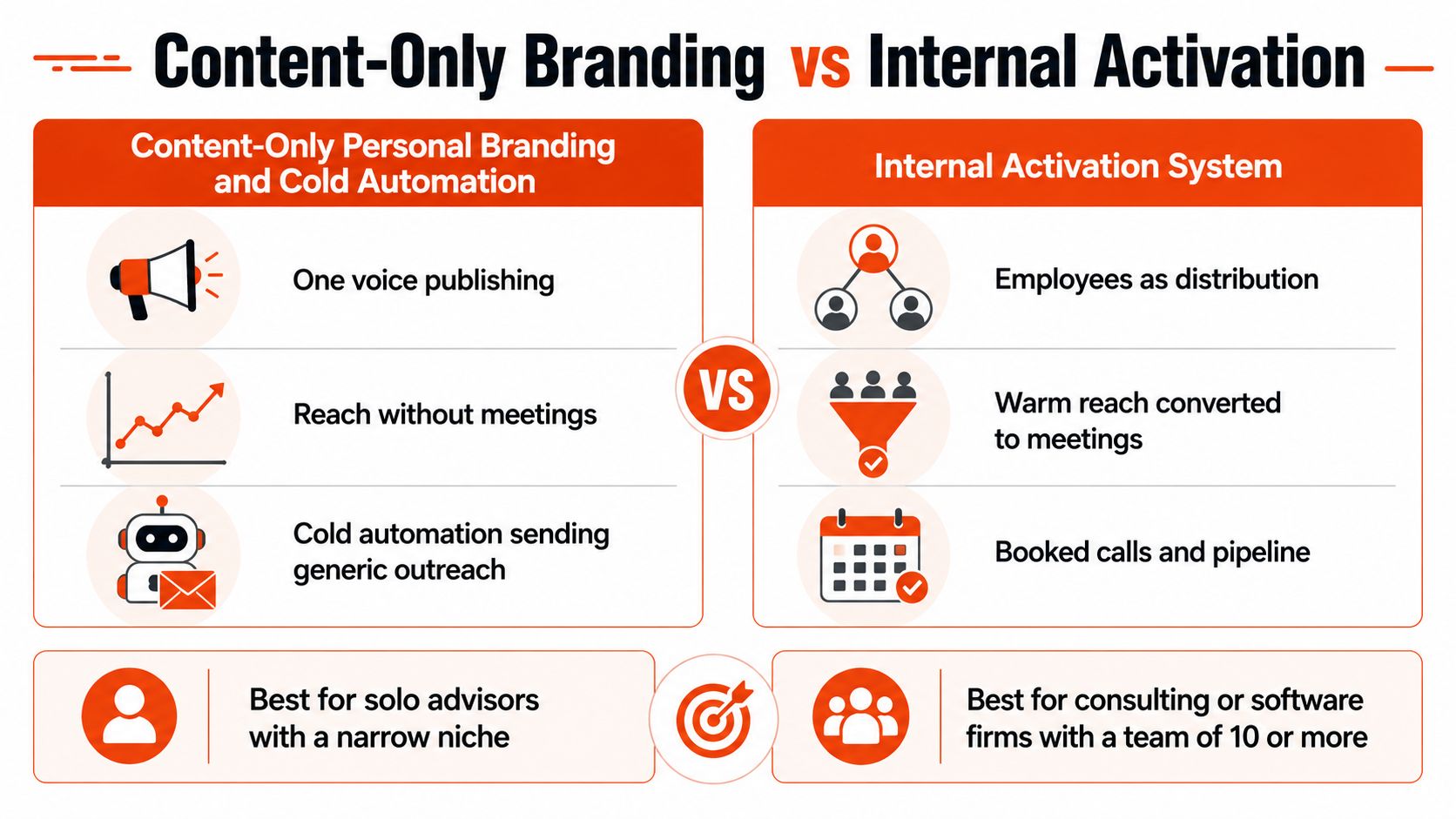
Content-only branding has a narrow ceiling
Content-only personal branding works best for solo advisors with a tight niche and simple sales motion. It's less effective for a consulting firm with multiple service lines and multi-stakeholder deals.
Why? Because reach without routing becomes vanity. A partner publishes on procurement transformation. The post gets attention. Nobody tags the target accounts. Nobody checks whether the engagement came from a department head, analyst, or buyer. Nobody decides whether sales should act today or leave it alone.
That's where a structured content system for LinkedIn visibility helps. Not because posting more fixes the problem, but because message consistency makes later signal interpretation cleaner. If your leaders post random opinions, your market data becomes noisy.
Internal activation is where meetings come from
A firm-level activation model looks different:
- Partners publish authority content tied to active commercial themes.
- Senior consultants add operational depth so implementation buyers trust the message.
- Sales or growth teams tag engagement by account and topic.
- Alerts route signals within hours to the person best placed to act.
- Warm intros beat cold DMs whenever a mutual path exists.
A practical model for this is laid out in Ploot's article on dinámicas de activación, which shows how firms can connect employee presence to account action instead of treating LinkedIn as a broadcast channel.
One option in this category is Ploot, which builds LinkedIn audiences around partners and senior managers, detects buying intent in that audience, and routes outreach from authoritative profiles. That model fits firms with long sales cycles where credibility matters more than outbound volume.
What the operating rhythm looks like
For Spanish consulting and software firms, I'd run it like this:
- Partners post less often but with more market weight. They should address commercial problems, vendor decisions, and strategic risk.
- Delivery leads post practical content. Buyers want evidence that your team can implement, not just sell.
- A shared enablement chat logs signals fast. If someone from a target account engages with relevant content, the response owner should know the same day.
- Trigger events get routed by account owner. Leadership changes, procurement activity, and new strategic hires should never sit in a spreadsheet waiting for the weekly meeting.
Publishing creates the surface area. Activation creates the opportunity.
From Reach to Meetings in Practice
A mid-sized consulting firm in Madrid doesn't need celebrity-level visibility to generate pipeline. It needs discipline.
The strongest setup I've seen is simple. The firm aligns partner content with live commercial priorities, tracks which accounts interact, and moves quickly when the right people show up. If you want a more tactical view of that blend, this guide to LinkedIn outreach and content strategy is a useful companion because it ties messaging and contact timing together instead of treating them as separate motions.
A weekly rhythm that actually works
Monday starts with topic selection. Not random content ideas. Active market themes tied to current pursuits, stalled deals, and priority accounts.
Tuesday is where most firms either create advantage or lose it. Sales reviews draft posts for committee fit. If a post speaks only to peers and not to buyers, it gets rewritten. If it can attract procurement, operations, or transformation leaders, it stays.
Wednesday is publishing day across a controlled set of profiles. Partners carry the commercial argument. Practice leads add delivery credibility. The point isn't to flood the feed. It's to make sure target accounts repeatedly see relevant expertise from more than one voice.
The conversion moment
Thursday and Friday are where reach turns into meetings.
A procurement director from a target account reacts to a post about vendor consolidation. That's interesting, but still incomplete. Then a business unit lead from the same company engages with a separate post on implementation trade-offs. Now there's pattern recognition.
At that point, the system shouldn't send a cold pitch. It should alert the relevant partner, check for a mutual path, and use a warm introduction if one exists. Timing matters. Context matters more.
A useful internal reference here is this breakdown of LinkedIn lead generation, because it frames social activity as account-based meeting creation, not top-of-funnel noise.
What makes the meeting more likely
Three details usually separate meeting-worthy opportunities from vanity engagement:
- The originating post is specific. Broad thought leadership gets likes. Practical buying-topic content gets replies and introductions.
- The response is fast. Once the account shows clustered interest, waiting kills momentum.
- The outreach matches the stakeholder. Procurement gets a different angle than an operations lead or practice owner.
Don't follow up on engagement just because it happened. Follow up because the account context makes the engagement commercially meaningful.
That's the difference between a social program and a pipeline program.
Metrics That Tell You If the Opportunity Is Real
Most dashboards are built to flatter marketing. Opportunity capture needs a dashboard built to guide action.
Follower growth, impressions, and raw engagement aren't useless. They're just weak decision metrics for long B2B cycles. The better stack tracks whether your team is reaching the right people inside the right accounts, while the signal is still fresh enough to matter.
The four metrics I'd watch first
Use a small set of operational metrics and make both sales and marketing read the same scoreboard.
| Metric | What it measures | Target threshold |
|---|---|---|
| Account coverage rate | How much of the target buying committee you've identified and reached in a named account | Above 60 percent |
| Intent-score freshness | How recent the last verified signal is before the account is worked | Under 14 days |
| Meeting show rate | Whether sourced meetings from activated accounts actually happen | North of 70 percent |
| Sourced pipeline influence | Whether these accounts contribute meaningfully to closed-won movement | Qualitative trend in the first two quarters, then reviewed against closed-won evidence |
These are the thresholds I'd use for a first and second quarter operating baseline. Not because they're magic. Because they force the team to focus on usable opportunity, not broad visibility.
Why most teams track the wrong things
A post can perform well and still generate nothing commercial. A quiet post seen by three relevant stakeholders in one target account can be more valuable than a widely shared opinion piece.
That's why I'd wire the dashboard around:
- Named account progress, not aggregate lead counts
- Fresh signals, not old engagement totals
- Meeting attendance, not meeting bookings alone
- Commercial influence, not content vanity metrics
For teams tightening qualification discipline, this guide on cualificación de leads is useful because it forces the handoff question early: is this account ready for sales action, or are we still pretending attention equals demand?
If your dashboard can't tell sales which accounts have fresh, multi-role intent, it isn't an opportunity dashboard.
A 90-Day Plan to Capture the Right Opportunities
Don't roll this out as a brand project. Run it as a pilot with hard operating rules.
The first ninety days should prove one thing. Can your firm convert audience reach into qualified meetings by improving committee coverage and acting on fresh signals faster than your current process does?
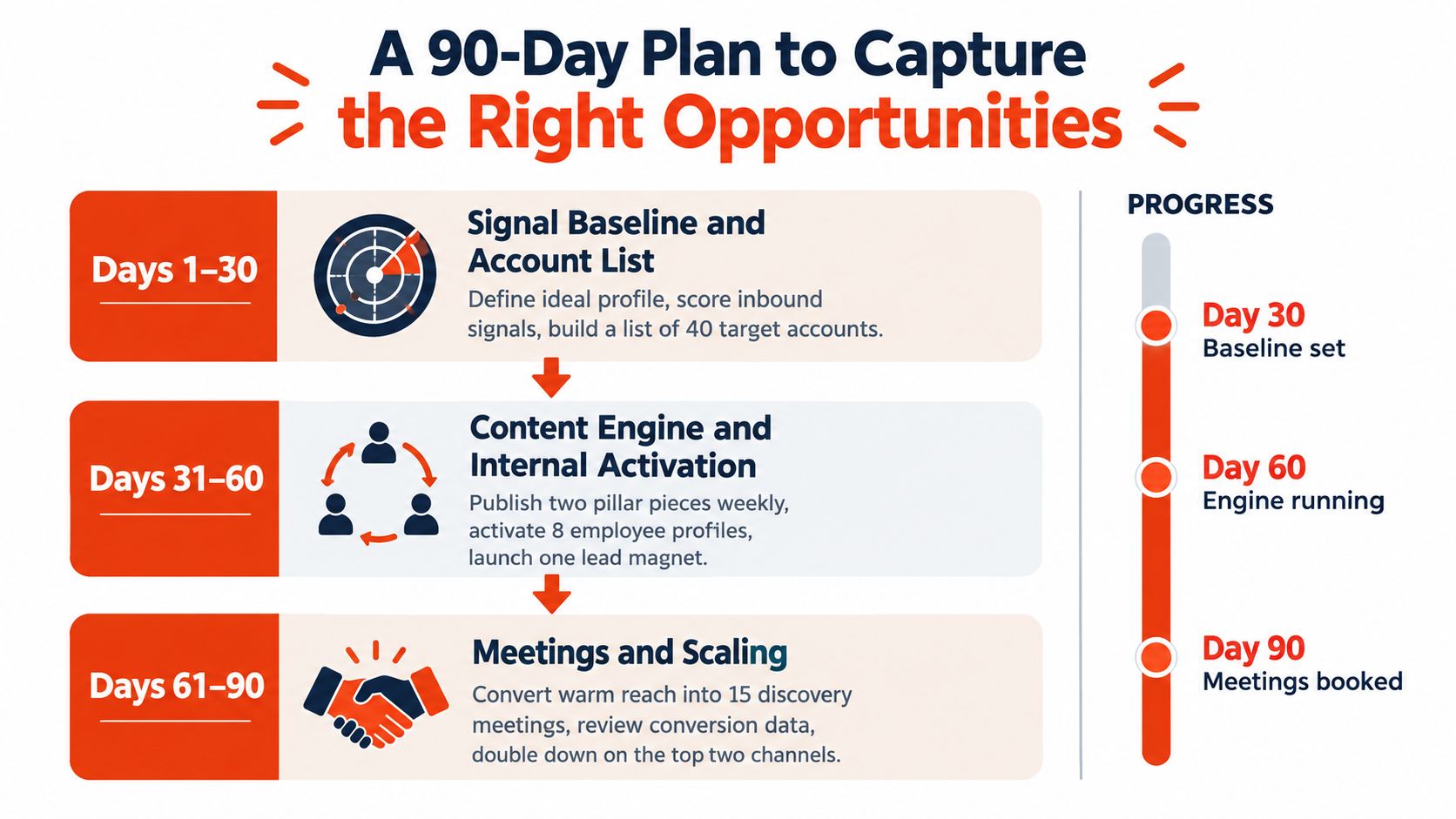
Days 1 to 30
Build the baseline.
- Define the account list. Choose a focused set of target accounts that fit your service lines and commercial reality.
- Map the likely committee roles. Budget owner, functional owner, evaluator, procurement, and implementation stakeholder are the minimum set.
- Audit current reach. Check which partners, directors, and senior managers already have relevant audience overlap with those accounts.
- Create signal rules. Decide what counts as meaningful engagement and what doesn't.
The Global Entrepreneurship Monitor's 2021/2022 Global Report found that in 15 of 47 economies, more than half of people starting or running a new business said COVID-19 had created new business opportunities, compared with 9 of 46 economies in 2020, based on survey coverage of at least 2,000 respondents in each of 47 economies in its opportunity amid disruption report. The lesson for B2B teams is straightforward. Shifts in buyer openness happen fast, so your baseline has to be ready before the window opens.
Days 31 to 60
Turn content into signal infrastructure.
- Onboard the first wave of employees. Start with partners and senior subject matter experts, not the whole company.
- Lock in commercial themes. Focus on buying problems, implementation trade-offs, and decision criteria.
- Create routing rules. Every meaningful signal needs an owner and a response path.
- Standardize warm outreach. Mutual introductions, relevant follow-up notes, and role-matched messaging beat generic follow-up.
A short tactical explainer can help align the team before rollout.
Days 61 to 90
Push for meetings and review account quality.
- Work only the strongest opportunities. Fresh, relevant, multi-stakeholder signals get attention first.
- Review meeting quality weekly. Which topics, profiles, and account patterns are converting into real conversations?
- Cut low-yield activity. If something creates attention without committee movement, stop pretending it helps.
- Document the repeatable motion. Your goal isn't more content. It's a system the commercial team can run every week.
My view on 2026 is blunt. The most valuable oportunidades de negocio in Spanish B2B won't come from broader top-of-funnel volume. They'll come from committee-coverage economics, where AI-assisted intent scoring and coordinated employee presence become standard operating practice for firms selling complex services.
Ploot helps B2B firms turn partner and senior team visibility into a sales channel by detecting buying intent, routing warm outreach, and booking qualified meetings from authoritative profiles. If your team already has reach but not enough pipeline from it, this is exactly the gap to fix. Visit Ploot to see how that model works in long-cycle consulting and B2B software.