

Most advice treats a prueba de valor as a better product demo. That framing is wrong for high-ticket B2B sales. A buyer rarely needs another guided tour of screens, integrations, or dashboards. They need evidence that a commercial problem can move under real operating conditions, and that the movement justifies a budget decision.
The useful question isn't, “Can the platform perform the feature?” It's, “What measurable business event will happen if the buyer adopts it?” That event might be qualified meetings booked, pipeline influenced, operating cost reduced, productivity improved, or revenue protected. A pilot that can't connect its activity to an outcome is usually an extended trial with better presentation materials.
Table of Contents
- Why Most Prueba de Valor Pilots Fail Before They Start
- What a Prueba de Valor Actually Is in B2B Sales
- Structure, Scope, and Duration That Actually Work
- Key Metrics and How to Instrument the Pilot
- Real Examples in Tech and Professional Services
- Templates for Consultative Sales and Pilot Proposals
- Risks, Misconceptions, and Best Practices
- Turning a Prueba de Valor Into Pipeline You Can Measure
Why Most Prueba de Valor Pilots Fail Before They Start
Most pilots fail before anyone logs in. The seller and buyer agree to access, data, users, and meetings, but they never agree on what commercial evidence must exist at the end. The result is predictable. Everyone can describe what the product did, yet nobody can explain why the customer should sign.
A prueba de valor should be a structured evaluation in the customer's environment, generally lasting about 2 to 8 weeks, long enough to expose workflow effects, adoption friction, and measurable business outcomes rather than feature behavior alone, as described in this B2B proof of value framework. The duration matters less than the design. A short, focused evaluation can create more buying confidence than a long pilot with no decision mechanism.
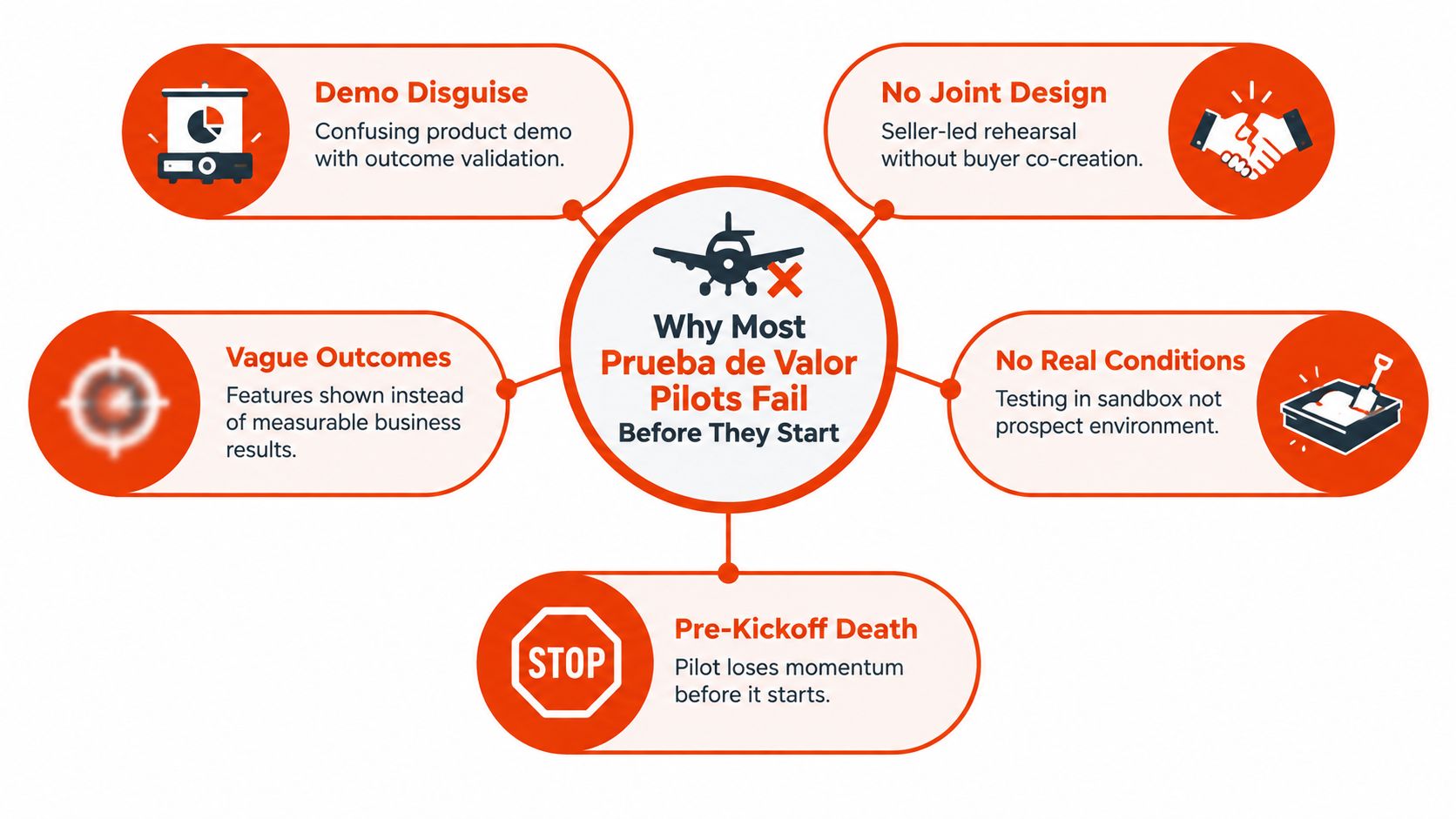
The three structural mistakes
Over-scoping is the first problem. Sellers add departments, use cases, integrations, and reporting requests to make the pilot look substantial. Buyers then spend the evaluation coordinating internal teams instead of testing the business hypothesis.
Vague success criteria create the second failure. “Users will adopt the platform” isn't a success criterion. “The team will complete the agreed workflow, compare its output with the current process, and review the commercial consequence” is closer, because it creates something the buying committee can inspect.
The third mistake is the missing executive sponsor. A champion can coordinate users, but a champion without access to the economic buyer often can't carry the result into procurement or budget approval.
Commercial rule: If the pilot ends with a feature recap instead of a buying decision, it wasn't a prueba de valor.
The strongest evaluations define one or two primary KPIs before kickoff, connect each to a baseline, and measure the change against that baseline at the end. The seller must also instrument cause and effect, linking user actions to operational changes and outcome movement. That is what turns screen time into evidence.
What a Prueba de Valor Actually Is in B2B Sales
A prueba de valor is a time-boxed, jointly designed commercial test that evaluates whether a solution creates enough measurable business impact to justify purchase. It runs under the prospect's real conditions, uses an agreed baseline, and ends with a documented go or no-go decision.
That definition separates it from a proof of concept. A PoC asks whether something can work technically. A prueba de valor asks whether the result is valuable enough to fund, adopt, and expand. In a high-ticket B2B cycle, technical feasibility is only one part of risk. The buying committee also needs confidence around economics, workflow disruption, adoption, ownership, and the path from evaluation to contract.
The distinction is often blurred when English-speaking teams use “proof of value” as a polished synonym for “proof of concept.” That creates internal confusion. Engineers may optimize for a successful integration while finance and sales leaders are waiting for evidence of productivity, cost reduction, ROI, or revenue influence. A concise Proof of Value meaning guide can help align terminology, but the operating design still has to come from the deal team.
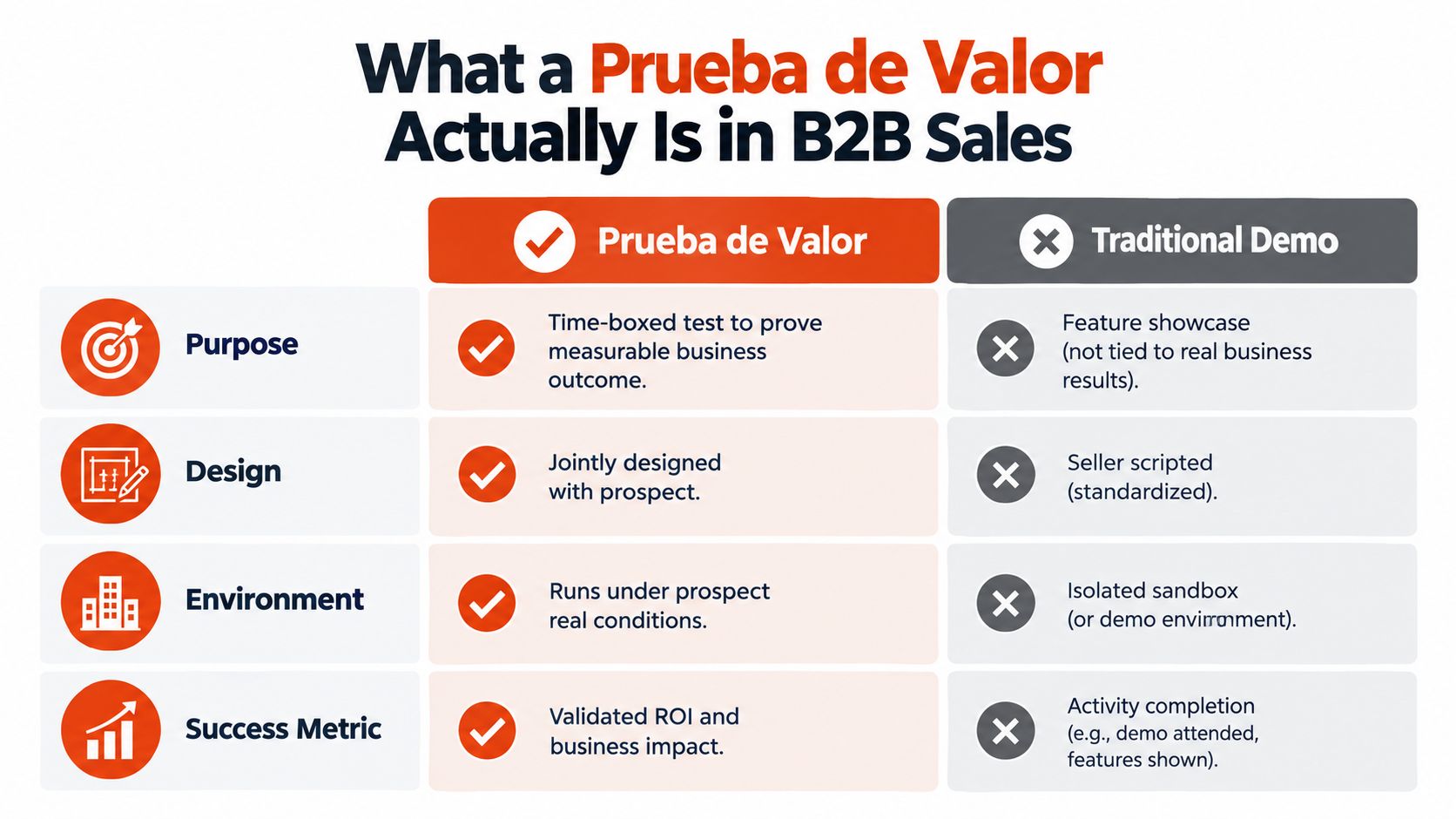
Four components make it real
Economic hypothesis: State the business change the buyer expects. For example, a sales team may test whether intent-led outreach creates more qualified conversations than its current prospecting motion.
Baseline: Record how the relevant workflow performs before the pilot. Without a baseline, the team can celebrate activity without proving improvement.
Success threshold: Define what result would be sufficient to justify the next commercial step. The threshold must be agreed before the participants see the result.
Go or no-go decision: Specify who decides, when they decide, and what happens after each outcome. A successful pilot should lead to a commercial proposal, expansion discussion, or implementation plan. An unsuccessful one should stop cleanly or trigger a documented change in the hypothesis.
The demo still has a place. It helps users understand the workflow and gives stakeholders a shared view of the solution. It isn't the proof. The proof is the business result produced when the workflow meets the buyer's operating reality.
Structure, Scope, and Duration That Actually Work
A pilot survives a buying committee when the team can answer five questions in writing before kickoff: what business outcome is being tested, which workflow is in scope, how long the test runs, which measures determine success, and what commercial decision follows.
For most high-ticket evaluations, a 30 to 60 day operating window is a practical design choice. That range is an application of the broader 2 to 8 week evaluation guidance cited earlier, not a universal rule. The right duration depends on the workflow, data availability, decision cycle, and time needed for users to reach meaningful behavior.
I favor one use case and one stakeholder group. A 45-day test of one workflow with a clearly named owner often produces better evidence than a 120-day, multi-department pilot that keeps adding requirements. The longer version feels safer at the start, but it gives every stakeholder another reason to defer a decision.
Lock the commercial mechanics first
The kickoff document should specify the data required, access responsibilities, meeting cadence, measurement method, and success threshold. It should also state what happens if the pilot underperforms. A seller that refuses to define an exit clause is usually protecting delivery effort, not building buyer confidence.
The scope should be narrow enough to manage and important enough to matter. Testing a trivial workflow produces clean data with no budget consequence. Testing the entire organization produces noisy data and weak accountability. The useful middle is a material business problem with a controlled operational boundary.
| Element | What to Lock Before Kickoff |
|---|---|
| Business objective | The outcome the buyer wants to influence |
| Scope | One use case, stakeholder group, and agreed workflow |
| Duration | Start date, end date, review points, and decision date |
| Data access | Systems, permissions, owners, and privacy constraints |
| KPIs | Baseline, measurement method, target threshold, and reporting owner |
| Governance | Champion, executive sponsor, seller lead, and meeting cadence |
| Commercial exit | Purchase, expansion, redesign, or termination criteria |
The consultative B2B sales framework is useful here because it reinforces a buyer-led diagnosis instead of a seller-led demonstration. The pilot proposal should reflect that same discipline. If the customer can't see how the test connects to a decision, the document is incomplete.
Key Metrics and How to Instrument the Pilot
The best pilot dashboard doesn't contain every available metric. It contains the few measures that connect user behavior to a business result. In practice, I separate them into leading indicators, which show whether the test is moving, and lagging indicators, which show whether the investment created commercial value.
Leading indicators can include time to the first meaningful result, workflow completion, adoption depth, stakeholder participation, and milestone completion. A satisfaction signal can help identify friction, but it shouldn't replace operational evidence. Lagging indicators can include qualified pipeline, revenue influenced, contract conversion, expansion activity, or a documented change in cost or productivity.
Measure the delta, not the activity
Start by documenting the current process. Record how the team completes the workflow, who owns each step, where delays occur, and which commercial outcome the process currently produces. Then define the target movement before the pilot begins. The important comparison is the delta against the baseline, not the absolute volume of activity generated during the evaluation.
Instrumentation needs to be agreed before users start. Connect relevant events to the CRM, establish naming conventions, identify the system of record, and assign one person to maintain data quality. A weekly read-out should show what happened, what caused it, what remains uncertain, and whether the original hypothesis still stands.
| Phase | Metric | Baseline | Target | Owner |
|---|---|---|---|---|
| Before kickoff | Current workflow result | Documented existing process | Agreed comparison point | Buyer operations lead |
| Early pilot | Time to first meaningful result | Current time or qualitative baseline | Pre-agreed improvement signal | Implementation lead |
| Active pilot | Adoption depth | Existing usage pattern | Agreed usage quality and consistency | Customer champion |
| Active pilot | Process delta | Current steps and friction | Defined operational change | Functional owner |
| Review | Qualified commercial event | Existing meeting or pipeline process | Agreed event definition | Sales leader |
| Decision | Business impact | Baseline economics | Threshold for next step | Economic buyer |
A single source of truth matters because disputes about measurement can consume the final review. The CRM integration guide offers relevant context for connecting activity data to commercial records, but the principle applies regardless of the tools involved.
Don't move the goalposts after seeing the results. If the original KPI proves difficult to measure, document the limitation and agree on a replacement transparently. Changing the target halfway through may rescue a narrative, but it destroys buyer trust.
Real Examples in Tech and Professional Services
Consider a SaaS vendor working with a mid-market logistics prospect. The teams agreed to a 60-day evaluation, selected three KPIs, and reviewed usage every week. The vendor didn't wait until the end to discover that one user group wasn't engaging. Weekly instrumentation exposed the adoption problem early, and the customer adjusted ownership rather than treating the issue as a product defect.
The result was mixed, which is normal. Two of the three measures reached the agreed threshold, while the third remained below it. The buyer expanded the deal because the successful outcomes addressed the priority workflow and the unresolved measure had a clear implementation explanation. The executive sponsor used the weekly record to defend the decision internally. Without that sponsor, the same result might have stayed with the operational team and stalled.
Services require a different proof pattern
A management consultancy tested an AI-enabled diagnostic with an industrial client. The firm kept the scope narrow, formed a joint steering committee, and charged for the evaluation rather than offering unpaid delivery. The paid structure forced both sides to treat access, participation, and review time as real commitments.
The evaluation produced a documented business case and became the foundation for a multi-phase statement of work. The consultancy didn't sell the pilot as a completed transformation. It used the evidence to define the next workstream, clarify responsibilities, and make the commercial path easier for the client to approve.
These examples also expose two failure patterns. Some pilots become so broad that legal review turns into the project, with every new department adding another data and liability question. Others prove value but stall because no champion carries the result upward. Evidence doesn't sell itself. Someone with authority must translate it into a budget decision.
Pricing can evolve after a successful evaluation, but it shouldn't be improvised at the final meeting. The proposal should explain whether the pilot fee is separate, credited toward implementation, or treated as a standalone advisory engagement. Buyers tolerate commercial clarity much better than surprise.
Templates for Consultative Sales and Pilot Proposals
Consultative sales and pilot proposals solve different problems. The first is useful when the buyer understands the business pain but hasn't yet defined the right intervention. The second fits when the solution is credible and the remaining uncertainty concerns performance under the buyer's conditions.
A consultative motion should begin with diagnostic interviews and a hypothesis-driven workstream. Its main artifact is a documented business case, not a feature scorecard. A paid discovery sprint can be appropriate when the seller must analyze processes, data, stakeholders, and economics before recommending implementation.
A pilot proposal should be more operational. It needs boundaries, governance, measurement, pricing, exit clauses, and a handoff plan. The buyer should know who participates, what the seller delivers, how evidence is captured, and what commercial conversation follows the final review.
| Dimension | Consultative Sales Template | Pilot Proposal Template |
|---|---|---|
| Best fit | Problem is clear, solution path is uncertain | Solution is known, real-world value needs testing |
| Opening activity | Diagnostic interviews and process review | Kickoff, access validation, and workflow configuration |
| Core hypothesis | Which intervention can address the business problem | Whether the selected solution reaches the agreed threshold |
| Primary artifact | Business case and recommendation | Pilot report and go or no-go decision |
| Buyer roles | Business owner, subject experts, economic buyer | Champion, users, executive sponsor, procurement |
| Seller roles | Consultant, analyst, account executive | Pilot lead, implementation owner, account team |
| Commercial model | Paid discovery or advisory engagement | Fixed evaluation fee with defined next step |
| Exit | Recommendation, proposal, or stop decision | Purchase, expansion, redesign, or termination |
For demand generation pilots, the same logic applies to appointment-setting support. A team may need hire appointment setters when the commercial event is a qualified meeting, but the pilot still needs a defined audience, intent signal, meeting standard, and CRM handoff. Booking activity without meeting quality is only another version of feature counting.
SaaS teams can automate usage evidence, services firms can document decision quality and workflow impact, and hybrid providers can combine product telemetry with consulting deliverables. The template changes by business model, but the discipline stays constant: define the value hypothesis before asking the buyer to invest attention.
Risks, Misconceptions, and Best Practices
The most common risk is a verbal agreement that sounds aligned until the final review. “Improve efficiency” means different things to a sales director, operations manager, and finance leader. Put the KPI, baseline, threshold, owner, and decision date in the proposal.
Scope creep is harder to spot because it often arrives as a helpful request. A new integration, department, or reporting view may be reasonable, but each change alters the evidence. Use a frozen scope document and a simple change-control rule. If the buyer adds work, both sides should record its effect on timing, ownership, and commercial interpretation.
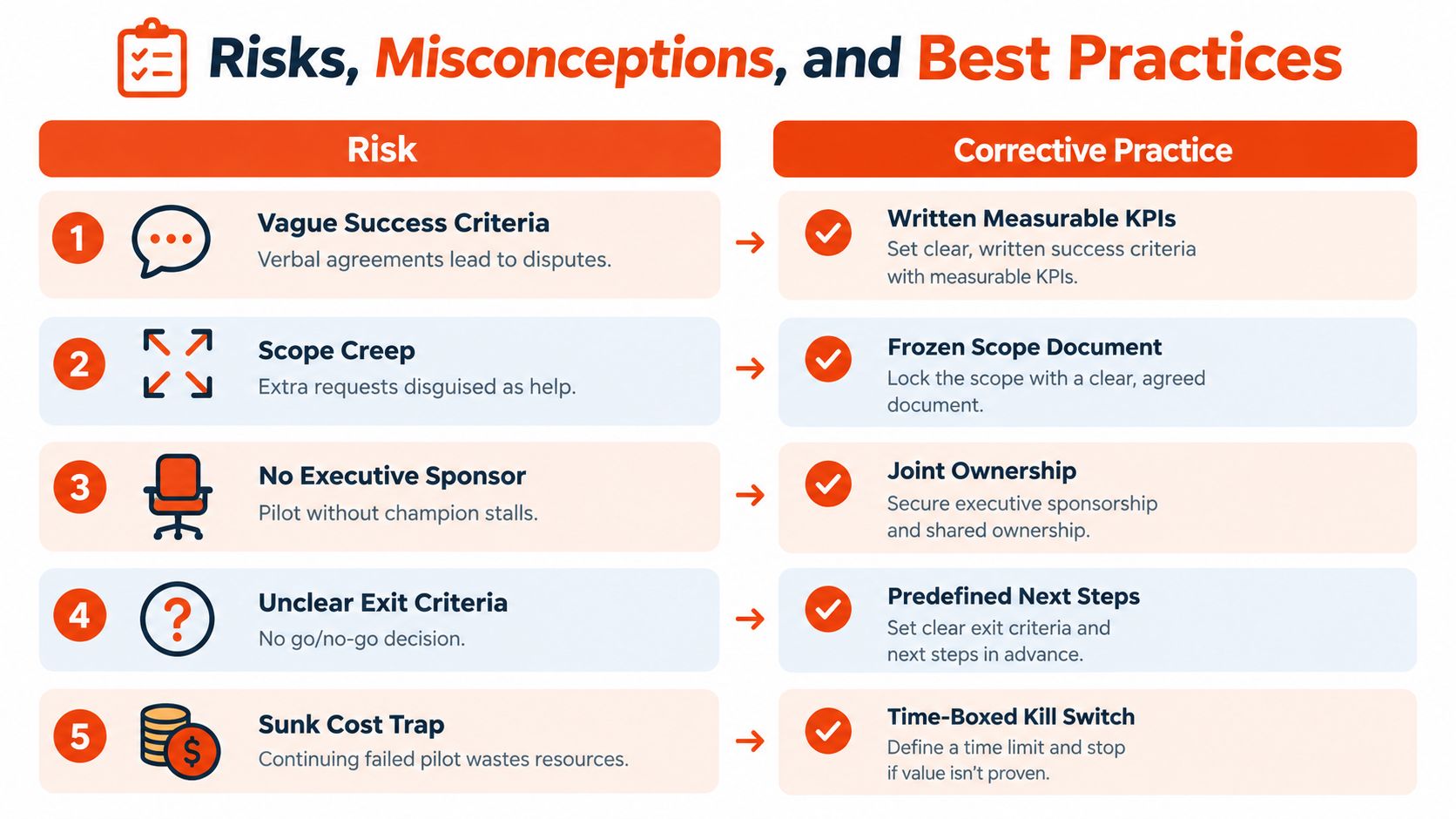
Misconceptions that waste budget
- A longer pilot proves seriousness: Length can hide indecision. Use a time-boxed evaluation with a decision date instead.
- Technical success guarantees conversion: A working integration doesn't prove economic value. Connect technical activity to a business outcome.
- Free delivery reduces friction: Free work can reduce buyer commitment and leave the seller carrying all the risk. Use mutual investment or a paid evaluation where appropriate.
- A champion is enough: A champion can organize the test, but an executive sponsor must help secure budget and resolve cross-functional objections.
- Pilot output equals buying signal: A report is evidence. A buying signal is a commercial action, such as an executive review, expansion request, procurement step, or agreed roadmap.
A practical pre-kickoff checklist should confirm:
- Written success criteria: KPIs, baselines, thresholds, and measurement owners are documented.
- Frozen scope: The use case, users, data, integrations, and exclusions are explicit.
- Dual sponsorship: A day-to-day champion and an economic buyer are identified.
- Mutual investment: Time, access, fees, and responsibilities are clear on both sides.
- Weekly governance: The team has a recurring review and a named decision-maker.
- Defined exit: The next commercial step or kill decision is agreed before work begins.
A pilot without an exit is not cautious. It's an unmanaged commitment.
Turning a Prueba de Valor Into Pipeline You Can Measure
The commercial output of a prueba de valor isn't necessarily a signed contract during the evaluation. The more useful standard is a qualified commercial event that can be tracked and attributed. That might be an executive review, an expansion into another business unit, a reference commitment, or a funded roadmap.
Connect pilot telemetry to CRM stages so the account team can distinguish three outcomes. Pipeline created emerged because the pilot generated a new opportunity. Pipeline accelerated moved faster because the evidence removed an objection. Pipeline unblocked became possible because a reference, executive sponsor, or documented result resolved internal hesitation.
| Pilot Signal | Pipeline Outcome | Forecast Stage |
|---|---|---|
| Agreed workflow reaches the success threshold | Commercial proposal accepted for review | Qualified opportunity |
| Executive sponsor attends the final review | Budget and procurement discussion begins | Decision stage |
| Buyer requests another business unit or use case | Expansion opportunity created | Expansion forecast |
| Customer agrees to act as a reference | Reference-led opportunities become possible | Influenced pipeline |
| Results remain below threshold | Opportunity is redesigned or closed | Disqualified or reworked |
The conditions are straightforward, though they aren't easy to execute. The buyer and seller need shared metrics, active executive engagement, clear renewal economics, and a defined handoff to the account team. The account team should know what changed, which evidence matters, who approved it, and what objection remains.
For AI and software teams, the operational handoff deserves particular attention. Guidance on taking AI pilots to production is useful because a successful evaluation still needs ownership, deployment planning, and commercial continuity after the test ends.
Forecasting should begin with observed signals, not optimism. Record the baseline account stage, the commercial event produced, the decision-maker involved, the next dated action, and the economic assumption behind expansion or renewal. Teams that need to connect engagement evidence with account prioritization can also review lead scoring in HubSpot, provided the scoring model reflects real buying intent rather than surface-level activity.
A prueba de valor moves deals forward when the evidence is designed for the next decision. If the final meeting only proves that users touched the product, the seller has measured adoption. If it proves that a defined workflow changed and created a qualified commercial event, the seller has measured value.
Ploot helps B2B teams turn partner and executive LinkedIn audiences into measurable sales opportunities by identifying buying intent and booking qualified meetings from trusted profiles. Visit Ploot to explore a structured pilot with agreed success criteria and a direct connection between audience engagement and pipeline.