

Marketing has flagged an interested prospect. Sales hasn't contacted them because the record contains a name and a score, but no explanation of what happened. Meanwhile, someone else on the team is preparing a message to the same person.
That's a marketing to sales handoff problem, not necessarily a lead-quality problem. The fix starts by treating the handoff as a shared qualification period, with clear responsibility while interest develops, rather than a single moment when marketing passes a record to sales.
Table of Contents
- What a Marketing-to-Sales Handoff Is and Why It Breaks
- The Six Stages From Buying Signal to Meeting
- A Lead Moving Through the Handoff Day by Day
- Response-Time Targets Based on Buying Intent
- Qualification Rules Between Nurture and Outreach
- Rejection Reasons and Feedback Loops That Fix Leaks
- Set Your First Handoff Agreement This Quarter
What a Marketing-to-Sales Handoff Is and Why It Breaks
A marketing-to-sales handoff is the point where a lead moves from marketing-led engagement to sales-led follow-up under rules both teams have agreed. Think of a relay race: passing the baton only works when both runners know when to take it and who runs next.
The unit being passed should be a sales opportunity: a real person within the ideal customer profile who has shown buying intent through content interaction, a profile visit or another relevant signal, and who reaches the salesperson with context. The ideal customer profile, or ICP, describes the companies you're equipped to serve. An opportunity to investigate isn't yet a confirmed deal.
In a 2021 survey of 1,732 sales, marketing and operations professionals, 60% said their teams were aligned to deliver growth, compared with 52% in the previous measurement, leaving 40% without alignment, according to LeanData's State of B2B Lead Management report.
Agreement needs operating rules
A productive relationship between department heads isn't enough. Teams need:
- Shared definitions that distinguish interest from readiness.
- Ownership rules that name the person responsible.
- Routing instructions that send records to the right seller.
- Follow-up expectations that define an appropriate response.
- Feedback loops that turn outcomes into process changes.
Without these mechanisms, marketing can optimize for reach or lead volume while sales evaluates quality and revenue potential. Both teams can meet their own targets while leaving prospects unattended.
Quick check: Pick an interested prospect in your CRM. Can you name their owner, and can that seller explain why the record reached them?
This matters especially in long, high-ticket B2B sales cycles. Someone may investigate a problem well before they're ready to discuss a project. Your process needs to preserve that interest without ignoring the prospect, duplicating outreach or forcing a premature sales conversation.
The Six Stages From Buying Signal to Meeting
A buying signal is easy to misread. A prospect opens a case study, visits a profile or matches a signal, and the team immediately asks whether sales should call. The better question is where that person sits in a shared qualification period. Interest may be real while the person is still figuring out the problem, the internal stakeholders and the timing. This six-stage flow turns that gray area into visible ownership.
This flow shows the progression and the return path to nurture.
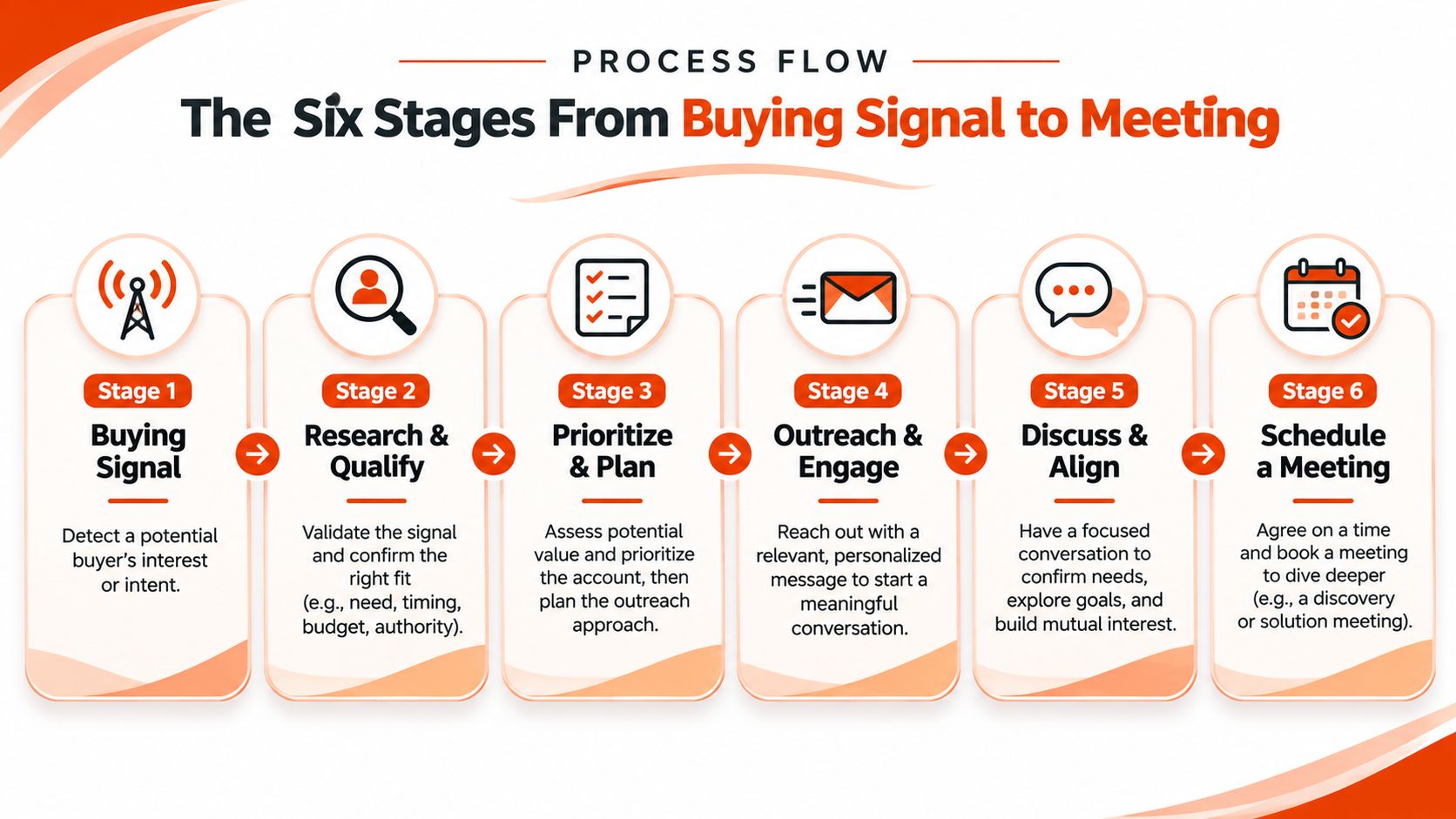
| Stage | Trigger | Exit criterion |
|---|---|---|
| 1. Signal detected | Content engagement, profile visit or matching signal | Signal logged with timestamp and source |
| 2. Fit check | Signal from a person inside the ideal customer profile | ICP fit and buying signal confirmed, or prospect returned to campaigns |
| 3. Owner assigned | Confirmed fit and an active signal | One named seller accepts the record with context |
| 4. First human contact | Accepted prospect with signal context | Reply, qualified meeting or documented “not now” |
| 5. Qualification | Live conversation | Need, role, project context and timing recorded |
| 6. Meeting or nurture | Qualification outcome | Qualified meeting booked, or prospect returned to campaigns with a clear reason |
Treat the table like a relay race. Each stage has a baton, and the baton is context. Marketing operations captures observable behavior without claiming that every interaction proves purchase intent. The fit reviewer checks whether the person belongs inside the ideal customer profile and whether the signal points to real interest. A seller then accepts the record only when there is enough context to start a relevant conversation.
Acceptance isn't the same as assignment. An automated notification proves that a system routed the record, not that a seller reviewed it. Require an acceptance timestamp and a named owner.
Pass the context with the record
Before the seller reaches out, attach the signal source, timestamp, content viewed, company details, contact role and any previous interaction with the proposed owner. Include the first question the seller should resolve, such as whether the prospect is exploring a live project or researching a problem for later.
That context changes the tone of outreach. A message sent from a team member's own profile can refer to what the person looked at, instead of opening with a generic pitch. Ploot uses this approach: messages are sent from team profiles through LinkedIn or email with the team member's approval, and buying signals guide the personalized message.
Give the first-contact stage an intermediate status such as awaiting reply, plus a next-action date. Otherwise, a record can sit open while each team assumes the other is handling it. When the answer is “not now,” the record goes back into campaigns, preserving the relationship without forcing a premature meeting.
This video offers another way to visualize the handoff.
Map each stage to a field in Salesforce, HubSpot or a shared spreadsheet, then flag stages without an owner. Pay particular attention to fit checking and live qualification. Both stages need a decision, because both can stop a promising record from moving forward.
Returning a prospect to nurture after qualification is a useful outcome when the need is real but the timing is not. Qualified prospects move on to qualified meetings, while “not now” replies re-enter campaigns. If the conversation later reaches proposals, the CRM-integrated document signing explained guide is a useful resource for keeping document activity attached to the customer record.
A Lead Moving Through the Handoff Day by Day
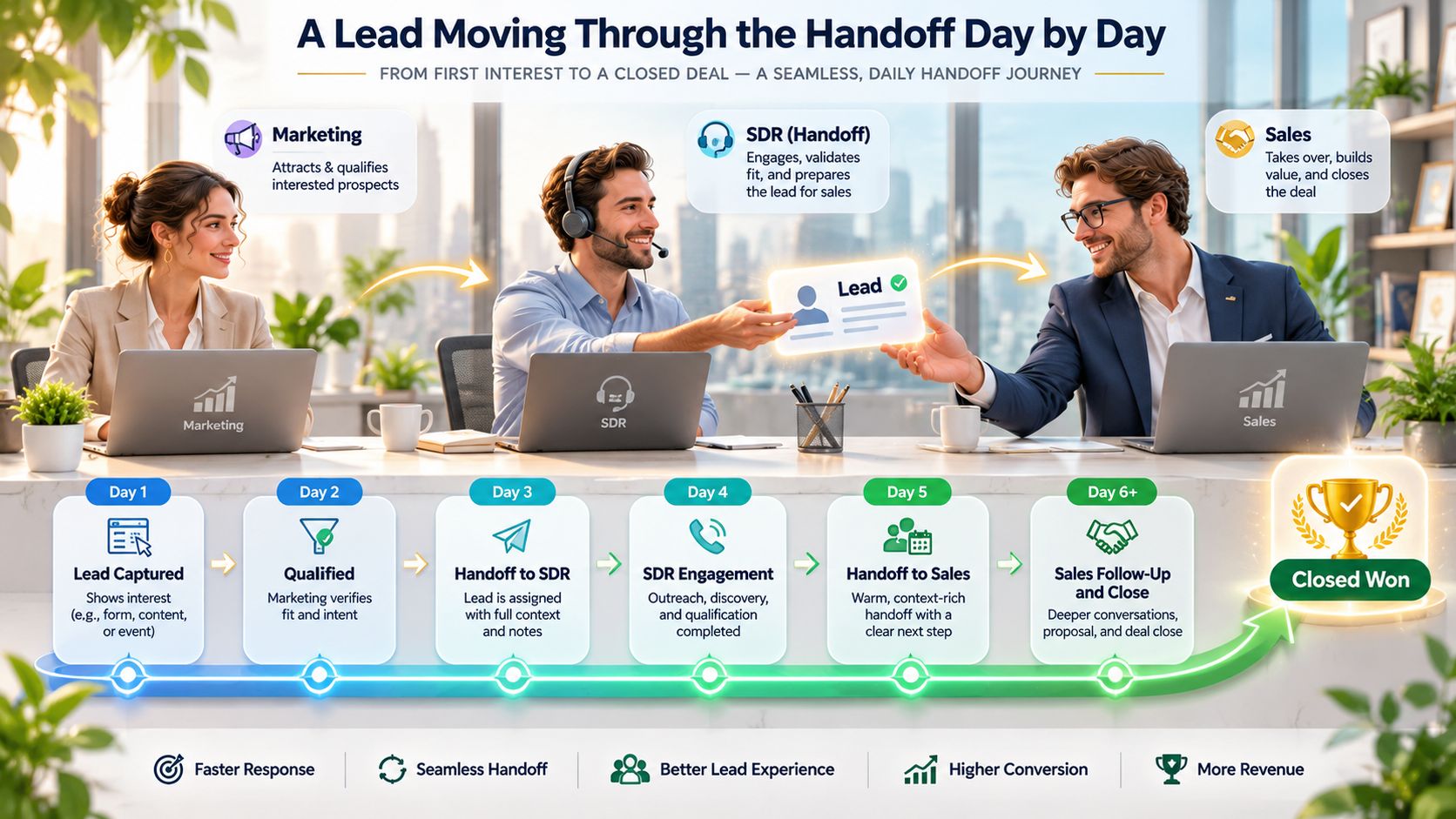
Consider this hypothetical example. A marketing director at an IT consultancy was monitoring engagement from target accounts, including a regional sales director who already knew one of the consultancy's partners.
The timeline below illustrates how the record moved without turning every interaction into an outreach trigger.
The main path
Monday morning. The director opened a case study through an identifiable campaign interaction. Marketing recorded the timestamp, campaign source and case-study topic, but didn't request a sales message.
The company matched the consultancy's target profile. The contact's regional remit suggested relevant influence, although nobody had verified purchasing authority.
Wednesday afternoon. The director returned to the case study. Marketing added the new timestamp and moved the account into a monitored state, with the marketing director responsible for reviewing further activity.
Thursday morning. The director commented on the partner's post about the same operational problem. The comment added useful context: the director was considering how the issue affected regional teams.
The partner became the outreach owner because an existing relationship made them the most credible person to start a conversation. Marketing prepared the context, and the partner approved and sent a personal message from their own profile that working day.
The message referred to the case-study topic and asked whether the regional issue was under active review. It didn't announce that someone had been tracking the director's reading activity.
Alternative outcomes
- Not now. The director replied that the subject mattered, but another initiative took priority; marketing recorded the reason, returned the contact to relevant campaigns and set a future review date.
- Outside the target profile. Had the fit check shown that the company couldn't use the consultancy's service, marketing would have closed the signal with a reason rather than asking the partner to contact them.
An observable action gave the team something to investigate. It didn't give them permission to assume a buying decision.
The handoff ran on evidence, an appropriate relationship holder and a relevant opening question, not a score alone. Write your own version using actual dates from a recent prospect's record, including the moment responsibility changed and what the next owner received.
Response-Time Targets Based on Buying Intent
In 2025, the average B2B lead response time was 47 hours, and only 23% of companies responded within five minutes, according to Optifai's study of 939 B2B companies. Those figures make response timing an operational concern, not just a seller productivity preference.
An analysis of 1.25 million leads across 29 B2B and B2C companies found that organizations attempting contact within an hour were nearly seven times more likely to qualify a lead than those waiting even an additional hour, as summarized by Venture Harbour.
Match the response to the request
A service-level agreement, or SLA, records what each team commits to doing and when. Start its clock when the qualifying signal is detected, not when somebody eventually opens a dashboard.
The following are proposed pilot targets, not universal benchmarks. Test them against your staffing, operating hours and observed buyer behavior.
| Intent tier | Example signal | Response target | Action |
|---|---|---|---|
| High intent | Pricing page visit or direct reply | Within 1 hour | Human call or personal message from the owner |
| Medium intent | Repeated engagement across several people at one company | Same business day | Owner reviews context and sends a personalised message |
| Early interest | Single post like or profile view | Within 1 week | Automated nurture, with human outreach once signals grow |
A pricing visit needs interpretation. A known prospect reviewing pricing during an active evaluation deserves different treatment from an unidentified visitor who briefly lands on the page. A direct reply requesting a conversation is clearer still.
For medium intent, check whether colleagues are exploring related subjects before contacting them separately. Use the purchase intent scale to help distinguish tentative interest from behavior that justifies a personal approach.
Early interest belongs in relevant, permitted nurturing. Don't enroll someone in email campaigns merely because they viewed a profile.
Measure human action separately
Track time to automated acknowledgment separately from time to first human action. A confirmation email doesn't prove a seller read the request.
Specify whether targets use elapsed time or business hours, and define out-of-hours coverage. If an owner misses the agreed deadline, escalate the record to the sales manager or designated backup.
The qualification benchmark concerns inbound leads across B2B and B2C companies, not LinkedIn audience engagement specifically. Use it as directional support for prompt action, not a promised conversion multiplier or an automatic contractual target.
Qualification Rules Between Nurture and Outreach
42% of respondents reported poor alignment on lead qualification, while only 32% said their teams were very aligned in executing go-to-market strategy, according to LeanData's B2B State of MarTech and Revenue Operations report. The same report describes a 2026 survey in which marketing reported a 31% average MQL-to-SQL rate, compared with an 8% acceptance rate reported by sales, a 23-percentage-point gap.
Those measures shouldn't be treated as interchangeable. A marketing-qualified lead, or MQL, has met marketing's criteria for further attention; a sales-qualified lead, or SQL, has met agreed criteria for a sales conversation. Sales acceptance is a separate decision to take responsibility for working a record.
Define readiness in observable terms
RichAPI's explanation of how SQLs differ from MQLs can help teams resolve terminology. Then turn the labels into evidence requirements specific to your service.
Move a prospect toward human outreach when the record supports these conditions:
- Verified fit. The company has a problem your business can credibly address.
- Buying influence. The contact has a relevant role or a credible route to someone who does.
- Meaningful behavior. A strong signal or related interactions support more than casual curiosity.
- Timing evidence. A project, business change, question or explicit request makes contact relevant now.
- A concrete next step. The seller can propose something more useful than a generic introductory call.
An engaged researcher may lack budget authority but still become an internal advocate. Conversely, a senior title doesn't prove an active need. Your sales-qualified lead definition should distinguish the right person from the right moment.
Give incomplete interest an owner
Create a monitored qualification status between general nurture and immediate outreach. Marketing maintains the engagement record; the designated account owner contributes relationship knowledge and decides whether a personal approach is appropriate.
Write down who owns that status, when it must be reviewed and what new evidence allows it to advance. Set the review date around the prospect's circumstances rather than leaving the record active indefinitely.
Anonymous research, distant timing or an unclear stakeholder map can justify continued nurturing. Missing purchasing authority alone shouldn't automatically disqualify a useful contact.
Decision rule: Keep the record monitored when you can explain the interest but can't yet explain why a sales conversation would help the prospect.
Judge this process by pipeline created, meaning credible potential deals that meet your opportunity criteria. Increasing the MQL count without improving subsequent conversations isn't evidence of a better handoff.
Rejection Reasons and Feedback Loops That Fix Leaks
In 2025, 28% of go-to-market professionals said marketing-sales misalignment caused delayed or inconsistent lead follow-up, according to an Unbounce and Ascend2 survey cited in Vandfort's sales handoff process guide.
Require a structured reason whenever a seller declines a record or ends a qualification attempt. Keep pre-contact rejection separate from post-conversation disqualification, even if both use the same reason categories.
| Rejection reason | What it signals | Fix |
|---|---|---|
| Wrong role | Signal came from someone without buying influence | Tighten the role check in the fit stage |
| No current need | Interest is real but timing is not | Return to nurture with a review date |
| Duplicate owner | Two sellers contacting the same company | Name one committee-level owner before contact |
| Stale signal | Contact made after the signal window closed | Shorten the SLA for high-intent tiers |
| No response after attempts | Sales follow-up may have stopped too early | Escalate to the sales manager after the agreed attempts |
Diagnose before changing the rules
No response doesn't prove poor follow-up. Check the activity log before deciding whether the seller stopped early, the contact details were wrong or the prospect wasn't interested.
Likewise, don't label an unworked record as a weak signal. Separate signal quality, routing delay and follow-up execution so each problem reaches the person able to fix it.
As a practical operating cadence, schedule a short weekly review of rejected and stalled records. Have marketing operations, a sales representative and the revenue operations owner inspect examples, agree changes and assign responsibility.
A monthly source-level review should compare acceptance rate with time to first human action. For interpreting what prospects said, you can browse the sales call intelligence guide from VoxNote and use conversation summaries alongside CRM fields.
Look for corrected behavior
Watch for an unowned record, competing sellers contacting the same account and a prospect left waiting in a queue. These are different failures and need different fixes.
The strongest test isn't whether sellers select more specific reasons. It's whether the team changes its behavior: previously rejected records don't return unchanged, ownership conflicts stop recurring, and each process change has an accountable owner.
Set Your First Handoff Agreement This Quarter
Keep the agreement to a page, with a linked field dictionary if your CRM needs more detail. The working document should be short enough for a seller to use while reviewing a record, not just during a leadership meeting.
Treat the following as a pilot checklist. Each commitment needs evidence in the CRM or spreadsheet so the review can distinguish a missed rule from a rule that needs changing.
- Define qualification by writing the lead definition and accepted signals, then record the evidence in
Qualification basisandSignal type. - Assign responsibility for each stage, including acceptance, using
Stage owner,Accepted byandAcceptance timestamp. - Set response commitments by intent tier and name the escalation recipient, with
Response due atandEscalation owneras evidence. - Agree rejection categories and require sellers to complete
Decision type,Rejection reasonand a supporting note. - Define the return path through nurture eligibility rules, recorded in
Nurture track,Review ownerandReview date. - Choose your measures of time to first human action, acceptance rate and meetings from accepted leads, supported by activity timestamps and recorded outcomes.
- Review the pilot after an agreed initial period using those fields, and document every rule change with an owner and effective date.
Make the pilot testable
Set success criteria before launching: consistent use of required fields, reliable ownership, compliance with response commitments and useful qualification outcomes. Give the pilot enough time to observe buying signals and subsequent conversations without promising immediate revenue.
Use the B2B marketing and sales alignment guide to connect the operating agreement with leadership responsibilities. A workflow can't resolve conflicting incentives if marketing is rewarded only for volume and sales only for near-term deals.
At Ploot, our process develops the team as a reference voice, filters prospects by ICP fit and buying signals, sends approved messages from team members' profiles and moves qualified prospects into conversations. We don't do mass prospecting: we contact low volumes of people who've already interacted with the client, its company or its sector.
Before launch, ask each owner to find their responsibilities on the page and show where they'll record completion. If the agreement fits on a page and everyone can identify their own decisions, it's ready to run.
Ploot turns your team's expertise and LinkedIn audience into buying signals, contextual outreach and qualified sales meetings. Visit Ploot to book a call and discuss how interested prospects could move into your sales process with the context your sellers need.