

Most demand teams still treat one “likely to buy” answer, or a burst of content clicks, as proof a prospect is ready. That advice is popular because a CRM can store it in a single field. It also packs the pipeline with people who have a problem in mind and no path to a purchase.
A purchase intent scale only earns its place when it ranks how close someone is to a buying conversation, then sends each rank to a different follow-up. One label can't do that job. Someone can study a category for months, already prefer another firm, and still have no budget owner.
Score three separate dimensions, combine them with explicit rules, and tie each level to one action you can test against meetings and revenue.
Table of Contents
- Purchase Intent Scale Levels at a Glance
- Signals That Reveal Real Buying Intent
- How to Score a Prospect Across Three Dimensions
- Why Stated Intent Overstates Buying Readiness
- Routing Intent Levels to the Right Follow-Up
- Set Up Your Scale Before the Next Campaign
Purchase Intent Scale Levels at a Glance
| Level | Score | What the prospect shows | Evidence threshold |
|---|---|---|---|
| Unaware | 1 | Engages with general category content only | No problem or timing signal |
| Curious | 2 | Reads or shares topic content from partners | Interest in the problem, no timeline |
| Considering | 3 | Visits solution pages or follows a senior peer | Named problem, no budget or timing |
| Evaluating | 4 | Asks a direct question or requests a call | Defined evaluation window |
| Ready | 5 | Confirms budget, sponsor or an approved project | Budget or sponsor confirmed and timing set |
A purchase intent scale is a ranked estimate of how close a prospect is to buying, usually on five levels from 1 (unaware) to 5 (ready to buy). Each row names the behaviour you must see and the evidence bar that has to be cleared before anyone moves the score up. Reading a category post is not the same signal as asking for a call. Confirming a sponsor is not the same signal as visiting a services page twice.
Treat the levels as an operational shorthand, not a forecast of closed revenue. A level 4 prospect with a named evaluation window should outrank a level 5 sticker that came from one click on a profile. The number tells the team who to work first. It does not tell finance what the quarter will book.
Use the table as the shared language for finding signals, scoring them, and choosing the follow-up. If two people can't point to the same row for the same account, the scale isn't ready for a campaign.
Signals That Reveal Real Buying Intent
No single signal proves a prospect will buy. Signals fall into four families with unequal weight: read what the person did first, check whether the account fits second, and ask whether trust is already in the room third.
Explicit signals are the strongest evidence. A direct question, a request for a proposal, a meeting request, or a visit to a pricing or capability page shows the person is past casual reading. Behavioural signals are weaker alone: repeated engagement with partner content over several weeks, a comment from a senior person, a return visit inside a short window, or sustained time on a high-intent page. Firmographic signals only establish that the account could buy: company size, sector fit with the ideal customer profile, the person's seniority, and whether the account is already on the target list. Trust signals sit on top. In relationship-led Spanish consulting and technology markets, a peer introduction or named referral often outweighs anonymous research.
Each family answers a different question. Behavioural and explicit activity speaks to interest and timing, trust speaks to preference, and firmographics only establish eligibility. A score built from one family alone is guessing.
Take a marketing director at a 120-person consulting firm in Madrid who comments on a partner's post about a recurring delivery problem, opens the services page twice in one week, then asks a colleague for an introduction. The comment is behavioural. The page visits add weight. The introduction is a trust signal that also marks preference. Firmographics say the firm fits the profile. None of the four, alone, proves the director will buy.
For longer technology programmes where timing and sponsorship outweigh raw interest, Continuum Solutions' note on 2026 IT strategy for enterprise leaders is a practical companion. Pair it with a working list of buying signals worth logging and tag each signal by family, so the record shows what kind of evidence arrived.
That tagging is what turns signals into a usable handoff. A sales opportunity is a real person within the ideal customer profile who has shown buying intent by interacting with content, visiting a profile or matching a signal, and reaches the salesperson with context. If the handoff arrives without that context, the signal work was wasted.
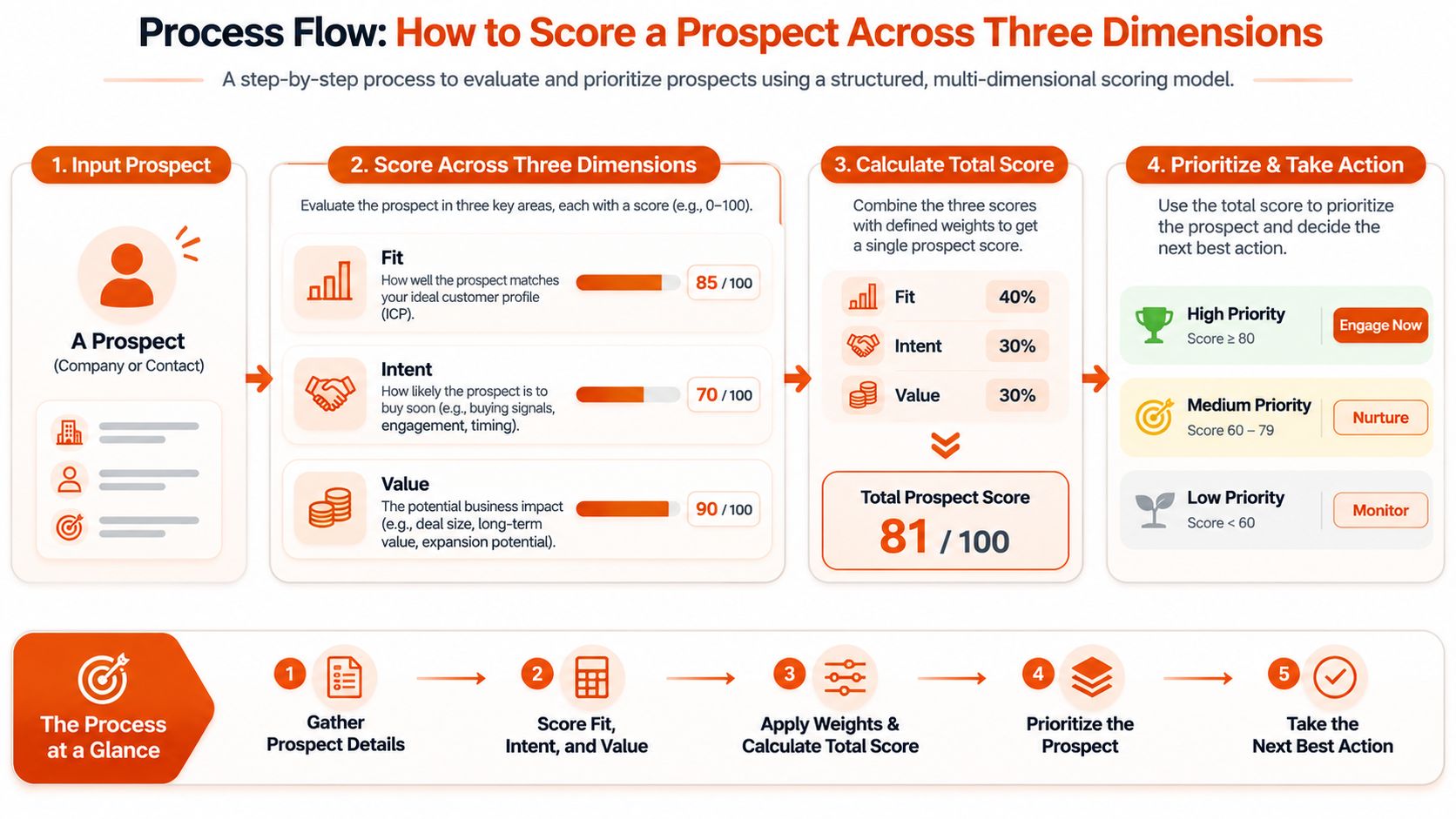
How to Score a Prospect Across Three Dimensions
Interest, preference, and readiness are different facts. Forrester reported that 68% of B2B buyers begin a purchase process with a preferred vendor already in mind, and that this preferred vendor wins 55% of the time. A high generic intent score doesn't tell you whom to contact.
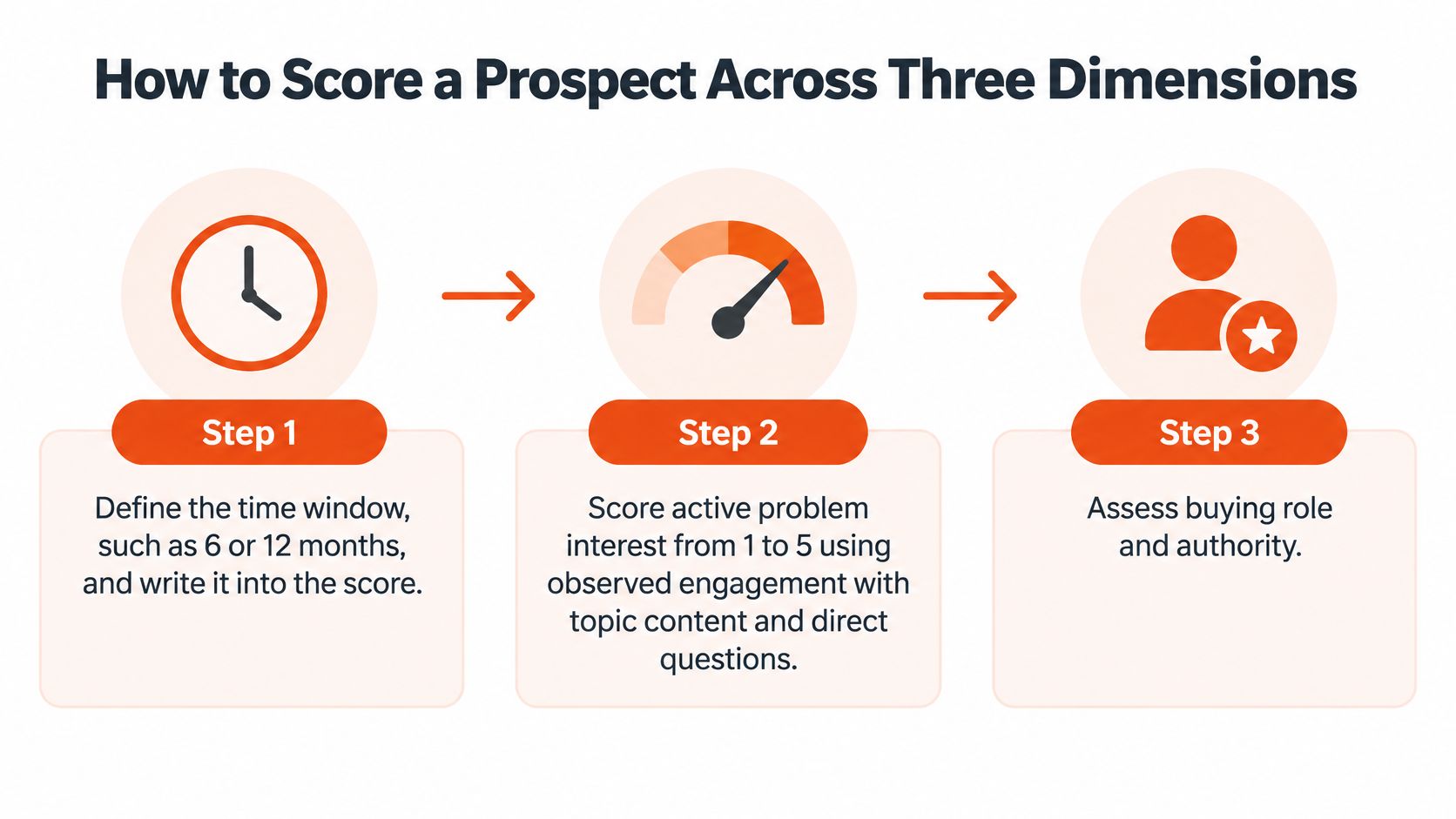
- Write the time window into the score. Use 6 or 12 months and put that horizon on the record. Without it, “interested” can mean this quarter or next year. The usual slip is leaving the window blank and treating every recent click as current.
- Score active problem interest from 1 to 5. Use observed engagement with topic content and direct questions, not likes on unrelated posts. Reason: category curiosity is the floor, not the ceiling. The slip is calling heavy reading a buying decision.
- Score vendor preference separately. Does the prospect name your firm, ask a peer about you, or request your expertise by name? Preference is its own dimension because many buyers already have a favourite before they talk to you.
- Score operational readiness. Look for an identified budget owner, access to the decision maker, defined timing, and an approved project. Scoring interest and treating it as readiness is the mistake that creates false pipeline.
- Combine the three with hard caps. Set level 5 only when all three dimensions score 4 or higher and a budget owner or sponsor is confirmed. Set level 4 when problem interest and vendor preference both score 3 or higher and an evaluation window is defined. Set level 3 when problem interest scores 3 or higher. Otherwise set level 2 for interest without a timeline. Any dimension at 1 caps the total at level 2.
- Review a false-positive sample every month. Pull prospects at level 4 or 5 who never booked a meeting. If that pile is large, the thresholds are too soft, or the outreach ignored preference.
Practical rule: The highest-value pattern is a prospect who is actively evaluating a problem and is receptive to a particular expert or firm, not the person with the biggest generic score.
A healthy scale has most prospects at levels 1 and 2, a small group at 4 and 5, and meetings that follow that top group. Test whether the levels predict meetings, qualified opportunities, and revenue. Clicks and survey replies are not the test.
If you already score leads in HubSpot, map these three dimensions onto properties before you automate anything. A practical walkthrough of property design sits in this lead scoring in HubSpot guide. For the message that follows a high score, browse AI outbound email strategies that keep volume low and relevance high, so a level 4 note doesn't read like a blast.
Why Stated Intent Overstates Buying Readiness
Asking "will you buy?" often gets a shrug. Asking for a probability gives you a number you can plan around, the way a forecast of rain is more useful than "it might be wet."
Thomas F. Juster's 1966 article, "Consumer Buying Intentions and Purchase Probability: An Experiment in Survey Design," in the Journal of the American Statistical Association (volume 61, September 1966, pages 658–696), moved measurement from a vague intention to an estimated chance. The Juster scale uses 11 points, from 0 to 10, each a stated probability of purchase inside a defined period. Someone who answers 7 or 8 has said something stronger than "I'm interested." It remains a self-report. For B2B demand generation the lesson is narrow: anchor intent to a time horizon and an explicit likelihood, and don't treat engagement as a purchase commitment.
What the validation actually shows
Probability scales beat simpler intention questions, and they still miss plenty of purchases. One study summarised in the academic validation literature found the 11-point Juster score significantly related to actual adoption at four weeks (p = 0.009) and at 12 months (p = 0.014), while the simpler purchase-intention measure was not statistically significant (p = 0.117).
That result cuts both ways. A stated probability is the better question, yet statistical significance still leaves a wide gap between a number and a signature. Inside a three-dimension score, stated intent feeds only one of them. It says nothing about vendor preference or who owns the budget, which is exactly why a high probability answer on its own should never set the top level.
Why a high score can flatter you
Asking the question can change the answer's relationship to later behaviour. Across three large field studies, the correlation between stated intentions and later purchase was 58% greater among surveyed consumers than among comparable people who were not surveyed, according to research on self-generated validity in survey research. The act of measuring intent inflates it. In a long B2B cycle that effect is a warning: several stakeholders sit between a polite "yes" and a signature, and an expressed signal can sit months ahead of any purchase. The score doesn't prove budget, authority, or a live business problem.
The score tells you who to talk to first. It doesn't tell you what they will buy.
The test is against outcomes, not other scores. Track whether the prospects who gave high probabilities booked meetings, created opportunities, and closed, and track the misses in both directions: high scorers who never met, and low scorers who became pipeline anyway. Keep the numeric scale. Collapsing it back into "hot" and "cold" throws away the resolution that made it useful.
Routing Intent Levels to the Right Follow-Up
Higher intent earns faster, more senior, and more personal contact. Lower intent gets useful content and patience. The point of the scale is the route, not the badge.
| Intent level | Follow-up action | Channel | Review window |
|---|---|---|---|
| 5 Ready | Book a qualified meeting this week | Direct message from a senior team member | Daily |
| 4 Evaluating | Share a relevant case and propose a call | Direct message plus email | Every two days |
| 3 Considering | Send a tailored insight or invite to a session | Content and direct message | Weekly |
| 2 Curious | Keep in nurture with topic content | Partner and team content | Monthly |
| 1 Unaware | No direct outreach | Content only | Quarterly |
Qualified prospects move on to qualified meetings, and those who reply “not now” go back into campaigns rather than being dropped. ContentBuck's guide on qualifying B2B leads is a useful check on what “qualified” should mean before a meeting is booked. Match that definition to your own sales qualified lead standard so marketing and sales aren't using two clocks.
- Never message level 1 directly. There is no problem or timing signal, so outreach reads as noise.
- Don't send the same note at levels 3 and 4. Level 3 gets an insight or an invitation. Level 4 gets a case and a proposed call.
- Reassign the moment the level changes. Yesterday's nurture owner shouldn't still hold a prospect who just confirmed a sponsor.
- Review movement between levels every week. That review is a pipeline health check, not a content report.
Set review windows to the sales cycle. A long consulting pursuit can live with a slower cadence than a short software trial, but level 5 still needs a same-week meeting attempt. Contact too early and you spend trust the account hasn't offered. Contact too late and the evaluation window the prospect opened has already closed on someone else.
Set Up Your Scale Before the Next Campaign
- Write the time window and the five level definitions in one shared document, and name the owner who approves changes. If nobody owns the definitions, every rep will invent a private scale by Friday.
- Pick three signals per dimension that the CRM can capture, such as a meeting request, repeat engagement from the same account, and a named evaluation window. Drop any signal nobody can record the same way twice.
- Score last quarter's prospects and compare each level with the meetings and opportunities that followed. Run a short pilot with an agreed success line, such as the share of level 4 and 5 prospects who book a meeting, before you commit campaign budget.
Log the first false positives and the first false negatives so the next version is judged on outcomes. Start with a score you can defend in a pipeline review, then tighten it against real meetings and revenue. The scale is a way to decide who gets time. It isn't a revenue forecast.
Companies and agencies that want to see the workflow on their own accounts can book a call and watch the product in action.
Ploot turns partner, director, and senior-manager audiences into a sales channel by spotting buying intent and contacting only people who have already shown interest, so the purchase intent scale becomes meetings rather than another dashboard. We focus on long, high-ticket B2B cycles in consulting and software, and we hand sales the context behind each conversation. If you want that scale running against your own audience, visit Ploot.