
Can your team prove that its outreach creates qualified pipeline, or can it only prove that someone sent a message? That gap is where many B2B marketing directors get stuck. Events, paid campaigns, and partner activity create attention, yet the revenue conversation still ends with a request for meetings, opportunities, and forecastable pipeline.
A marketing director at an IT consultancy might have strong event attendance and a busy LinkedIn presence, while sales still works through a spreadsheet of accounts with no clear buying context. A software company may run carefully written sequences, but senior buyers receive generic follow-ups that don't reflect what they've researched. In both cases, the problem isn't a shortage of activity. It's the absence of a reliable connection between buyer intent, outreach, and CRM evidence.
The sales engagement platform market reflects that pressure. One industry summary reports 22% growth from 2021 to 2022, reaching $2.5 billion, and projects $4.8 billion by 2027, with a projected 18.7% CAGR over that span (World Metrics market summary). The category has moved beyond simple cadence automation. Buyers now need to decide whether they're purchasing an activity engine or a system that helps the revenue team act on meaningful signals.
This guide gives you a practical way to make that decision. You'll get a plain-English definition, a comparison of vendor patterns including intent-based engagement such as Ploot, a CRM and data-quality test, and a selection process built around qualified meetings rather than impressive feature lists.
Table of Contents
- Why Sales Engagement Has Become a Pipeline Question
- What a Sales Engagement Platform Does
- Core Features and Use Cases Across the Buying Cycle
- Evaluation Criteria That Separate Real Value From Feature Lists
- Comparing Vendor Patterns in the Current Market
- When Intent-Based Beats Volume-Based Outreach
- Your Selection Checklist and Pilot Plan
Why Sales Engagement Has Become a Pipeline Question
A marketing director at a B2B consulting firm doesn't usually start looking for a sales engagement platform because the team wants another dashboard. The search often begins after a pipeline review where event leads are still unworked, paid campaigns are being judged on impressions, and partners are relying on personal follow-up that nobody can measure consistently.
The pressure becomes sharper when sales cycles are long. A prospect may interact with a partner's content, attend a discussion, involve several stakeholders, and then disappear from view until the buying committee is ready. If the CRM only shows a contact record and a last-touch date, marketing can't explain whether the account is warming up or just consuming content without commercial interest.
That makes the platform decision a revenue question. The right system should help the team answer who should be contacted, why now, through which channel, and what happened next. A sequence that produces visible activity but no useful context leaves marketing with the same attribution problem it had before implementation.
Pipeline rule: If the platform can't connect a buyer signal to a contact, an action, and a CRM outcome, it's an activity tool, not a pipeline solution.
For firms reducing their dependence on trade shows, the operating model matters even more. A practical pipeline generation plan needs a repeatable way to turn expertise, audience engagement, and account knowledge into conversations. That doesn't mean automating every interaction. It means giving sales and marketing a shared view of which people are showing enough interest to justify a human approach.
The strongest buying decision starts with the bottleneck, not the demo. If your problem is inconsistent follow-up across a large outbound team, a traditional sequencing platform may fit. If your problem is that partners have authority but sales contacts people before they show intent, a signal-led approach deserves priority.
What a Sales Engagement Platform Does
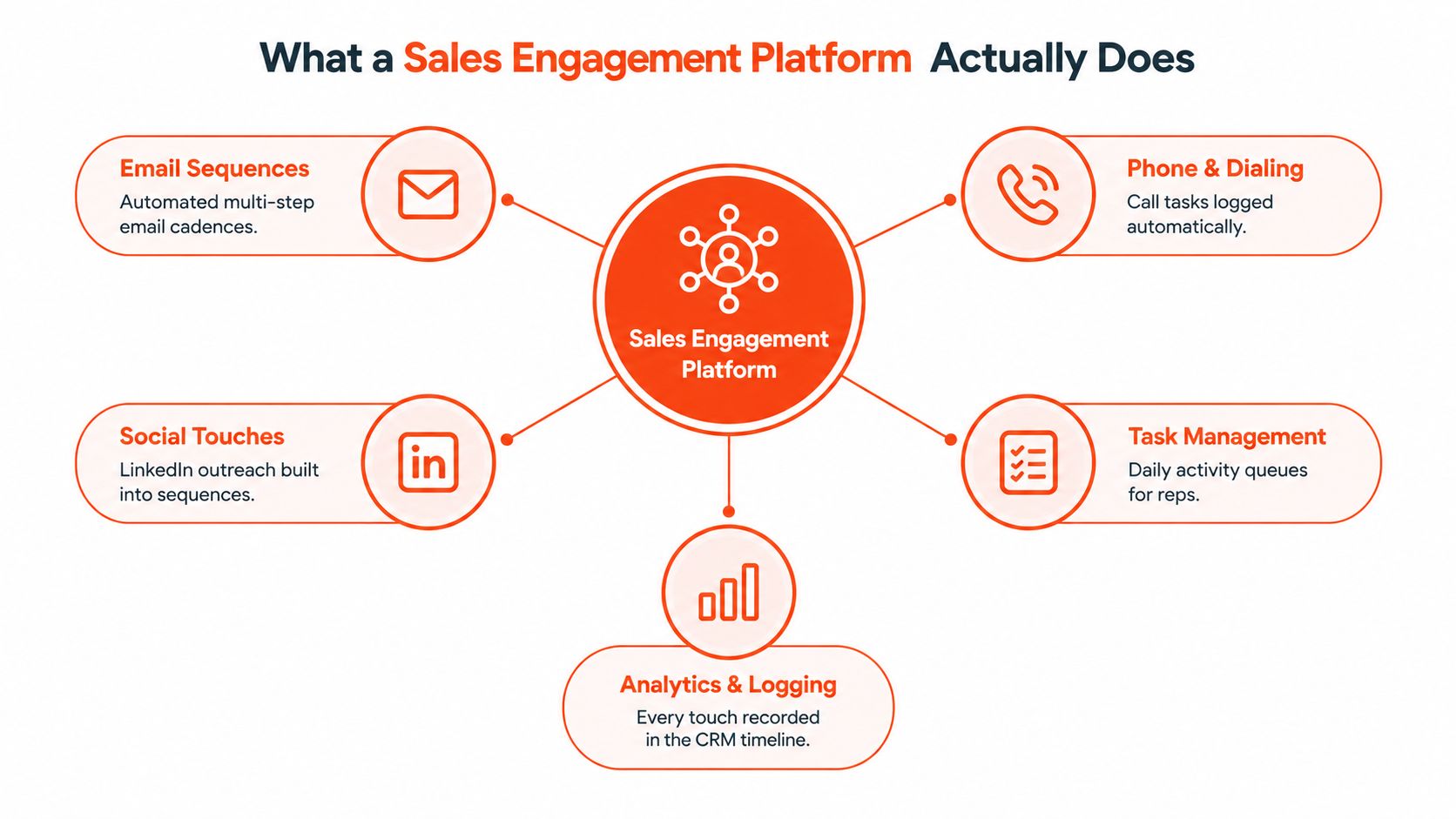
What should a sales engagement platform change in your revenue process? It should turn a defined buyer signal or sales action into coordinated follow-up, then return usable outcome data to the CRM. A sales engagement platform organizes outreach across email, phone, social channels, meetings, and tasks. It gives reps a repeatable workflow, automates routine steps, and records engagement so managers can connect activity with pipeline movement.
The category has four practical jobs:
- Plan the motion. Reps build sequences for prospecting, event follow-up, dormant-account reactivation, or deal progression.
- Execute across channels. Workflows can combine email, voice, social touches, meeting requests, and manual tasks.
- Capture interaction data. Replies, calls, meetings, and other events are attached to the relevant contact, account, or opportunity.
- Improve decisions. Reporting and AI-driven next-best-action guidance help managers prioritize follow-up and identify weak stages.
CRM versus system of action
A CRM is the system of record. It stores accounts, contacts, opportunities, stages, ownership, and commercial history. A sales engagement platform is the system of action. It helps a rep complete the next touch and send the resulting information back to the CRM.
That distinction matters. A CRM record can look complete while giving a rep no useful direction on how to engage. A sequencing tool can also produce a busy activity stream without preserving a reliable account history. Define ownership for fields, activities, consent, and status changes before connecting the systems.
The platform also differs from pure cold outreach automation. Cold outreach automation sends messages at scale. Sales engagement coordinates workflows, channels, tasks, meeting follow-up, reporting, and CRM context. A cold-email tool confirms that a message was sent. A mature engagement system should show the account's position, the rep's next action, and the commercial result. For a fuller definition, read our guide to outreach and what it covers.
How the category matured
The category grew from fragmented sales workflows. Reps once switched between a CRM, email tool, phone system, social network, calendar, and spreadsheets. Remote selling exposed the cost of that fragmentation, since teams needed consistent execution and management visibility without sharing an office.
One forecast puts the global sales engagement platform market at US$9.2 billion in 2026, growing to US$26.8 billion by 2033 (Persistence Market Research forecast). Other methodologies size the market much smaller, so use this figure as directional context rather than a precise business-case input.
Sales engagement also sits beside enablement. Teams can use guidance on how to boost deal closure with enablement to separate content and coaching gaps from outreach execution problems.
The decision is operational: choose a tactical outreach tool when volume and follow-up consistency are the bottlenecks. Choose a broader revenue-operations layer when CRM data quality, account context, and buying-intent signals must determine who gets contacted and why. Feature count matters less than whether the platform turns those inputs into meetings and measurable pipeline.
Core Features and Use Cases Across the Buying Cycle
A vendor demo usually starts with the same familiar screen, a sequence builder. Don't judge the platform there. Judge whether each capability solves a specific problem in your buying cycle and whether the resulting data remains usable after the interaction.
Orchestration for multiple stakeholders
Multichannel sequencing coordinates email, voice, SMS, meetings, social touches, and manual tasks. For an IT consultancy, that could mean a thoughtful message from a partner, a follow-up task for a business development lead, and a meeting request after an account stakeholder responds. For B2B software, it may support different messages for a technical evaluator, an executive sponsor, and procurement.
Meeting scheduling removes a common point of friction, while task management gives reps a daily queue rather than a list of forgotten contacts. Buyer interaction tracking should show the history of the account, not just isolated actions by individual reps.
Signals and next actions
Modern platforms increasingly add AI-driven guidance. The useful version doesn't merely generate another email. It helps a rep decide which account deserves attention, what changed, and which action fits the buyer's context.
Use that capability against real scenarios:
- Dormant accounts: Find the last meaningful interaction, identify the current owner, and create a relevant reactivation task.
- Event follow-up: Separate a genuine conversation from a scanned badge, then route the right follow-up to the right senior person.
- Partner-led outreach: Keep partner activity visible while allowing a business development rep to coordinate execution.
- Intent-triggered contact: Start outreach when a person or account shows a meaningful buying signal, not just because a record entered a list.
The four technical tests
The category is typically evaluated across channel coverage, CRM sync depth, reporting granularity, and admin governance, as outlined in Outreach's platform comparison guidance.
Channel coverage should match your motion. A firm that sells through partners may need LinkedIn and email coordination more than an aggressive dialer. A high-volume inside-sales team may prioritize voice workflows and queue management.
CRM sync depth determines whether engagement data lands on the correct contact, account, campaign, and opportunity. A weak integration can attach an activity to the wrong record, delay a stage update, or create duplicate contacts. The sequence may look successful inside the platform while the CRM remains incomplete.
Reporting granularity is what turns activity into diagnosis. You should be able to compare performance by segment, account owner, channel, sequence, and stage. If every response is counted together, you can't tell whether your enterprise segment needs better messaging or whether one rep is just targeting easier accounts.
Admin governance protects consistency. Managers need permissions, approval processes, naming standards, suppression rules, and an audit trail. Without governance, each rep creates a private version of the process, and marketing loses the ability to compare campaigns.
For broader campaign work, a practical guide to LinkedIn and email campaign analysis can complement the platform's own reporting. The key is to connect channel activity to account progression, not to celebrate isolated engagement metrics.
Evaluation Criteria That Separate Real Value From Feature Lists
A feature list tells you what a platform can do. An evaluation tells you whether your team can operate it, trust it, and connect it to revenue.
Start with the four technical dimensions. A platform should cover the channels your sales motion uses, not every channel a vendor can place on a slide. It should sync closely with the CRM, report at the level where decisions happen, and give administrators enough control to prevent inconsistent execution.
A reusable scorecard
| Criterion | What to Test | Warning Sign |
|---|---|---|
| Channel coverage | Run a real workflow across the channels your team uses, including manual senior-rep tasks | The platform supports channels individually but can't coordinate them in one motion |
| CRM sync depth | Create, update, reassign, and close test records, then inspect every CRM object | Scheduled syncs, duplicate records, unclear field ownership, or missing activity history |
| Reporting granularity | Filter a pilot report by segment, rep, channel, sequence, and opportunity stage | One aggregate activity total with no path to pipeline |
| Admin governance | Test permissions, approvals, suppression logic, naming standards, and audit history | Every rep can change the process without review |
| Implementation burden | Ask who configures integrations, data rules, templates, and reporting | The vendor treats setup as a quick launch while your team owns the complexity |
| Pricing model | Map cost to activated users, profiles, data, channels, and support | Pricing is opaque, quote-only, or penalizes the people who need to participate |
| Senior-user fit | Have partners, directors, or executives complete the workflow themselves | The system assumes a full-time SDR and creates more work for senior sellers |
One enterprise platform may offer strong governance and reporting but require substantial implementation. A lighter tool may be easier to launch but provide less channel depth or fewer controls. An intent-based approach may create fewer actions by design, which makes signal quality and audience construction more important than raw sequencing capacity.
Disqualifying criterion: If the vendor can't show where a real engagement event lands in your CRM and how that event appears in a pipeline report, stop the evaluation.
Your CRM integration plan deserves particular attention. The practical issues are covered in this guide to CRM integration, but the buyer-side test is straightforward. Ask the vendor to demonstrate a contact update, an account association, a rep reassignment, a sequence exit, and an opportunity-stage change using your own data model.
Don't ignore senior-user fit. Consulting firms often depend on partners and directors whose credibility drives the conversation. A workflow that demands constant queue management may work for a dedicated outbound team and fail completely when the authority holder has limited time.
Comparing Vendor Patterns in the Current Market
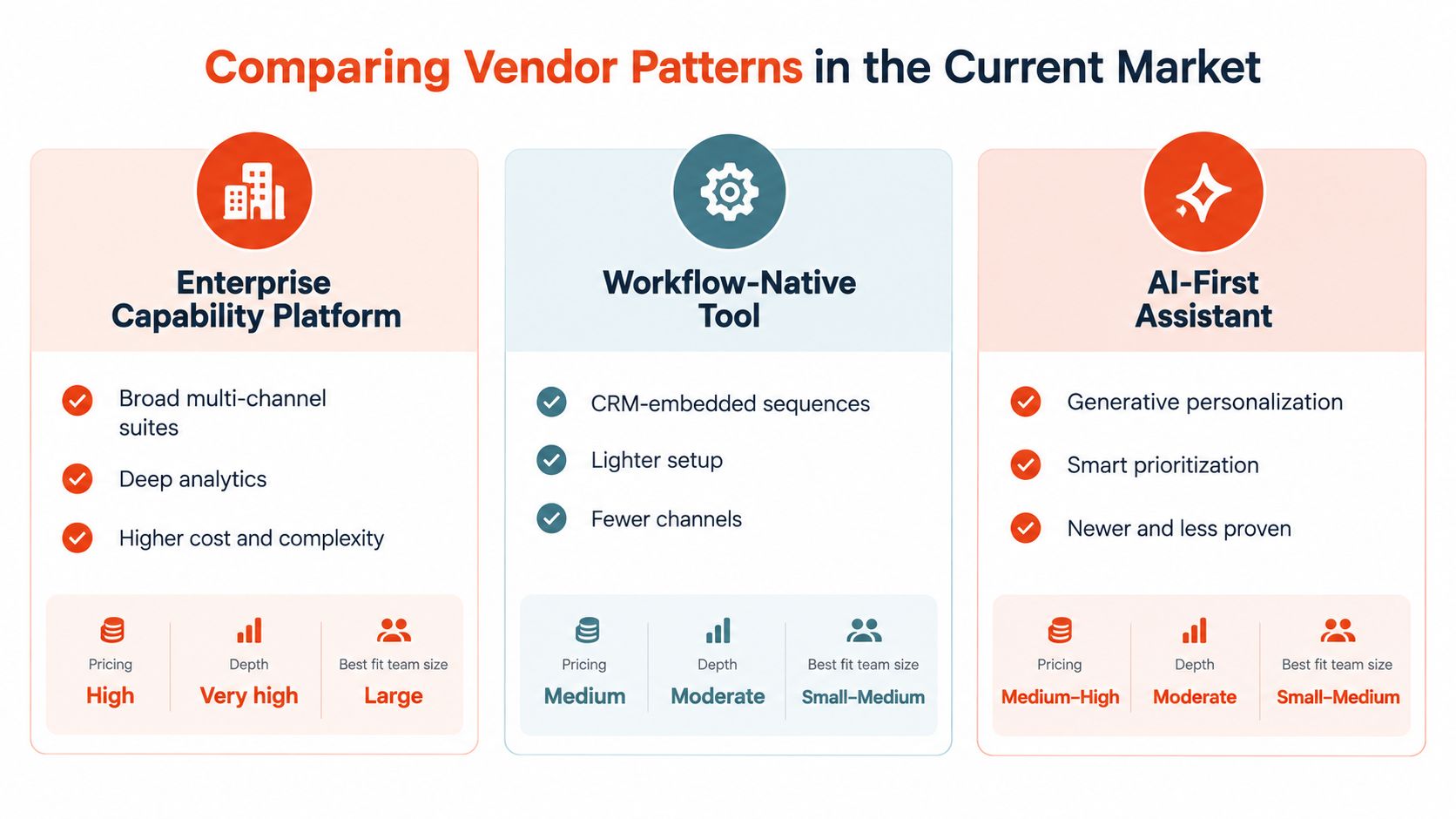
The current market is easier to understand as three vendor patterns rather than a long list of brands. The right choice depends on your sales motion, your data maturity, and whether you need more activity or better prioritization.
Enterprise capability platforms
Outreach and Salesloft represent the enterprise capability pattern. These platforms typically emphasize broad multichannel orchestration, AI assistance, detailed analytics, governance, and Salesforce-grade implementations. Comparison tables place them around quote-based pricing and substantial setup overhead for complex deployments (ROX's comparison of sales engagement tools).
This pattern fits a software company with a dedicated revenue-operations function, several sales roles, established CRM processes, and a need for standardized execution across teams. It also fits a large IT services organization where managers need to govern sequences, measure rep performance, and coordinate multiple channels.
The trade-off is clear. You buy depth, control, and operational scale, but you also accept implementation work, administration, and a longer path to adoption. If your senior sellers won't use the workflow, the platform's capability won't matter.
Lighter workflow tools
Lighter tools prioritize simpler setup and narrower channel sets. They can work well for a small B2B software team that mainly needs email sequences, task reminders, basic CRM logging, and a manageable reporting layer.
This pattern is useful when the problem is execution discipline rather than complex orchestration. A marketing-led growth team may need to standardize follow-up after content downloads or product conversations without hiring a dedicated administrator.
The limitation appears when the buying cycle involves many stakeholders, several business units, or senior relationship owners. A tool that handles simple sequences well may struggle with account-level governance, advanced permissions, or detailed pipeline analysis. Choose it because the motion is simple, not because the demo feels easy.
Intent-based engagement
The intent-based pattern changes the starting point. Rather than beginning with a large prospect list and asking reps to send more messages, it builds an audience around authoritative team profiles, detects which people show buying intent, and activates contact when the timing is more credible.
For an HR consulting firm, the relevant audience may form around partners and senior directors who already speak to the market. For business consulting, the value lies in turning visible expertise into a way to identify interested buyers before a direct sales conversation. This approach suits firms where brand reputation and relationship quality matter more than high-volume activity.
Ploot is an example of this pattern. It builds the LinkedIn audience of partners, directors, and senior managers, detects buying intent in that audience, and supports contact at the appropriate moment to book qualified sales meetings.
The differentiator isn't how many steps a platform can automate. It's whether the system helps a credible person approach a relevant buyer with a reason to talk.
An enterprise capability platform is the stronger fit for complex, high-volume execution with mature operations. A lighter workflow tool suits a focused team that needs speed and simplicity. An intent-based model suits consulting and B2B software firms whose pipeline depends on authority, timing, and long consideration cycles.
When Intent-Based Beats Volume-Based Outreach
More activity doesn't automatically create more pipeline. It can create more noise, more records to clean, and more pressure on senior people to respond to conversations that never had a credible reason to start.

Volume-based sequencing has a legitimate place. A team with a defined addressable market, repeatable messaging, dedicated outbound reps, and enough data to manage deliverability may benefit from systematic email and phone workflows. It provides consistency and makes it easier to assign work across a large team.
The model becomes weaker when the seller is a partner, director, or senior consultant whose profile carries the firm's reputation. A generic sequence sent from that person can damage trust faster than a junior rep's poorly timed message. High-ticket buyers also need context. They may be researching a business problem privately, discussing it with several stakeholders, or looking for evidence that the seller understands their sector.
Intent-based engagement narrows the action. The team first builds an audience around authoritative profiles, then looks for meaningful interest, and only contacts people whose behavior provides a defensible reason for outreach. It doesn't remove the need for good positioning or human judgment. It changes the trigger from list membership to relevance.
For a consulting firm, this can support a partner-led motion without forcing the partner to monitor every interaction. For a B2B software company, it can help marketing and sales prioritize people who are already closer to evaluation. Resources such as SignalSpot buying signals explained can help teams distinguish useful signals from superficial engagement.
Data quality determines whether either model produces a reliable forecast. Legacy sales engagement tools often rely on scheduled CRM syncs, which can create latency, duplicate records, and reporting gaps that hurt forecasting accuracy, according to commentary on the category's data-quality challenge (Coffee.ai analysis). That matters as platforms move toward AI-driven next-best-action guidance. An AI recommendation based on stale or duplicated records is still a bad recommendation.
Choose volume-based outreach when you need repeatable coverage and have the operational discipline to govern it. Choose intent-based engagement when a smaller number of better-timed conversations matters more than activity totals, particularly when senior people represent the brand.
Your Selection Checklist and Pilot Plan
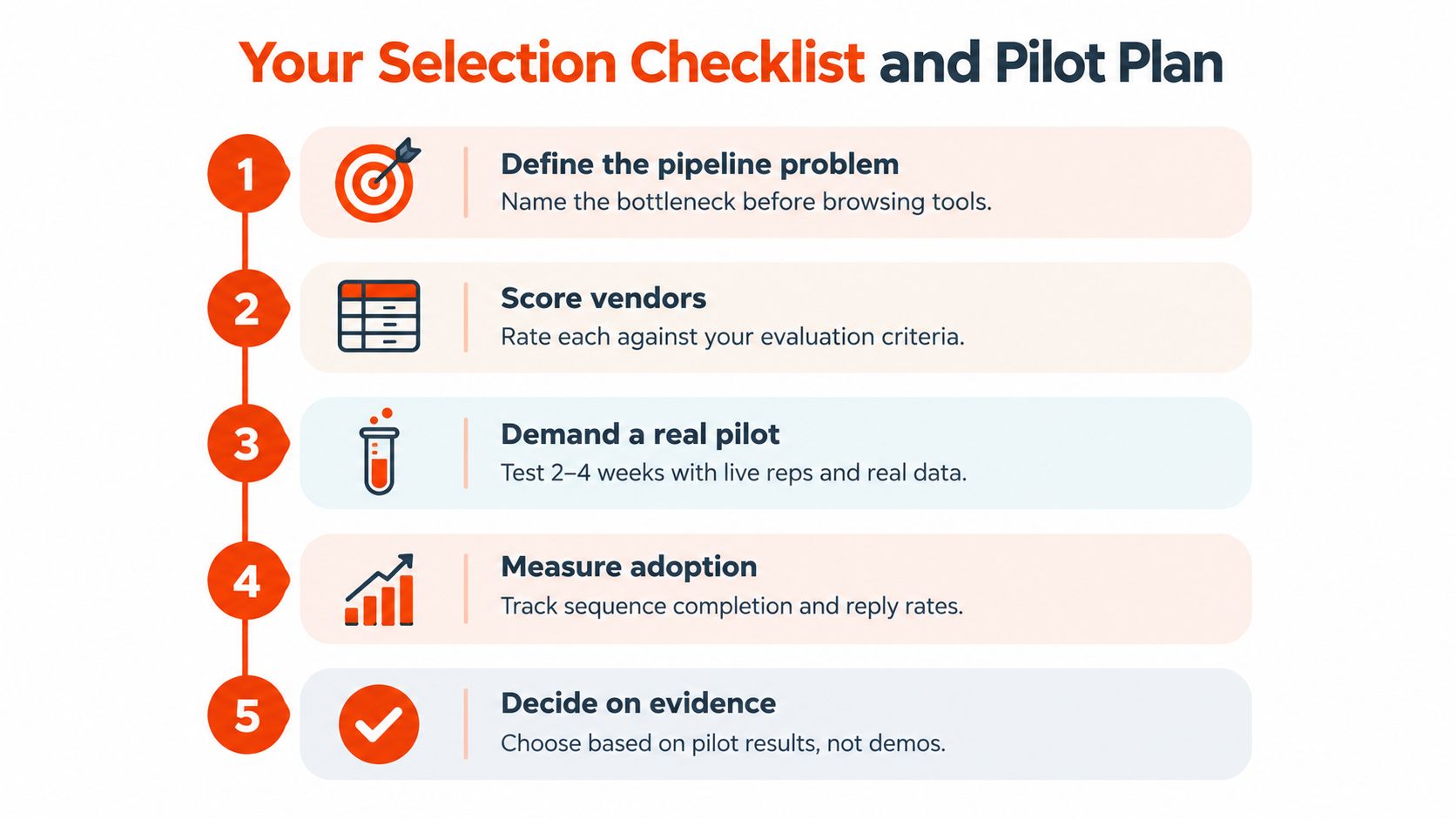
Don't shortlist platforms until you've named the pipeline problem. Write one sentence that describes the bottleneck, such as “qualified follow-up after partner-led content is inconsistent” or “enterprise sequence activity isn't visible by opportunity stage.” That sentence should guide every demo and pilot.
Use this process:
- Define the pipeline problem: Identify the stage, audience, owner, and data failure creating the gap.
- Score vendors: Use the scorecard above and require evidence inside your CRM, not a polished demo environment.
- Demand a real pilot: Run a controlled pilot with live representatives, real accounts, agreed targeting, and documented exit criteria.
- Measure adoption: Track whether reps complete the workflow, whether records remain accurate, and whether follow-up happens on time.
- Decide on evidence: Judge the pilot by qualified meetings and pipeline relevance, not by message volume or dashboard activity.
Pricing deserves a direct test. Ask whether cost scales with seats, contacts, channels, data, or activated profiles. Flat per-seat pricing can discourage partner participation when senior people need to contribute only at specific moments. A model aligned with activated profiles may fit a firm that turns a limited group of authoritative team members into a demand channel.
For a three-month pilot, agree in advance on the audience, signal definition, CRM fields, meeting qualification standard, and reporting owner. Measure qualified meetings booked and the quality of those conversations. Activity volume can remain a diagnostic metric, but it shouldn't be the success criterion.
Pick the vendor pattern that matches your motion. If you need governed multichannel execution at scale, buy enterprise capability. If you need straightforward sequencing with low setup overhead, choose a lighter workflow tool. If your firm wins through authority, relevance, and timing, test intent-based engagement before committing to a volume machine.
Ploot turns the LinkedIn audience of your partners, directors, and senior managers into a channel for identifying buying intent and creating timely sales conversations. If your B2B firm needs qualified meetings rather than more impressions, visit Ploot to explore a three-month pilot with agreed success criteria.