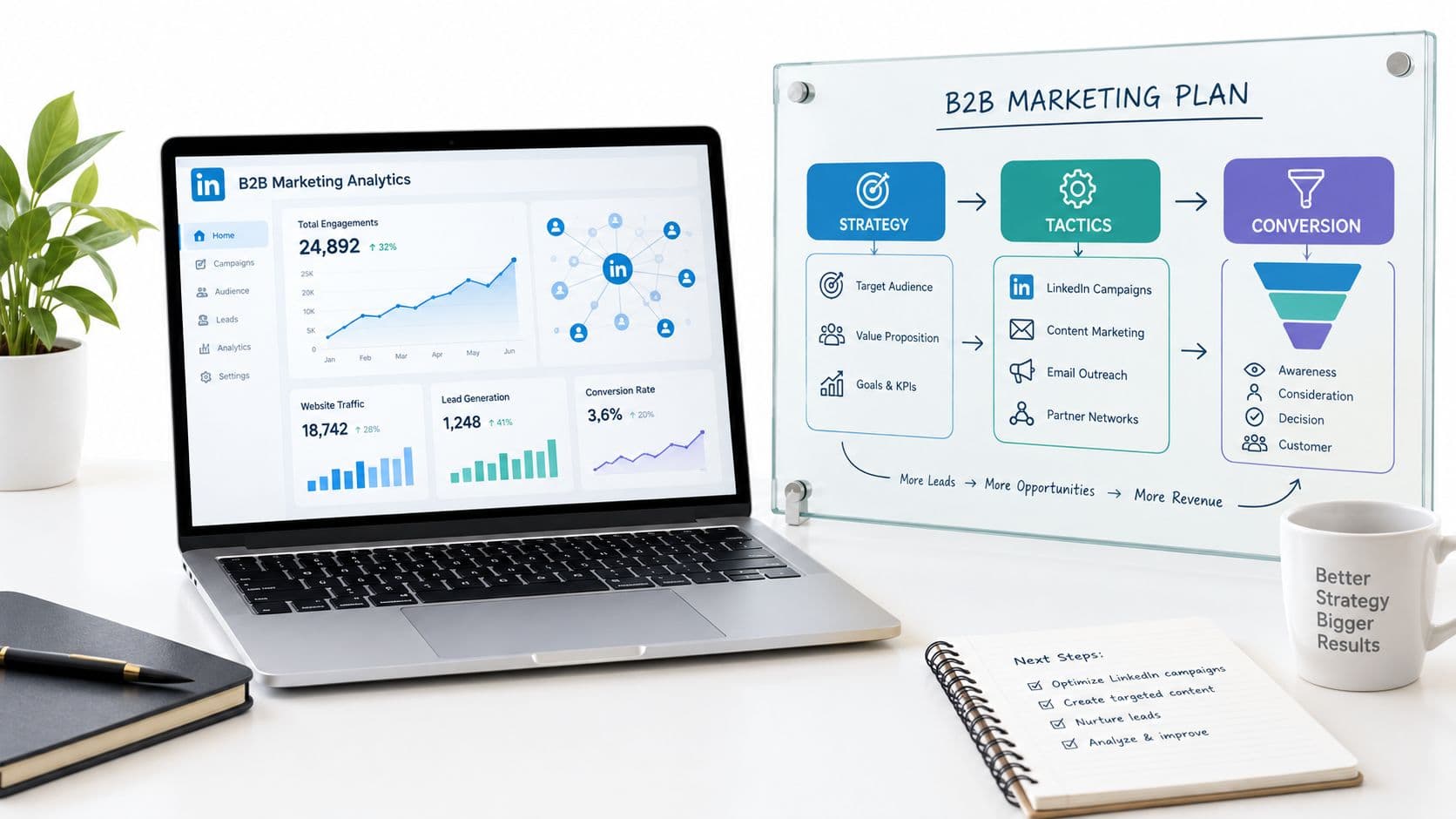

A striking $1 trillion annual cost is attributed to poor sales and marketing alignment, yet only 8% of companies report strong alignment between the two functions, according to an industry summary of alignment data. That gap should change how B2B leaders frame the problem. Misalignment isn't a meeting problem or a matter of teams using different vocabulary. It determines whether a high-intent account receives a useful response while the buying window is still open.
In consulting firms and B2B software companies, the damage usually appears in the handoff. Marketing sees engagement, sales sees an unqualified contact, and nobody owns the next action. The fix is to align around buyer intent signals, not just shared calendars, CRM fields, or revenue slogans.
Table of Contents
- The Trillion-Dollar Cost of Misalignment
- Why Signal-Based Alignment Outperforms Process Alignment
- Speed-to-Lead SLAs and Response Metrics
- Closing the Perception Gap Between Leadership and Frontline
- The Practical Playbook for Full Alignment
- Turning Alignment Into Sustained Revenue Growth
The Trillion-Dollar Cost of Misalignment
Sales and marketing alignment is often treated as a collaboration initiative. In high-ticket B2B, it is a pipeline control problem. When teams pursue different accounts, interpret readiness differently, or pass demand without context, the business loses time, seller capacity, and opportunities that may not return.
The larger implication of the industry's alignment findings is clear: weak coordination turns qualified demand into unworked or poorly timed pipeline. The Revenue Memo alignment statistics summary points to a gap between the resources companies invest in revenue generation and the small share of demand that both teams recognize as actionable. For firms with long sales cycles, that gap can distort pipeline coverage and make forecasts appear healthier than the underlying opportunities justify.
Misalignment leaks pipeline before the forecast shows it
Marketing can hit campaign targets while sales struggles with weak opportunities. Sales can increase outreach while marketing continues attracting accounts outside the firm's serviceable market. Each function may look productive in its own dashboard, yet the combined system produces little qualified pipeline.
The leakage often starts before a lead is rejected. A high-intent account may visit several pages, return after a proposal-related search, or involve multiple people from the same buying group. If those signals remain separate from sales activity, the account is treated as a contact instead of a developing opportunity.
The problem becomes more expensive in long-cycle environments. A consulting buyer may involve a partner, an operational sponsor, procurement, finance, and several subject-matter reviewers. A software purchase can follow a similar path, with technical, commercial, security, and executive stakeholders entering at different moments. Treating one form fill as the whole opportunity hides the buying group and makes timing harder to judge.
Practical rule: Alignment should be measured by whether both teams recognize the same account, interpret the same signal, and agree on the next action.
Shared meetings do not guarantee that outcome. A unified CRM does not guarantee it either. Those tools help only when they support a common operating decision: which account matters now, why it matters, who acts, and what evidence will confirm progress.
The executive view can hide operational friction
The perception gap is especially dangerous. Leaders may see shared planning and common targets while frontline teams experience rejected leads, unclear ownership, missing context, and delayed follow-up. Executives can therefore report alignment while account teams still disagree about which signals warrant action.
That difference explains why alignment projects often stall. Leadership concludes that the issue has been addressed, while the people handling accounts continue working around broken definitions and slow decisions. A serious program must inspect the handoff where intent becomes outreach, review the evidence available to the seller, and test whether the agreed next action gets done.
Why Signal-Based Alignment Outperforms Process Alignment
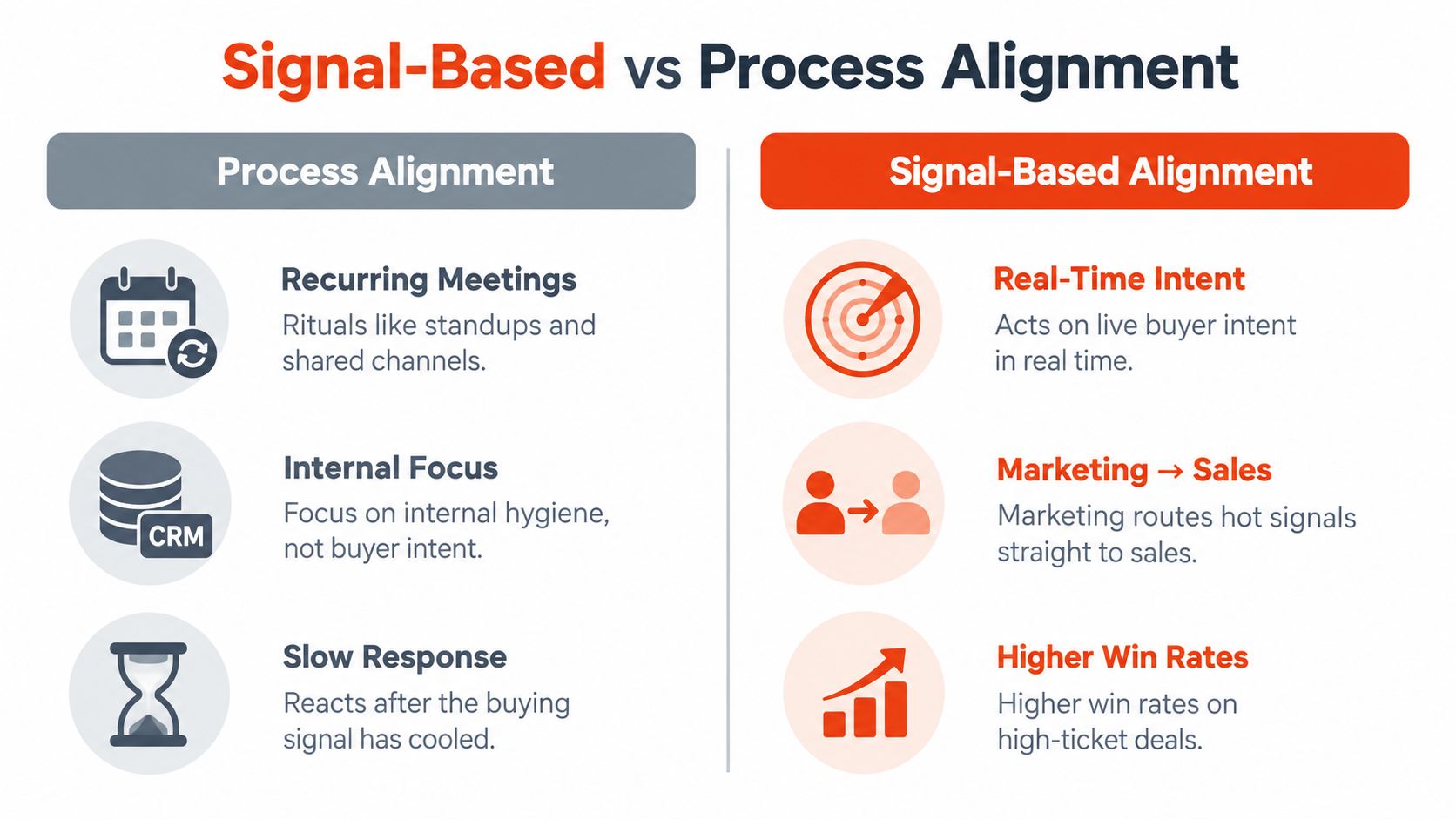
A shared sales and marketing meeting can improve communication, yet it cannot show which account deserves attention today or give a seller the context needed for a relevant conversation.
Process alignment coordinates internal activity. Signal-based alignment coordinates action around observable buyer behavior. That distinction matters in long-cycle sales. Teams may share an account list while contacting different stakeholders, relying on different assumptions, and missing the point when interest becomes actionable.
Meetings are inputs, not proof of alignment
Mural's 2025 GTM Alignment Gap Index found that only 11% of companies had both effective handoff and high audience overlap, while 36% had effective handoff but a large cold sales audience, according to the Mural alignment gap report. Teams can therefore move contacts efficiently while sales works an audience that differs from the one marketing engaged.
Influ2's 2025 analysis reported that 53% of organizations experience handoff misalignment, defined as fewer than 35% of engaged contacts being outreached by sales, as summarized in the same Mural research. The operational issue is larger than transferring a lead between systems. The right people, within the right account, must receive coordinated attention.
Signal-based alignment applies five practical questions:
- What changed? Someone researches a relevant topic, several stakeholders engage, or an account returns to a commercial page.
- Why does it matter? The activity may indicate a business priority, but fit, role, and context still require checking.
- Who owns the response? A named seller, marketer, or account team receives responsibility.
- What happens next? The teams choose a defined action, such as targeted outreach, role-specific content, or continued nurture.
- What closes the loop? Sales records whether the signal was useful, premature, misrouted, or connected to an active opportunity.
Tools for detecting buyer intent signals can support this workflow. They do not resolve unclear qualification. Each signal needs a shared definition, an accountable owner, and feedback that improves future routing.
Audience overlap is the test
Review the accounts marketing is actively engaging alongside the accounts sales is contacting. If the lists barely overlap, more meetings will not correct the problem. Leaders must identify whether the cause is targeting, account identification, buying-group coverage, or seller capacity.
Process still matters. Shared definitions, clean CRM records, and regular reviews provide the operating base. They are not the result. Alignment exists when both teams act on the same buying evidence and can explain why the next action belongs to them.
Speed-to-Lead SLAs and Response Metrics
Intent decays when nobody acts. In a long sales cycle, the first response won't always create an immediate meeting, but a delayed response can still waste the context that made the signal valuable.
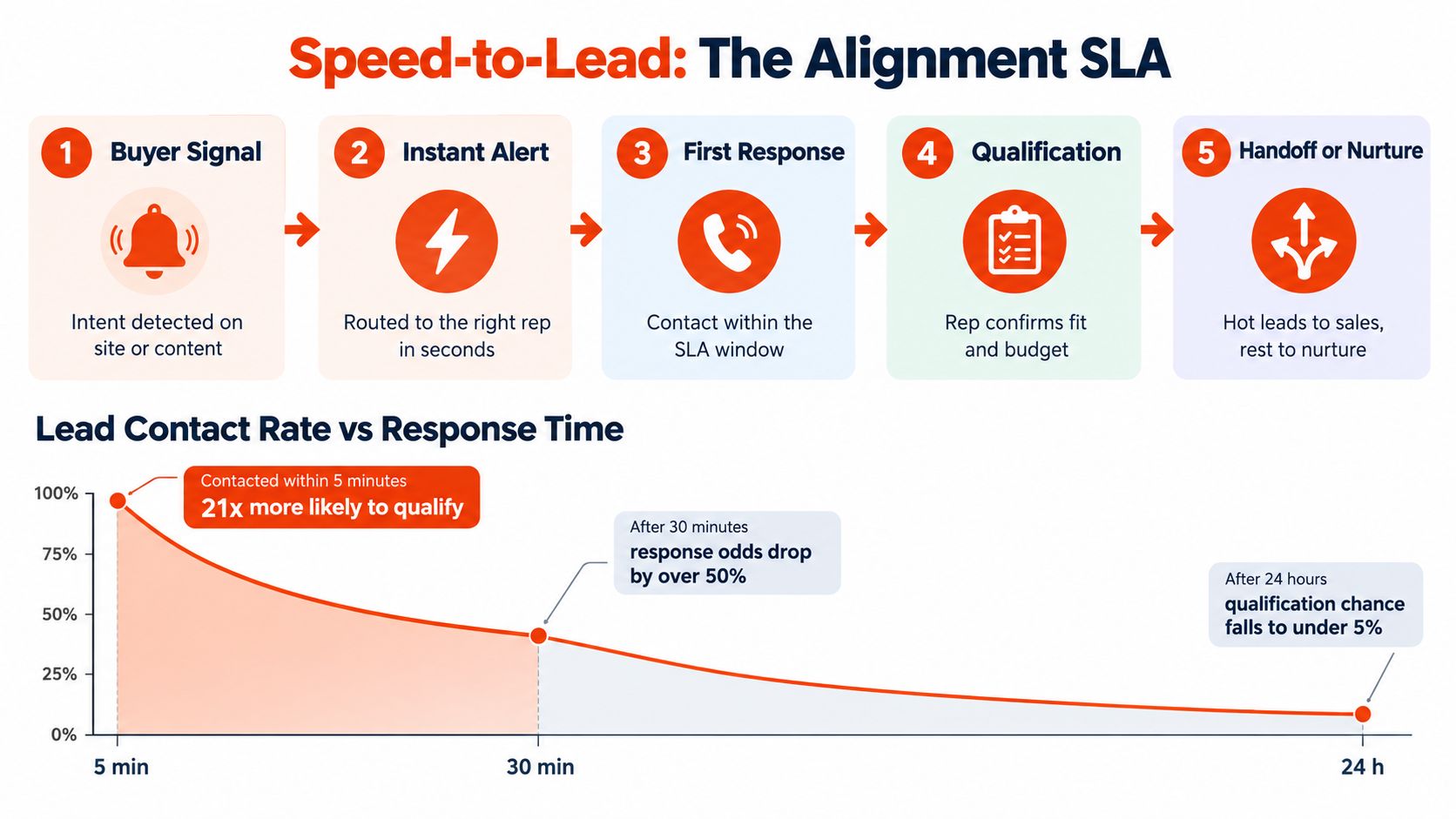
Research cited in Cirrus Insight's sales follow-up statistics found that contacting an inbound lead within 5 minutes made it about 100 times more likely to be contacted and 21 times more likely to be qualified than waiting 30 minutes. The same research reported that calling within 1 minute increased conversion likelihood by about 391%, with the lift falling to roughly 17% by 24 hours, according to that source.
Build the SLA around decisions
A useful SLA isn't just “sales follows up quickly.” It defines the conditions under which a signal becomes an owned action:
- Trigger: Identify the event or combination of events that requires review.
- Qualification: Confirm account fit, role relevance, engagement context, and available contact information.
- Owner: Route the alert to the person responsible for the next step.
- Response window: Set the maximum time before the owner begins the agreed action.
- Feedback: Record the outcome, including accepted, premature, wrong account, wrong person, or active opportunity.
- Recycling: Specify how marketing continues engagement when sales determines that timing isn't right.
The practical trade-off is coverage versus precision. If every low-value activity creates an alert, sellers learn to ignore the system. If the threshold is too high, marketing hides useful early demand from sales. Start with signals that combine fit and intent, then adjust the threshold using response quality and opportunity progression.
Response latency is a revenue metric. If the CRM records the lead but not the time between signal and action, the business can't see where demand is being lost.
A pipeline generation plan should therefore include routing logic and response measurement, not just campaign themes and target volumes. Review median response time, unaccepted alerts, recycled accounts, and the reasons sellers reject signals. These measures show whether the handoff works operationally.
Make routing resilient
High-ticket teams often rely on one seller or partner to notice an alert manually. That creates a single point of failure. Use named ownership, backup coverage, escalation rules, and a visible queue for unresolved signals.
The first response also needs context. A generic “I saw you were interested” message wastes the signal. The seller should know which account is involved, what changed, which role engaged, and which business problem the conversation can address. Speed matters, but speed without relevance only accelerates poor outreach.
Closing the Perception Gap Between Leadership and Frontline
Executives often assess alignment through intent and shared plans. Frontline teams assess it through the handling of a live buyer signal. Both perspectives can be honest while describing different operating conditions.
Forrester's Q2 2024 survey found that 65% of sales and marketing professionals saw a lack of alignment between leaders, while summaries of the same research reported that 82% of C-level executives believed their teams were in sync, as discussed in Forrester's analysis of B2B sales and marketing alignment. Leaders see common objectives, governance, and investment priorities. Operators see a qualified account rejected without explanation, an incomplete record that blocks follow-up, or outreach sent after the buyer's interest has cooled.
Ask each layer a different question
One alignment survey cannot expose that gap. Executives should explain whether the functions share a revenue model and investment priorities. Managers should show whether routing, content, ownership, and feedback rules work across teams. Frontline staff should demonstrate what happens after an account produces a meaningful intent signal.
Compare the answers instead of averaging them. A leadership team may report strong agreement while sellers and marketers describe daily friction. That disagreement identifies where the operating model fails.
MarketingProfs and Mutiny research from 2025 found that only 24% of respondents said they were completely aligned, while two-thirds said they think about replacing their counterparts, according to Forrester's discussion of the alignment problem. The finding points to strained working relationships alongside process defects. Teams can attend the same meetings yet blame one another when signal quality, follow-up, or opportunity progression falls short.
Turn complaints into observable checks
Replace “sales doesn't follow up” with a review of accepted signals, response time, and disposition reasons. Replace “marketing sends bad leads” with checks on account fit, role relevance, intent strength, and progression into opportunities.
Managers should inspect rejected handoffs and the account history behind successful and failed opportunities. They should listen to real calls, ask sellers which assets supported live conversations, and review which objections repeatedly appear in sales notes. Marketers can then adjust messaging and signal definitions based on evidence rather than assumptions.
The executive view becomes credible only when frontline evidence supports it. Alignment exists when the people handling buyer signals can see why an account was routed, what action follows, and how the outcome feeds the next decision.
The Practical Playbook for Full Alignment
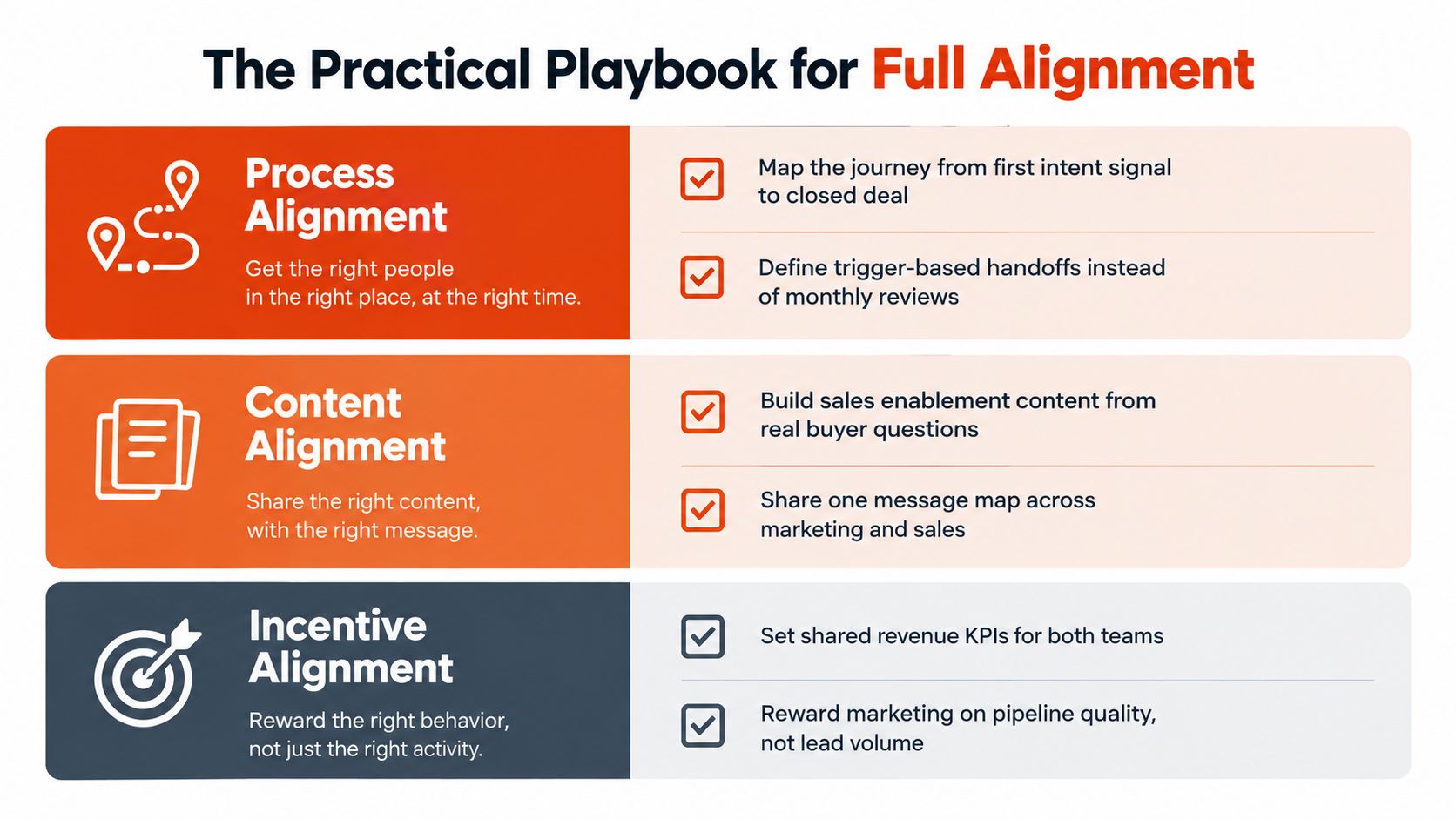
A workable model has three connected layers: process, content, and incentives. If one is missing, the other two compensate badly. Process without useful content creates efficient but weak outreach. Content without process leaves assets disconnected from live demand. Incentives without either encourages teams to optimize their own numbers.
1. Process alignment begins with the signal
Map the path from first meaningful signal to meeting, opportunity, and closed business. For each stage, document the entry condition, owner, action, response window, required data, and recycling rule.
Don't start with a monthly meeting. Start with a live account scenario. A target account shows relevant engagement from several people. Marketing verifies fit and identifies the buying group. Sales receives the context, chooses the appropriate outreach, and returns a disposition. Operations then checks whether the account advanced, stalled, or returned to nurture.
Use CRM fields that support those decisions. A dropdown for “marketing qualified” isn't enough if nobody knows why the account qualified or what the seller must do next.
2. Content alignment follows buyer questions
Marketing should build content from recurring questions in sales conversations, not from an internal publishing calendar alone. Consulting firms often need material that helps a buyer understand scope, implementation risk, governance, and commercial value. Software teams may need role-specific proof for technical evaluators, financial approvers, and daily users.
Create one message map for each important use case:
- Problem: What operational or commercial issue is the buyer trying to resolve?
- Relevance: Why does that issue matter to each stakeholder?
- Proof: Which evidence, capability, or delivery detail reduces risk?
- Objection: What could delay the decision?
- Next action: What useful step should follow the current signal?
When a team also needs to coordinate publishing and distribution, a resource on automating social media campaigns can help structure the operational side. The content still needs sales validation. A polished asset that doesn't answer live buyer objections won't improve the handoff.
3. Incentive alignment changes behavior
Marketing shouldn't be rewarded only for lead volume, and sales shouldn't be judged only by activity. The shared scorecard should connect signal quality, accepted handoffs, useful meetings, opportunity progression, and revenue outcomes.
That doesn't mean every function receives identical compensation. Marketing can retain channel and audience responsibilities. Sales can retain account and opportunity responsibilities. The important point is that neither team should benefit from creating work the other team can't use.
Review incentives against failure patterns. If sellers ignore signals, examine whether the alerts are credible and whether follow-up is recognized. If marketing overproduces low-fit demand, examine whether volume is valued more than qualified pipeline. A shared outcome makes those trade-offs visible.
Turning Alignment Into Sustained Revenue Growth
Signal-based alignment gives a consulting firm or B2B software company a practical operating rhythm. Marketing identifies where relevant demand is forming, sales receives the context while it remains useful, and both teams record what happened. Managers then refine the signal threshold, message, routing, or account coverage based on evidence.
The system stays healthy when teams review the same account outcomes rather than defending separate dashboards. A weekly review can focus on active signals and unresolved handoffs. A monthly review can examine quality, conversion, response latency, and stalled opportunities. Leadership can use those findings to adjust targeting and capacity instead of declaring alignment complete.
The core lesson is simple: alignment is not agreement in a meeting. It's coordinated action around the same buyer evidence. That is the standard that turns marketing activity into qualified pipeline and helps sellers spend time on accounts with a credible reason to engage.
For teams designing a more systematic revenue growth approach, the practical sequence is clear. Define the account and signal, assign the action, enforce the response window, equip the seller with relevant context, and measure what happened next. Repeat the cycle until the handoff becomes an operating habit rather than a quarterly initiative.
Ploot helps B2B teams detect buying intent across the LinkedIn audiences of partners, directors, and senior managers, then move interested prospects into qualified sales conversations with contextual outreach and CRM handoff. Visit Ploot to explore a signal-based approach for consulting or software pipeline, including a structured pilot with agreed success criteria.