

Clean stages don't create forecast confidence. A tidy CRM can still hide weak qualification, invented close dates, and deals no buyer would recognize. Strong B2B sales pipeline management starts earlier, with observable intent, an identified stakeholder, a concrete business problem, and evidence a deal has earned its stage. Everything else is arithmetic built on hope.
Table of Contents
- Why Most Pipelines Mislead Long-Cycle B2B Teams
- The B2B Pipeline Stages and Their Exit Criteria
- Pipeline Metrics That Actually Predict Revenue
- The Marketing to Sales Handoff That Preserves Intent
- Speed to Lead as a Pipeline Velocity Lever
- Tools for Pipeline Visibility and Forecast Discipline
- When to Add a Human and When to Stay Out of the Way
- A Weekly and Monthly Pipeline Review Cadence
Why Most Pipelines Mislead Long-Cycle B2B Teams
Most pipeline problems begin with a category error. Teams treat opportunity creation as proof of demand, then multiply the total value by a stage probability and call the result a forecast. In long consulting, technology, and software cycles, buyers evaluate problems, suppliers, technical requirements, and internal consensus long before a rep opens a record.
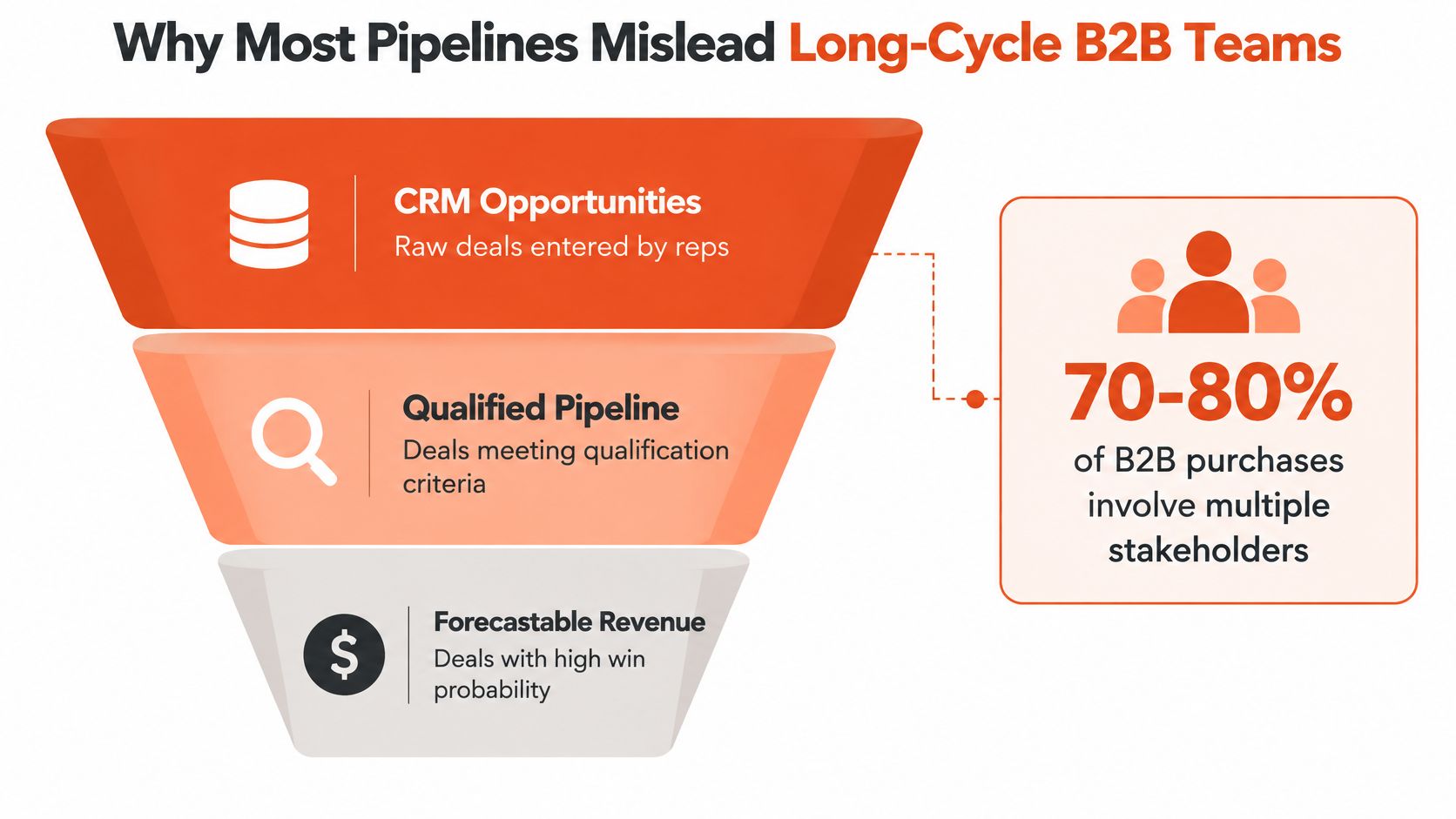
That invisibility isn't marginal. Compiled Gartner research on B2B buying time shows buyers spend only 17% of purchasing time meeting potential suppliers, roughly 5% to 6% with any one representative, while 70% to 80% of a considered purchase may occur before vendor contact. A pipeline built only from forms and late sales activity therefore misses most of the decision and overweights the small part your team can see.
Where false confidence enters
Three habits make weak pipelines look healthy.
- Counting records: Ten unqualified opportunities can produce impressive coverage while adding little closeable revenue.
- Accepting seller dates: Close dates often follow the quota calendar rather than a customer-confirmed decision process.
- Crediting the last touch: A meeting request gets attribution even though months of audience engagement and peer influence created the willingness to talk.
Practical rule: Pipeline isn't the number of deals reps entered. It's the set of buying situations you can describe by stakeholder, problem, next step, and decision path.
For a marketing director, the conversation with a CEO changes once you separate raw pipeline, qualified pipeline, and forecastable revenue. Coverage may look adequate at the first layer and dangerously thin at the third. That's not pessimism. It's the first honest view of what sales can close.
The B2B Pipeline Stages and Their Exit Criteria
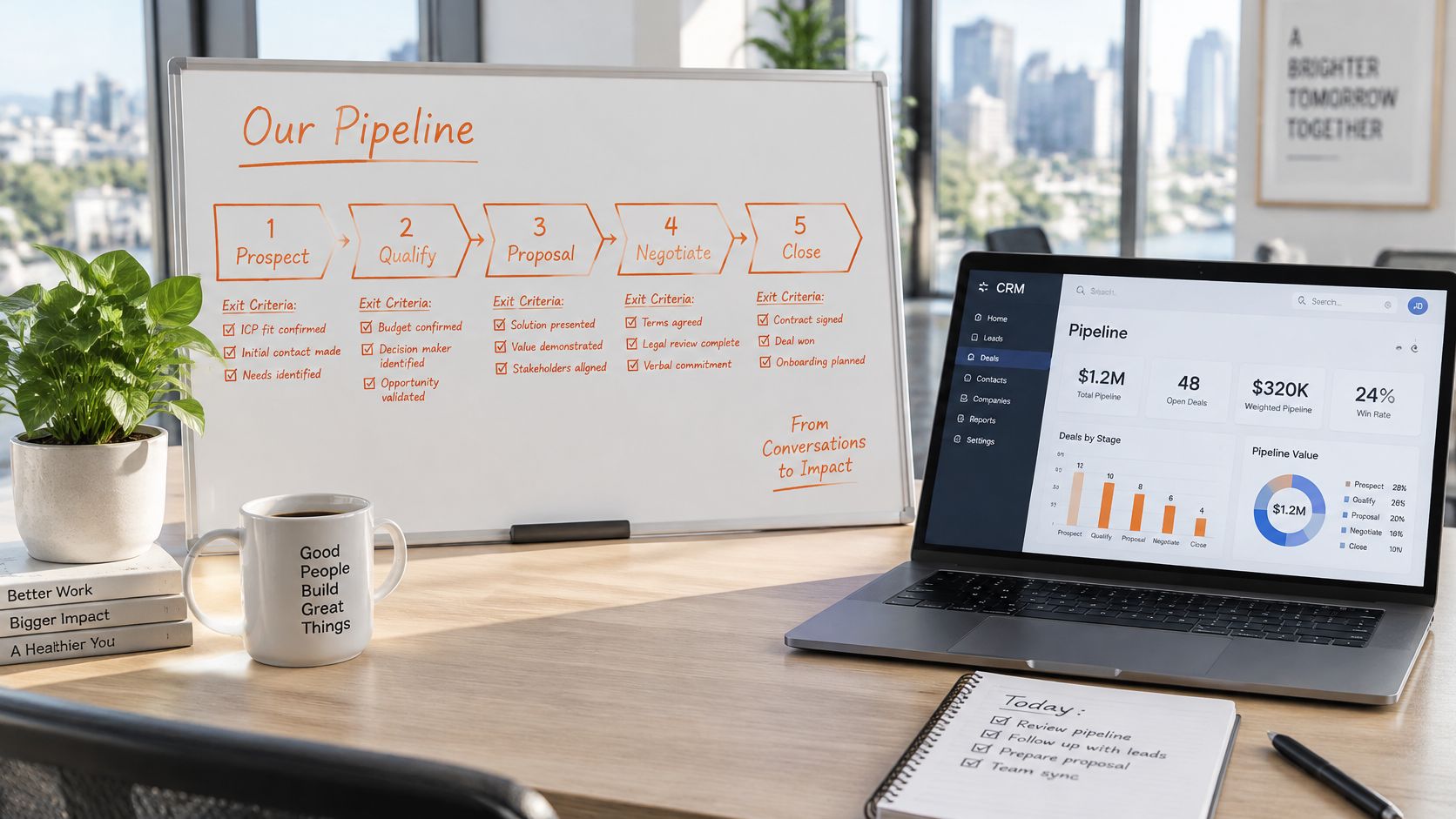
Stage names matter less than the gates between them. The structure below works for high-value consulting and software because each transition requires evidence a manager can audit in the CRM, not a rep's interpretation of a good call.
The workspace view below is useful only if the process behind the dashboard is equally explicit.
A stage dictionary you can audit
- Pre-pipeline intent: Exit when a named person at a target account shows relevant, recent buying behavior and an owner accepts follow-up. No opportunity exists yet.
- Qualified opportunity: Exit when you've validated a business problem, identified the economic buyer or buying committee, estimated commercial value, and booked a defined next meeting.
- Discovery complete: Exit when current process, impact, stakeholders, constraints, and the customer's decision criteria are documented in the customer's terms.
- Solution fit: Exit when the buyer confirms the proposed approach addresses the problem and technical, security, or delivery requirements are known.
- Proposal: Exit when scope, price logic, expected decision date, and procurement requirements have been shared with the people who can approve them.
- Negotiation: Exit when remaining commercial, legal, and procurement issues are listed with owners and customer-confirmed timing.
- Closed won or closed lost: Close won requires contractual commitment. Close lost requires a reason specific enough to improve qualification, not a generic label such as timing.
Notice what isn't a gate. Sending a deck doesn't prove solution fit. A friendly champion doesn't prove access to the economic buyer. A proposal sent to one contact doesn't prove committee review. If reps can advance deals on activities they control, the pipeline measures seller effort.
The short walkthrough below reinforces how stage discipline looks when managers inspect evidence rather than labels.
Use one test in your next CRM audit. Pick any opportunity and ask which buyer supplied the evidence for its current stage. If the answer is only the rep, move it back or mark the missing evidence as the next step.
Pipeline Metrics That Actually Predict Revenue
A forecast call doesn't need more metrics. It needs a small set that expose different failure modes. Coverage tells you whether enough qualified value exists. Win rate tells you how much of that value historically converts. Stage conversion shows where deals stop earning advancement, while cycle length and stage aging show whether they're progressing at a plausible pace.
The common 3 to 1 pipeline coverage rule becomes misleading when it's detached from your actual win rate. Recent benchmark summaries on B2B win rates and forecast accuracy report average win rates of roughly 21% to 28%, while a 2025 benchmark covering about $48 billion of pipeline reported average B2B SaaS win rates near 19%, down from about 29% the prior year. Only about 7% of sales organizations achieve forecast accuracy of 90% or higher in those summaries.
That arithmetic has a blunt implication. If roughly one qualified opportunity in five closes, three times quota in comparable pipeline won't be enough. Padding coverage with early, weak deals makes the ratio pass while leaving the underlying shortage untouched.
Connect the metrics before you act
Pipeline velocity brings the components together by combining qualified opportunity volume, average deal size, win rate, and sales cycle length. When velocity falls, don't default to demanding more top of funnel activity. Identify which input moved. A smaller average deal requires a different response than deteriorating stage conversion, and longer cycles may signal missing stakeholders rather than insufficient urgency.
| Metric | What it measures | Benchmark | Primary lever |
|---|---|---|---|
| Pipeline coverage ratio | Qualified pipeline value against quota | Calibrate to win rate, do not copy a universal ratio | Create qualified pipeline or remove inflated deals |
| Win rate | Closed won share of qualified opportunities | Roughly 21% to 28% in recent summaries | Tighten qualification and buying group access |
| Stage conversion | Movement from one evidence gate to the next | Compare against your historical segment baseline | Fix the stage where evidence stalls |
| Forecast accuracy | Forecast result against actual closed revenue | 90% or higher is reached by only about 7% of organizations | Auditable exit criteria and aging alerts |
| Sales cycle length | Time from qualified opportunity to close | Compare by segment, source, and deal size | Earlier stakeholder and procurement discovery |
Scoring discipline affects every row because weak inputs contaminate coverage and conversion. Teams implementing that discipline in HubSpot can use a practical lead scoring setup for HubSpot pipelines to keep behavioral interest separate from sales acceptance.
Pick coverage, stage conversion, and aging for the next forecast review. They will tell you whether you have a sourcing problem, a qualification problem, or deals that are no longer moving.
The Marketing to Sales Handoff That Preserves Intent
Intent dies fastest at the handoff.
A director at a target account downloads a partner's guide, returns to a pricing page, and a colleague registers for the same workshop. If sales receives only a name and content title, the rep has to reconstruct the account story before making contact. The buyer gets generic outreach, and marketing records activity that sales is unlikely to trust.
The remedy is a handoff package with acceptance criteria. Marketing owns evidence, context, and routing. Sales owns review, acceptance or rejection with a reason, and a first touch that uses what marketing supplied. Shared accountability ends the argument over whether a lead was "good."
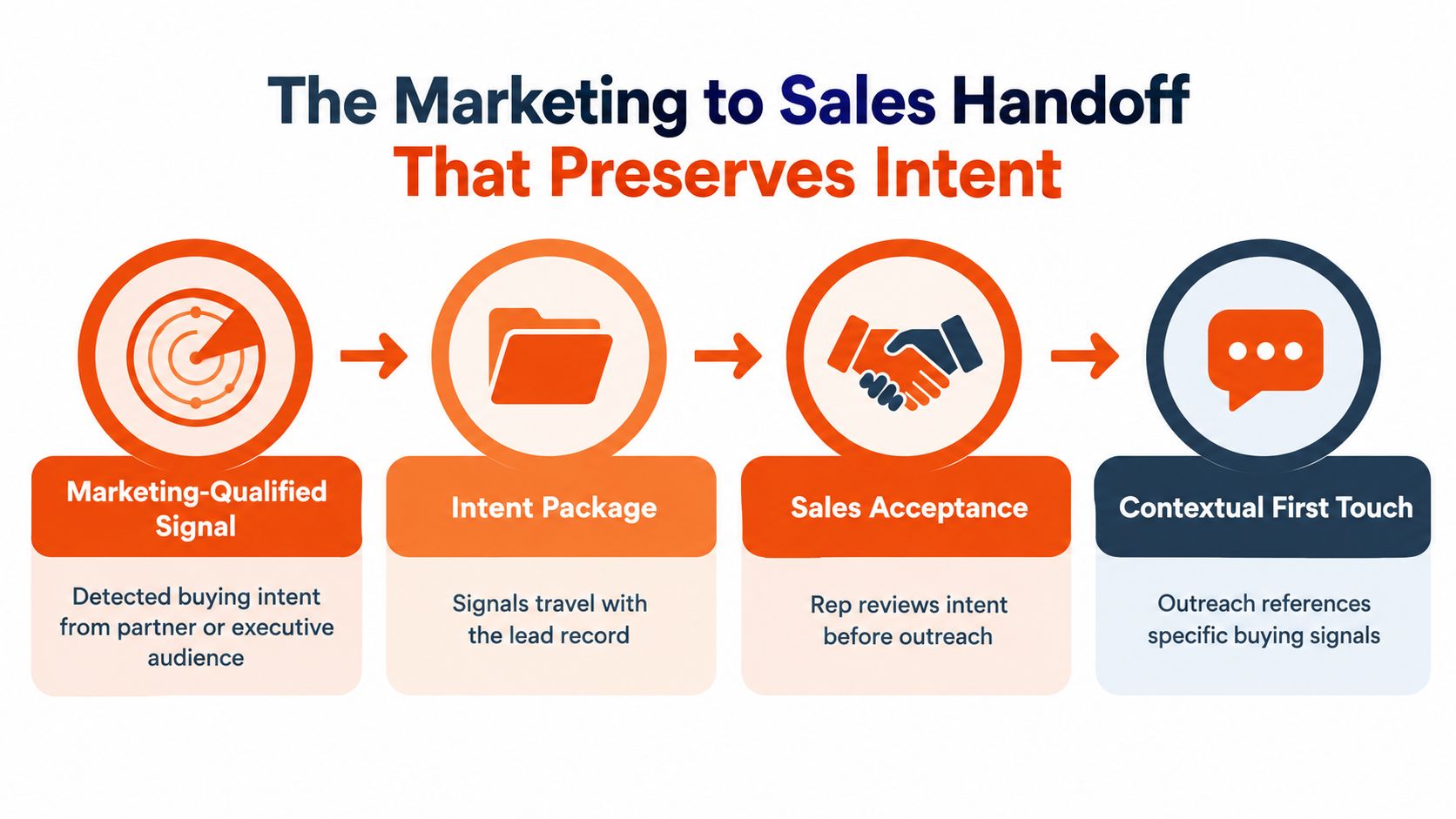
Before a rep takes ownership, the record should answer five questions: Who acted, and how does that person relate to the buying group? What business problem did the material address? When did the strongest signal occur? Which named owner or backup receives it? What outcome and reason will sales enter after review?
That package makes intent operational. Stakeholder identity, business context, recency, ownership, and disposition travel together, so both sides can distinguish a raw interaction from a qualified deal.
A workable acceptance rule for long cycles is repeated engagement around one problem, fit with a target account, a reachable stakeholder, and enough context for a relevant first conversation. A meeting request can qualify on its own when it names a decision need. Weak or premature signals return to nurture with a recorded reason.
This protects buyers from irrelevant outreach and prevents marketing from inflating pipeline with attention metrics. It also improves forecast judgment because opportunities enter with documented evidence. Industry reporting on forecast confidence and revenue intelligence notes that only 45% of sales leaders report high confidence in forecast accuracy, while organizations using more rigorous revenue intelligence practices generally land within about plus or minus 10% of predictions.
The requirement is stricter for Spanish consulting, HR, and software firms. Influence often begins in a partner's audience months before a formal project exists, and much of the journey remains invisible to sales. Shared definitions for B2B marketing and sales alignment let both teams credit meetings and opportunities without mistaking impressions for revenue.
Speed to Lead as a Pipeline Velocity Lever
A demo request from a named account can lose value before a CRM owner even sees it. Raw clicks can wait. Evidence-qualified intent cannot.
The MIT and InsideSales lead response research covered more than 15,000 web leads and over 100,000 call attempts and found contacting a lead within five minutes produced about 21 times higher qualification odds than waiting 30 minutes; the same source summarizes an audit of 2,241 U.S. companies where only 37% responded within an hour and 23% never responded. Treat those bands as an operating ceiling for high-intent events, not as a reason to blast every form fill.
| Control | Minimum standard |
|---|---|
| Signal timestamp | Record when intent was detected, not when a rep noticed it. |
| Routing | Assign by account ownership, segment, and relationship to the relevant executive or partner profile. |
| First action | Measure time to a meaningful call, message, or email; an autoresponder does not count. |
| Exception path | Missing contact data, absent owners, and unassigned accounts trigger a named backup during staffed hours. |
| Reporting | Compare under five minutes, five to thirty minutes, and over thirty minutes by source, segment, seniority, and intent type. |
The scoring rule decides who deserves that clock. For a concrete implementation perspective, see how Internal Systems handles lead scoring and compare its real time routing assumptions with your acceptance rules. The score matters when it sends the right owner fast enough.
In Spanish consulting and software cycles, route toward the partner or practice lead who already carries trust, even if a generic queue would be quicker. Review three outputs weekly: time to first human action, qualification rate by response band, and meetings booked per accepted signal. If fast cohorts do not outperform slower ones after controlling for intent type, your high-intent definition is too loose.
Tools for Pipeline Visibility and Forecast Discipline
Most tool purchases start with a feature list and end with another dashboard nobody trusts. Flip the order. Name the decision that is failing first: sloppy stage hygiene points to one category of fix, invisible buying group activity to another, and intent lost between marketing and sales to a third.
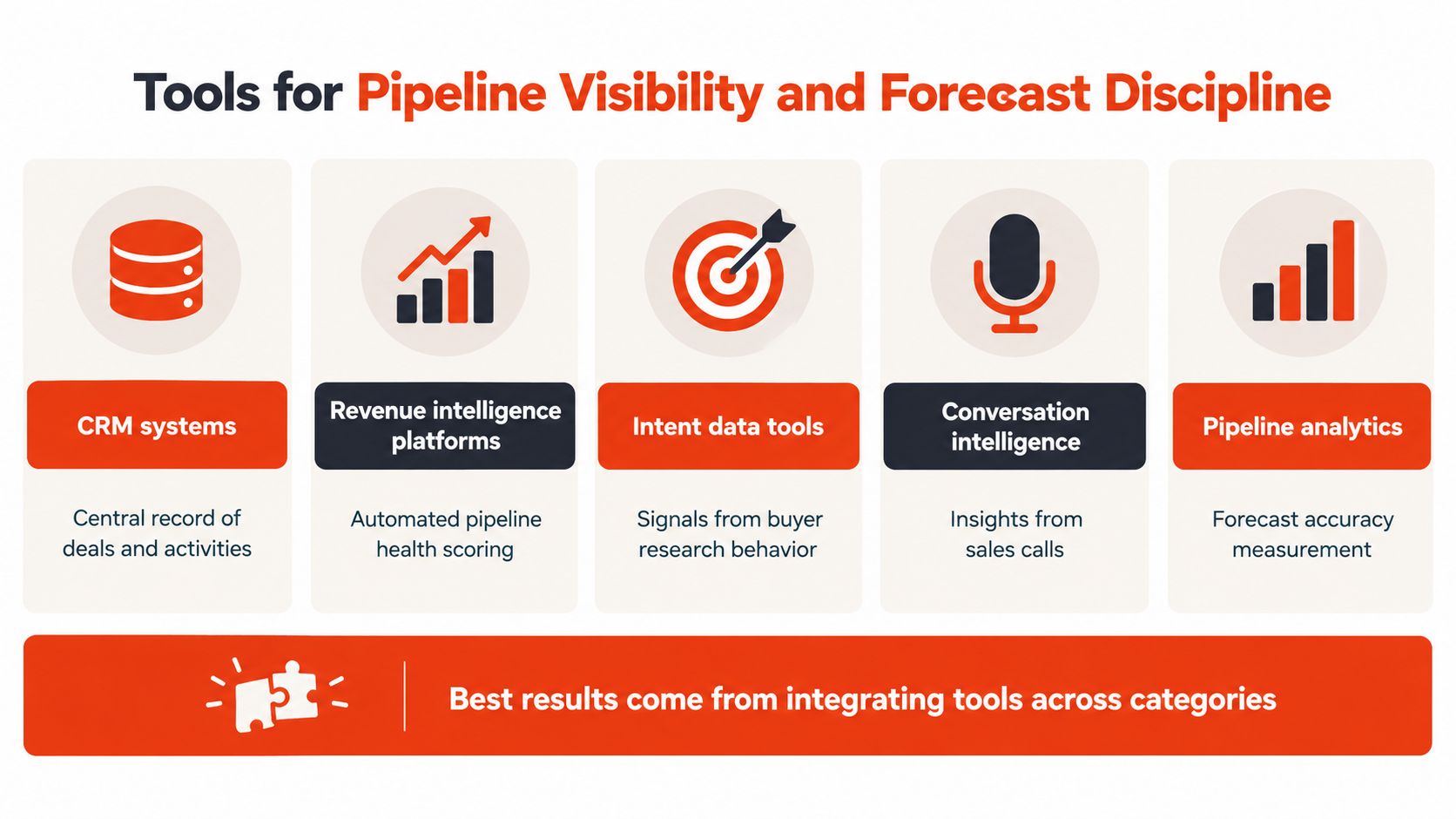
I group the stack into three jobs.
The record job. CRM systems hold the system of record for accounts, stakeholders, stages, values, and next steps. Manual fields still reflect rep judgment, so no CRM produces discipline on its own.
The signal job. Intent data tools surface research behavior before vendor contact. They pay off only when signals can be tied to named accounts, relevant topics, and a routing owner.
The inspection job. Revenue intelligence platforms flag deal risk, missing stakeholders, aging, and forecast movement across the open book. Conversation intelligence verifies problems, objections, decision criteria, and agreed next steps from calls, though it cannot rescue conversations that never reach the economic buyer. Pipeline analytics expose conversion, aging, slippage, and historical stage probability, and they calibrate only when stage definitions stay stable.
For every candidate in these categories, ask whether its alerts change what a seller does next or fill a manager's report.
Ploot covers the demand side of this stack for Spanish B2B firms: it builds partner and executive LinkedIn audiences, detects buying intent inside them, and contacts interested people to book qualified meetings. Run it as a feeder into your CRM and acceptance process, leaving stage governance where it belongs.
Before signing, test integration depth on real records, data residency, stakeholder-level reporting, and stalled-deal alerts. Then check which fields a CRM integration must preserve so source, signal time, owner, and acceptance outcome survive the trip into sales reporting.
When to Add a Human and When to Stay Out of the Way
The fashionable extremes are both wrong. High volume outreach assumes every interaction justifies a conversation. Rep-free absolutism assumes buyers never need judgment from someone who has seen similar implementations, risks, and internal approval fights. Long-cycle buyers need control over research and access to expertise at specific decision points.
The Gartner 2025 sales survey on rep free buying preferences found 61% of B2B buyers prefer an overall rep-free experience, while 73% actively avoid suppliers sending irrelevant outreach. Those figures don't say human input has no value. They say unsolicited, poorly timed input damages trust.
Separate information from judgment
Let digital content handle information gathering. Buyers can compare approaches, read partner perspectives, review implementation considerations, and understand commercial models without booking a call. Instrument that behavior carefully, but don't treat reading as consent to pursue.
Add a senior human when the task becomes contextual. Examples include judging fit for a specific operating model, challenging an unrealistic scope, quantifying implementation risk, mapping affected stakeholders, or helping a sponsor build internal consensus. At those moments, a partner or experienced consultant offers something self-service content can't responsibly decide.
Design triggers around active evaluation, not passive attention. Repeated engagement by several stakeholders, movement from general topics to implementation detail, direct interaction with an executive profile, and account changes that create urgency all justify review. One isolated reaction usually justifies continued relevance, not a meeting request.
Fewer conversations can outperform more outreach when each conversation starts with a specific reason to talk. That's especially true in high-ticket consulting, where authority is part of the product being evaluated.
A Weekly and Monthly Pipeline Review Cadence
Pipeline hygiene decays between reviews. A weekly cadence should inspect movement and risk, not invite reps to narrate every opportunity. Start with exceptions, deals with no next step, repeated close date movement, missing economic buyer access, or age far beyond the historical pattern for their segment.
Weekly inspection checklist
- Coverage by quality: Compare raw, qualified, and forecastable pipeline against target instead of reviewing one blended total.
- Conversion by source and segment: Look for channels or audience types that create meetings but fail sales acceptance.
- Stage aging: Flag records that exceed the normal dwell time for their stage and require new evidence, downgrade, or closure.
- Next step validity: Confirm each committed deal has a dated, customer-agreed action with a named buyer participant.
- Intent response: Review time to first human action and acceptance outcomes for new high-intent signals.
The monthly review should change the system, not repeat the weekly meeting at greater length. Recalibrate stage probabilities from historical conversion and aging. Compare last month's forecast with the actual result by team, source, and segment. Audit rejected marketing signals for false negatives and accepted signals that never became opportunities for false positives.
The need is clear from benchmark summaries on forecast accuracy by team maturity, which report that only about 20% of organizations hit forecasts within 5% of projection, 43% miss by at least 10%, and world-class teams reach roughly 80% to 95% accuracy compared with 50% to 70% for average teams.
Monthly question: Which rule, definition, or source created the largest forecast error, and what evidence would have exposed it earlier?
Close the month by reviewing leading indicators, intent to meeting rate, sales-accepted opportunity rate, qualified pipeline created, and stage aging. Those measures show whether next quarter's revenue is being built now or merely being promised by records already in the CRM.
If your partners and directors already have credibility with the buyers you need, Ploot can turn that LinkedIn audience into detected buying intent, timely contextual outreach, and qualified sales meetings your CRM can track. Visit Ploot to start with a focused pilot and judge the channel on pipeline created, not impressions reported.