

Most advice about LinkedIn audience expansion starts with the wrong question. It asks how much additional reach the feature can create, when high-ticket B2B teams should ask whether the additional people can become relevant members of a buying committee. More impressions can make a dashboard look healthier while making pipeline attribution harder.
The stronger approach treats expansion as a signal generator. Executive profiles create authority and engagement, paid campaigns help identify adjacent professionals, and sales teams act only when several signals point to account fit and buying interest. That requires more discipline than switching on a broader audience setting, but it gives marketing directors a much clearer answer to the question that matters: did LinkedIn help create qualified sales conversations?
Table of Contents
- The Pipeline Reality of LinkedIn Audience Expansion
- Building a High-Intent Seed Audience
- Activating Executive Profiles for Organic Expansion
- Measuring Pipeline Impact Beyond Blended Metrics
- When to Avoid Expansion and Leverage Exclusions
- Structuring a 90-Day Pilot for High-Ticket Sales
The Pipeline Reality of LinkedIn Audience Expansion
More reach doesn't automatically mean more pipeline. LinkedIn audience expansion can show ads to member accounts that resemble the selected audience, but similarity isn't the same as commercial relevance. A person may share a job function, industry, or professional attribute with an ideal prospect without having the authority, timing, problem, or account context required for a serious purchase.
That distinction matters most for consulting firms and B2B software companies with narrow markets. A cheap click from an expanded segment may indicate curiosity, not demand. If the visitor works at the wrong type of company, sits outside the buying committee, or can't be served in the relevant geography, the click has little sales value.
LinkedIn's own reporting creates a further complication. Impressions, clicks, and professional-demographic metrics are combined across explicitly targeted and expanded audiences, while the forecasted audience size doesn't include expansion accounts, making pre-campaign reach estimates incomplete and pipeline attribution more difficult (LinkedIn's audience expansion reporting documentation).
Reach and demand are different jobs
Manual targeting answers, “Did we reach the people we selected?” Expansion answers, “Can the system find people who resemble them?” Neither answer proves that an account moved toward a sales conversation.
For a high-ticket campaign, separate the outcomes:
- Distribution: How many relevant professionals saw the message?
- Account quality: How many engaged accounts match the ICP?
- Buying-committee coverage: Did engagement come from decision-makers, influencers, or adjacent stakeholders?
- Commercial progression: Did qualified accounts book meetings, enter an opportunity, or influence pipeline?
A guide for B2B sales leaders can help sales and marketing teams align these stages before launching campaigns. That alignment prevents marketing from presenting raw platform activity as evidence of sales impact.
Practical rule: Use audience expansion to discover adjacent people around a known ICP, not to excuse an undefined ICP.
The most useful discovery is often inside an existing account's buying committee. A technology director may engage first, while procurement, finance, operations, or an executive sponsor becomes important later. Expansion can help surface those neighboring professionals, but the team still needs account-level validation before outreach.
The operational consequence is straightforward. Keep the explicitly targeted audience and the expanded segment conceptually separate in your CRM, reporting, and sales handoff, even when LinkedIn's native dashboard blends them. If the campaign produces more activity but fewer qualified accounts, broader delivery hasn't solved the demand problem.
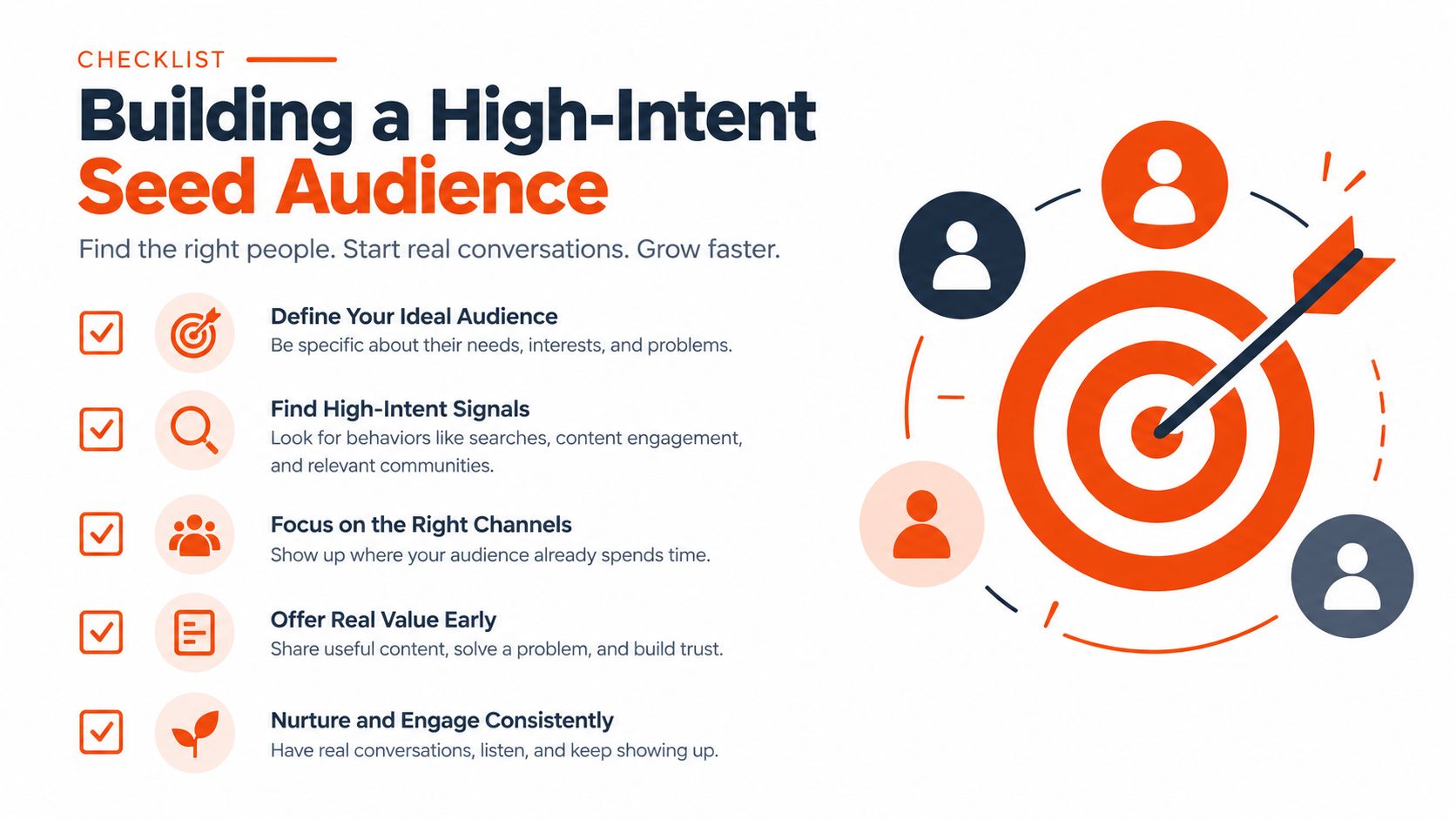
Building a High-Intent Seed Audience
Audience expansion is only as intelligent as the audience you give it. A clean seed teaches LinkedIn what a commercially valuable prospect looks like. A contaminated seed teaches it to find whatever is easiest to match, which may be employees, students, competitors, existing customers, or people who visited a low-intent page.
Start with a first-party source that reflects actual commercial relevance. Suitable inputs include qualified contacts, high-intent website visitors, company-page followers, or people who engaged with previous campaigns. For a consulting or software firm, the best source is usually a carefully filtered audience connected to accounts and roles that sales already recognizes as valuable.
Validate the seed before enabling expansion
Use a short validation process rather than uploading a large list and trusting the algorithm:
- Define the commercial boundary. Agree on target industries, company profiles, seniority, geography, and buying-stage criteria with sales. “People interested in our content” is not a sufficient definition.
- Remove weak signals. Exclude employees, students, competitors, existing customers, irrelevant job functions, and visitors who only consumed low-intent material.
- Separate markets and roles. Don't combine Spanish prospects with unrelated international segments or executives with junior practitioners if the message and sales motion differ.
- Check the matched audience. LinkedIn requires at least 300 matched member accounts for expansion, and location filters can reduce a list that initially appears large enough below the serving threshold (LinkedIn's audience expansion requirements).
- Record the seed definition. Save the source, filters, exclusions, upload date, and owner. Without that record, later performance comparisons become guesswork.
The threshold is a delivery requirement, not a quality standard. Reaching the minimum with poor contacts won't create a useful audience. A small but commercially coherent seed is more valuable than a larger list full of people who never had a realistic reason to buy.
Protect against algorithmic drift
Split the seed by market, seniority, industry, and buying stage wherever the sales motion changes. A Spanish HR consultancy shouldn't treat an international software audience as interchangeable with local HR directors. Likewise, a campaign for executive transformation shouldn't use every website visitor as its learning signal.
Keep a non-expanded comparison audience available before launch. Use the same objective, creative, geography, bid strategy, and frequency conditions where possible, then compare qualified-account outcomes rather than delivery volume. This gives the team a way to determine whether expansion found useful adjacent prospects or only added activity.
Activating Executive Profiles for Organic Expansion
Company pages have a role, but they shouldn't carry the entire authority strategy. Senior buyers usually evaluate expertise through people who appear close to the problem, not only through a corporate publishing stream. A partner explaining a difficult implementation decision, a director interpreting a market shift, or a technical leader challenging a familiar assumption can create stronger context for later paid activation.

The performance gap supports this operating model. A 2026 benchmark based on Metricool's analysis of 673,658 LinkedIn posts from 63,108 accounts reported average engagement of 2.60% for personal profiles compared with 1.74% for company pages, making personal-profile engagement approximately 63% higher (Oktopost's LinkedIn social media benchmark summary).
That doesn't make engagement a pipeline metric. It does show why executive profiles can be a more productive source of early audience signals than company-page publishing alone.
Build authority around commercial problems
Select a small group of credible partners, directors, or senior managers. Don't choose people only because they hold senior titles. Choose leaders who can explain customer problems with enough experience to be specific and enough restraint to avoid turning every post into a pitch.
Give each profile three to five repeatable topic pillars connected to commercial problems. For example:
- A consulting partner can discuss why transformation programs stall after strategy approval.
- A software executive can explain the operational cost of disconnected systems.
- An HR leader can examine the tension between hiring speed and quality.
- A technology director can unpack the risks of treating implementation as a purely technical project.
Native posts should make a useful point, describe a recognizable situation, and invite informed disagreement. Avoid turning every post into a gated asset or product announcement. The audience needs a reason to trust the profile before a sales action becomes appropriate.
The employee advocacy on LinkedIn model is useful here because it frames distribution as a coordinated activity rather than a request for employees to share corporate copy. Each profile needs its own perspective, editorial rhythm, and boundaries.
Turn engagement into an account signal
Track post-level viewers, reactions, comments, profile visits, saves, clicks where available, and engagement from ICP accounts. Then score accounts using recency, role fit, account fit, and repeated engagement. A single reaction from an unknown person isn't enough to justify human outreach.
A senior profile should earn attention before the sales team asks for time.
Use at least two meaningful signals before routing an account to a salesperson, such as repeated engagement or an engagement combined with a profile visit. Review the person's role and company before contact. A thoughtful comment from a relevant director is a stronger signal than a high volume of anonymous likes.
Paid audience expansion works better after this organic layer has produced a defined, relevant audience. The executive profile creates context. Paid distribution can then extend the message to adjacent professionals, while sales receives a warmer and more interpretable signal. Teams that want to improve the transition from engagement to direct contact can also consult these Sift AI outreach tips, particularly when deciding whether a message should be conversational, useful, or sales-led.
The best executive-led programs don't optimize for maximum posting volume. They create a recognizable point of view, observe which accounts return to it, and let that pattern inform the next paid and human touch.
Measuring Pipeline Impact Beyond Blended Metrics
Native reporting can tell you what happened across the campaign, but it may not tell you whether the explicitly selected ICP or the expanded segment produced the result. That makes a blended click-through rate a weak decision tool for high-ticket B2B. The team needs a measurement design that connects audience quality to account progression.
Start by defining the two cohorts before launch:
| Cohort | Working definition | Primary question |
|---|---|---|
| Core ICP | Members and accounts inside the selected targeting criteria | Did the intended audience engage and progress? |
| Expanded segment | Members and accounts discovered through audience expansion | Did the algorithm find commercially relevant adjacent prospects? |
Measure account quality before conversion
The first useful metric isn't a click. It's qualified-account reach, meaning the number of ICP-fit accounts reached by the campaign. Add the engaged target-account rate, which shows how many relevant accounts did more than passively receive an impression.
Then examine progression:
- Meetings per 1,000 reached: Connects distribution with a sales action while controlling for audience volume.
- Opportunity conversion: Shows whether engaged accounts entered a real commercial process.
- Pipeline value: Connects campaign influence to the amount of potential revenue associated with qualified opportunities.
- Buying-committee progression: Shows whether engagement spread from one relevant person to other roles in the account.
These metrics should be segmented by core and expanded audiences wherever the data allows. If LinkedIn can't provide a clean cohort split in its standard report, use matched audience definitions, CRM account data, landing-page parameters, campaign structure, and account-level review to create the clearest operational approximation available. Don't present an approximation as perfect attribution.
Use a controlled holdout
Run expansion as a controlled experiment against a non-expanded holdout. Keep the campaign objective, creative, bid strategy, geography, and frequency as consistent as possible. The difference should be the expansion setting, not a simultaneous change in offer, landing page, or sales follow-up.
A holdout doesn't eliminate every attribution problem. It does improve the decision. If the expanded group creates more qualified accounts and meetings without weakening account fit, the feature has earned further testing. If it raises reach and clicks but produces weaker seniority, industry relevance, or opportunity progression, the team has evidence to constrain or disable it.
Organic executive activity becomes particularly valuable here. Compare accounts that engaged with senior-profile content before paid exposure with accounts that only interacted with ads. The former may produce a more useful signal because the person has shown repeated interest in a point of view, not just a response to a promoted placement.
For teams formalizing this process, a practical pipeline generation framework can help connect audience activity, account qualification, sales routing, and opportunity measurement. The reporting conversation should stay focused on whether expansion discovered the right people around the buying committee and moved them toward a sales conversation.
When to Avoid Expansion and Leverage Exclusions
Audience expansion isn't a default setting for every campaign. Manual targeting, expansion, and predictive audiences solve different problems, so the right choice depends on how much control the sales motion requires.
| Approach | Best fit | Main trade-off |
|---|---|---|
| Manual targeting | Named accounts, narrow geographies, regulated markets, and tightly defined roles | Strong control, less discovery |
| Audience expansion | Finding adjacent professionals around a validated audience | More discovery, weaker cohort clarity |
| Predictive audiences | Algorithmic discovery based on a suitable first-party source | Broader automation, less direct control over selection |
Use manual precision when sales can serve only a narrow market or when account fit matters more than scale. This is common for a regional consultancy, a regulated provider, or a firm selling to a small set of named enterprise accounts. Expansion can be useful when the core audience is validated and the team wants to identify adjacent buying-committee members or similar prospects.
Predictive audiences are a separate choice, not a reason to activate every automated option simultaneously. Review the available campaign configuration first. LinkedIn's documentation states that excluded attributes aren't included in audience expansion, and that the feature is unavailable for dynamic ad formats, auto-generated predictive audiences, and certain campaign types (LinkedIn's documentation on audience expansion and exclusions).
Treat exclusions as commercial boundaries
Exclusions should reflect the business model, not just platform hygiene. Exclude existing customers when the campaign is for new logo acquisition. Exclude competitors, employees, unsuitable company types, irrelevant industries, and roles that can't influence the purchase. Preserve hard constraints such as geography, company size, seniority, and serviceable markets.
The exclusion logic matters because similarity can otherwise pull the campaign toward adjacent but unusable audiences. A Spanish consulting firm may welcome professionals from related industries, but not if those companies fall outside its delivery market or buying context. A software company may want several roles within an account, but not students, suppliers, or competitors who resemble the intended audience professionally.
Know when not to turn it on
Avoid expansion when the seed is contaminated, the target market is highly constrained, or the team can't inspect account quality after delivery. Don't use it to compensate for weak creative, unclear positioning, or an undersized sales capacity. More delivery won't fix a message that fails to explain a commercially important problem.
A sound test keeps the hard constraints intact and compares expansion with a deliberately constrained control. Judge the result by incremental qualified accounts, relevant seniority, engaged-account progression, meetings, and opportunity creation. If the expanded audience only improves blended reach, the campaign has generated distribution, not proven demand.
Structuring a 90-Day Pilot for High-Ticket Sales
A 90-day pilot should test a complete operating system, not just a Campaign Manager toggle. It needs executive content, a validated seed, paid distribution, account scoring, sales routing, and agreed commercial criteria. Without those components, the team can report activity but won't know whether the motion can produce repeatable pipeline.
Days one through thirty establish the signal
Choose a small number of senior leaders with clear subject-matter credibility. Give each profile defined topic pillars and a practical publishing plan tied to the problems that buyers already discuss with sales. At the same time, build the seed from qualified contacts, relevant website visitors, company-page followers, or prior campaign engagers.
Document exclusions before the first paid impression. Define what counts as an ICP account, which roles matter, and what engagement signals justify review. Build a control audience without expansion so the comparison exists from the beginning rather than being reconstructed later.
The initial phase should answer whether the content attracts the right professional audience. Track account fit, role relevance, repeat engagement, profile visits, and meaningful comments. Don't trigger outreach because someone liked one post.
Days thirty-one through sixty connect paid discovery to human review
Activate expansion only after the seed has passed validation. Keep the campaign objective, creative, geography, and bid strategy consistent between expanded and non-expanded groups. Use executive content as the authority layer, then promote or adapt the strongest commercial themes for paid distribution.
Create a routing rule that requires multiple signals, such as two engagements or an engagement combined with a profile visit. A marketer or sales development representative should review the account, role, recent activity, and fit before sending a message. The first outreach should reference a relevant problem or discussion, not reveal that the person has been algorithmically classified.
Use this pipeline generation plan to give marketing and sales a shared operating cadence. The practical objective is to identify which accounts deserve deeper research, which should remain in nurture, and which should be removed from the active audience.
Days sixty-one through ninety decide whether to scale
Review the pilot against predefined thresholds agreed before launch. Compare core and expanded cohorts on qualified-account reach, engaged target-account rate, meetings per 1,000 reached, opportunity conversion, and pipeline value. Also review negative evidence, including irrelevant industries, unsuitable seniority, repeated low-intent engagement, and accounts that sales can't serve.
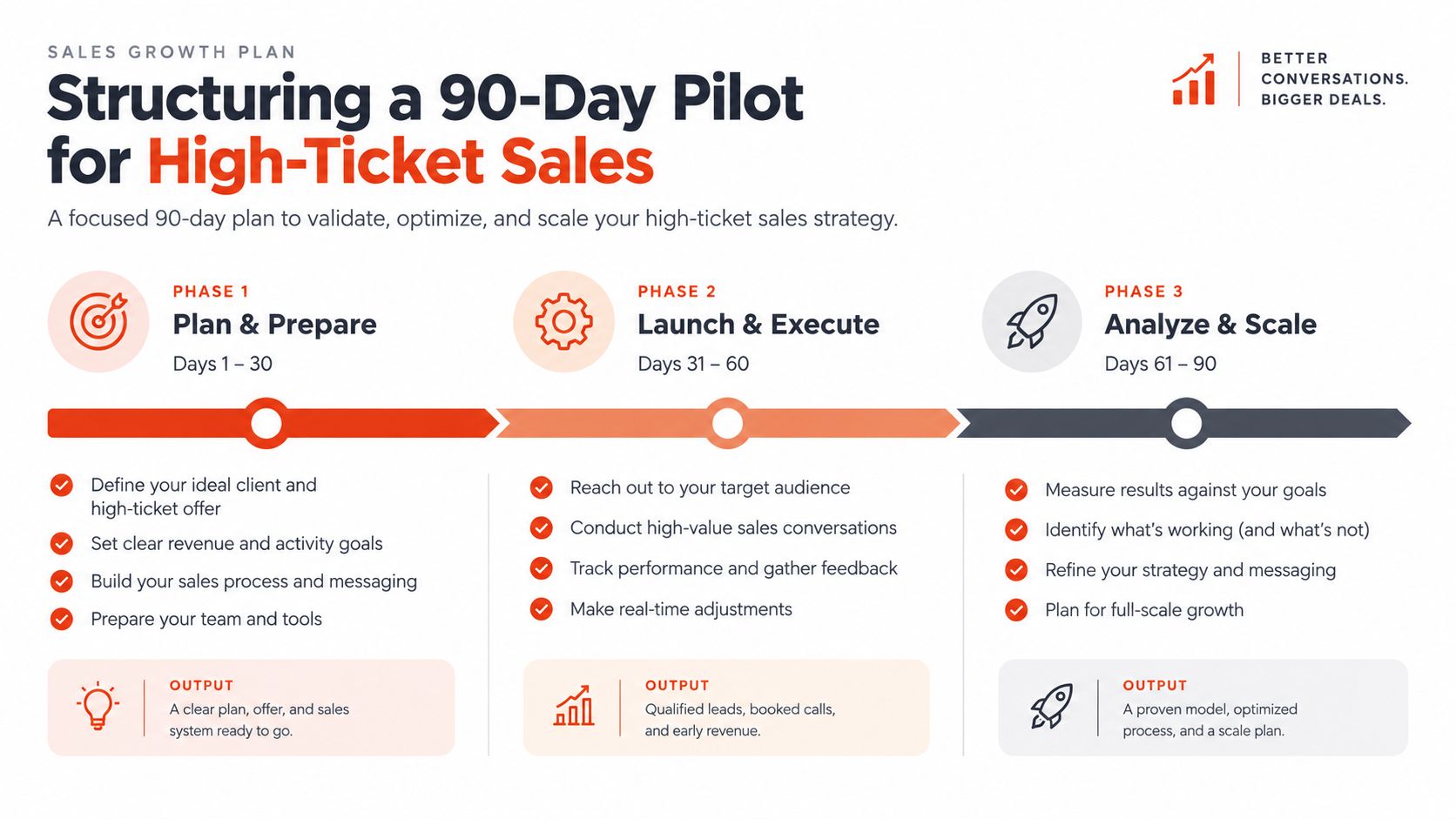
Scale only if the expanded cohort produces incremental qualified accounts and supports sales progression without eroding account quality. If the result is mixed, narrow the seed, strengthen exclusions, change the executive content pillars, or keep expansion as a limited discovery layer. If the feature produces reach without commercial movement, turn it off and invest in the authority and targeting foundations instead.
The pilot succeeds when sales can explain why an account was contacted and marketing can show what happened afterward.
The practical outcome isn't a larger audience for its own sake. It's a repeatable path from executive authority, to observable interest, to qualified human outreach, to measurable pipeline.
Ploot helps B2B teams build the LinkedIn audience of partners, directors, and senior managers, detect buying signals, and activate relevant prospects through LinkedIn or email. If you need to test executive-led audience expansion against qualified pipeline rather than impressions, visit Ploot to explore a three-month pilot with agreed success criteria.