

A director returns to your site to read about technology transformation. That behaviour may suggest their organisation is exploring a purchase, but it could also reflect research for a presentation or general learning. A buying signal is observable behaviour that suggests an organisation may be moving beyond awareness toward a purchase. It is evidence of direction, not proof of a deal.
A dashboard can show returning visitors, webinar attendees and reactions to a partner's LinkedIn posts. Those activities alone may not tell sales which accounts merit attention.
The useful question is which evidence justifies contacting a particular account now. Account context helps distinguish a meaningful clue from an isolated click. A smaller set of well-understood signals can guide outreach better than a long activity list.
Table of Contents
- What Buying Signals Are and Why They Matter
- Behavioural, Intent and Engagement Signals Compared
- Telling Passive Interest From an Active Buying Cycle
- Why One Person's Click Is Not Enough
- How to Detect Buying Signals Step by Step
- Where Buying Signals Mislead and Go Blind
- Timing Outreach to Book Qualified Meetings
What Buying Signals Are and Why They Matter
A director at a consulting prospect reads an article about technology transformation. That click could reflect general learning, preparation for a presentation or research for an active project. The same action means more when it fits a change in the organisation and appears alongside other relevant evidence.
A single footprint shows that someone passed by. A trail heading toward a door offers more direction, though it still cannot prove the visitor will knock. Buying signals work the same way: they guide attention, but they do not confirm a deal.

The business change behind the behaviour
Suppose a consulting prospect is exploring delivery governance. A broad article view offers little to act on. Repeated interest in implementation content, alongside a company restructuring its operating model, gives the activity a plausible business context. It still does not prove the organisation has chosen to buy.
Gartner describes B2B buying as a non-linear process involving recurring jobs such as problem identification, solution exploration, requirements building and supplier selection. Buyers may revisit these jobs rather than move neatly from awareness to purchase, as outlined in its research on the B2B buying journey.
That pattern helps explain why a prospect might explore suppliers, return to defining the problem, then reconsider requirements. Restructuring, new leadership, technology initiatives or changing requirements can help make a behaviour relevant. A content download alone cannot tell you which buying job is underway.
Practical rule: Treat a signal as evidence of direction, not proof of a deal.
What a useful signal should help you decide
For a marketing director, signals are useful when they help prioritise accounts. The aim is to distinguish companies worth monitoring from those where a well-informed conversation may help.
Ask four questions:
- Behaviour: What has the account done?
- Business relevance: Does the activity relate to a problem your team can solve?
- Context: Is there an organisational reason for the interest?
- Uncertainty: What still needs to be confirmed in conversation?
Behavioural, intent and engagement signals describe different evidence. Account triggers provide context for interpreting it. A few relevant clues, considered across an organisation, can support a better decision than a long dashboard of clicks. None is an automatic declaration that a prospect is ready to buy.
Behavioural, Intent and Engagement Signals Compared
| Signal | Family | B2B example | Strength alone | What it suggests |
|---|---|---|---|---|
| Repeat visits to pricing or implementation pages | Behavioural | The same account returns to commercial and rollout information | High | Evaluating cost and effort |
| Use of ROI calculator or assessment tool | Behavioural | A finance contact runs a cost model on your site | High | Building a business case |
| Category or comparison searches | Intent | Research combines a consultancy category with a competitor's name | High | Comparing options |
| Visits to review or comparison sites | Intent | Staff investigate independent reviews of your category | Medium-high | Building a shortlist |
| Gated content download | Engagement | A contact downloads a whitepaper | Low | Interest in a topic |
| LinkedIn profile visit by a decision-maker | Engagement | A director views a partner's profile after a post | Low | Curiosity worth monitoring |
| Comments or reactions on expert posts | Engagement | A CFO comments on a delivery problem | Low-medium | Problem awareness |
| Webinar or event attendance by several people | Engagement | Colleagues attend a session on AI adoption | Medium | Shared interest in a topic |
| New senior hire or changed role in target account | Account trigger | A new CMO joins a target company | Medium, as context | A possible change in priorities or vendors |
These strength labels are working judgements, not measured conversion probabilities. “High” means the action deserves investigation, not that a meeting or purchase is likely.
What each family tells you
Behavioural signals describe activity on your owned properties. Pricing visits, implementation research and assessment-tool use reveal what someone is examining. They don't establish whether that person controls budget or represents an approved project.
For a hypothetical B2B software trial, a finance contact opening pricing and security documentation suggests practical evaluation. It still leaves open whether they're assessing a purchase, checking an existing arrangement or helping someone else.
Intent signals concern research beyond your website, including category searches, supplier comparisons and review activity. Keep the research behaviour separate from the audience you build around it. A guide to custom intent audiences can help clarify that distinction, but audience membership shouldn't be treated as confirmation of an individual's purchase plans.
Engagement signals describe interactions with people and content. A substantive comment on a partner's post gives you different information from a reaction: the comment may reveal the problem someone recognises, while the reaction may reveal little beyond interest.
Account triggers add context, not certainty
A new CMO, restructuring, funding announcement or technology programme can make those actions more relevant. But a trigger alone doesn't prove that your category is a priority.
The strongest interpretation comes when different families support the same explanation. Be careful about duplication: a webinar registration, confirmation-email click and attendance record may all reflect the same underlying action. Counting them separately can make an ordinary interaction look unusually important.
Telling Passive Interest From an Active Buying Cycle
In its 2025 study, MarketOne reported that UK and Irish B2B buyers controlled 57% of the journey before vendor contact, compared with 61% globally, illustrating how much research can happen before a sales conversation in its B2B buyer study.
Silence, then, isn't a reliable stage label. A more useful approach is to classify the evidence you can see while keeping your confidence separate from the buyer's confirmed status.
The visual below provides an orientation, not a substitute for qualification.
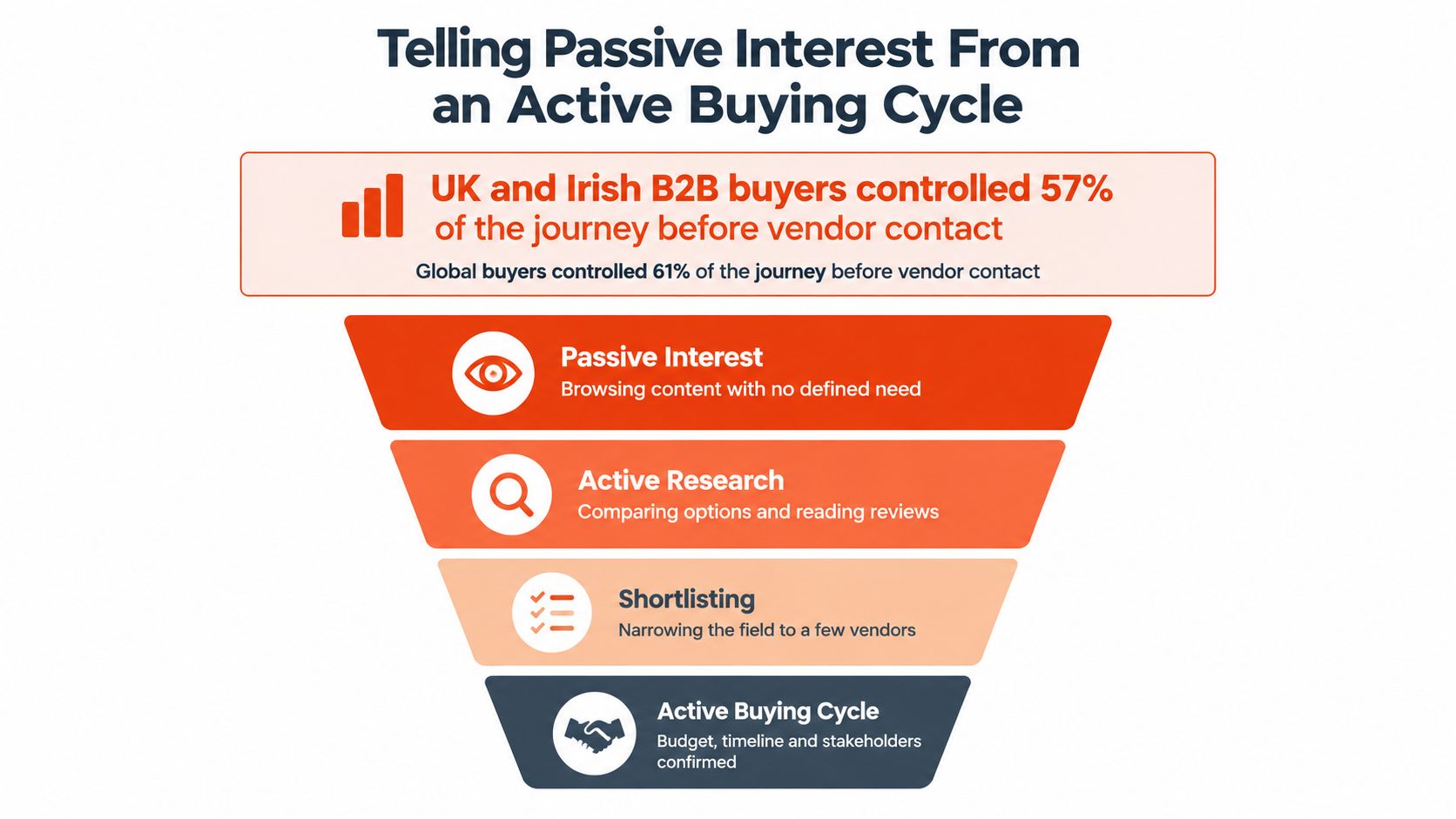
From awareness to evaluation
Follow a hypothetical account researching an HR technology change:
- Awareness, low confidence: A senior manager reads a broad article about workforce planning. There's topic interest, but no visible purchase problem.
- Consideration, medium confidence: The account returns to content about fragmented workforce data. A consistent problem theme gives you a reason to keep watching.
- Evaluation, high confidence: Implementation research appears alongside supplier comparisons and participation from other relevant colleagues. Outreach may now be useful if the account fits.
- Decision-stage evidence, very high confidence: Requirements-focused questions, senior stakeholder involvement and a documented organisational change support a stronger interpretation. Budget and authority still need confirmation.
These are proposed operating categories, not scientifically calibrated scores. Very high confidence in your interpretation isn't the same as a confirmed buying decision.
Check alternative explanations before contacting anyone
The same activity could come from students, competitors, journalists, job seekers or existing customers. A pricing-page visitor might be doing competitive research, while someone reading implementation documentation may already use your product.
Before assigning a stage, check the account relationship, the person's role where known, and whether the topic matches a plausible business need.
Start outreach when you can explain why a conversation would help the account, not merely why its activity attracted your attention.
For long, high-ticket sales cycles, evaluation-stage evidence from a suitable account is a sensible starting threshold. Keep the classification provisional, and let the buyer's answers determine what happens next.
Why One Person's Click Is Not Enough
A director at a consulting firm reads a post about project overruns. That click gives you a clue about one person's interest, not proof that the firm is evaluating a solution. In B2B sales, the decision often involves several colleagues with different concerns, so account context matters more than a longer list of individual clicks.
Gartner found that 74% of B2B buyer teams experience unhealthy conflict during the decision process, according to its buying-team evidence and Gartner's consensus findings. Participation from multiple people can indicate that a business issue is under review, but it does not show that they agree. A highly engaged contact may be enthusiastic while colleagues still question the cost, feasibility or need.
Look for complementary activity
Now suppose an operations colleague from the same firm reads implementation material, while someone in finance examines the business case. Together with the director's interest in project overruns, these actions suggest people are approaching the same potential problem from different angles. They still do not prove the firm has chosen a provider or is ready to buy.
Look for patterns that connect activity to the account:
- Role coverage: Are commercial, operational or financial perspectives represented?
- Problem consistency: Does each person's activity relate to the same underlying need?
- Complementary questions: Are colleagues exploring feasibility, value and delivery, rather than repeatedly viewing broad introductory material?
- Known relationships: Is this a new prospect, an existing client or an account already speaking with sales?
A lone click is like one piece of a puzzle: it may be useful, but it cannot show the whole picture. Related activity from colleagues provides a stronger reason to investigate, especially when their roles and questions fit a shared business issue.
Participation still isn't consensus
The careful conclusion is that the account may be investigating a shared issue. You cannot infer that everyone supports the same solution, that finance approves the spend or that procurement is ready. Record the interpretation as provisional. “Possible delivery-governance evaluation” is more accurate than “purchase-ready.”
If you use HubSpot, the same distinction applies when reviewing lead-scoring approaches. An individual score can help manage contacts, while account prioritisation requires evidence from the wider group. Use that evidence to decide whether a conversation could help, then let the buyer's answers test your interpretation.
How to Detect Buying Signals Step by Step
A pricing-page visit can look like buying intent, but it may come from a student, a competitor or someone researching a different project. A defined review process helps sales and marketing connect activity to a relevant account before treating it as evidence of a buying cycle.
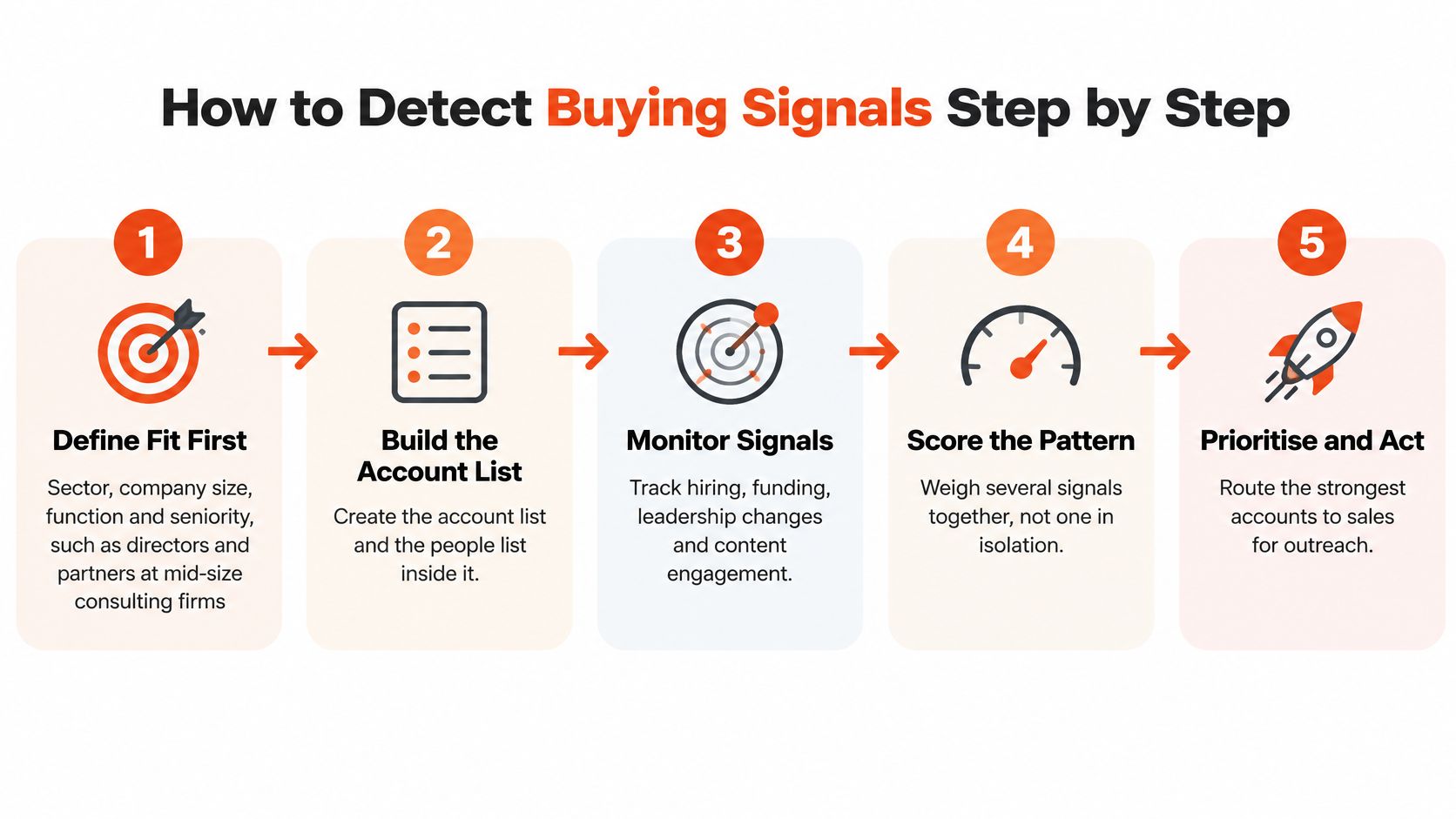
Build a usable evidence record
Define fit before monitoring activity. Set the sectors, company size, geography, functions and seniority relevant to your offer. A consulting service, for example, might suit directors and partners at mid-size firms. This keeps a single visit from qualifying an account by itself.
Map accounts and people together. Record relevant functions, known relationships and likely responsibilities at each target account. Titles are clues, not a map: directors at different firms may own very different decisions.
Collect evidence from complementary sources. Use site analytics for activity on your properties, LinkedIn for visible engagement, available third-party intent data for external research, and CRM notes for account changes. Each source offers a partial view. Tools may not identify every visitor or reveal private searches.
Tag the signal family and likely stage. Where available, preserve the action, date, topic, source and account connection. A pricing-page visit and a general blog view should remain distinct, just as a detailed product question differs from casual browsing.
Turn observations into decisions
Score the account pattern. Consider recency, repetition, topic relevance, fit and participation by distinct stakeholders. Independent evidence should build confidence more than duplicate records of one interaction. Old activity should not keep an account high on the list indefinitely.
Set an outreach threshold sales can explain. Require a suitable account, recent evaluation evidence and confirmation from another relevant source or stakeholder. A trigger should have a plain-language reason behind it, so teams can review and improve the rule.
Review outcomes regularly. Track whether flagged accounts led to meetings, whether those conversations uncovered a real business problem, and why false positives occurred. Booked meetings alone are a weak basis for adjusting weights if the conversations were not commercially relevant.
For example, a consultancy account may deserve review when a director repeatedly examines rollout material while colleagues research supplier comparisons. A student reading an introductory article does not become a qualified account through engagement alone.
The accompanying video presents the buying-signal workflow in video format.
Keep a short explanation beside every prioritised account: what happened, why it matters and what remains unknown. Like a case file, it should connect the evidence to the account and make uncertainty visible. That gives reviewers a clear basis for action without mistaking a score for proof.
Where Buying Signals Mislead and Go Blind
A dashboard shows the activity your systems can observe, not the full buying process. Treating those records as the whole story is like judging a committee's decision from one person's calendar: the evidence may be real, but the conclusion is incomplete.
More signals must mean more opportunity
More records can mean duplicate tracking, irrelevant activity or engagement from an unsuitable account. Automation that reacts to every event just sends more noise to sales.
Ask reviewers to explain the business hypothesis behind each alert. If the activity does not connect to a plausible problem at a suitable account, keep it under observation instead of starting outreach.
Review test: Could a salesperson explain this account's priority without mentioning its numerical score?
A form fill identifies a contact, not a buying decision
A form submission confirms that one contact completed an action. It does not establish that person's role in the decision, reveal the buying group or prove readiness to buy.
The reverse is also true: an account can be evaluating a solution without anyone submitting a form. Treat declared interest as one piece of evidence, not the boundary between demand and no demand.
Practical corrections include:
- Separate identity from readiness: Knowing who engaged does not explain why.
- Keep unknowns visible: Missing budget or timing details are unknown, not proof of qualification.
- Preserve account history: Existing relationships may explain activity that otherwise looks like new demand.
Some meaningful signals can't be traced
A prospect might discuss vendors in a private AI conversation, or see your company in an AI-generated shortlist. Website analytics cannot reveal those interactions, identify who saw the shortlist or prove that a specific account is evaluating you.
Forrester's analysis of zero-click B2B buying discusses AI's influence on B2B research. That broader shift does not make private research visible to your team or connect it to an account.
Look for indirect clues, such as public questions, relevant peer discussions, changing account-level engagement and participation from different stakeholders. These clues can guide investigation, but they cannot confirm what happened privately.
The practical response is to combine observable evidence with account context and human review. Several relevant clues across an account provide a stronger basis for judgment than a long dashboard of clicks, while some accounts will remain unclassified.
Timing Outreach to Book Qualified Meetings
Timing should follow the signal pattern, not a generic campaign calendar. A relevant account actively comparing implementation options deserves a different response from someone who downloaded introductory content.
Use the following contact windows as qualitative operating guidance, not measured response-time benchmarks.
| Signal pattern | When to reach out | Opening move |
|---|---|---|
| Job change in a target account | After checking the new remit and relevant priorities | Congratulate them and offer a short priorities review |
| Several people from an account recently active | Promptly after validating fit and the shared topic | Share an insight addressing the apparent problem |
| Repeat pricing or implementation visits by a person | After checking context and corroborating evidence | Offer an existing, relevant case study or implementation resource |
| An isolated content download or profile visit | Don't contact on that evidence alone | Continue useful expert-led content and watch for stronger evidence |
The visual below illustrates a possible sequence. Treat its calendar windows as hypotheses to test, not universal rules.
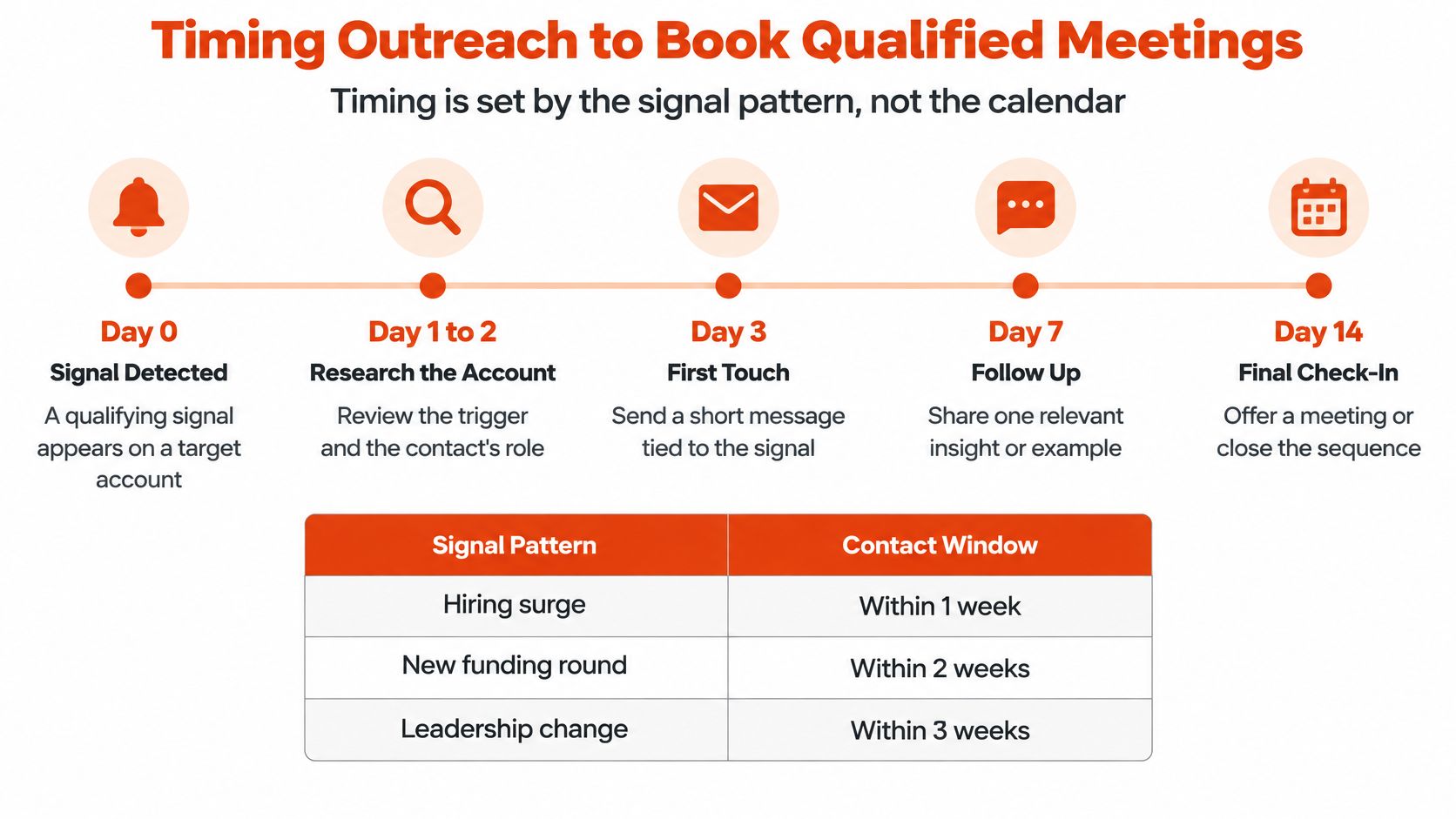
Begin with account research, not the message
Before sending anything, confirm fit, review existing CRM conversations and check whether another colleague already owns the relationship. Choose a sender whose expertise matches the problem, such as a consulting partner addressing delivery governance.
The opening should demonstrate relevance without reciting surveillance. Don't tell a prospect exactly which pages they visited. Connect a public business change or relevant topic to a useful insight, then offer help without assuming an approved project exists.
For example, a message about a newly announced technology programme could offer a readiness checklist. The buyer can accept the resource, correct your interpretation or explain that the issue isn't a priority.
Follow up to validate, not pressure
If there's no response, follow up with something that helps the buyer assess the problem. Offer a diagnostic conversation with a clear purpose, such as identifying implementation dependencies or reviewing stakeholder requirements.
For additional reading on proactive outreach, Visbanking's guide to proactive outreach provides a separate resource. Keep that activity connected to your broader outbound sales lead-generation process, rather than running signal-triggered messages as an isolated campaign.
Use a bounded sequence, account for holidays and known absences, and return unresponsive accounts to monitoring. Silence doesn't justify escalating pressure.
Measure meetings booked from flagged accounts, then check whether those meetings uncovered a stated problem and a plausible next step. Review unsuccessful alerts as carefully as successful conversations.
The timing rule is simple: contact when the evidence supports a useful conversation, then let the buyer confirm the need.
Ploot builds the LinkedIn audiences of partners, directors and senior managers, detects interest in those audiences and contacts relevant prospects to book qualified sales meetings. Visit to discuss how an expert-led, signal-based approach could support your pipeline, with agreed criteria for judging meeting quality rather than reach alone.