

A marketing team can have a busy LinkedIn presence, strong follower growth and posts that attract reactions, yet still struggle to book meetings with the companies it wants to win. The problem often isn't a shortage of attention. It's that attention isn't connected to named accounts, relevant buying roles or a clear next step.
Account based marketing on LinkedIn reverses the usual sequence: choose the companies first, then coordinate content, signals and sales conversations around them. The practical test isn't how many people saw a post. It's whether the right accounts move towards a qualified meeting and pipeline.
Table of Contents
- How LinkedIn ABM Works Stage by Stage
- Build a Tiered Target Account List
- Map Buying Groups and Assign Your Profiles
- Read Buying Intent Signals Without Overreacting
- How to Time Outreach and Book the Meeting
- Measure Pipeline and Run a Pilot
How LinkedIn ABM Works Stage by Stage
| Stage | LinkedIn Action | Signal to Advance | Metric |
|---|---|---|---|
| 1. Define target accounts | Build a named list ranked by fit | Account matches industry, size and service need | Accounts scored and tiered |
| 2. Map buying groups | Identify economic buyers, evaluators and users | Two or more roles found per account | Buying-group coverage |
| 3. Build credibility | Post expert content from partner and director profiles | Repeat engagement from target roles | Account reach |
| 4. Detect intent | Track reactions, comments and profile visits | Multiple contacts at one account engage | Engaged accounts |
| 5. Route conversation | Personal message from the most credible profile | Reply or meeting accepted | Meetings booked |
A team that starts by building a broad audience of followers can generate reach without identifying companies it can sell to. The order above fixes that: marketing defines the list, sales and marketing map the buying group, senior profiles build category credibility, and the team checks for account-level engagement before sales starts a personal conversation.
The account, not the individual lead, is the unit of progress. A single person reacting to a post may be curious, but that doesn't establish that the company is evaluating a solution. Look for relevant activity across roles, then check the account's sales context before acting.
LinkedIn reported that 56% of more than 800 B2B marketers worldwide said their organizations were already using ABM in a 2025 survey, and more than 80% planned to increase ABM budgets during the following year, according to LinkedIn's account-based marketing survey. For teams selling consulting, technology or software with long sales cycles, the decision is less about whether ABM is a real operating model and more about whether the workflow connects marketing activity to sales outcomes.
To make the first stage concrete, use a saved Sales Navigator account list and a shared account matrix. A practical guide to building account lists with Sales Navigator can help your team turn its criteria into a usable starting list.
First-week test: Can you name the accounts you want to win next quarter, and the profile that will speak to each one? If not, start with account selection, not another post or broader audience.
Build a Tiered Target Account List
Accounts come before audience. Start with a shortlist of companies your team can serve well, rather than asking how to expand the number of people who might see a campaign.
Score each candidate against industry, geography, company size and service need, then include estimated deal value. Agree on the cutoff with sales before you build the list. An account that fits the industry but lacks the need your service solves shouldn't receive the same attention as a company with a clear problem and a strong commercial fit.
The LinkedIn and Bain buyer-group finding offers a reason to avoid thin account lists: 81% of senior B2B buyers said the product they ultimately purchased was known by everyone in the buying group on day one, while 4% said the purchase occurred when awareness was limited to a few decision-makers. The takeaway for your list is practical. Choose accounts you can cover across relevant roles, not just companies that look attractive on a spreadsheet.
For a Spanish consulting firm with a long sales cycle, a tightly selected list of 20 to 40 accounts is a useful pilot scope, not a universal benchmark. It gives marketing and sales room to research each company, adapt content and follow up. Four hundred loosely matched accounts can create activity without enough focus to learn which companies are progressing.
| Tier | Deal Value and Need | Coverage | Owner |
|---|---|---|---|
| Tier 1 | High deal value, live need | Three to five profiles plus full buying group | Named sales owner |
| Tier 2 | Strong fit, smaller deal | Two profiles and key roles | Named sales owner |
| Tier 3 | Sector fit, unclear timing | Company page and one profile | Marketing owner |
Tier 1 gets the deepest research and coordinated profile activity. Tier 2 gets focused coverage of the decision-makers and evaluators most likely to matter. Tier 3 stays visible with lighter effort until timing or need becomes clearer.
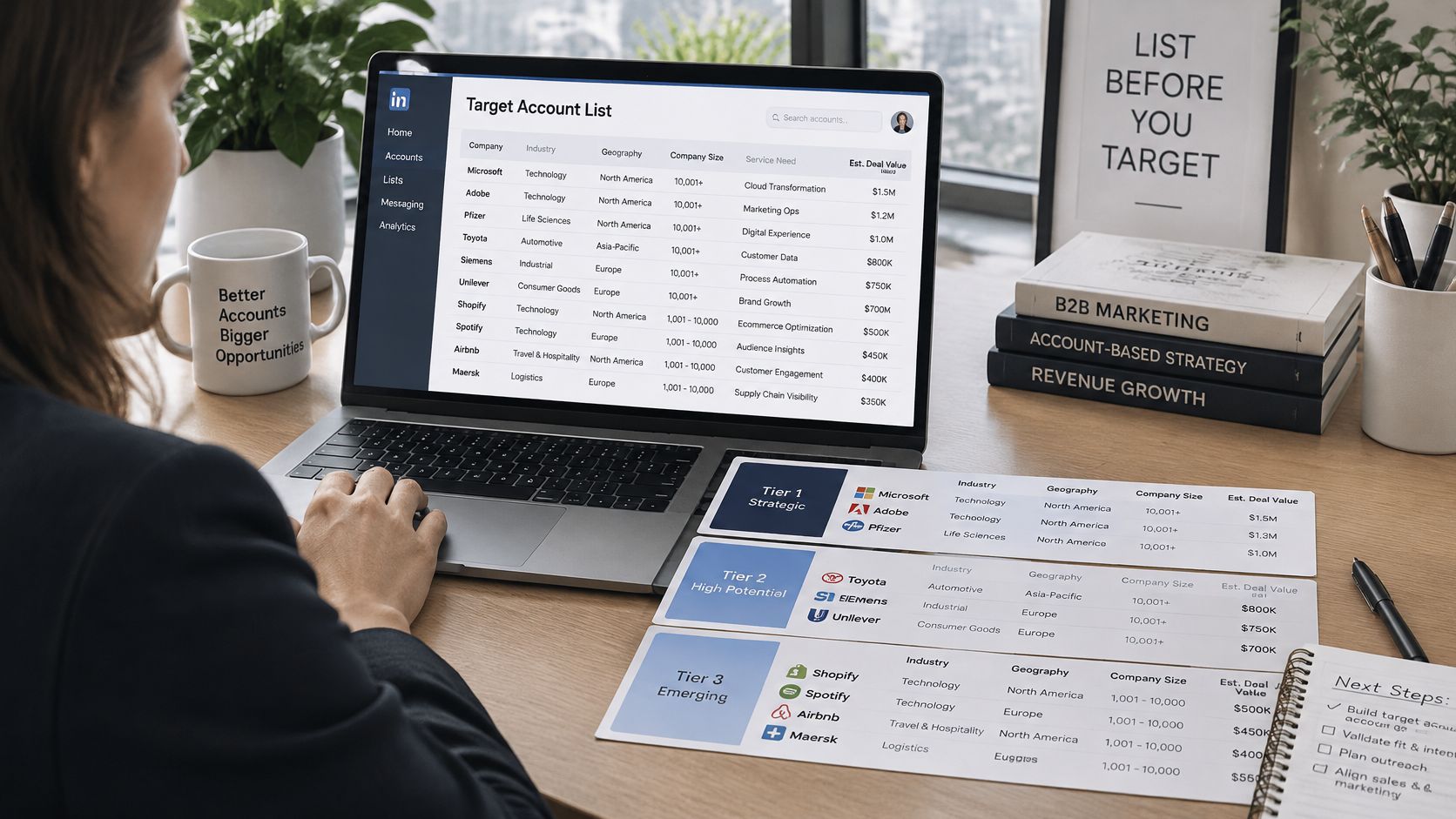
Build the list as a saved account list in LinkedIn Sales Navigator. Filter by industry, geography and company size, rank accounts in a matrix, then move that matrix into your CRM so every account has a tier, sales owner, reason for inclusion and last-review date. Review the list quarterly. Leadership, priorities and budget can change, and an account that once fit may no longer deserve active coverage.
For a more detailed approach to audience criteria, use this guide to LinkedIn audience targeting. Then draft a Tier 1 list of five companies and write one clear reason each fits. If the reason is vague, the account probably needs more research before it earns priority.
Map Buying Groups and Assign Your Profiles
Targeting one executive is a common shortcut, but it leaves the rest of the buying process unaddressed. A purchase may involve the person who controls the budget, the person who evaluates the approach, the team that will use it and people who can influence or slow the decision.
Map those roles before deciding which of your team's profiles should build the relationship. A partner may have the authority and sector credibility to speak with an economic buyer. A senior manager can discuss delivery methods with a technical evaluator. A director in the relevant service line may be the most credible peer for a department head or champion.

| Buying Role | Typical Titles | Profile to Use | What to Share |
|---|---|---|---|
| Economic buyer | CEO, managing partner, CFO | Partner with sector authority | Business outcome and risk case |
| Technical evaluator | IT director, solutions lead | Senior manager in the practice | Method, proof and case detail |
| User or champion | Department head, team lead | Director in the service line | Practical how-to and peer stories |
| Influencer | HR or procurement lead, analyst | Director or senior manager | Benchmarks and category content |
Say the target is a mid-size consulting firm. The managing partner may care about the commercial outcome and risk of choosing an unproven approach. The IT director may want to understand the method, integrations and delivery implications. The HR lead may be assessing how a change will affect people and adoption. Sending all three the same message misses those distinct concerns.
Find likely contacts through the account's leadership page, public professional profiles and recent company announcements. Record each role, named contact, profile responsible for engagement, relevant content theme, observed activity and next action in the named-account matrix. This doesn't need to become a research project: start with the people most likely to shape the decision, then fill gaps as the account responds.
A short example of how teams can think about using LinkedIn in B2B outreach is available below.
Messages should come from the team's own LinkedIn profiles or email addresses, not from a brand account, and should mention what the person engaged with. Keep the mapping useful by attaching a message angle to every named contact, rather than collecting titles without a reason to contact them.
Don't call an account covered until at least two buying roles have a named contact. Then check whether each role has a message that speaks to its actual concern.
Read Buying Intent Signals Without Overreacting
One employee likes a post, and the team sends a sales message that afternoon. That's a familiar mistake: treating an individual interaction as proof that a whole company is ready to buy.
Sort activity by strength instead. A comment that asks a relevant question, a profile visit from a buying-group role after a specific post, or repeated engagement with high-intent content can justify closer review. A reaction from one person, a company-page follow or a view of case-style content is worth monitoring, but not enough on its own to assume a live buying process.
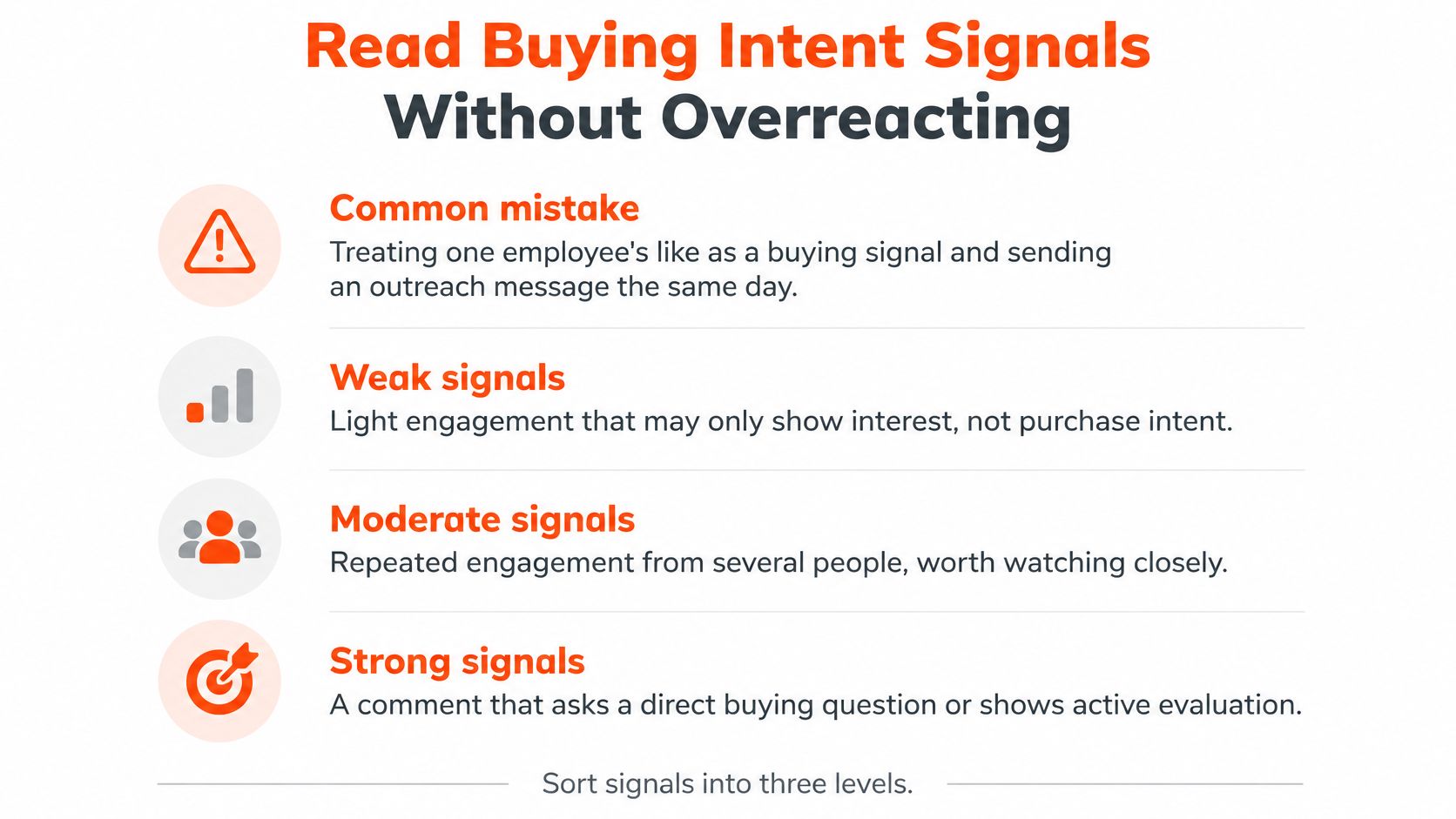
Use this working classification:
- Strong signals: A buying-group contact asks a direct question in a comment, visits a relevant profile after engaging with a post, or repeatedly engages with high-intent content.
- Medium signals: A single person reacts to content, follows the company page or views a case-style post.
- Weak signals: A one-off like, a generic repost or activity from someone outside the mapped buying group.
A practical outreach rule is to move an account forward when at least two buying-group roles show strong or medium signals within the same 30-day window, then check the CRM to confirm there isn't an active deal already underway. This is an operating threshold, not a claim that a particular pattern guarantees purchase intent. It gives the team a consistent way to separate account momentum from isolated activity.
The distinction between activity and intent is central to understanding B2B intent data. To supplement LinkedIn signals, teams can also learn how to spot accounts already researching vendors. Treat these as inputs to judgment, not a reason to automate a pitch.
Review signal rules monthly and adjust them when sales feedback shows they're producing irrelevant conversations. Tier matters too: strong activity at a Tier 3 account may warrant monitoring, while the same pattern at a high-priority account may merit prompt, carefully researched follow-up.
This week, scan the named account list, mark the roles behind each interaction, separate strong from medium and weak signals, and check CRM status before routing anything to sales. If only one person has engaged, keep listening instead of forcing a meeting.
How to Time Outreach and Book the Meeting
Outreach works best when it responds to a real interaction and arrives from someone with a credible reason to start the conversation. Use this sequence to keep the message personal without turning it into mass prospecting.
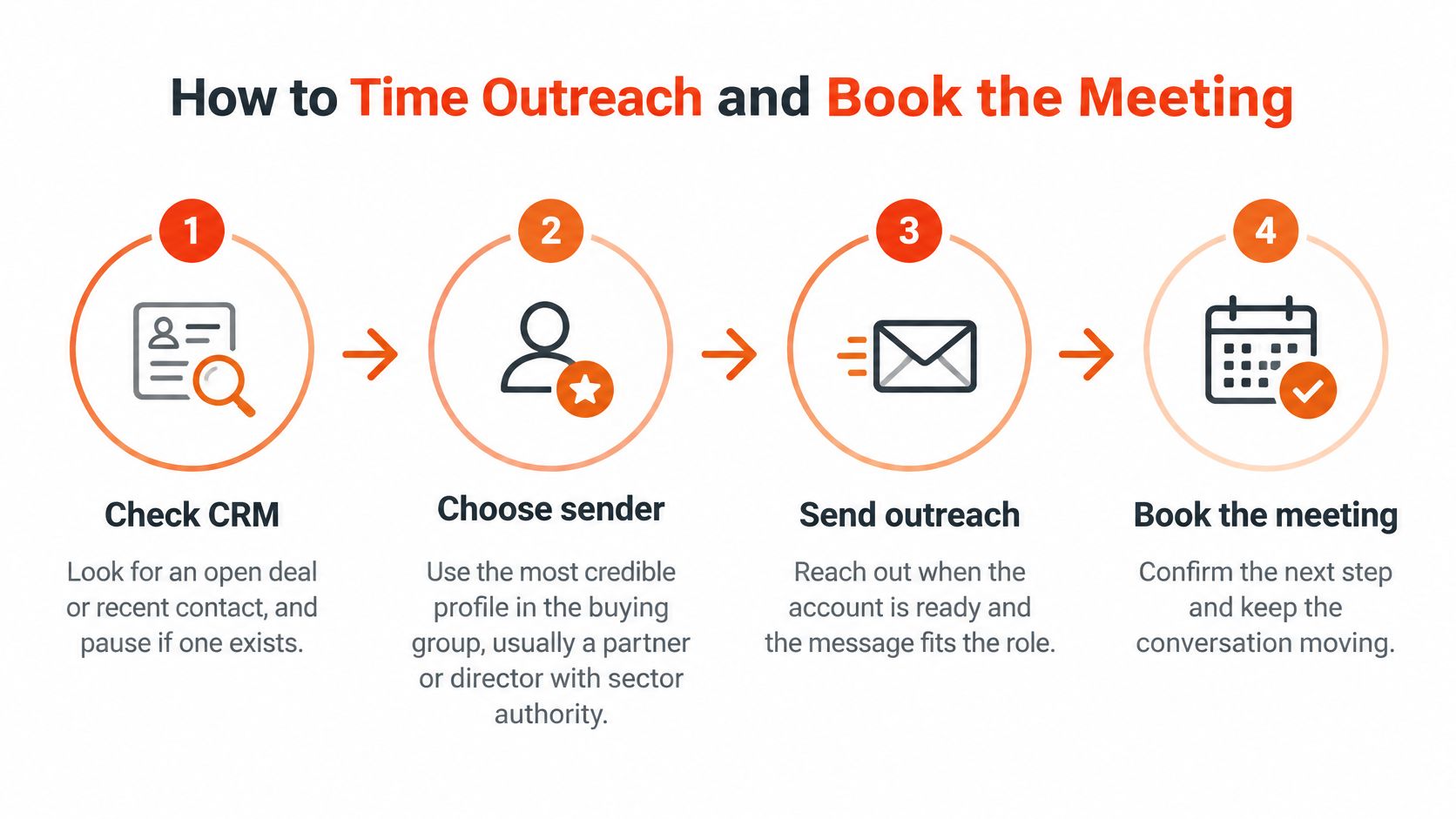
Check the CRM first. Look for an open deal or a recent conversation with the person or account. Pause if one exists, then coordinate with the current owner so the prospect doesn't receive conflicting messages.
Choose the sender. Use the profile with the strongest connection to the person's role and sector, often a partner or director. A senior title alone isn't enough; the sender needs a credible reason to discuss the topic.
Write to the interaction. Mention the post, comment or topic the person engaged with, then ask one specific question about their situation. Keep the message under 80 words and leave the pitch out.
Send from a personal profile. Don't send the note from a brand account. Ploot's approach is to use the team's own LinkedIn or email profiles and refer to what the person looked at, rather than presenting a generic company introduction.
Wait before following up. Give the person two working days to reply. If they don't, send one follow-up with something useful, such as a relevant checklist or benchmark, then stop contact for 14 days.
Handle “not now” as useful timing information. Record the reason and a date to revisit, then return the contact to nurture rather than treating the reply as rejection. Qualified prospects can move into meetings, while people who say “not now” can return to campaigns.
Make a positive reply easy to act on. Offer two specific time slots within the next week and state the meeting agenda in the invitation. That gives the prospect a clear choice and tells them what the conversation will cover.
A starting line might be: “I noticed your comment on our post about [topic]. Is [specific issue] something your team is evaluating this quarter?” Adapt the detail to the person's role and the interaction they had. A message that opens with the company pitch instead of the prospect's expressed interest breaks the sequence before the conversation has begun.
Measure Pipeline and Run a Pilot
A campaign that generates reactions but no qualified conversations has not proved pipeline impact. Judge it from week one on booked meetings and pipeline per account, not impressions. A single employee's interaction is noise until the account shows multiple engaged roles. Set account-level measures before launch, then use the CRM to connect activity across roles with meetings, opportunities and revenue. LinkedIn's campaign measurement announcement describes qualified-lead optimization, first-party data matching, account-level revenue attribution and a 365-day lookback window; the LinkedIn campaign measurement announcement covers the details.
Use a funnel that starts with account engagement and ends with commercial outcomes. Define an engaged target account as one with activity from at least two roles, and review that list weekly. Track buying-group coverage monthly, qualified conversations weekly, meetings monthly, and opportunities and pipeline value quarterly. Review revenue influenced quarterly using the 365-day lookback, which helps account for long buying journeys.
| Metric | What It Shows | Counted At | Review Cadence |
|---|---|---|---|
| Engaged target accounts | Accounts with two or more roles engaged | Account | Weekly |
| Buying-group coverage | Share of buying roles with a named contact | Account | Monthly |
| Qualified conversations | Replies that show a real problem and timing | Account | Weekly |
| Meetings booked | Calls held with a buying-group role | Account | Monthly |
| Opportunities and pipeline value | Deals created and their size | Account | Quarterly |
| Revenue influenced | Closed revenue touched by LinkedIn activity over a 365-day lookback | Account | Quarterly |
Tag each CRM opportunity to its account and record the buying roles that interacted. That gives the team a way to assess whether activity from a partner, director or senior manager preceded a meaningful conversation. A sales opportunity should represent a real person who fits the ideal customer profile, has shown buying intent through an interaction or signal, and reaches sales with context, not just a contact record.
The 2024 6sense ABM benchmark found that organizations with ABM practices recorded a 15% coefficient of variation, compared with 21% for organizations without ABM practices. A lower coefficient of variation means less relative dispersion, so performance is more predictable across accounts. The same benchmark found that ABM practice and buying-group-centric measurement were each independently associated with better financial performance. These are associations, not guarantees that an individual LinkedIn program will produce a particular result. Set your own baseline and judge the account journey, not just the platform metrics.
Set the pilot rules before launch
A three-month pilot can test early indicators. Complex B2B sales cycles often run past that window, so the pilot should assess account progression and meeting quality rather than closed revenue alone. Agree the decision criteria in advance. Use a pilot success criteria template to keep the team aligned on what counts as progress and what would trigger a change.
- Select the account set. Choose 20 to 40 accounts across the tiers, as a practical pilot scope, and document why each belongs.
- Define role coverage. Decide which buying roles each tier needs before an account can count as covered.
- Set the signal threshold. Specify which activities qualify and how many roles must engage before sales outreach begins.
- Agree on meeting and pipeline targets. Define what counts as a qualified meeting and how the team will record opportunity creation and value.
- Assign follow-up ownership. Name the person responsible for checking CRM status, routing signals and recording outcomes.
At week six, check whether the threshold is producing relevant conversations. Compare cost per meeting, calculated as total program spend divided by meetings booked, with the current events budget. Also review whether meetings include buying-group roles and whether the conversations identify a real problem and timing. A campaign can make commercial progress with modest reach if it moves a strategically valuable account forward; reach by itself can obscure that result.
If the pilot meets its agreed criteria, expand to the next wave of accounts. If it doesn't, adjust the signal threshold, tier list or message before adding more profiles. Adding activity without fixing the weak point makes the program larger, not more useful. Ploot's full system covers content, intent detection and personalized follow-up, and plans differ only in the number of active LinkedIn profiles.
If your team is ready to connect LinkedIn activity to qualified conversations, start by defining the accounts, roles and meeting criteria you'll use to judge progress. Ploot helps B2B teams build the LinkedIn audience of their senior profiles, detect buying intent and contact interested prospects at the right moment.