

57% of B2B purchasing decision-makers bought a tool without meeting the vendor's sales team, according to HubSpot's 2024 survey of 422 U.S. B2B purchasing decision-makers, which also found that 75% preferred gathering product information independently. A missing sales conversation doesn't necessarily mean a missing buying process.
That's why B2B intent data is a timing and confidence problem, not a shortcut to a list of ready buyers. The useful question isn't who clicked. It's whether you have enough evidence to justify a particular human action without damaging trust.
Table of Contents
- What B2B Intent Data Actually Shows
- Sources and Signal Types Worth Tracking
- Scoring Intent and Ruling Out False Positives
- Using Intent in Demand Gen ABM and Sales
- Privacy Limits on Intent Data
- Pilot Intent Data Against Real Pipeline
What B2B Intent Data Actually Shows
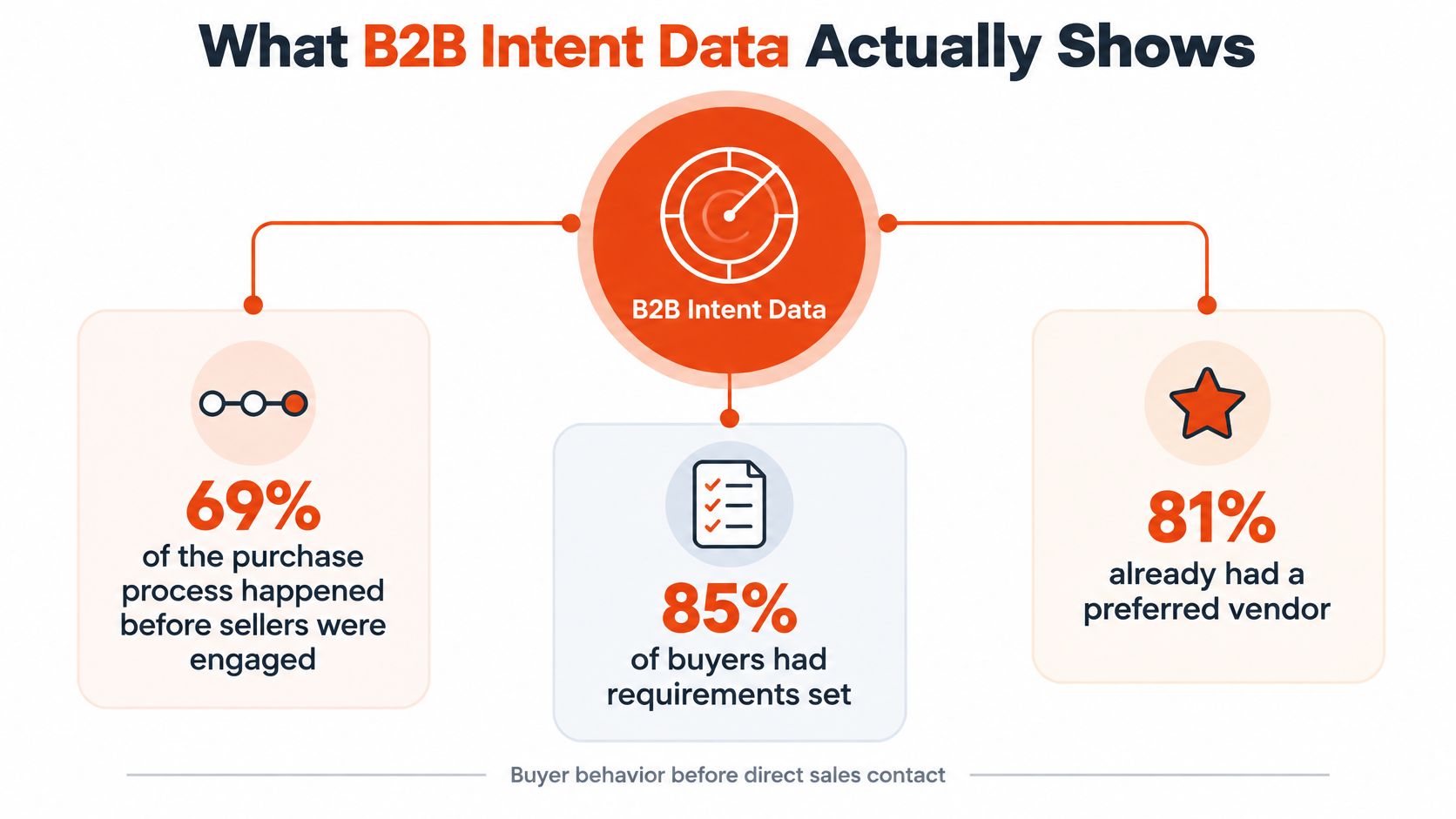
In the 6sense 2024 Buyer Experience Report, which analyzed 2,509 recent B2B buyers, 69% of the purchase process occurred before buyers engaged with sellers, 85% had established purchase requirements before contacting sales, and 81% had selected a preferred vendor before speaking with a sales representative. For a marketing director, the implication is uncomfortable: a newly captured lead may already have a well-developed shortlist.
B2B intent data is observed research and engagement that suggests an account or person may be evaluating a problem, category, or solution. It can capture activity before someone fills out your form or books your call, although explicit requests can also contribute to the picture.
The buying pattern looks like this:
Separate interest from identifiable engagement
Say an operations team is considering new workflow software. Someone reads about process bottlenecks, colleagues compare platforms, and a director later comments on an implementation discussion.
Those events belong to different evidence layers:
- Topic interest means someone is consuming material about a problem. They might be learning rather than shopping.
- Account-level research means activity can be associated with a company. It doesn't necessarily identify the people involved.
- Person-level engagement means a particular individual took an identifiable action. Their role and reason for engaging still need interpretation.
The distinction matters because sellers can easily turn company-level evidence into an unsupported claim about a person. A finance director's employer researching workflow software doesn't establish that the director personally evaluated your product.
Use intent as a forecast
Think of intent as a weather report for a buying journey. It helps you decide whether to prepare, pay attention, or change your timing. It doesn't guarantee rain.
A signal should change your next decision, not erase your uncertainty.
Intent isn't a purchase order, a complete lead score, or permission to pitch. You still need account fit, credible communication, and a sensible reason to involve the recipient.
For another practical perspective on interpreting these clues, how H2 approaches B2B buying signals provides useful context alongside your own qualification rules. Keep the operational decisions separate: which signal deserves attention, how much confidence it supports, and which human action it justifies.
Sources and Signal Types Worth Tracking
B2B intent sources and what each signal can prove
| Source | Typical events | Identifies | Main limit |
|---|---|---|---|
| First-party website | Pricing, comparison, demo or solution-page clusters | Account or anonymous visitor | Most visitors never fill a form |
| Review and comparison sites | Category or competitor-page research | Account in evaluation | Vendor identity may be unclear |
| Publisher and data co-ops | Topic surge or content-syndication spike | Category interest at account level | Delayed and often sold to many sellers |
| Search or bidstream topics | Repeated category or problem keywords | Early awareness | Noisy and privacy-constrained |
| Professional network | Profile visits, comments, saves or repeat post engagement | A specific person plus topic | Not budget, authority or consent to be sold to |
| CRM, product or sales history | Open opportunity, usage change or prior meeting | Known account context | Misses net-new anonymous research |
Distinguish observed events from inferred topics
First-party behavior is specific to your business. A visit to your integration documentation tells you more about the subject being explored than a broad category label does. But unless the visitor identifies themselves through an appropriate mechanism, avoid attaching that activity to a named contact.
Review-site activity can be closer to evaluation, particularly when someone compares alternatives. Even then, distinguish research about your category from research about your particular offering. Those deserve different messages.
Publisher co-ops and search-derived topics can reveal activity beyond your own properties. Before using them, inspect the delivery timestamp, topic definition, collection method, and distribution terms. Don't assume an alert is immediate, exclusive, or based on a direct product comparison.
Read professional activity in context
Professional-network activity adds conversational context. A comment about migration risk gives a consultant a clearer opening than a profile visit alone, provided the response addresses the discussion rather than forcing a sales pitch.
Community conversations can also help you understand the language buyers use. Bazzly's guide to Reddit monitoring tools is relevant when evaluating how to follow problem discussions, but a community mention shouldn't automatically become a contact record or outreach trigger.
Buying groups make isolated events especially easy to misread. Forrester's 2024 survey of more than 16,000 global business buyers found that an average of 13 people participated in the buying decision. A researcher, technical evaluator, and economic buyer may all investigate different subjects within the same initiative.
Preserve the evidence behind the alert
CRM and product records help distinguish acquisition from expansion, implementation support, and an existing sales conversation. Check ownership before sending a supposedly new prospect to an outbound queue.
Our guide to what buying signals are helps separate research behavior from broader commercial triggers, such as organizational changes.
Keep the source label attached to every alert, along with the event, timestamp, identity confidence, and topic. Collapsing everything into an interested flag removes the information a seller needs to judge whether contact is appropriate.
Scoring Intent and Ruling Out False Positives
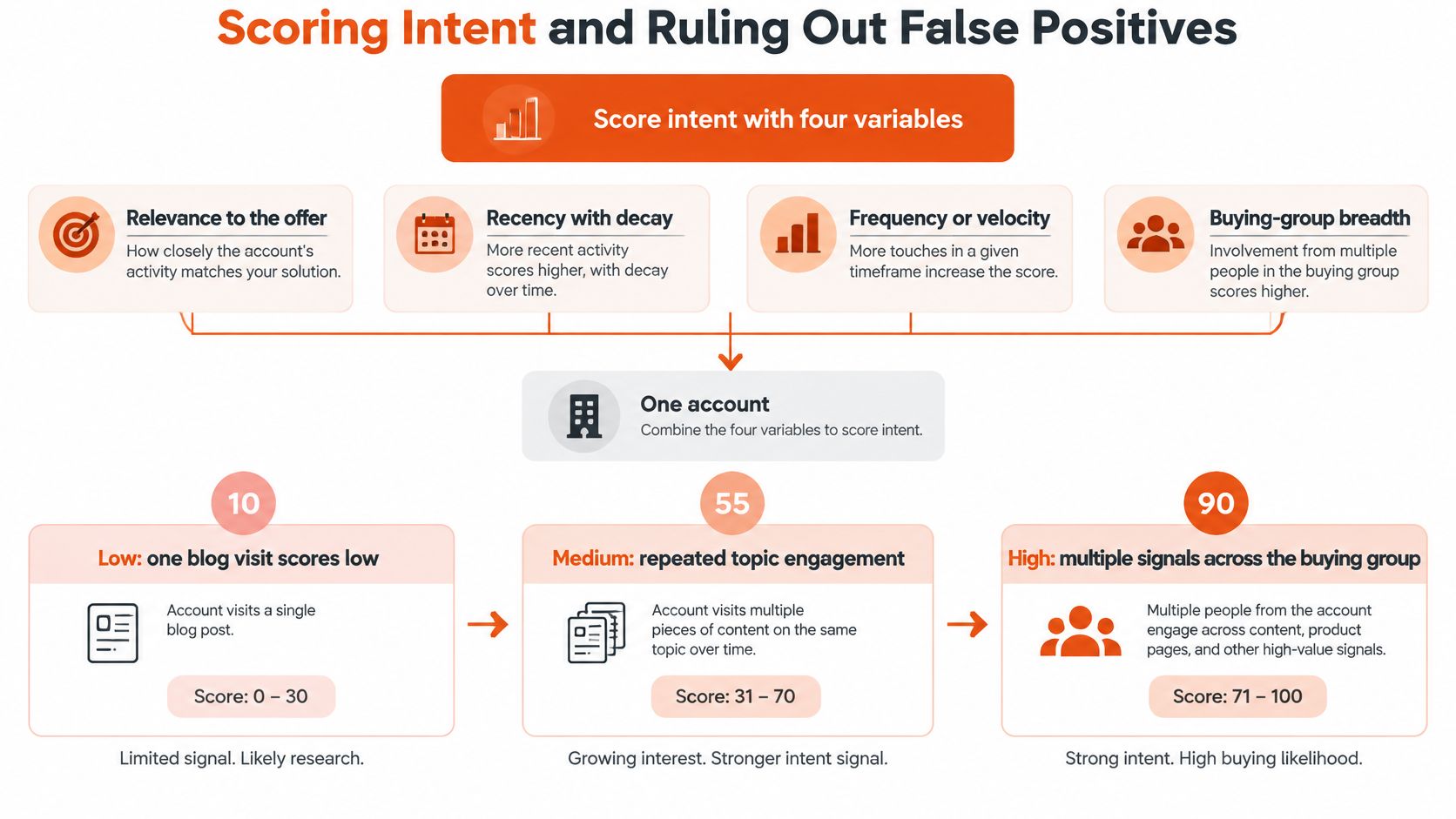
Score intent using relevance, recency, frequency or velocity, and buying-group breadth together. Salesmate's buyer-intent guide supports combining these dimensions rather than treating an isolated interaction as a permanent expression of interest.
Relevance asks whether the activity connects to what you sell. Recency asks whether it still describes an active situation. Frequency describes repetition, while velocity captures a change in activity. Breadth asks whether the evidence extends beyond an isolated researcher.
The progression should remain visible to the person reviewing the account:
Set an activation threshold
Use a minimum rule before sales outreach: ICP fit, recent category activity, and either repeated relevant engagement or evidence from multiple stakeholders. A high-confidence classification should also require a plausible recipient and a clear reason for the message.
Intent confidence tiers and the allowed next action
| Tier | Evidence required | Allowed action | Do not do |
|---|---|---|---|
| Low | One broad visit or a single general topic view | Keep educating the account | Pitch or book a meeting from that event |
| Medium | ICP fit plus repeated topic engagement within the defined freshness window | Relevant note or tailored content from a credible person | Generic automation or a pricing push |
| High | ICP fit plus recent pricing, demo or comparison activity and seniority or several stakeholders | Short conversation tied to the observed topic | Claim the account is ready to buy |
| Suppress | Competitor, student, job seeker, poor role fit, or stale signal | Exclude or cool off | Any outreach based on that signal |
For a hypothetical starting configuration, an account reading three solution pages and a competitor comparison within fourteen days, with activity from two relevant roles, could move to medium confidence. Pricing or demo activity involving a senior stakeholder within seven days could justify a high tier, provided the account fits your ICP.
Those windows are test settings, not universal buying laws. Choose them before the pilot, document the reasoning, and adjust them against qualified outcomes rather than alert volume.
Decay the score instead of preserving a hot label
A recent evaluation pattern should outweigh equivalent activity from weeks earlier. Recalculate when new events arrive and when existing events age out, rather than leaving the account permanently marked hot.
Keep fit and behavior separately visible, even if your CRM calculates a combined score. Our explanation of lead scoring in HubSpot is useful when translating these distinctions into a CRM workflow.
Practical rule: A reviewer should be able to explain the tier using observable events, not just point to a number.
Confidence in the underlying records deserves scrutiny too. The 2025 State of B2B Marketing report found that only 45% of surveyed B2B marketers felt very confident connecting data across teams, with confidence in data accuracy lower still. An impressive dashboard doesn't resolve mistaken identity or missing context.
Apply exclusions before any sequence starts
Define suppressions as routing rules, not reminders that sellers may overlook:
- Competitor research: Exclude it from acquisition outreach.
- Student or educational research: Suppress commercial activation unless the person establishes a relevant business context.
- Career or recruiting interest: Remove careers-page activity from purchase-intent calculations.
- Anonymous activity without account fit: Keep it in education rather than prospecting.
- Customer implementation activity: Route it to the account team.
- Stale research: Drop it below the activation threshold when it exceeds the decay window.
For medium-confidence outreach, send a relevant note and then cool off if there's no reply. Don't interpret silence as a reason to increase message volume.
Review false positives by reason, including mistaken account identity, irrelevant role, and noncommercial research. A high tier means confidence that meaningful research is occurring, not certainty that a purchase will follow.
Using Intent in Demand Gen ABM and Sales
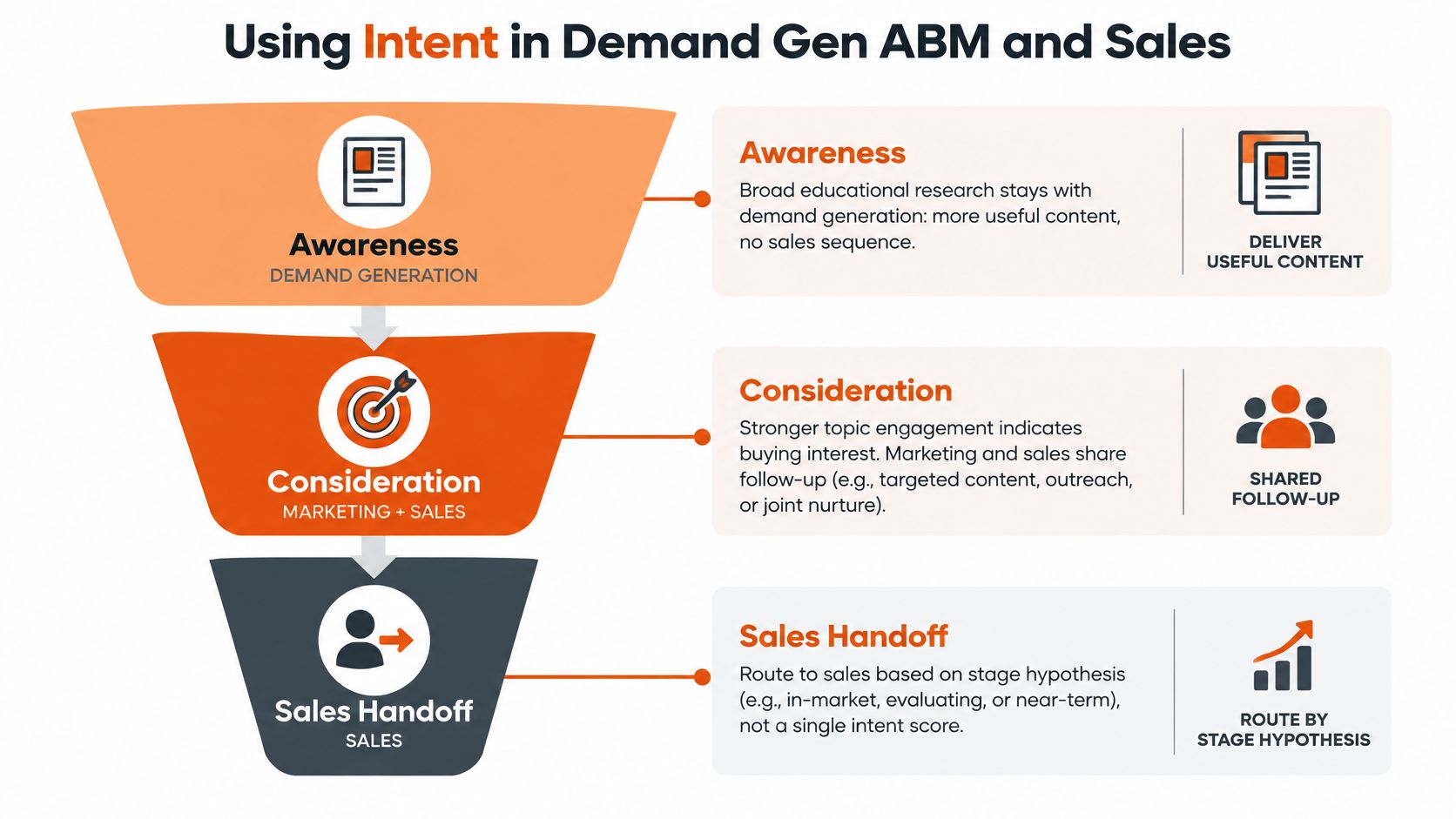
Intent is a confidence problem as much as a timing problem. A single broad topic visit may justify more relevant education, but it rarely gives a salesperson enough context for a personal approach. Route by buying-stage hypothesis and the strength of the evidence, not by score alone. Sona's intent-activation guide describes educational activity, solution evaluation, and decision-oriented behavior as distinct grounds for choosing a channel and sender.
The next action should match both the evidence and the buyer's likely needs:
Awareness
Broad educational research belongs with demand generation. If an HR team reads about retention problems but has not explored possible interventions, offer a diagnostic checklist or explain how to assess the issue. A consulting pitch would assume more readiness than the activity shows.
Track content progression alongside engagement rate. One post attracting attention is weak evidence; movement toward more specific material is a better reason to adjust what the account sees next.
Consideration
Repeated engagement with solution content or comparisons can support problem-specific account-based messaging, especially when the account fits the target profile. For example, an IT consultancy could share a migration-risk framework when a suitable account explores deployment options and integration constraints.
Choose a sender with relevant technical or sector knowledge. Track qualified meetings and time to opportunity, while checking whether the visible contact is an evaluator, coordinator, or person responsible for the initiative. Activity alone does not establish their role.
For an accompanying video, use the player below.
Decision
Procurement content, pricing activity, and explicit demo requests support faster handling. If a software prospect asks about security review and implementation scope, route the conversation to someone able to address those questions instead of restarting a generic qualification script.
Buying stage, signal and routed action
| Stage | Typical signals | Routed action | Metric |
|---|---|---|---|
| Awareness | Broad educational research, low-depth content, general topic searches | Keep educating through demand gen content, no sales sequence | Engagement rate and content progression |
| Consideration | Repeat solution content, competitor comparisons, several stakeholders | Account-based messaging on the problem being evaluated | Qualified meetings and time to opportunity |
| Decision | Pricing pages, procurement or RFP content, demo requests, a research sprint | Faster, specific outreach from a sender with real context | Response rate, opportunity creation and win rate |
Sort the sales review queue by freshness and confidence tier, with the topic and recommended owner attached. Raw event volume can make an account look active without showing meaningful intent. Do not present anonymous browsing as knowledge of a named person.
Buying processes can pause. Forrester's 2024 global business-buying research reported that 86% of B2B purchases stalled during the buying process. A pause may call for useful assistance rather than another follow-up.
Outbound prospecting can support the effort to build a stronger outbound pipeline, but outreach should remain proportionate to the evidence and the buyer's stage.
Privacy Limits on Intent Data
Treat behavior that can be tied to an individual as personal data for operational handling, not harmless exhaust from a scoring system. Purpose, access control, retention, and the recipient's expectations deserve attention before activation. This is practical governance guidance, not a substitute for legal advice.
Collect only fields needed to assess fit, topic, timing, and routing. Don't append sensitive attributes, reuse audience records for unrelated advertising, or let sellers export entire engagement histories when they only need a concise explanation of relevance.
Separate account prioritization from personal contact
Account-level co-op activity should remain an account-prioritization input until there's an appropriate basis for person-level engagement. Finding a senior employee's name doesn't establish that they performed the observed activity.
For professional-network conversations, refer to an actual public interaction when one exists. A response to a comment can name the question the person raised and offer something useful, with an easy way to decline. Don't send from a faceless brand account while pretending the note is personal.
Do not infer:
- Budget from category research.
- Authority from a job title alone.
- Purchase timing from a concentrated burst of activity.
- Consent from a profile visit or public comment.
Assign responsibility for the records
When professional-network access is involved, authorized permissions and separation between customer accounts matter. At Ploot, we access only the LinkedIn data strictly necessary under authorized permissions, don't share those data with other users, and don't use them for advertising or sell them.
Long consulting, IT, and software buying cycles leave plenty of room for repeated unwanted contact. Assign a named operations owner to suppression lists and make those exclusions available across sales and marketing workflows.
Store enough context to explain the action, not everything you can collect.
After a deal is lost, review what remains necessary, who can access it, and what should be deleted or retained under your documented policy. A closed opportunity shouldn't leave an indefinite prospecting history that nobody owns.
Pilot Intent Data Against Real Pipeline
Start with a bounded pilot before expanding intent-data coverage. 6sense's guide to changing B2B buyer research reports that only 3% of website visitors self-identify through forms, while buyers consume an average of 13 content pieces across the journey. Those figures show why form submissions alone cannot capture every step toward a meeting. They do not, by themselves, prove that a particular intent signal predicts a sale. A pilot tests how much evidence is enough to act with confidence.
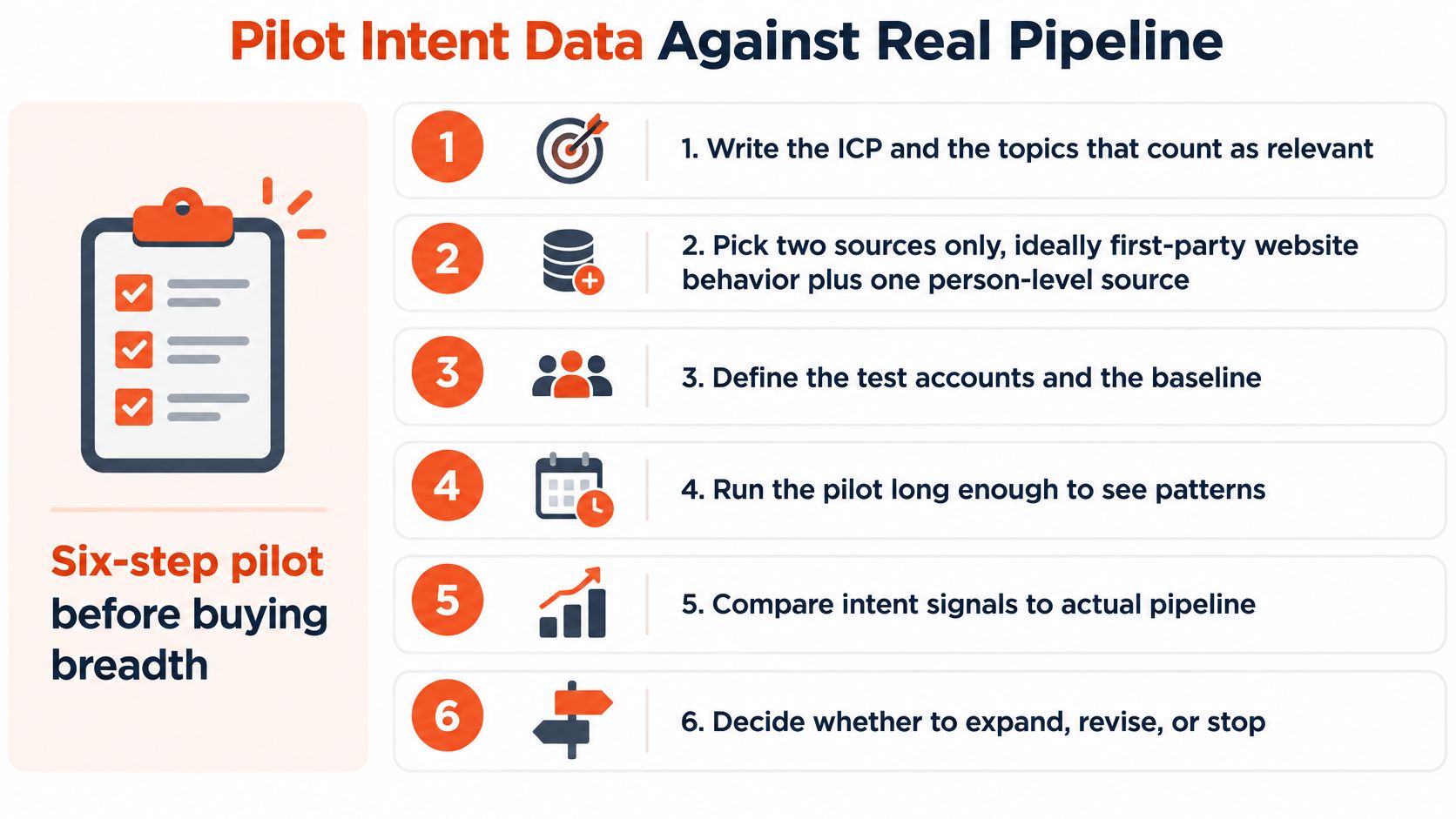
Use a written plan so sales and marketing agree on what would justify expanding the test:
Define the test before activating accounts
Write the ICP and relevant topics. Specify eligible companies, buying roles, business problems, and exclusions. Separate topics the team can credibly address from adjacent subjects that may attract attention without showing purchase interest.
Choose a small source pair. For example, combine first-party website behavior with a person-level professional channel. Check that each source adds distinct evidence, rather than counting the same activity twice.
Set thresholds and suppressions. Define medium and high confidence, signal freshness, and exclusions. Select test accounts and a matched comparison group with similar fit and existing engagement. A single signal can justify review without being enough to prompt outreach.
Assign each tier an action and owner. Name who reviews alerts, sends messages, and handles replies. Keep the offer comparable across groups so unrelated campaign changes do not cloud the result.
Record the first qualified signal. Connect later contacts, meetings, and opportunities to the account. Log the source, topic, timestamp, routing decision, and reason the meeting qualified.
Evaluate after a fixed observation window. Compare qualified-meeting rate, opportunity creation, cycle time, and win rate with the matched group. Set the window before launch, allow for the sales cycle, and do not treat early replies as proof of commercial impact.
Write decision rules before launch with a pilot success criteria template. Keep immature opportunities separate from completed outcomes so an unfinished cohort does not distort the conclusion.
Test the human action as carefully as the signal
For a pilot based on public interactions, keep contact low-volume. Send from the named person's own profile, refer to the actual interaction, and make it easy to decline. Avoid exposing inferred browsing history in the opening message. A signal should guide timing and context, not create unwarranted certainty about someone's plans.
Ploot's process establishes the team as a reference voice, filters prospects by ICP fit and buying signals, sends messages from team profiles, and moves suitable prospects toward qualified conversations. The pilot should measure whether this sequence contributes to pipeline, rather than assume that a signal or a message caused a deal.
Expand only if qualified meetings and pipeline improve. Revise or stop if apparent gains amount to clicks or replies, and avoid crediting an entire deal to one recorded touch.
Ploot turns team expertise and LinkedIn audiences into a sales channel, using buying signals to support contextual outreach and qualified meetings. Companies and agencies can book a Ploot product walkthrough to see the system in action and discuss a pilot with agreed criteria for meetings and pipeline.