

Buyers had already completed 57% of the purchasing process before contacting a supplier directly in the Google and CEB Marketing Leadership Council study of approximately 1,500 business leaders. That's why a pipeline program measured only by form fills misses most of the work. If you're not visible and credible while buyers define requirements and narrow vendors, you're not competing for the deal. You're waiting to be excluded from it.
Table of Contents
- The Seven-Step Demand Generation Strategy at a Glance
- Goals and KPIs That Separate Reach From Pipeline
- Personas and Target Accounts for Buying Committees
- Channel Mix for Long B2B Sales Cycles
- Intent Scoring and Qualification Before Sales Outreach
- How to Orchestrate Campaigns Across Channels
- Measuring Influence Without Overclaiming Results
- Launch a 90-Day Pilot With Agreed Success Criteria
The Seven-Step Demand Generation Strategy at a Glance
A demand generation strategy is the plan that builds buyer interest among a defined set of accounts before they ask for a meeting, then turns that interest into qualified conversations and pipeline. It isn't a content calendar, an ad campaign, or a lead target. It's an operating system that connects account selection, credible expertise, behavioral signals, and sales follow-up in a specific order.
For high-ticket consulting, technology, and software, that order matters because the sale is long and rarely decided by one person. You need familiarity across an account before anyone raises a hand, then a disciplined way to act when interest becomes commercially relevant.
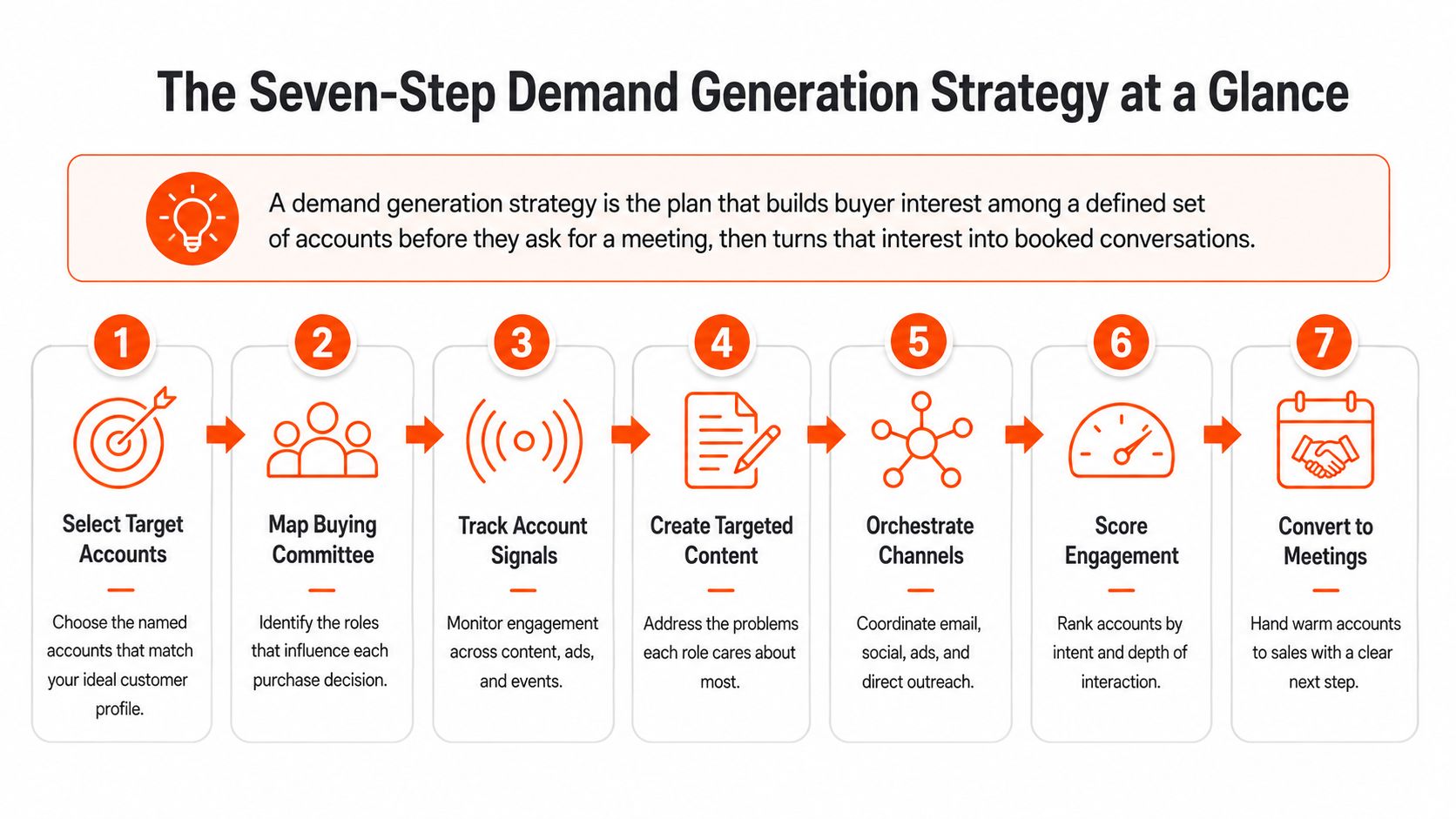
The build in order
- Set goals and KPIs. Establish the baseline and stage targets.
- Define ICP and target accounts. Produce a named list sales agrees is worth pursuing.
- Map the buying committee. Identify the roles that can champion, fund, block, or implement the purchase.
- Choose the channel mix. Assign each channel a job and a budget.
- Set intent scoring and routing. Decide which signals justify outreach and who receives the account.
- Orchestrate campaigns. Run coordinated content, events, and outreach for 90 days.
- Measure and optimize. Review stage conversion monthly and make explicit decisions.
| Step | Output | Owner | Timing |
|---|---|---|---|
| 1. Set goals and KPIs | Baseline and stage targets | Marketing director | Week 1 |
| 2. Define ICP and target accounts | Named account list | Marketing with sales | Weeks 1-2 |
| 3. Map the buying committee | 3-5 roles per account | Marketing and sales | Weeks 1-2 |
| 4. Choose the channel mix | Channel plan with budget split | Marketing | Weeks 2-3 |
| 5. Set intent scoring and routing | Scoring model and hand-off rules | Marketing ops with sales | Weeks 3-4 |
| 6. Orchestrate campaigns | 90-day content and outreach calendar | Demand gen lead | Weeks 4-12 |
| 7. Measure and optimize | Monthly review with decisions | Leadership team | Monthly |
Steps 1 to 3 come before channel spend for a practical reason. You can't choose useful content, credible profiles, or events until you know which accounts matter and what each role needs to believe. Launching LinkedIn activity before the account list exists usually buys impressions from people who'll never enter your pipeline.
Practical rule: If a campaign can't be tied to a named account, a mapped role, and a next action, it isn't ready to launch.
Write down the seven outputs for your firm now, even in rough form. That one page becomes the control document for the pilot. Every later argument about budget, content, or credit should be settled against it.
Goals and KPIs That Separate Reach From Pipeline
Most demand generation reporting fails at the goal sheet. Impressions rise, MQL volume looks healthy, and sales still gets meetings with no budget, no sponsor, and no timing. The fix is to separate reach metrics, which show whether the right accounts are paying attention, from pipeline metrics, which show whether that attention becomes commercial progress.
That frustration is widespread. A 2025 benchmark survey reported that 55% of marketers wanted to improve MQL-to-opportunity conversion, 52% wanted better ROI measurement, and 31% wanted to shift from lead volume toward higher-quality leads, according to the figures cited in LinkedIn's Rethink the B2B Buyer's Journey study.
Six metrics worth governing
| Metric | Stage | What it tells you | How to set the target |
|---|---|---|---|
| Target-account engagement rate | Reach | Share of target accounts with a meaningful interaction in 30 days | Baseline from first 30 days, then raise |
| Committee reach | Reach | Distinct stakeholders engaged per account | Aim for 2-3 roles per target account |
| Engaged-account-to-meeting conversion | Qualification | Whether engagement leads to conversations | Baseline from last 12 months of CRM data |
| Meeting-to-opportunity conversion | Pipeline | Quality of meetings booked | Baseline from last 12 months of CRM data |
| Opportunity velocity | Pipeline | Median days from first engagement to opportunity | Set against your known sales cycle length |
| Sourced and influenced pipeline | Revenue | Pipeline with a demand generation touch, reported separately | Agreed credit rules before launch |
Target-account engagement rate tells you whether distribution is reaching the accounts you want. A post can perform well publicly and fail completely on this measure. Committee reach then shows whether one curious contact is carrying the account or several relevant roles are seeing your expertise.
The qualification and pipeline rows are where weak programs get exposed. If engaged accounts don't become meetings, your routing threshold or outreach angle is wrong. If meetings don't become opportunities, you're booking curiosity instead of need. Opportunity velocity adds timing, because a program that creates opportunities faster has value even when total volume is similar.
Set targets from your own baseline
Pull the last 12 months of CRM data on meetings, opportunities, account source, and stage dates. Compute a baseline for each metric before setting targets. Set one target per stage, not one overall pipeline number that nobody can diagnose when it's missed. Assign an owner and review date to every target.
Keep impressions and raw MQL volume on a diagnostic dashboard, not the goal sheet. They're useful for explaining movement, but they're too easy to inflate.
Say a consultancy sets a goal of 20 qualified meetings a quarter from named accounts, supported by targets for engaged accounts and committee reach. If meetings stall, the team can see whether too few accounts engaged, engagement stayed with one role, or sales conversion broke down. A target of 5,000 impressions can't answer any of those questions. I would always choose the smaller set of stage goals over a large dashboard nobody trusts.
Personas and Target Accounts for Buying Committees
One persona is a convenient fiction in complex B2B sales. Google and Bain research on B2B marketing strategies reported that B2B buying committees average 17 cross-functional stakeholders, while 92% of buyers already have a shortlist of preferred vendors before they begin an active buying process. You're therefore building preference across a group, much of it before a formal process exists.
Build the pilot list
Start with ICP fields you can verify: sector, company size, buying trigger, geography, and seniority. A trigger might be a new regulation, a growth round, a leadership change, or a system replacement. Then select 150 to 300 accounts for a pilot. Fewer can make results anecdotal. More usually dilutes research, content relevance, and seller follow-up.
Map three to five roles per account, not every possible stakeholder. For each role, define the concern that could stop the deal, the proof that addresses it, and the observable signal that suggests interest. A structured approach to building B2B buyer personas by account and role helps keep those fields consistent across the list.
| Role | Typical concern | Content that fits | Signal to watch |
|---|---|---|---|
| Marketing director | Pipeline proof and cost per meeting | Benchmark report and case study | Repeat visits to case studies |
| CFO or finance lead | Payback and financial risk | Business case template and cost breakdown | Visits to pricing or ROI pages |
| Operations director | Feasibility and delivery effort | Process diagnostic and implementation outline | Several ops colleagues viewing the same asset |
| IT or technology lead | Integration and security | Technical point of view and architecture notes | Comments on technical posts |
| CEO or managing partner | Strategic fit and reputation | Point of view and peer proof | Profile visits after a business event |
The marketing director usually champions the problem but needs evidence that activity can become pipeline at an acceptable cost. Finance doesn't need more thought leadership. Finance needs a credible payback model, clear scope, and downside protection. Operations will test whether delivery is realistic, while IT looks for integration effort, security, and support risk. The CEO or managing partner judges strategic fit and whether your firm is safe to recommend internally.
Put the map to work
Say a Spanish HR consultancy targets a 300-person industrial group. Map the HR director as champion, the CFO as budget owner, and the operations director as delivery skeptic. Create one diagnostic asset for each concern instead of sending all three the same corporate deck.
Don't build more than three role-based messages per account at the start. Each extra variant adds production and approval cost, usually without surfacing a new buying concern. Cover the champion, the economic buyer, and the most likely blocker first. Add roles only when engagement data shows another function is actively researching.
Senior partner, director, and manager profiles can each reach different parts of that committee. Treat them as distributed trust assets, but assign coverage deliberately. Otherwise, several people will speak to the same friendly contact while finance and operations never hear from you.
Channel Mix for Long B2B Sales Cycles
Choose channels by the job they perform during a long cycle, not by popularity. Some channels create familiarity. Some deepen trust with specific roles. Some reveal timing. A channel that's excellent at visibility can still be a poor place to ask for a meeting.
LinkedIn will usually sit at the center for consulting and B2B software because partners, directors, and buyers are identifiable by role and company. It still needs discipline. Company page content supports legitimacy, senior profiles carry expert credibility, and targeted distribution helps you reach mapped accounts. Broader social media guidance for B2B teams is useful for operating basics, but your account list and committee map should decide who the content is for.
| Channel | Role in the cycle | Best for | Main risk | Measure |
|---|---|---|---|---|
| Expert content on LinkedIn | Builds authority across the committee | Diagnostic posts and point of view | Reach without buyers | Target-account engagement rate |
| Senior and partner profiles | Distributed trust with decision-makers | Director-level credibility in a sector | Weak authority if profiles are inactive | Committee reach |
| Partner and referral channels | Warm introductions | Accounts that already trust a partner | Slow to scale | Meetings from referred accounts |
| Intent signals from profile visits and engagement | Timing of outreach | Routing to sales at the right moment | Inflated scores from low-quality clicks | Engaged-account-to-meeting conversion |
| Hosted small events | Deeper conversation with accounts | Roundtables and small webinars | Low attendance from target roles | Meetings booked after event |
| Trade shows and large conferences | Brand visibility | Accounts that already gather in one place | High cost per qualified contact | Qualified contacts per euro spent |
Hosted small events deserve a defined place because they let several roles from target accounts discuss a specific operational problem without a sales presentation. Forrester's Q1 2025 State of B2B Events Survey found that in 2025, 59% of B2B organizations planned to increase their use of smaller hosted events during the following 12 months. Use them monthly in a pilot, invite by account and role, and judge them by qualified follow-up conversations rather than registrations.
A practical first-quarter allocation
Put most effort into expert content and active senior profiles. Run one hosted roundtable per month. Use partners for named introductions where trust already exists. Attend large events only when a meaningful share of your target accounts will be present and you can pre-book meetings.
When evaluating support for activating partner and director profiles, Ploot is one option to compare. Ask any provider how profiles are selected, how consent is handled, whether meeting precision is reported by segment and profile, and whether a holdout group is used. Those answers reveal more than sample posts.
Partner and referral channels produce the warmest introductions, but they're the slowest to scale because they depend on another firm's relationships and timing. Expert content scales better, yet it needs intent routing to become pipeline. Your mix should balance those trade-offs instead of expecting one channel to do every job.
Intent Scoring and Qualification Before Sales Outreach
Intent isn't a page view. I would treat it as a confidence-weighted combination of fit, timing, engagement depth, stakeholder breadth, and explicit context. A single download by the wrong person is weak evidence. Repeated service-specific engagement by three relevant people at one target account is much harder to dismiss.
Much of that evidence will remain incomplete. Recent coverage of dark social and demand generation reports that buyers spend only 17% of their purchasing time meeting suppliers and that 94% of B2B buyers use large language models during a purchase. Private messages, forwarded assets, peer conversations, and AI-assisted research won't appear neatly in your CRM.
Build the staged model
First, apply a fit gate. The account must match your sector, size, geography, and sales model, and the contact must have relevant seniority or functional ownership. No behavioral score should rescue a poor-fit account.
Second, award points only for actions with plausible buying relevance. Third, require at least two meaningful signals in a defined window before routing. Fourth, subtract points for mismatched roles, competitor activity, generic engagement, and stale behavior. Fifth, hold back a comparison group so you can estimate whether outreach created incremental meetings.
LinkedIn's presence justifies careful monitoring, since LinkedIn's lead generation research summary reports that 89% of B2B marketers use the platform for lead generation and 62% say it generates leads. It doesn't justify contacting everyone who clicks. A clear reference on recognizing genuine buying signals can help marketing and sales agree on definitions before points are assigned.
| Signal | Example | Starting points | Rule |
|---|---|---|---|
| Fit gate | Spanish B2B consultancy, director-level contact | Pass or fail | Must pass before any scoring |
| Repeated engagement with a service post | Three service-post interactions in 30 days | +10 per signal | Count only service-relevant posts |
| Multi-person account visits | Three people from one account in 30 days | +25 | Strongest sign of committee interest |
| Case study or diagnostic download | Operations director downloads a diagnostic | +20 | Only from target roles |
| Pricing or implementation page visit | Finance lead views ROI or pricing material | +25 | Triggers faster human follow-up |
| Job mismatch or competitor activity | Student or competitor employee engages | -20 | Exclude from routing |
| Stale signal | Last engagement over 60 days ago | -10 | Drops score, never routes alone |
Treat these points as a starting model, then calibrate after four to six weeks using sales-accepted rate and qualified-meeting rate. Keep the scoring logic, owner, consent status, and next action in one operating view. Teams evaluating workflow options can review approaches to streamlined lead tracking for growing businesses, but the tool won't compensate for vague signal definitions.
For private or AI-mediated demand, use consent-based capture and self-reported attribution. Add a simple "How did you hear about us?" field, ask at meeting booking, and record the answer verbatim. Combine that with fast human follow-up when explicit questions appear. Don't buy opaque third-party scores you can't inspect, and don't use surveillance tactics that create privacy or GDPR risk.
The common failures are duplicate outreach to several people in one account, inflated intent from low-quality clicks, and judging conversion before a long cycle has matured. Report precision by segment and activated profile. Aggregate averages hide exactly where the model is wasting seller time.
How to Orchestrate Campaigns Across Channels
Orchestration is where a demand generation strategy stops being a plan and becomes weekly operating discipline. The goal isn't to touch an account everywhere. It's to sequence credible exposure, useful proof, and human contact so each step earns the next one.
Run the 90-day sequence
- Plan a sequence per account. A senior profile shares a point of view, the account receives a diagnostic asset, relevant roles get a roundtable invitation, and direct outreach starts only after the routing threshold is met.
- Set a sustainable cadence. Use three to five profiles posting weekly, publish one diagnostic asset per month, and host one small event per month during the pilot.
- Name the trigger and owner. When an account passes the threshold, assign it to a named seller within 48 hours.
- Contact one lead per account. Choose the role most likely to champion the purchase. Give other stakeholders content and event invitations, not parallel sales messages.
- Protect a holdout. Keep 10% to 20% of fit accounts free from direct outreach so you can estimate incremental meetings.
- Use a standard hand-off note. Include account, roles engaged, signals in the last 30 days, last content viewed, suggested angle, and consent status.
- Review weekly for 30 minutes. Start with accounts that passed the threshold but show no seller action.
That sequence prevents a familiar breakdown. Marketing celebrates engagement, sales receives a name with no context, and the seller either ignores it or sends a generic introduction. By the time anyone investigates, the timing signal is stale.
Make the hand-off usable in two minutes
A useful note might read:
Example hand-off: Fictional IT consultancy account. Operations director and finance lead engaged in the last 30 days. Both viewed the delivery capacity diagnostic, and finance opened the implementation cost breakdown. Suggested angle: capacity risk during the next client onboarding cycle. Consent status: business contact basis recorded. Lead contact: operations director.
That note changes the first message. Instead of asking for an introductory call, the seller can reference delivery capacity, acknowledge finance's cost concern, and offer a short diagnostic discussion. The buyer sees relevance without being told they've been tracked.
Keep the note short enough to read in under two minutes. Long activity exports don't help. Sellers need the account context, the strongest signals, the likely concern, and a recommended opening angle.
Also define what happens when the first contact doesn't respond. I would allow one relevant follow-up tied to new proof or an event invitation, then return the account to nurture. Repeated chasing burns the authority your senior profiles built. Patience is part of the system, especially when the buying trigger hasn't fully formed.
The weekly review should end with decisions, not commentary. Advance the account, keep nurturing it, change the lead role, or remove it from the pilot. If an account remains "engaged" for weeks with no owner action, that's not demand generation. It's an unresolved queue.
Measuring Influence Without Overclaiming Results
Last-touch attribution gives false confidence in a buying process that mostly happens out of view. Industry reporting on social media and B2B demand generation cites 61% of the B2B buying journey taking place anonymously, 95% of buyers forming a shortlist before contacting a vendor, and the pre-contact favorite winning 80% of deals. Several people may consume content, discuss vendors privately, and enter the CRM weeks apart.
Separate three kinds of value
Measure demand creation among target accounts first. Look at engaged accounts, committee reach, repeat engagement, and movement from passive viewing to diagnostic or commercial content. This tells you whether you're entering future consideration sets.
Measure demand capture when known buyers raise their hands. Track qualified meeting requests, event follow-ups, routed accounts, sales acceptance, and meeting conversion. Explicit intent becomes a conversation at this stage.
Measure pipeline contribution only after opportunity creation. Report sourced and influenced pipeline separately, with opportunity rate, velocity, stage progression, and revenue. Finance can accept influenced pipeline as meaningful evidence when you label it clearly and apply consistent rules.
Agree credit rules before launch
Use simple rules that an auditor can follow:
- Sourced pipeline: Count it only when the first known touch came from the program.
- Influenced pipeline: Count it when a program touch occurred within a defined window, such as 90 days before opportunity creation.
- No double counting: Assign one sourced owner per opportunity, even when several channels influenced it.
- Account-level evidence: Prefer multiple stakeholder engagement and stage progression over precise credit for individual clicks.
- Sales evidence: Record self-reported attribution and seller notes alongside CRM touches.
Other hard-to-track channels face the same governance problem. Frameworks for measuring podcast advertising ROI are useful as a reminder that probabilistic influence and direct response need different labels. The same discipline applies here. Don't present influenced pipeline as sourced revenue.
| Symptom | Likely cause | Fix |
|---|---|---|
| High engagement, flat meetings | Outreach to the wrong role or too generic | Narrow the ICP and check committee coverage |
| Meetings booked, few opportunities | Fit gate too loose | Tighten the fit gate and recheck the threshold |
| Opportunities stall at discovery | Slow seller follow-up after hand-off | Enforce 48-hour follow-up and review stalled accounts weekly |
| Impressions rise, MQLs flat | Content not tied to buying signals | Redirect content to diagnostic assets |
| Pipeline credit disputes | No agreed credit rules before launch | Write and sign credit rules before the pilot |
Change one variable per six-week cycle. If you alter the audience, content, threshold, and outreach message at once, you won't know what improved conversion. Compare results with the holdout or a prior-period baseline, and wait for enough sales cycle maturity before declaring failure.
The defensible claim isn't that one post created one deal. It's that target accounts exposed to the program engaged across more roles, converted to meetings at a higher rate, or created opportunities faster than the comparison group. That's a claim finance can test.
Launch a 90-Day Pilot With Agreed Success Criteria
The key decision isn't whether demand generation sounds attractive. It's whether you'll commit budget, senior profile time, and seller capacity to a test that can produce a clear yes, no, or adjust decision. A 90-day pilot only works when its thresholds and comparison method are agreed before launch.
The visual below summarizes the pilot structure before you set the detailed gates.
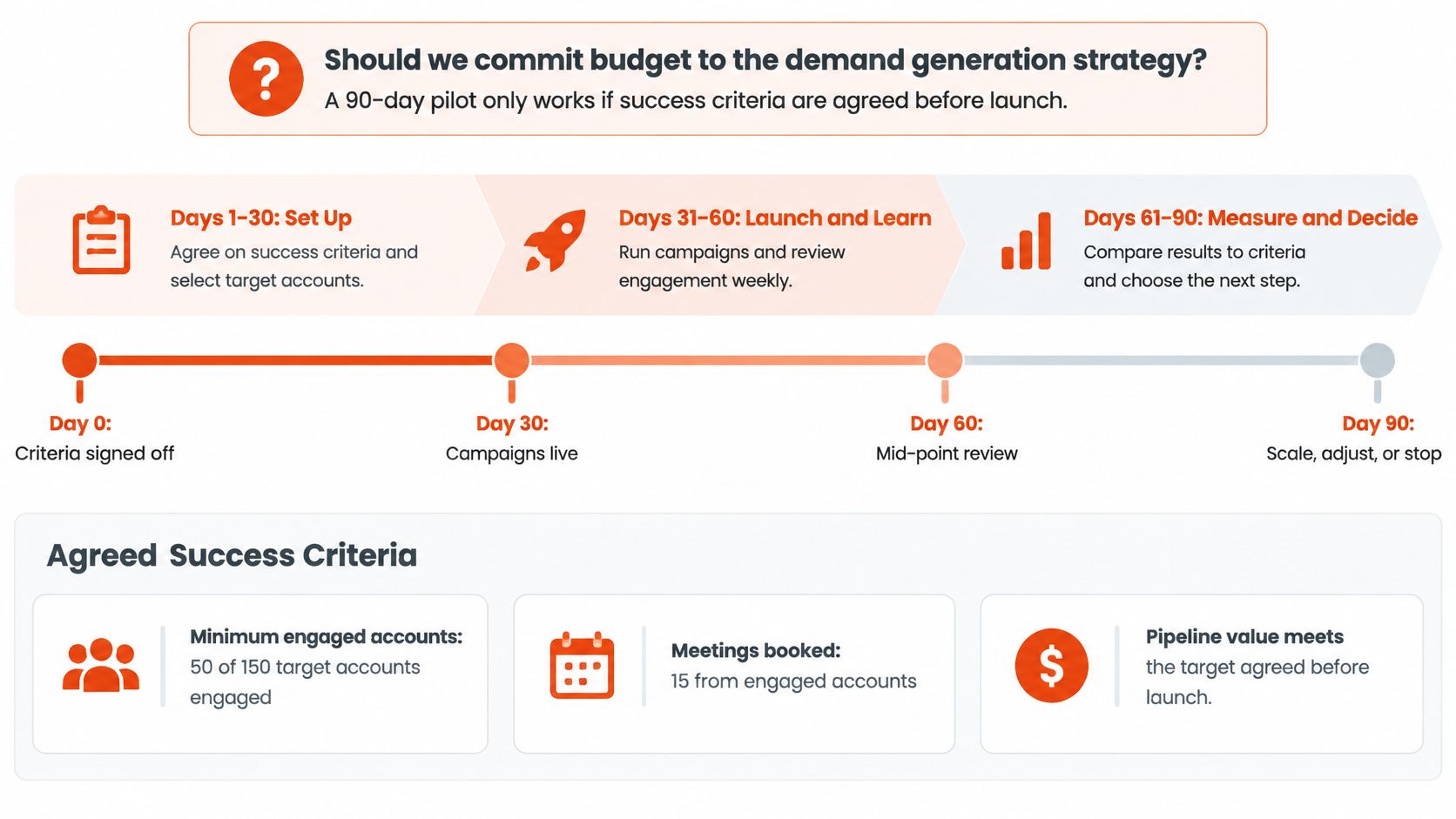
Run four phases with decision gates
| Phase | Timing | Main actions | Decision gate |
|---|---|---|---|
| Setup | Weeks 1-4 | ICP, account list, buying committee map, scoring model, credit rules | Baseline and thresholds signed off |
| Launch | Month 2 | Weekly content, first outreach from qualified accounts, hand-off template | Outreach volume delivered and seller follow-up within 48 hours |
| Mid-pilot review | Month 3, week 6 | Stage conversions vs thresholds, adjust one variable | Engaged accounts and meetings on track |
| End-of-pilot decision | Day 90 | Compare vs control cohort or prior-period baseline | Continue, adjust or stop |
- Setup, weeks 1 to 4. Finalize the ICP, named accounts, committee map, scoring model, and credit rules. Don't proceed until marketing and sales sign the baseline and thresholds.
- Launch, month 2. Publish weekly, run the first event, route qualified accounts, and use the hand-off template on every account.
- Mid-pilot review. Compare stage conversion with the thresholds and adjust one variable only. That might be the lead role, the routing window, or the diagnostic offer.
- Decision, day 90. Compare the pilot cohort with the control group or prior-period baseline. Continue, adjust, or stop based on the signed criteria, not on whoever argues loudest.
Before launch, complete a sign-off checklist. Name an owner for each of the seven steps. Record targets for minimum engaged accounts, qualified meetings, and opportunities created. Sign the credit rules, confirm the consent process, define the 10% to 20% holdout, and agree what evidence finance will accept. A ready-made pilot success criteria template can give that checklist a consistent format.
The short video below is useful for aligning marketing and sales on what the pilot must prove before resources are committed.
Keep the signed checklist as the audit record. If the pilot misses its meeting threshold but beats the control group on engaged accounts and opportunity velocity, you may have a timing problem rather than a failed strategy. If reach is strong but sales acceptance is poor, tighten fit or routing before buying more distribution.
Your first action is simple. Confirm the seven outputs, choose three success thresholds, and test any outside provider against the checklist before committing budget. I would not fund a pilot that can't state its account list, routing rule, holdout, and stop condition on one page.
If you want that pilot run through the LinkedIn profiles of your partners, directors, and senior managers, with buying signals tracked and outreach sent only when interest is shown, visit Ploot to see how the three-month pilot is structured. Bring your account list, success thresholds, and credit rules, and judge the work by qualified meetings and pipeline rather than impressions.