
Most advice about demand generation software starts in the wrong place. It treats lead volume as the win, then wonders why sales keeps complaining about quality, timing, and bad-fit meetings. In high-ticket B2B, the core job is narrower and harder, turn digital attention into a credible human conversation only when the account is truly ready.
| Evaluation Area | What You Should Optimize For | What Usually Goes Wrong |
|---|---|---|
| Intent precision | Accounts that show repeated, relevant buying signals | Treating every topic spike as purchase intent |
| Identity resolution | Clear account and contact matching across channels | Fragmented profiles and duplicate records |
| CRM alignment | Opportunity stages that sales actually uses | Pretty dashboards that don't map to pipeline |
| Sales orchestration | Timely handoff to a real authority profile | Blind automation that burns trust |
| Measurement | Pipeline quality and conversion, not vanity metrics | Reporting impressions while revenue stalls |
Table of Contents
- Why Lead Counts Are the Wrong Starting Point
- The Core Capability Stack for High-Ticket Demand Generation
- A Buyer's Comparison Framework, Not a Tool Checklist
- Why Multichannel Buying Breaks Simple Funnels
- Setting the Bar for Intent Precision Before You Buy Anything
- What Most Platforms Miss in Dark-Social Conversations
- Pipeline Metrics That Actually Predict Revenue
- Running a Three-Month Pilot Without Fooling Yourself
Why Lead Counts Are the Wrong Starting Point
Lead counts are comforting because they're easy to inflate. They're also the fastest way to buy a false sense of progress in consulting, software, and other long-cycle markets where buying committees are large and cautious. Gartner's 2022 B2B Buyer Survey found that the average enterprise buying group had 5 to 11 stakeholders from about five business functions, while 75% of B2B buyers preferred a rep-free experience, yet rep-assisted digital purchasing cut buyer regret by half and made buyers 1.8 times more likely to complete a high-quality deal when they used supplier digital tools with a sales rep. Gartner's B2B buying research
That is the true filter. If your demand generation software only creates more form fills, you're optimizing for the wrong moment in the journey.
Quality of attention beats volume of contact
A CMO at a Spanish IT consulting firm does not need another dashboard celebrating raw reach. They need to know which accounts are moving, which stakeholders are involved, and when a senior seller or subject matter expert should step in. That same standard applies to B2B software vendors selling into complex accounts, because the challenge is not traffic, it's coordination.
Practical rule: if a platform can't tell you which account showed interest, who showed it, and what happened next, it's not a demand generation system, it's a lead capture layer.
A lot of vendors hide behind MQL language because it makes the product sound busy. Busy is not useful. In high-ticket motions, the software has to help you create awareness, detect intent, and hand off to a credible human at the right time.
The Core Capability Stack for High-Ticket Demand Generation
The core stack starts with identity resolution. If the platform can't unify visitors, contacts, and account activity, every downstream metric gets muddy. A procurement lead revisiting pricing pages and a CTO engaging with technical content twice in ten days should not look like random noise, because both signals matter when a committee is comparing vendors.
Then comes first-party engagement tracking. Third-party interest alone is too weak to justify outreach. The software should log repeated visits, content depth, and role-relevant behavior, then connect that activity back to the right account and opportunity stage.
The next layer is behavioral scoring. Scoring only works when it reflects buying context, not generic clicks. In high-ticket B2B, a repeat visit from a target account is more meaningful than a one-off ebook download, especially when a buying group is moving through independent research, remote conversations, and in-person validation.
Good scoring doesn't ask, “Did they engage?” It asks, “Did they engage in a way that justifies a human intervention?”
What the stack should actually connect
A serious platform should connect six things in one flow, identity, engagement, scoring, CRM stages, sales routing, and authority activation. If those parts live in separate tools, the handoff falls apart. If they're integrated, marketing can route a warm account to the right seller or executive profile without guessing.
If you want a broader market view of vendor categories, the demand generation software for 2026 overview from FOMOchat is a useful complement because it frames software by function rather than hype.
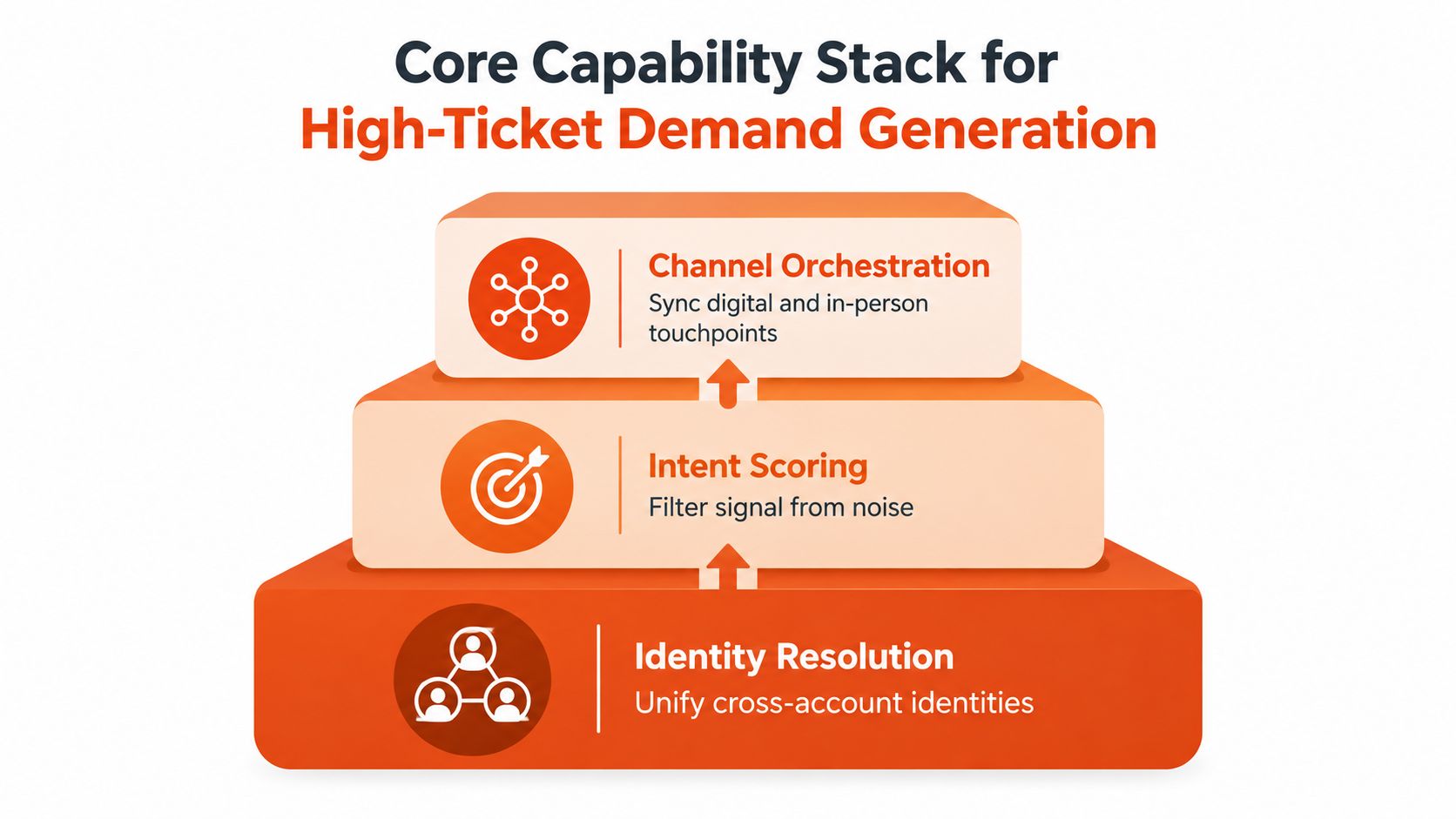
The point of the stack is simple. Identity tells you who, scoring tells you when, orchestration tells you how to respond. If a platform is strong in only one layer, it won't hold up in a long sales cycle.
A Buyer's Comparison Framework, Not a Tool Checklist
Stop comparing vendors by feature clutter. Compare them by whether they can support a high-ticket handoff without forcing your team to guess. The right question isn't “does it have intent data,” it's “can it identify a real account, separate signal from noise, and pass that signal into the CRM in a way sales will trust?”
| Criterion | What Good Looks Like | Disqualifying Failure Mode |
|---|---|---|
| Intent reliability | Repeated, relevant signals tied to real accounts and validated against downstream outcomes | Topic spikes treated as purchase proof |
| Account resolution accuracy | Clean matching across accounts, contacts, and companies | Duplicate profiles and broken attribution |
| CRM and pipeline integration | Opportunity stages, routing rules, and activity history map cleanly into sales workflow | A pretty dashboard that doesn't affect pipeline decisions |
| Sales orchestration quality | Handoffs go to the right role, at the right moment, with context attached | Automated blasts that ignore buying readiness |
| Authority-profile activation | Outreach comes from credible employee or partner profiles, not anonymous sequences | Cold automation that damages trust |
Use that lens when you review platforms. If the vendor can't explain how it handles account matching and contact-level context, move on. If it can't show how it triggers a human handoff, move on faster.
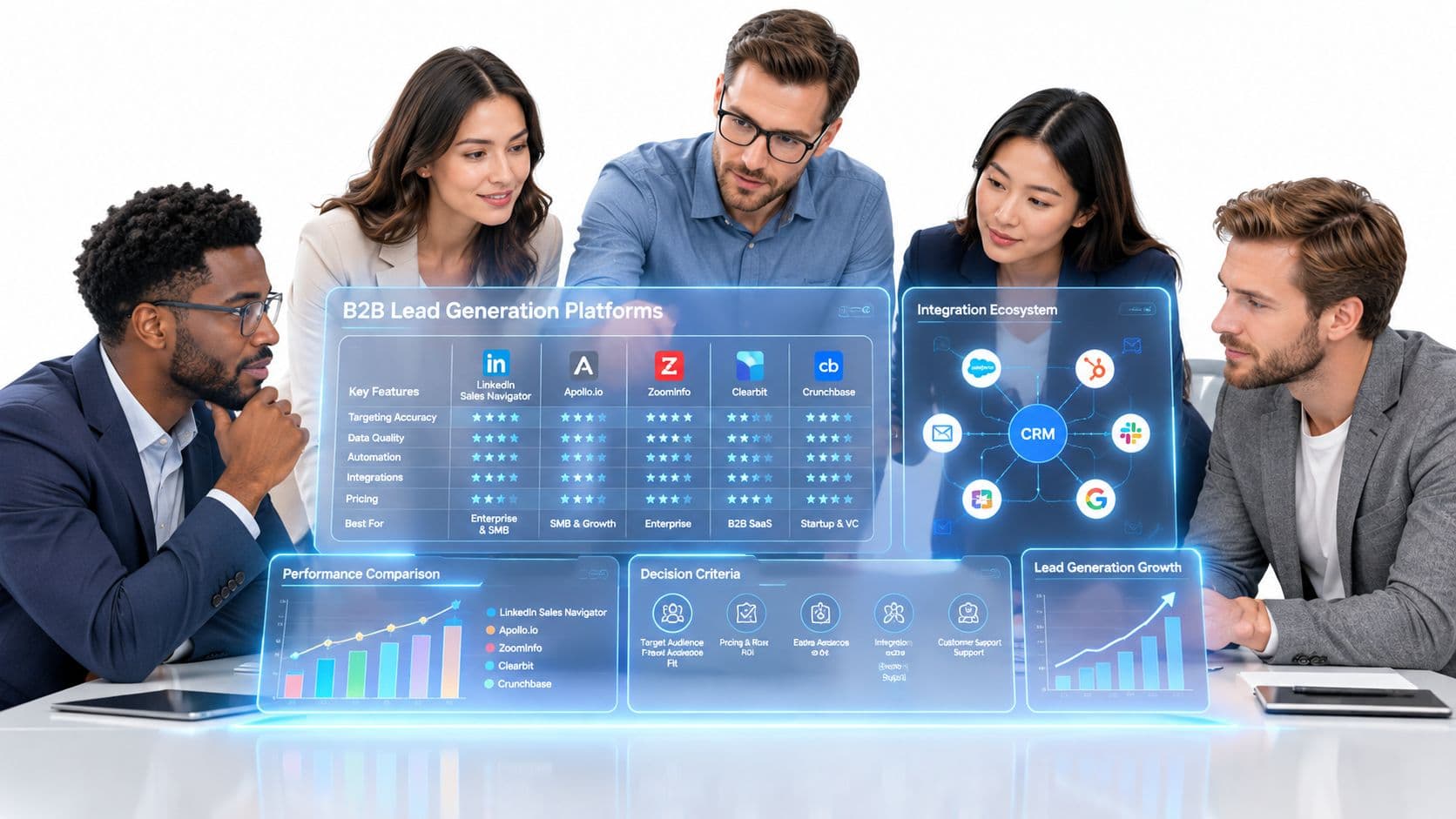
For a practical companion to vendor comparison, the B2B lead generation platforms guide is worth reading because it keeps the evaluation grounded in how tools support pipeline, not just activity.
Score the system, not the logo
A lot of buying teams get distracted by surface polish. They like the interface, the sales demo, the reporting screenshots. None of that matters if the platform can't help the marketing director prove that a routed account became a qualified conversation.
Compare the failure mode first. If the failure mode is “sales gets bad leads,” the tool is not good enough for a long-cycle motion.
The best comparison frameworks force a vendor to answer operational questions. What signal threshold do you need before outreach? How does the platform prevent over-contacting? How does it preserve context when a buyer moves from digital research to a meeting? Those are the questions that decide whether a tool helps or hurts.
Why Multichannel Buying Breaks Simple Funnels
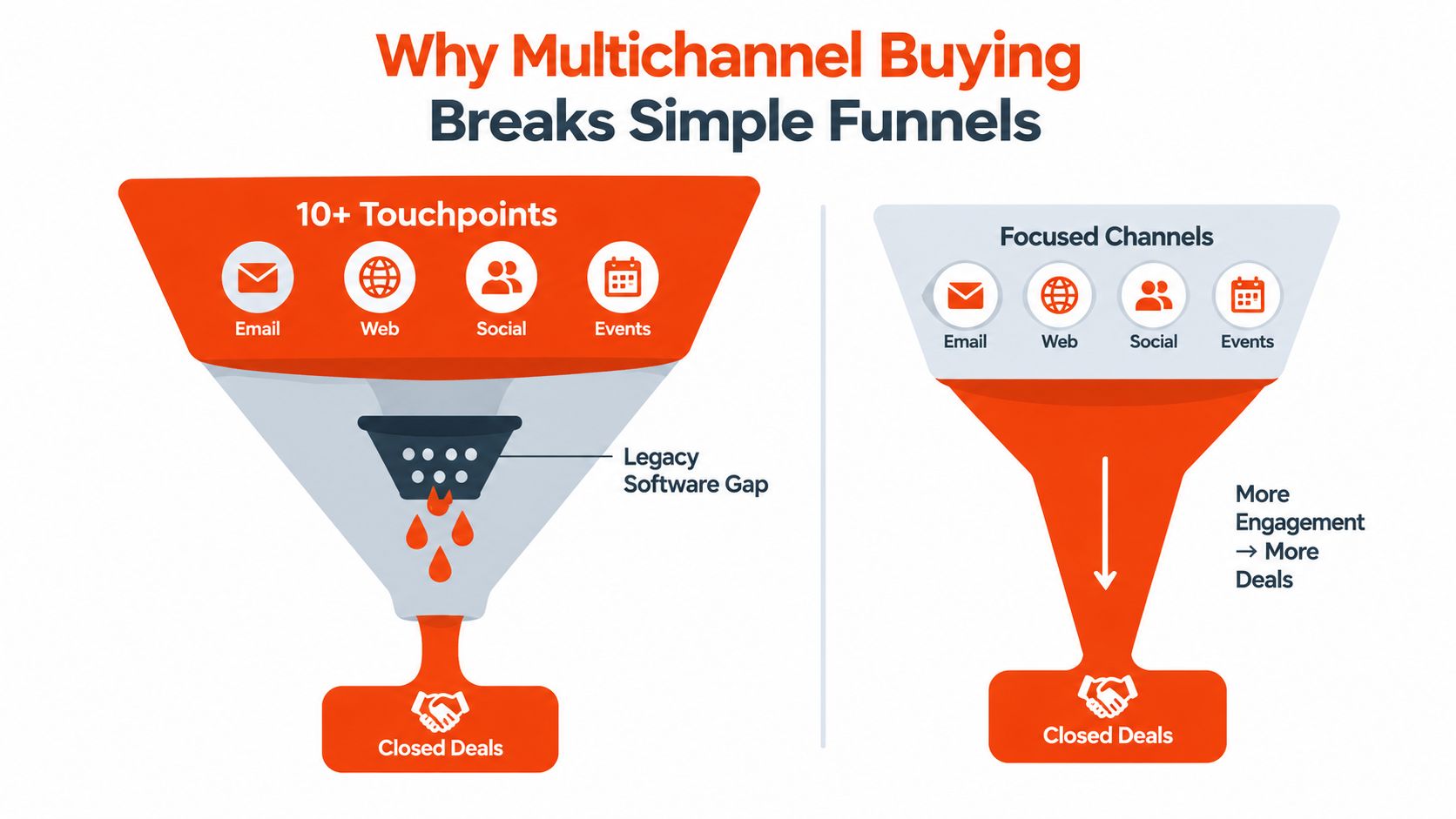
McKinsey's B2B research showed buyers now interact with suppliers across about 10 touchpoints, up from about five channels in 2016. It also described a rule of thirds, where B2B interactions split roughly across in-person, remote, and digital self-service channels, while 71% of B2B companies offered e-commerce and roughly one-third of revenue among those companies flowed through digital channels. McKinsey's B2B growth research
That breaks simple funnels. A buyer might read a comparison article, talk to a colleague, attend a webinar, revisit a pricing page, and then finally reply to a senior seller. If your software treats each touchpoint as a separate universe, you lose the thread.
The channel matters less than the continuity
The mistake many teams make is measuring campaign activity instead of buying continuity. They ask how many people saw the message. They should ask whether the same account can move from search, to remote conversation, to a live meeting without losing context.
That's why CRM-native orchestration matters more than shiny campaign dashboards. The software has to remember where the buying committee was, which roles were active, and which commercial owner should respond next. Without that continuity, the competitor who threads context better will usually win.
Setting the Bar for Intent Precision Before You Buy Anything
Intent data is useful, but not as proof. Available testing suggests that strong intent providers may match topic activity to the correct company only 30 to 65% of the time, while weaker sources can fall near 10 to 25%. A separate benchmark says precision reaches 67% when third-party intent is tied to first-party engagement, and falls to 41% without that layer. Intent precision benchmarks
That means one signal is not enough. A topic surge alone is not a buying decision. In a high-ticket market, you need at least two independent signals before anyone reaches out.
A usable operating rule
Use a simple gate. Require relevant content engagement plus repeat visits, or third-party intent plus first-party activity, then add a recency check and human review. If the account only shows curiosity, leave it alone. If it shows repeated evidence across multiple channels, route it to an authorized seller or executive profile.
- Treat surges as hypotheses: A spike says, “look closer,” not “call now.”
- Demand corroboration: Pair external intent with owned engagement before routing.
- Use recency decay: Old behavior should matter less than what happened this week.
- Protect the brand: One bad cold message can poison a target account faster than a weak campaign ever could.
The goal is not maximum outreach. The goal is minimum wasted outreach.
A tool that can't support this thresholding logic will create noise, and noise is expensive in consulting and software markets where trust is part of the product.
What Most Platforms Miss in Dark-Social Conversations
A senior partner at an IT consultancy publishes a sharp LinkedIn post about a common systems failure. A director at a target account shares it in a private Slack group, then a procurement lead brings it up in an internal meeting. No dashboard sees the Slack thread, but the deal moves anyway.
A week later, a B2B software vendor gets a demo request from a prospect who heard about the product in a closed peer community and checked the site after a colleague mentioned it on a podcast. The attribution model tries to pin the journey on search or direct traffic because those are the visible events. That is cleaner math, but it's still wrong.

The attribution gap is not small. One synthesis reports buyers credited search with only 12% of their journey while attribution software credited it with 78%. Dark-social and B2B buyer measurement
Measure confidence, not fantasy precision
That's why a confidence-based framework beats deterministic attribution. Separate sourced pipeline from influenced pipeline. Track self-reported discovery. Record corroborating intent signals. Then report what you know, not what your dashboard wants to believe.
For teams trying to tighten reporting discipline, tracking the metrics that matter is a useful reminder that not every visible click deserves equal weight. If a platform cannot distinguish public engagement from private influence, it will undercount the true drivers of demand.
Pipeline Metrics That Actually Predict Revenue
The metrics that matter sit downstream of the click. For mid-market B2B programs with 45–120-day sales cycles, useful directional benchmarks are 20–40% MQL-to-SQL, 40–60% SQL-to-opportunity, 20–35% opportunity-to-win, and enterprise win rates that are typically lower at roughly 10–20%. Pedowitz Group benchmarks for demand generation
Those figures are not targets to brag about. They are guardrails for building scoring, routing, and pilot criteria.
What to measure first
If you're comparing software, ask whether it can report:
- MQL-to-SQL conversion: Whether marketing handoff quality is strong enough for sales to accept.
- SQL-to-opportunity conversion: Whether the meeting turns into a real commercial conversation.
- Opportunity-to-win rate: Whether the pipeline created is worth the spend.
- Sales-cycle length: Whether demand gen shortens or stalls the process.
- Pipeline coverage: Whether enough qualified pipeline exists to support forecast.
- Cost per SQL: Whether the program creates efficient handoffs, not just activity.
A platform that reports only impressions, clicks, or MQLs can't establish commercial efficiency. It can show motion, not outcome. The architecture that matters is the one that links identity resolution to CRM opportunity stages and revenue attribution.
For a broader planning view, the demand generation programs guide is useful because it connects channel work to pipeline design instead of treating campaigns as isolated events.
If your measurement stack can't answer whether more attention turned into more qualified opportunities, it isn't a decision system.
Running a Three-Month Pilot Without Fooling Yourself
A three-month pilot should test one thing, whether your team can turn credible digital engagement into qualified meetings through real authority profiles. Pick one product line, one audience, and a small set of senior profiles. Define in advance what a qualified meeting is, what a noise lead is, and what baseline you'll use for cycle length and SQL conversion.
Use the first 30 days to validate signal quality. Use 60 days to see whether routing is creating conversations sales actually wants. Use 90 days to decide whether the program deserves expansion or a hard stop.
For audit-ready reporting structure, iHatePosting on audit-ready reporting is a helpful reference because it keeps the focus on evidence you can defend, not vanity metrics you can't. That's the standard a marketing director should apply before scaling.
If you need a process lens, the pipeline generation plan is the right companion because it forces the conversation onto pipeline, ownership, and handoff.
The right question is not which tool generates the most leads. It's which signals are strong enough to justify a reputation-sensitive human intervention, and whether your team can prove that those interventions create pipeline quality worth repeating.
If you need a system built for this exact problem, visit Ploot. Ploot turns senior LinkedIn audiences into qualified meetings by combining authority profiles, intent detection, and timed outreach, which is exactly the handoff high-ticket B2B demands. If you're comparing demand generation software for consulting or software sales, start there and judge the platform by pipeline quality, not lead count.