

Stop measuring demand generation by the number of names in your CRM. In long-cycle B2B markets, that mindset burns budget, flatters dashboards, and hides the only thing that matters, whether buyers move into pipeline and revenue.
A demand generation program is not a content calendar with some paid spend on top. It's an operating system for creating and capturing buying demand before sales gets involved, then converting that demand into qualified meetings, opportunities, and closed business. In a 2024 survey summarized by the Content Marketing Institute, only 24% of demand-generation marketers rated their organization's strategy as extremely or very successful, while 20% said demand generation consumed more than half of their marketing budget, a blunt sign that spend is real but confidence is weak (Content Marketing Institute summary).
Table of Contents
- Why Most Demand Generation Programs Miss the Pipeline
- The Six Buyer Jobs Your Program Has to Cover
- The Four Building Blocks of a Demand Generation Program
- Orchestrating Channels Across a 90-Day Window
- KPIs That Survive a Six-Month Sales Cycle
- Using Intent Data Without Paying for False Precision
- Launching a Three-Month Pilot You Can Defend
Why Most Demand Generation Programs Miss the Pipeline
Teams still run demand generation like this, buy traffic, count leads, hand them to sales, and hope something closes. That workflow looks busy, but it ignores how B2B buyers actually move. They research for months, compare options before they talk to a rep, and often show up with a short list already in hand.
The result is predictable. Marketing celebrates activity, sales complains about quality, and leadership asks why pipeline still feels thin. The core error is simple, teams confuse demand creation with lead capture, then judge success too early. This is exactly the trap of confusing demand capture with demand generation, which we break down in detail in demand capture vs demand generation.
If your program can't explain how an account moves from anonymous research to an accepted meeting, it isn't a demand generation program. It's a traffic program.
The better model is to treat demand generation as a pipeline discipline. Build every asset, channel, and follow-up around what a buyer is trying to do, not around what is easiest to count in a dashboard. That often looks underwhelming early on, because payoff shows up in qualified meetings and later-stage opportunity movement, not raw form fills.
For teams that still blur demand creation and capture, how B2B teams structure demand generation is worth keeping close. The point is whether your program changes pipeline or just collects contacts.
The Six Buyer Jobs Your Program Has to Cover
B2B buyers don't march through a neat funnel. They loop through six recurring jobs, and your program has to support each one if you want pipeline that survives a long sales cycle. Those jobs are problem identification, solution exploration, requirements building, supplier selection, validation, and internal consensus creation.
Buyers spend only about 17% of total purchasing time meeting potential suppliers, while independent online research accounts for roughly 27%, which means most of the journey happens before your rep gets a seat at the table (buyer journey benchmark). That's why content needs to map to the job, not the funnel stage label.
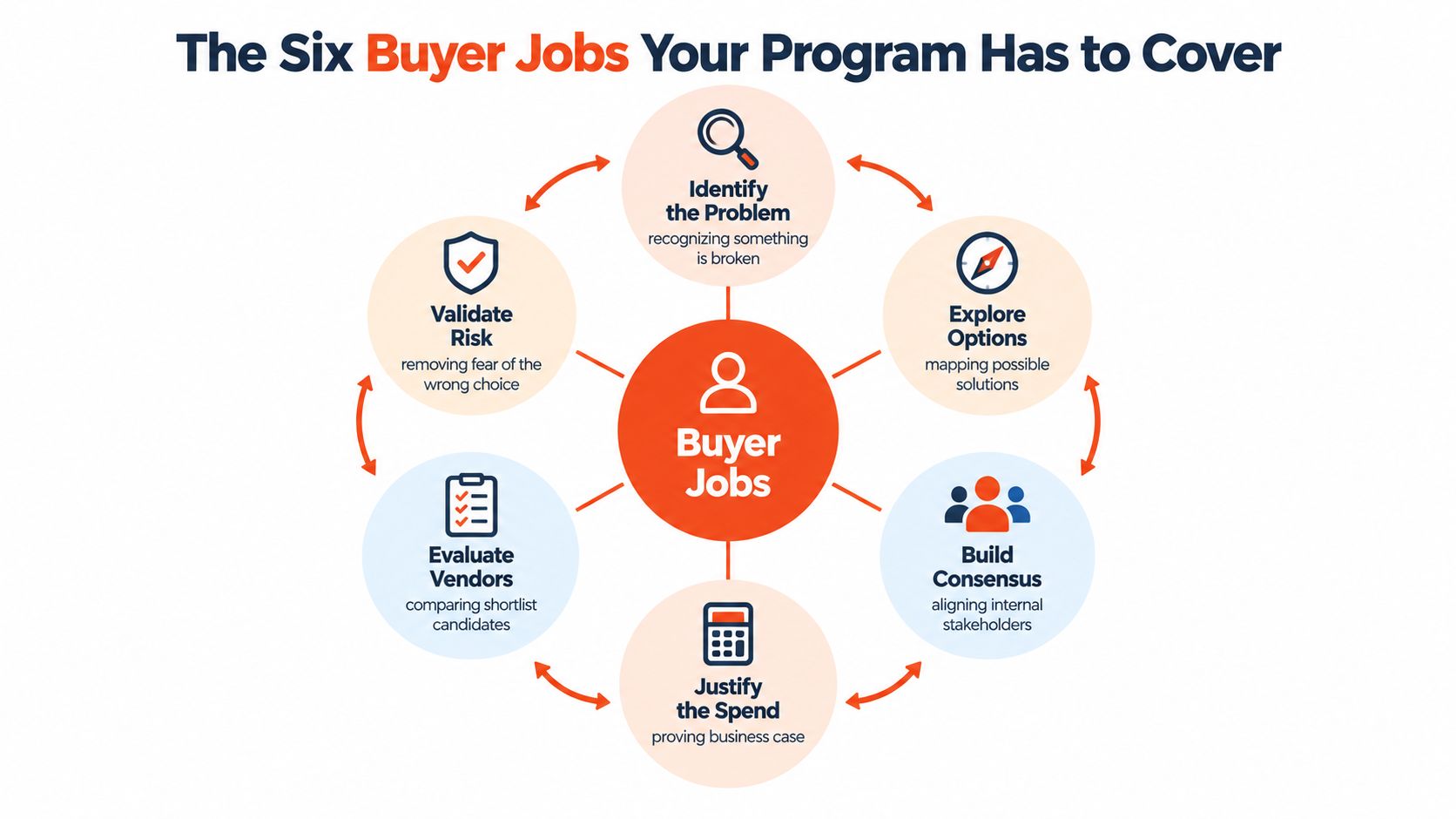
Match the asset to the job
- Problem identification: Publish diagnostic content, founder POVs, and sharp category framing. The signal is repeated visits to problem-based pages and senior-level engagement.
- Solution exploration: Use comparison pieces, explainers, and webinar recordings. The signal is multiple contacts from the same account consuming related content.
- Requirements building: Offer checklists, buying guides, and scoping templates. The signal is return visits, saves, shares, or a direct question about fit.
- Supplier selection: Put proof assets in front of the account, case studies, demos, and third-party validation. The signal is shortlist behavior and side-by-side evaluation.
- Validation: Give risk-reduction content, implementation overviews, and references. The signal is deeper engagement from decision-makers and operators.
- Internal consensus creation: Build business cases by role. Finance cares about payback, operators care about workload, executives care about outcomes.
The mistake is to treat every form fill as an MQL and call it progress. In reality, some actions just mean a buyer is still gathering context. A strong program segments by observable stage signals and uses those signals to decide when to route to human outreach.
The Four Building Blocks of a Demand Generation Program
Every serious program rests on four blocks, and if one is weak, the whole thing leaks. You need a narrow ICP, a focused channel mix, an offer matched to the buyer job, and a cadence that does not fade after one touch. That is the difference between a program and a pile of tactics.
Build the ICP for fit, not fantasy
Your ICP has to be narrow enough for sales to believe it. If the team selling the product cannot explain why the list belongs in the market, the definition is too broad. In long-cycle B2B, fit beats volume every time.
Choose channels where buyers already research
Do not pick channels because they are easy to buy. Pick them because buyers already use them while they evaluate options. That usually means a mix of content, paid distribution, events, and senior-led outreach, but the mix should follow the buying journey, not vendor preference.
Design offers that fit the buying job
Your offer should answer the buyer's current question. Early-stage buyers want clarity, later-stage buyers want proof, and internal stakeholders want a business case they can defend. If the offer is misaligned, even strong distribution will not save it.
Set cadence for speed and follow-through
Once a qualified signal fires, contact speed matters. One cross-industry benchmark reports that contacting a qualified lead within five minutes produces 21 times higher qualification odds than waiting 30 minutes (lead response benchmark). That does not mean every inquiry deserves an immediate call. It means your process has to move fast once a real buying signal appears.
The core question is never “which tactic?” It is “which block is broken?” how B2B teams structure demand generation is useful as a comparison point, but the framework only works when you diagnose the failure inside your own program.
| Building Block | Standard B2B Setting | Long-Cycle Setting | Common Mistake |
|---|---|---|---|
| ICP | Broad segment definition | Narrow, sales-aligned account profile | Chasing too many accounts |
| Channels | Pick the easiest channels to launch | Pick channels buyers already trust | Overweighting one platform |
| Offers | One generic lead magnet | Offers mapped to buyer job and stage | Recycling the same ebook |
| Cadence | Nurture until conversion | Fast response, then staged follow-up | Letting signals sit untouched |
Practical rule: if the ICP, channel, offer, and cadence do not all point to the same buyer job, the program will create motion without pipeline.
When you audit your own program, start by asking which of the four blocks is broken, not which tactic to add.
Orchestrating Channels Across a 90-Day Window
A useful demand generation program doesn't stack channels randomly, it sequences them. Think of a mid-market HR director at a consulting target account. She sees senior-led content first, then a relevant event touch, then a direct message only after the account shows enough buying evidence.
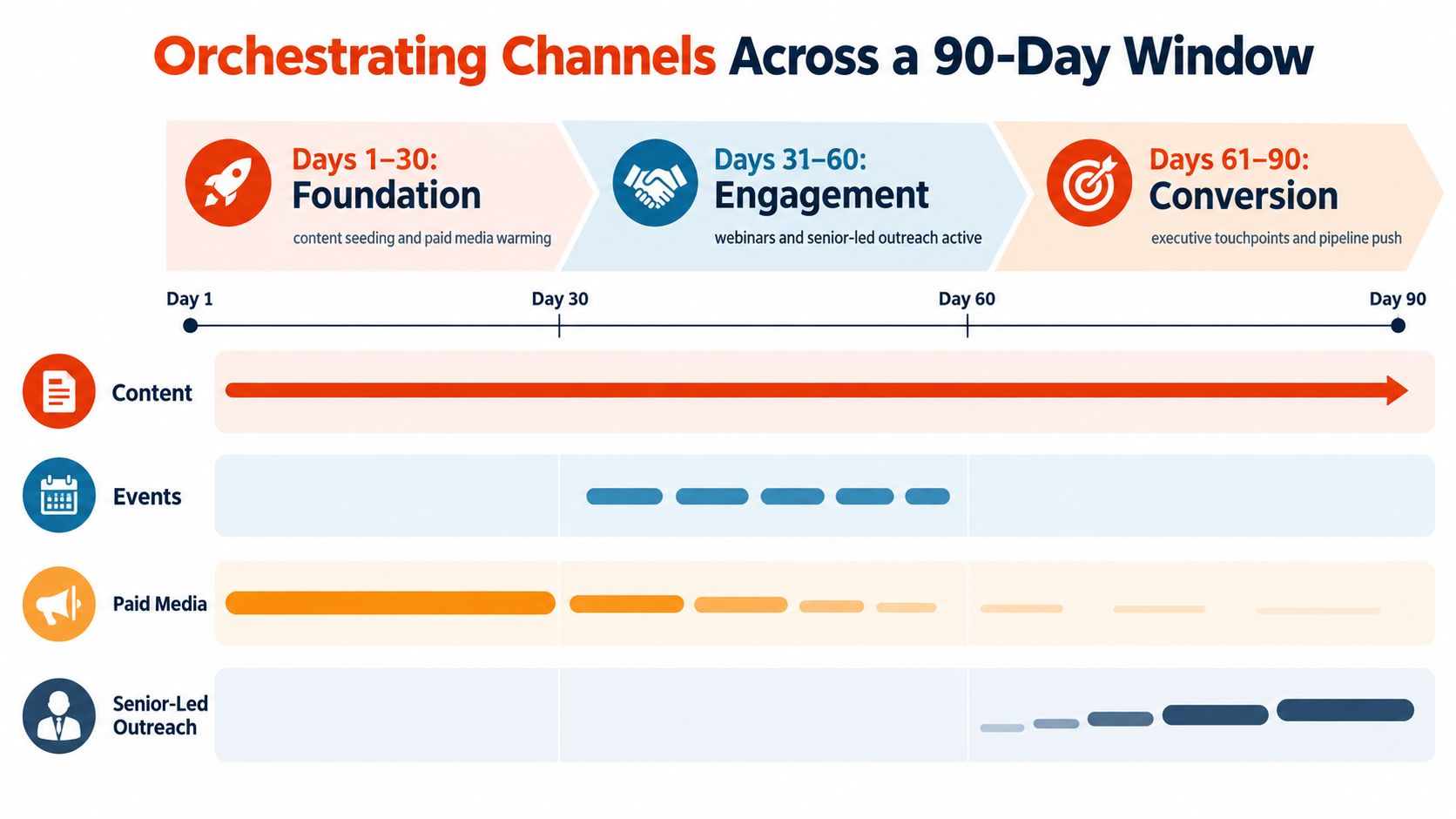
A buyer doesn't care that you launched six campaigns. She cares whether each touch answers the next question in her process.
A working 90-day pattern
A representative account might start with a senior leader's post on a problem the HR director already feels but hasn't named. That's the foundation phase. Paid media supports that content so the account sees the point of view more than once, while the program watches for repeat engagement, not just clicks.
In the middle phase, the account attends a webinar or event conversation and a second stakeholder from the same company shows up. That's the signal that the conversation is moving from curiosity to evaluation. At that point, the account should get proof assets, not more top-level education.
By the conversion phase, senior-led outreach becomes relevant. A direct message works only if it's tied to the account's observed behavior, not sprayed at random. If the account has shown repeated engagement with the right content, a short, credible note from an authoritative profile can earn an accepted meeting.
Why the sequence matters
The wrong way to run this is to treat every channel as equal and active all the time. That makes reporting easy and orchestration useless. The right way is to let each channel do one job, then hand off to the next channel only when the account shows readiness.
This is the same reason a strong pipeline plan needs pipeline generation planning discipline. If the sequence is sloppy, the program feels active but never concentrates enough pressure to create qualified meetings.
Demand Gen Report's 2023 buyer research found that more than half of B2B buyers spend at least three months actively researching before engaging with a sales representative, compared with approximately 47% in 2020 (buyer research summary). That's not a short-cycle environment. It's a patience game with strict orchestration.
KPIs That Survive a Six-Month Sales Cycle
Most KPI dashboards are built for convenience, not truth. They overvalue early activity and undervalue the steps that actually move a deal. If your executive review is still dominated by MQL volume and open rates, you're measuring motion, not progress.
A long-cycle program needs a harder scorecard. Qualified meetings held, sales-accepted opportunities, stage conversion rates, pipeline velocity, and account-level engagement depth tell you whether the program is producing business. Raw lead counts do not.
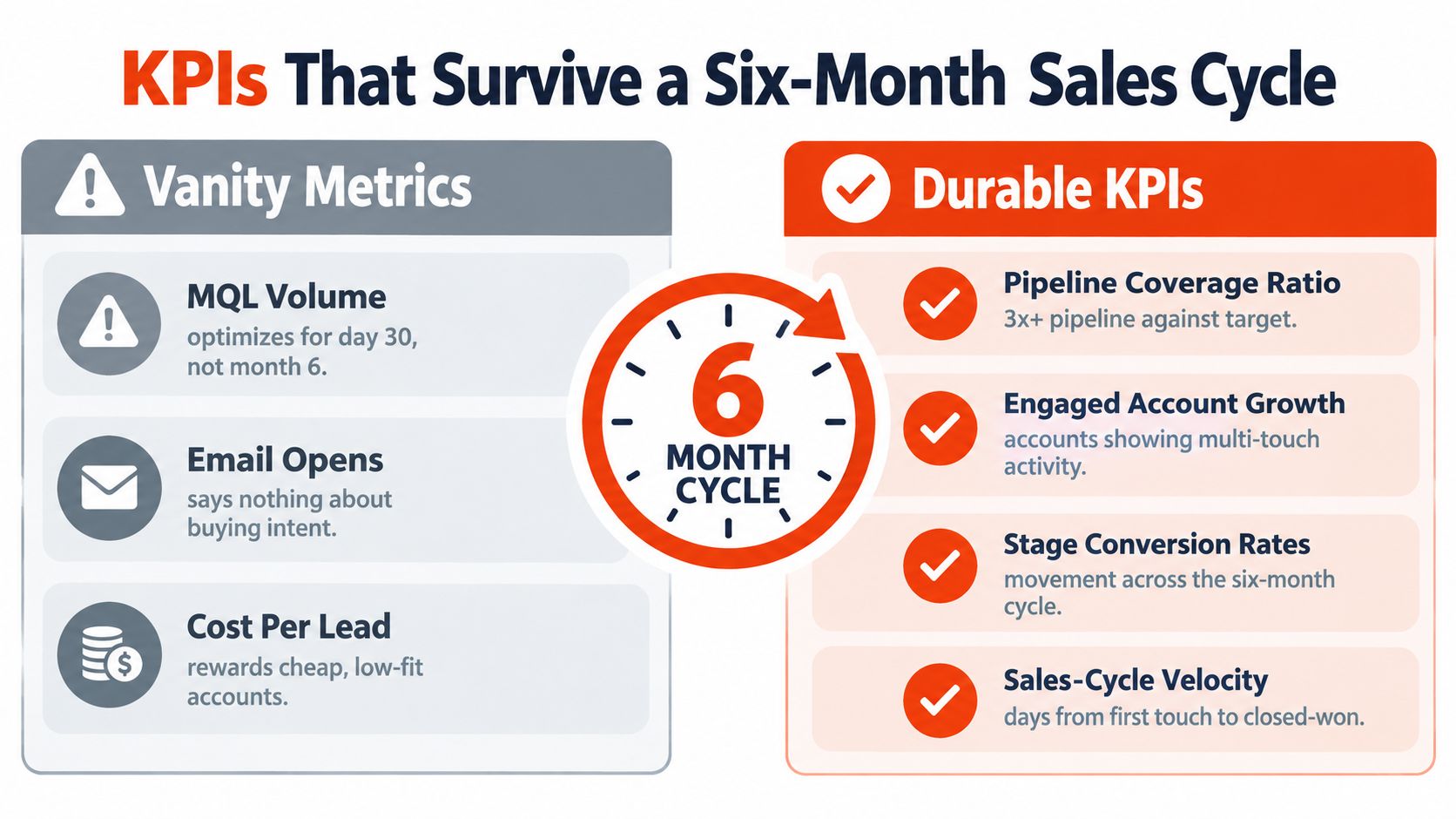
What to keep and what to kill
- Keep qualified meetings held. Meetings that happen are proof the signal was real.
- Keep sales-accepted opportunities. Sales acceptance shows the program found something worth pursuing.
- Keep stage conversion rates. If accounts stall at the same point, the offer or follow-up is weak.
- Keep response time. Speed to contact matters once intent is real.
- Drop raw MQL volume as the main success metric. It rewards activity that may never convert.
- Drop open rates as a core KPI. They don't prove buying movement.
- Drop cheap cost per lead thinking. Cheap leads are often just cheap distractions.
The harder measurement problem is attribution across anonymous buying groups. 94% of B2B buying groups rank preferred vendors before contacting sales and consume an average of 13 content pieces during the process, largely anonymously, which makes individual-level attribution misleading for long-cycle programs (buying group behavior analysis). That means you need account-level evidence, self-reported attribution, and controlled tests, not a fantasy spreadsheet that assigns credit to every touch.
Useful standard: if a metric can't help you decide whether to keep, kill, or change a program in the next review cycle, it doesn't belong in the executive report.
For teams that want a deeper framework on reporting and measurement, the complete 2026 attribution guide is a practical reference point. The important thing is not to worship attribution models. It's to use measurement that survives a long sales cycle.
Using Intent Data Without Paying for False Precision
Intent data only matters when it improves timing and prioritization. If it just adds alerts, it becomes expensive noise. That is a trap teams fall into constantly: they buy signal volume, then mistake volume for readiness.
One industry source says 91% of B2B marketers use intent data, yet only 24% report exceptional ROI (intent data industry source). The gap is not access. It is operational discipline.
Classify signals before you contact anyone
Treat signals in layers, not as equals. Passive attention is the weakest layer, repeated engagement is stronger, social proof or referral is stronger again, explicit problem investigation is more serious, and active buying-group behavior is the point where outreach starts to make sense.
For a closer look at the types of B2B information signals worth paying for, see our guide to B2B information services.
The rule is simple, require multiple independent signals before sales acts. A single content view is not a trigger. A topic spike from multiple people in the same account, plus a referral, plus a relevant role match is a trigger worth checking.
Put rules around the signal
Before you scale the program, define the signal-to-meeting conversion rate you expect, the false-positive tolerance you will accept, the response-time rule after a strong signal, and the opt-out safeguard that keeps the process respectful. If those rules are not written down, the team will drift toward spam.
For consulting and B2B software firms, that discipline matters because high-consideration buyers can engage with authority content for a long time before they show obvious commercial intent. A strong setup lets you reach out when the timing is real, not when the software is loud.
Operational trust matters too. Sales teams stop believing intent alerts when most of them go nowhere. Once that happens, even good signals get ignored. That is a process problem, not a data problem.
Launching a Three-Month Pilot You Can Defend
Start with one defined ICP, two or three channels, two offers, and a 90-day window. Write the success criteria before launch, then get sales to sign off on the definitions. If you can't defend the pilot in a boardroom before it starts, the scope is wrong.
Pilot scorecard
| Metric | Definition | Target | Source of Truth |
|---|---|---|---|
| Accepted meetings | Meetings sales accepts as valid opportunities | Pre-agreed before launch | CRM and sales disposition |
| Sales-accepted opportunities | Opportunities accepted by sales after qualification | Pre-agreed before launch | CRM |
| Opportunity value | Value of opportunities created from the pilot | Pre-agreed before launch | CRM |
| Response time | Time from qualified signal to first human contact | Immediate workflow standard | Marketing automation and CRM |
| Pipeline created | New pipeline generated from pilot accounts | Pre-agreed before launch | CRM |
Run a weekly review with marketing and sales together. Kill weak signals fast, route strong ones immediately, and keep the scope tight enough that you can clearly see cause and effect. The program should either create qualified meetings and opportunity movement, or it should be changed.
The three failure modes to watch are easy to name. Don't count unverified engagement as demand. Don't optimize for MQL volume. Don't let intent signals sit without an SLA.
If you want a team that can do this without turning your GTM motion into a spam factory, visit Ploot. It helps B2B teams turn LinkedIn audiences into qualified meetings by detecting buying intent and contacting prospects from authoritative profiles at the right moment.