

Setting a KPI and checking it at the end isn't a pilot strategy. It's a reporting schedule. A useful pilot success criteria template tells your marketing and sales teams what evidence they must collect, what operational risks they must test, and what would justify committing more budget.
For a B2B sales pilot, the question isn't whether you hit the meeting target. It's whether you can generate qualified demand through a process your team can repeat, measure, and support without exceptional intervention.
Table of Contents
- Why Most Pilot Templates Fail Before They Start
- The Four Building Blocks of a Pilot Success Criteria Template
- Writing SMART Criteria for a Three-Month B2B Pilot
- Designing Attribution for Influence, Not Last-Click
- Scale, Iterate, or Stop - Decision Rules That Beat Pass-Fail
- The Pilot Success Criteria Template Scorecard
- Pre-Pilot Checklist to Lock the Template Before Launch
Why Most Pilot Templates Fail Before They Start
The familiar KPI-and-review-date approach creates three bad decisions: scaling activity that isn't commercially useful, rejecting a channel before the evidence matures, and extending an inconclusive pilot without a defined learning objective.
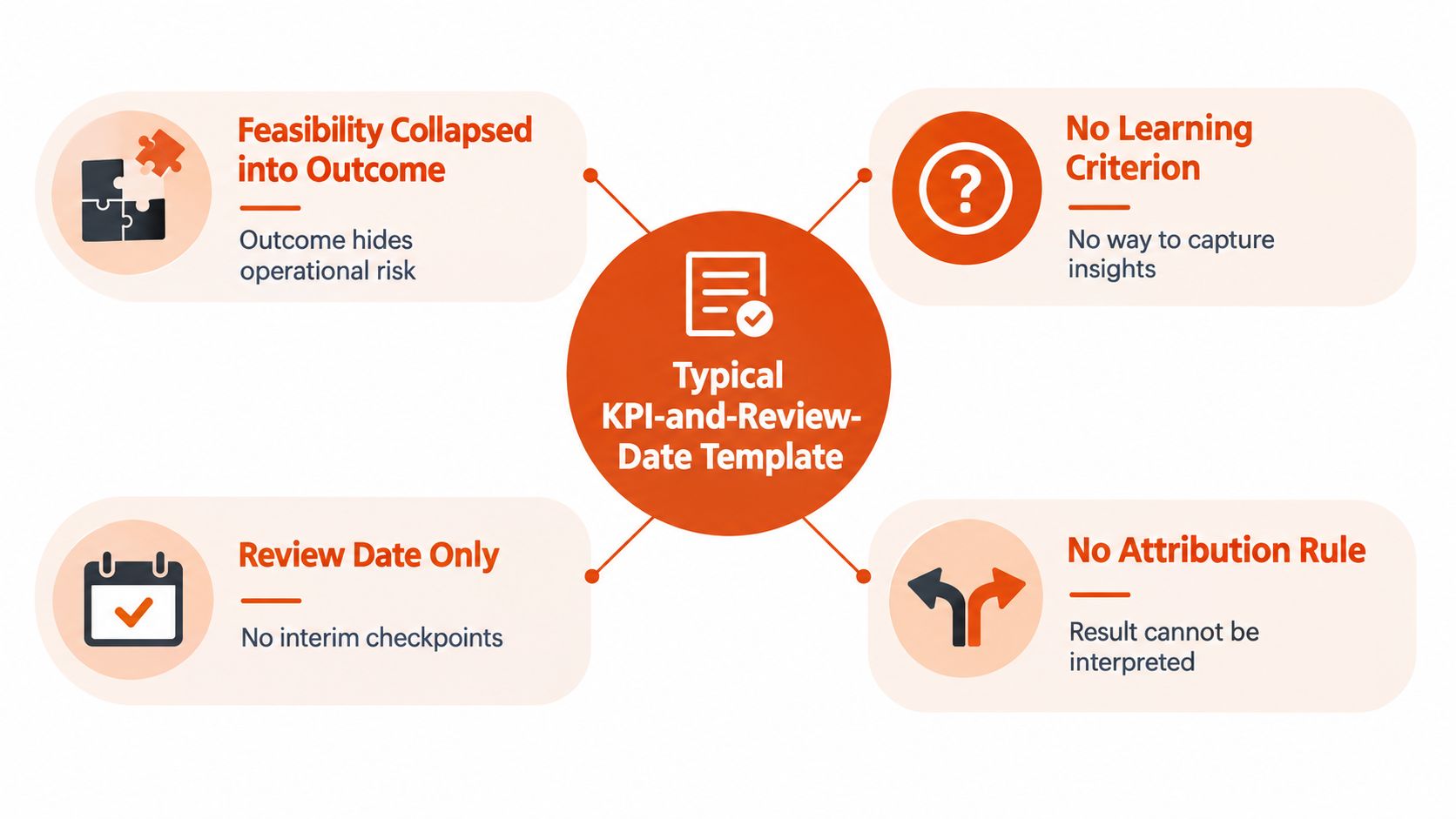
Behind those decisions sit four design flaws. Teams collapse feasibility into commercial outcomes, omit learning criteria, postpone judgment until the final review, and leave attribution undefined.
Duke University's pilot-study guidance makes the distinction explicit: criteria should be specified in advance and based primarily on feasibility objectives, including the evidence needed to show that delivery works as intended. A pilot tests feasibility and learning, not just a smaller rollout.
Separate the result from the operating model
- Feasibility hidden by outcomes: Meetings arrive, but nobody records the senior partner's manual effort.
- Learning left undefined: The team misses its target without discovering whether targeting, messaging, or follow-up caused the shortfall.
- A review date without checkpoints: Managers discover preventable delivery problems too late to address them.
- Attribution left open: Marketing and sales apply different definitions of contribution after seeing the results.
Executive-led demand generation needs particular discipline. Don't assume senior participants will provide consistent input, that early meetings represent future demand, or that revenue will mature within the evaluation window.
For a software-enabled pilot, Continuum Solutions on MVP builds is a related resource to consult when defining the limited build you intend to test.
Practical rule: Define success as credible business evidence, workable delivery, interpretable attribution, and a defensible next decision. Hitting the number is only part of that judgment.
The Four Building Blocks of a Pilot Success Criteria Template
Build the document around outcomes, feasibility, attribution, and decision gates. Keep these blocks separate so a strong result in one category can't conceal a weakness elsewhere.
The underlying distinction matters. Public-sector guidance on evaluating pilot programs treats implementation, early evidence of promise, feasibility, and scalability as distinct evaluation questions. Your commercial scorecard should preserve that separation rather than reduce everything to a headline KPI.

Outcomes establish commercial promise
Start with evidence sales will defend: attended qualified meetings, sales-accepted opportunities, and qualified pipeline. Write the qualification definition beside the criterion, including account fit, buyer role, business need, and the required next step.
An example field is sales-accepted opportunity creation. Its target should specify the agreed minimum, while its measurement method should require a CRM record and acceptance from the sales owner. A calendar booking alone doesn't satisfy it.
Feasibility tests delivery and repeatability
Implementation quality asks whether people can execute the workflow as designed. Feasibility and scalability ask whether they have the capacity, data, and support to keep doing it.
For executive-led prospecting, an example criterion is usable participant input within the agreed workload allowance. Another is reliable routing of buying-intent signals to the responsible salesperson. Record exceptions and manual repairs instead of treating them as invisible support.
- Attribution establishes interpretability: Include an evidence field explaining why an opportunity is classified as pilot-sourced or pilot-influenced. Unsupported labels shouldn't qualify.
- Decision gates establish consequences: Write the conditions for scaling, revising, or stopping before launch. Assign a decision owner rather than assuming the final meeting will produce consensus.
Keep a learning log alongside these blocks. Each entry should name the assumption tested, the evidence observed, the implication, and the action owner.
Useful learning changes a decision. Discovering that a particular buyer role responds but lacks purchasing authority should alter targeting or qualification. Recording that engagement looked encouraging shouldn't.
Writing SMART Criteria for a Three-Month B2B Pilot
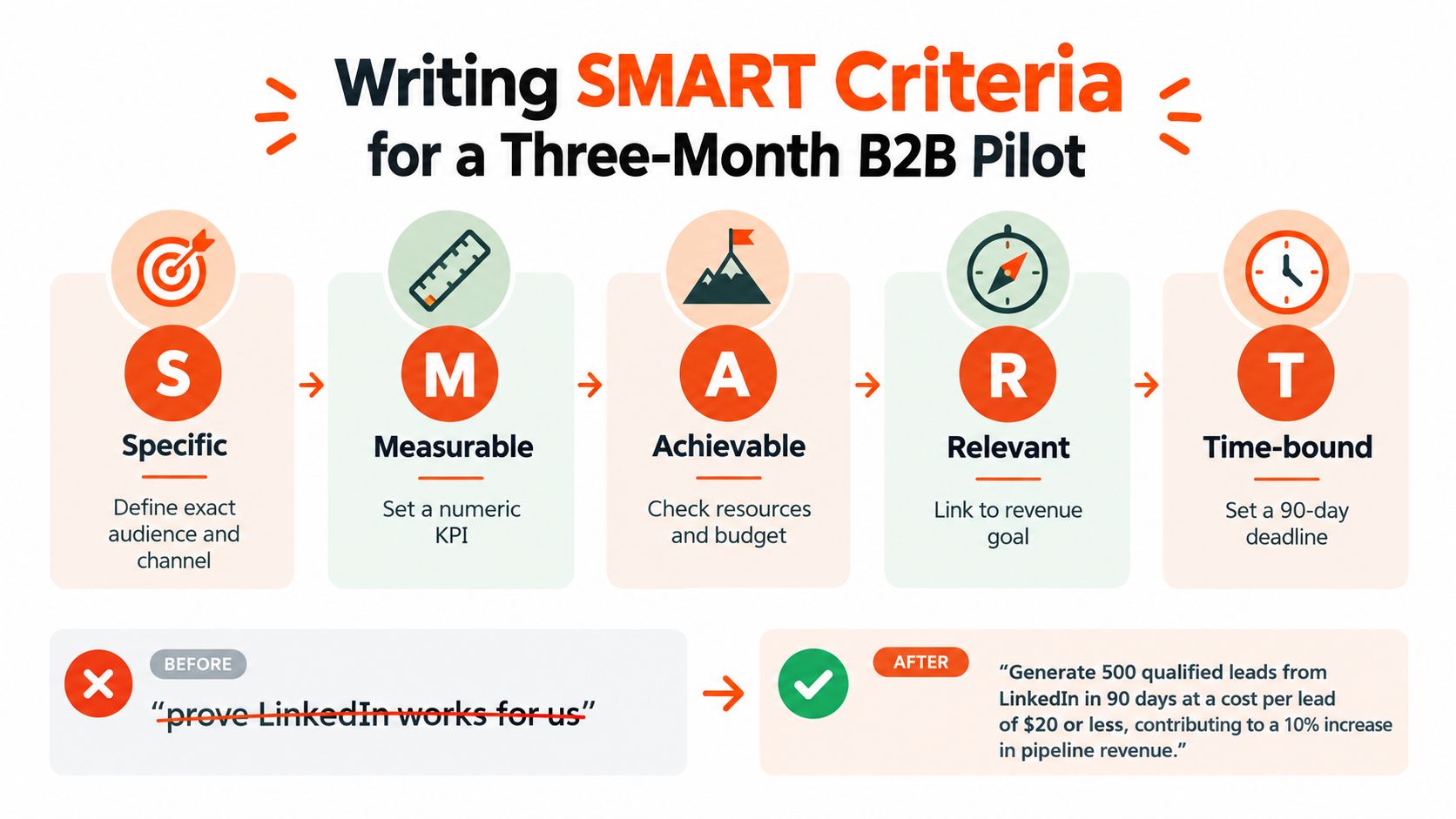
Proving that LinkedIn works is too vague to approve. Replace it with a statement naming the participants, target accounts, commercial threshold, operating constraints, and decision deadline.
For a three-month evaluation, write the objective using Specific, Measurable, Achievable, Realistic, and Time-bound fields. Treat each field as a drafting test, not as an acronym to paste above an unchanged ambition.
Replace ambition with an auditable commitment
A usable statement would read:
By the final pilot review, activate the agreed executive profiles, identify buying-intent signals within the approved account segment, and generate the signed-off minimum of qualified opportunities, while remaining within participant workload and outreach guardrails.
That statement isn't complete until your team inserts its actual thresholds. Don't borrow targets from another company's funnel. Set them using your historical conversion data, available sales capacity, content resources, and buying-cycle length.
- Specific: Name the activated profiles, target industries, buyer seniority, geography, and exclusions. Define activation as completion of the agreed setup and operating requirements.
- Measurable: Enter explicit minimums for sales-accepted meetings and opportunities, plus the qualified-account rate and pipeline target. Specify the numerator and denominator for each rate.
- Achievable: Check whether participants can supply usable input and sales can handle the proposed conversation volume.
- Realistic: Match the commercial target to the sales cycle. Don't require closed revenue when your historical buying process makes opportunity progression the more defensible test.
- Time-bound: Schedule weekly operating reviews, a midpoint checkpoint, and the final decision at the end of month three.
Connect these criteria to your pipeline generation plan. The pilot should test a defined route to commercial demand, not a disconnected publishing experiment.
Pair delivery signals with business evidence
Use profile activation, relevant audience growth, detected intent, and accepted conversations as leading indicators. Use qualified meetings, opportunities, pipeline value, and cost per opportunity as lagging indicators.
Leading indicators help diagnose a shortfall. They don't replace the commercial target.
Don't annualize an unusually strong opening period or declare a channel ineffective from an inconclusive result. Duke's guidance on pilot inference warns that small samples can produce imbalanced covariates and imprecise confidence intervals, and that nonsignificant results aren't proof of no effect. Unless the pilot was designed and powered to establish channel performance, report directional evidence with its limitations.
Designing Attribution for Influence, Not Last-Click
Last-click attribution is too narrow for evaluating executive-led demand generation. In long, high-ticket B2B purchases, social activity can shape a buying conversation without producing the click attached to the eventual opportunity.
Use the customer journey to identify where evidence of influence could enter the sales record.

Research on social-first B2B attribution recommends triangulating platform analytics, web data, CRM outcomes, and buyer feedback during a 60–90-day measurement pilot. It emphasizes decision-maker engagement, qualified conversations, pipeline conversion, deal size, and win rate rather than raw engagement.
Make attribution an operating requirement
Create separate CRM fields for source and influence. Source records the agreed origin of the opportunity; influence records supported interactions that contributed to the buying conversation.
Require salespeople to ask how the buyer heard about the firm, retain the answer, and tag relevant sales-call evidence weekly. Use B2B marketing and sales alignment to establish who captures that evidence and who adjudicates disputed classifications.
For the recording mechanics, consult Chartsy's practical SaaS attribution setup, then document the fields and rules your own pilot will use.
- Freeze the rule before launch: Establish the baseline period and attribution window, and use a control or matched comparison where feasible.
- Track the funnel as rates: Eligible audience → detected intent → contacted → positive response → qualified meeting → sales-accepted opportunity.
- Record exclusions: Flag duplicate contacts, existing opportunities, out-of-market accounts, and meetings rejected by sales. Keep profile-level and account-level denominators separate.
Use the accompanying video as a discussion aid, not as a substitute for your written attribution specification.
Compare influenced and other opportunities by qualification, stage progression, expected value, and win rate where outcomes have matured. Treat differences as evidence to investigate, not automatic proof of causation.
Low direct attribution isn't enough to declare failure. Equally, an influence label isn't enough to claim success. Require traceable buyer or CRM evidence and a credible connection to pipeline quality.
Scale, Iterate, or Stop - Decision Rules That Beat Pass-Fail
Approve a decision policy before approving spend. Otherwise, the final review becomes a negotiation over whether disappointing evidence is acceptable or encouraging evidence is sufficient.
Use scale, iterate, and stop as distinct decisions. The evaluation guidance discussed earlier supports separating implementation and scalability questions; these gates turn that distinction into a commercial commitment.
Scale requires evidence beyond the headline result
Scale only when the agreed outcome and feasibility thresholds are met, attribution is interpretable, and guardrails remain intact. Require corroborating evidence outside the original source of success, such as another approved profile or buyer segment.
Don't expand into an untested industry and call that repeatability. Authorize the scope supported by the evidence, and name what still needs validation.
- Scale: Approve the next deployment scope, budget owner, capacity plan, and monitoring requirements.
- Iterate: Identify a promising commercial signal and a fixable constraint. Specify the change, responsible owner, retest window, and evidence required to graduate.
- Stop: End the pilot when credible commercial evidence is absent after adequate execution and observation, or when a material guardrail breach makes continuation unacceptable. Record the reason and exit actions.
Apply the gates to conflicting evidence
Consider this hypothetical decision scenario, not a reported case study. An executive-led pilot misses its pipeline target, but participants provide usable input, buying-intent detection is auditable, and sales accepts the resulting conversations. Opportunities are progressing, while the team has identified and corrected a follow-up delay.
The defensible decision is iterate, provided the retest addresses that delay and has a firm endpoint. The team has evidence worth pursuing, but it hasn't earned a scale decision.
Now reverse the situation. The pilot meets its commercial target through a senior partner's personal intervention, while other participants can't reproduce the process and sales disputes meeting quality. Even a closed deal wouldn't justify expanding that operating model.
Don't scale a result your team can't reproduce. Don't stop a workable process solely because commercial evidence hasn't matured.
Keep safety separate from optimization. A correctable routing problem can justify a retest; unacceptable data handling or outreach practices should trigger escalation and suspension, not an optimistic extension.
The Pilot Success Criteria Template Scorecard
Use a spreadsheet, not a presentation slide. The Pilot Success Criteria Template Scorecard should let a reviewer trace each judgment from criterion to evidence without asking the campaign owner to reconstruct events.
The targets below are fields to complete, not universal benchmarks. Replace every agreed minimum, ceiling, and date with a signed-off value before launch.
Pilot Success Criteria Template Scorecard
| Criterion | Type | Baseline | Target | Measurement | Owner | Review date |
|---|---|---|---|---|---|---|
| Attended qualified meetings | Outcome | Historical attended meetings | Agreed minimum | Calendar attendance and qualification record | Sales lead | Weekly and final |
| Sales-accepted pipeline | Outcome | Comparable historical pipeline | Agreed minimum value | Accepted CRM opportunities | Sales director | Midpoint and final |
| Profile activation | Feasibility | Current readiness | Agreed profiles operational | Setup and publishing checklist | Marketing lead | Launch checkpoint |
| Intent routing | Feasibility | Current response performance | Agreed response-time threshold | Timestamped signal and handoff log | Demand-generation lead | Weekly |
| Attribution evidence | Feasibility | Existing field completeness | Required evidence on counted opportunities | CRM audit and buyer answers | Revenue operations | Weekly |
| Participant workload | Guardrail | Current effort | Agreed workload ceiling | Participant effort log | Program owner | Weekly |
| Brand quality | Guardrail | Approved content standard | Content meets approval requirements | Content and message review | Brand owner | Before release |
| Data accuracy | Guardrail | Current audit findings | Agreed accuracy threshold | Contact and account audit | Revenue operations | Weekly |
| Outreach compliance | Guardrail | Approved operating policy | Approved process followed | Suppression and outreach review | Compliance owner | Before outreach and weekly |
| Decision readiness | Feasibility | Outstanding evidence gaps | Gate evidence complete | Scorecard and learning-log review | Commercial sponsor | Final decision |
Make the evidence accessible
Store qualification records, exclusions, and exception logs beside the scorecard. For organizing commercial reporting, Micro CRM's guidance to track your sales performance is a related resource.
- Keep observed and assumed values separate: Use the ROI calculator for scenario planning, but label forecast conversions and deal values as assumptions.
- Preserve original targets: Record approved revisions separately, with the reason and authorization.
- Name individual owners: A department name doesn't establish accountability for missing evidence.
Don't average guardrails into a composite score. Strong pipeline must never offset an unacceptable compliance breach.
Pre-Pilot Checklist to Lock the Template Before Launch
Turn the template into a signed operating agreement. Marketing, sales, participating executives, revenue operations, and the commercial sponsor should approve the same definitions and decision policy.
The SMART evaluation framework emphasizes Specific, Measurable, Achievable, Realistic, and Time-bound objectives, supported by explicit evidence of success. Apply that discipline to ownership and decision-making, not just target wording.
Prepare the documents and systems
- Signed scorecard: Confirm scope, baselines, targets, evidence requirements, owners, and review dates. Resolve disagreements about qualification before any outreach begins.
- Attribution specification: Document CRM classifications, exclusions, attribution windows, denominator rules, and the process for reviewing disputed records.
- Learning log: Assign an owner to record tested assumptions, observations, unresolved questions, and changes requiring approval.
- Escalation path: Name who can pause publishing or outreach, who investigates problems, and who authorizes restart.
- CRM readiness: Test the source, influence, buyer how-heard response, qualification, sales acceptance, and deal-stage progression fields. Check that salespeople can retrieve the evidence during reviews.
Run a dry test through the workflow. Have the responsible people record a signal, route it, capture a sales response, and update the scorecard. Fix missing permissions, ambiguous fields, and handoff failures before starting the evaluation clock.
Book the decisions and confirm the boundaries
Schedule the weekly operations meeting, midpoint checkpoint, and final commercial decision in advance. Give each meeting a required output: corrective actions, an approved change decision, or a signed scale, iterate, or stop outcome.
Confirm these boundaries with the responsible legal and commercial owners:
- Data handling: Approve collection, access, retention, deletion, and any permitted sharing.
- Profile usage: Establish account permissions, participant consent, content approval, and responsibility for messages.
- Outreach controls: Confirm opt-out handling, suppression procedures, applicable compliance requirements, and prohibited practices.
- Commercial exit: Agree what happens to access, records, pending conversations, and continuing sales follow-up when the pilot ends.
Approval test: If reviewers can't explain what would change their decision, the template isn't ready to sign.
Your next action is to convene the commercial sponsor and sales owner, complete the scorecard, and test the evidence workflow. Don't launch with unresolved thresholds and promise to settle them later.
Protect against both errors: scaling encouraging but unrepeatable results, and rejecting a credible operating model because the evidence is incomplete. That's the standard a commercially useful pilot must meet.
Ploot offers executive-led LinkedIn demand generation, building senior participants' audiences, detecting buying intent, and contacting interested buyers to book qualified sales meetings. Visit Ploot to discuss a three-month pilot with agreed success criteria, and bring your qualification definitions, workload limits, and decision gates to that conversation.