

You're preparing the CMO's pipeline review, and the CRM tells an awkward story. Sales owns the referral that opened an important deal, but your team supplied the executive posts, case study, and webinar the buying committee used during evaluation. Reporting only the referral leaves marketing invisible. Claiming the entire deal as marketing-generated feels just as wrong.
Marketing influenced pipeline gives you a way to show that contribution without rewriting the deal's origin. The useful version isn't a software-generated percentage presented as certainty. It's an opportunity-level record of what marketing reached, when it happened, and how much confidence you should place in the evidence.
Table of Contents
- Sourced Versus Influenced Pipeline Defined
- Whose Engagement Actually Counts as Influence
- How to Measure Influence Without Claiming Cause
- A Referral Account and the Evidence That Holds
- Rules for a Board-Ready Influence Report
- Lock the Influence Rule Before the Next Review
Sourced Versus Influenced Pipeline Defined
Marketing-influenced pipeline is the value of opportunities any channel may have started, where marketing still had a documented qualifying interaction before the decision. Marketing-sourced pipeline identifies opportunities marketing first identified or engaged. One measures origin; the other records participation.
Say a partner at an IT consultancy forwards a warm introduction for a hypothetical €100,000 opportunity. Sales records the source as referral. During evaluation, the economic buyer reads a director's LinkedIn post, a technical evaluator engages with a case study, and procurement attends a webinar. The referral opened the deal. The content shaped how the committee judged it.
The two categories show up at different rates in practice. Pintel's B2B marketing statistics compilation reports 2026 summary averages of 41% marketing-sourced and 71% marketing-influenced pipeline, alongside healthy-program ranges of about 25% to 45% sourced and 60% to 85% influenced.
Sourced pipeline versus influenced pipeline
| Question | Marketing-sourced pipeline | Marketing-influenced pipeline |
|---|---|---|
| Core question | Who first created or identified the opportunity? | Did marketing touch the account before revenue? |
| What it measures | Demand marketing created | Contribution to demand created anywhere |
| 2026 summary average | 41% of pipeline | 71% of pipeline |
| Healthy program range | About 25% to 45% | About 60% to 85% |
| Origins included | Marketing first identification or engagement | Sales, partner, referral, event, or outbound plus a later marketing touch |
| €100,000 referral example | Not sourced if a partner referral opened it | Influenced if the committee used qualifying content in evaluation |
| KPI role | Direct demand generation | Cross-funnel contribution, beside sourced and closed-won |
| Main risk | Hides marketing help on non-marketing-origin deals | Overstates cause if every weak touch is credited |
The gap between sourced and influenced benchmarks makes sense once you see how deals start in practice. An opportunity can begin through a partner's network and still receive meaningful marketing support during evaluation. Influenced reporting recognizes that support without transferring ownership of the introduction, which is why the influenced figure typically runs higher than the sourced figure in the same program.
One definitional choice changes your numbers more than any benchmark does: whether your influenced view includes marketing-sourced opportunities. A broad participation view counts them, since sourced deals almost always receive further marketing touches. A narrower non-marketing-origin view excludes them, isolating the deals marketing helped but didn't start. Neither convention is wrong, but a report that doesn't name which one it uses will produce numbers nobody can compare quarter to quarter.
What the pipeline value actually means
For the referral scenario, sourced reporting leaves the €100,000 under referral. Influenced reporting includes its value when the committee's activity meets the company's qualification rules. It doesn't turn the content interactions into additional opportunities, and it doesn't reassign the deal.
Nor does the influenced value mean marketing created that amount of economic value. It's the value of a deal associated with qualifying activity, not an estimate of revenue that would disappear without marketing. That distinction matters when the CMO asks whether the number justifies more investment.
Board-pack rule: Treat sourced pipeline as the direct-demand KPI, influenced pipeline as the cross-funnel contribution KPI, and closed-won revenue as the outcome.
Pipeline also isn't revenue. An open opportunity may shrink, stall, or be lost, so don't describe its full recorded value as money marketing earned.
Before comparing performance with peers, publish your eligible touches, lookback window, opportunity stages, and duplicate-credit rules. A broad influence policy can produce an impressive number without producing a better sales pipeline.
If the underlying budget question is whether to prioritize immediate lead capture or longer-term demand creation, Lead Printer's guide to choosing the right B2B pipeline strategy provides useful context. Make that strategic choice separately from deciding how to label contribution.
Whose Engagement Actually Counts as Influence
Buyers spend only about 17% of purchase time meeting suppliers, falling to 5% to 6% when comparing several suppliers, according to Gartner research covered in Influ2's account of the B2B buyer journey. The same coverage discusses a 2025 synthesis in which purchases can involve 13 people inside the buying organization and nine external participants.
That makes an engaged account a starting signal, not an automatic pipeline claim. A junior researcher skimming an introductory article tells you something different from a budget owner returning to delivery scope or a technical evaluator reviewing implementation requirements.
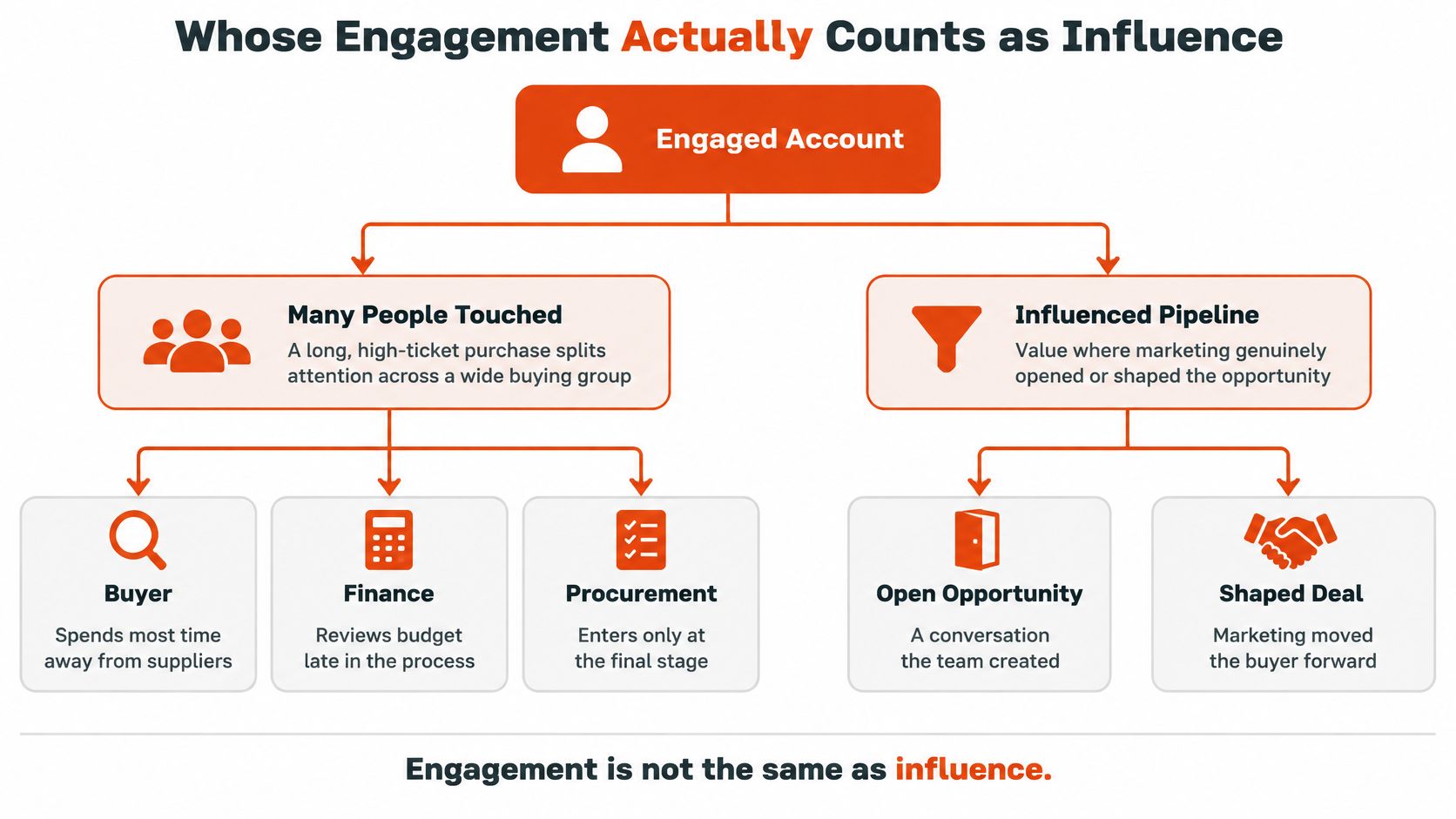
Weight signals by role and buying task
Record the person's role, the topic they engaged with, and the account match. Don't assign the same significance to every interaction merely because your platform can capture it.
Use the following as a proposed qualification policy. A “yes” means the signal can support an influence label when it's attributable to the account and satisfies your documented rules, not that it proves a commercial effect.
| Signal | Counts as influence? | Why |
|---|---|---|
| Repeated engagement from two or more relevant roles | Yes, with an account match | Supports committee-level interest |
| Shift from thought leadership to pricing, scope, or implementation | Yes, when attributable | Signals evaluation rather than general curiosity |
| Intent that appears soon after trusted executive content | Yes, with corroboration | Timing supports a connection, but doesn't establish cause |
| Single anonymous page view | No | No reliable account match or role |
| Unmatched traffic | No | Cannot be tied to a buying account |
| One like from outside the ideal customer profile | No | Wrong role and customer profile |
| AI-assisted research sessions | No, when untracked | Validate through sales conversations rather than inventing a touch |
A relevant role isn't always the most senior person. An implementation lead may have more influence over technical approval than an executive who casually reacts to a post. Weight the signal against the buying task, not just the job title.
Act on coordinated interest, not surveillance
Observe public and consented engagement. Don't imply that you identified an anonymous reader or tracked a private research session when you didn't.
Generative AI adds another visibility gap: buyers can evaluate suppliers through interactions your attribution system won't capture. Ask sales to document volunteered explanations of how the buyer researched the problem, rather than treating missing clicks as missing influence.
For outreach, adopt a practical handoff threshold: several relevant roles, a shift toward commercial topics, and a named account match. This account-based sales development guide helps connect that account context to a relevant sales conversation.
A handoff should describe the likely need, not announce that marketing has detected a purchase. Sales still needs to confirm the problem, timing, and willingness to engage.
How to Measure Influence Without Claiming Cause
A multi-touch percentage is a contribution view, not proof that marketing created an opportunity. For a creation-cohort report, use this working definition: the value of opportunities whose account received a qualifying marketing touch within a documented lookback window before or during opportunity creation.
Keep later-stage activity in a separate progression view. Otherwise, a webinar attended during negotiation could retrospectively change how you describe the opportunity's creation.
The operating model combines CRM records, controlled comparisons, and human feedback, rather than asking attribution software to answer every question. LoudDemand's B2B attribution guidance supports this combination of CRM attribution and incrementality controls.
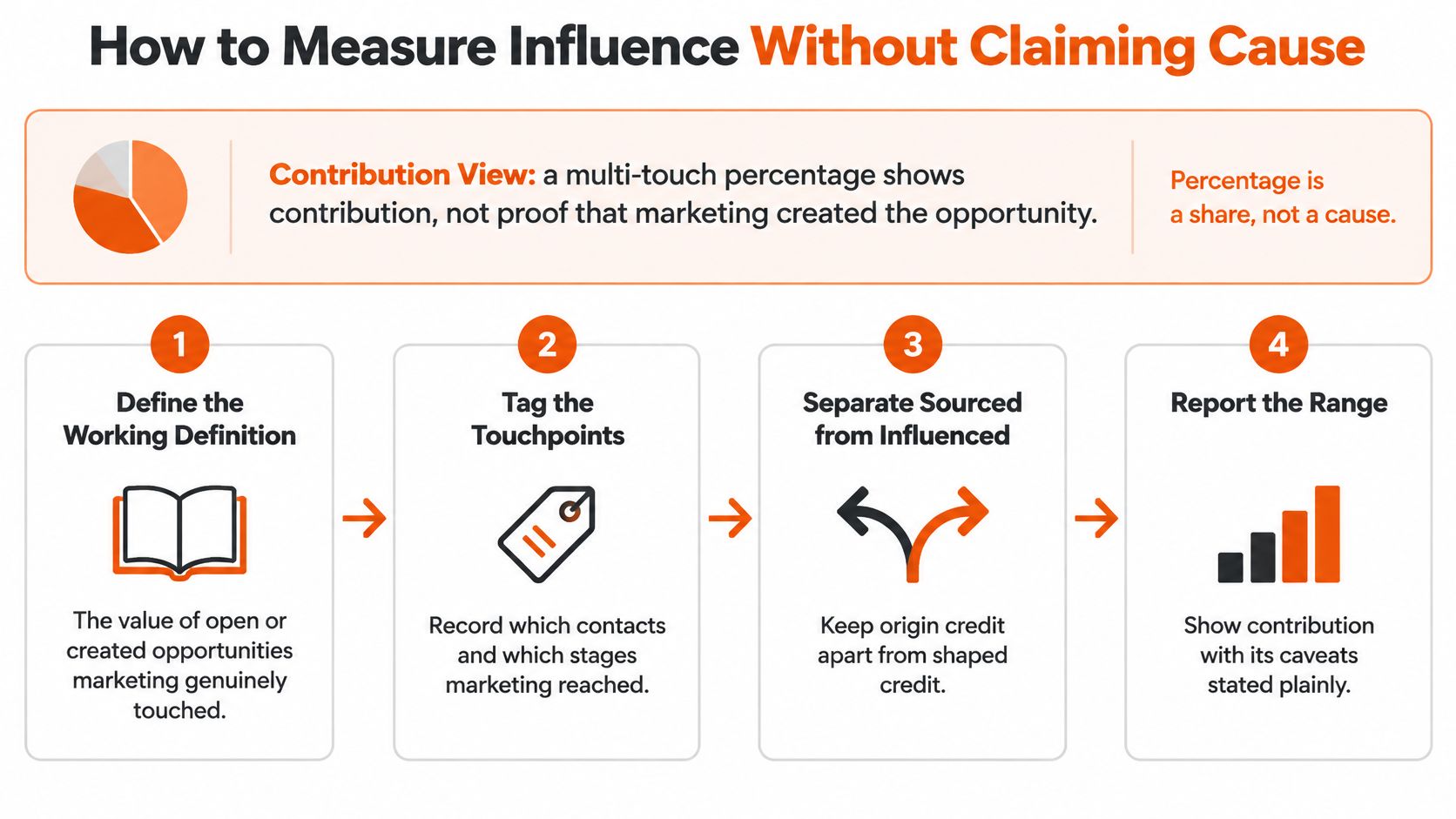
Build the evidence in layers
Record observable facts in the CRM. Store opportunity creation date, stage history, value, and revenue outcome. Timestamp qualifying touches and associate them with the account and opportunity, not merely an isolated contact. Freeze the creation-cohort flag at opportunity creation. Anti-inflation rule: lock the qualifying-touch definition before reporting starts.
Compare outcomes against a credible baseline. Match exposed accounts with comparable unexposed accounts using factors such as customer profile, opportunity source, stage, and deal size. Randomized exposure is stronger where feasible; matched comparisons remain vulnerable to differences you haven't observed. Anti-inflation rule: report outcome lift against the baseline, not raw influenced value as incremental impact.
Capture what buyers and sales can explain. Add structured notes for partner conversations, private communities, or content discussed during calls. Record what the buyer said, rather than a salesperson's assumption about what persuaded them. Anti-inflation rule: every note needs a named account and date.
A matched comparison can still mislead if sales gives exposed accounts more attention or if those accounts were already more likely to buy. Record those limitations alongside the result. A positive association deserves investigation, not an automatic causal label.
Publish the policy before the dashboard
Your attribution policy needs these fields:
- Minimum engagement event: Specify whether attendance, an identified response, or substantive content engagement qualifies.
- Account-matching method: Define how contacts and interactions connect to the buying organization.
- Lookback length: Choose a period that fits your sales process and apply it consistently.
- Repeated-touch credit: Decide whether repetition changes an evidence score, while keeping opportunity value deduplicated.
Adding recorded touches can increase reported influence without adding any pipeline.
For channel-level diagnostics, Crescade's guide to channel attribution models that work helps distinguish credit-allocation approaches. For the account-level operating view, use this guide to measuring account-based marketing.
For partner or executive activation, track influenced opportunity rate, influenced pipeline per activated profile, meeting-to-opportunity conversion, stage velocity, and win rate against a comparable non-activated cohort. Together, these measures test whether visible engagement accompanies commercial progress, rather than merely making the attribution chart busier.
A Referral Account and the Evidence That Holds
Return to the consultancy's referral opportunity. The useful question isn't what blended percentage the software assigns to marketing. It's which statements the team can defend about that particular account.
Sales has the introduction record. Marketing has identifiable content engagement. The evaluator later mentions the case study during a call. Those records support different labels, and they shouldn't be compressed into a single claim.

Follow the account through distinct labels
Sourced describes the director's referral that opened the conversation. Marketing doesn't claim origin because a prospect subsequently consumed content.
Influenced describes qualifying engagement by relevant committee members within the eligible window. In this scenario, the executive post and case study supply account-linked evidence.
For accelerated, suppose the account moves through technical evaluation faster than comparable referral accounts without exposure. That supports a possible acceleration finding, but a single faster deal doesn't isolate content from budget urgency, salesperson skill, or procurement readiness.
Assisted captures the evaluator's explanation that the case study helped answer an implementation question. No form fill is necessary when sales has recorded a dated, attributable buyer statement.
| Label | Evidence required | Sufficient on its own? |
|---|---|---|
| Sourced | Sales-logged referral that created the first conversation | Yes, for the sourced line only |
| Influenced | Timestamped qualifying touch from a relevant role inside the lookback window, with account match and stage data | Yes, if the account match is recorded, for the contribution label only |
| Accelerated | Stage velocity faster than a comparable account that never saw the content | No, needs a credible matched baseline |
| Assisted | Sales-call note that the evaluator cited the content, with no form fill | No without sales confirmation; the attributable note supplies that confirmation |
| Not sufficient | Reach, impressions, or a single anonymous session | No |
Why the final click can tell the wrong story
A synthesis discussed by CMSWire on the changing B2B buyer journey reports that 94% of buying groups had ranked their shortlist before engaging sellers. It also describes an analysis where software credited web search with 78% of conversions, while buyers credited it with 12%.
In the consultancy scenario, a search visit might help the evaluator find a supplier already recommended by a peer. Giving that visit all the credit would erase the recommendation; ignoring the visit would also lose a useful observation.
For a stronger account-level assessment, retain the matched account, timestamped touch, relevant role, opportunity stage, and value. Add buyer or sales confirmation, or supporting cohort evidence, when making a stronger claim about contribution.
A precise attribution weight isn't automatically more credible than a qualified buyer explanation.
Record the opportunity as sales-sourced through referral and marketing-influenced. In the notes, distinguish confirmed content use from possible acceleration and leave the incremental revenue effect unproven.
Rules for a Board-Ready Influence Report
In 2025, companies with effective marketing-sales handoffs had marketing influence up to 29% of pipeline, compared with 10% where handoffs were broken, according to Influ2's sales and marketing alignment research. Treat that contrast as an operating concern, not proof that changing a handoff alone will produce the same result.
Sales and marketing need a shared opportunity record before they can produce a report either team will defend. If the campaign system identifies an account but sales can't locate the supporting activity, the board number isn't ready.
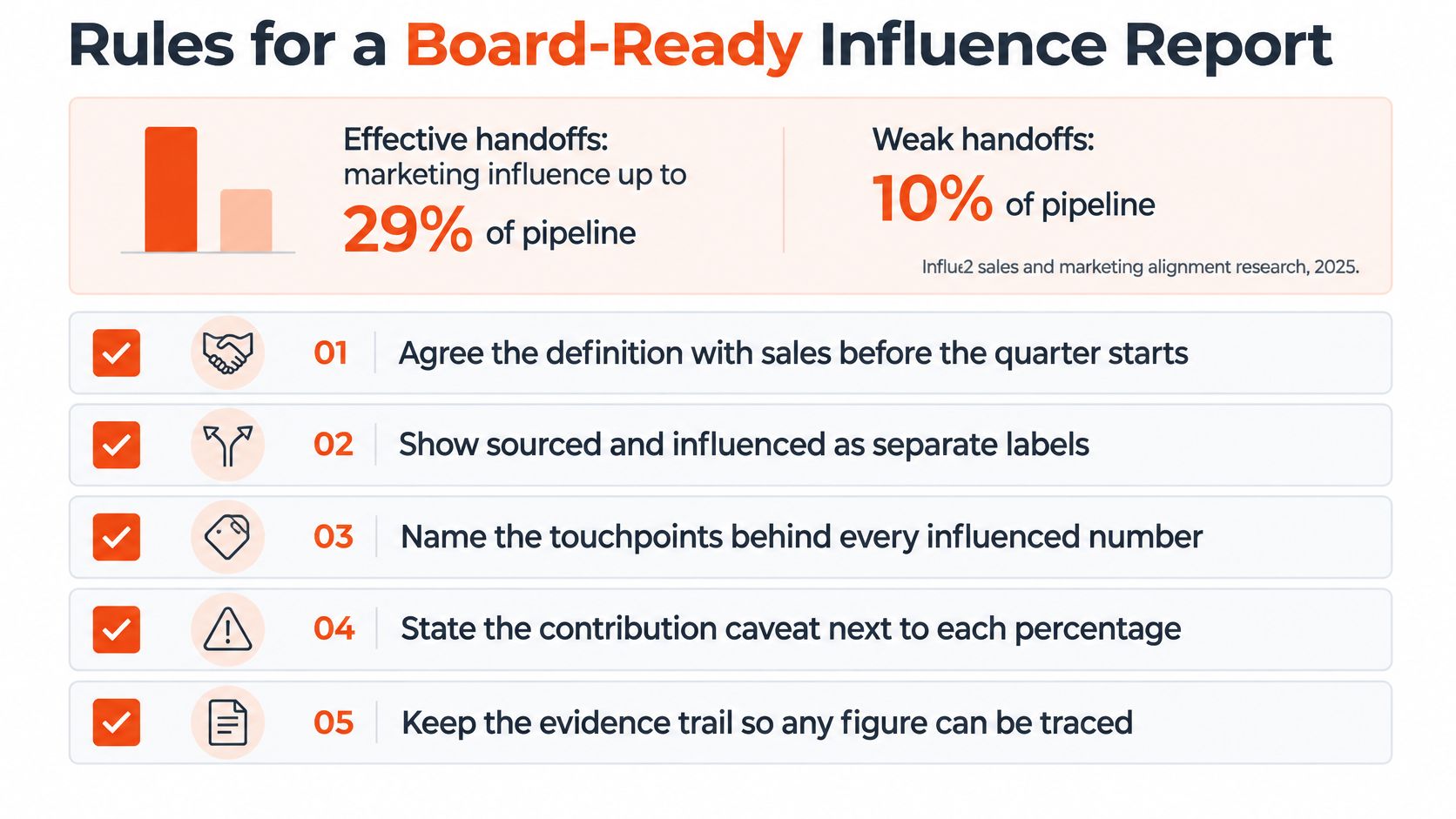
Put commercial outcomes on the report
Include these lines in the monthly pack:
- Marketing-sourced pipeline value and count: Opportunities with marketing recorded as origin.
- Marketing-influenced pipeline value and count: Opportunities meeting the agreed participation rule.
- Overlap: Identify shared opportunities so the lines aren't added into an inflated total.
- Influenced pipeline by stage: Separate early qualification from evaluation and negotiation.
- Closed-won revenue: Apply the same source and influence labels to completed business.
Declare whether the denominator is newly created pipeline or open pipeline at the reporting date. Mixing a monthly creation figure with an open-pipeline balance makes the percentage hard to interpret.
For a value-based influenced share, divide qualifying opportunity value by total eligible opportunity value for the same cohort. Keep currency treatment, opportunity eligibility, and reporting dates consistent. A count-based share answers a different question and should have its own label.
This guide to account-based marketing KPIs can help place the influence line alongside conversion and revenue measures rather than activity totals.
Put the policy underneath the chart
| Policy field | What the board should be able to identify |
|---|---|
| Qualifying touch | The specific event that earns inclusion |
| Account matching | How the person and interaction map to the opportunity |
| Lookback window | The eligible period for the reported cohort |
| Freeze point | The stage and date when the flag becomes fixed |
| Duplicate handling | Repeated touches never create another opportunity |
Add an uncertainty note stating the report's coverage: CRM-complete digital activity plus sales-noted offline influence, with no claim that exposure caused the win. Name missing coverage when it could change the interpretation.
A report saying that marketing influenced almost everything, without a window or evidence trail, isn't auditable. Separate lines backed by frozen eligibility rules let a reviewer inspect the underlying opportunities.
First-touch, last-touch, and even-weighted multi-touch views can remain diagnostic charts. They don't replace the opportunity-level influence record.
Use sales acceptance as the final test. If sales won't accept the touch rule in the CRM, don't present the number to the board.
Lock the Influence Rule Before the Next Review
Use the coming month to agree a reporting policy, not to rebuild every attribution model. Put the qualifying touch, lookback window, and freeze stage on a single page, and get sales to accept how those fields will work in the CRM before the next forecast.
Choose representative opportunities and test whether both teams reach the same inclusion decision. Resolve disagreements about account matching or content engagement before the rule reaches the dashboard.
Make the next review a decision
- Separate the results: Keep sourced pipeline, influenced pipeline, and closed-won outcomes on distinct lines so broader participation doesn't look like newly created demand.
- Test the commercial claim: Compare the influenced cohort with comparable unexposed accounts, record the outcome difference, and identify factors that weaken the comparison.
- Include uncertainty immediately: Don't postpone the caveat until someone challenges the report.
At month-end, inspect disputed records. If sales rejects the freeze stage, revise it once, document the change, and flag the reporting break. Then hold the policy steady through the quarter so the trend remains interpretable.
If the matched comparison shows no lift, reduce the impact claim in the next board pack. You can retain a valid contribution label without suggesting the activity improved outcomes.
Our process at Ploot starts by making the team a reference voice, filters prospects by ideal customer profile fit and buying signals, sends messages from team profiles, and moves interested prospects toward qualified conversations. We don't do mass prospecting: we contact low volumes of people who've already interacted with the client, its company, or its sector.
Agree the evidence rule before activating more profiles. That gives marketing and sales a shared basis for judging the conversations that follow.
Ploot turns your team's expertise into LinkedIn content, identifies buying signals, and contacts interested prospects from team profiles to book qualified meetings. To explore how that process could support a measurable pipeline program, visit Ploot and book a call to see the product in action.