

If your highest-traffic keyword attracts people who'll never join a buying committee, is it really your best keyword? For B2B marketers, the useful question isn't just how many people search. It's whether those searches reveal a purchase someone is trying to evaluate, justify or approve.
Commercial intent keywords help you spot that difference. Used carefully, they reveal the questions behind a potential deal, including questions from stakeholders who aren't ready to speak with sales.
Table of Contents
- Commercial Intent Keywords Defined and Read Through Buying Signals
- Why Commercial Queries Are Fewer but Closer to a Decision
- Mapping Intent Clusters Across the Buying Committee
- How AI Search Is Changing Commercial Research
- How to Turn Commercial Keywords Into a Prospect List
- Choose the First Intent Cluster to Test
Commercial Intent Keywords Defined and Read Through Buying Signals
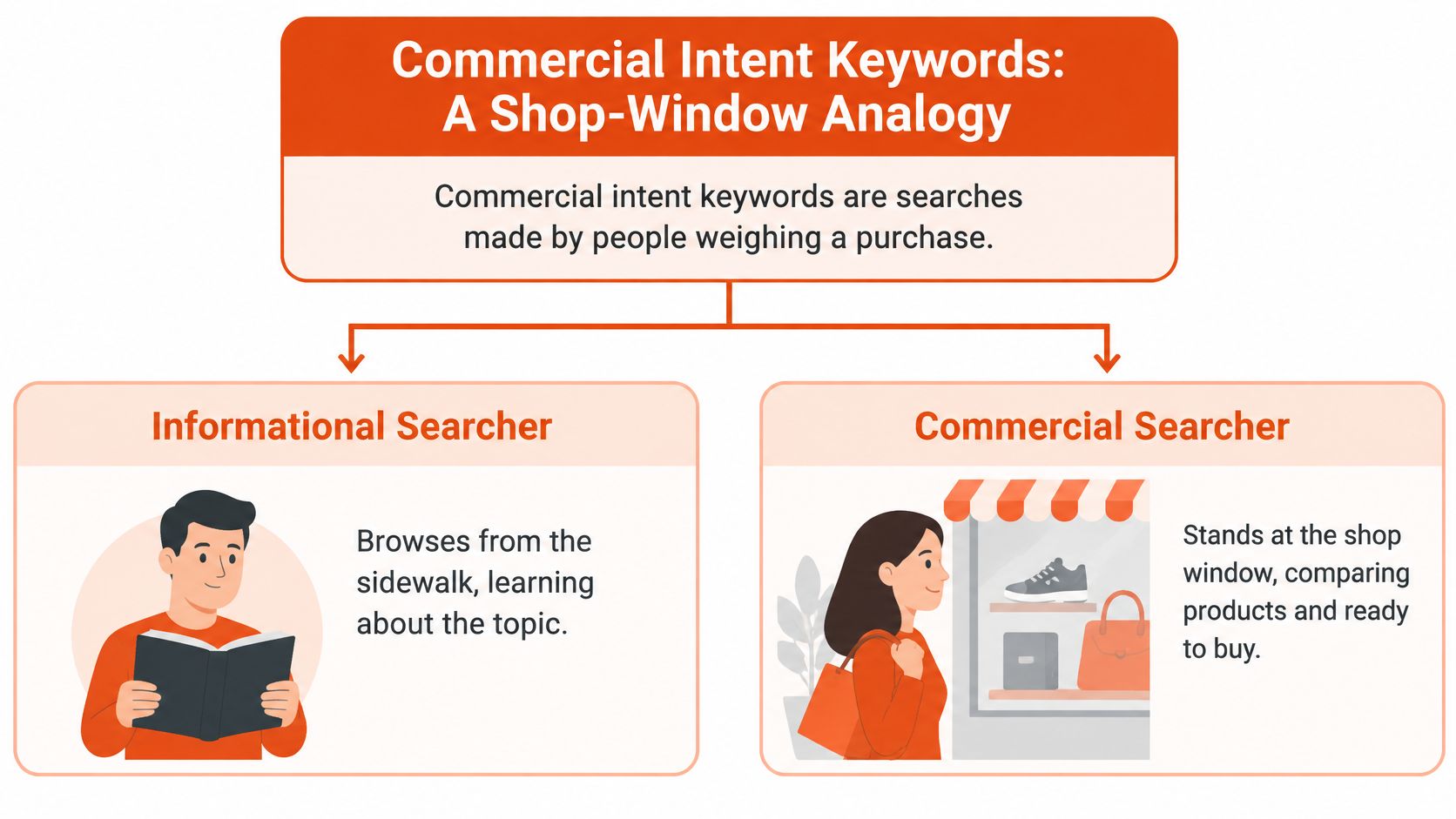
Commercial intent keywords are searches made by people weighing a purchase, not only learning about a topic. Think of an informational searcher browsing a shop window to understand what's available. A commercial searcher is holding competing products and comparing their labels.
In B2B, those labels might be integration requirements, implementation support or contract terms. Someone searching for best IT consulting firm for healthcare is evaluating providers. Someone searching for HubSpot vs Pipedrive is comparing named alternatives, while what is CRM software primarily signals education.
The distinction is about the decision behind the query, not whether the search contains a business-related word.
Separate investigation from action
Commercial investigation and transactional intent are related, but they aren't identical. A person comparing vendors still needs help choosing; a person trying to purchase needs a clear route to act.
Intent types, modifiers and B2B examples
| Intent type | Typical modifiers | Example B2B query | Buyer stage |
|---|---|---|---|
| Transactional | buy, order, purchase, discount, coupon | buy CRM software annual plan | Ready to purchase |
| Commercial investigation | best, top, vs, review, comparison, alternative, price, cost | HubSpot vs Pipedrive | Comparing vendors |
| Informational | what is, how to, guide, examples | what is CRM software | Learning the problem |
| Navigational | brand name, login, official site | Pipedrive login | Already chose a vendor |
Use these stages as working classifications, not personal biographies. A login search usually means someone wants access to an existing service, but it doesn't prove that person chose the vendor or controls its budget.
A useful quick test is whether the query combines a category with a vendor, price or comparison. That usually suggests commercial investigation, whereas a broad problem or concept usually suggests information gathering. Exceptions matter: CRM integration guide could be educational, or it could come from a technical evaluator checking a shortlisted platform.
Practical rule: Classify the question first, then validate your interpretation against what the visitor actually does.
Check wording against observable behavior
Modifiers such as compare, review and price suggest investigation. Buy, order and purchase indicate stronger transactional intent. But a consulting buyer can be seriously evaluating a provider without ever typing a purchase verb.
The Google Ads Search terms report shows the actual searches that triggered ads, alongside impressions, clicks and performance. Use it to inspect the queries behind your targeted keywords, then compare their conversion outcomes. A broad keyword such as IT consulting might attract vendor comparisons, job searches and definition-seeking queries that deserve different treatment.
Advertiser competition offers another check. Its low, medium and high categories describe advertiser bidding density, not organic ranking difficulty. High competition can suggest commercial value, but it doesn't prove that a term will generate profitable opportunities for your business.
Build your assessment from complementary signals:
- Query language: Does the searcher compare options, request evidence or investigate cost?
- Advertiser competition: Are advertisers competing to reach this audience?
- Repeated engagement: Does the visitor return to relevant comparison, implementation or pricing content?
- Business relevance: Does the apparent need match the customers and problems you serve?
B2B intent data becomes useful as a broader qualification framework. Don't confuse an interesting phrase with an identified opportunity: a single visit isn't pipeline evidence. Repeated evaluation behavior provides a stronger reason to investigate, but sales still needs to establish fit and a real buying situation.
Why Commercial Queries Are Fewer but Closer to a Decision
A 2024 SERP analysis cited by LaFactory estimated that queries were approximately 53% informational, 32% navigational, 14% commercial and 1% transactional. The useful implication isn't that you should reproduce that mix in your content calendar. It's that purchase evaluation represents a narrower slice of search activity than general learning.
The visual makes that imbalance easier to see.

Say your consulting firm publishes a popular explanation of digital transformation and a more specialized comparison of healthcare implementation partners. The explanation may attract students, job candidates and professionals who are learning. The comparison addresses someone deciding which provider deserves closer consideration.
The smaller audience can be more valuable if it produces relevant sales conversations. That condition matters: commercial wording doesn't guarantee budget, authority or urgency.
Treat commercial intent as a qualification signal, not a prize for attracting fewer visitors.
For marketing directors and consulting partners, this changes how content deserves attention. A narrowly relevant comparison page might need better customer evidence and a clearer next action before the business needs another broad awareness article.
Use the accompanying video as a further learning resource.
Evaluate the traffic mix against your own sales context. Review which pages attract suitable companies, which questions appear in discovery calls and which visits lead to meaningful next steps. The cited distribution is directional industry analysis, not a universal benchmark for every sector, geography or keyword set.
Mapping Intent Clusters Across the Buying Committee
The common mistake is treating a query as a buyer moving neatly toward purchase. A business purchase can generate related searches from people with different responsibilities, each checking a different reason the project might fail.
In G2's buyer behavior report, two-thirds of buyers preferred to contact sales only after completing their own research. That finding supports making useful evaluation material available before contact. It doesn't establish which anonymous search belongs to which stakeholder.
Build intent constellations around shared decisions
An intent constellation groups queries by buying problem, stakeholder, risk, proof requirement and next action. Instead of treating every phrase as a separate content opportunity, connect the questions that could surround the same purchase.
Stakeholder queries and the risk each one tests
| Stakeholder | Likely query | Risk being checked |
|---|---|---|
| Marketing director | best demand-generation platform | Will it produce pipeline rather than impressions |
| Sales director | CRM integration with our existing stack | Will the team adopt it without rework |
| Finance lead | implementation cost for consulting firms | Is the budget justified and predictable |
| CEO | consulting ROI for mid-size firms | Is the return worth the change |
These are illustrative roles and queries, not a method for identifying a searcher's job title. Their value is in showing what your content must help a committee resolve.
For example, an integration question may require a supported-systems list, a description of data flows and clear ownership of setup work. Finance may need cost components, exclusions and assumptions. Giving both stakeholders the same generic demo invitation leaves their actual concerns unanswered.
Make the next action fit the risk
Connect comparison pages to security documentation, implementation plans, procurement information and business-case material. Give an executive access to an approval-ready explanation rather than expecting them to assemble the case from product pages.
This approach complements account-based marketing tactics: organize useful evidence around the account's buying situation, not just an individual form submission. A narrow technical query from an active committee can deserve more attention than a popular provider list.
Track account-level engagement and qualified pipeline where you have reliable account identification. Keep anonymous activity separate rather than assuming unrelated visitors belong to the same deal.
How AI Search Is Changing Commercial Research
In G2's 2025 global survey of B2B software buyers, 79% said AI search had changed how they research, while roughly 29% said they started research with AI tools more often than Google. Those findings describe reported research behavior, not proof that conventional search has stopped contributing to purchases.
The practical change is that buyers can express a whole situation instead of assembling short keyword searches. A buying question or scenario becomes a useful planning unit alongside the keyword.
Translate modifiers into decision questions
Consider these illustrative prompts:
- Implementation fit: Which Spanish IT consulting firms could integrate with our existing ERP within our required delivery window?
- Evidence requirements: What evidence should a consulting buyer require before booking a meeting?
To develop variations grounded in actual decision tasks, use MyMentions' examples of prompts buyers ask AI assistants as a planning resource. Adapt the structure to your customers' constraints rather than copying prompts unrelated to your offer.
A page can rank for conventional commercial terms and still be absent from an AI-generated shortlist. Rankings alone don't establish that your content provides the specific proof, comparison criteria, implementation detail and independently verifiable customer evidence needed to support an answer.
Build content that helps someone justify a recommendation, not just discover a vendor's name.
Turn a general comparison into a decision resource: explain who each option suits, where it falls short and what evidence supports the assessment. State limitations openly rather than implying universal fit.
Track inclusion in AI answers, branded searches, qualified conversations and pipeline influence alongside rankings and clicks. Record the prompts you test and the answers returned, while recognizing that a sampled answer isn't a complete measure of buyer exposure.
How to Turn Commercial Keywords Into a Prospect List
A keyword list isn't a contact database. A sales opportunity is a real person within your ideal customer profile who has shown buying intent by interacting with content, visiting a profile or matching a signal, and reaches the salesperson with context.
Search tools generally won't identify the individual behind a query. Use query patterns to guide targeting and content, then use legitimate CRM records and identifiable engagement to decide whom sales can approach.
Connect search evidence to identifiable engagement
The workflow requires a deliberate handoff from topic analysis to qualification.
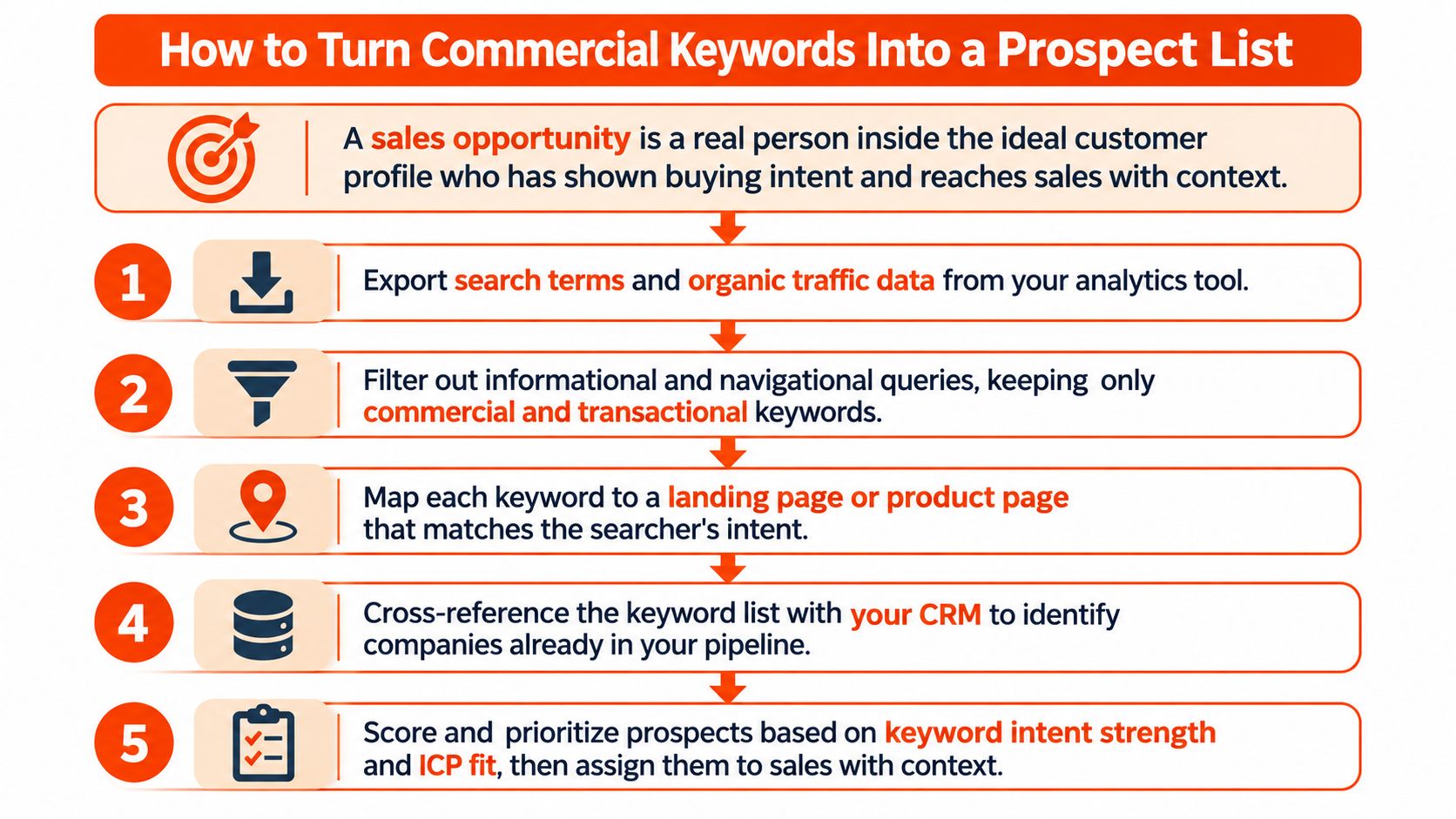
Export and tag actual search terms. Use Google Ads search terms and available organic query reporting to distinguish investigation, transactions, education and navigation. Tagging by search volume instead of the task behind the query gives popular topics undeserved priority.
Group queries by stakeholder and risk. Put implementation fees, onboarding requirements and deployment support into a coherent evaluation cluster when they address the same buying concern. Don't group phrases solely because they contain the same product name.
Score the strength of the evidence. Record verb strength, repeated engagement and business relevance separately so your team can explain each priority. Avoid a single opaque score that disguises weak fit or treats an isolated visit as an opportunity.
Match relevant clusters to known accounts and roles. Cross-reference CRM contacts, declared interests and identifiable company engagement with your ideal customer profile. Don't claim that an account searched a particular phrase unless you have evidence connecting that activity.
Prioritize corroborated evaluation activity. Review whether a suitable account's known contacts have engaged with related decision material during your chosen review period. The common slip is merging anonymous searches into an invented account-level buying journey.
Address the concern in outreach and log the response. Offer an integration explanation, cost breakdown or relevant proof rather than a generic demo request. Record replies and objections so sales can distinguish active evaluation from curiosity.
Give sales a usable handoff
Make the handoff part of your B2B lead generation process, with the contact, fit rationale, observed signal and suggested conversation attached. For managed service providers adapting this approach, Revenue AI Lab's guide to winning MSP clients offers a sector-specific companion resource.
Qualified prospects should move toward meetings. Those who reply that the timing isn't right need a recorded reason and an appropriate later follow-up, not automatic deletion or persistent immediate chasing.
Choose the First Intent Cluster to Test
Start with the cluster closest to a decision, where you can name both the stakeholder and the unresolved concern. CRM integration for an established consulting firm's sales team is a more workable test than a broad category such as business software.
Choose a concern your team can answer credibly. If you don't have clear implementation documentation or a defensible cost explanation, prepare that evidence before contacting anyone.
Agree on what qualifies as success
Set success criteria around qualified conversations and meetings, not impressions or clicks. Define what makes a conversation qualified, including customer fit, a relevant problem and a plausible next step.
Use a compact test brief:
- Audience: Specify the account characteristics, relevant roles and observed engagement required for inclusion.
- Evidence: Name the resource or explanation you'll offer to address the buying concern.
- Review: Set a review date and record outcomes, objections and next actions in the CRM.
Keep outreach low-volume and relevant. At Ploot, we don't do mass prospecting: we contact only people who've already interacted with the client, the client's company or its sector. Matching a keyword cluster alone isn't a reason to contact an account.
Expand because the test produces qualified conversations, not because the keyword tool shows an attractive audience.
At the review, separate unsuitable contacts, unresolved objections and genuine timing issues. That distinction tells you whether to change the audience, improve the evidence or schedule follow-up.
Write the success criteria and review date into a concise test brief, then share it with the sales lead before the first message goes out. Agreement at that point makes the result easier to judge without moving the goalposts.
Ploot turns your team's expertise into demand, detects buying signals and delivers qualified leads with context, helping you move beyond reach toward relevant sales conversations. Visit Ploot to book a call, see the product in action and discuss how intent-led qualification could fit your sales process.