

A sales qualified lead is a prospect that sales has verified as worth active pursuit because it shows a real business need, access to the buying decision and a credible timeline.
But if sales accepts a lead and nothing commercially meaningful follows, was the prospect qualified, or did the team make the wrong judgment? That's the gap behind many pipeline disagreements. Marketing counts a successful handoff; sales sees another contact without a project.
The useful answer to what is a sales qualified lead goes beyond a definition. You need evidence for the decision, an owner who makes it, and a way to check whether that judgment predicted a productive conversation.
Table of Contents
- What a Sales Qualified Lead Is and How Leads Reach It
- SQL, MQL and Lead Compared Side by Side
- Qualification Criteria to Check Before Accepting a Lead
- Handing an SQL to Sales Within a Clear SLA
- Pipeline Metrics That Prove SQL Quality
- Set Your SQL Definition Before Your Next Campaign
What a Sales Qualified Lead Is and How Leads Reach It
An SQL is a prospect that sales has explicitly accepted as worth active pursuit after checking commercial fit and purchase readiness, not a contact who merely engaged with marketing.
Say a Madrid IT consultancy publishes a report about systems migration. A marketing director downloads it to understand the subject. Separately, a senior partner at a target account asks for a call about an upcoming migration, explains the operational problem and confirms that funding has been approved.
Both contacts deserve attention, but not the same attention. The director has demonstrated interest in a topic. The partner has described a buying situation that sales can investigate.
Salesforce's explanation of sales qualified leads distinguishes general engagement from sales readiness, using evidence such as need, buying authority, budget and timing. That makes the partner a credible SQL once sales verifies the details. The download alone doesn't establish the director's readiness.
Follow the prospect through the filters
The partner's journey illustrates the progression:
- The account fits the target profile. The consultancy checks whether the business operates in a sector, region and technology environment it can serve. A relevant job title doesn't compensate for an account outside its market.
- Marketing identifies an MQL. The contact matches the ideal customer profile and shows meaningful engagement. Marketing records why the prospect deserves sales review rather than forwarding an email address.
- Sales accepts the SQL. A salesperson checks the migration problem, the partner's influence, the funding path and the intended purchasing timeframe. Acceptance means there's enough evidence to justify active pursuit.
- Discovery establishes an opportunity. The buyer and seller clarify scope, stakeholders and a commercial next step. Sales can then manage an actual deal rather than an interested contact.
These stages are filters, not automatic promotions. A prospect can enter through a direct request without completing a long nurture campaign, but sales still needs to check commercial credibility.
A pricing request, trial or demo booking deserves prompt review. It doesn't prove that the person has a relevant project, can influence a purchase or understands what the solution costs.
Record what changed the decision
For the migration partner, the sales record should identify a problem the consultancy can solve, access to the decision, an identifiable budget path and a realistic timeframe. Write what the buyer said rather than using a vague note such as promising prospect.
Now consider the marketing director. They might be a strong MQL if the account fits and their engagement meets marketing's criteria, while remaining unsuitable for active sales outreach because they're researching generally.
A third prospect requests a migration discussion, then explains that the project has been postponed and funding withdrawn. Sales should recycle that lead to nurturing with the changed evidence recorded. That's not a failed relationship; it's a revised assessment.
For another practical explanation of that distinction, DMpro on qualifying prospects for sales is a useful companion when discussing stage definitions with colleagues.
Apply this tomorrow: write down the evidence required for promotion, then require a reason whenever a lead stays put or returns to nurturing.
SQL, MQL and Lead Compared Side by Side
| Stage | Who qualifies it | Typical trigger | Next action |
|---|---|---|---|
| Lead | Marketing | Form fill, download or content interaction | Nurture by campaign |
| MQL | Marketing | Fit with the ICP plus repeated engagement | Hand to sales review |
| SQL | Sales | Verified need, access to the buyer and timeline | Active sales outreach |
| Opportunity | Sales | Agreed discovery, scope and budget path | Forecast in pipeline |
Each column answers a different operational question. Stage names the current classification; who qualifies it identifies the decision-maker; typical trigger describes the evidence for progression; and next action tells the owner what to do.
The MQL-to-SQL boundary is where teams can disagree. Marketing may interpret repeated engagement as readiness. Sales may expect a confirmed initiative and access to someone involved in buying.
Neither team can resolve that disagreement by changing a dashboard label. They need to agree what evidence permits the transition.
Separate acceptance from qualification
Some businesses use a sales-accepted stage before SQL. That lets sales acknowledge ownership while investigating whether the prospect meets the qualification criteria.
Marketingo's discussion of SQL definitions highlights how definitions differ between organizations, including whether qualification means acceptance for follow-up or a completed assessment. Choose a convention, document it and keep it stable enough to compare outcomes.
A company that treats every form fill as sales-ready will report more SQLs than one requiring verified buying context. That difference says little about which company has the healthier pipeline.
CRM configuration should reflect the agreement, not create it. For teams evaluating the marketing platform around that workflow, Docket's take on HubSpot marketing provides additional platform context, but the business still needs to decide its own stage rules.
Definition test: Ask two colleagues to classify the same prospect independently. If they choose different stages, inspect the criteria before questioning either person's judgment.
Also distinguish opportunity creation from forecast confidence. Opening a deal record doesn't mean the buyer has committed, and the forecast category should reflect the evidence available.
The central distinction is straightforward: an MQL is marketing's judgment about fit and engagement; an SQL is sales' judgment about readiness for active pursuit. Every classification needs a named owner and written criteria.
Qualification Criteria to Check Before Accepting a Lead
| Criterion | Question to ask | Evidence of an SQL | Red flag |
|---|---|---|---|
| Fit | Does the account match the ICP? | Target sector, size and region confirmed | Outside target sector or size |
| Buying influence | Does the contact shape the decision? | Owns or participates in the buying group | Researching only, with no buying role |
| Business need | Is there a problem we solve? | Named initiative or pain in their own words | Generic interest in content |
| Intent | Have they asked for a next step? | Requested call, pricing or demo | Only passive clicks or views |
| Timing | Is a purchase realistic soon? | Budget cycle or project date | Someday or no timeframe given |
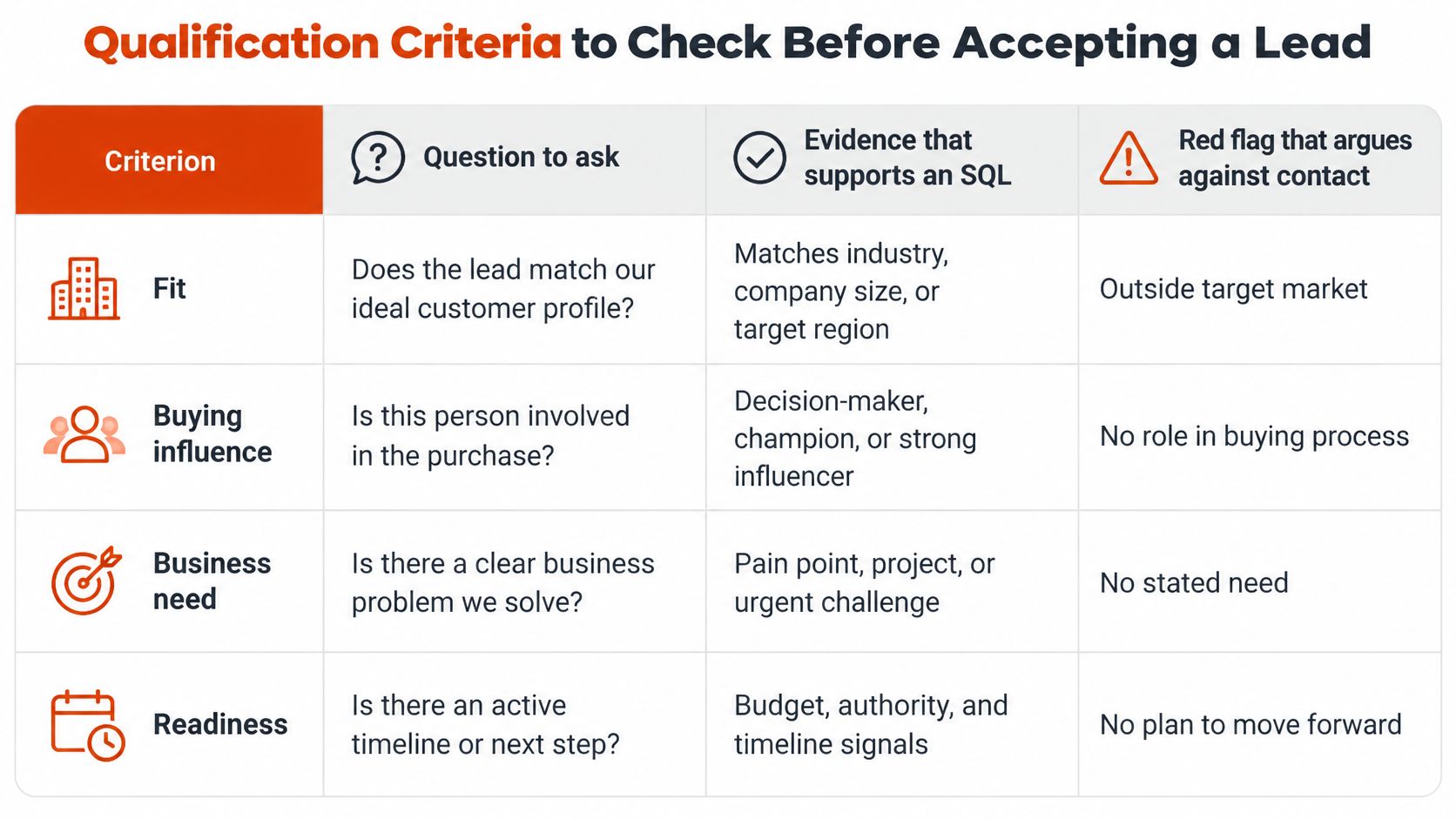
Use these questions to distinguish missing evidence from negative evidence. An unknown budget isn't the same as a buyer explicitly saying there's no funding path. The first calls for clarification; the second may justify recycling.
This visual condenses the main checks for a qualification conversation.
Ask whether seller involvement is useful now
Fit includes the relevant technology environment, not just company size. Buying influence can come from a technical evaluator or internal champion, not only an executive who signs the contract.
Business need should be specific enough to discuss consequences. Ask what prompted the initiative, what isn't working and what happens if the buyer does nothing.
Intent and timing then help determine whether human involvement is welcome. In Gartner's B2B buyer survey, 61% of B2B buyers preferred an overall rep-free buying experience, while 73% actively avoided suppliers sending irrelevant outreach.
A senior executive following migration content may therefore fail on need despite excellent account fit. Keep that person in a relevant campaign rather than inventing a project from their seniority.
Use scoring to organize evidence
BANT, budget, authority, need and timeline, works as a verification checklist rather than a substitute for judgment, as Salesforce's qualification guidance explains. A contact can fail a criterion today and remain worth nurturing.
For a hypothetical scoring model, assign each criterion zero points for a red flag, one for partial evidence and two for clear evidence. The sales owner might test acceptance at seven out of ten, while requiring at least one point for both buying influence and business need.
Those are test settings, not industry benchmarks. Don't let accumulated engagement compensate for a missing business problem; review the threshold against actual outcomes. When implementing the rules, lead scoring in HubSpot can help structure the CRM workflow.
Use the following video as an additional discussion aid before agreeing your team's rules.
Finish by selecting the criteria most important to your business and writing what sufficient evidence looks like for each.
Handing an SQL to Sales Within a Clear SLA
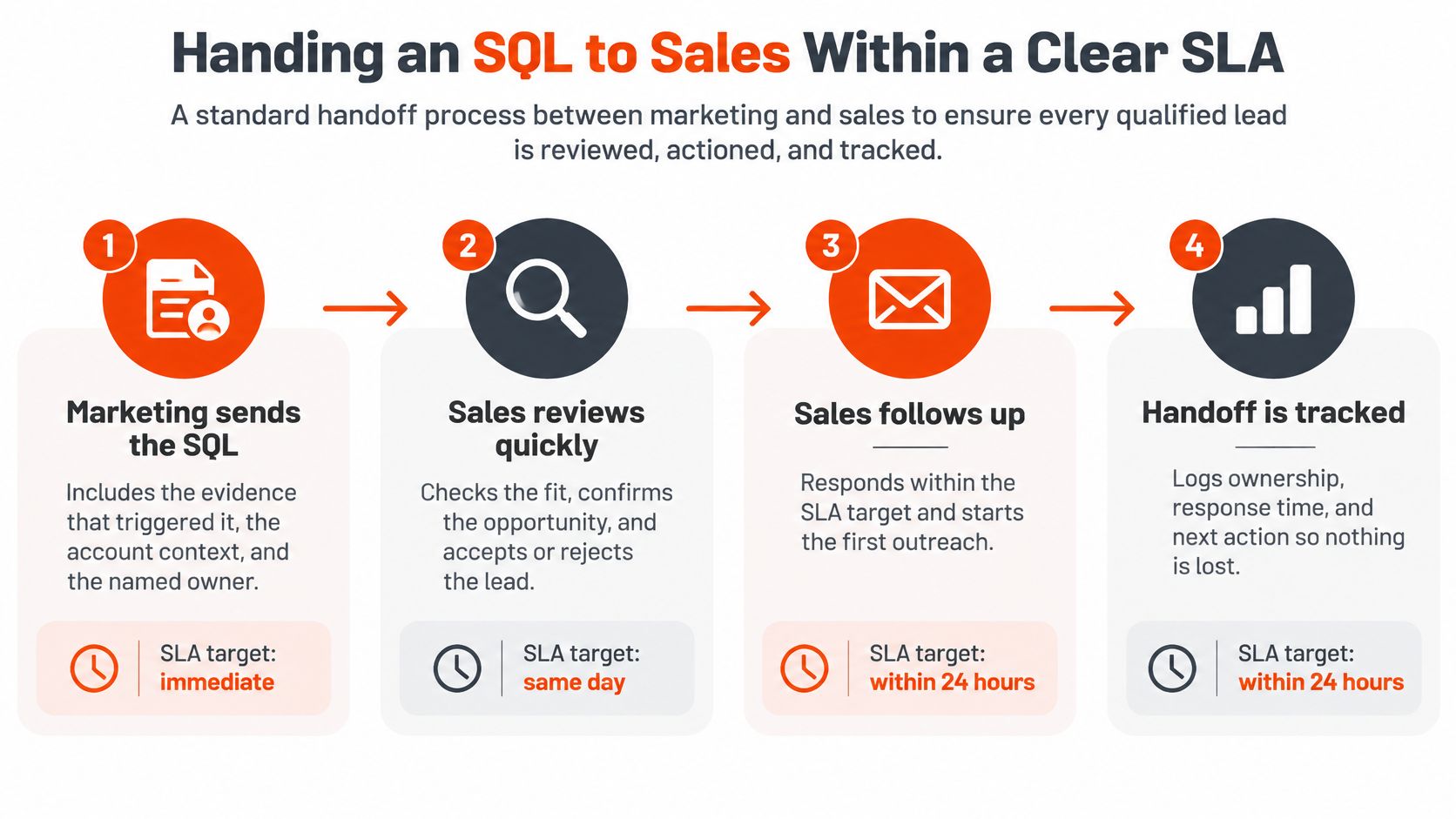
A service-level agreement, or SLA, tells marketing and sales who acts, what they must record and when action is due. It should also distinguish a candidate awaiting review from an SQL sales has accepted.
Use this handoff map to make ownership and response targets visible.
Make every transition auditable
Marketing sends the evidence with the record. At the point of routing, include the triggering action, its timestamp, account context and named sales owner. An activity alert without context forces sales to reconstruct the qualification decision.
Set an acceptance window appropriate to your staffing and coverage. For example, a team might test one business day for accepting or rejecting a candidate, with a mandatory reason recorded before the review is closed.
Define a separate first-contact target. Measure elapsed time from the meaningful intent signal, not an unrelated earlier form fill. In a hypothetical workflow, the owner could be required to contact an accepted prospect within the same working day, with out-of-hours handling explicitly documented.
Before sending anything, the owner reviews the buyer's context. The message should address the stated project and requested help; meeting a speed target with an irrelevant template doesn't satisfy the purpose of the SLA.
Route deferrals when the reply arrives. At Ploot, qualified prospects move on to qualified meetings, and those who reply “not now” are put back into campaigns. Keep the timing explanation attached so future contact reflects what the person told you.
Log the outcome before closing the task, then review rejection reasons monthly. Without those reasons, marketing can't distinguish poor targeting from missing information, and sales can't show which criteria need changing.
Test the process with contrasting scenarios
Say the migration partner requests a discussion and receives a context-aware reply while arranging supplier calls. They book a meeting because the owner makes the next step easy.
In a contrasting scenario, an unassigned request sits untouched. When someone finally responds, the buyer has already arranged discovery with a competitor. These are scenarios, not promised outcomes, but they show what to inspect in the activity history.
Use B2B marketing and sales alignment to connect responsibilities across teams. For smaller organizations designing their acquisition workflow, measurable lead acquisition for small businesses offers related context.
Start with an acceptance window and a first-contact target, both written into the shared operating agreement.
Pipeline Metrics That Prove SQL Quality
| Metric | How to calculate | Weak result signals |
|---|---|---|
| SQL acceptance rate | Accepted SQLs divided by SQL candidates sent | Criteria too loose or unclear |
| MQL-to-SQL conversion | SQLs divided by MQLs | Too many unqualified MQLs entering |
| SQL-to-opportunity rate | Opportunities divided by accepted SQLs | Weak discovery or wrong contacts |
| Time from signal to contact | Hours between intent signal and first sales touch | Slow follow-up potentially losing active buyers |
| Meeting-booked rate | Booked meetings divided by contacted SQLs | Weak fit or message mismatch |
Treat the final column as a diagnostic hypothesis, not a verdict. A weak meeting rate could reflect unsuitable contacts, poor messaging or unavailable calendar slots.
Keep cohorts comparable by source, segment and qualification definition. A study summarized by SurveySparrow reported that website-generated leads converted to SQLs at 31.3% in 2024, compared with 17.8% for webinar leads.
A separate B2B benchmark synthesis discussed by Captiwate places MQL-to-SQL conversion around 12%–18%. These figures describe different populations and shouldn't become interchangeable targets.
Inspect the judgments that were wrong
False positives are accepted prospects who appeared commercially credible but never had a genuine project. Review discovery notes to find which evidence was misleading or never verified.
Don't label every lost deal a false positive. A qualified buyer can choose a competitor, postpone a legitimate initiative or fail to reach internal agreement.
False negatives are credible buyers the team rejected or left in nurturing. Look for later opportunities among rejected records and contacts who returned after researching privately, then examine what was known when the original decision was made.
A qualification mistake concerns the evidence available at the time. A buyer's circumstances changing later doesn't automatically make the earlier decision wrong.
You can't count every missed buyer from CRM records alone. Report observed false negatives and acknowledge the blind spot around buyers who never return.
For disciplined B2B sales pipeline management, review the last quarter's mature cohorts monthly, sort by outcome and inspect accepted meetings, opportunity progression and revenue. Change one criterion at a time so you can identify what helped.
Set Your SQL Definition Before Your Next Campaign
A useful definition is short enough to apply during a working day and specific enough for colleagues to reach the same decision. Don't launch with unresolved disagreements and expect the CRM to settle them.
Write the qualification paragraph. Name the account-fit requirements, evidence needed for acceptance and sales owner authorized to decide. Include how missing information should be handled.
Agree the acceptance window and first-contact target with sales. Put coverage rules and escalation ownership beside them so the agreement works when someone is unavailable.
Choose a small measurement set. Establish baselines for acceptance, opportunity creation and response time using comparable records. Keep the underlying notes available for reviewing individual decisions.
Run a time-boxed test with a clearly defined segment. At the end, examine false positives and observed false negatives before changing the criteria or expanding the campaign.
Keep volume separate from readiness
Our plans include automated lead generation of at least 30 leads per week. That's an acquisition commitment, not a claim that every generated lead meets your SQL definition; sales readiness still requires the agreed evidence.
Both teams need to approve the test rules before leads arrive. Otherwise, each can interpret the results using a different standard.
Schedule the definition workshop this month and bring a rejected lead to discuss. Use that record to agree what evidence would have justified acceptance.
Ploot turns your team's expertise into demand, detects buying intent and delivers qualified leads with context. Visit Ploot to discuss how that process could support your qualification criteria and help your team turn relevant interest into qualified sales meetings.