

Account-based marketing means selecting a defined set of companies, treating each one as an individual market, and coordinating marketing and sales around those named accounts instead of chasing an anonymous lead list. That's the plain definition, and it's also why the most popular advice about ABM is wrong.
You're often told to start ABM by personalizing more ads, emails, and landing pages. Don't. If you're still reporting lead volume, a first name in a subject line won't fix anything. The change isn't cosmetic. The planning unit changes, from a person who filled in a form to a company with a buying group, a deal size worth pursuing, and a next commercial step an owner can name.
More personalization is not the test of ABM. Coordinated progress among credible stakeholders is.
Table of Contents
- What Account Based Marketing Means
- How an Account Becomes the Market
- When High-Ticket B2B Teams Should Use ABM
- Account Metrics That Replace Lead Volume
- One-to-One Few and Many in Practice
- What ABM Is Not
- Decide Whether to Pilot ABM
What Account Based Marketing Means
Account-based marketing (ABM) means you pick a finite set of companies, treat each named organization as its own market, and plan messaging, content, engagement, and measurement around it. That understanding of Account Based Marketing meaning is now the mainstream one. In N.Rich's 2025 survey of 107 B2B companies, 67% defined ABM as a strategic go-to-market alignment motion rather than merely a campaign tactic.
Read that definition against broad demand generation and the difference becomes concrete.
| Dimension | Account-based marketing | Broad demand generation |
|---|---|---|
| Planning unit | Named account and its buying group | Individual lead or anonymous contact |
| Audience | Finite list chosen for value and fit | Broad segment or open market |
| Message | Coordinated by role and account pain | One offer scaled to many people |
| Sales alignment | Shared account plan and next action | Handoff after a marketing-qualified lead |
| Success measure | Meetings, pipeline, revenue and cycle time | Reach, clicks and lead volume |
| Best fit | Long cycle, several buyers, high contract value | Low price, one buyer, self-serve |
Reading the comparison row by row
Start with the planning unit. In demand generation, a lead is a success even if you don't know whether their employer can buy. In ABM, one interested employee is a clue, not a result, because the account hasn't moved until people in relevant roles engage.
The audience row follows from that. You don't buy reach against a segment and hope the right logos surface. You choose companies for contract value, buying fit, and a credible path to a deal, then you accept that the list is finite. Work like account research for multi-product sales teams fits here, because useful research helps you decide which companies deserve scarce senior time and what each buying role cares about, rather than giving you a longer contact export.
Message and sales alignment are where many programs revert to lead thinking. An ABM message isn't one whitepaper blasted wider. It's a coordinated set of points, so finance hears about payback, IT hears about integration risk, and the executive sponsor hears why the problem matters this year. Sales doesn't wait for a handoff. Marketing and sales share an account plan, agree who owns each role, and decide what happens after each response.
A team celebrating a longer contact list is running demand generation under a new label. A team that can name the accounts, the roles inside them, and the next commercial step is using ABM.
The last two rows keep you honest. Success is engaged accounts, meetings, opportunities, pipeline, and revenue, not impressions. And the fit matters. ABM concentrates expensive resources, so it earns its keep when a deal is valuable enough to justify that attention. If a single user can swipe a card, you don't need an account plan to win them.
How an Account Becomes the Market
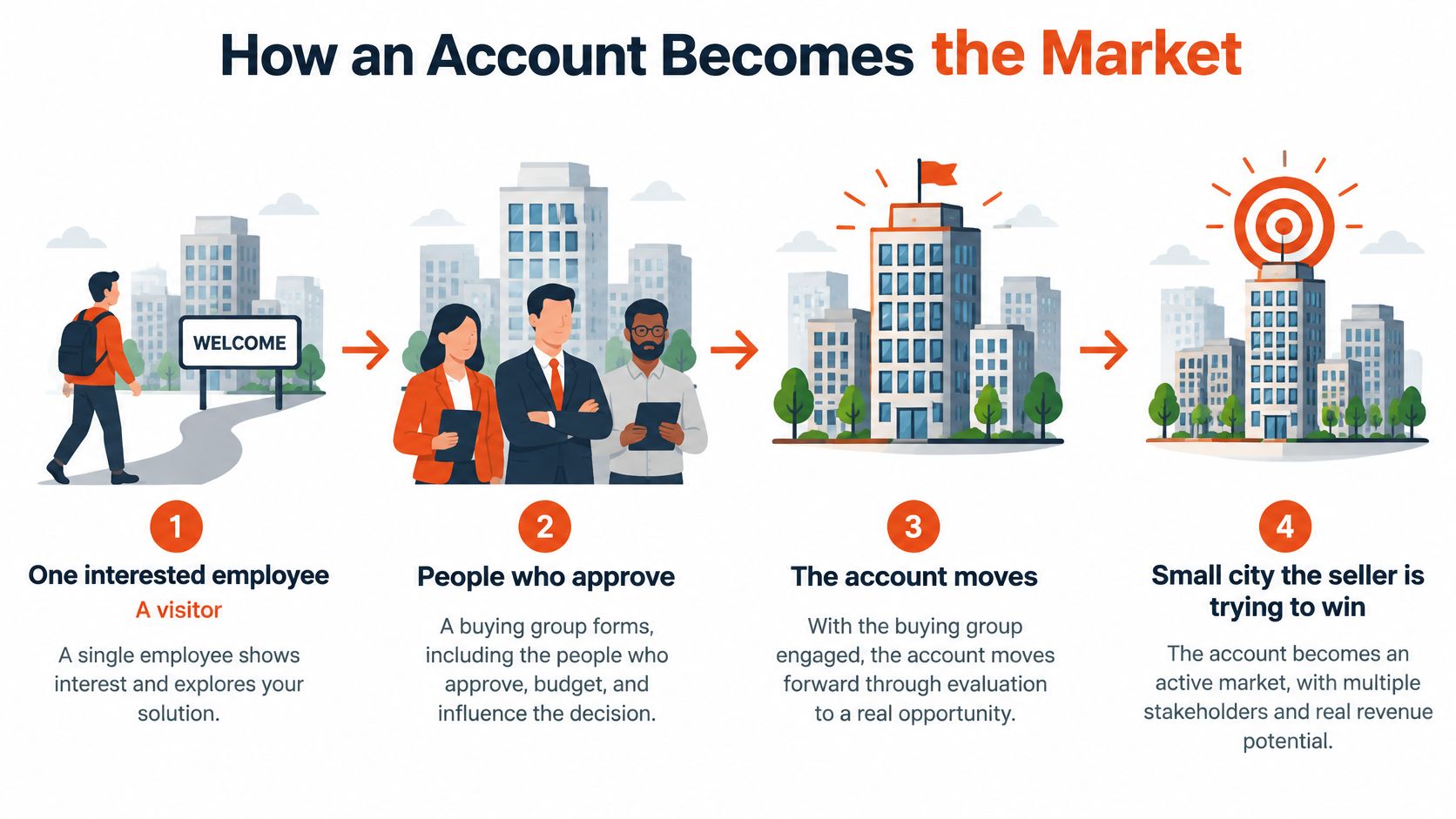
Treat a target company like a small city you're trying to win, not a single visitor at the gate. One curious employee has visited. They haven't opened the budget, passed security review, or convinced their boss. The account moves when the people who approve, evaluate, use, and sponsor the purchase are known and engaged.
That's the founding idea behind the term. According to ET BrandEquity's martech glossary, the term is generally attributed to the Information Technology Services Marketing Association (ITSMA) in 2004, which treated an individual account as a market in its own right.
The diagram below shows that shift from one visitor to an active account.
Five moves, five concrete outputs
Say a Spanish IT consultancy wants to win mid-sized manufacturers that need a systems upgrade. Here's how the account becomes the market, in order.
- Write the ideal-customer profile: Industry, company size, the specific problem you solve, and the minimum deal size that makes senior effort worthwhile. The output is a one-page ICP you can argue about and revise.
- Build the target-account list: Name the actual companies. Not a scraped universe, not every manufacturer in Spain. The output is a finite list both teams sign.
- Map the buying committee: For each priority account, identify the economic buyer who owns the budget, the technical evaluator who checks feasibility, the day-to-day user who lives with the result, and the executive sponsor who can break a deadlock. The output is a role map with named people where you have them and gaps where you don't.
- Collect account intelligence: The priority pain, a recent trigger such as a new CIO or an expansion, and who inside the account already knows you. A clear explainer on how B2B intent data works can help you separate a genuine trigger from background browsing at this stage. The output is a short brief per account, not a data dump.
- Coordinate the interactions: Marketing, sales, and customer success if the company is already a client, agree who contacts whom, with what, and in what order. The output is a shared sequence with an owner for the next action.
Where readers usually get confused
An ICP, a named list, and ABM aren't the same thing. The ICP says who fits. The named list says who to pursue. ABM adds the buying group and the shared orchestration on top of both. Teams that stop at step two have targeting, not account-based marketing.
Modern programs run at different depths, from one-to-one work on a few strategic accounts to grouped programs for similar companies, and CRM, automation, and analytics tools made that scaling easier. The tooling doesn't change the test, though.
Apply this test to your own list. For each priority account, can you point to the name on the list, the role map, and the person who owns the next action? If any of the three is missing, that account hasn't become a market yet. It's still just a company you like the look of.
When High-Ticket B2B Teams Should Use ABM
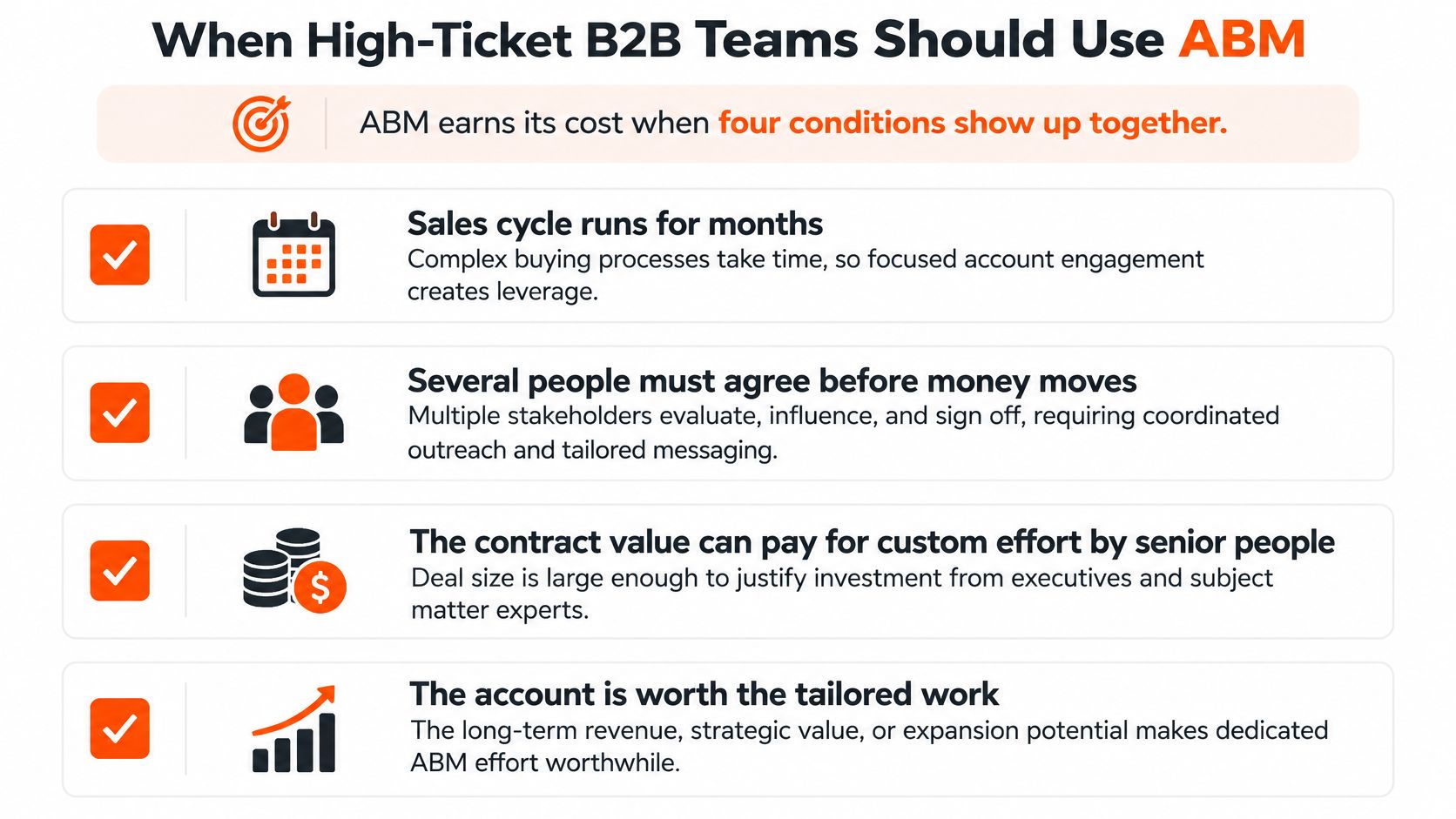
ABM earns its cost when four conditions show up together. Check your own pipeline against them before you commit budget.
- The sales cycle runs for months: There's time for coordinated touches to matter, and time for deals to stall if one stakeholder goes quiet.
- Several people must agree before money moves: A single champion can't sign, so coverage across roles is a real requirement, not a nice extra.
- The contract value can pay for custom effort: Senior partners and directors can spend hours on one account and the deal still makes economic sense.
- A wrong-fit logo would waste serious time: Choosing carefully matters because pursuing the wrong account has a real opportunity cost.
The checklist below puts those four conditions in one view.
Why professional services and complex software fit
A consulting firm selling a six-figure transformation doesn't win because one manager downloaded a report. Operations has to believe the change is feasible, finance has to fund it, and a partner-level sponsor usually has to defend it internally. One person's click proves almost nothing about organizational readiness.
Complex software follows the same pattern. If you're selling into IT, finance, and operations at once, each group judges you on different criteria. Coverage of a named account, with a relevant point of view for each group, beats another open webinar that fills seats with people who'll never buy.
Content still does work inside that model. A short, specific video from a senior profile can carry a point of view to several roles in one account, and if your team needs to produce that kind of asset quickly, Tutorial AI's script-to-video guide is a practical starting point for turning a written script into a usable video. The asset serves the account plan. It doesn't replace it.
When to skip it, and the hybrid most teams land on
Don't make ABM your only motion when the product is low price, self-serve, and decided by one user. Broad demand generation finds that volume more cheaply, and an account plan per logo would cost more than the deal returns.
A hybrid approach is common. Demand generation continues targeting the broad market, while only the logos able to impact the year progress to an account plan.
The one-quarter test: If losing a logo would materially change your year, and winning it needs more than one relationship, put it on the ABM list. If winning it is a single online checkout, leave it in demand generation.
Do the exercise now, on paper. Write the accounts that pass, note who owns each one, and set the rest aside. You should end with a clear yes, no, or hybrid for your pipeline, not a vague intention to be more account-based.
Account Metrics That Replace Lead Volume
Judge ABM on whether named accounts move, not on how many people saw a post. That sounds obvious, but it forces a specific reporting change. Every number in your quarterly review should answer one question: what decision does this change?
| Metric | What it shows | Why it beats lead volume |
|---|---|---|
| Engaged target accounts | Named companies with meaningful activity | Separates focus from anonymous traffic |
| Buying-group coverage | Share of mapped roles reached | One employee is not the account |
| Qualified meetings | Conversations with relevant seniority | Proves commercial access |
| Opportunities | Accounts with a real next sales step | Separates interest from pipeline |
| Pipeline value | Money tied to target accounts | Links activity to revenue potential |
| Win rate | Share of target opportunities won | Tests whether focus improves close |
| Sales-cycle duration | Time from serious engagement to close | Shows whether orchestration speeds deals |
| Revenue | Closed value from the target list | The commercial result ABM exists to change |
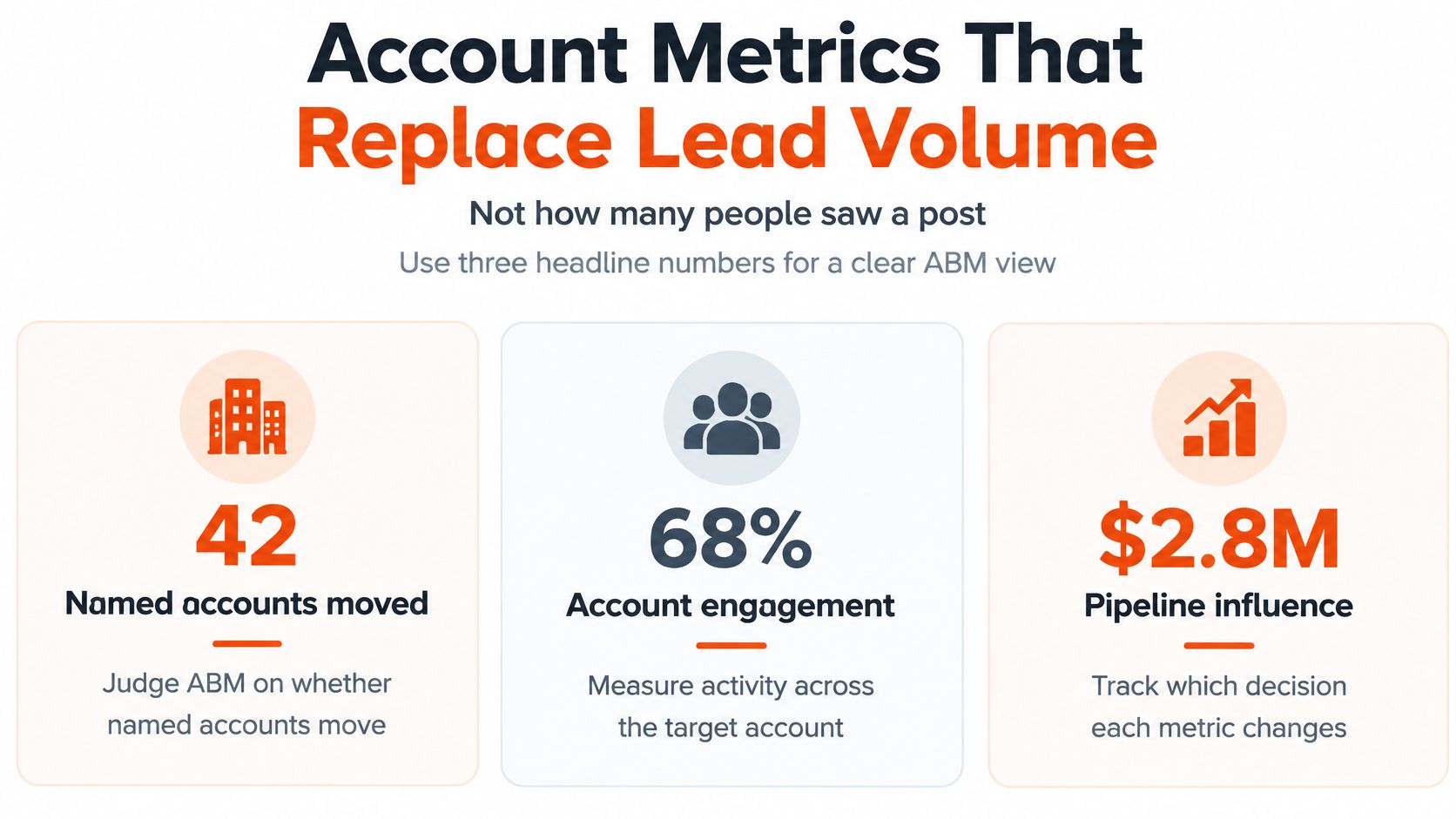
The three headline numbers below are the ones to lead a quarterly review with.
Three headline numbers, and what each one decides
Use buying-group coverage, qualified meetings, and pipeline value as your headline set, compared against a pre-program baseline for the same accounts. Coverage tells you whether to keep investing in reach inside the account or switch to direct engagement. If you've mapped five roles and only reached one, you don't have a pipeline problem yet. You have an access problem.
Qualified meetings tell you whether engagement converts into commercial access. A meeting with a relevant senior person is the first hard evidence that the account will spend time on you. When you capture contacts at industry events as part of that engagement, GDPR-compliant event lead collection matters because consent and clean records decide whether those contacts can enter your account reporting at all.
Pipeline value tells you whether access is turning into money at stake. It's the bridge between marketing activity and the number sales leadership manages, which is why it helps to align it with disciplined B2B sales pipeline management rather than reporting it in a separate marketing deck. Keep impressions and clicks in an appendix. They're diagnostics, not results.
Benchmarks as context, not proof
Two reference points help you calibrate expectations. In the 6sense 2024 ABM benchmark covering 715 organizations, 64% of marketers said their teams used either an ABM program or a target-account approach. The same benchmark found organizations with ABM practices had a coefficient of variation of 15%, compared with 21% for non-account-based teams. A lower figure means a tighter spread of results, so read it as consistency, not proof that ABM caused the gap.
Forrester reported in 2024 that the most common ABM ROI range was 21% to 50% higher than non-ABM marketing, according to surveyed ABM decision-makers. Treat that as a reference range for a business case, not a promise for your list.
Review win rate and sales-cycle duration after at least one full sales cycle, not monthly. They move slowly, and monthly swings will mislead you. And hold one firm rule in professional services: don't call an account engaged because one contact liked a post. Count it only when a second relevant role responds.
One-to-One Few and Many in Practice
The same definition scales to three depths. The tier you pick depends on how different your accounts are and how large the deal is, not on which tier sounds most advanced.
The diagram below sets out the three models side by side.
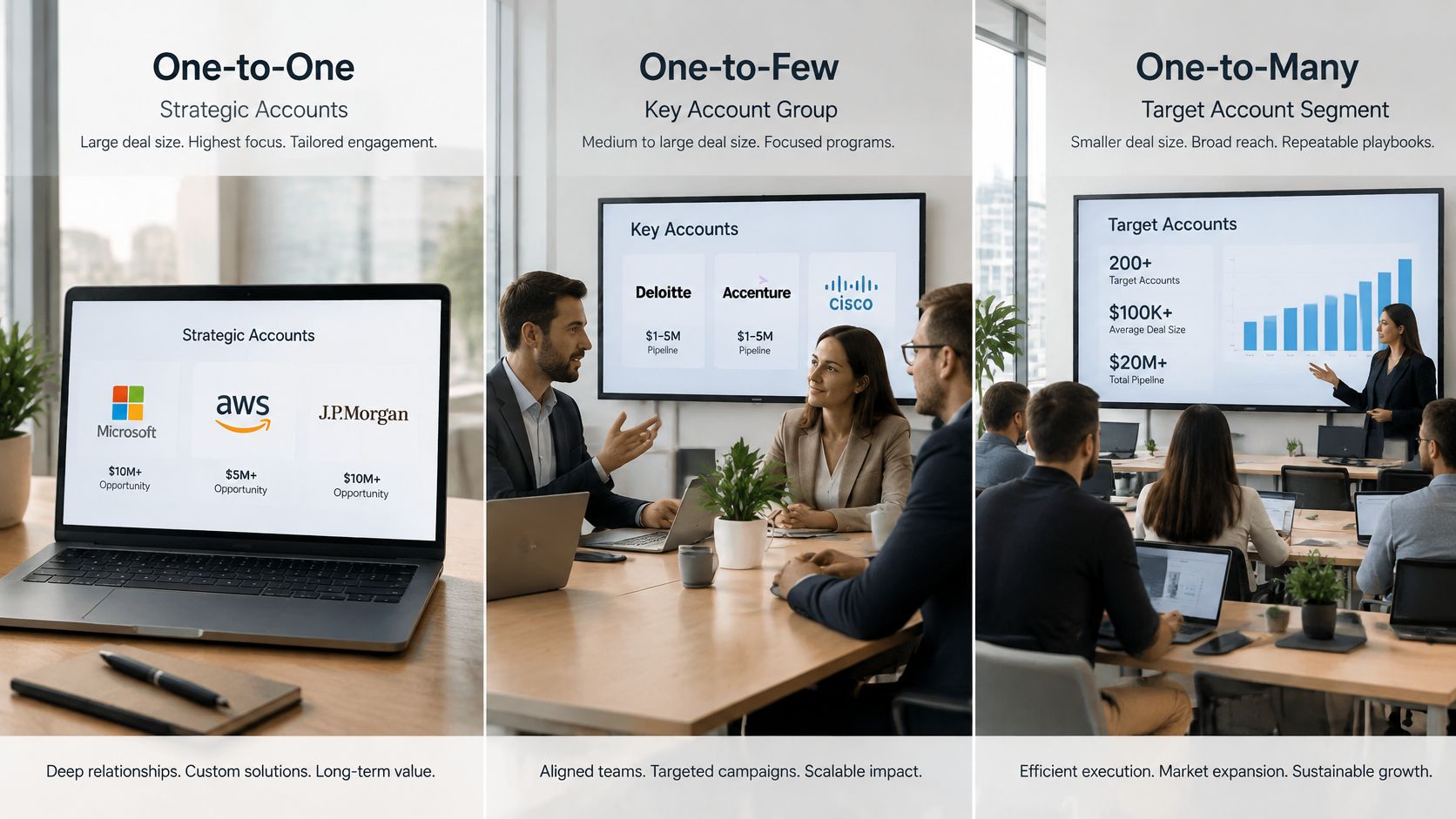
One-to-one fits a short list of strategic logos. A consulting partner might work eight accounts, each with its own point of view, an executive relationship to build, and a shared marketing and sales plan. Nothing is reused without rethinking it, because each account's politics and priorities differ.
One-to-few fits clusters that share an industry, size, and problem. A software company might run one narrative across about forty accounts and change only the role-level proof, so a CFO sees cost evidence while an operations lead sees workflow evidence. The story rhymes across the cluster. The proof doesn't have to be identical.
One-to-many fits a larger lookalike set, sometimes a few hundred accounts, running shared plays. The discipline that keeps it ABM is scoring. Engagement still rolls up to the account and triggers sales action at account level, rather than drifting into a loose lead count.
One useful week for a relationship-led consultancy
Monday, two partners publish a point of view on a problem their target accounts share, written in their own voice. Wednesday, the team reviews engagement rolled up by company, not left sitting on individual profiles. One target account shows a finance director and an operations manager both engaging. That's two relevant roles, so it passes the bar.
Thursday, a partner sends a short, specific message from their own profile referencing what the person read. No blast, no sequence to the whole list. Friday, marketing and sales update the account plan together and agree who follows up, with what, the next week.
The short video below walks through how the tiers differ in practice.
A failed week looks different. The team runs the same ads as the demand program, mail-merges the account name into the copy, reports clicks on Friday, and calls it ABM. Nobody owns a buying group, and nobody can say which account moved.
Pick your tier from deal size and similarity. If every account needs its own story, stay one-to-one and keep the list short. If the stories rhyme, cluster them. If accounts only share a category, use one-to-many, and refuse to call a click a meeting.
What ABM Is Not
Three confusions keep teams busy without changing pipeline. Clearing them up is cheaper than any new tool.
Personalization is not the test
A first name in an email is not ABM. An ad aimed at a named company domain is not ABM either, if nobody owns the buying group behind that domain. Both are lead thinking with better decoration.
The test is coordinated progress among the people who can buy. Ask whether a second and third relevant role in the account is moving, whether sales has a next step, and whether the account is closer to a meeting than it was last month. If the answer is no, more personalization won't save the program.
Intent data is a signal, not proof
An intent spike means someone associated with an account researched a topic. It might be a buyer. It might also be a student, a competitor, an existing customer, or an employee doing routine reading. Smaller companies also leave a thinner public trail, so silence doesn't mean absence of need.
The measurement work is hard, which current research makes plain. Reporting summarized by MarketingCharts on B2B measurement challenges found 51% of surveyed B2B marketers struggle with messy CRM data and platform integration, while 46% struggle to connect anonymous account engagement to known stakeholders.
So treat intent as a reason to investigate, not as permission for automated cold contact. Act only when several checks line up.
- Fit: The account matches your ICP and deal-size floor.
- Role relevance: The activity maps to someone in or near the buying group.
- Recency and repetition: The behavior is recent and repeated, not a single stray click.
- More than one stakeholder: A second relevant role shows interest too.
A channel is not an operating model
ABM isn't LinkedIn ads, email, or any other single channel, and it isn't a one-off campaign with an end date. It links account selection, stakeholder mapping, relevant engagement, a sales action, opportunity progression, and later expansion into one system. When a vendor pitch sells ABM as more emails or more ads, it's selling you distribution. You can now name what's missing from that pitch, and that's the point.
Decide Whether to Pilot ABM
Decide on a focused pilot before you buy any stack. Write it on one page with four agreed items.
- Name 25 to 50 accounts that pass the value and multi-buyer test.
- Map at least three roles on the top ten accounts.
- Define engagement as activity from more than one role, and refuse to count a single anonymous click.
- Set the success target as qualified meetings and pipeline against a historical baseline, reviewed after one quarter.
Use a shared pilot success criteria template so marketing and sales sign the same definitions before activity starts. Our own process runs in four steps: the team becomes a reference voice, prospects are filtered by ICP fit and buying signals, messages are sent from team profiles, and the calendar fills with qualified conversations. We don't do mass prospecting. We contact low volumes and only people who've already interacted with the client, the client's company, or its sector.
Build the ROI estimate the way a marketing director can defend it. Our ROI calculator estimates added revenue from leads, conversion rate, and average contract value, counting 21 working days per month, so the pilot is judged on meetings rather than reach.
The decision is binary. If the list, the role map, and the meeting target are agreed, start the pilot. If they're not, ABM is still a slogan in your building, and outreach should wait.
If your team sells high-ticket consulting or B2B software in Spain and needs named accounts to turn into qualified meetings rather than impressions, we can help you run that pilot. Ploot builds the LinkedIn authority of your partners and senior managers, detects buying signals from the people engaging with them, and contacts prospects from those trusted profiles at the right moment. Visit Ploot to see how a three-month pilot with agreed success criteria would work for your account list.