

Buyers spend only about 24% of their buying time interacting directly with potential suppliers, according to Gartner's commercial strategy guide. The rest of the cycle is research, internal debate, and digital comparison, even when a seller eventually joins. That split is why demand generation services should be scored on meetings and buying-group coverage, not on impressions, form fills, or a busy content calendar.
Three purchases sit in front of a marketing director. A full-service agency runs the campaigns. A specialist platform hands the system to your operators. A managed partner-amplification service activates senior profiles and books meetings after interest shows up. The comparison below treats those as different contracts, then shows how to write a pilot that proves which one creates pipeline.
Table of Contents
- Three Demand Generation Service Models at a Glance
- What Each Model Actually Delivers
- Pricing and Engagement Models Side by Side
- Pilot Success Criteria to Agree Before You Sign
- Pros and Cons for Consulting Firms and Software Companies
- Which Model Fits Your Situation
- Choose a Model and Set Pilot Terms Before Signing
Three Demand Generation Service Models at a Glance
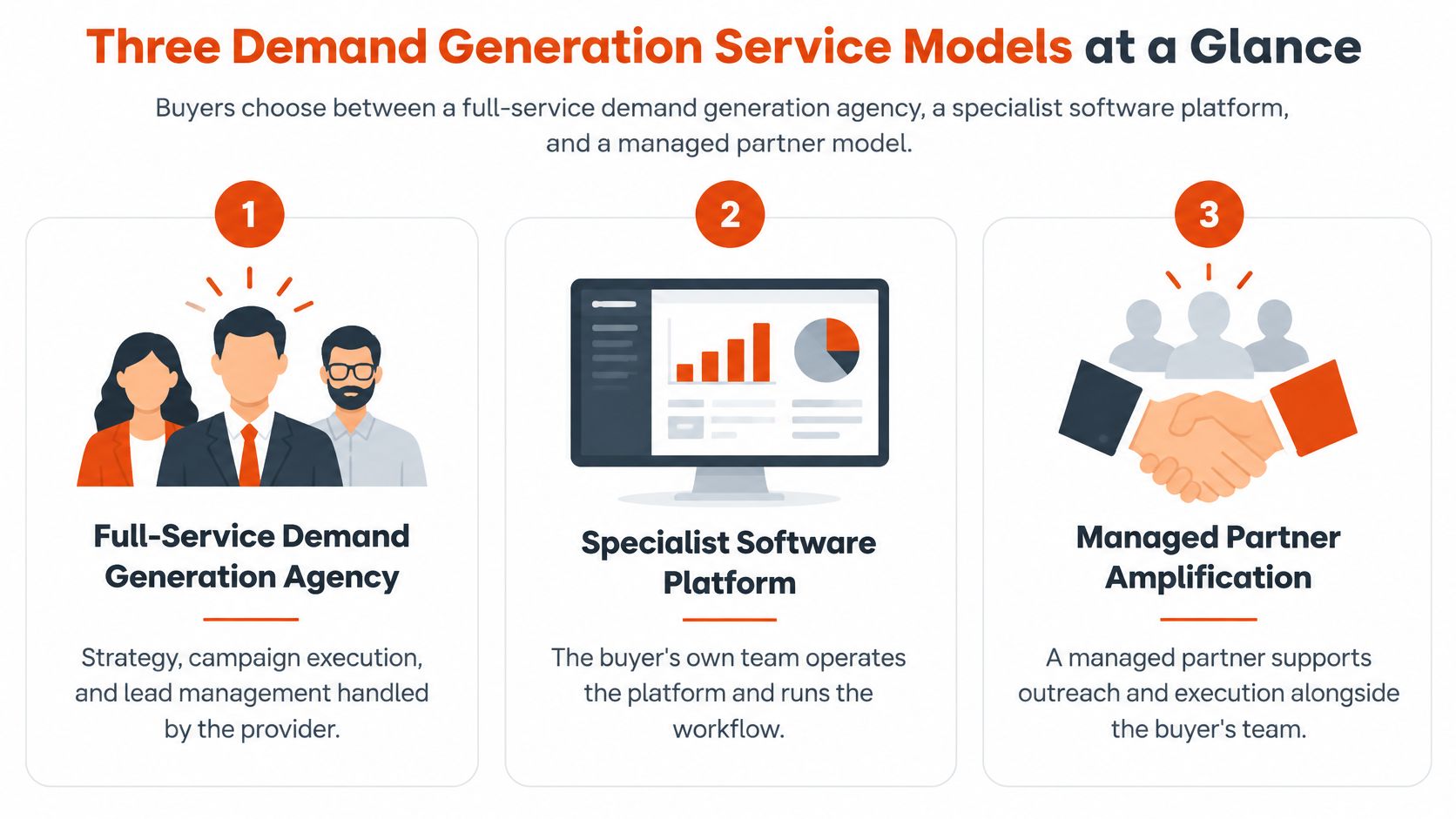
The choice is between three services that sell different things.
A full-service demand generation agency takes strategy, content, paid media, and reporting off your team. A specialist software platform sells data, intent, sequencing, and account tools, and your people operate the workflow. Managed partner amplification builds an audience around partners, directors, and senior managers, then uses detected interest to book meetings.
How the columns change the shortlist
What you buy shows whether the invoice is for campaigns, data, or meetings. Engagement shows the commercial shape you are signing, retainer, subscription, or a price per profile. Best fit is about the team you already employ. No public benchmark reliably states how many weeks pass before the first meeting, so that number stays out of the table. The pilot, not a generic promise, should set the expectation.
Before you lock a model, Fypion Marketing's demand generation tactics for 2026 is a useful scan of the channel mix these services usually draw from.
| Model | What you buy | Engagement | Best fit |
|---|---|---|---|
| Full-service agency | Strategy, content, paid campaigns and reporting | Monthly retainer plus media spend | Firms without an in-house demand generation team |
| Specialist platform | Data, intent feeds, sequencing and account-based tools | Subscription by seats, contacts or account volume | Firms with operators who can run the software |
| Managed partner amplification | Partner-led audience build, signal-triggered outreach and booked meetings | Price per activated profile, starting with a pilot | Consulting and B2B software firms that need meetings from senior profiles |
Shortlist two rows before you read pricing or pilot terms. If the best-fit cell is not your company, drop that model now.
What Each Model Actually Delivers
Each model has one output you can hold the vendor to. Everything else is activity.
Agencies deliver assets and media management. You receive campaign creative, content, paid placement, and a reporting pack. Unless the contract names a commercial metric, the scorecard stays on leads and engagement. That can be the right buy when nobody inside can brief, launch, and report a programme this quarter.
Platforms deliver a system, not a meeting. Intent feeds, sequencing, and account-based tools only produce conversations if someone builds lists, writes sequences, and works the replies. Bought without an operator, the same stack produces dashboards. If you are weighing software against a managed service, read how demand generation software has to be staffed before you treat a licence as pipeline.
Managed partner amplification delivers meetings from named people. The provider activates partners, directors, and senior managers, detects buying-intent signals in that audience, and contacts prospects at the moment of interest. The contracted output is a booked meeting, not a reach report.
A summary of 6sense's 2024 global buyer research, covering 2,509 B2B buyers, reports that 69% of the purchase process occurred before buyers engaged sellers, while 85% had already established their purchase requirements before that engagement, as covered in this roundup of B2B buyer statistics. The same research reported an average B2B buying cycle of 11.3 months in 2024. A model that starts only when someone fills a form walks in after requirements and much of the shortlist are already set.
The question is not which model creates more activity but which one owns the meeting.
Read the output named in the statement of work. If it ends in assets, feeds, or dashboards, you still own the meeting. If it ends in meetings or opportunities, the provider does.
Pricing and Engagement Models Side by Side
The bills are not comparable until you put them on the same months and the same scope.
Agencies bill a monthly retainer plus media spend. The retainer pays for labour. The media budget pays for reach. Platforms bill a subscription by seats, contacts, or account volume, and implementation or data feeds are often a separate line. Managed partner amplification bills a price per activated profile, so cost moves with the number of senior people on the programme, and a new client can start on a three-month pilot with success criteria written down.
Monetary ranges are not verified here, so they stay off the table. Ask each provider to quote the same months and the same activation scope, then compare those quotes.
| Model | Pricing basis | Commitment | What is included | Main risk |
|---|---|---|---|---|
| Full-service agency | Monthly retainer plus media spend | Rolling monthly retainer, judged after the first quarter of pipeline data | Strategy, content, paid campaigns and reporting | Paying for activity with no pipeline link |
| Specialist platform | Subscription by seats, contacts or account volume | Subscription stays live for as long as seats or accounts remain active | Data, intent feeds, sequencing and account-based tools | Licence cost without operator time |
| Managed partner amplification | Price per activated profile | Three-month pilot with agreed success criteria | Partner-led audience build, signal-triggered outreach and booked meetings | Total cost rises with the number of profiles activated |
Fee plus the people who make it work
A low monthly number can hide the staff hours required to run the service. Total cost equals the fee plus the operator time. An agency retainer still needs a marketing owner to brief, approve, and challenge the report. A platform subscription still needs a marketing-operations person who lives in the tool. Profile-based pricing still needs those senior people to publish and to answer when a contact comes back.
Practical rule: Ask every provider to price the same number of months and the same activation scope before you compare a single figure.
If one quote includes media and another excludes it, or one assumes your SDR writes the follow-up, you are not looking at the same purchase.
Pilot Success Criteria to Agree Before You Sign
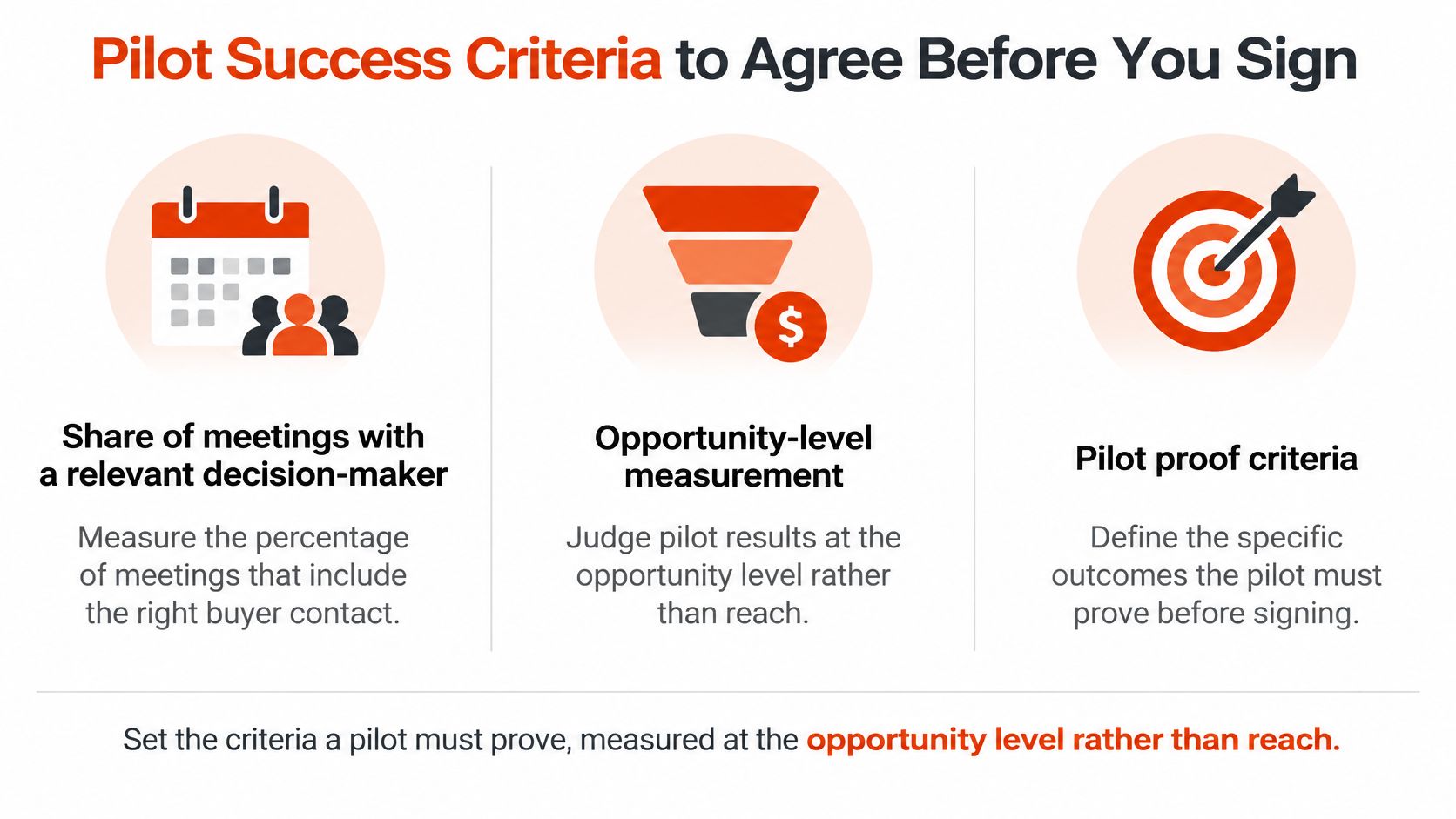
A pilot should prove that outreach creates relevant sales conversations and reaches more than one role in a target account. Agree on the measures before the first message goes out.
Gartner's B2B buying report reports that enterprise B2B buying groups typically contain 5 to 11 stakeholders across about five business functions, and that buyers are 1.8 times more likely to complete a high-quality deal when supplier digital tools are used together with a sales representative. A form fill alone does not show whether a buying group is engaged. The measures below connect meetings to relevance, coverage, and pipeline.
The table defines each measure without numeric targets, because account-list size and cycle length set the number you write into the contract, not a universal benchmark. Use this pilot success criteria template to turn the measures into agreed terms.
| Metric | Definition | Why it matters |
|---|---|---|
| Relevant decision-maker share | Percentage of booked meetings with a decision-maker or budget holder | Shows whether outreach reaches the buying group |
| Meeting-to-opportunity conversion | Share of meetings that become qualified opportunities | Tests meeting quality rather than volume |
| Signal-to-contact time | Days from a detected intent signal to first contact | Shows whether outreach is timed to real interest |
| Buying-group coverage | Stakeholder roles reached per target account | Reflects multi-person purchase decisions |
| Pipeline per activated profile | Qualified pipeline divided by active profiles | Links cost to commercial output |
The first measure prevents a programme from counting meetings with coordinators as qualified pipeline. Meeting-to-opportunity conversion tests whether those conversations develop into sales opportunities. Signal-to-contact time shows whether the team acts while interest is current, while buying-group coverage tracks which roles have been reached within each account. Pipeline per activated profile ties commercial output to the profiles used.
This short walkthrough shows how a sales and marketing team can turn those measures into a signed pilot rather than a slide.
Baseline and the lookback window
Record meeting volume and meeting source for the previous two or three quarters before the pilot starts. That baseline helps distinguish new meetings from the pipeline the team already generates.
Write the attribution rule in the same document. Specify the signal type, the originating profile, the time-to-contact, and the lookback window used to count influenced revenue. Assign each meeting to one source so it is not credited both to an agency and to a profile programme.
Put the measures and attribution rules in writing before launch. Otherwise, the pilot can report activity without showing whether it produced relevant meetings or qualified opportunities.
Pros and Cons for Consulting Firms and Software Companies
The best demand generation model depends on who buyers trust and how they prefer to engage. For consulting firms, that may be a partner; for software companies, it may be a self-guided buying process.
Consulting firms
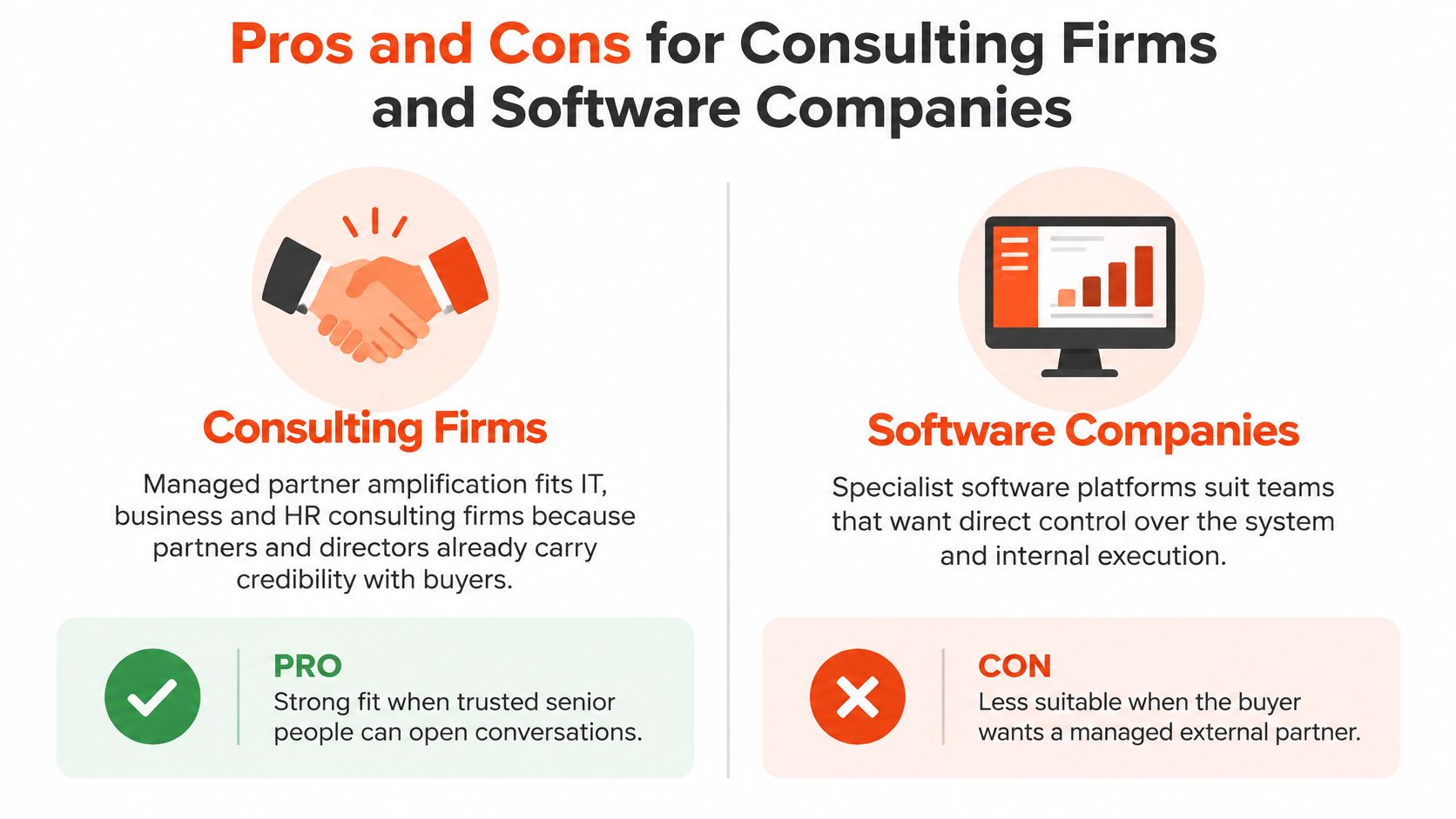
Managed partner amplification can suit IT, business, and HR consultancies whose partners and directors already have client trust. Activating those profiles can support pipeline between events, but the model depends on senior people making time to participate and respond to contacts. Several partners who already speak at client events give the programme more profiles to activate than a firm relying on one visible leader.
- Credibility the firm already has: Buyers may recognise a partner's name before they recognise the firm's brand.
- Partner time sets the limit: If a director is unavailable to participate or respond, that profile contributes less to the programme.
- Agency as the brand layer: A full-service agency can help build broader presence when the firm needs more than partner-led outreach. For firms handling client ad operations, the guide to automating client ad operations covers a different operational concern from turning trusted partner profiles into sales meetings.
The consulting lead generation approach is relevant when buyers already know the partners, rather than product marketers.
Software companies
In 2024, 75% of B2B buyers preferred a sales experience without direct involvement from a sales representative, according to Digital Commerce 360 and Forrester Research. For software companies, that makes timing and relevance important: contact tied to a real buying signal is more aligned with this preference than a sequence triggered by job title alone.
- Platform control: An in-house team keeps the data model, sequences, and account list. It also takes responsibility for staffing and the ramp before meetings begin.
- A credible spokesperson: Managed partner amplification can fit a software company with a senior voice or a sales-led motion. Long product cycles may require more nurturing before a buying signal appears.
- Early outbound as a failure mode: A sequence based only on job title can reach buyers before they show interest, producing activity without evidence of readiness.
Which Model Fits Your Situation
There is no single winner. The right row is the one that matches the team and the cycle you have now.
The most common case is a company with no in-house demand generation team that still needs campaigns inside a quarter. An agency brings strategy and execution without a hiring plan. Watch the report. If it never reaches a pipeline metric, you are paying for activity.
A team that already has analytics and marketing operations should buy the specialist platform and keep the data. The failure mode is a licence nobody opens.
Forrester's 2025 event-budget research found that 32% of professional-services event professionals and 36% of high-tech and telecommunications event professionals reported year-over-year budget decreases in 2025. Cutting the booth does not remove the need for a person buyers trust. Managed partner amplification turns senior credibility into meetings between shows, or instead of them. Watch how fast those people can be activated.
| Situation | Best fit | Why | Watch for |
|---|---|---|---|
| No in-house demand generation team and results needed within a quarter | Full-service agency | Brings strategy and execution without hiring | Activity reporting that never reaches pipeline |
| Strong in-house operations and analytics staff | Specialist platform | Keeps data and tooling under the buyer's control | Licence cost with no one to run it |
| Heavy trade-show dependence and falling event budgets | Managed partner amplification | Turns existing senior credibility into meetings without relying on events | Pace of partner availability and profile activation |
| Long purchases with several senior stakeholders | Managed partner amplification, or agency plus platform | Reaches buying-group roles over time | Missing shared definition of pipeline across providers |
| Very small target account list | Direct executive outreach, supported by a service | Relationship depth matters more than reach | Overspending on services for too few accounts |
A hybrid is often the honest answer. The agency handles content and paid reach. Managed amplification books the meetings. Both must report into one pipeline view, or you will double-count the same opportunity. On a very small account list, direct executive outreach matters more than any paid service, and a large retainer is the wrong spend.
Pick the row closest to your situation and read its watch-for cell before you book a vendor call.
Choose a Model and Set Pilot Terms Before Signing
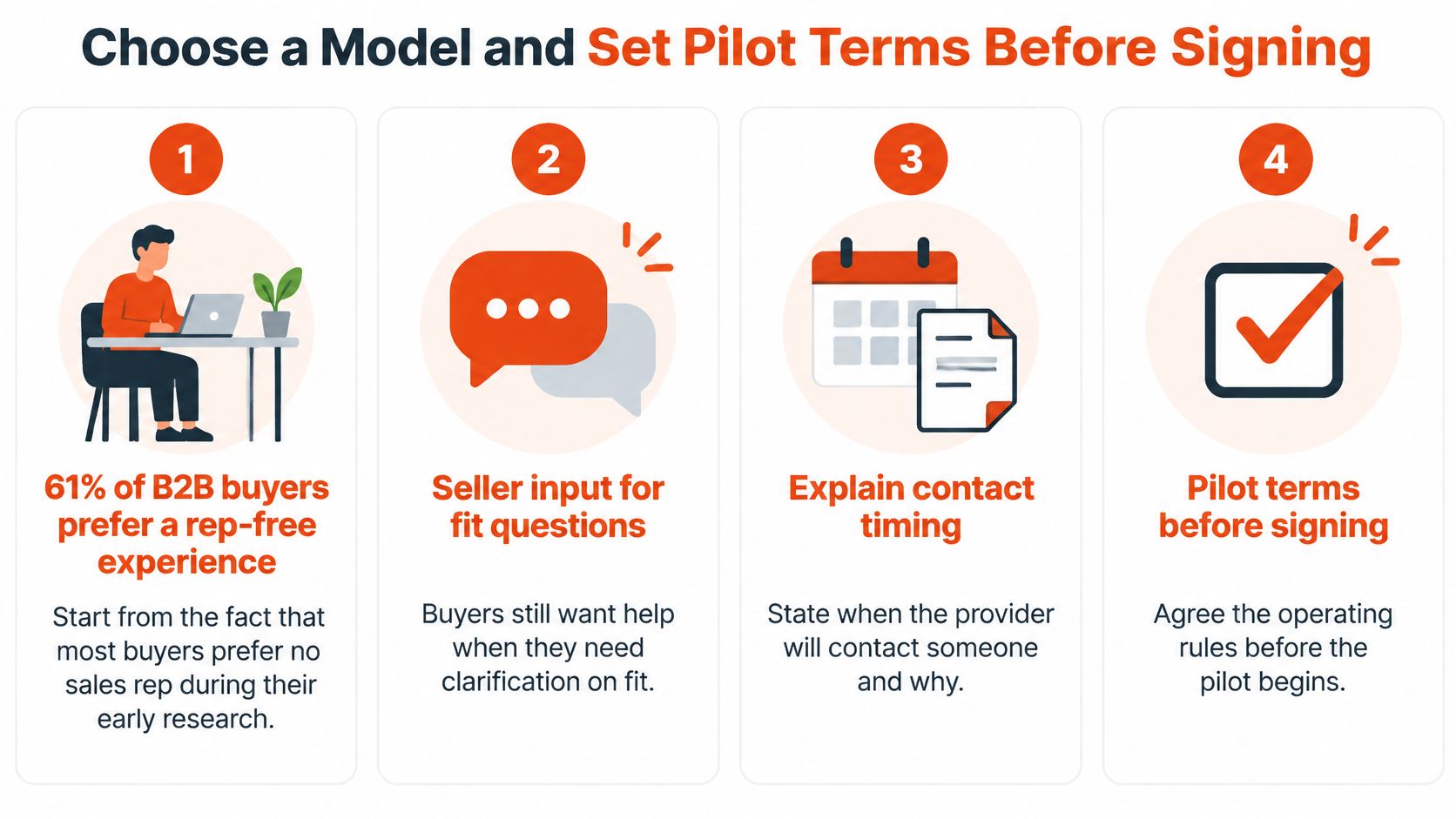
Gartner's 2025 sales survey found that 61% of B2B buyers prefer an overall rep-free buying experience, yet they still prefer seller input for contextual tasks such as determining whether a solution fits their company's needs. A provider has to say when it will contact someone, and why that moment is help rather than an interruption.
The checklist to send before you sign
- Contracted output. Confirm the deliverable is meetings or opportunities, not only assets, leads, or a dashboard.
- What counts as intent. Ask which behaviours count as a signal, how many are required before contact, and what happens when the evidence is weak.
- Buying-group map. Check that several functions are named on each target account, not a single form-fill contact.
- Who sends the message. Profiles that contact prospects need real sector authority, and nobody is contacted without detected interest.
- Pilot scope in writing. Number of profiles, number of months, success criteria, and exit terms belong in the same document.
- Your CRM, not theirs. You need data and reporting access so meetings can be verified in your own system.
- One account owner. Agree how the provider's outreach is coordinated with accounts your sales team already works, so two people do not hit the same buyer.
For a Spanish B2B consulting or software firm, Ploot offers a three-month pilot priced by activated profiles. Put that quote next to an agency retainer and a platform subscription, score all three on the pilot metrics you already defined, and sign only once the terms are in writing.
Ploot builds the LinkedIn audience of your partners, directors, and senior managers, detects who in that audience is showing buying intent, and contacts them only then to book qualified meetings. That is a practical way to judge demand generation services by meetings and buying-group coverage rather than by reach. If that matches the pilot you want to run, visit Ploot.