

Demand generation marketing creates awareness and interest before a buyer has fully defined a need, then converts that interest into qualified opportunities and revenue. Content marketing ranks among the most effective strategies for this, and the value concentrates before a buyer can even name a vendor.
So why do so many marketing directors still treat a form fill as the only proof that demand exists?
A finance director can read your analysis for months, pass it to a colleague, and never leave an email address. A conventional program calls that "no lead." Meanwhile, the buying group has already started forming a shortlist.
The missing piece is a threshold: the point where anonymous attention becomes a reason for a human conversation that doesn't feel like cold prospecting. Standard definitions stop at "create awareness, then capture leads." A marketing director needs the rule in between. When does an interaction justify outreach, who should send it, and what do you report if the deal lands two quarters later? That is the practical meaning of demand generation for consultancies, technology firms, and software companies with long, high-ticket cycles.
Table of Contents
- What Demand Generation Marketing Means
- Demand Generation, Lead Generation and ABM Compared
- Why Long B2B Sales Cycles Need Demand Generation
- The Demand Generation Funnel From Awareness to Revenue
- Tactics That Work for Long Sales Cycles
- When Intent Signals Justify a Sales Conversation
- Measuring Demand Generation Against Pipeline and Revenue
- Confirm Your Demand Generation Plan Before You Spend
What Demand Generation Marketing Means
Demand generation marketing creates awareness and interest before a buyer has fully defined a need, then converts that interest into qualified opportunities and revenue.
Content marketing is widely regarded as one of the most effective demand-generation strategies, and much of its value lands before a buyer can name a vendor. The job is to shape the problem, the category, and the preferred solution before a sales conversation starts. A working definition also needs a second half: a threshold where attention from an audience becomes a concrete reason for one person to contact another.
Creation and capture are different jobs
Demand creation expands or shapes the market. Demand capture identifies people already researching a solution and moves them forward, which is the job lead-generation and nurturing programs are built for. Demand generation is the whole cycle, and it works like a farm. Planting and tending the field early is creation. The crew gathering ripe crops is capture. Hire only the harvest crew and you eventually run out of crops. Plant and never pick, and you have a pretty field with no revenue.
A consultancy director publishes a short analysis of a regulatory change. Three months later, two people at a prospect company have read it and neither has filled in a form. When one of them starts looking for advisors, the firm is already on the shortlist, because the problem and a credible voice were linked in their minds. That is creation paying off. A gated checklist downloaded the same week is capture. Both are useful, and they answer different questions.
The threshold sits between the two. Creation runs at audience level, but a buying decision needs a named person. Demand generation earns its budget when engagement from an individual inside your ideal customer profile gets specific enough that contacting them feels like continuing a dialogue rather than starting one cold.
What the definition excludes
This is not a lead-volume program, and it is not a campaign you judge by impressions. Reach matters only when you can connect meaningful engagement to pipeline. For a consultancy, a technology company, or a software provider, that means credible expertise placed in the networks buyers already trust, watched at account level rather than counted as a pile of names.
Apply a simple test to any live program. Does it change which problems and suppliers buyers consider, or does it only change who fills in a form? If the honest answer is the form, you are capturing demand someone else created.
Demand Generation, Lead Generation and ABM Compared
Teams use these three labels as if they were the same budget line. They aren't. The table is the cleanest way to separate them before anyone argues about channels.
| Dimension | Demand generation | Lead generation | Account-based marketing |
|---|---|---|---|
| Primary goal | Create awareness and preference before a need is defined | Capture contacts ready to engage | Win and expand a named set of accounts |
| Starting point | Market problem and category | Known form fill or content download | Defined target account list |
| Unit of measure | Engaged buying groups and influenced pipeline | Leads and conversion rate | Pipeline and revenue per account |
| Typical timeline | Continuous, across a long buying cycle | Short campaign cycles | Account plans over several quarters |
| Main channels | Expert content, LinkedIn, events, partner networks | Gated content, paid search, webinars | Personalized multi-channel plays for key accounts |
Demand generation starts with a market problem. You are teaching a category, not waiting for a search query. The unit you care about is an engaged buying group and the pipeline that group influences. The work doesn't end when a quarter closes.
Lead generation starts later, with someone who has already raised a hand through a form, a download, or a webinar registration. You measure leads and conversion rate, and a campaign can be planned in weeks. It is faster, and the pipeline it produces is less durable if nobody planted demand first.
Account-based marketing starts with a named list. The goal is to win and expand those accounts, reported as pipeline and revenue per account, over several quarters of personalized plays. If you need the meaning of that targeting method in more detail, this explanation of account-based marketing is a useful companion.
How the three overlap
ABM is a targeting method that often sits inside a demand generation program. Lead generation is the capture step that can follow either one. A B2B software company can run all three without mixing the scorecards. Expert analysis on LinkedIn reaches the sector and is reported as engaged accounts. A named list of 40 priority accounts gets personal plays and is reported as pipeline per account. Gated webinars capture contacts and are reported as leads and conversion rate. The same webinar shouldn't be asked to prove all three.
Outbound still has a place once you know who is worth a conversation. A practical way to balance outbound prospecting with lead generation is to treat prospecting as a response to fit and behavior, not as a substitute for either program.
Use this rule when you allocate the next quarter:
- The buyer market is still forming. Invest in demand generation first, so preference exists before procurement starts.
- The target list is fixed and deals are large. Add ABM on top, with account plans rather than more broad campaigns.
- You need contact volume now. Lead generation delivers faster, and you should expect less durable pipeline from it alone.
Why Long B2B Sales Cycles Need Demand Generation
B2B customers used an average of six interaction channels during the decision journey, and nearly 65% became frustrated by inconsistent experiences across those channels, according to McKinsey research. Buying has moved from a mainly salesperson-led process to a mix of digital research, remote interaction, and in-person conversations.
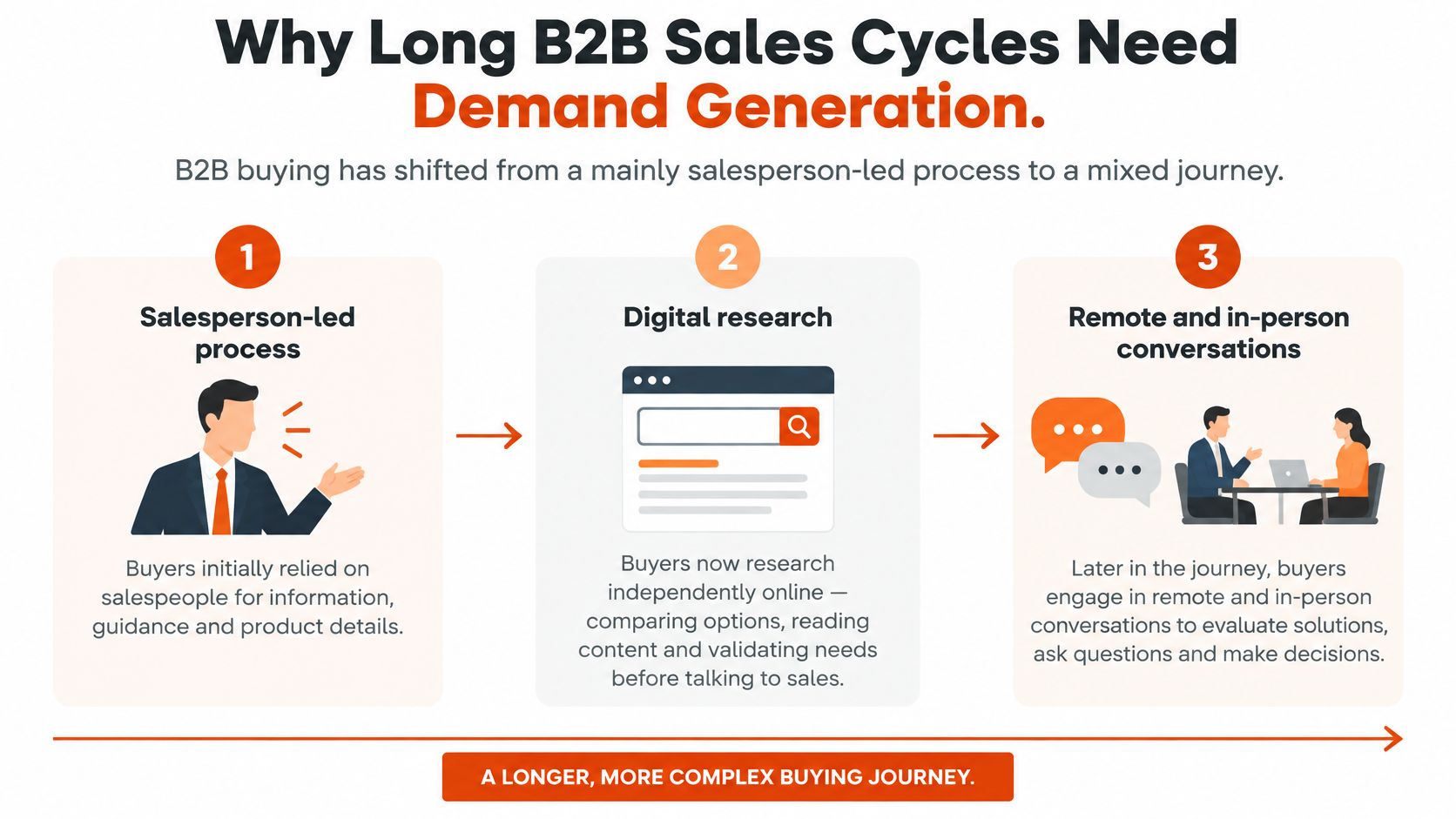
What the channel spread means for a long cycle
Read that finding as a planning constraint. Every channel is a place where your story can drift apart, and that frustration rate tells you buyers notice. They cross-check the LinkedIn post against the website against what a seller says on a call. When the three describe different problems, the response is quiet. The account drifts down the shortlist.
Cycle length is what makes this expensive. On a short cycle, a confused buyer still buys something simple. On a cycle measured in quarters, every new stakeholder re-reads your public material and retells it to colleagues. A buying group passes your argument along like a relay baton, and each inconsistency between channels reaches the next runner distorted, resetting the trust you spent months building.
Demand generation exists to hold one diagnosis steady across that whole span. It coordinates authoritative content, professional visibility, buyer signals, human conversations, and measurement, so the account meets the same argument wherever it looks.
One decision, many people, one message
A form fill captures one moment. The decision spans many channels and several people, so judge a program by whether the message stays consistent across all of them.
A CFO reads an article on margin pressure in the sector. Six weeks later a COO from the same firm attends a webinar and hears the same framing, with the operational consequence spelled out. Six months after the article, the sales conversation starts with both of them already agreed on the problem.
That agreement is the threshold most programs miss. An interaction becomes actionable when a real person inside the buying group crosses from reading into responding, and the message that follows references what they saw. The rep who writes to the COO about the webinar arrives as the first human voice in a story the account has followed for half a year. Open that call with a different diagnosis and six months of teaching get untaught in one reply.
The Demand Generation Funnel From Awareness to Revenue
Treat the funnel as a planning map, not a conveyor belt. Buyers loop, skip, and re-enter. You still need a stage for every campaign, or you can't tell whether it worked.
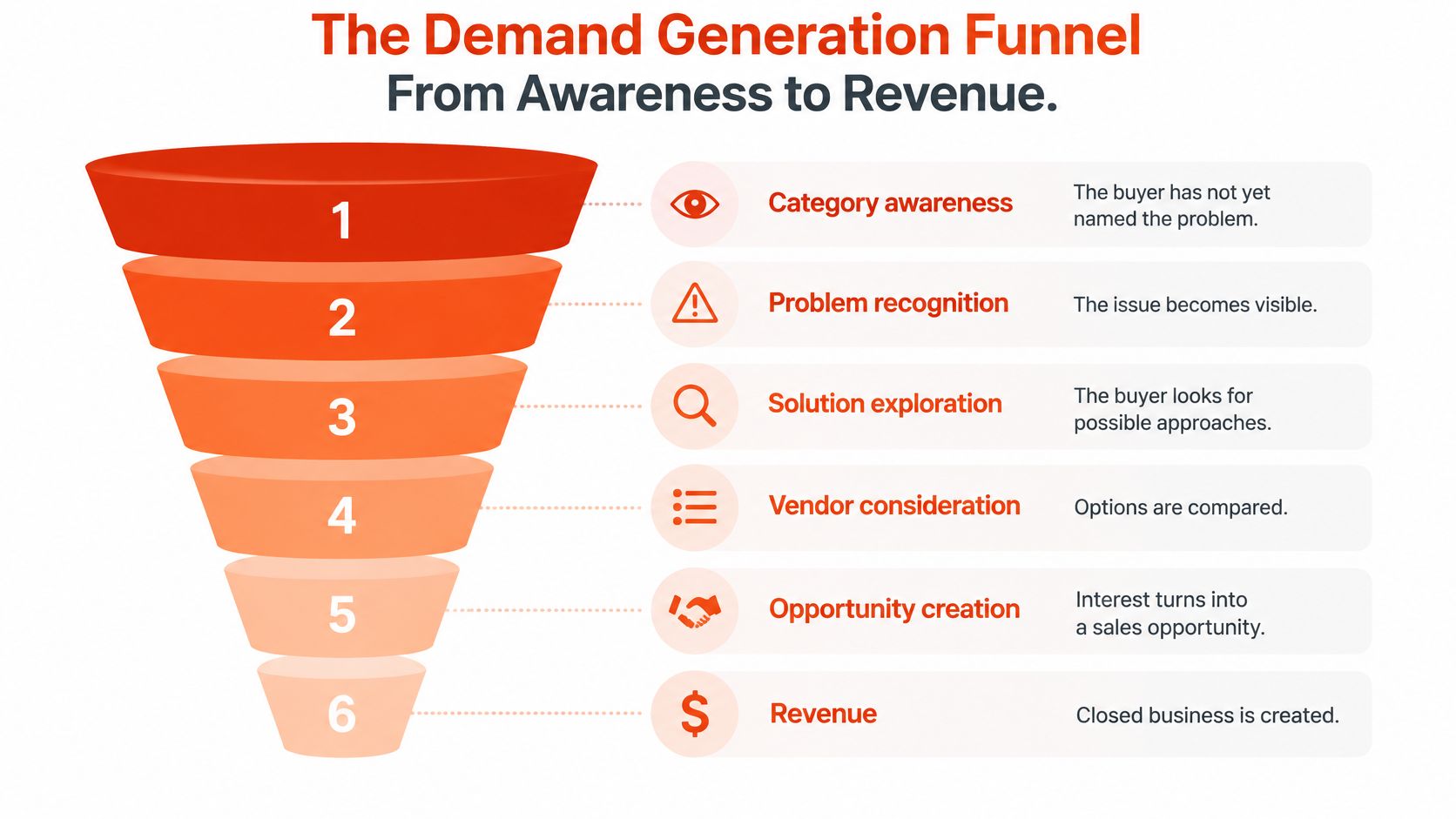
| Stage | Buyer state | Marketing action | Signal to track | Hand-off trigger |
|---|---|---|---|---|
| 1. Category awareness | Has no named problem yet | Publish expert analysis on the sector issue | Reach and returning visitors from the target sector | None, keep nurturing |
| 2. Problem recognition | Sees a cost in the status quo | Explainer content and short guides | Repeat views of problem content | None yet |
| 3. Expert engagement | Compares approaches and follows a trusted voice | Partner and expert posts, webinars | Comments, saves, and profile visits by senior roles | Relevant engagement from a target account |
| 4. Intent and account signals | Researching options, often with colleagues | Follow-up content matched to each role | Several stakeholders from one account engage | Signal threshold met |
| 5. Sales activation | Open to a conversation | Personal message from a known profile referencing the interest | Reply or meeting accepted | Qualified meeting booked |
| 6. Opportunity and revenue | Evaluating suppliers | Shared account narrative with sales | Sales-accepted opportunity and stage progress | Closed won or lost |
How to read the rows
Stages 1 and 2 have no sales hand-off. Publishing and explaining are the work. A spike in reach with no returning visitors from the target sector means you entertained the wrong audience. Repeat views of problem content are the first sign the status quo has a cost in someone's mind.
Stage 3 is where a named expert or partner earns attention through comments, saves, and profile visits by senior roles. Stage 4 is where colleagues show up together. That is the moment marketing matches follow-up content to each role instead of sending one generic sequence. A meeting is stage 5, and only after a qualified meeting is booked. What counts as a sales-qualified lead should be agreed before that booking, or sales and marketing will argue about the same conversation.
Stage 6 is shared. Marketing doesn't disappear at the opportunity. The account narrative has to match what the seller says, or the earlier stages were theatre.
People don't walk the six stages in order. A buyer can jump from a saved post to a pricing question, then go quiet and return at problem recognition because a new colleague joined. The map tells you which metric to trust. It doesn't tell you to push everyone downward on a timer.
For a fuller view of how content, capture, and sales activity fit on one operating system, the digital marketing insights from Verbatim Digital are worth reading beside your own stage map. Then name the stage each current campaign serves, and the one metric that shows whether it is working. If you can't name both in a sentence, the campaign isn't ready to spend against.
Tactics That Work for Long Sales Cycles
Buyers self-educate, then look for a person when the decision feels risky. These five tactics are in the order a long-cycle consulting or software firm should build them. Measurement of the resulting pipeline sits in the next section, so this list stops at what you publish, who carries it, and what sales is allowed to say.
Named expert content on LinkedIn. Publish original analysis from people with real sector authority, not only brand posts. Buyers trust a director who has done the work more than a logo that "shares insights." Two posts a week from a named partner will usually teach the market more than a month of company-page updates.
Partner and team amplification. Ask partners and senior staff to share the same analysis in their own words. Buying committees don't sit in one feed. When a finance lead and an operations lead both see the piece through someone they already follow, you have reached the group, not a single subscriber.
Educational formats built for buying groups. Run a roundtable or a webinar aimed at two or three roles, such as the finance lead and the operations lead, in the same room. A solo demo teaches a product. A two-role session teaches the internal argument those people will have after you leave.
Account-level content for priority targets. For each named account, prepare a short brief on the sector problem most relevant to its roles. You aren't writing a custom white paper for every logo. You are giving the seller and the expert one page that connects your category to that account's situation.
A shared narrative with sales. Use the same message in LinkedIn content, on the website, and in the sales conversation. Gartner research found that buyers use an average of seven information sources during a purchase, and 69% prefer validating AI-generated insights with sales representatives. Earlier Gartner research found buyers are 2.8 times more likely to complete a high-quality deal when they perceive consistent information between a supplier's website and its representatives.
Disconnected campaigns create friction. Synchronized content and seller messaging reduce uncertainty. An intent signal should not fire a mass sequence. It should tell you when a credible expert or seller can add context.
A 90-day start
Don't launch all five at full volume. Choose two expert voices, one educational format, and one target list. Agree the narrative in writing before you scale. If sales can't repeat the problem statement from the posts without a slide, you don't have a narrative yet.
When Intent Signals Justify a Sales Conversation
The common assumption is that an intent signal means someone is ready to buy. It doesn't. It means someone researched something. A spike can be education, competitor analysis, a hiring plan, academic interest, or one person with no buying authority. Industry reporting on intent is right that digital signals often show up before a sales conversation, and that category research can happen weeks before a shortlist. Treating every spike as a meeting request is how teams over-contact curious people and train the market to ignore them.

Build a composite, not a score of one
Single-contact scoring is unreliable in consulting and B2B software, where buying groups and long cycles are normal. Combine five dimensions before anyone writes a message:
- Account fit: the company matches the sectors and size you can serve.
- Seniority and role: the person can influence or own the problem, not merely read about it.
- Repetition or escalation: the same topic returns, or the behavior gets more specific.
- More than one stakeholder: colleagues from the same account show up.
- Topic match: the subject connects to a commercial problem you solve.
Weak signals earn more useful expert content. Moderate signals earn a social interaction, such as a thoughtful comment or a connection request. A direct meeting invitation goes out only when intent and context converge. For a working definition of the inputs, see how B2B intent data should be read before it is routed anywhere.
A threshold you can defend
Say a finance director views three articles on a regulatory change, and two colleagues from the same firm read the same piece in one week. Role, repetition, and account breadth are all present. A personal message from the expert who wrote the article, referencing that piece, is a continuation. One curious visit from an unknown title is not. The difference is why the outreach doesn't feel like cold prospecting: it comes from the profile that created the engagement, and it mentions what was read.
Would the message still make sense if the reader knew exactly what they had looked at? If you would be embarrassed to say it out loud, the threshold hasn't been met. Keep publishing. A short walk-through of how teams separate research activity from a real conversation is here:
Measuring Demand Generation Against Pipeline and Revenue
Impressions are not the final KPI. Enterprise purchases involve multiple stakeholders across several functions, so a report built on one form fill misses the buying unit entirely. The shortlist also forms early: Gartner's B2B buying research notes that only 2% of B2B buyers begin a purchase with no vendors already in mind. Preference is built before procurement starts. Your report has to show whether you are on that mental shortlist at account and buying-group level.
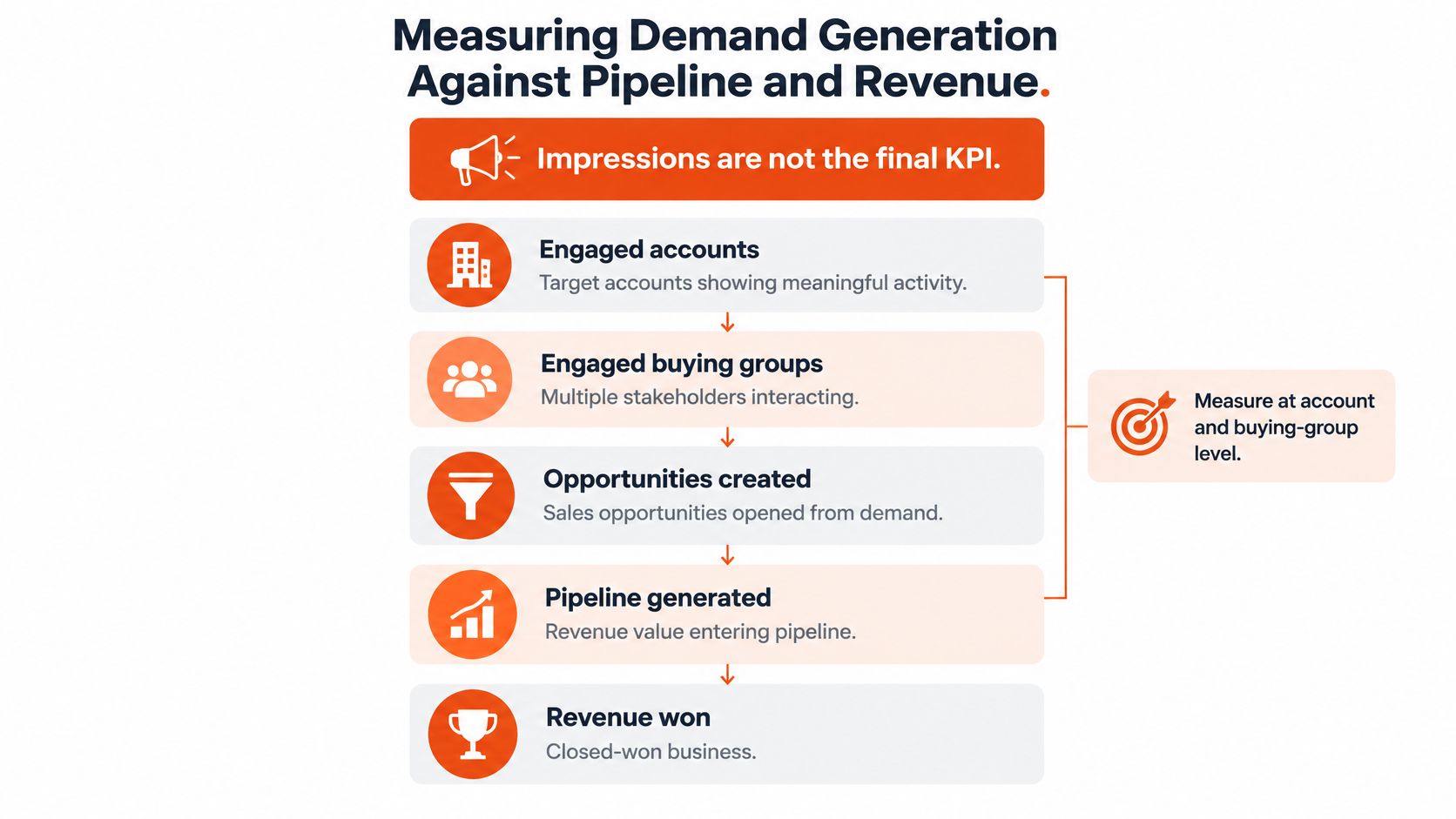
| Metric | What it shows | Reporting level |
|---|---|---|
| Engaged accounts | Target companies with relevant interaction | Account |
| Engaged buying roles | Number of distinct stakeholders involved | Account |
| Sales-accepted opportunities | Engagements that sales agrees to pursue | Opportunity |
| Sourced pipeline | Pipeline created by a demand generation touch | Opportunity |
| Influenced pipeline | Pipeline where demand generation touched the deal | Opportunity |
| Time to response | Days or hours from signal to sales action | Program |
| Win rate by signal type | Share of won deals by the signal that triggered them | Program |
| Revenue | Closed-won value from engaged accounts | Business |
Sourced and influenced are both real
Sourced pipeline is an opportunity a demand generation touch created. Influenced pipeline is a deal the program shaped along the way. Long cycles rarely have one clean first touch, so report both. A seller who "found" the account on a call may still have walked into a room your experts had been teaching for two quarters. Hiding that influence makes the program look smaller than it is. Claiming every deal as sourced makes it look dishonest.
Add three efficiency reads. Time to response shows whether a qualified signal sat in a queue. A signal that cleared your threshold but waited for follow-up loses the context that made the outreach feel like a continuation. Stage velocity shows whether engaged accounts move or stall. Win rate by signal type shows which behaviors deserve a meeting and which only deserve another article. If you want a broader method for how to track the commercial impact of marketing, use it to pressure-test this table, not to replace it with vanity totals.
A quarter you can explain
Say a consultancy records 12 engaged accounts in a quarter. Four of them have two or more engaged roles. Two become sales-accepted opportunities, and one closes two quarters later. The 12 tell you the market is paying attention. The four tell you buying groups are forming, a stronger leading sign than 12 lone readers. The two tell you sales agreed the context was real. The one closed deal is the lagging proof, and it will not show up in the quarter you did the work.
Read the same example in reverse and it audits your threshold. Meetings that stall before acceptance mean the signals you rewarded were too weak. Accepted opportunities that convert mean the threshold is doing its job. That is why a monthly review of account engagement and a quarterly review of pipeline and win rate belong together. Treat attribution as a trend. No single post causes a single signature on its own.
Confirm Your Demand Generation Plan Before You Spend
Spend after the rules are written, not before. Five checks are enough:
- Name the problem and the roles. Write the market problem in one sentence and list the buying roles you must reach. If you can't, the content will drift toward whatever is easy to post.
- Lock the stage map. Each campaign serves one stage and has one metric. A webinar that is "awareness and leads and pipeline" will be graded on whichever number looks best.
- Set the signal threshold first. Agree account fit, role, repetition, and multi-stakeholder rules before any outreach is turned on.
- Agree the narrative with sales. The problem statement in the posts is the problem statement in the meeting.
- Report at account level. Review engagement monthly and pipeline on a quarterly cadence, including influenced as well as sourced.
How to judge outside support
Hold any partner, including us, to three criteria. Outreach stays at low volume and only reaches people who have already interacted with you, your company, or your sector. Messages go by LinkedIn or email from real team profiles, mention what the person looked at, and don't come from a brand account. Results are judged on meetings and pipeline, not impressions. A new client can start with a 3-month pilot with agreed success criteria, which is the right shape for a first test because the success line is set before the invoice.
The decision is simple. Don't commit the annual budget to a motion you haven't defined. Start with a pilot, write the success criteria into the brief, and spend only against that brief.
Ploot turns your partners' and directors' LinkedIn expertise into demand, detects who in that audience is showing buying intent, and contacts them from those same profiles to book qualified meetings. That is demand generation for long, high-ticket B2B cycles, measured in conversations and pipeline rather than reach. See how it works at Ploot.