

Your SDR dashboard shows healthy activity. A partner has booked a promising meeting, marketing can point to engagement from a target account, and sales has sent a proposal. Then the conversation stalls because the people reviewing the purchase have never heard your case.
That's the gap account based sales development should close. The job isn't to get a senior contact to reply. It's to build enough relevant relationships inside an account to identify a real buying opportunity, then give sales evidence it can act on.
Table of Contents
- What Account Based Sales Development Actually Covers
- How to Map Roles Inside a Target Account
- Which Buying Signals Deserve a Human Reply
- How to Engage Without Sounding Like Cold Outreach
- When an Account Is Qualified Enough to Hand Off
- How to Prove the Program Created Pipeline
- Commit to Account Coverage or Stay With Volume
What Account Based Sales Development Actually Covers
Say a consulting partner meets a CHRO who wants help redesigning workforce planning. The conversation goes well, but the sponsoring director hasn't helped define the scope, and IT security hasn't reviewed how employee data would be handled. The proposal reaches a committee the consulting firm never mapped, and nobody there feels responsible for moving it forward.
Account based sales development is the sales motion that identifies, engages, and qualifies named accounts by working across their buying groups. It sits inside account-based marketing, but its work goes beyond attracting attention: someone must establish who matters, decide when contact is justified, and determine whether the account is ready for sales.
The buying-group reality explains why this matters. Forrester research covering more than 16,000 B2B buyers in 2024 found that a typical purchase involved 13 stakeholders, while 89% of purchases included participants from at least two departments, as summarized in Take the Market's buying-committee benchmark.
The account is the unit of work
A marketing director, procurement lead, or CEO might open the conversation without controlling the decision. Other people can shape requirements, approve technical risk, release budget, or take responsibility for implementation.
The operating model therefore has connected parts:
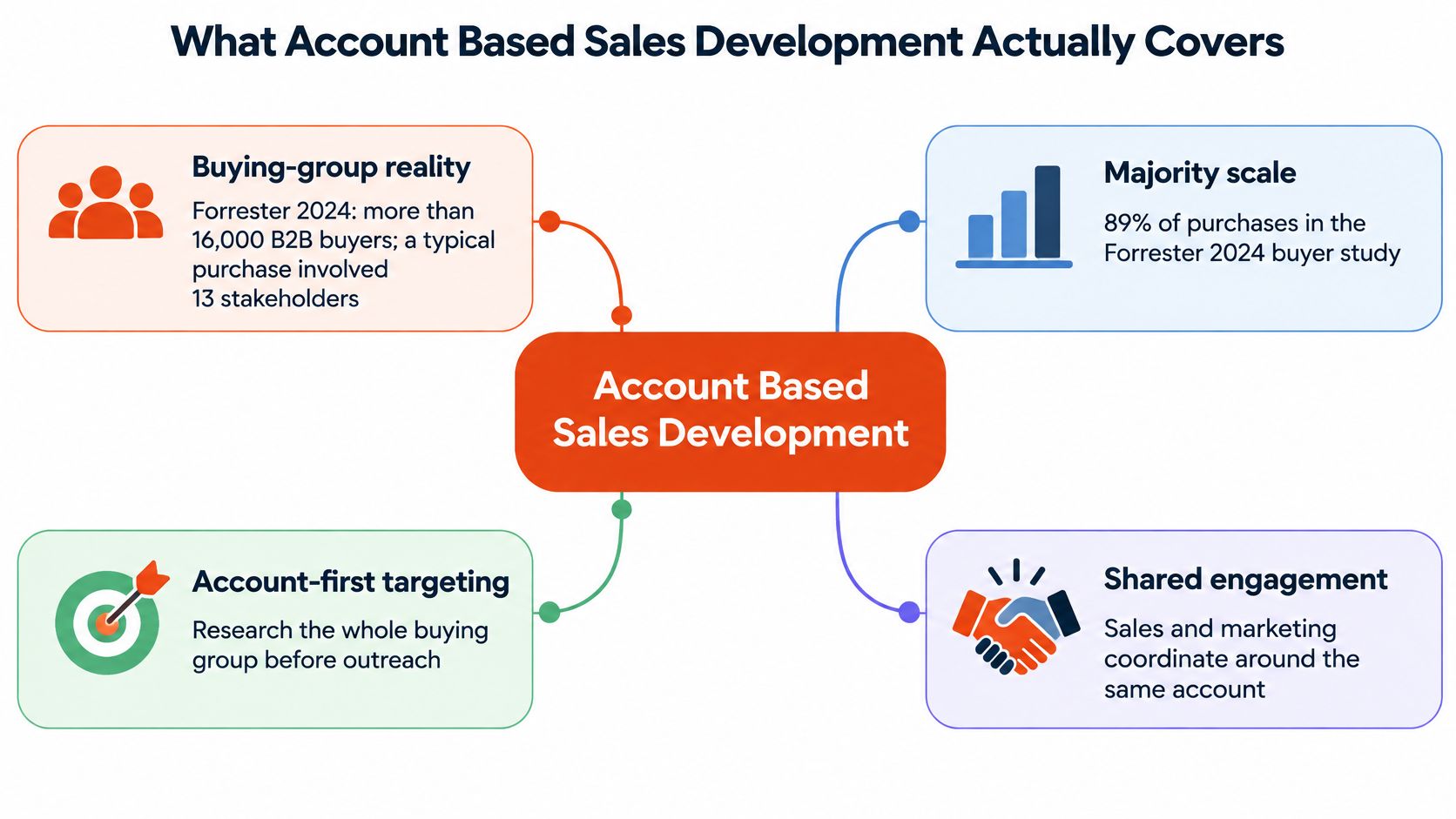
Volume SDR work typically organizes activity around individual leads, calls, and sequences. Account-based work organizes it around an account hypothesis: this company has a problem we can solve, these people influence the purchase, and this evidence justifies a conversation.
That doesn't mean every employee becomes a prospect. It means the team investigates the roles that can change the outcome rather than treating the first reply as complete coverage.
Split responsibility without splitting the account
- Marketing selects and warms the list. It defines account fit, develops relevant content, and builds familiarity.
- Sales development investigates and qualifies. It maps stakeholders, interprets signals, and opens appropriate conversations.
- Sales owns the commercial process. Once the account clears the agreed gate, a seller develops the opportunity and owns the forecast.
Before choosing accounts, challenge assumptions about who experiences the problem. Narrareach's audience discovery experiment is a useful companion for that audience-definition work.
The practical foundation is an account map, a contact rule, a qualification gate, and a pilot that tests whether the extra coordination produces pipeline.
How to Map Roles Inside a Target Account
A contact list tells you who works at a company. An account map tells you who can change the buying decision, what each person cares about, and how your team can reach them credibly.
There's time for relationships to develop, but that's not a reason to postpone mapping. According to 6sense's 2025 B2B Buyer Experience Report, based on nearly 4,000 buyers and summarized by Sci-Tech Today, the average global B2B buying cycle fell from 11.3 months in 2024 to 10.1 months in 2025.
Build the map before starting a sequence
Define the ideal customer profile through a problem. Record industry, the operational issue you solve, and the deal-size range your delivery model supports. Enterprise technology companies is too vague. A clearer hypothesis is a software business whose customer onboarding requires consulting support because implementation complexity is delaying deployment.
List decision-making seats, then find names. Include the economic buyer, operational user, technical evaluator, procurement contact, and executive sponsor. A person can occupy several seats, and some seats may remain unknown. Mark those gaps instead of filling them with assumptions based on seniority.
Choose the likely conversation opener. This might be an operational director who owns the problem rather than the executive who approves spending. Write down why that person would talk to you and what useful insight you can offer. Don't confuse accessibility with purchasing authority.
Assign credible voices from your team. A partner may be best placed to discuss strategic priorities with the sponsor. A senior specialist may be better suited to a technical evaluator. Give each relationship a named owner so colleagues don't send overlapping introductions.
Record meaningful interaction by seat. Define buying-group penetration as the share of relevant seats with a real interaction. A substantive reply, an attended discussion, or a request for technical material qualifies under a clear rule. A LinkedIn connection alone doesn't.
Keep evidence separate from interpretation
Your CRM account record or shared worksheet should distinguish confirmed facts, working hypotheses, and unknowns. Record the evidence date, too. A director's former responsibility won't help if the project has moved to another department.
A blank seat is useful information. An invented decision-maker is a planning error.
Keep the working map on a page: account problem, fit rationale, buying seats, named contacts, internal relationship owners, interaction evidence, and next action. Store detailed correspondence elsewhere so the map stays usable during an account review.
A desirable logo with no active problem belongs in audience nurturing. Don't create an outreach sequence merely because the organization looks impressive on the target list.
Which Buying Signals Deserve a Human Reply
One weak action isn't a buying window. Suppress a pitch when the only evidence is a generic content view or an isolated profile visit. Escalate when independent observations support the same account-level problem.
MarketBetter's intent-data guidance offers operating benchmarks of a 5–15% signal-to-meeting rate and contact within four hours for high-intent signals. Treat these as planning references, not promised results for your market or offer.
The important distinction is between repetition and corroboration. Repeated activity from the same person may indicate interest, but it doesn't establish organizational demand. Activity from relevant colleagues, commercial-page engagement, and a business change can provide different kinds of evidence.
What to do with each buying signal
| Signal strength | Evidence | Response | Timing |
|---|---|---|---|
| Single weak action | One generic content view or a lone profile visit | Suppress outreach and keep nurturing | No same-day pitch |
| Passive topic interest | Repeated reads on one relevant theme by one person | Useful follow-up, not a meeting ask | Inside the normal content cycle |
| Converging account signals | Several people, commercial pages, a role change, hiring, or repeat topic engagement | Human message naming what they engaged with | Within four hours when intent is high |
| Explicit evaluation | Pricing, comparison, demo, or RFP-like behavior from ICP roles | Meeting request with context | Same day, inside four hours |
| Dependent or off-ICP cluster | A high score built from one weak class or the wrong company | Hold and require a second independent signal class | Re-score before any contact |
The converging-signals row requires judgment. A hiring announcement alone doesn't prove a purchase is underway. Hiring alongside sustained engagement with a relevant solution, from people who could own the problem, supports a stronger hypothesis.
Likewise, an anonymous pricing-page visit shouldn't become a personalized claim about what a named individual read. Use only evidence you can reliably attribute, and distinguish account-level observations from person-level actions.
Weight evidence instead of counting clicks
Build your scoring rules around these classes:
- Recency and frequency. Is the activity current and sustained, or an old isolated event?
- Commercial proximity. Does the behavior concern general education, implementation, comparison, or evaluation?
- Seniority and role relevance. Can the person influence this particular purchase?
- Account fit. Does the organization have the problem and characteristics your offer serves?
- Cross-contact corroboration. Are distinct people or independent signal classes supporting the hypothesis?
A deeper explanation of what buying signals mean can help the team label observations consistently. For public discussions outside LinkedIn, OGTool's guide to monitoring brand mentions across Reddit offers another discovery approach, but a mention still needs account-fit and intent checks.
After a month, review median signal-to-first-touch time, qualified meetings per activated profile, and whether those meetings involve target buying-group roles. Inspect rejected alerts alongside accepted ones. If the same weak evidence repeatedly triggers outreach, change the rule rather than asking reps to write more persuasive messages.
How to Engage Without Sounding Like Cold Outreach
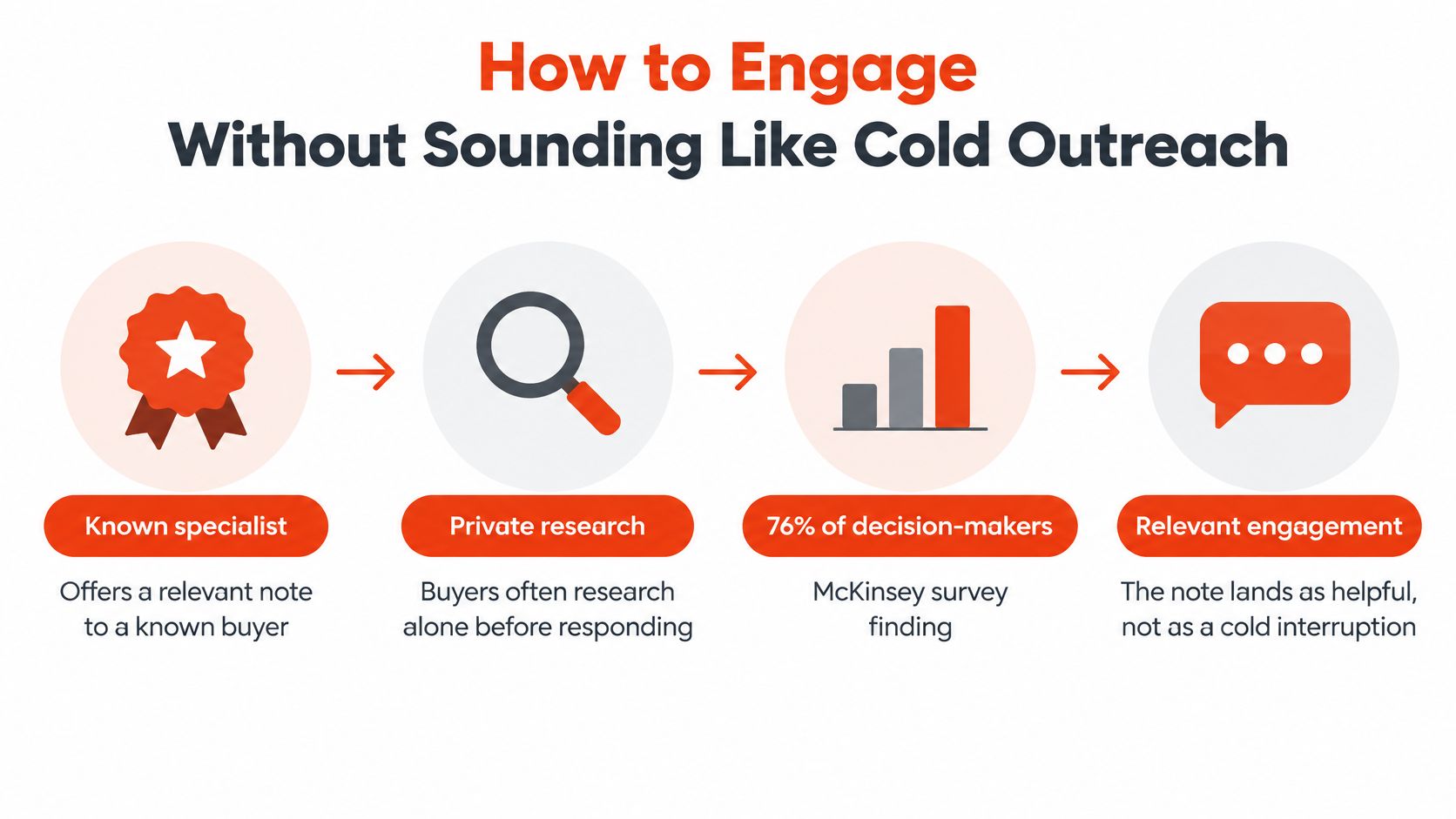
A useful message feels like a relevant specialist offering help, not a stranger announcing that someone has been tracked. The sender's credibility matters, but so does restraint about what the evidence supports.
Buyers' preference for independent research doesn't mean they never want human help. A McKinsey survey cited in the B2B Research Report found that 76% of decision-makers said speaking with a salesperson was helpful when researching a new product or service.
Use that distinction to guide the interaction:
Give the message a credible owner
Choose a partner, director, or senior specialist who can answer the recipient's likely questions. Don't borrow an executive's identity to send a message that executive wouldn't recognize or defend.
At Ploot, we send messages through LinkedIn or email from team members' own profiles, not a brand account. Each person approves the wording before it goes out, and the message mentions what the recipient looked at.
That approval should cover substance, not just tone:
- Evidence accuracy. Does the message describe an interaction you can verify?
- Useful contribution. Does the sender offer an observation, resource, or answer relevant to the topic?
- Appropriate directness. Is the requested next step proportionate to the recipient's demonstrated interest?
Offer help before asking for time
Say an HR director has engaged with a partner's workforce-planning post. A suitable note might explain that separating headcount assumptions from capacity assumptions can make the discussion easier, then offer a worksheet. It shouldn't begin by asserting that the company needs a transformation program.
Broader B2B demand generation tactics from Sprints & Sneakers can support the educational activity around that exchange. The direct message should still stand on its own as useful communication.
This video offers another format for considering the outreach approach:
We don't do mass prospecting. We contact low volumes and only people who have already interacted with the client, its company, or its sector.
If someone replies not now, return them to nurturing rather than increasing the cadence. Reject sequences designed primarily to maximize touches per account. The objective is a welcomed conversation, not an exhausted recipient.
When an Account Is Qualified Enough to Hand Off
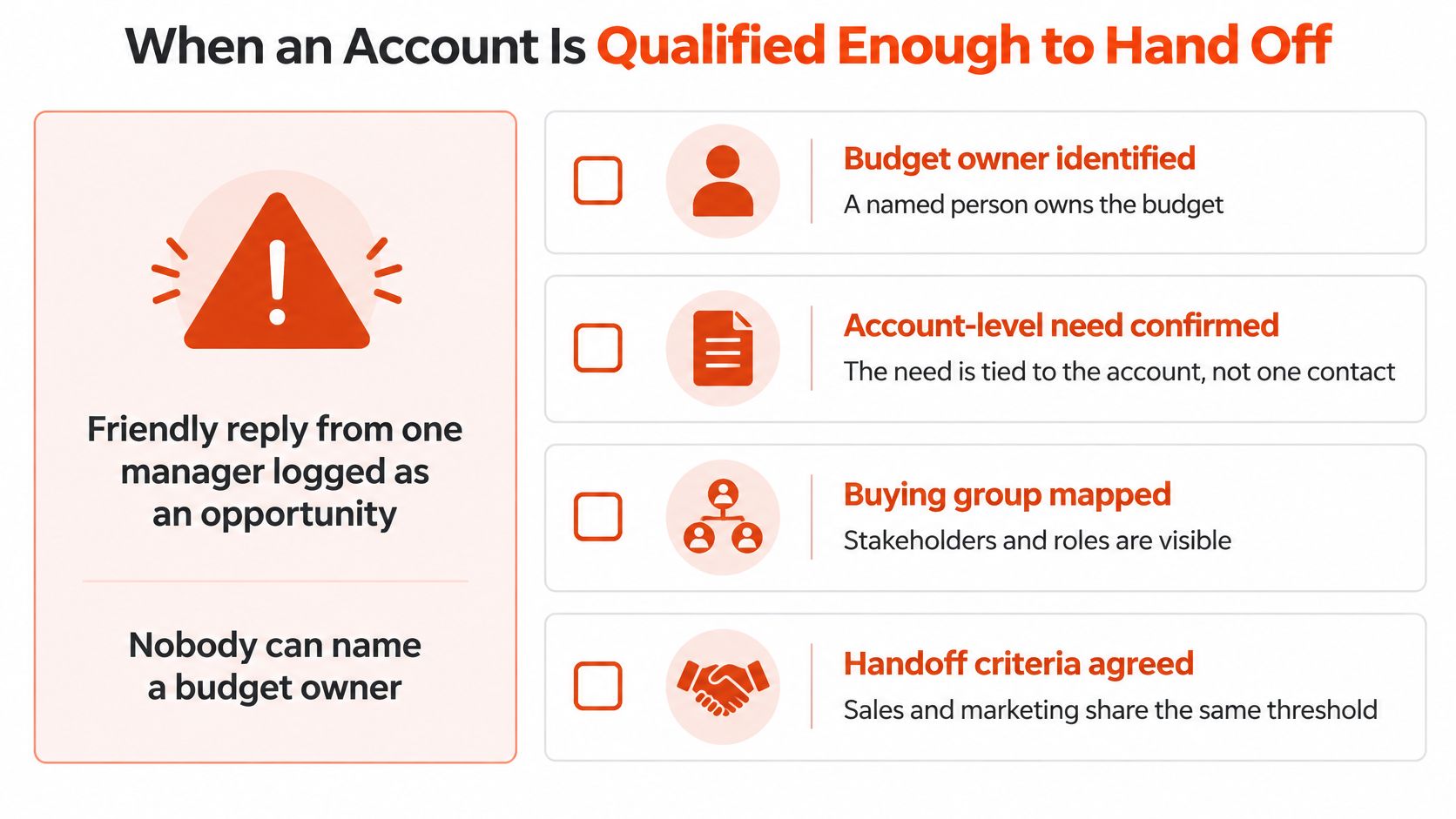
A manager replies warmly, agrees to a discussion, and suddenly appears in the opportunity report. Yet nobody can name a project, identify who owns spending, or explain who else will participate. That's a conversation, not sufficient evidence for the forecast.
Qualification is an account decision, not a contact score. Use a shared pass-fail card so marketing, sales development, and sellers don't assign different meanings to a positive reply.
The distinction is visible in this checklist:
Account qualification gates
The following thresholds are proposed operating rules for your team to agree on, not universal research benchmarks.
| Gate | Pass | Fail |
|---|---|---|
| Account fit | Named ICP and the problem matches the offer | Prestigious logo with the wrong problem |
| Buying group | At least two relevant roles known, with a path to the economic buyer | One friendly contact and no map |
| Intent quality | Two independent signal classes in the same window | One weak click or dependent signals |
| Commercial reality | Timeline, budget owner, or an active project is visible | Curiosity with no project |
| Handoff | Sales receives the person, the signals, and roles already touched | A name with no context |
Consider a software company discussing implementation support. Account fit passes when its implementation problem matches your delivery capability. It fails if the contact really wants recruitment services that your firm doesn't provide, regardless of the company's reputation.
Buying-group coverage passes when the operational lead can identify the relevant technical evaluator and explain the route to spending approval. A friendly champion who won't or can't introduce anyone else remains in development.
Test what the evidence permits
Intent quality requires independent support. A post reaction and a profile visit from the same browsing session shouldn't automatically count as separate evidence classes. A substantive response about a problem alongside an active evaluation request is a different proposition.
Commercial reality doesn't require pretending every detail is settled. A visible project with an unresolved budget can justify seller involvement, provided sales understands that uncertainty. General interest in a topic, with no organizational initiative attached, belongs in nurturing.
Handoff test: Could the receiving seller explain why this account should act, who is involved, and what remains unconfirmed without asking the prospect to repeat everything?
Make the marketing-to-sales handoff a documented transfer of evidence. Include the named person, account problem, interaction history, stakeholder map, commercial facts, unanswered questions, and agreed next action.
Sales should accept the account against the same gates or record a specific reason for returning it. That feedback makes the qualification rule better. A silent rejection only creates an argument about lead quality.
How to Prove the Program Created Pipeline
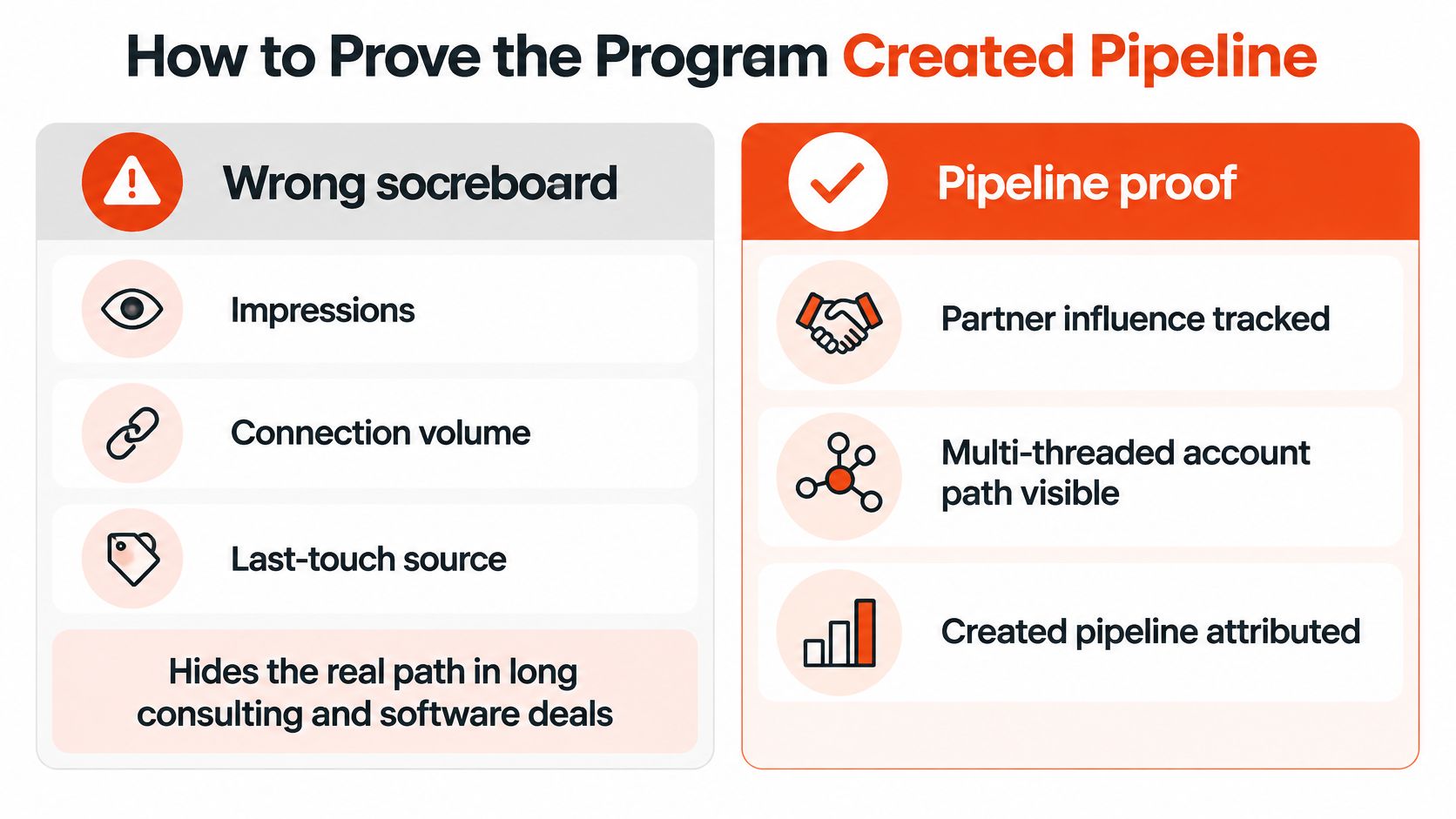
Stop treating last-touch credit as proof of contribution. A partner can introduce an idea through LinkedIn, an operational director can circulate it internally, and procurement can later submit the inquiry. Crediting only the form submission erases the earlier relationships.
Highspot's account-based selling guidance emphasizes account-level engagement and commercial outcomes. For a credible pilot, go further: test whether treated accounts produce more qualified pipeline than comparable accounts receiving ordinary activity.
The scoreboard needs to distinguish activity from commercial evidence:
Compare accounts that could plausibly perform alike
For a hypothetical pilot, select 40 similar IT-consulting target accounts and split them equally between a treatment cohort and a comparison cohort. Run coordinated partner coverage and signal-based outreach in the treatment cohort; leave the comparison cohort on the existing inbound motion. Review the results after a quarter.
Match accounts on characteristics that could affect the result: company size, problem fit, existing relationships, prior engagement, and known projects. Randomly allocate matched accounts where practical, and document exceptions before outreach begins.
Keep other treatment differences visible. If sales gives the treatment cohort preferential event invitations or extra executive attention outside the planned motion, record it rather than attributing everything to signal-based messages.
Measure penetration and commercial progression together
- Buying-group penetration. Track the share of relevant roles meaningfully engaged before opportunity creation.
- Qualified meetings. Apply the same qualification standard to both cohorts.
- Opportunity creation and progression. Record accepted opportunities, their value, and subsequent movement.
- Revenue. Follow outcomes beyond the initial review when deals remain open.
- Self-reported first influence. Ask what first made the account consider your firm, and preserve the answer alongside recorded activity.
Use consistent definitions and a fixed reporting cutoff. Otherwise, one team may count booked meetings while another counts attended, qualified conversations.
The discipline behind measuring account-based marketing applies here: connect relationship development to commercial outcomes without pretending every touch deserves exclusive credit. More activated profiles don't automatically produce more pipeline.
A small matched pilot offers directional evidence, not certainty. Report cohort differences, account histories, and unresolved deals fully. If the treatment cohort generates engagement but no additional qualified opportunities, investigate coverage, timing, and qualification before expanding the program.
Commit to Account Coverage or Stay With Volume
Commit to account coverage when a buying group shapes a high-value, long-cycle purchase. Stay with volume development when an individual buyer can make a straightforward transactional decision. Don't impose stakeholder mapping on a purchase that doesn't need it.
For consulting and complex software firms, commitment means assigning relationship owners and protecting their time. Partners and directors can't serve as credible voices if they only appear as names attached to messages nobody has reviewed. Sales leaders also need to reward account progress rather than preserving activity quotas that encourage indiscriminate outreach.
Make the pilot an operating decision
Bring a single-page brief to the sales leader with these decisions completed:
- Accountable owner. Name the revenue operator responsible for execution and reporting.
- Cohort membership. List treatment and comparison accounts, with the rationale for matching them.
- Participation. Identify the partners, directors, specialists, and sales-development staff involved.
- Success criteria. Agree on qualification, opportunity acceptance, and commercial reporting before messages are sent.
- Review date. Set a three-month review and specify how open opportunities will be followed afterward.
Ploot is one way to operate this motion: we turn team expertise into demand through LinkedIn content, detect buying intent, filter prospects by ICP fit and signals, and deliver qualified leads with the context sales needs.
Don't start with tool shopping or an ROI worksheet. Start by asking whether your team can execute the operating commitments in that brief. If nobody owns the account map or sales won't agree on acceptance criteria, software won't resolve the disagreement.
Approve a bounded pilot, not an indefinite content program. Expand only when the comparison gives you a defensible reason to invest further.
Ploot helps your partners, directors, and senior managers turn their expertise into qualified sales conversations, with interest-based outreach from approved team profiles. Visit Ploot to discuss a three-month pilot built around named accounts, agreed success criteria, and pipeline evidence rather than impressions.