
Stop filling the top of the funnel. That's the popular advice, and it's why so many B2B marketing teams can show reach while sales still complains about empty calendars. For high-ticket consulting and software, your job isn't to collect more contacts. It's to move the right accounts toward qualified meetings and revenue, even when buyers research privately, loop back on decisions, and involve people who never fill in a form.
Table of Contents
- Why the Demand Generation Funnel Is Really a Pipeline Engine
- How B2B Buyers Actually Move Through the Funnel
- The Five Stages of a Demand Generation Funnel and What to Do at Each
- The KPIs That Actually Predict Revenue
- Why Account-Level Signals Beat Contact-Level Conversion
- Capturing the Demand That Happens Outside Your Funnel
- A 90-Day Plan to Optimize the Funnel for Pipeline
- The Operating Principles That Make the Funnel Work
Why the Demand Generation Funnel Is Really a Pipeline Engine
Many teams measure a demand generation funnel like a brand campaign, then optimize it like a lead form. They celebrate impressions, downloads, and marketing-qualified leads. Then they're surprised when the board asks a simpler question. Where's the pipeline?
That disconnect happens because the funnel was built around a contact, not a purchase. A junior manager downloads a guide and becomes an MQL. The partner who owns the budget, the operations lead who feels the pain, and the procurement stakeholder who'll block the deal never appear in the report. You've measured activity. You haven't measured demand.
Use a Pipeline Definition of the Funnel
Use this operating definition instead. A demand generation funnel is the set of stages, signals, and plays that move target accounts from unawareness to qualified opportunity. Every stage needs an entry signal, an exit signal, and an owner. If you can't name those three things, you don't have a funnel. You have a content calendar.
That definition changes what you defend in the room. Pipeline coverage comes first, followed by qualified meetings, stakeholder coverage, and opportunity progression. Lead volume becomes a diagnostic metric, useful for spotting a leak, useless as proof of success.
If a campaign can't plausibly create a qualified conversation in a target account, cut it or relabel it as brand spend. Don't let it borrow credibility from pipeline reporting.
For long-cycle deals, this discipline matters even more. Revenue closes months after first engagement, so you need leading indicators sales trusts. Report engaged target accounts, buying groups with more than one active stakeholder, meetings accepted by the right roles, and opportunities created. That's a pipeline engine. Anything softer is decoration.
How B2B Buyers Actually Move Through the Funnel
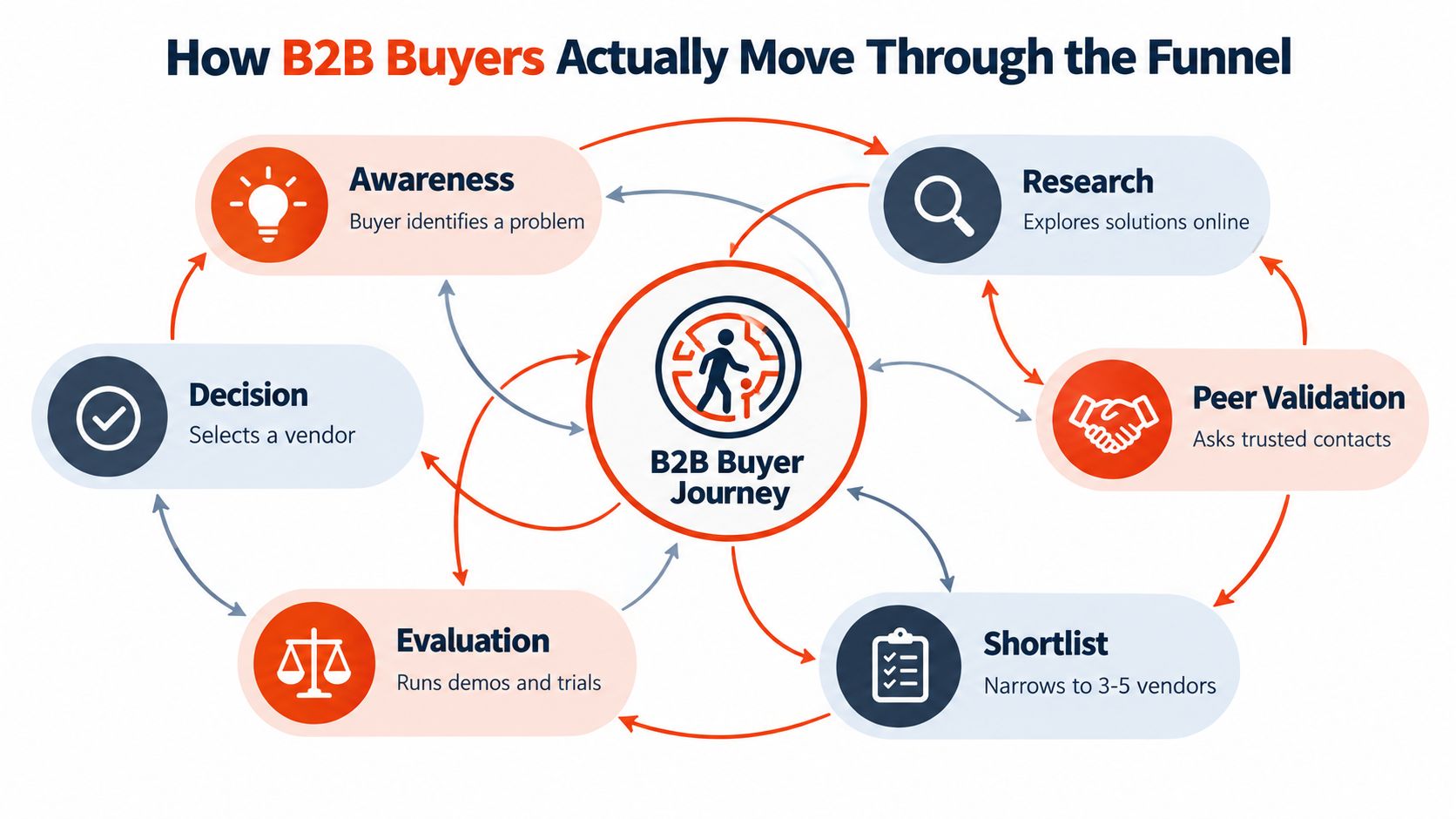
Buyers don't march from awareness to purchase in a neat line. They identify a problem, explore options, get distracted by internal priorities, return with new requirements, and then ask someone else to validate the shortlist. Your funnel has to support that messy loop, not punish buyers for failing to follow your diagram.
Design Around Buying Jobs, Not Campaign Steps
Gartner's research on the B2B buying journey identifies six recurring buying jobs, problem identification, solution exploration, requirements building, supplier selection, validation, and consensus creation, and found that 99% of B2B purchases are driven by organizational changes such as a new strategic priority, leadership change, restructuring, or technology initiative. Buyers revisit those jobs rather than finishing them once.
Build assets and signals for each job separately:
- Problem identification: Name the cost of the status quo in the buyer's language.
- Requirements building: Give stakeholders criteria they can reuse internally.
- Validation: Provide proof, references, and risk reduction they can forward.
- Consensus creation: Arm your champion with a one-page business case, not another product deck.
The diagram below shows why linear stage reporting breaks down in committee buying.
Digital self-service matters, but don't confuse preference with isolation. Buyers often research alone, then make better decisions when a credible human helps them interpret trade-offs. That's why partner and executive profiles work. They provide education in public and a low-friction route to a conversation in private.
If you're redesigning from first principles, build a demand generation system around those jobs before you buy more distribution. Stop rewarding only first touch and last touch. A stakeholder who forwards your requirements checklist to Finance has moved the deal, even if your CRM calls it a page view.
The Five Stages of a Demand Generation Funnel and What to Do at Each
Keep five stages. More than that and your team will debate definitions instead of running plays. Fewer than that and you'll miss where high-ticket deals stall, which is usually evaluation and internal consensus.
Map Content and Outreach to the Buyer's Job
| Stage | Primary Content | Outreach Play | Stage KPI |
|---|---|---|---|
| Awareness and category education | Short partner or executive posts, sharp market POV | Consistent LinkedIn activation in target accounts | Target-account reach and repeat engagement |
| Problem activation | Problem-specific playbooks, diagnostics, cost breakdowns | Signal-based message referencing the problem viewed | Engaged accounts with problem-level intent |
| Solution comparison | Comparison guides, implementation checklists, webinars | Role-specific invite or peer roundtable | Multi-stakeholder engagement per account |
| Vendor evaluation | ROI cases, security or methodology proof, demos | Direct outreach to economic and technical buyers | Qualified meetings and opportunities |
| Consensus and procurement | Business case, references, commercial FAQ | Champion enablement through sales | Opportunity progression and win rate |
At awareness, don't gate the thinking. Your goal is recognition among people who fit the account profile, not email capture from anyone curious. Short, specific posts from partners and senior managers outperform generic company content because buyers trust named experts more than logos.
Problem activation is where most funnels get lazy. A broad ebook doesn't activate anything. Publish the diagnostic question a director is already asking in a management meeting. Show the operational cost, the hidden handoff, the failed workaround. Then trigger outreach only when engagement repeats around that problem.
Separate Demand Content From Sales Enablement
Demand content creates and shapes the conversation. Sales enablement helps a buying group choose you. Mixing them produces bloated assets that do neither job well. For a useful external breakdown of stage-level measurement, see Prometheus Agency on funnel metrics, then adapt the KPIs to your own cycle instead of copying generic targets.
At comparison and evaluation, give each role different proof:
- Finance: Payback logic, cost of delay, commercial risk.
- IT or Operations: Implementation effort, integration, adoption risk.
- Executive sponsor: Strategic outcome, peer evidence, downside protection.
- Procurement: References, terms, compliance, delivery governance.
Score intent conservatively. One click is curiosity. Repeated problem engagement, profile interaction, a direct reply, and a second stakeholder from the same account showing up, that's a pattern worth contacting. Don't spam on the first signal. Don't wait until a competitor is already in the room either.
The KPIs That Actually Predict Revenue
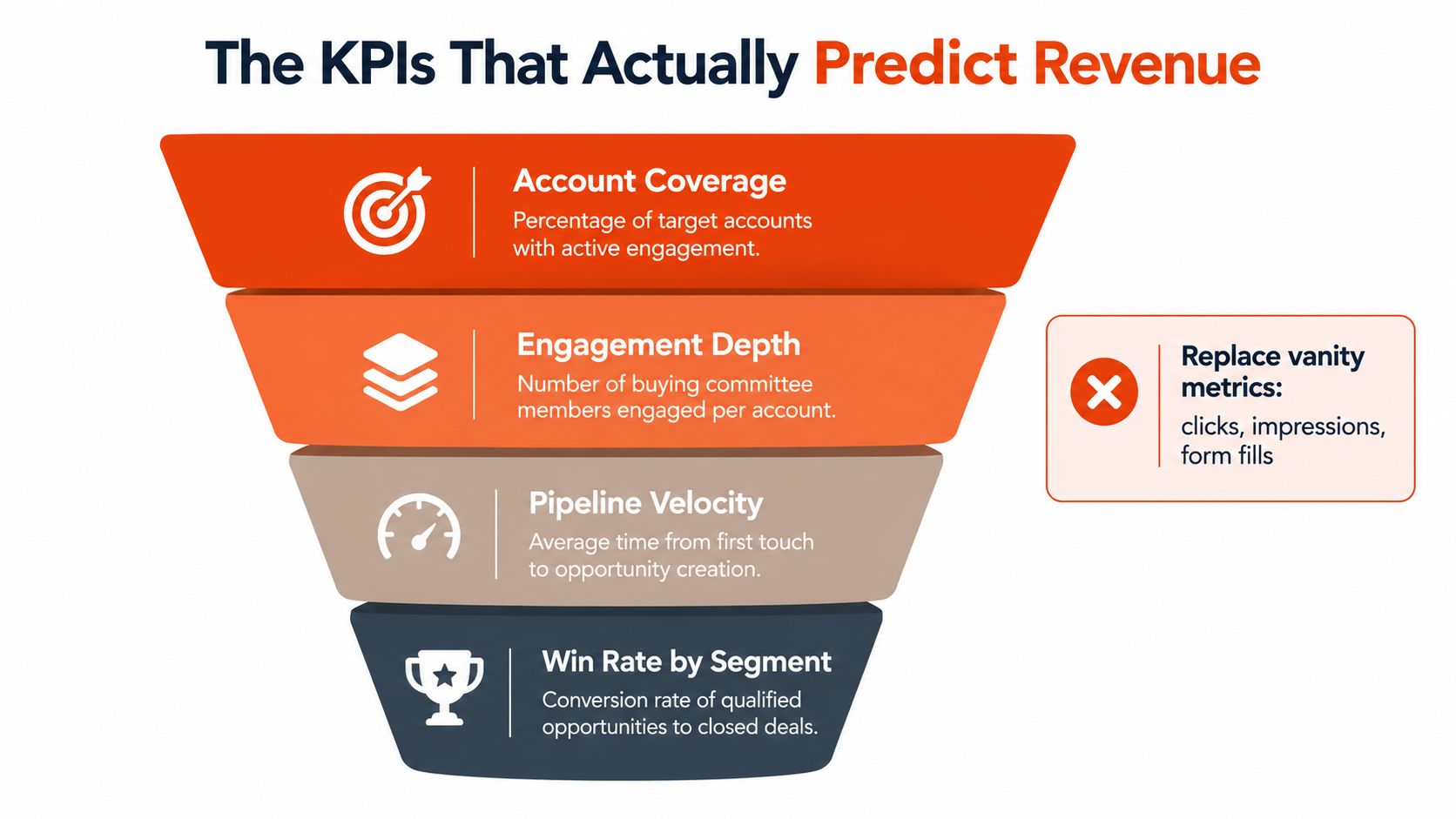
Delete half your dashboard. Impressions, raw clicks, likes, and form fills don't predict revenue in long-cycle B2B. They tell you something was distributed. They don't tell you whether a buying group is forming.
Follow the Conversion Math to the Bottleneck
Model the funnel as state transitions, lead to MQL to SQL to opportunity to customer. Benchmark data compiled across B2B companies reports approximately 31% lead-to-MQL conversion, 13% MQL-to-SQL conversion, and 47% SQL-to-opportunity conversion, and a common pipeline-coverage rule recommends marketing source roughly 2 to 3 times the revenue quota in pipeline.
Run that math before you ask for more top-of-funnel budget. Those rates turn 10,000 leads into roughly 403 opportunities before win rate, using the same benchmark sequence. The weakest transition is usually MQL to SQL, because that's where vague interest meets fit, seniority, timing, and a real problem. Fix qualification there and you create more pipeline without buying more traffic.
The visual below prioritizes the measures I'd put in front of a sales director.
Work backward from revenue. A €300,000 target needs roughly €600,000 to €900,000 in qualified pipeline under that coverage rule, adjusted for your actual win rate and cycle length. If your current plan produces half that coverage, you don't have a stretch goal. You have a gap you're refusing to name.
Track account progression, qualified meetings booked, pipeline coverage ratio, sales cycle length, and win rate by source. Break conversion down by source, activated profile, account segment, and time to contact. If you need cleaner web behavior feeding that view, NotFair's Google Analytics connector is one practical reference for connecting analytics data, and our guide to advanced analytics for pipeline reporting covers how to use that data without turning it into vanity reporting.
Practical rule: Set pilot success at qualified meeting or opportunity level. If success can be achieved with impressions alone, sales will ignore the result, and they'll be right.
Why Account-Level Signals Beat Contact-Level Conversion
The unit of demand in high-ticket B2B is the account. Treating each contact as an isolated lead destroys pipeline quality. The person who filled in the form gets the credit and the follow-up. The partner, director, or technical evaluator who influenced the decision stays invisible.
That mismatch is now the normal case. A 2025 buyer report found that 72% of B2B purchases involve complex, multi-stakeholder buying groups, and a separate 2025 survey of 534 B2B marketing professionals found that 74% reported longer sales cycles, with 41% seeing moderate-to-significant increases of two to six months, as summarized in Pipeline360's 2025 B2B marketing survey release. Longer cycles with more stakeholders punish single-contact qualification.
Aggregate Signals Before You Trigger Outreach
Roll signals up to the account and weight them by recency and intent strength. Passive content consumption is weak. Repeated engagement with one problem topic is stronger. A profile interaction, a direct response, and an accepted meeting sit at the top. This is the logic behind buying-signal detection at account level, and you should apply the same logic in your CRM even if you build it manually.
Use hard rules:
- Fit plus intent threshold: Contact only when ICP fit, seniority, and account relevance combine with observable intent.
- Signal record: Log source profile, stakeholder role, signal type, and timestamp for every trigger.
- Outcome record: Connect that signal to meeting held, opportunity created, stalled, or disqualified.
- Dual reporting: Show contact conversion for operations, account progression for leadership.
Your account-level funnel should read engaged account, buying-group coverage, qualified meeting, opportunity, revenue. That view exposes the problem in many consulting funnels. You don't lack leads. You lack a second and third stakeholder in accounts that already know you.
Qualify on the account, not on the form fill. Multi-thread early, tailor proof by role, and make stakeholder coverage a KPI before an opportunity exists. By the time procurement asks for references, it's too late to discover IT was never engaged.
Capturing the Demand That Happens Outside Your Funnel
Your funnel doesn't see the moments that decide many deals. A partner recommends you in a private message. A director screenshots an executive's post for a colleague. A buyer asks an AI tool to compare providers and never clicks your ad. Standard attribution calls that nothing. It's often the start of the deal.
Recent research on B2B buying journey trends indicates that 64% of B2B buyers regard peer recommendations in private, dark-social channels as their most trusted research source, while 71% of B2B technology buyers used generative-AI tools during evaluation in 2025. If your reporting only credits owned channels, you'll underfund the activity buyers trust most.
The image below captures the split your measurement has to handle, private messaging on one side and AI-assisted research on the other.

Make Unattributed Demand a Managed Category
Don't invent precision you don't have. Capture influence qualitatively and consistently:
- Ask directly: Add a required field and a first-call question, what prompted this conversation?
- Record mentions: Log partner, peer, community, executive profile, and AI answer mentions in the CRM.
- Track profile demand: Monitor branded search, executive-profile engagement, and repeat target-account interaction.
- Compare cohorts: Compare influenced opportunities against a defined control group of similar accounts with no recorded influence.
This distinction between creating demand and capturing existing demand matters, which is why we separate demand capture from demand generation in planning and reporting. Capture metrics reward harvest activity. Influence metrics show whether authority is building before a tracked click exists.
Optimize for authority, audience overlap, signal intensity, and assisted meetings, not only last-click conversion. Unattributed doesn't mean ineffective. It means your measurement system needs a category for how buyers learn.
A 90-Day Plan to Optimize the Funnel for Pipeline
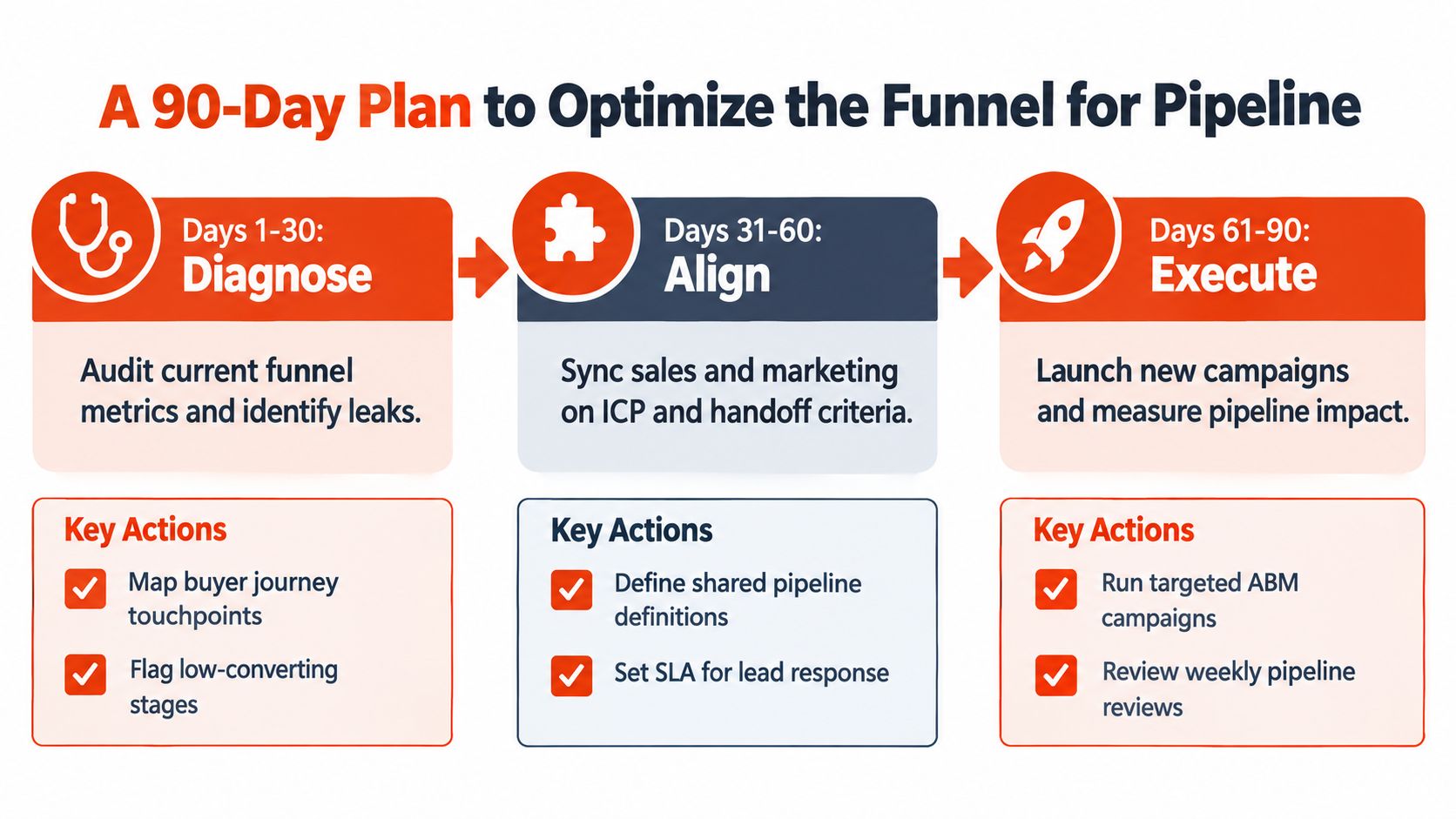
Ninety days is enough to prove whether your funnel creates pipeline. It isn't enough to close every long-cycle deal, and you shouldn't pretend otherwise. Judge the pilot on qualified meetings, activated buying groups, stakeholder coverage, and pipeline created.
The sequence below keeps instrumentation ahead of campaign volume.
Days 1 to 30 Instrument and Tighten Qualification
Audit conversion by transition, source, segment, and activated profile. Define ICP fit, seniority, account relevance, engagement, and timing rules with sales, then rewrite the MQL and SQL definitions in plain language. Add account-level reporting, signal logging, self-reported influence fields, and a pipeline coverage target. Kill any KPI that can't affect a decision in the weekly pipeline review.
Days 31 to 60 Rebuild Plays Around Buying Groups
Map content to the five stages and fill the gaps by role. Activate a small set of partner and executive profiles with problem-led posts, comparison assets, and proof their audiences can forward internally. Tools and services can help here, from CRM workflow tools such as HubSpot or Salesforce to Ploot, which publishes expert-led LinkedIn content, detects buying signals from that audience, and contacts interested prospects to book qualified meetings. Whichever route you choose, outreach triggers only after fit plus intent clears your threshold.
This short video walkthrough is useful for aligning marketing and sales on the handoff before you launch the pilot.
Days 61 to 90 Run the Pilot and Review Weekly
Run targeted plays in a defined account list. Review signal quality, meeting acceptance, stakeholder coverage, and disqualification reasons every week with sales. Fix the tightest bottleneck first, usually MQL to SQL qualification, slow time to contact, or single-threaded accounts. At day 90, report pipeline coverage, qualified meetings, opportunities, and influenced accounts. Scale only the plays that moved those numbers.
The Operating Principles That Make the Funnel Work
Use these principles as a filter for every budget request, campaign idea, and dashboard change. If a proposal violates two or more, send it back.
- Instrument buying jobs: Don't force nonlinear buying into linear stages.
- Measure accounts and contacts: Contact conversion runs operations, account progression predicts revenue.
- Report pipeline coverage: Qualified meetings and opportunities outrank impressions every time.
- Qualify before outreach: Fit without intent is a list, intent without fit is noise.
- Capture invisible influence: Record peer, partner, profile, and AI-driven demand instead of calling it unattributed and moving on.
- Multi-thread early: One engaged contact is interest, a covered buying group is momentum.
A demand generation funnel works when target accounts become qualified pipeline at a predictable rate. Everything else is supporting evidence.
Hold that line and marketing stops defending activity. You start managing a system sales can inspect, finance can model, and leadership can fund with confidence.
If your partners and senior managers already have credibility in the market but that authority isn't turning into qualified meetings, Ploot can help you build their LinkedIn audience, detect buying intent in that audience, and contact interested prospects at the right moment. Start with a focused pilot, agree the pipeline criteria upfront, and judge us on qualified conversations, not impressions.