

Your campaign dashboard shows a full month of new leads. Meanwhile, the sales team's calendar sits half empty. Marketing celebrates the volume, sales replies that none of these contacts are ready to talk, and the next pipeline review turns into an argument about lead quality.
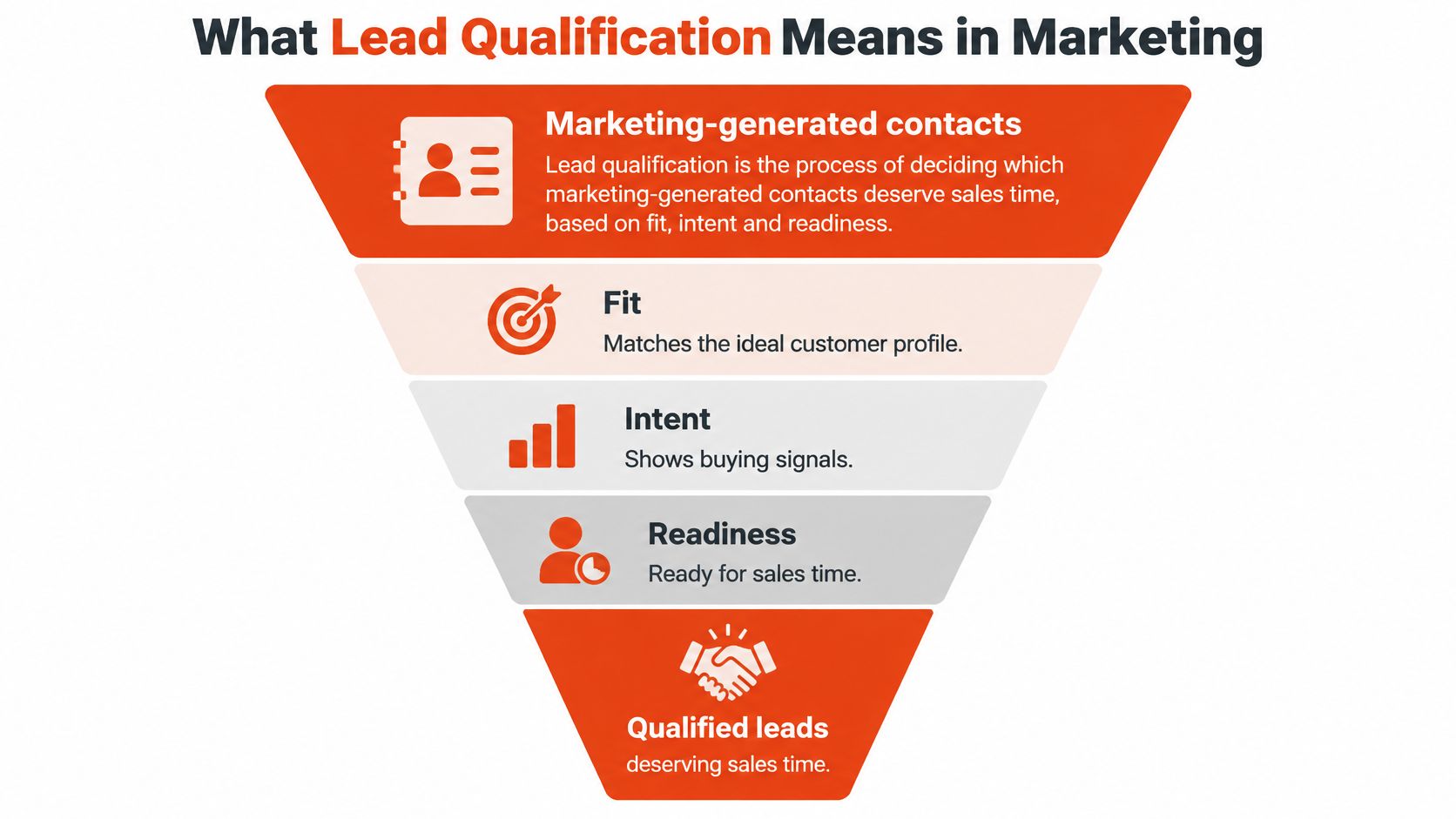
Lead qualification is the process of deciding which marketing-generated contacts deserve sales time, based on fit, intent and readiness. Many B2B teams discover the cause is not their scoring software. Marketing and sales use the same stage names to mean different things.
Effective lead qualification marketing starts with a shared agreement: what counts as evidence, who checks it, and what happens to each contact next.
Table of Contents
- What Lead Qualification Means in Marketing
- Why Response Speed and Lead Readiness Matter
- The Five Criteria That Separate Qualified Leads
- How to Build a Qualification Process Step by Step
- Routing Leads Between Marketing and Sales
- Common Mistakes and How to Avoid Them
- Confirm the Criteria Before Your Next Pipeline Review
What Lead Qualification Means in Marketing
Think of your funnel as a sieve with a checkpoint. Lead generation fills the bucket with potential interest. Qualification decides which contacts pass through to a salesperson and which need more time, more information or no further attention.
A historical MarketingSherpa benchmark summarized by Statistics Fundamentals reported that only 27% of marketing leads were sales-ready when first generated. It's a useful reminder that lead generation and sales readiness are separate stages, not a current conversion target for your business.
Give every stage a practical meaning
These are workable starting definitions, not universal rules.
| Stage | What It Means | Who Decides | Example |
|---|---|---|---|
| Visitor | Anonymous site or profile visit | No one yet | Viewed the pricing page |
| Lead | Contact who gave details or engaged | Marketing | Downloaded a sector report |
| Marketing-qualified lead (MQL) | Fits the target profile and shows interest | Marketing, against agreed criteria | Director at a target firm attended a webinar |
| Sales-qualified lead (SQL) | Sales confirms need, authority, timing and budget | Sales after a conversation | Confirmed a project with a defined decision window |
| Opportunity | Active deal with a defined scope and value | Sales and marketing together | Proposal requested |
A pricing-page visitor might be evaluating suppliers, checking a competitor or researching for a colleague. Without an identity or conversation, you can't confidently choose between those explanations.
A report download creates a contact record. A director at a target company who attends a relevant webinar adds evidence of fit and interest, which may satisfy your MQL definition. Neither action confirms an approved purchase.
The funnel below shows the filters behind that progression.
Separate a prediction from a confirmed deal
An MQL is marketing's assessment. An SQL includes sales validation. An opportunity goes further: the buyer and seller can describe the work being considered and its commercial value.
For an Australian services perspective, Truespeak's 2026 funnel guide for Australian services provides an additional resource for thinking through funnel stages.
Your own definitions still need local agreement. If budget can't be confirmed until technical discovery, record that explicitly rather than letting salespeople apply different rules.
Practical check: Place each active contact in a stage and name the person accountable for moving it forward. If colleagues disagree, fix the definition before adjusting the score.
Why Response Speed and Lead Readiness Matter
Research attributed to Harvard Business Review and InsideSales.com, summarized in Tomba's B2B buyer journey statistics, found that organizations contacting an inbound lead within 5 minutes were up to 9 times more likely to qualify it than those waiting 30 minutes or longer. Treat that benchmark as an operational target, not a guarantee: it reflects observed correlations that can vary by industry, lead source, geography and buying complexity.
For a high-value consulting inquiry, the first useful conversation can matter more than a polished follow-up sequence. A prospect comparing providers may let the most responsive supplier help define the problem, evaluation criteria and next step.
That doesn't mean every content interaction deserves an immediate sales call. Fast response to an explicit inquiry and premature outreach to a casual reader are different behaviors.
Match urgency to what the buyer asked for
Say an operations director requests a discussion about replacing a legacy system. A salesperson should acknowledge the request, understand the business problem and arrange the appropriate conversation without waiting for a campaign report.
Now consider someone downloading an implementation checklist. Delivering the resource promptly is appropriate; assuming they want a discovery call isn't.
Your response process should distinguish those cases before the CRM assigns tasks. Set coverage rules for business hours, out-of-hours inquiries and absent account owners, so a high-intent request doesn't sit in an unattended queue.
Measure useful outcomes alongside speed
Track response time with:
- Accepted leads: Did the receiving salesperson agree that the contact met the handoff criteria?
- Booked meetings: Did the response produce a relevant conversation, rather than just an automated acknowledgment?
- Pipeline value: Did those conversations become opportunities with credible scope and value?
An instant confirmation email proves that an automation ran. It doesn't prove that anyone interpreted the inquiry or helped the buyer.
Audit this month's inbound requests using the submission timestamp and the first meaningful response timestamp. Separate explicit sales inquiries from resource requests, and inspect delays by owner and working-hours coverage.
Then compare your inbound response performance with the operational benchmark. If the delay comes from unclear ownership, buying another scoring tool won't solve it.
The Five Criteria That Separate Qualified Leads
Use the following as an example qualification policy, with action thresholds chosen jointly by marketing and sales. These thresholds illustrate how to make a rule testable; they aren't industry benchmarks.
| Criterion | Question It Answers | Example Signal | Evidence Needed |
|---|---|---|---|
| Fit | Is this a target company and role? | Director at a consultancy in your target sector | Firmographic data matches the ideal customer profile |
| Intent | Is there active interest in the problem? | Opened three service pages within two weeks | Two or more actions on the same topic |
| Timing | Is a decision likely soon? | Mentions a Q3 tender or budget cycle | Dated trigger confirmed by the contact |
| Authority | Can this person buy or influence the purchase? | Partner or budget holder | Title and reporting line confirmed in conversation |
| Need | Is there a problem the firm solves? | Asks how to reduce reliance on events | Need described in the contact's own words |
Fit concerns suitability, not enthusiasm. Marketing checks sector, company size, service requirements and role against the ideal customer profile.
Intent concerns behavior related to a buying problem. Repeated activity around a service is stronger evidence than unrelated engagement, but it still requires interpretation.
Decide what each signal can actually prove
Timing needs a buyer-confirmed trigger, such as a procurement event or renewal. Authority requires understanding the person's role in the decision, not admiring their job title.
Need is clearest when the contact explains the problem themselves. Record their description in the CRM rather than replacing it with a seller's assumption.
A purchase intent scale can help organize the difference between light interest and evaluation. Keep the underlying evidence visible, so a salesperson can understand why a contact received a particular assessment.
For a starter agreement, let fit plus a meaningful intent signal create an MQL. Require sales to confirm authority and timing before SQL status, alongside the agreed need and budget checks.
Apply the rules to a realistic contact
Say a partner at a 120-person IT consultancy opens three service pages and mentions a Q3 tender. In this hypothetical scenario, the company matches your target profile, the activity meets your example intent rule and the tender supplies timing evidence.
Authority is still unconfirmed. The partner may sponsor the project while another executive controls the purchase.
A senior title is a reason to ask about the decision process, not permission to skip the question.
Sales should ask who approves the supplier and how the project will be funded. Set the thresholds together, then review them quarterly against actual qualification outcomes.
How to Build a Qualification Process Step by Step
Build the agreement before configuring automation. A CRM can apply a rule consistently, but it can't resolve a disagreement about whether that rule makes commercial sense.
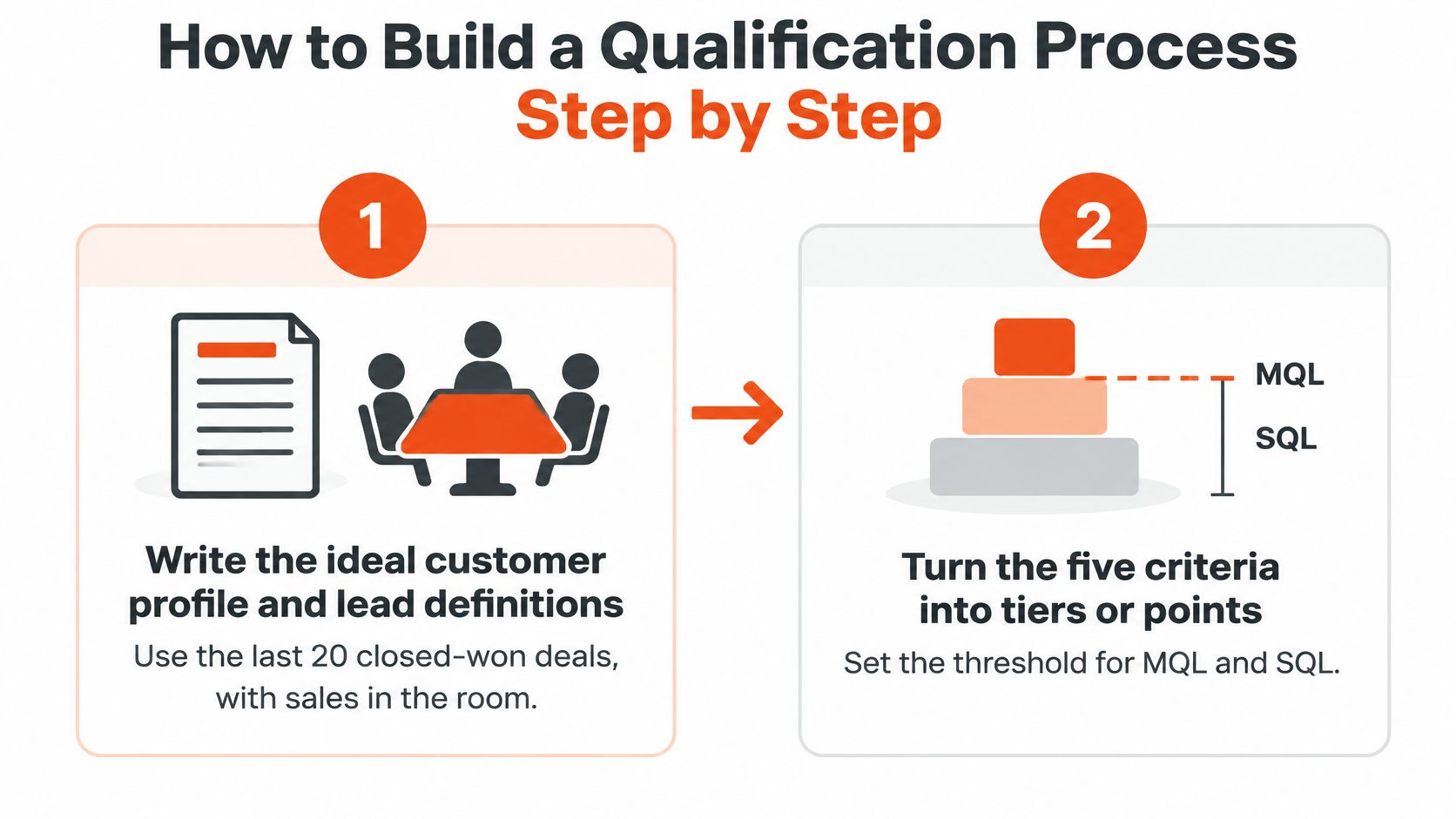
The opening decisions are the ideal customer profile and the qualification thresholds.
Turn judgment into an operating agreement
Write the ideal customer profile with sales present. Use a manageable sample of recent closed-won deals to identify shared business problems, company characteristics and buying roles. The common slip is letting marketing define fit from campaign targeting while sales uses a different definition in discovery.
Translate the criteria into tiers or points. Specify what evidence qualifies a contact for MQL and SQL status, including which fields require a conversation. Don't let accumulated engagement points override a poor-fit company or an explicitly absent need.
Give each handoff a response commitment. Assign an owner, a backup and an expected action for each tier, so the clock refers to meaningful work. A frequent failure is setting a deadline without deciding who covers an unavailable salesperson.
Map every signal to its source. Identify the CRM field, form answer, event record or identifiable LinkedIn interaction that supports the decision. Don't treat inferred information as buyer-confirmed evidence, and record when the information was captured.
Create a rejection loop. Require sales to return rejected leads with a reason such as wrong role, unsuitable company, no budget or no active timing. A free-text complaint without a consistent category leaves marketing unable to identify a correctable pattern.
Review stage conversion monthly. Compare accepted and rejected contacts by source, service line and reason, then inspect the records behind the totals. Changing the threshold without checking examples can hide a routing problem or inconsistent sales follow-up.
For implementation in HubSpot, a lead scoring configuration guide can help translate the agreement into system rules. Keep the written definitions authoritative rather than allowing a workflow's settings to become an undocumented policy.
Connect capture to qualification
Your website should collect information the receiving team will use. Alpha Omega Digital's lead generation playbook is a relevant companion when reviewing how website design supports that capture process.
Avoid adding form questions merely because they're available. Ask what changes the routing decision, and leave complex discovery questions for a conversation.
The finished agreement should fit on a page: criteria, thresholds, owners, response commitments, rejection reasons and a review date. Have the marketing and sales leaders sign it, then store it where both teams work.
A signature isn't the objective. The objective is that either team can explain the same contact's status using the same evidence.
Routing Leads Between Marketing and Sales
Treat these as proposed routing rules, not universal service standards. The inbound target applies to explicit inquiries, while the other timings are example operating choices for your agreement.
| Lead Tier | Typical Signals | Owner | Response Target |
|---|---|---|---|
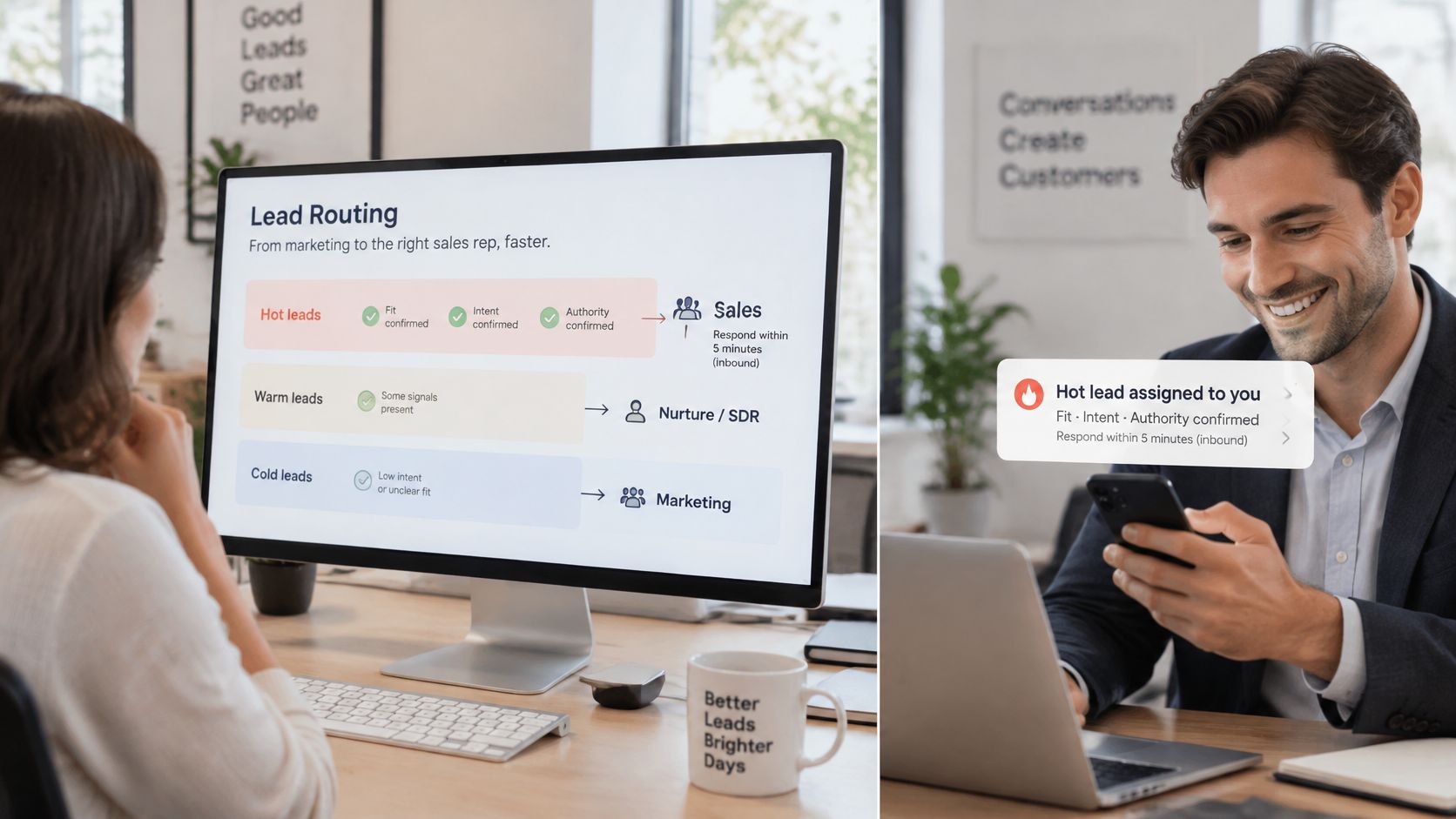
| Hot | Fit, intent and authority confirmed | Sales | Within 5 minutes for inbound inquiries |
| Warm | Fit and intent, authority unclear | Sales development, discovery call | Within two working days |
| Nurture | Fit with low or early intent | Marketing automation with content | Reviewed monthly |
| Discard | Poor fit, or no response after nurture | Not routed | Removed from the active list |
The routing view should show the owner, supporting evidence and next action together.
Make acceptance and return explicit
The receiving team should accept the lead or return it with a reason. Include the source interaction, relevant buyer comments and unresolved questions in the marketing-to-sales handoff, not just the contact's name and score.
A buyer who says the project is postponed belongs in nurture with a review date. Removing someone from active prospecting isn't the same as deleting their history, and silence alone shouldn't be recorded as confirmed poor fit.
WebinOne's explanation of combining CMS and CRM offers useful context for connecting website interactions with customer records. Whatever your setup, check that ownership and status changes survive the transfer.
Use the following video as a prompt for a team discussion about how leads move between systems and people.
Route the account without overstating readiness
Give related contacts at the same company a single coordinating owner. That person can compare roles and topics before colleagues send overlapping messages.
The State of B2B Marketing report recommends account-level measures including pipeline, time to qualification and buying-group activity. Apply that perspective with an account-and-person matrix: record each contact's role, topic, intent evidence and buying stage alongside the account's fit.
As an example escalation rule, send an account to sales-led review when multiple relevant stakeholders show related intent during the same review period. Review is not automatic qualification: a technical evaluator and a procurement contact discussing the same project provide stronger evidence than unrelated content reactions from separate departments.
Common Mistakes and How to Avoid Them
Say a B2B software company labels every content downloader an MQL. Marketing reports a busy funnel, but sales returns most contacts because nobody has checked company fit or whether there's an active project.
The team adds a fit filter, requires corroborating topic-related activity and records a reason for every rejection. In this hypothetical example, marketing would expect fewer handoffs and would test whether sales acceptance improves, rather than declaring success because the scoring model changed.
Correct the rule behind the symptom
- Counting a download as buying intent: Require supporting context, such as a related return visit or a direct question. A resource request may reflect professional interest rather than supplier evaluation.
- Keeping old intent indefinitely: Introduce a decay rule that reduces the weight of activity after an agreed inactive period. Retain the history, but stop presenting old behavior as current urgency.
- Applying identical thresholds across service lines: Separate the rules where buying processes differ. A narrowly scoped software purchase and a consulting transformation shouldn't require identical evidence.
- Scoring contacts without an account view: Check whether related stakeholders support the same buying hypothesis. Don't turn scattered engagement into several apparently independent opportunities.
- Ignoring rejection reasons: Review recurring categories with sales and inspect examples. Otherwise, marketing can't distinguish weak targeting from premature timing or inconsistent qualification.
Admit what you can't observe
The Drum's discussion of unmeasured B2B buying activity highlights the limits of conventional dashboards. Private recommendations, internal discussions and other unseen activity can leave your team with an incomplete picture.
Don't fill those gaps with false certainty. Label inferred intent by confidence, distinguish observation from interpretation and keep a short explanation of the outreach decision in the CRM.
Audit test: Could another colleague understand why this person was contacted, using only the evidence recorded?
For lightly identified engagement, seek permission through a relevant, low-pressure conversation rather than implying knowledge of a hidden project. Leave anonymous activity anonymous unless the buyer identifies themselves through an appropriate interaction.
If sales can't explain a rejection using the agreed criteria, the teams don't yet share a qualification agreement.
Confirm the Criteria Before Your Next Pipeline Review
- Book a working session this week with the marketing lead and sales lead, not just the CRM administrator.
- Bring closed-won and rejected contacts from the latest review period, including rejection reasons where they exist.
- Test the criteria against those records. Check whether fit, intent, timing, authority and need distinguished useful opportunities from premature handoffs.
- Approve the stage thresholds. Specify the evidence marketing can assess and the facts sales must confirm.
- Set routing commitments and rejection codes for each tier, including what happens when a buyer isn't ready.
- Name an owner for every stage and schedule the first monthly review.
Choose signal sources with clear limits
If you lack intent visibility, Ploot is an optional sales system for B2B firms in Spain with long sales cycles. We detect buying intent across the team's LinkedIn audience and deliver qualified leads with context.
We contact low volumes, only reaching people who have already interacted with the client, its company or its sector. Each message comes from a team member's profile with that person's approval.
Sales still needs to confirm authority and timing. Qualified prospects move into qualified meetings, while people who reply “not now” return to campaigns.
Bring your written agreement to a product demonstration and test how the signals support your criteria, rather than accepting a qualified label without examining it.
Ploot turns your team's expertise into demand, detects buying signals and helps move relevant prospects into qualified sales conversations. Visit Ploot to book a demonstration, and bring your qualification criteria so you can assess how the process would support your marketing-to-sales agreement.