

Partner marketing is a structured growth strategy in which two or more non-competing organizations coordinate marketing activities to reach shared audiences and generate measurable business outcomes. The coordination is planned, budgeted and attributed, which is what separates it from a co-branded webinar that nobody follows up on.
Partner-marketing activities accounted for an average of 37% of respondents' overall marketing budgets in 2024, per Foundry's survey on partner marketing investment. That's a strange number for a channel plenty of B2B teams still describe as a side project.
The gap isn't ambition. It's structure. Most firms run partners as a favor economy: an introduction when someone remembers, a reseller agreement signed and forgotten, a webinar with two logos on the slide. Partners sit between a buyer's first search and their final vendor choice, which is exactly where cold outreach gets ignored and paid media gets expensive. Treating that position as a managed demand channel, with named roles, agreed rules and a dashboard, is the whole job.
Table of Contents
- Why B2B Marketers Are Betting on Partner Marketing
- What Is Partner Marketing?
- The Seven Models of Partner Marketing
- What Partner Marketing Looks Like in B2B
- Why Partner Marketing Works
- How to Build a Partner-Led Demand Engine
- Misconceptions That Sink Partner Programs
- Choose Your First Partner Motion
Why B2B Marketers Are Betting on Partner Marketing
The teams that get value from partners run them the way they run paid search: a channel with an owner, a budget line and a weekly review. The teams that don't get value treat partners as a favor economy, where introductions happen when someone remembers and nothing is ever counted.
That gap is what this guide closes. Most B2B firms use the term loosely, as a synonym for referrals or a co-branded webinar, and never build the channel into anything managed.
Meanwhile partners sit precisely where cold outreach struggles and paid media gets expensive. A consultant recommending a platform during a client assessment does more for pipeline than a sponsored post, and costs less.
What follows moves in order: a formal definition, a comparison table of the seven models, three B2B scenarios, the trust evidence behind the channel, a six-step playbook for generating demand through partners, the misconceptions that sink programs, and a 90-day pilot. If you only need the map, read the models table and stop. If you're rebuilding the channel, take the playbook. This is written for marketing directors, demand-generation leads and founders at B2B consulting and software firms with long, high-ticket sales cycles.
What Is Partner Marketing?
Definition: Partner marketing is a structured growth strategy in which two or more non-competing organizations coordinate marketing activities to reach shared audiences and generate measurable business outcomes.
Structured is the load-bearing word. Most explanations of what is partner marketing start with tactics and stop before the boring part: what gets agreed, who approves the message, and how the pipeline gets credited. The structure typically includes:
- Agreed objectives, written down, with one owner on each side and a target that isn't "awareness".
- Joint campaigns and shared content, from co-hosted webinars to co-authored benchmark reports.
- Lead or opportunity handoffs, with a clear rule for who works the account and when.
- A method for attributing pipeline and revenue, which is the part everybody postpones and later regrets.
Think about how a mutual friend vouches for you at a dinner party. You arrive warm, without having pitched anything, and the credibility belongs to the friend, not to you. A partner introduces your firm the same way: borrowed trust, delivered inside an existing professional relationship that paid media can't buy.
Where the borders sit
Partner marketing is broader than networking, because networking is informal and produces nothing measurable. It's broader than a referral scheme, which is one mechanism inside it. It's distinct from affiliate marketing, which is a transactional subset built on tracked conversions, and from sponsorship, which buys attention without shared goals. An implementation firm that shapes a shortlist and never signs a referral agreement is still doing partner marketing in the only sense that matters commercially.
Forrester reporting cited by Digital Commerce 360 on partner ecosystem marketing found that 45% of B2B marketing decision-makers said new or renewed business from ecosystem partners was the primary source of their organization's revenue. That's not a referral program. That's a route to market sitting alongside direct sales, events and outbound.
If you're new to the operational side of these relationships, partner management basics from Affiliate Landscape covers onboarding, tiering and joint planning, the mechanics that sit underneath the marketing.
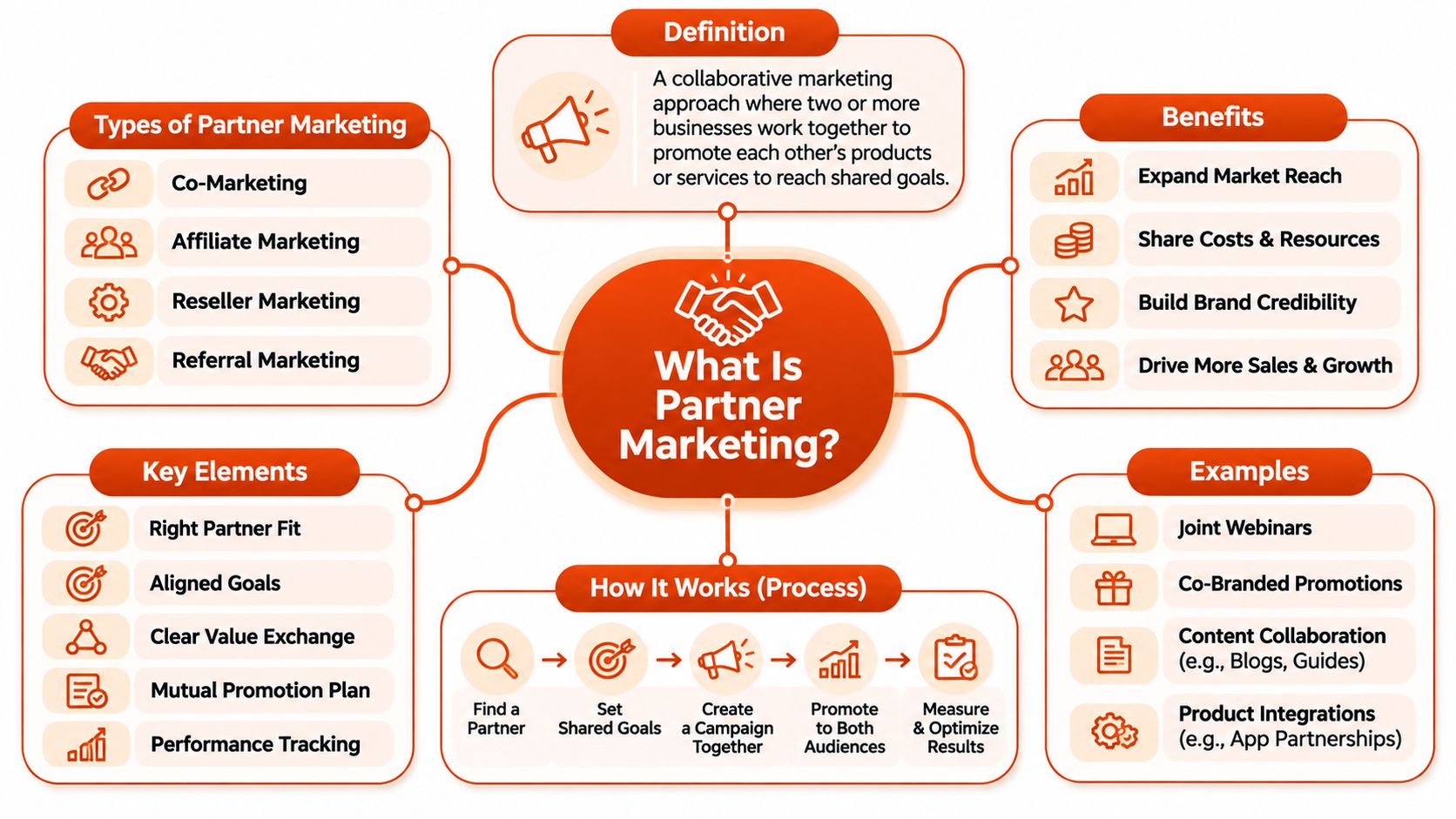
Partners are a route to market, not a side project. Budget, staffing and reporting should follow that sentence.
The Seven Models of Partner Marketing
Most firms run one model well and dabble in two others. The dabbling is where the waste lives, so it pays to know what each model asks of you before committing.
| Model | How it works | Best for | Typical value exchange |
|---|---|---|---|
| Affiliate marketing | Partner promotes your offer through links or content and earns per conversion | Self-serve SaaS, e-commerce | Commission per sale or lead |
| Referral partnership | Partner makes warm introductions to qualified prospects | Consultancies, agencies, high-ticket B2B | Fee per meeting or deal, or reciprocal referrals |
| Reseller and channel marketing | Partner sells your product directly with enablement | Software, hardware, telecoms | Reseller margin or discount |
| Co-marketing alliance | Partners run joint webinars, reports and campaigns | Complementary firms with similar buyers | Shared costs and access to each other's audiences |
| Technology or integration partnership | Products connect and are marketed together | SaaS platforms, IT services firms | Joint value proposition and marketplace reach |
| Influencer and content partnership | Sector experts create or amplify content for your audience | Niche, trust-heavy B2B audiences | Flat fee, revenue share or mutual promotion |
| Strategic ecosystem alliance | Long-term joint go-to-market with bundles and shared planning | Enterprise vendors plus consultancies | Shared pipeline, market entry and co-innovation |
Read each row across: the first column names the model, the second describes the mechanism, the third names the business types it suits, and the fourth shows what each side gives and gets. The mechanism matters more than the label, because it tells you what to measure. Affiliate is measured in conversions; referral in meetings; an integration alliance in sourced pipeline from a marketplace or a shared launch.
The scale is real. Partnerize reported that 54% of surveyed companies generated more than one-fifth of their revenue through performance partnerships, per its analysis of how partner marketing evolved. That's the affiliate end of the table doing serious commercial work, not a marginal experiment.
The selection rule is simple and almost always ignored: match the model to your sales motion and your buyer, not to whatever a competitor runs. If your product needs a demo and a security review, a per-conversion affiliate program will attract traffic that never buys. If you're weighing that model for a self-serve product, compare SaaS affiliate programs before you set a commission rate you'll have to renegotiate later.
For consulting firms, the executive-as-channel motion behaves more like an ambassador arrangement than a reseller deal, and how an ambassador represents a brand explains how senior people carry a firm's name into accounts they don't formally own.
What Partner Marketing Looks Like in B2B
Abstract models get clearer with roles attached. These three patterns cover most of what B2B consulting and software firms run.
An IT consultancy and a software vendor. The consultancy's architects recommend the platform during client assessments and architecture reviews. The vendor co-funds a webinar series aimed at the consultancy's clients. The consultancy wins the implementation work and the vendor receives warm, pre-qualified pipeline that arrives with a technical recommendation attached. Neither side pays a referral fee; the value exchange is access for delivery revenue.
An HR consultancy and a non-competing employment-law firm. They exchange referrals on either side of the same client conversation and co-author an annual benchmark report on compensation or retention. Each reaches the other's client base with credibility it didn't have to manufacture and neither spends a euro on media.
The executive as channel. Senior consultants publish sharp sector insight on LinkedIn, week after week, on a narrow topic they can defend in a room. When people from target accounts engage with those posts, a follow-up conversation references exactly what they read, and the meeting gets booked on borrowed authority rather than on a cold sequence.
Guardrail: only contact people who have already interacted with the firm, its partners or its sector, and never run mass prospecting under a partner's name. That's our own operating rule at Ploot: we contact low volumes and only people who have already interacted with the client, the client's company or its sector. Volume is not the point; a message that references a real interaction is.
In all three patterns, the partner contributes trust and access, not just reach. The reach is a by-product.
Why Partner Marketing Works
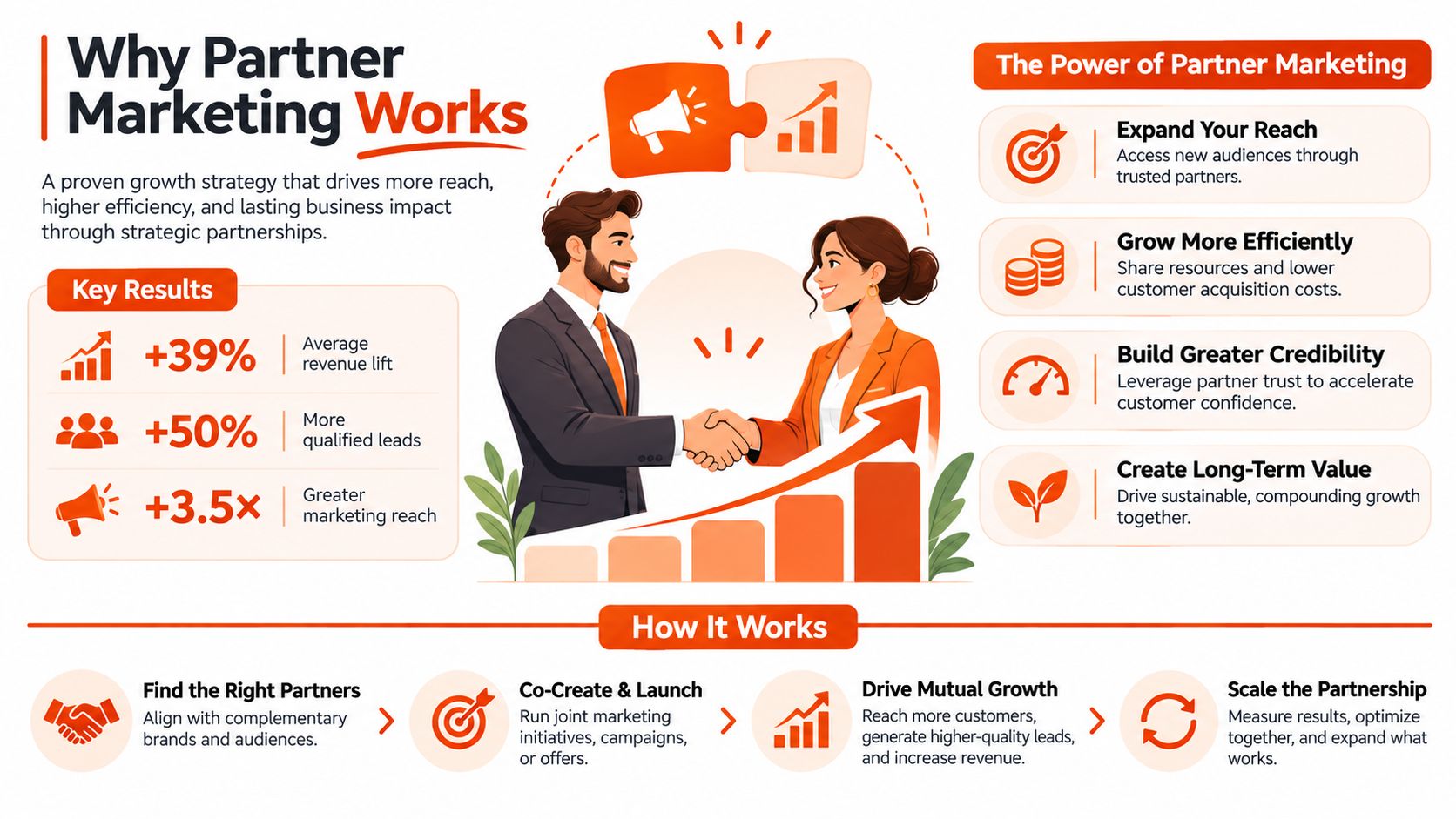
B2B buyers trust information from professional communities (peers, current customers, colleagues, industry sources) more than advertising and most vendor-controlled channels, according to Bain's research on B2B marketing priorities. The same work found more than 50% of surveyed buyers said manager-level colleagues significantly influence technology purchases, rising to as high as 80% for director-level staff below the vice-president level.
Timing explains why partners matter more than their share of voice suggests. Only 19% of B2B buyers start with peer recommendations, but 58% use them at some point while evaluating a potential vendor, and 90% consider peer validation important, according to a 2025 B2B buyer research report published by Mixology. The highest-value moment isn't discovery. It's the risk-reduction middle, when buyers compare suppliers and look for evidence that implementation won't fail.
The mechanism is credibility transfer. A relevant partner lowers perceived vendor risk because the recommendation is embedded in a relationship that predates your campaign. That produces five practical benefits:
- Warm audiences instead of cold impressions. You enter a conversation that already has context, which changes reply rates before you've written a single subject line.
- Lower cost per qualified conversation than pure outbound. Outbound pays for volume and filtering; a partner has already filtered.
- Compounding authority from shared content. Reports, webinars and posts keep working after the launch date, and both brands get credited.
- Market reach without headcount. You borrow distribution instead of hiring for it.
- Better-qualified pipeline. The partner pre-filters for fit, because their reputation is on the line with the introduction.
None of this appears by itself. Partner activity has to be tied to buying intent and measured past the impression, or you end up with a dashboard full of likes and an empty calendar. The right scoreboard tracks qualified conversations and pipeline, not reach, and account-based marketing KPIs is a better template for that than a social media report.
How to Build a Partner-Led Demand Engine
A partner-led engine is a sequence, not a launch. Each step depends on the one before it, and skipping straight to recruiting is why so many programs stall in month two.
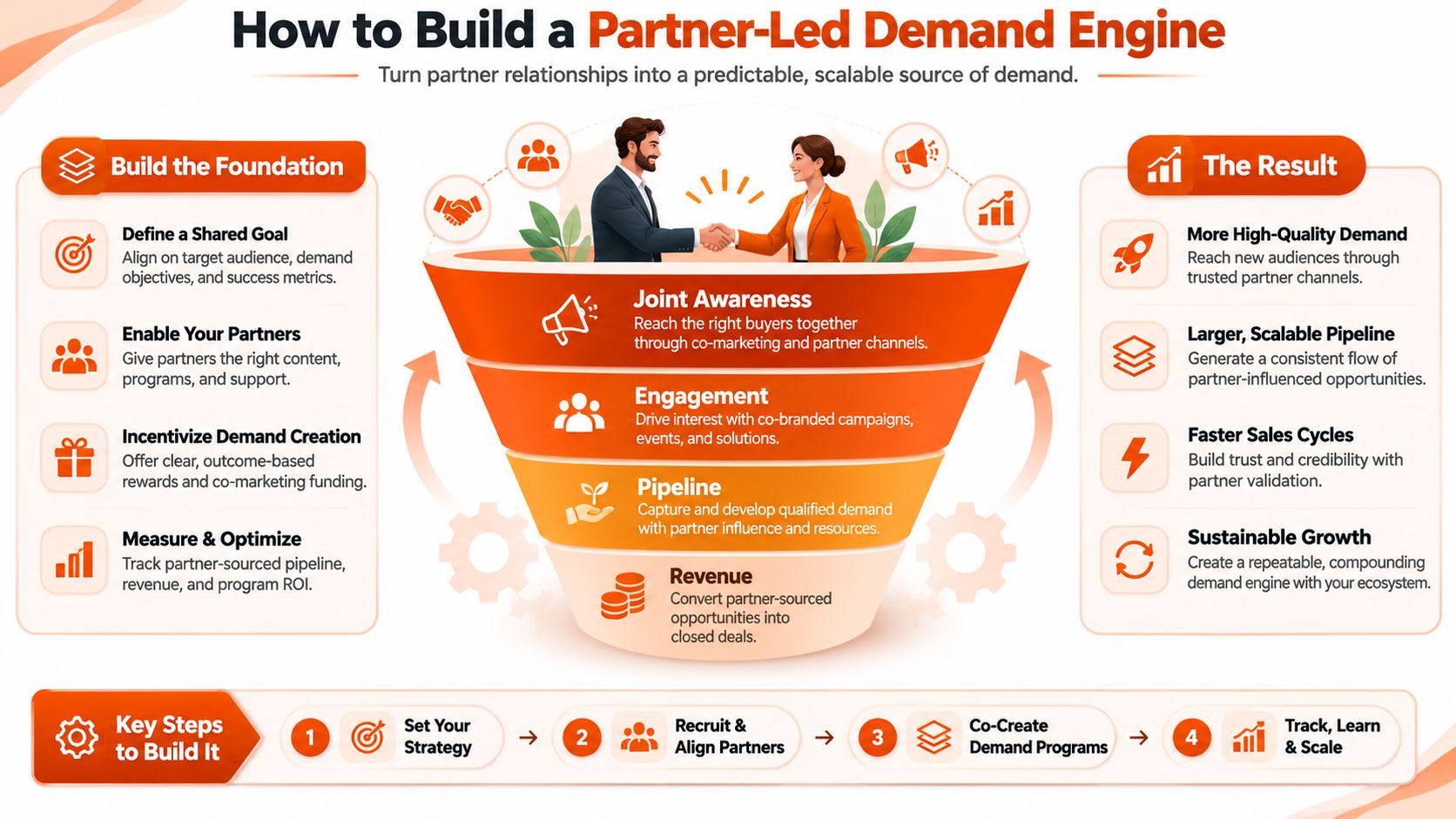
Define the ICP and each partner's job before recruiting. Write down who you sell to, then decide whether this partner sources revenue, builds credibility or opens access. The job sets the metric, and the metric sets what you ask them to do. A partner without a defined job becomes an inbox item within a month, and a program built on request-for-favors dies.
Select on fit, not follower count. Score candidates on audience overlap, seniority, sector authority and evidence of engagement. A consultant with 4,000 followers who posts weekly and gets comments from target accounts beats an account with 60,000 followers and no replies. Overlap with your ICP is the variable that predicts meetings, so weight it hardest.
Agree the value exchange and the rules in writing. Referral fees or reciprocity, who supplies the co-branded assets, who approves any message sent in the partner's name, and how disputes get settled. Ambiguity here is what turns into channel conflict six months later, usually in front of a client.
Run a weekly activation rhythm. Consistency beats intensity. Content goes out at two posts per active profile each week, which keeps authority compounding without swamping the person publishing. Track weekly output per profile, because a profile that stops posting is a partner who has exited the program.
Capture intent and route it fast. Watch which people from target accounts engage with partner or executive content, then send personalized messages from the team member's own profile, with that person's approval, referencing exactly what the prospect read or watched. The reference is the whole advantage; without it you're just another sequence. When the program is working, those signals start reinforcing each other, and recognizing a partner network that is starting to compound helps you tell real momentum from a lucky month.
Measure with rules agreed before launch. Separate partner-sourced revenue, where the partner originates the opportunity, from partner-influenced revenue, where the partner changes account progression or win probability. Set those rules early: a 2026 channel-marketing survey found only 29% of respondents actively measure ABM ROI, while 44% already use or plan to use AI-powered targeting and analytics, per StackAdapt's B2B advertising trends report. Dashboards aren't the bottleneck; agreed crediting rules are. Use holdout groups or pre-and-post comparisons wherever the sample allows.
For a visual walkthrough of how a buying signal becomes a booked meeting, this short video covers the routing step described above.
The metrics that matter form a funnel: qualified reach, engaged target accounts, identified intent, response, meeting, opportunity, revenue. Watch them in this order rather than as a flat list, because a drop between two adjacent stages tells you what to fix. If you're building the wider program this sits inside, demand generation strategy covers how partner activity connects to the rest of the channel mix.
| Metric | What it tells you | Watch out for |
|---|---|---|
| Partner-sourced pipeline | Opportunities the partner originated | Do not book influenced deals as sourced |
| Partner-influenced pipeline | Deals where the partner changed progression or win odds | Needs agreed multi-touch attribution rules |
| Activated partner profiles | How many partners actually produce activity | Activity without meetings is not pipeline |
| Time-to-meeting | Speed from buying signal to booked conversation | Long lags mean weak intent filtering |
| Meetings per partner per quarter | Partner productivity for pilot decisions | Small partners need longer evaluation windows |
| Win rate vs other channels | Quality of partner-generated demand | Compare against deals of similar size |
Misconceptions That Sink Partner Programs
Four beliefs do most of the damage, and each one is cheap to correct before launch rather than after a quarter of arguing about credit.
"Partner marketing means referral and reseller programs." Current ecosystem research describes a broader model with both transactional and nontransactional partners creating value at different stages of the lifecycle, per Forrester's analysis of modern B2B partner programs. Associations, clients, executives and complementary consultancies can influence awareness, evaluation or expansion without ever receiving referral credit. Classify partners by the job they do, which means revenue sourcing, credibility building, access, implementation and customer success, then give each type its own objective and metric. Believe the myth and you'll ignore the partners who shape the shortlist.
"More partners means more growth." The same Forrester analysis reports that nearly half of organizations say their partner program is not profitable by tier, while two-thirds plan to rearchitect or significantly update it within the next year. Adding partners without defined roles buys administrative cost, channel conflict and influence nobody can measure.
"Reach is the KPI." A partner's value is credibility, relevance, timing and access to named accounts. Audience size is the least predictive of the four, and a big audience that never buys is a media buy without the invoice.
"Attribution is automatic." Multi-person buying committees and dark-funnel influence break any model that only counts form fills. Sourced and influenced rules belong in the agreement, not in the post-mortem.
Discipline in partner roles, not partner count, is what makes the channel profitable.
Choose Your First Partner Motion
If sales are high-ticket and trust-dependent, run one motion as a 90-day pilot instead of launching a program. Match it to the business: consultancies start with referral reciprocity plus executive content, software companies start with one integration alliance and a co-marketing webinar series.
Define success criteria before the first post goes live: meetings per activated partner profile, partner-sourced meetings per month, and pipeline influenced, each booked under the sourced and influenced rules you set at launch. Without those three numbers agreed in advance, the day-90 review turns into a debate about anecdotes.
This week, map five candidate partners and score each from one to five on audience overlap, seniority and evidence of engagement. Drop any candidate who scores low on overlap regardless of their follower count, because a famous partner with the wrong audience will produce congratulatory comments and no pipeline.
Practical rule: the time cost of the executive-content motion is smaller than most directors expect, roughly half an hour a week to review and approve material, with the publishing and follow-up handled for you.
Review at day 45 and day 90. Keep the motion that produces qualified meetings, retire the rest, and resist the urge to add a second motion before the first has a win rate. Pick one motion, one partner and one metric, and start the pilot this quarter.
Ploot turns your partners, directors and senior managers into a demand channel: it builds their LinkedIn audience, detects who in that audience is showing buying intent, and reaches those people at the right moment so qualified meetings land on the calendar. If you'd rather see the engine running than read about it, visit Ploot and book a call to see the product in action. You can start with a three-month pilot and agreed success criteria rather than a full program.