

Median pipeline coverage is 3.2x quota, with median MQL-to-SQL conversion at 13%, SQL-to-won conversion at 22%, and marketing-sourced revenue at 36%. Pipeline generation is the process of identifying, qualifying, and advancing potential buyers into structured sales opportunities with a defined value, stage, and expected close date, rather than merely collecting more contacts.
That distinction challenges the most popular advice in B2B marketing. More leads don't automatically create more revenue. A database full of names can still leave sales without credible opportunities, while a smaller set of accounts with verified need, buying authority, and timing can give revenue leaders something they can actually forecast.
The practical question isn't only “what is pipeline generation?” It's which opportunities did we create, how did they progress, and what evidence suggests they'll become revenue? That requires tighter definitions, better signals, and a willingness to stop rewarding activity that never reaches the sales forecast.
Table of Contents
- Redefining Pipeline Generation Beyond Lead Volume
- The Measurement Gap and True Pipeline KPIs
- Stages of a High-Ticket B2B Sales Pipeline
- The Shift to Signal-Based Pipeline Tactics
- Turning LinkedIn Authority Into Qualified Meetings
- Building a Focused Pipeline Generation Engine
Redefining Pipeline Generation Beyond Lead Volume
Many teams still treat lead volume as a proxy for pipeline health. Marketing reports form fills, downloads, registrations, and MQLs, while sales inherits a queue of contacts and is expected to discover which ones might eventually buy. That process creates the appearance of momentum without proving that buyers are moving toward a commercial decision.
Pipeline generation has a stricter standard. It identifies a potential buyer, tests whether the account fits the ideal customer profile, validates a relevant business problem, and advances the opportunity through agreed stages. A real opportunity has a defined value, current stage, and expected close date, not just a person's email address.
The technical distinction is important because lead generation optimizes for contact volume, while pipeline generation optimizes for opportunity quality and conversion probability. ZoomInfo's explanation of pipeline generation makes this distinction explicit by separating the process of advancing potential buyers into structured opportunities from the broader task of acquiring leads.
Why more leads often fail to create more pipeline
A lead can be interested without being ready. Someone may download a report for research, attend an event for education, or interact with a post without having a project, budget, or internal agreement. Treating each action as pipeline forces sales representatives to spend time separating curiosity from commercial intent.
That creates several predictable problems:
- Weak qualification: Reps work accounts that don't match the target market or lack a credible use case.
- Inflated forecasts: Early contacts are presented as opportunities before anyone confirms business impact or timing.
- Poor handoffs: Marketing measures delivery, while sales measures acceptance and progression.
- Misleading attribution: A campaign receives credit for a contact even when another interaction created the buying momentum.
Practical rule: A lead becomes useful to revenue teams only when someone can explain why the account might buy, what must happen next, and who owns that next step.
The answer isn't to abandon lead generation. Lead capture remains an input into the revenue process. The mistake is reporting that input as though it were an opportunity already advancing toward a decision.
What a revenue-quality opportunity contains
A structured opportunity should answer basic commercial questions:
- Fit: Does the company resemble the accounts your solution serves well?
- Problem: Has the buyer identified a business issue your offer can address?
- Stakeholders: Who experiences the problem, influences the decision, and controls approval?
- Value: Can the team define the likely commercial value without guessing?
- Timing: Is there a credible reason for the project to progress now?
- Next step: Has the buyer agreed to a specific action?
Teams that want to improve the top of the funnel can still use practical guidance such as how Pipecorn improves lead generation. The important operating choice is to keep lead acquisition and pipeline creation as separate stages, with separate owners and separate success criteria.
The Measurement Gap and True Pipeline KPIs
The measurement gap appears when teams use one word, pipeline, to describe several different things. Open pipeline is the value of opportunities currently sitting in the CRM. Sourced pipeline is the value of opportunities attributed to a particular team, channel, or program. Pipeline generated should refer to opportunities created within a defined reporting window.
Those measures answer different leadership questions. Open pipeline shows the current inventory. Sourced pipeline shows contribution. Opportunities created during a period show whether the revenue engine is producing new commercial potential. Confusing them makes a stagnant CRM look healthier than it is.
A neutral explanation from COSEOM's pipeline generation guide highlights this distinction between opportunities created in a time window and the snapshot represented by open pipeline. That difference should appear in every marketing and sales dashboard.
Report the points where value is lost
The available B2B demand-generation benchmarks show why lead volume alone is a poor management metric. The reported median is 3.2x quota for pipeline coverage, followed by 13% MQL-to-SQL conversion, 22% SQL-to-won conversion, and 36% marketing-sourced revenue share in 2026 data from Digital Applied's demand-generation analysis.
These figures shouldn't be used as universal targets. They do, however, demonstrate the shape of the problem. A large number of MQLs can shrink sharply by the time sales accepts them, and a smaller group of SQLs can shrink again before a deal is won. Each transition needs an owner, an acceptance rule, and a reason for rejection.
| Metric Category | Lead Generation Focus | Pipeline Generation Focus |
|---|---|---|
| Primary count | Contacts, responses, MQLs | Opportunities created |
| Quality test | Engagement or form completion | Fit, need, authority, timing, and next step |
| Time view | Campaign activity | Opportunities created within a reporting period |
| Value | Estimated audience interest | Defined opportunity value |
| Progression | Handoff to sales | Stage movement toward a commercial decision |
| Leadership question | How much attention did we capture? | What qualified revenue potential did we create? |
The KPIs that deserve executive attention
Marketing directors should report the metrics that connect activity to commercial movement:
- New opportunities created: Count opportunities opened during the period, separated by source, segment, and owner.
- Sourced pipeline value: Show the value attributed to marketing or another originating motion, with the attribution rule stated clearly.
- Stage conversion: Track movement from accepted lead to meeting, meeting to opportunity, opportunity to proposal, and proposal to won.
- Pipeline coverage: Compare qualified pipeline with the relevant quota, without including contacts that lack opportunity status.
- Sourced revenue: Connect closed-won revenue to the original source using a consistent attribution model.
- Pipeline ageing: Flag opportunities that remain in a stage without a buyer-confirmed next action.
Marketing and sales alignment matters because neither team can interpret these measures in isolation. A useful marketing and sales alignment framework should clarify definitions, handoff responsibilities, and how feedback reaches the campaign team.
The CFO doesn't need another activity report. The CFO needs to know which investments create qualified opportunities, how reliably those opportunities convert, and where the process loses value.
Stages of a High-Ticket B2B Sales Pipeline
High-ticket sales pipelines become unreliable when CRM stages describe internal activity rather than buyer progress. “Contacted,” “demo,” and “proposal” are not enough if different representatives use them to mean different things. Each stage needs an exit condition that proves the buyer has taken a meaningful step.
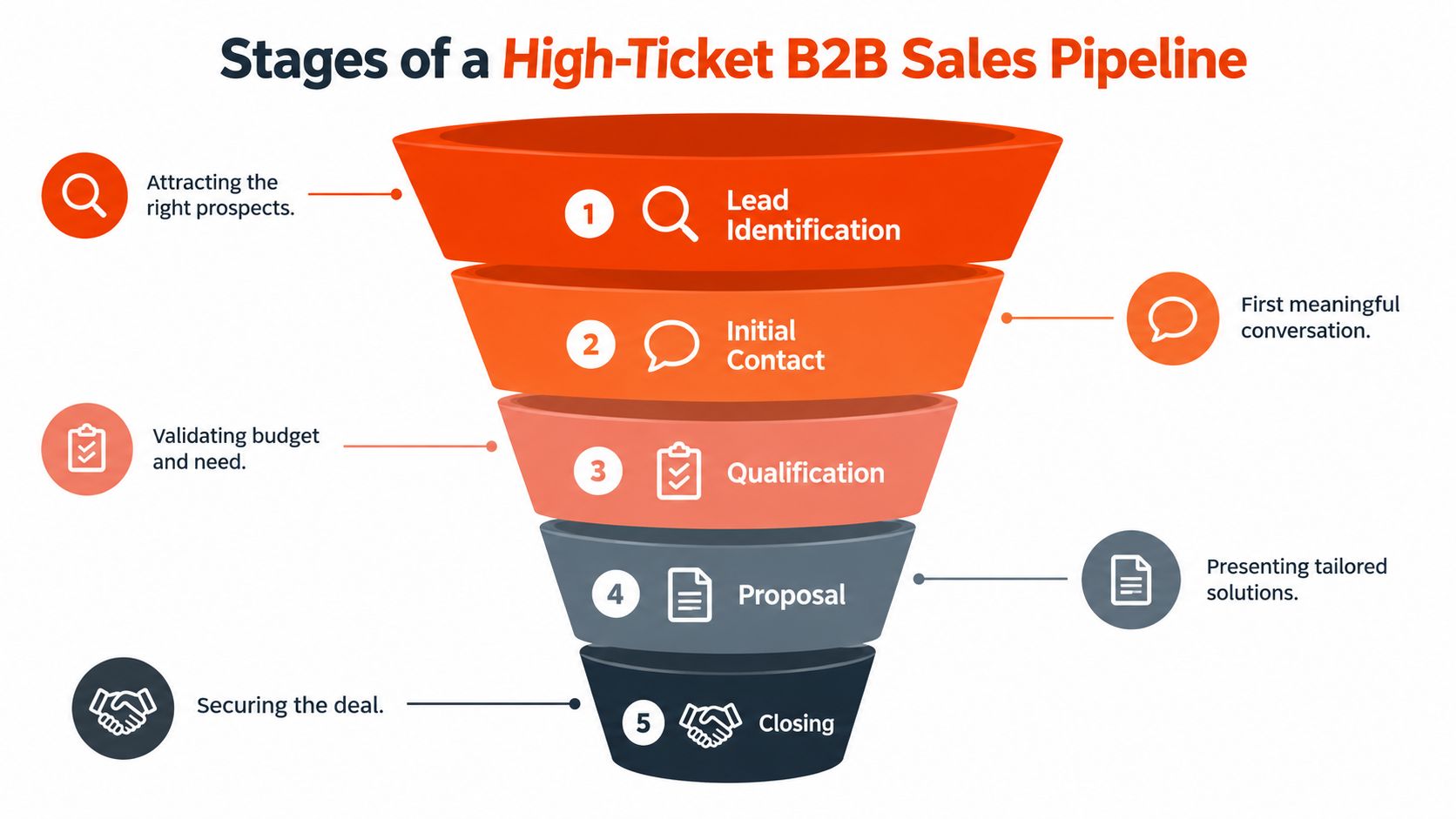
Lead identification
Start with account fit rather than personal activity. The team should identify companies that match the ideal customer profile and then locate the roles likely to experience, influence, or approve the problem being addressed.
A useful signal can come from a pricing-page visit, a relevant hiring pattern, repeated engagement with a topic, a referral, or a direct response to an executive post. None of these proves purchase intent by itself. The account enters an active prospecting list only when the signal combines with business fit.
Initial contact
Initial contact should create a reason for conversation, not merely announce that a salesperson exists. The message should connect a relevant observation to a business problem and offer a low-friction next step.
The exit condition is a meaningful response or conversation. An automated email sent without a reply isn't progress. A social reaction without context isn't a meeting. The record should show what the buyer engaged with and why the representative believes a conversation is warranted.
Qualification
Qualification is where the pipeline earns its credibility. The representative confirms the problem, consequences, stakeholders, decision process, timing, and commercial fit. Budget doesn't always need to be approved at this point, but the team should understand how the buyer would fund the initiative and who can authorize it.
For complex consulting and software deals, qualification also requires mapping the buying committee. A single enthusiastic contact may lack the authority to move the project forward. The opportunity should advance only when the team has evidence of a business need, a plausible path to approval, and a buyer-agreed next step.
Proposal and closing
A proposal should follow discovery, not replace it. The document must reflect the buyer's stated requirements, success criteria, stakeholders, implementation concerns, and decision process. If the team can't explain why the proposed solution fits the account's priorities, the deal isn't ready for proposal.
Negotiation, procurement, legal review, and internal approval need their own visibility. A verbal “looks good” isn't a reliable close signal. The opportunity should move to closed-won only after the commercial agreement is complete, and closed-lost reasons should be recorded specifically enough to improve targeting and qualification.
The funnel below is useful as a visual model, but each company should define its own stage names and exit criteria around how buyers decide.
The Shift to Signal-Based Pipeline Tactics
The old volume model starts with a static list and asks the sales team to create interest from scratch. The signal-based model starts with evidence that an account may already be researching, changing, hiring, comparing, or discussing a problem. That changes the timing and relevance of outreach.
This shift matters because B2B buyers increasingly educate themselves before speaking with sales. A 2026 industry analysis reports that 80% of B2B decision-makers prefer digital engagement and that 89% use generative AI as a top information source across buying phases, according to SalesIntel's pipeline generation trends analysis. These figures point to a practical reality: buyers can form opinions about vendors before a representative knows their names.
Treat signals as evidence, not proof
A signal should change prioritization, not trigger reckless automation. A visit to a solution page may indicate interest, but it could also come from a student, competitor, or existing customer. A relevant job vacancy may suggest a problem, but it doesn't confirm budget or urgency.
Strong signal-based workflows combine several dimensions:
- Account fit: Industry, company profile, geography, use case, and commercial suitability.
- Behavioral intent: Content engagement, return visits, event participation, or interaction with a specific offer.
- Change events: Hiring, leadership changes, expansion, new initiatives, or a visible shift in business priorities.
- Relationship context: Existing connections, previous conversations, referrals, and engagement with trusted executives.
- Timing: Recency and repetition, because an old signal deserves different treatment from a current pattern.
The right response depends on the signal. A prospect who repeatedly engages with a specific problem may receive a useful insight from a subject-matter expert. An account showing stronger commercial intent may justify a direct meeting invitation. A weak signal may only warrant continued education.
Concentrate channels around the account
SEO, events, social media, and paid search can all contribute to demand, but the pipeline team should connect those interactions at the account level. An executive who sees a LinkedIn post, searches for a solution, attends an event, and returns to a product page isn't four unrelated leads. Those interactions form a more useful picture of account interest.
A signal-detection workflow such as Ploot's audience signal detection capability can support this operating model by helping teams identify engaged audiences and decide when outreach is appropriate. The human judgment still matters. Sales should review the context, choose the message, and confirm whether the account belongs in an active pipeline motion.
Signal-based generation doesn't mean abandoning outbound. It means replacing arbitrary outreach schedules with relevant contact at a defensible moment.
Turning LinkedIn Authority Into Qualified Meetings
Personal branding fails when it ends at reach. An executive may publish thoughtful posts, attract comments from senior buyers, and build recognition in a market, yet still create no measurable opportunity because nobody connects audience behavior to a sales process.
The stronger model treats executive LinkedIn activity as a relationship channel. A partner, director, or senior manager publishes from genuine experience, responds to relevant discussions, and builds trust around a specific category problem. Marketing then identifies which engaged people match the target account profile and gives sales a reason to start a conversation.

Start with authority that matches the buyer
A managing partner should not write like an anonymous demand-generation account. A technology director should discuss implementation trade-offs, operating risks, and lessons from delivery. A senior HR consultant should address the organizational consequences of hiring and talent decisions.
The content needs a clear point of view, but it shouldn't become a product catalogue. Good authority content helps a buyer name a problem, understand its implications, or assess an approach. It also gives the audience a natural reason to comment, share an experience, or ask a follow-up question.
A practical publishing system can include:
- Observed problems: Patterns the executive sees across client conversations.
- Decision guidance: Questions buyers should ask before selecting a provider.
- Operational lessons: What tends to work, what creates friction, and why.
- Contrarian analysis: Popular advice that fails under complex buying conditions.
- Useful evidence: Internal experience and clearly sourced external information.
Separate engagement from buying intent
A comment is not a qualified opportunity. A connection is not a sales meeting. Marketing should classify activity by relevance and context rather than passing every interaction to sales.
Suppose a Spanish consulting firm publishes an executive post about modernizing a fragmented technology function. A senior leader from a target account comments with a specific challenge. That person later returns to related content and engages with a post about implementation risk. The first interaction creates awareness. The repeated, problem-specific behavior creates a reason to research the account and consider a personal message.
The message should acknowledge the topic without pretending to know the buyer's plans. It might offer a relevant observation, ask whether the issue is active for the account, or suggest a short conversation with no forced pitch. If the buyer responds with a concrete challenge, the representative can qualify it. If the buyer doesn't respond, the team should continue nurturing rather than escalating pressure.
Authority creates permission to start a conversation. Qualification determines whether that conversation belongs in the pipeline.
Make the handoff measurable
The LinkedIn workflow needs clear ownership:
- Marketing defines the audience: Identify target accounts, roles, themes, and exclusion rules.
- The executive builds trust: Publish and engage consistently in a voice the market recognizes.
- The revenue team reviews signals: Confirm fit, recency, topic relevance, and relationship context.
- A named person contacts the buyer: Use a specific observation and a useful next step.
- The CRM records progression: Track response, meeting acceptance, opportunity creation, and outcome.
Teams looking to operationalize this motion can use guidance on social selling in B2B on LinkedIn. The key is to connect the authority channel to opportunity records without reducing every human interaction to an automated lead score.
Building a Focused Pipeline Generation Engine
Broad activity creates a comforting dashboard. Focus creates a pipeline the sales team can use. A 2025 survey found that marketing contributed nearly 50% of pipeline across most companies, while 70% of marketing-sourced pipeline came from SEO, events, social media, and paid search. The same Insight Partners pipeline generation survey found that half of companies still used 11 to 15 pipeline-generating channels, with minimal additional impact beyond those leading four.
The lesson isn't that every company should use the same channels. It's that teams should identify their productive motions and stop confusing channel count with strategic coverage. More programs create more reporting complexity unless they produce qualified opportunities.
Audit the current engine
Start with a source-level review. For every channel, record contacts, accepted leads, opportunities created, sourced pipeline, closed-won revenue, sales cycle context, and disqualification reasons. Keep the attribution model visible so leadership can distinguish first touch, influenced activity, and direct source.
Then ask four practical questions:
- Does the channel reach the right accounts?
- Does it create conversations with a business problem attached?
- Do opportunities from the channel progress through the stages?
- Can sales explain why the resulting accounts might buy?
If the answer is no, adding budget won't repair the underlying process. The team may have a targeting problem, a qualification problem, a handoff problem, or a message that attracts attention without commercial relevance.
Concentrate around a shared operating model
Marketing and sales should agree on the definition of an opportunity before launching a new campaign. They should also agree on source rules, stage exit criteria, response ownership, and the time period used to measure creation.
A focused engine usually has these operating habits:
- One shared target: Marketing, SDRs, and sales work from the same account and opportunity definitions.
- Signal-based prioritization: Recent, relevant behavior receives attention before generic list membership.
- Executive distribution: Subject-matter experts create trust in channels where target buyers already research.
- Closed-loop reporting: Sales records why opportunities progress, stall, or close.
- Regular reallocation: Budget and effort move toward channels that create qualified pipeline, not just activity.
Run a controlled pilot
A practical pilot should focus on a defined audience, a small number of executive profiles, a clear set of intent signals, and agreed success criteria. Track qualified conversations and opportunities created, not impressions or connection counts. Review the quality of every accepted meeting with sales and refine the audience, content themes, and outreach language as evidence accumulates.
Don't wait for a quarterly review to discover that the pipeline is inflated. Check stage movement, buyer-confirmed next steps, source quality, and disqualification patterns throughout the pilot. That cadence gives marketing directors a defensible story for leadership, grounded in sourced opportunities and revenue progression.
For high-ticket B2B teams, pipeline generation becomes dependable when the system does less indiscriminate outreach and more intelligent prioritization. The objective isn't maximum reach. It's a steady flow of credible opportunities that sales can qualify, forecast, and close.
Ploot turns executive LinkedIn audiences into a measurable pipeline channel by identifying target buyers who show relevant intent and helping teams contact them at the right moment to book qualified meetings. Visit Ploot to explore a focused approach for B2B consulting and software teams that need sourced pipeline rather than more impressions.