

North America alone held 32.85% of global B2B SaaS revenue in 2025, while one market estimate values the worldwide category at USD 390 billion in 2025 and projects USD 1.58 trillion by 2031 according to Mordor Intelligence's B2B SaaS market analysis. That should kill the lazy excuse that growth is hard because demand has disappeared.
Demand exists. The problem is that most companies still treat crecimiento de ingresos like a traffic problem. They ask marketing for more leads, ask SDRs for more activity, and ask sales to “push harder.” Then they wonder why the pipeline gets noisier while bookings stay flat.
That model breaks because revenue in B2B is usually constrained by operations, not awareness. Weak qualification, sloppy pricing, long approval loops, poor expansion motions, and uninstrumented conversion leaks do more damage than a thin top of funnel. If you're selling consulting, software, or high-ticket services, the job isn't generating attention. It's turning buyer intent into pipeline and pipeline into booked revenue with less waste.
Table of Contents
- Why Revenue Growth Has Become an Operating Problem
- The Five Levers That Actually Drive B2B Revenue
- Acquisition Versus Expansion as the Growth Engine
- Pricing Discipline and Conversion Improvements
- How EGC and Partner-Led LinkedIn Build Real Pipeline
- A 90 Day Plan for Putting the Levers Together
- Diagnosing Your Own Revenue Motion in 30 Minutes
Why Revenue Growth Has Become an Operating Problem
54% of companies exceeded revenue growth targets in 2024, while only 14% hit target exactly, and 2025 expectations rose to 1.3 times 2024 growth on average in Bain's summary of the B2B growth divide. That gap matters. Plenty of teams can post a good quarter. Far fewer can produce revenue predictably because their commercial system still runs on channel activity, rep heroics, and discounting.
Revenue growth is now an operating issue.
The old playbook treated growth like a marketing math problem. Add leads, increase SDR output, push more campaigns, hope pipeline follows. That logic breaks in B2B because bookings depend on how well the whole revenue motion works after interest appears. Pipeline creation, stage conversion, pricing control, deal velocity, expansion coverage, and approval discipline decide whether demand becomes revenue or dies in the CRM.
That is why "more leads" is usually a weak diagnosis. If stage two conversion is poor, if reps discount too early, or if account teams ignore expansion until renewal, you do not have a demand problem. You have an operating problem.
Four operating variables usually explain the miss:
- Pipeline conversion: how efficiently qualified opportunities move from first meeting to closed won
- Expansion execution: whether account teams run account plans and create revenue after the initial sale
- Pricing discipline: whether margin and average contract value are protected instead of traded away
- Demand source quality: whether your channels create real buying conversations, not just form fills
If you want a practical systems view, Captiwate's explanation of what is a revenue acceleration platform is useful because it treats revenue as coordinated execution across the funnel, not a stack of disconnected campaigns.
The companies that grow faster operate differently. They measure pipeline by source, conversion by stage, and discounts by rep and segment. They do not treat LinkedIn, partner referrals, outbound, and paid demand as "brand" versus "performance." They ask a simpler question. Which channels create qualified pipeline and booked revenue at an acceptable payback?
That is the shift many B2B teams still resist.
Employee-led LinkedIn and employee-generated content matter here, but not for the reason growth content usually gives. The point is not reach. The point is creating identifiable opportunities, warmer first calls, and lower-cost pipeline from people buyers already trust. Demand generation still matters. It just needs to be judged like an operating input to pipeline, not a creative exercise.
| Operating signal | What it usually means |
|---|---|
| Pipeline grows but bookings stay flat | Conversion, qualification, or pricing discipline is weak |
| New logo growth stalls while renewals hold | Acquisition motion needs work, but expansion is carrying the number |
| High activity with low win rates | Sales effort is compensating for poor fit or poor deal execution |
| Heavy discounting late in quarter | Forecast pressure is driving bad pricing behavior |
Practical rule: If your first response to a revenue miss is "we need more leads," you are probably measuring activity instead of diagnosing the constraint.
The teams that win treat crecimiento de ingresos as a pipeline and bookings system. They know which lever is underperforming, who owns it, and what operational change fixes it.
The Five Levers That Actually Drive B2B Revenue
In B2B, revenue moves on five operating levers. The table below shows what each lever changes, who owns it, and how quickly it should pay back. If your team cannot point to one of these levers and name the metric it is trying to improve this quarter, you do not have a growth plan. You have busy teams.
For SaaS teams that want a clearer model for tying demand generation to pipeline and bookings, this guide to a revenue marketing system for SaaS is useful because it treats marketing as a commercial input, not an MQL factory.
| Lever | Primary Metric | Owns It | Time to Impact |
|---|---|---|---|
| New customer acquisition | New ARR | CRO | Medium |
| Account expansion | Net revenue retention | CSO or account leadership | Slowest, but most durable |
| Pricing and packaging | Average contract value | CFO and RevOps | Fast |
| Conversion rate optimization | Win rate | CMO and sales leadership | Fast to medium |
| Commercial efficiency | Sales cycle length | COO and RevOps | Medium |
Start with the levers that can change deals already in motion. That usually means pricing, conversion, and commercial efficiency. Acquisition and expansion matter, but they rely on longer-cycle changes in channel mix, customer adoption, account coverage, and delivery quality.
You can use this related framework on palanca de crecimiento if you want a tighter view of how one lever becomes the operating priority.
What each lever really controls
New customer acquisition creates net-new pipeline and booked revenue from accounts you do not serve yet. Treat it as a channel economics problem. Which sources produce qualified opportunities, acceptable win rates, and sane payback? Employee-led LinkedIn, partner referrals, outbound, and paid demand all belong in the same pipeline review. If a channel gets attention but does not produce opportunities or shorten trust-building, it is not helping revenue.
Account expansion increases revenue from the base you already have. Cross-sell, upsell, seat growth, usage growth, and multi-region rollout sit here. Teams usually underperform on expansion because ownership is fuzzy and account plans are weak, not because customers need more nurturing content.
Pricing and packaging determines how much value you keep. This lever gets neglected because discounting hides bad habits for a quarter or two. Then margin slips, reps learn to negotiate against themselves, and the forecast gets harder to trust.
Conversion rate optimization in B2B is a pipeline-to-bookings discipline. It includes qualification criteria, discovery depth, stakeholder mapping, proposal design, mutual action plans, and procurement handling. If pipeline grows while bookings do not, this is one of the first places to look.
Commercial efficiency controls how much effort it takes to turn pipeline into revenue. Long approval chains, messy handoffs, bloated stages, and late-stage discount approvals drag cycle time and distort forecasting. Revenue can still show up for a while. It just costs too much and becomes less predictable.
Audit the levers by where deals stall, where margin slips, and where booked revenue breaks from pipeline. That is how you find the operating constraint.
Acquisition Versus Expansion as the Growth Engine
Overinvestment in acquisition happens because it's visible. New logos feel like momentum. Expansion feels operational, so it gets pushed to customer success and forgotten.
That works early. It stops working once the cost of winning each new account rises and the existing customer base gets large enough to matter. Then expansion stops being a nice-to-have and becomes the cleaner source of growth.
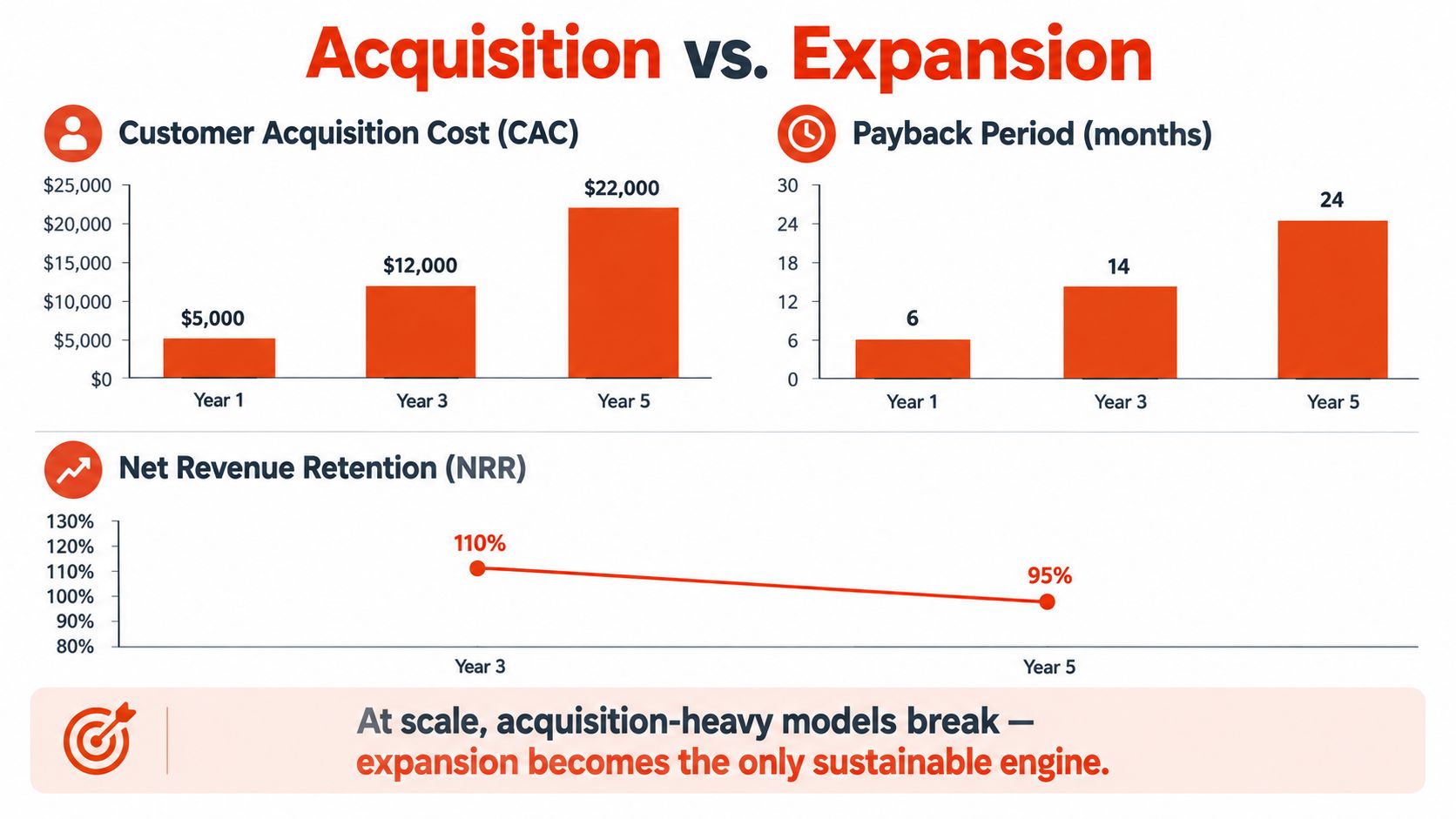
Expansion compounds. Acquisition resets.
Acquisition asks your team to start from zero every time. New account, new trust curve, new buying group, new legal review, new implementation risk. Expansion starts with a customer who already knows whether you deliver.
That changes the economics. A healthy expansion motion adds revenue without recreating the full cost of a net-new sale. It also creates better forecasting because account growth is usually easier to model than a cold pipeline.
When the model starts to break
You don't need a spreadsheet marathon to diagnose this. Ask a few blunt questions:
- Is CAC directionally rising while account growth is flat?
- Are customer-facing teams focused on renewal defense instead of expansion planning?
- Do sellers treat cross-sell as opportunistic instead of scheduled?
- Does leadership celebrate new logos while ignoring revenue concentration inside the installed base?
If the answer is yes to most of those, acquisition is carrying too much of the load.
Expansion is usually less glamorous than acquisition. It's also where mature B2B companies protect efficiency.
There's another reason this matters. The consulting market and broader business services market are still growing. A recent industry summary says global management consulting revenue grew by 8.1% in 2023 versus 2022, another report in the same summary says consultancies globally increased revenue by 9% in that period, the U.S. consulting industry reached USD 406 billion in 2023, and Europe's consulting market grew 6.2% to EUR 130 billion in 2023 according to Worldmetrics' management consulting industry summary. In a market that broad, firms that can't expand accounts are leaving obvious revenue on the table.
The practical takeaway is simple. Early-stage firms can still lean heavily on acquisition because they need references and market proof. Once your base is meaningful, growth quality starts to matter more than logo count.
Pricing Discipline and Conversion Improvements
If I had to fix one thing first in a stalled B2B revenue motion, I'd start with pricing discipline. Not because pricing is fashionable. Because it affects every live opportunity without needing more headcount, more spend, or more leads.
Most firms underprice in subtle ways. They package by internal logic, discount to rescue weak discovery, and approve commercial exceptions with no memory. Then they try to make up the gap with volume.
Start with value, not feature inventory
Rebuild offers around the cost of the problem you solve, not around the list of things you include. A buyer doesn't care that one tier has more workshops or extra seats unless those things map to an economic outcome they recognize.
A useful way to pressure-test that logic is this guide on prueba de valor, which gets at the commercial proof buyers need before they accept a higher price point.
Put structure around discounting
The second move is a deal desk. Not a bureaucratic obstacle. A disciplined checkpoint.
Every non-standard deal should record three things:
- Why the discount exists: Competitive pressure, procurement mandate, budget timing, or scope trade-off.
- What the rep is protecting: ARR, margin, payback, expansion potential, or strategic logo value.
- What pattern repeats: If the same objection keeps showing up, pricing isn't the only issue. Positioning may be weak too.
| Move | Diagnostic Question It Answers | Primary Owner | Typical Time-to-Impact |
|---|---|---|---|
| Value-based pricing | Are we charging for outcomes or for deliverables? | RevOps with finance and sales leadership | Fast |
| Deal-desk discipline | Do we know why margin is leaking in active deals? | Finance and RevOps | Fast |
| Win-rate instrumentation | Can we see where qualified deals stall each week? | Sales leadership | Medium |
Instrument the funnel weekly
The third move is boring and critical. Track stage-to-stage conversion with a question attached to each stage. Not just “did it advance?” Ask what had to be true for it to advance.
Examples:
- Discovery to solution fit: Did the buyer describe the business problem in commercial terms?
- Proposal to validation: Did the account confirm decision criteria?
- Validation to close: Did someone inside the buyer org own the cost of inaction?
Pricing fixes compound across the whole book. Conversion fixes help, but they eventually plateau if your commercial model still invites unnecessary discounting.
Teams love to debate messaging. Fine. But if your pricing is soft and your approvals are random, better messaging only helps you lose money faster.
How EGC and Partner-Led LinkedIn Build Real Pipeline
Corporate content has a credibility problem in long B2B sales cycles. It says the right things, but it rarely changes the shortlist. Buyers trust people closer to the work.
That's why employee-generated content, used narrowly and properly, matters. I don't mean generic thought leadership posts about “the future of X.” I mean posts from partners, directors, and senior operators who talk about real client problems, real operating decisions, and real points of view from the field.
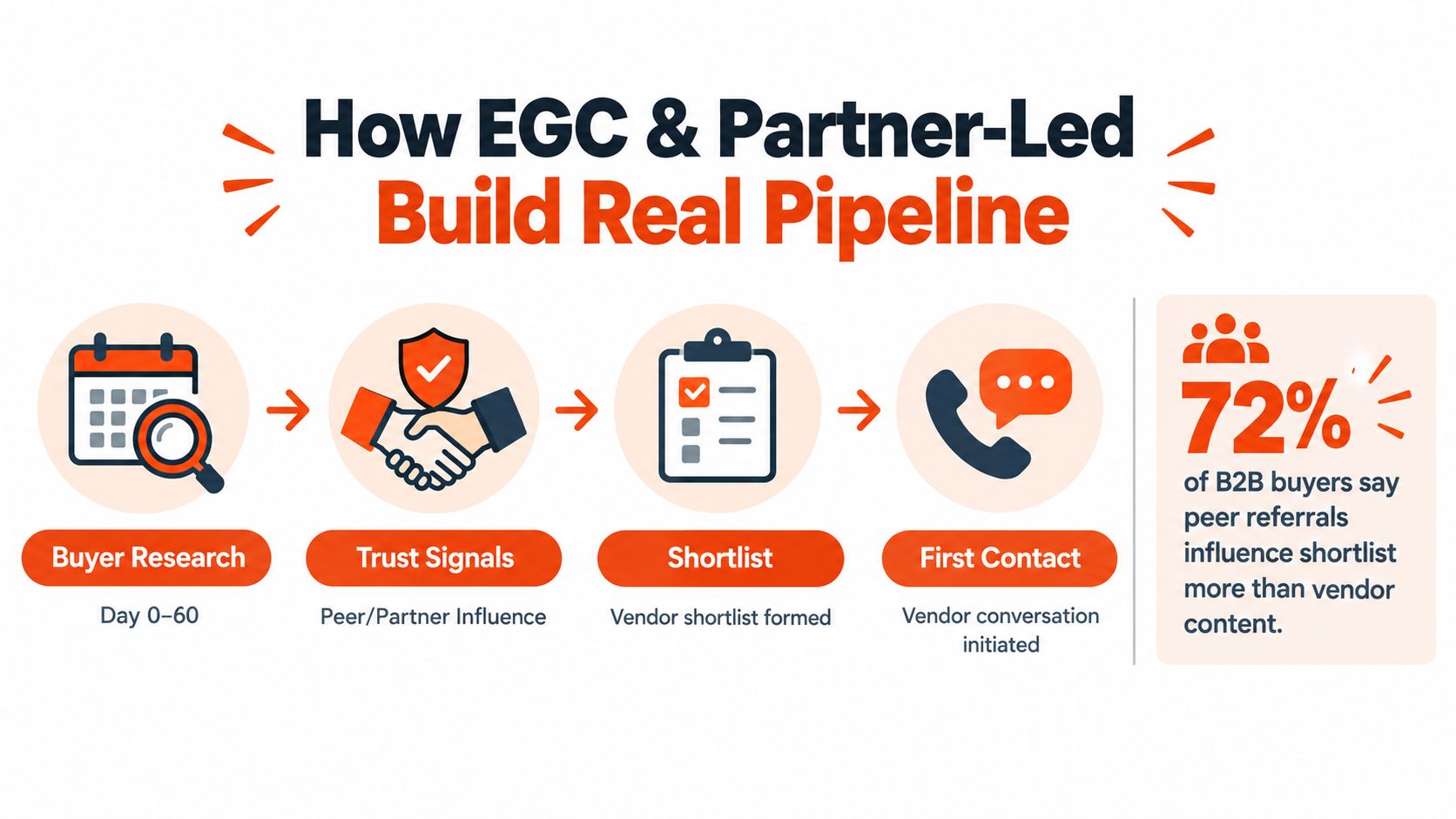
Trust beats polish
In consultative sales, buyers usually form an opinion before sales gets invited in. They notice who explains the problem clearly. They notice which firm's people show pattern recognition. They notice who gets referenced by peers and partners.
That makes LinkedIn useful, but only if you run it as a pipeline channel instead of a brand theatre stage. If you want a practical view of that model, this piece on employee-generated content captures the distinction well.
The operating loop that works
The channel works when you keep it narrow and measurable.
- Pick revenue-adjacent employees: Start with the people closest to commercial conversations. Partners, practice leads, senior consultants, and client-facing directors.
- Tie content to active market reality: Weekly posts should come from live engagements, recurring buyer objections, implementation lessons, or category shifts your team is seeing.
- Activate adjacent partners: Bring in a small set of partner firms or ecosystem players that speak to the same buyer. Their amplification matters because trust often moves laterally before it moves directly.
- Measure replies and meetings: Impressions are context, not the scoreboard. Track qualified conversations, reply quality, and meeting creation.
Why this beats form-first demand in complex sales
Top-performing revenue marketing teams reportedly get more than 50% of pipeline from marketing, while many firms remain stuck in lead-generation stages. The same benchmark says aligned B2B organizations grow revenue 19% faster than misaligned peers according to The Pedowitz Group's revenue marketing index. That's the right frame for EGC. Not as “social content,” but as a pipeline input inside a marketing and sales system.
One option in this category is Ploot, which helps B2B teams build LinkedIn audiences through senior employee profiles, detect buying intent in those audiences, and reach out when interest appears. That's materially different from personal branding software because the commercial goal is meetings, not reach.
Buyers don't need another branded carousel. They need evidence that your people understand the problem before the first call happens.
A 90 Day Plan for Putting the Levers Together
A quarter disappears fast. If your pipeline is soft, win rates are flat, and reps are discounting to save deals, 90 days is enough time to expose the constraint and fix part of it. It is not enough time to run a dozen disconnected growth experiments.
Take a mid-size B2B consultancy with steady inbound traffic and stalled bookings. Interest exists. Meetings exist. Revenue slips because stage conversion is weak, pricing varies by rep, and existing accounts are treated like delivery work instead of expansion opportunities. That is an operating problem.
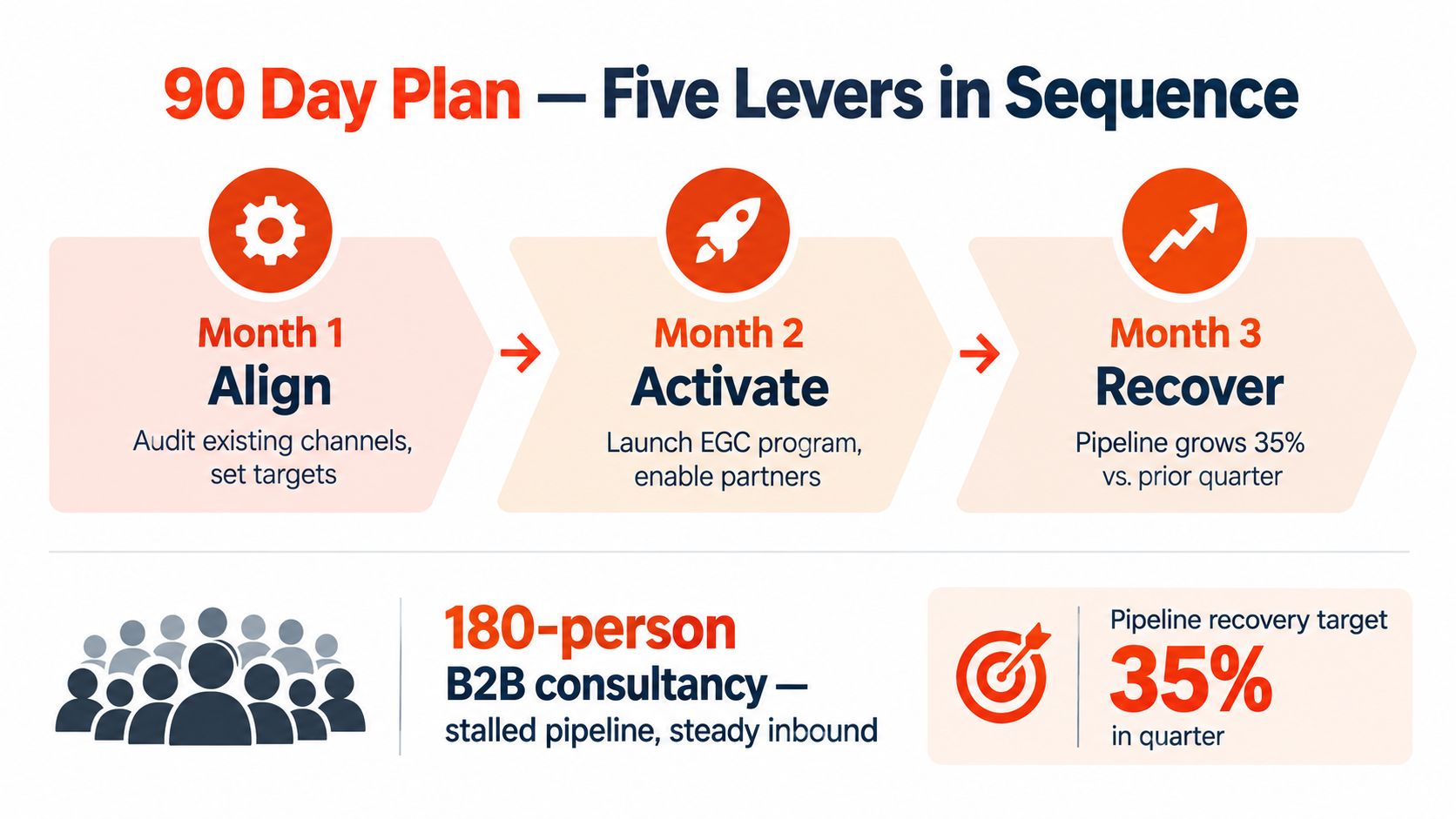
Days 1 to 30
Build the scoreboard first.
RevOps should publish a stage conversion dashboard with three things: stage-to-stage conversion, average days in stage, and a written exit criterion for each stage tied to buyer behavior. If a deal can move to proposal without a confirmed problem, budget path, and decision process, the CRM is lying to you.
In the same 30 days, finance and sales leadership should review every discounted deal from the last two quarters and tag each one by reason code: procurement pressure, unclear scope, competitive pressure, or rep discretion. That gives you the first useful pricing artifact of the quarter: a discount baseline by segment and reason.
Marketing has a narrower job. Pick ten employees who are already in real buyer conversations and give them a weekly post calendar tied to live objections, implementation lessons, and category shifts. The deliverable is not “more content.” It is a tracked list of posts, replies, and meetings created from those conversations.
Days 31 to 60
Change operating rules.
Launch a deal-desk approval template for any non-standard pricing, custom scope, or discount above your threshold. Keep it simple: requested price, standard price, reason code, commercial risk, approver, and expected contract value. If reps cannot explain why a concession is needed, the concession should not happen.
Repackage offers around outcomes buyers purchase. If proposals keep stalling because scope is fuzzy, your packaging is hurting conversion. Fix that with named service tiers, clear inclusions, and a standard commercial narrative sales can repeat without improvising.
This is also the point where employee-led LinkedIn and partner amplification need a real target. Require four partner-amplified EGC posts in this window and track whether they create qualified conversations. The metric is meetings booked, not reach.
Days 61 to 90
Now push on the levers that proved they can move.
Sales should use the new package structure and pricing controls on every active deal, then review weekly whether proposal-to-close conversion improves. Account teams should build expansion plans for the top existing accounts by current revenue, whitespace, and likelihood to buy in the next two quarters. Each plan needs one named expansion hypothesis, one stakeholder map, and one next commercial action.
By day 90, you want three visible outputs: a stage conversion dashboard the whole revenue team trusts, a deal-desk record that shows where margin gets lost, and a small EGC and partner motion that has produced at least six qualified meetings or shown clearly that the message is wrong.
That is what a useful quarter looks like. Better instrumentation. Better pricing control. Better pipeline creation from people buyers already trust. Growth usually improves after those changes, not before.
Diagnosing Your Own Revenue Motion in 30 Minutes
You don't need another strategy workshop to figure out where crecimiento de ingresos is getting blocked. You need a short audit and brutal honesty.
Run this as a working session with marketing, sales, RevOps, and whoever owns customer expansion. If people disagree on the answers, that's already a diagnosis.
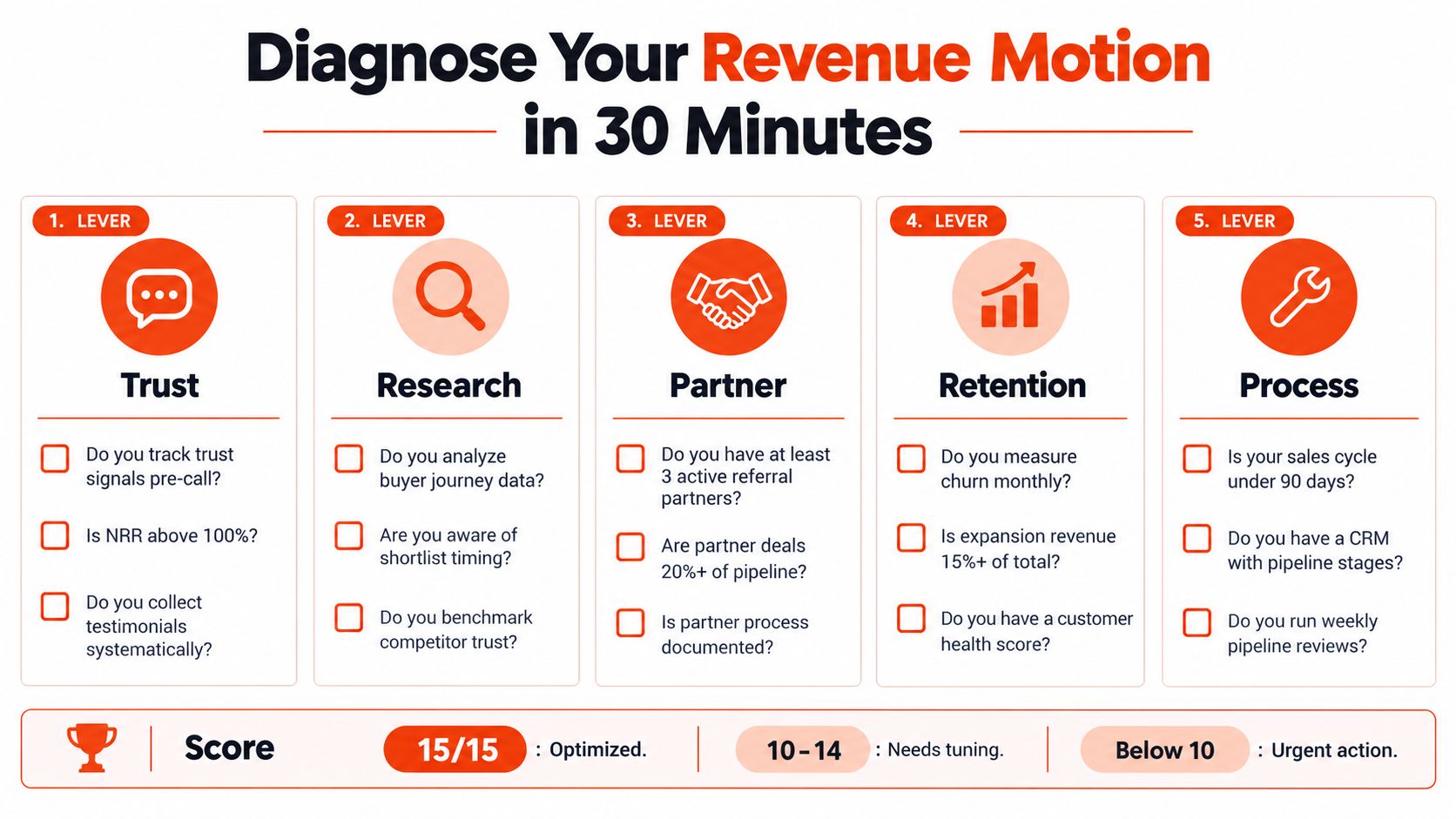
The five-lever checklist
Acquisition
- Do we know which channels create qualified pipeline, not just inquiries?
- Can sales name the top reasons sourced meetings fail to progress?
- Is demand generation optimized for booked conversations or form fills?
Expansion
- Does every major account have an explicit growth plan?
- Do account teams review whitespace before renewal risk?
- Is expansion owned by someone with a quota or a clear commercial target?
Pricing and packaging
- Are discounts logged with a reason code and approver?
- Can we explain price differences by value delivered, not by rep preference?
- Do we revisit packaging when deals repeatedly stall on scope confusion?
Conversion
- Can we see stage-to-stage movement weekly?
- Does every stage have an exit criterion tied to buyer behavior?
- Do we know where good opportunities most often die?
Commercial efficiency
- Are approvals slowing deals down unnecessarily?
- Do handoffs between marketing, sales, and delivery create friction?
- Is forecasting built from stage evidence instead of rep optimism?
How to score the result
Score each question yes or no. The red zones are obvious.
- Mostly red in acquisition: Your demand quality is weak.
- Mostly red in expansion: You're overdependent on net-new deals.
- Mostly red in pricing: Margin is leaking before revenue lands.
- Mostly red in conversion: Sales execution and qualification need surgery.
- Mostly red in efficiency: Process drag is suppressing bookings.
If forecasting is part of the problem, this guide on how to forecast revenue with confidence is a good companion because it forces the discussion back to evidence and operating assumptions.
Don't fix more than one or two red levers at a time. Teams that try to overhaul the full revenue motion in one quarter usually end up with new dashboards, more meetings, and the same number.
Ploot helps B2B companies turn senior employee LinkedIn presence into a pipeline channel by building the right audience, detecting buying intent, and converting that attention into qualified meetings. If your crecimiento de ingresos is stuck because corporate marketing creates reach but not conversations, visit Ploot and look at the model through a pipeline lens instead of a content lens.