63% of consultants say referrals and networking are their most powerful marketing channel, while 70% report zero website leads in a typical month, according to a 2025 practitioner survey cited in industry guidance on consultant lead generation. That isn't a reason to abandon referrals. It's a warning that many consulting firms have built pipeline around relationships they can't consistently scale.
The better question isn't, “How do we generate more consulting leads?” It's, “How do we identify credible prospects, reach them while they're researching, and turn authority into qualified meetings?” For a high-value consulting firm, one well-timed conversation can matter more than a dashboard full of unqualified form fills.
Table of Contents
- Why More Leads Is the Wrong Goal for Consulting Firms
- How Consulting Buyers Research Before They Ever Talk to You
- The Referral Reality and Its Hidden Ceiling
- Building Authority-Led Channels That Outperform Cold Outreach
- Detecting and Qualifying Buying Intent the Right Way
- Nurturing High-Value Leads Into Booked Meetings
- Measuring Pipeline Instead of Impressions
- Your 90-Day Plan for Consulting Lead Generation
Why More Leads Is the Wrong Goal for Consulting Firms
A lead count is easy to report and easy to misunderstand. It tells you that someone submitted a form, downloaded an asset, attended an event, or replied to an email. It doesn't tell you whether that person has a relevant problem, access to budget, influence over the decision, or a reason to speak with your firm now.
Consulting firms usually don't sell an interchangeable product. They sell judgment, specialist expertise, and confidence in an outcome. A generic lead-generation offer attracts curiosity, not necessarily commercial intent. If your team celebrates every contact equally, senior consultants waste time filtering people who were never plausible buyers.
The consulting lead generation research from Thinkable Group points to the underlying constraint. More than 70% of consultants generate eight or fewer calls per month, while many firms still rely on referrals and networking for distribution. That means the practical problem is often not an enormous pool of missed demand. It's the failure to convert limited attention into the right conversations.
Practical rule: Measure the next commercial step, not the first digital action.
What a useful system actually does
A serious consulting lead generation system has four jobs:
- Build authority: Make partners, directors, and senior managers visible to the people they want to advise.
- Capture intent: Detect meaningful research behavior instead of treating every visitor as equally valuable.
- Qualify fit: Combine account relevance, business problem, timing, and buying-group context.
- Create a credible invitation: Give the prospect a reason to book a conversation that follows naturally from their research.
This changes the operating target from lead volume to qualified pipeline contribution. Content should create recognition. Authority should create trust. Intent data should help your team choose the moment. Sales should then make a relevant, human approach.
Broad traffic still has a role, but it isn't the finish line. A consulting firm should be willing to accept fewer leads if those leads are closer to a real business conversation, easier for a partner to qualify, and more likely to become opportunities that sales accepts.
How Consulting Buyers Research Before They Ever Talk to You
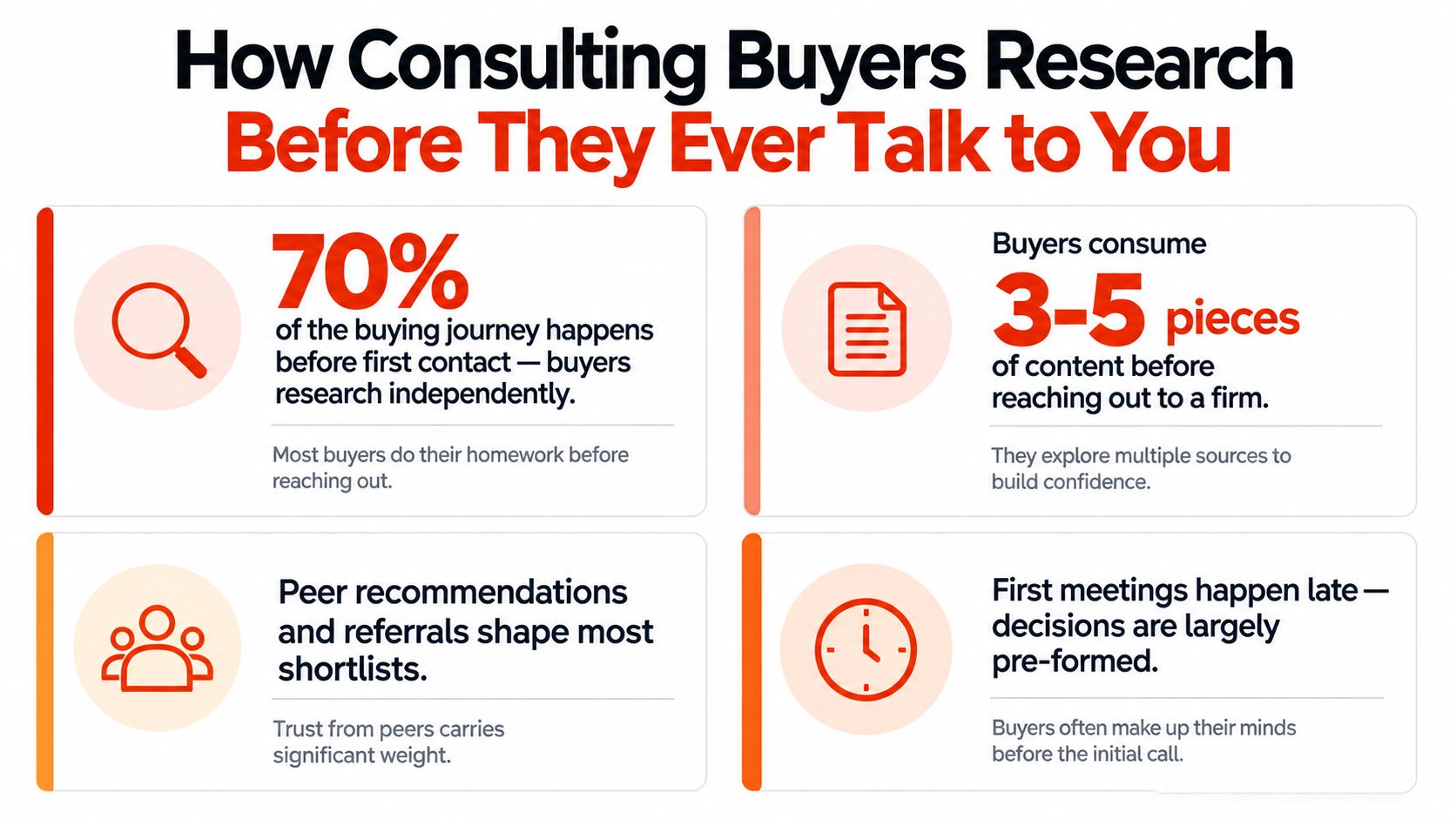
Consulting buyers don't wait for a salesperson to explain the market to them. They search for answers, compare specialists, read opinionated content, ask peers for recommendations, and inspect the credibility of individual experts. By the time they agree to a meeting, much of the shortlisting work may already be complete.
A 2026 B2B buyer behavior report says buyers spend about 17% of their purchase journey in direct contact with potential suppliers. Roughly 80% of decision shaping happens independently, which makes the period before the first meeting strategically decisive.
Buyers spend only about 17% of the purchase journey in direct contact with potential suppliers.
The invisible shortlist
Your firm can lose a deal before anyone from the buying team visits your contact page. A partner's LinkedIn profile may establish expertise, or a competitor's article may frame the problem first. A prospective buyer may consume several pieces of your content without identifying themselves, then arrive at a meeting already expecting evidence of a specific capability.
That changes what “visibility” means. Reach is useful only if it places the right authority in front of the right audience around a problem the audience recognizes. Anonymous brand content can support that effort, but it rarely carries the same trust as a clear point of view from someone who will lead the engagement.
The job of intent data is to connect this hidden research to an actionable decision. Website visits, content downloads, search activity, and review-site behavior can reveal that an account is investigating a topic. A single event isn't enough. Repeated, relevant behavior can tell your team where to look more closely.
Turn research into timing
Build content around the questions buyers ask before they define a project. Publish diagnostic frameworks, decision criteria, implementation risks, and practical interpretations of industry changes. Then make those assets easy to associate with a named partner or senior practitioner.
Your objective isn't to interrupt a buyer who has no reason to speak. It's to recognize when research has become active evaluation, then offer insight that helps the buyer make progress. Consulting lead generation works best when your outreach feels like the next step in an existing investigation.
The Referral Reality and Its Hidden Ceiling
Referrals remain powerful because they transfer trust. A client, former colleague, or partner gives your firm credibility before the first conversation, which is particularly valuable when the buyer is assessing expertise rather than comparing simple product features.
The problem is dependence. The same Thinkable Group survey summary reports that 63% of consultants name referrals and networking as their strongest marketing channel, while 70% report zero website leads in a typical month. Referral-led firms can win excellent work, but their pipeline often rises and falls with personal relationships, recent project visibility, and the willingness of a small network to make introductions.
Audit the source, not just the outcome
Review your recent opportunities and record how each one entered the firm. Separate direct referrals from partner introductions, event conversations, organic discovery, executive content, paid activity, and outbound. Then ask which sources consistently produce sales-accepted opportunities rather than merely names.
This audit usually exposes two weaknesses. First, the firm has no repeatable process for requesting, recording, and following up on introductions. Second, the website is expected to generate demand without giving buyers a strong reason to identify themselves or contact a specific expert.
A practical consulting referral tracking guide can help you create the operational layer referrals need. Track the source, relationship owner, referred problem, introduction date, next action, and commercial result. That turns goodwill into a managed channel without making the relationship feel transactional.
Referrals should remain part of the mix. They shouldn't be the entire growth plan. A firm needs owned authority and intent-based distribution to reach prospects outside its existing network, especially when partners are tired of waiting for the next event or introduction.
Building Authority-Led Channels That Outperform Cold Outreach
Authority-led distribution starts with a simple decision: stop hiding your expertise behind an anonymous company page. Consulting buyers want to know who understands their problem, who can explain it clearly, and who will be credible in front of their stakeholders.
Partner and senior-manager profiles can become repeatable demand assets when the firm gives them a defined audience, a sharp point of view, and a manageable publishing rhythm. The content shouldn't read like corporate announcements. It should explain how to diagnose a problem, challenge a familiar assumption, interpret a change, or avoid an expensive mistake.

Choose channels by job
| Channel | Scalability | Authority Signal | Best Fit |
|---|---|---|---|
| Partner visibility on LinkedIn | Moderate | Very strong | High-value advisory work where trust matters |
| Thought leadership content | Strong over time | Strong when tied to a named expert | Firms with distinctive expertise and reusable frameworks |
| Referrals and partnerships | Limited to moderate | Very strong | Relationship-led firms with complementary networks |
| Events and workshops | Moderate | Strong in a defined community | Complex offers that benefit from live discussion |
| Broad cold outreach | High in execution, weak in trust | Weak unless highly relevant | Narrow account lists with clear triggers |
Cold outreach isn't automatically useless. Untargeted outreach is the problem. Generic messages sent from an unfamiliar brand or junior profile ask the buyer to supply all the trust that the firm failed to establish beforehand. Industry guidance has reported cold email reply rates below 2% in 2025, alongside weaker unsolicited LinkedIn InMail response, so broad volume is a poor substitute for relevance and authority. See the consulting lead generation analysis from Enginy for the broader shift toward authority-led engagement.
Use each leader's profile for a specific market. One partner might own operational transformation for industrial businesses. Another might focus on workforce strategy for technology companies. Their content, comments, connection strategy, and follow-up should reinforce that positioning instead of scattering attention across every possible buyer.
A practical employee-advocacy workflow can help teams coordinate distribution without turning partner profiles into synchronized advertising. The LinkedIn employee advocacy guide is useful for thinking about how individual voices can extend company expertise while preserving personal credibility.
Then connect authority to an offer. A diagnostic, benchmark review, executive briefing, or working session gives interested readers a concrete next step. For guidance on building credibility through an expert-led content system, see this resource on how to earn trust through thought leadership.
The goal isn't to make every partner a full-time creator. Give each person a small set of recurring themes, reuse strong client questions, and let marketing handle research, editing, distribution, and measurement. The partner should supply judgment. That is the part buyers can't get from a generic brand page.
Events can still work when they create a concentrated conversation with a defined buying group. Treat them as a source of authority and signals, not as the entire pipeline engine. Publish the partner's perspective before the event, identify relevant attendees, follow up with useful context, and continue the conversation through content after the room empties.
Detecting and Qualifying Buying Intent the Right Way
Intent data is useful when it changes prioritization. It isn't useful when it becomes another list for sales to ignore.
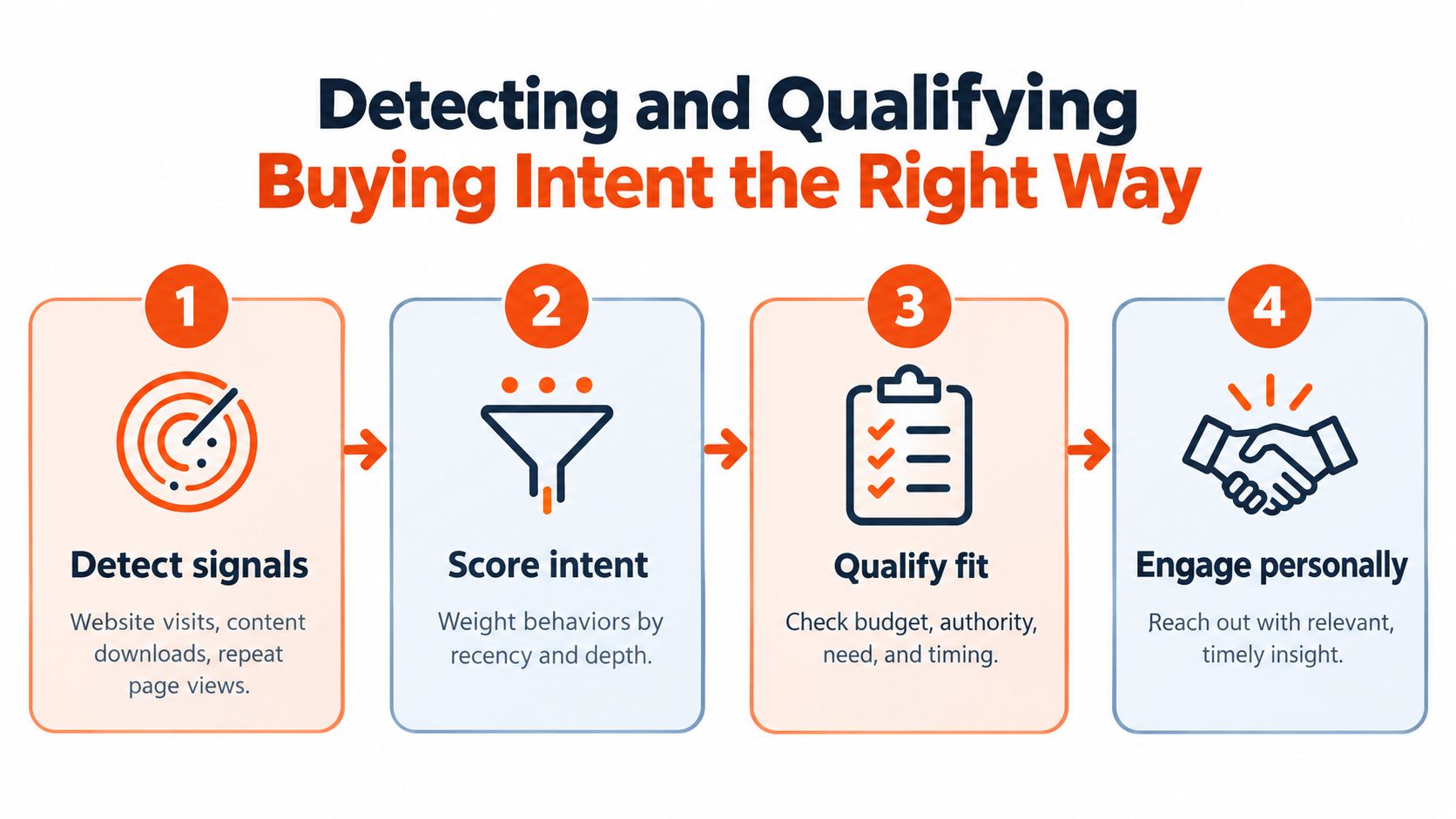
The basic mechanism is straightforward. Systems observe behaviors such as website visits, content downloads, search activity, and review-site engagement, then compare current activity with an account's historical baseline. A meaningful rise in research around a problem can indicate active evaluation, but it doesn't prove that the account is ready to buy. The ZoomInfo explanation of intent data makes this distinction important for any consulting lead generation program.
Use a layered signal model
First, collect approved signals. Decide which sources your firm can use responsibly and legally. Include owned web behavior, content interaction, known campaign engagement, and relevant external research activity where the data is available and permitted.
Next, classify the behavior. Group actions by business problem, not only by page title. A visitor reading several pieces about workforce planning is more useful to a talent advisory team than an undifferentiated “website lead.”
Then, resolve the account. Match activity to an organization or named contact only where the data supports it and privacy requirements allow it. Enrich the picture with CRM history, existing relationship ownership, account fit, role, and known buying-group information.
Finally, score against thresholds. Weight repeated and relevant behavior more heavily than a single page view. Include recency, depth, fit, and evidence of a live business issue. Route only accounts that cross an agreed threshold to human outreach.
Keep intent in its proper role
Intent is a prioritization signal, not a verdict. A large account may research extensively for education, procurement may be years away, or several stakeholders may be exploring different solutions. Your scoring model should help a partner decide where to invest attention, not replace that partner's judgment.
Content operations also matter. A structured content marketing hub from TheContentMap can help teams organize topics around buyer problems and build the assets that make intent interpretable.
For the qualification handoff, define the fields sales needs in the CRM. The lead qualification framework from Ploot offers a useful reference point for aligning marketing and sales around fit, need, authority, and timing.
Nurturing High-Value Leads Into Booked Meetings
A buying signal creates an opportunity for relevance. It doesn't create permission to send a pitch that ignores the prospect's context.
Start with the problem that triggered the research. If an account is engaging with material about operating-model change, don't send a generic “we help businesses transform” message. Send a short observation about the decision they're likely weighing, a relevant framework, or a question that helps the buyer clarify the issue internally.
The first contact should come from the profile with the strongest legitimate authority. That might be a partner who has written about the problem, a director who leads the relevant practice, or a senior manager who can speak credibly about implementation. Marketing can prepare the context, but the message should sound like a professional judgment, not an automated sequence.
Use a restrained sequence
A practical nurture path can include:
- Contextual connection: Refer to a relevant topic, role change, published view, or business issue.
- Useful follow-up: Share one diagnostic insight, not a catalogue of services.
- Proof of method: Offer a case example, framework, or anonymized pattern that matches the problem.
- Low-friction invitation: Suggest a short conversation only after the message has established relevance.
Email, LinkedIn, retargeting, and partner introductions can support one another, but don't repeat the same message across every channel. The buyer should experience continuity, not pressure.
The first meeting should feel like a continuation of the buyer's research, not an interruption to it.
Before sending a meeting invitation, check four things:
- Problem: Can you name the business issue the prospect appears to be investigating?
- Fit: Does the account match the firm's target market and service capability?
- Authority: Are you approaching someone who can influence the problem or connect you to the buying group?
- Reason now: Is there a credible signal that makes this moment more relevant than a random prospecting date?
If the answer to these questions is weak, continue nurturing. Senior consulting time is scarce, and a premature meeting request can spend trust faster than it creates pipeline.
Measuring Pipeline Instead of Impressions
Marketing teams lose credibility when they report activity that partners can't connect to revenue. Impressions, clicks, downloads, and form fills can diagnose distribution, but they don't prove that a channel is producing commercial progress.
For consulting firms, reporting should follow the handoff from attention to opportunity. Did the account show relevant intent? Did sales accept it? Did someone book and attend a qualified meeting? Did the opportunity enter a real pipeline stage? Those are the questions that justify budget.
Replace the dashboard's center of gravity
| Vanity Metric | Pipeline Metric | Why It Matters |
|---|---|---|
| Impressions | Pipeline contribution by source | Shows whether visibility creates commercial opportunities |
| Form fills | Sales-accepted accounts | Separates captured attention from usable demand |
| Content downloads | Qualified meeting rate | Connects content engagement to conversations with fit |
| Engagement rate | Opportunity conversion rate | Shows whether attention progresses through the funnel |
| Cost per lead | Cost per qualified meeting | Reflects the actual cost of creating sales capacity |
Track source and influence consistently. A meeting may originate from a partner's post, include several content interactions, and convert after a referral introduction. Your model doesn't need to pretend that one channel deserves all the credit. It needs to show the sequence of interactions and identify which sources help create accepted opportunities.
The guidance on measuring B2B lead generation beyond form fills reinforces the practical shift toward pipeline contribution, sales acceptance, conversion rates, and cost per qualified meeting. Those measures give marketing and sales a shared language.
Make reporting useful to partners
Give partners a view that answers three questions:
- Which accounts are active? Show relevant intent and the business problem associated with it.
- What action is due? Identify the responsible leader and the recommended next step.
- What happened commercially? Record acceptance, meeting quality, opportunity progression, and outcome.
Don't reward a channel for producing names that sales never wants. Reward the system for producing conversations that fit the firm's expertise and move toward a credible engagement.
Your 90-Day Plan for Consulting Lead Generation
Don't launch another collection of tactics. Run a focused pilot with a defined audience, a small group of visible experts, an intent workflow, and reporting that partners understand.
Days 1 to 30, establish the baseline
Audit recent opportunities by source and outcome. Identify which relationships, topics, partner profiles, events, and assets appeared before qualified conversations. Define the ideal account profile, the business problems you solve, and the signals that should trigger human review.
Agree on qualification before publishing anything. Marketing and sales should define what counts as a sales-accepted account, a qualified meeting, and a pipeline opportunity. Put those definitions in the CRM so the report won't change every time a partner challenges a number.
Days 31 to 60, activate authority
Choose a few partners, directors, or senior managers with genuine market credibility. Give each person a narrow audience, a set of recurring themes, and a practical offer such as a diagnostic or executive working session.
Build a distribution routine around their expertise. Publish original perspectives, repurpose client questions into useful content, engage relevant accounts from the right profiles, and route meaningful interactions to the appropriate owner. Keep the process light enough that senior people can sustain it alongside client work.
Days 61 to 90, connect signals to meetings
Turn on intent monitoring for the selected accounts and topics. Score behavior using recency, depth, fit, and known relationship context. When an account crosses the agreed threshold, route it to the authority profile best placed to start a relevant conversation.
Review accepted accounts, qualified meetings, meeting quality, and pipeline contribution. Avoid declaring victory based on reach or raw lead volume. The pipeline generation plan from Ploot provides a useful framework for sequencing this work around measurable commercial outcomes.
A three-month pilot gives partners enough time to see the operating model, test the handoff, and judge whether authority-led engagement is producing useful conversations. Set the success criteria before launch, then adjust the audience, content, scoring, or outreach based on evidence.
In consulting, one qualified meeting beats a hundred form fills. Build the system around that principle, and your firm can reduce event dependence without sacrificing the trust that makes advisory sales work.
Ploot helps consulting teams turn partner, director, and senior-manager authority into qualified meetings by building LinkedIn audiences, detecting buying signals, and supporting timely outreach from credible profiles. Visit Ploot to explore a focused pilot built around pipeline outcomes rather than impressions.