

Custom intent audiences are estimated audience segments assembled from keywords, URLs, and apps that model research behavior, not job titles; Google now places this capability within its “custom audiences” framework and commonly calls the setup “custom segments.” B2B buyers spend only about 17% of their purchasing journey meeting potential suppliers and roughly 6% speaking directly with sales, so marketers need a way to respond to research that happens before a prospect raises a hand.
You may be looking at a familiar dashboard: event leads are slowing, form fills arrive late, and broad campaigns deliver reach without enough qualified meetings. Meanwhile, a partner-led team at a Spanish consultancy could be comparing nearshore delivery models, assessing implementation partners, and getting internal agreement before contacting any supplier. Your dashboard can't show that whole process. Intent signals can offer a useful view of it, but they're clues to investigate, not proof that someone is ready to buy.
Table of Contents
- The Buying Reality B2B Marketers Have to Face
- What Custom Intent Audiences Actually Are
- The Inputs That Build a B2B Intent Segment
- Search Signals vs Context Signals Across Platforms
- From Signal to Meeting in Long Spanish B2B Cycles
- Measuring Whether an Intent Segment Produces Pipeline
- Three Misconceptions That Quietly Sink Intent Programs
The Buying Reality B2B Marketers Have to Face
Form fills and trade-show badges record the last minutes of a buying process that runs for months. By the time a Spanish mid-market prospect requests a call, the shortlist is mostly built and the internal argument is mostly settled. A pipeline plan that only counts those moments is reading the scoreboard, not the match.
The invisibility has a measurable size. In CIENCE's overview of B2B intent data, supplier meetings account for 17% of the purchasing journey and direct contact with sales reps for 6%. Everything else, the research, the comparisons, the internal selling, happens where your reporting sees nothing.
That gap widens in committee-driven deals. In Spanish IT consulting engagements of 100k€ or more, procurement often pulls five or more stakeholders across IT, finance, and operations into the evaluation before any supplier is contacted. Each of them researches on a different schedule, on a different device, sometimes on a different network. A form fill tells you one person finally raised a hand. It tells you nothing about the other four.
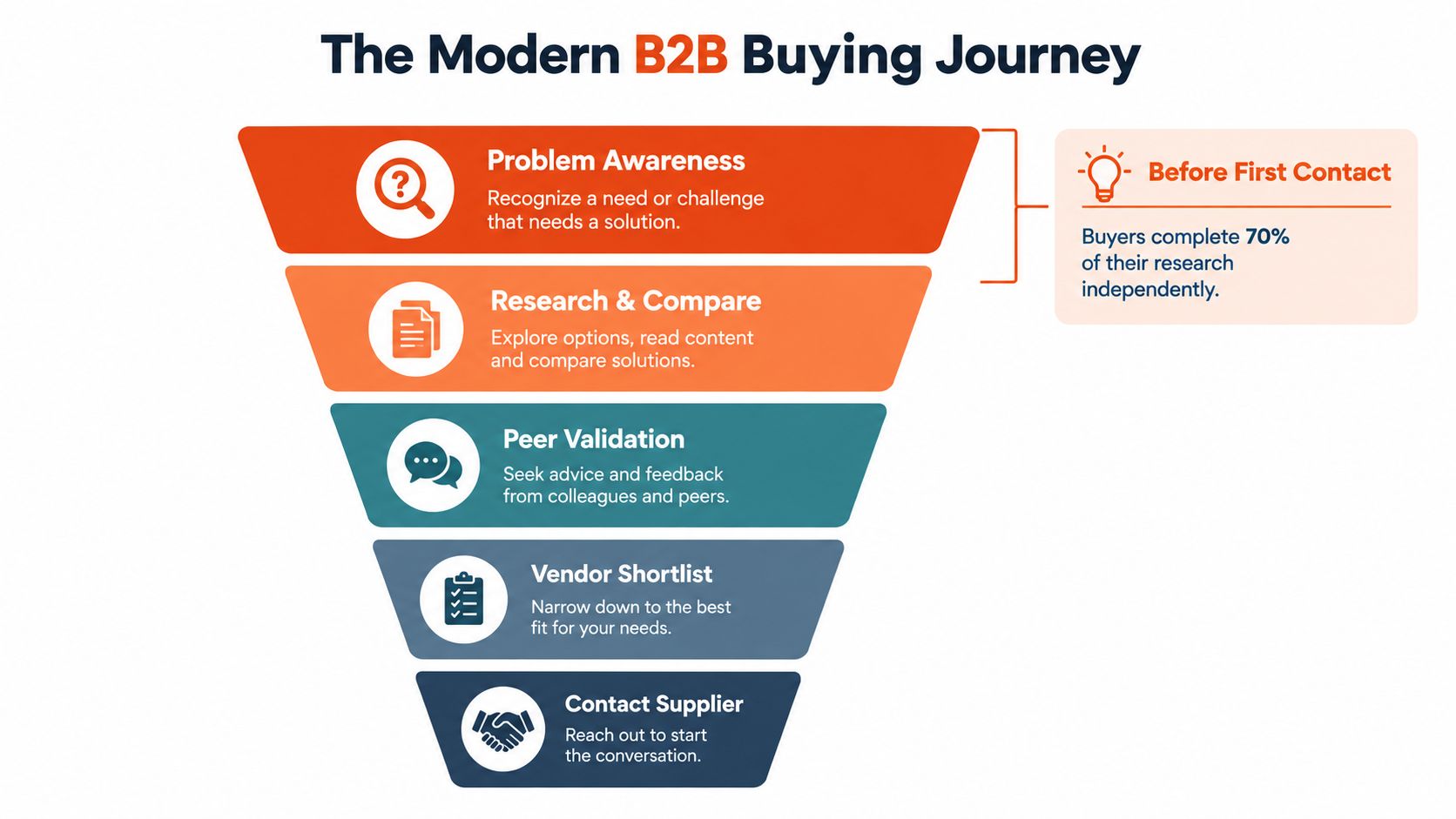
Take the same pattern inside a consulting firm evaluating ERP implementation partners. The team defines the problem, studies delivery approaches, polls peers, and drafts a shortlist over weeks. Marketing registers activity only when someone requests a call. Treating that request as the start of demand means you ignored every earlier chance to be relevant.
Intent is a visibility layer, not a shortcut
Custom intent audiences organize signals that suggest people are researching a category. That beats reach or a job-title filter, and it still leaves identity, authority, budget, and timing unproven. Treat the signal as a reason to qualify, not a reason to book.
Operating principle: Measure whether an intent signal helps your team earn qualified conversations. Reaching an audience is not evidence the audience is ready to buy.
If your pipeline only registers prospects after they contact sales, you are forecasting with a partial record. Intent belongs in the demand plan because it lets you act on research while it happens. Qualification is what keeps that action honest.
What Custom Intent Audiences Actually Are
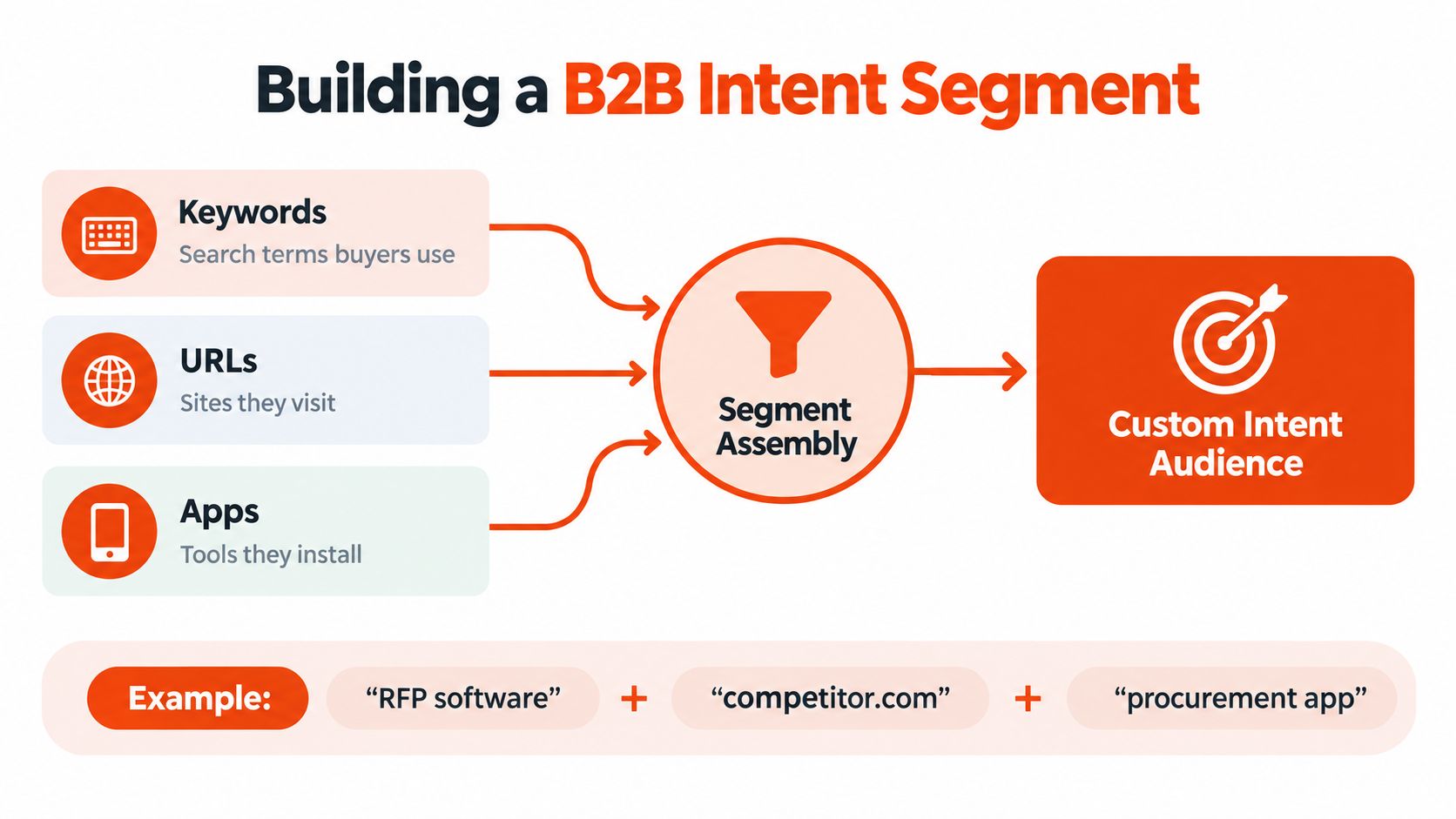
Think of a custom intent audience as a curated reading list you hand to an advertising platform. You provide keywords, URLs, or apps connected to a buying problem. Google uses those inputs to estimate which people may be interested in the topic or researching a related solution. The result is an audience model, not a verified roster of buyers.
That distinction matters. A URL associated with ERP implementation may be relevant to a buyer, but it could also attract a consultant, student, competitor, or existing customer. The platform estimates likely relevance from signals and behavior. Your team still has to establish whether those people fit your market and whether their activity connects to a real opportunity.

The name changed, the operating idea stayed
Google began rolling out custom intent audiences for Display campaigns in November 2017, expanded the model to YouTube video around four months later, and consolidated custom intent and custom affinity into the broader “custom audiences” framework in September 2020 (PPC Land's account of the rollout). Today, Google's documentation and interface increasingly use “custom segments” for audience construction.
Don't build a current campaign by blindly following an old tutorial that treats Custom Intent as a standalone product. The label and workflow have evolved, while the core idea remains useful: define a segment through behavioral inputs that relate to a specific research need, then tailor the campaign and follow-up to that need.
If you're comparing audience approaches across ad platforms, a practical overview of Facebook Ads audience targeting in 2026 can help clarify how platform-specific audience terminology and controls differ. Keep the strategic question constant: what behavior are you trying to reach, and what evidence would make that audience valuable to sales?
The Inputs That Build a B2B Intent Segment
Start with the buying problem, not the campaign settings. If you set out to “reach decision-makers,” you haven't defined an intent segment. A useful brief names the research task, such as selecting an ERP implementation partner or evaluating nearshore software development, then collects the online signals that relate to that task.
For an IT consulting campaign, the first input group is keywords. These might include “ERP implementation partner,” “nearshore software development,” or “IT consulting.” Keep terms tied to the same buying situation together. A person researching a broad technology topic is not necessarily in the same stage as someone looking for an implementation partner.
URLs add context. Consider analyst publications, category vendors, procurement resources, and relevant professional communities. The point isn't to claim that every visitor to those sites is a buyer. It's to give Google examples of the research environment associated with the segment.
Apps can add another behavioral proxy where relevant, especially when the tools relate to enterprise workflows or the use case under consideration. Google supports custom segments built with keywords, URLs, and apps across Display, Demand Gen, Video, Gmail, Shopping, and Performance Max (Google Ads' custom segment guidance).
Keep distinct use cases apart
Don't combine early learning and active vendor evaluation in one segment. A broad mix can blur the audience definition, make the ad message less relevant, and leave sales unable to tell which type of research contributed to a meeting. Build separate segments for separate use cases, such as educational interest in nearshoring and late-stage research for an implementation partner.
A written-first build keeps the work honest:
- Name the buying problem: State what the prospect is trying to solve.
- Collect the evidence: List relevant search terms, websites, and apps.
- Separate the stages: Keep broad education apart from vendor selection.
- Define the handoff: Decide what further evidence merits human follow-up.
The segment's quality is largely set before anyone adjusts bids or writes ads. Once a segment starts generating responses, connect those signals to your qualification process. A guide to lead scoring in HubSpot can help teams think through how to combine behavioral clues with fit and sales-readiness criteria.
Search Signals vs Context Signals Across Platforms
Not every input carries the same kind of evidence. A search-term-based custom segment can reach people who searched specified terms on Google properties, making it closer to observed demand than a list of related websites or apps. URL- and app-based inputs work more as contextual or behavioral approximations. Both can be useful, but they shouldn't receive identical treatment.
Use the distinction to set campaign expectations. Search-derived signals can justify more specific creative and faster follow-up because they reflect an explicit query. Research-context segments are better suited to useful education and a longer nurture path, since visiting a relevant site or using a related app doesn't show that a person has asked for a vendor conversation.
| Signal type | What it suggests | Practical campaign posture |
|---|---|---|
| Search-term input | The person searched for a specified term on Google properties | Address the problem directly and assess whether prompt follow-up is appropriate |
| URL input | The person's activity may relate to a relevant research environment | Offer useful proof or educational material |
| App input | The person may use tools associated with a relevant workflow | Test relevance and qualify downstream engagement |
Campaign type affects how the inputs are used, so check the available setup rather than assuming the same segment behaves identically everywhere. Google's custom segment documentation covers supported campaign types and the role of keywords, URLs, and apps. The important operating choice is still yours: decide how much confidence each signal deserves and what action it should trigger.
Fill the gaps with complementary signals
Paid custom segments won't tell you everything about account fit, a prospect's role, or activity across a buying committee. LinkedIn engagement audiences and B2B intent-data providers can add other signals, while partner-network approaches can help teams reach relevant people through trusted professional profiles. These sources serve different purposes. Don't stack them together and call the result “intent” without defining what each signal means.
For marketers reviewing how teams approach digital channel strategy, Mick-Mar's marketing expertise offers broader context. The useful lesson is to choose channels based on the gap you need to close, not just because a platform is familiar. Your strongest signal may come from search, professional engagement, or a combination of evidence.
From Signal to Meeting in Long Spanish B2B Cycles
A signal only matters if someone knows what to do with it. Send an early-stage researcher the same meeting request you would send an RFP-stage buyer and you have burned budget, a contact, and your credibility with sales. In Spanish consulting and software deals, where agreement can take quarters and often requires consensus from finance, procurement, and a founder who expects a personal call, mistimed outreach is expensive.
The timeline is a real constraint. As noted earlier, most B2B leads take at least three months to decide and a meaningful share wait more than a year. Spanish cycles stretch that reality further: buying committees are consensus-driven, procurement gates are formal, and decision-making slows sharply around August and year-end closings. Treat a signal as a timed event, not a status. An early signal earns a relevant message now, plus a decay rule for when it stops meaning anything.
Match the response to the research
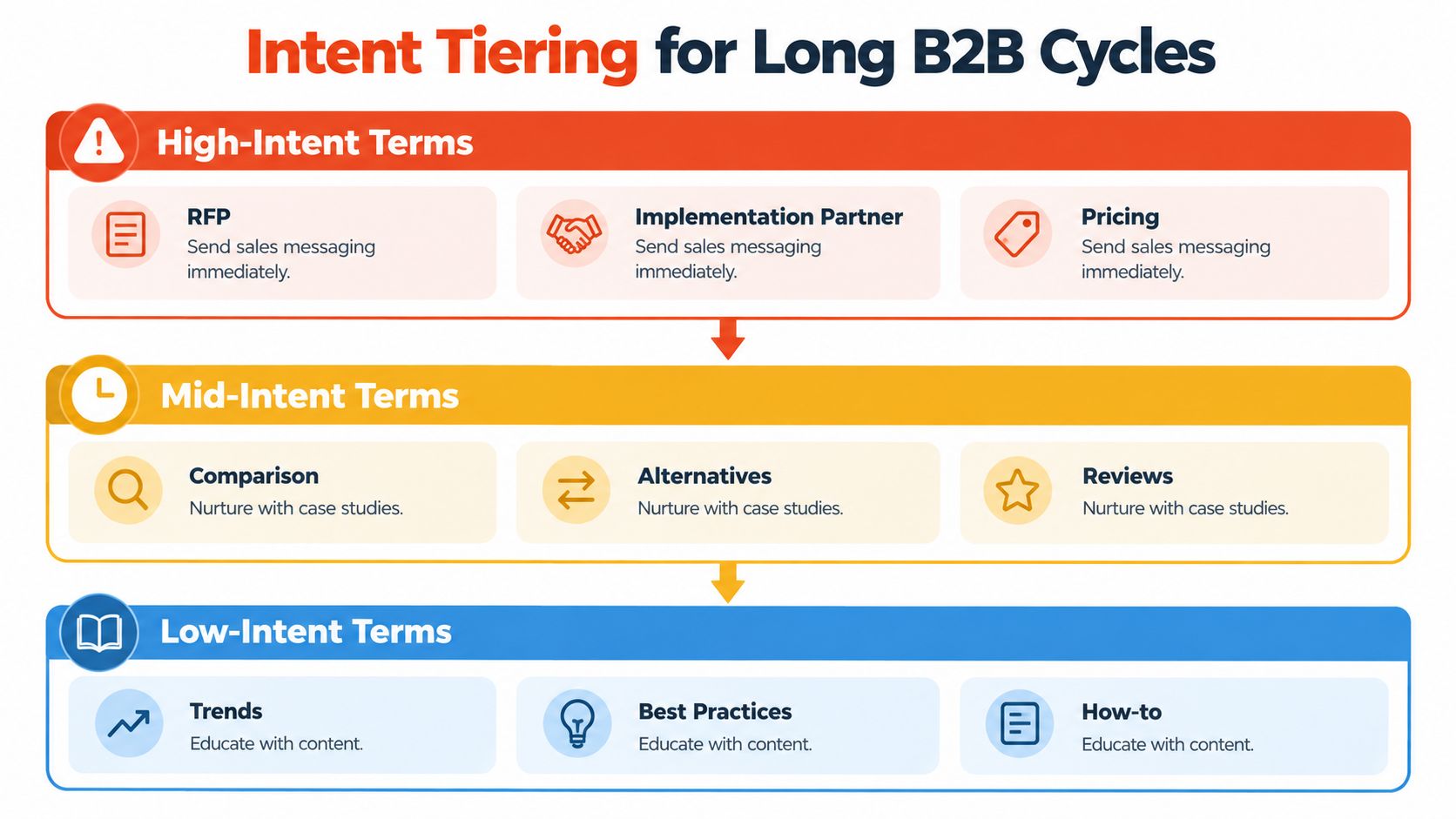
- High intent: Terms such as "RFP," "implementation partner," and "precios de" suggest active vendor evaluation. Direct, sales-oriented messaging, prompt human review, and follow-up from a senior profile that carries authority in the sector.
- Mid intent: Searches around vendor comparison, alternatives, or outsourcing strategy call for proof: case-led content, cost benchmarks, a defensible point of view. Sales monitors for stronger evidence before asking for time.
- Low intent: Broad category terms, trends, and how-to research belong in education. Forcing a demo ask on a learning signal only teaches the prospect to ignore you.
The same logic applies outside paid media. Spanish B2B runs on trust and introductions, so a signal that a Madrid-based systems integrator is researching your category is worth far more when it routes to a partner or director who can credibly reach out, rather than into an automated sequence. Paid custom segments surface the research; a trusted profile makes the approach land. Neither replaces checking fit and context.
Run a pilot to align marketing and sales on who owns each tier, what follow-up each signal earns, and what evidence justifies a handoff. A human verifies that the prospect fits the account profile, has a plausible need, and is open to a conversation before sales counts the signal as qualified. For teams working out when outreach becomes appropriate, Cyndra AI outreach strategies cover how to coordinate that timing. The aim is a timely conversation, not automation for its own sake.
For a broader view of the commercial motion behind software deals, see this guide to selling software as a service. The operational test stays simple: can your team explain why this prospect got this message now, and who owns the next step?
Measuring Whether an Intent Segment Produces Pipeline
Audience size and click-through rate are not pipeline outcomes. Google describes audience membership as estimated, based on interests, intents, and demographic characteristics, rather than a deterministic declaration about an individual (Google Ads' audience-segment overview). Treat each segment as a hypothesis to test against commercial results.
Set measurement at the segment level. Track incremental qualified meetings, opportunity creation, and whether opportunities progress through the sales cycle. Compare a search-term segment with a research-context segment under a controlled pilot, keeping the qualification rules consistent. If one segment reaches more people but creates fewer qualified opportunities, it isn't the stronger pipeline asset.
| Intent tier | Primary KPI | Follow-up SLA | Creative posture |
|---|---|---|---|
| High | Qualified meetings and opportunity creation | Prompt human review | Direct, sales-oriented |
| Mid | Qualified progression toward a meeting | Timely nurture review | Proof, comparisons, case-led content |
| Low | Relevant engagement that supports later qualification | Review as new signals appear | Educational |
Validate the audience, not just the ad
Look for false positives. Researchers, students, competitors, existing customers, or people outside your target accounts may respond to the same terms and URLs. Review the resulting audience and pipeline quality, then remove or revise inputs that consistently bring in poor-fit activity. You don't need to rebuild every campaign from scratch to improve a segment.
Agree on success criteria before launch, including what counts as a qualified meeting and which outcomes show progress by intent tier. Teams reviewing how stages connect can use a demand generation funnel guide to align measurement with the broader journey. Scale only when the segment contributes evidence of commercial value, not because reach looks impressive.
Three Misconceptions That Quietly Sink Intent Programs
The old product name is still the setup
“Custom Intent Audience” remains common in older tutorials, but Google has consolidated Custom Intent and Custom Affinity into “custom audiences” and increasingly uses “custom segments” across campaign types. The current documentation describes custom segments as audience constructions using inputs such as keywords, URLs, and apps. When following a tutorial, check whether its terminology and workflow match the interface you're using (Google's custom audience API documentation).
Intent means someone is ready to buy
It doesn't. A person's online activity provides a signal, and the platform estimates whether that behavior relates to the audience definition. The person might be researching, comparing, advising a client, or exploring a topic without authority to purchase. Combine the signal with fit, qualification, and recency before asking sales to act.
More precise keywords guarantee B2B precision
They don't. A list of consulting-firm websites or software-category terms can still include people who aren't buyers at target accounts. More inputs may widen the net without improving the quality of the audience. Separate use cases, examine who progresses, and remove signals that attract the wrong activity.
The goal isn't the largest possible audience. It's a smaller, more decision-dense group whose research gives your team a credible reason to act during a long evaluation. The marketers who make intent work keep testing and correcting the model instead of setting it once and trusting the label.
Ploot turns partners, directors, and senior managers into a LinkedIn sales channel by identifying buying intent in their audiences and supporting timely outreach to book qualified meetings. If your team needs pipeline beyond events and broad reach, visit Ploot to discuss a three-month pilot with agreed success criteria.