

Only about 5% of your addressable B2B market is actively buying at any given moment, while roughly 95% isn't ready yet. Demand capture converts the small group showing intent now, while demand generation builds preference among the much larger audience that may buy later.
That ratio changes the entire demand capture vs demand generation debate. Capture is faster and easier to attribute, but it can only harvest demand that already exists. Generation takes longer and creates more measurement friction, but it gives future buyers a reason to remember your company before a competitor enters the conversation.
For marketing directors in consulting, software, and other high-ticket B2B categories, this isn't a theoretical distinction. It's a capital allocation decision. If your team optimizes only for immediate conversions, you may hit this quarter's meeting target while weakening the pipeline several quarters from now. If you invest only in awareness, sales may run out of active opportunities before the investment pays back.
Table of Contents
- The Hidden Truth About B2B Pipeline Growth
- Core Objectives and Strategic Differences
- The Timing Gap in Buyer Behavior
- Measuring Success With Meaningful KPIs
- Real-World Scenarios for Each Approach
- Integrating Capture and Generation for Growth
The Hidden Truth About B2B Pipeline Growth
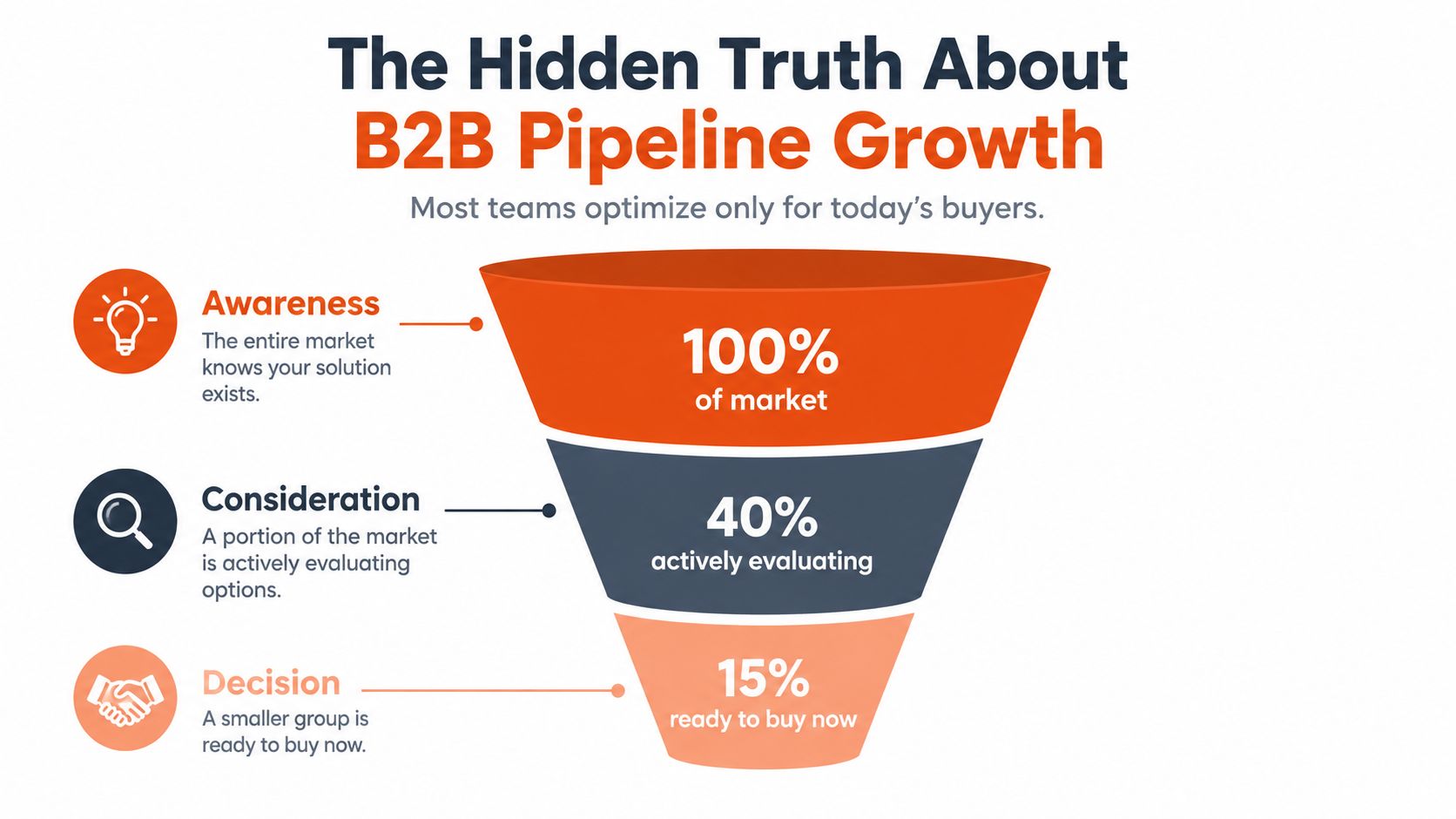
The most important fact in this debate is also the one many quarterly marketing plans ignore. The 95:5 principle says that only about 5% of an addressable market is in-market and actively buying at a given moment, while about 95% is not ready to buy yet. The principle is summarized in this overview of demand creation statistics.
That means capture and generation aren't competing versions of the same activity. They address different economic conditions. Capture works on visible demand, such as a buyer searching for a solution, returning to a service page, comparing vendors, or requesting a conversation. Generation works on the audience that hasn't formed a buying brief yet, but may become a buyer when a business problem becomes urgent.
Why short-term efficiency can mislead
Demand capture usually looks better in a dashboard. A paid search campaign can produce a form submission, a branded page can convert an existing visitor, and a retargeting audience can generate a meeting that sales can follow up quickly. The path is visible, so finance and sales leaders feel comfortable assigning credit.
The problem is that the visible path represents only the buyers already close to action. If every competitor targets the same high-intent searches and review environments, the company with the largest budget or strongest existing brand often wins the immediate contest. Capture doesn't create a new pool of buyers. It competes for the pool that has already appeared.
Demand generation addresses the less visible commercial work. A useful point of view, a strong executive perspective, an educational video, or a practical benchmark can give an early-stage buyer language for a problem they haven't yet turned into a vendor search. Teams building that layer can use a focused video strategy for B2B demand to make expertise easier to consume and share.
| Strategy | Primary job | Typical buyer state | Commercial strength | Main risk |
|---|---|---|---|---|
| Demand capture | Convert existing intent | Actively evaluating solutions | Faster path to meetings | Limited audience volume |
| Demand generation | Create awareness and preference | Aware of a problem, not ready to buy | Expands future pipeline | Slower feedback and attribution |
| Integrated program | Connect early influence to active conversion | Moving through different stages | Balances current and future revenue | Requires shared measurement |
Your first diagnostic should be simple. If your calendar is full today but future opportunities are thin, you have a generation problem. If your market knows you but buyers fail to take the next step, you have a capture problem. The distinction is also useful in understanding pipeline generation, because pipeline doesn't grow sustainably when marketing counts only the final interaction.
Practical rule: Capture protects near-term revenue. Generation protects the future revenue base that capture will eventually convert.
Core Objectives and Strategic Differences
Demand capture is a conversion system. It looks for evidence that a buyer has already moved toward a decision, then removes the obstacles between that evidence and a sales conversation. The work includes high-intent search pages, comparison content, review profiles, retargeting, clear service pages, strong calls to action, and fast follow-up.
Demand generation is a market-shaping system. It helps buyers recognize a problem, understand its financial consequences, and associate the problem with your company's expertise. The work includes executive content, research, events, educational media, opinionated articles, partner distribution, and useful assets that earn attention before the buyer is ready to contact sales.
The difference is easiest to see in the objective each team should own.
Capture harvests intent that already exists
A capture program asks, “Who is looking for this now, and what would make them choose us?” Its audience is narrower, but the commercial signal is stronger. A consulting firm might target searches for a specific transformation service. A software company might optimize a comparison page for buyers evaluating alternatives.
Capture succeeds when it improves the path from intent to qualified opportunity. That means:
- Match the message: Make the page answer the exact problem implied by the search, referral, or engagement.
- Reduce uncertainty: Show capabilities, delivery approach, relevant proof, and a clear next step.
- Route quickly: Send qualified signals to the right seller while the buying context is still fresh.
- Remove friction: Keep forms, scheduling, qualification, and follow-up proportionate to the buyer's interest.
Capture shouldn't be judged by traffic alone. A page can attract visitors who have no commercial fit, while a smaller audience can generate valuable conversations.
Generation expands the future buying pool
Generation asks, “Which people could become buyers, and what would make them care before they enter an active search?” The answer requires more than publishing frequently. It requires a distinctive commercial point of view tied to problems that matter to the ideal customer profile.
A generation program might explain why a familiar operating model no longer works, help a director build an internal business case, or give a partner language to lead a boardroom discussion. It creates familiarity and preference before the buyer reaches a vendor shortlist.
The mistake is treating these motions as alternatives. They work at different stages, with different expectations, and under different financial constraints. A practical comparison of outbound and inbound marketing can help teams decide how distribution and seller activity should support each motion.
Demand capture converts a market response. Demand generation influences the response that the market will make later.
The Timing Gap in Buyer Behavior
A quarterly target creates a predictable management error. When pipeline is behind plan, leaders fund the activities that can show movement soonest. That usually means branded search, retargeting, conversion work, and direct response campaigns. Those activities may be necessary, but they can't repair a demand-generation gap that developed over the previous planning cycle.
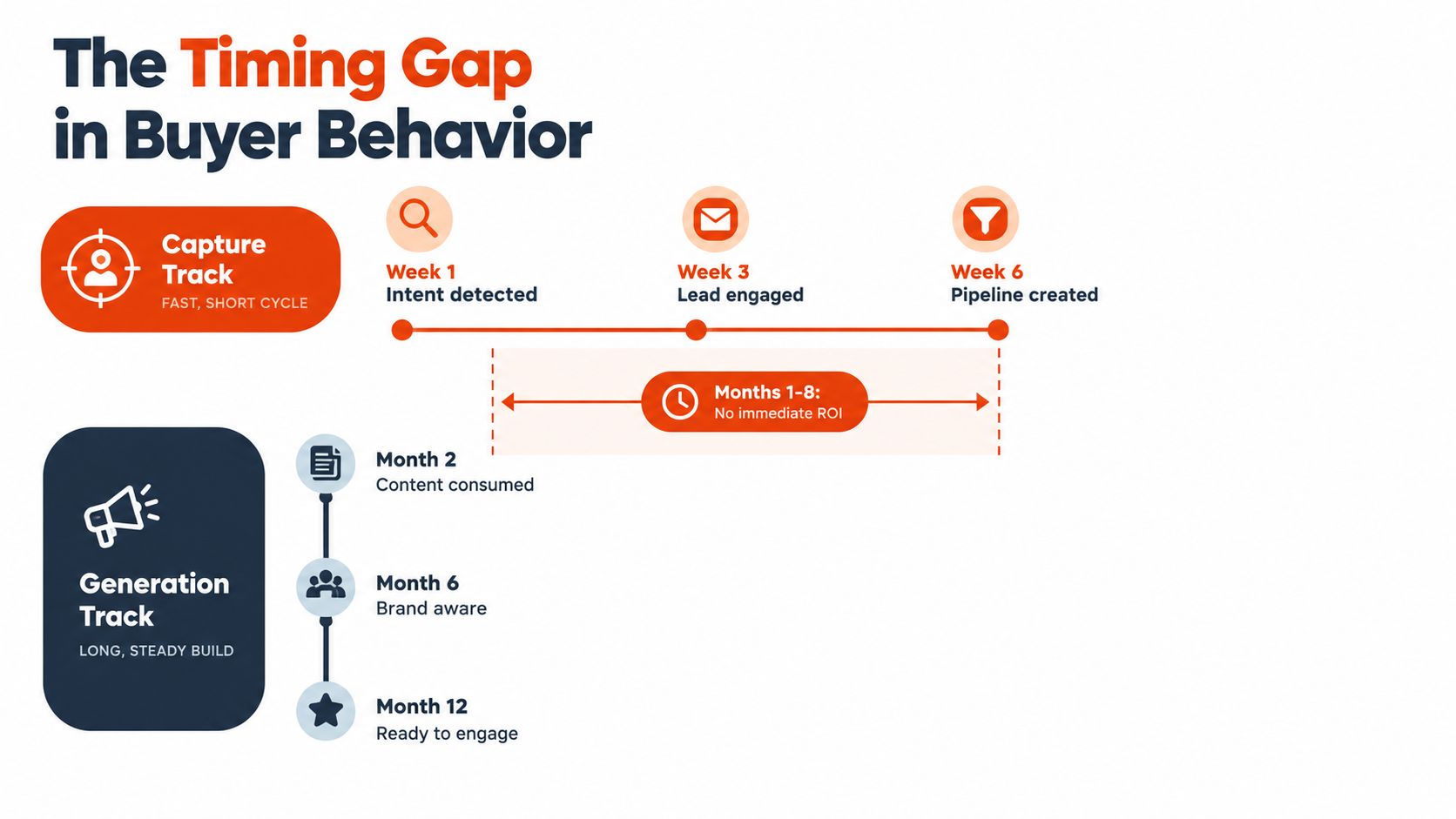
The timing difference is substantial. The cited B2B buyer research describes demand capture as a 1 to 3 month motion, while demand generation typically operates across 6 to 18 months. The same source reports that buyers were about 69% through the purchasing process before speaking with a seller, rising to 72.4% in APAC markets. These figures and time horizons are reported in the B2B buyer behavior comparison.
The buyer often arrives with a conclusion
When a prospect finally books a call, they may already understand the problem, define the required capabilities, compare vendors, and form an internal preference. The seller is no longer introducing the category. They're being asked to validate a decision that was shaped elsewhere.
That “elsewhere” can include a colleague's recommendation, a review site, a conference conversation, a private community, a LinkedIn post, or content shared in a team channel. Marketing that appears only at the final search stage arrives after much of the commercial framing has already happened.
This changes what a marketing director should ask sales. “How many leads did we generate?” is a weak question. Better questions include:
- Which accounts engaged before they became opportunities?
- What did buyers already understand when they contacted us?
- Which topics appear in conversations before a proposal is requested?
- Where do qualified buyers encounter our point of view?
- Which early signals correlate with later opportunity creation?
Budget follows the revenue horizon
Capture deserves protection when sales needs meetings now. It gives teams a practical way to improve conversion from existing interest, especially when the brand already has traffic, recognition, or a strong installed base. But capture should have a ceiling. Once the high-intent audience is fully covered, adding budget often means paying more to reach the same limited pool.
Generation needs a different budget conversation. Leaders shouldn't demand immediate opportunity volume from a program designed to influence future buyers. They should require a clear audience, a commercial thesis, consistent distribution, and evidence that the right accounts are consuming and responding to the message.
Don't ask a long-cycle program to behave like paid search. Don't ask paid search to create a market that hasn't formed yet.
Measuring Success With Meaningful KPIs
The fastest way to damage trust in marketing is to present activity as financial progress. Impressions, clicks, downloads, and form fills can help diagnose a program, but they do not prove pipeline impact. Directors need a measurement system that separates reach, intent, opportunity creation, and revenue movement.
For demand generation, the core question is whether the program creates more qualified future opportunities than the company would have created without it. Mature B2B programs are cited as sourcing 30% to 50% of total pipeline, according to this pipeline metrics guide. Treat that range as a planning benchmark and a diagnostic lens, not a guarantee.
Use different scorecards for different jobs
| Metric Type | Demand Capture Focus | Demand Generation Focus |
|---|---|---|
| Audience quality | High-fit accounts showing active intent | High-fit accounts reached and engaged |
| Conversion | Intent-to-meeting and meeting-to-opportunity rates | Engaged-account progression into known demand |
| Pipeline | Qualified opportunities influenced or sourced | Opportunities sourced and later influenced |
| Revenue | Near-term pipeline, win rate, and revenue contribution | Pipeline contribution across the longer buying cycle |
| Efficiency | Cost per qualified meeting and response speed | Cost per engaged account and cost per sourced opportunity |
| Diagnostic signals | Search terms, return visits, page actions, and form quality | Content consumption, repeat engagement, direct responses, and account coverage |
Capture reporting should expose leakage. If high-intent visitors do not book meetings, inspect the landing page, offer, qualification logic, calendar experience, and follow-up speed. If meetings do not become opportunities, inspect fit and message alignment before buying more traffic.
Generation reporting needs to connect account engagement to commercial progression. Track which target accounts consume content, return to the site, interact with subject-matter experts, or respond to distribution. Do not force every early interaction into a lead score. Buyers can be highly interested and still not ready to complete a form.
Use a scorecard that reflects stage, not vanity. A clean lead scoring framework for HubSpot helps separate fit from behavior so sales does not waste time on noise.
Put pipeline velocity in the executive report
Pipeline velocity belongs in the executive report because it combines opportunity volume, deal value, win rate, and sales-cycle length. The formula is (number of opportunities × average deal value × win rate) / average sales cycle length. That gives marketing and finance a shared language.
It also forces a harder conversation. More opportunities can improve velocity, but so can better qualification, stronger deal value, higher win rates, or a shorter sales cycle. That prevents teams from celebrating pipeline creation while ignoring whether sales can convert it at a pace that matters.
Use CRM stages consistently. Define what counts as a qualified opportunity, record the source and influence history, and agree with sales on when an opportunity enters the pipeline. A measurement framework should help prove your team's value without hiding behind attribution complexity.
The CFO does not need a perfect map of every touch. They need a credible explanation of how marketing changes the amount, quality, and speed of revenue entering the business.
Real-World Scenarios for Each Approach
Consider an IT consulting firm selling a complex transformation program. The sales cycle is long, several stakeholders influence the decision, and buyers rarely search for the firm's exact service until the problem has already gained executive attention.
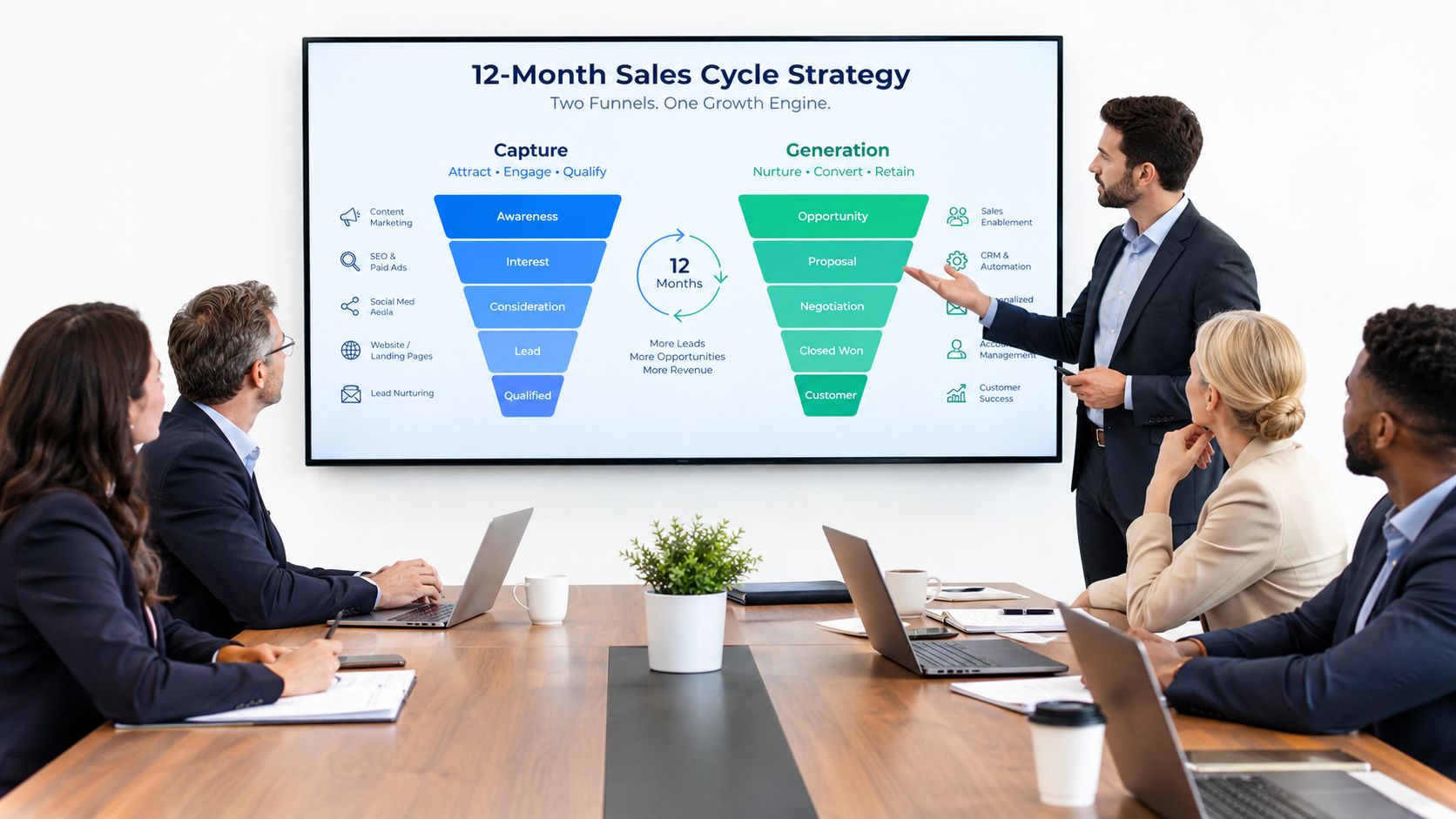
A pure capture strategy might improve branded search, bid on service terms, and retarget known visitors. It could produce efficient meetings from existing interest, but it would struggle to create new-logo demand if few accounts are actively evaluating the category. The firm needs generation that helps technology and operations leaders recognize the cost of delay, understand the transformation path, and remember the firm before a formal procurement process begins.
The capture layer still matters. Once an account visits a relevant service page, attends a webinar, engages with a partner, or returns through a referral, the firm should offer a clear diagnostic conversation and route the signal to a seller who understands the context.
A software launch needs two clocks
Now consider a B2B software company launching a major feature for existing users. Capture should lead the launch motion because the audience already understands the product and may have an immediate problem the feature solves. Product pages, in-app prompts, comparison material, customer education, and sales enablement can turn existing interest into expansion conversations.
Generation shouldn't disappear. The company also needs to reach prospects who don't yet know the category, don't use the product, or aren't connected to the existing customer base. Thought leadership, technical education, partner content, and executive distribution can build the audience for the next planning period.
The short-term launch target and the future market-building target must have separate owners and reporting windows. Combining them into one campaign number makes the launch look slow or the generation program look inefficient.
Diagnose the constraint before choosing a tactic
A useful decision tree is more valuable than a generic channel list:
- Full calendars and weak future coverage: Invest in generation, then improve capture for the accounts that respond.
- Strong awareness and low conversion: Fix offer clarity, proof, qualification, routing, and follow-up before increasing reach.
- Good traffic and poor opportunity quality: Tighten audience definition and exclude low-fit demand.
- Low awareness in a new category: Prioritize education and authority, then build capture paths around emerging intent.
- Existing customers with a clear expansion use case: Start with capture, while generation supports broader market adoption.
The distinction between the two motions is also visible in efficiency. Industry guidance describes capture as focusing on the 3% to 5% of accounts actively searching now, and reports fewer touches to progress prospects than demand creation, with 3.7 touches compared with 8.2 in the cited benchmark-style reporting from this demand generation framework. That efficiency makes capture valuable, but it doesn't make the reachable audience larger.
Form design is part of the commercial system. A relevant form integration for CRM workflows can send context to sales without making the buyer repeat information across disconnected tools.
The following video provides another way to think about the operating model and the handoff between marketing activity and sales conversations.
Integrating Capture and Generation for Growth
The binary choice is wrong. A serious B2B team needs both motions, but it shouldn't fund them identically or judge them with the same dashboard.
Generation creates the conditions for future demand. Capture converts the demand that becomes visible. The operating model should connect the two without pretending that every early interaction is a lead or that every late-stage conversion was caused by the last click.
Build a portfolio, not a campaign pile
Start with a stable generation base. Define the audience, choose a small number of commercially important problems, and publish a point of view that sales can use in real conversations. Distribute that perspective through channels where senior buyers already learn and exchange recommendations.
Then build capture around the signals that indicate movement. Those signals may include high-intent search, repeat visits to solution pages, engagement with a subject-matter expert, attendance at a relevant event, interaction with a partner, or activity from a target account. The signal should change the next action. A generic nurture email isn't enough if the buyer has shown a specific business concern.
A practical operating sequence looks like this:
- Create the market context: Explain the problem, its business consequences, and the choices buyers face.
- Earn repeated attention: Use useful content, expert distribution, and credible participation in the buyer's information environment.
- Detect movement: Identify account and person-level signals that suggest evaluation, not just passive reach.
- Make the next step relevant: Offer a diagnostic, conversation, comparison, or resource that matches the buyer's stage.
- Route with context: Give sales the topic, source, account fit, and recent behavior so outreach feels informed.
- Close the loop: Feed objections, lost deals, and recurring questions back into content and capture optimization.
Capture now happens before the search box
Search remains important, but it isn't the whole capture layer. Buyers may be shaped by dark social, review sites, peer recommendations, and private professional conversations before they run a formal query. The cited commentary on modern demand capture and demand generation highlights this shift and the limits of relying on visible, last-click behavior.
For a consulting firm, that might mean monitoring engagement around a partner's LinkedIn post, then offering a relevant conversation to an account that has shown a meaningful pattern of interest. For a software company, it might mean connecting product education, review-site presence, community participation, and sales follow-up rather than treating each as an isolated channel.
The principle is simple: capture intent wherever it becomes observable, not only where it becomes a keyword.
Allocate according to the business constraint
When immediate pipeline is at risk, increase capture coverage, improve conversion paths, and tighten sales response. Don't dismantle generation to fund the response. That creates a recurring cycle in which the team hits a short-term number by consuming the limited demand created in previous periods.
When future coverage is weak, protect generation even if the reporting window feels uncomfortable. Set expectations with finance before launch. Agree on the audience, the commercial problem, the leading indicators, the opportunity definition, and the point at which the program will be reviewed.
The right question isn't whether capture or generation is better. Ask which part of the revenue system is currently constrained:
- Not enough qualified attention: Strengthen generation.
- Attention without preference: Improve authority, proof, and message.
- Preference without action: Improve capture and conversion.
- Action without progression: Fix qualification, routing, and sales alignment.
- Pipeline without revenue: Inspect deal quality, value, win rate, and sales-cycle friction.
The strongest demand program doesn't maximize activity. It gives the business enough future demand to avoid desperation and enough capture discipline to convert buyers when timing turns in its favor.
If your team needs more than impressions from LinkedIn expertise and audience activity, Ploot can build the LinkedIn audience of partners, directors, and senior managers, detect buying intent, and support timely outreach that books qualified B2B sales meetings. Visit Ploot to assess whether this signal-led approach fits your long, high-ticket sales cycle and pipeline targets.