
The most popular outbound advice is still "send more." More sequences, more mailboxes, more names on the list. That advice burns accounts. A marketing director who reports impressions and event leads while sales demands meetings is usually running two programs that never meet. Outbound sales lead generation only works when contact is timed to real interest and sent from people the buyer already treats as credible.
A single cold note cannot carry a high-ticket decision. Treat outreach as intent-timed contact from authoritative profiles, and judge it by meeting quality and pipeline, not by activity.
Table of Contents
- Why Outbound Sales Lead Generation Changed
- Choose Accounts and Buying Roles Worth the Effort
- Write Sequences That Match Buyer Research
- Qualify Intent Before You Ask for a Meeting
- Compare Cold Automation with Intent-Driven Outreach
- Measure Pipeline Quality and Scale What Works
Why Outbound Sales Lead Generation Changed
Volume-first cold outreach assumes the seller still controls the first conversation. Buyers retired that model. McKinsey's global B2B Pulse research found that buyers used about five distinct supplier-interaction channels in 2016, and by 2021 they regularly used ten or more. Those channels span face-to-face meetings, telephone and video, email, supplier websites, online marketplaces, chat, and other digital self-service.
One message is one touch inside a longer decision, not the decision itself.
In that same 2021 research, 94% of respondents said the omnichannel model, combining in-person, remote, and digital interactions, was at least as effective as the pre-pandemic sales model. High-ticket work didn't stay in the meeting room either. 35% of decision-makers said they were willing to spend at least $500,000 through remote or self-service interactions, up from 27% earlier in 2021, and 77% were willing to spend at least $50,000 that way.
What that means for long cycles
Consulting, technology, and B2B software firms with long cycles cannot run prospecting and demand generation as separate programs. A prospect may already have read the site, watched a talk, and compared marketplaces before anyone from sales speaks. Authoritative human outreach has to sit next to useful digital touchpoints, with the same point of view in both places.
Picture the marketing director who still presents booth scans and impression counts. Sales wants meetings that survive a second call. The gap isn't effort. It's that the cold sequence never connects to the research the buyer already did.
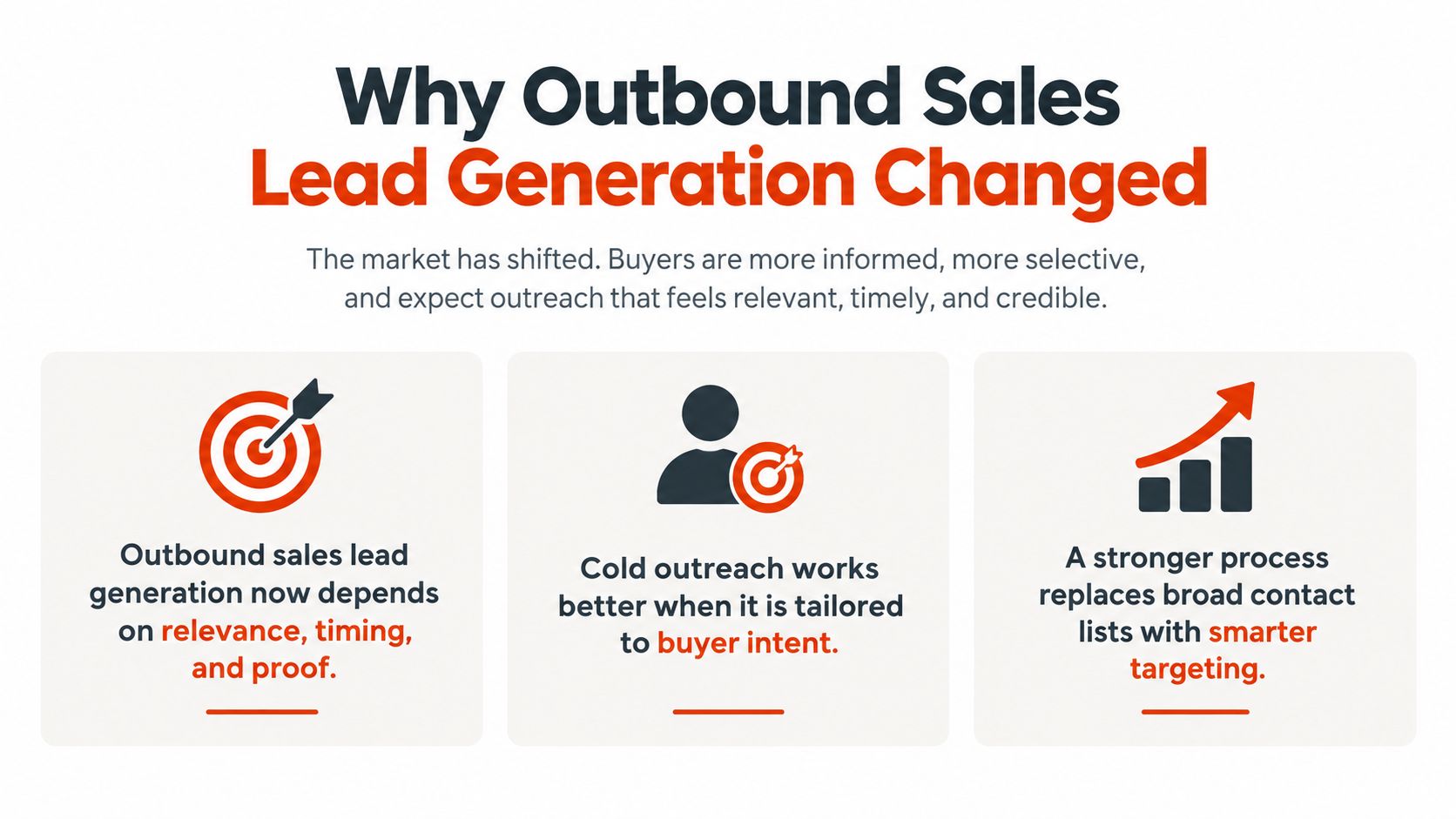
Practical rule: If the only proof of the program is sends and opens, the program is still a volume engine.
Pair a partner's point of view with pages, posts, and conversations that help a buyer evaluate without a rep. Then use sales contact when that evaluation needs a human. That is outbound sales lead generation after the channel shift, not a bigger blast list.
Choose Accounts and Buying Roles Worth the Effort
Write nothing until the account earns a place on a short list. Start with the ideal customer profile: sector, size, deal shape, and the problem you can change. Then name the buying roles that can move a high-ticket decision. A problem owner feels the pain. An economic buyer controls budget. Several other people must agree before anyone signs.
Most large B2B purchases trace back to a change inside the organization, so treat change as a filter. Prioritize accounts in the middle of a relevant shift: a new leadership mandate, a failed program, a hiring surge, a regulation, or a public commitment the current team cannot deliver. A larger list without a change trigger is volume prospecting with nicer job titles.
A pass that fits consulting and software
For an IT consulting or talent firm, the pass looks like this.
- Account traits. Named sector, a buying cycle you can support, and a problem with a number attached, such as time-to-fill, project overrun, or stalled adoption.
- Problem owner. The director who lives with that number every week.
- Economic buyer and the people who must agree. Finance, a partner, HR, IT, or the business unit that will live with the choice.
- One value proposition per role. Tied to that measurable problem, not to your service menu.
Build those roles the way you would build B2B buyer personas, then cut anyone who cannot influence the decision. RedactAI's guide to better prospecting is a useful check on whether the list is still a dump of titles.
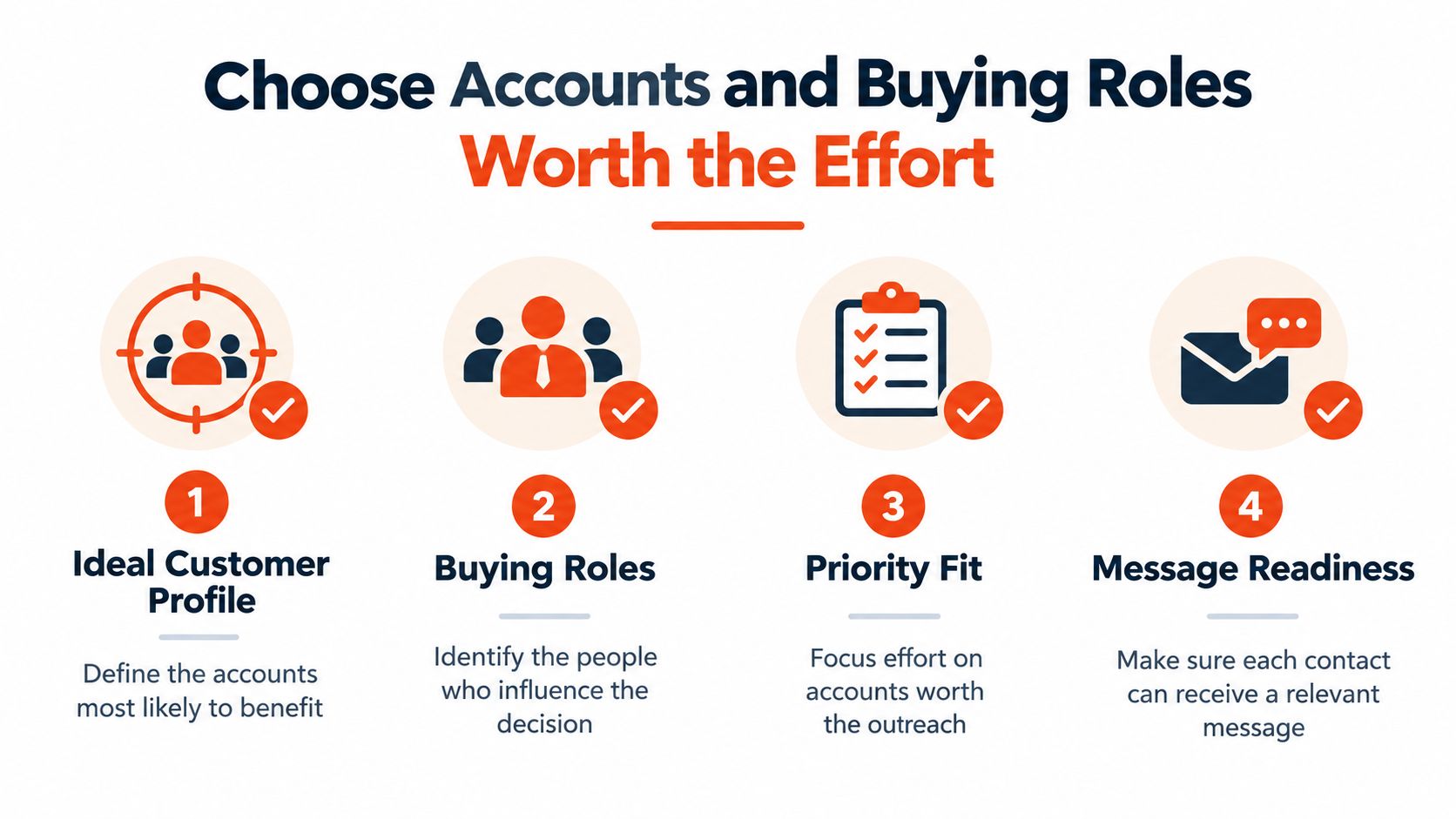
RAIN Group's study of 488 buyers and 489 sellers found that top-performing prospectors convert far more often than their peers. They win on targeting, reaching the right buyers at the right level, giving a stronger reason for the meeting, and making the first conversation specific to the buyer's situation. Message-market fit beats raw activity.
Each name on the list needs a written reason: the change, the role, and the problem you will discuss. No reason, no send.
Write Sequences That Match Buyer Research
Most buyers are already researching before they want a seller. A 2023 report summarizing TrustRadius research stated that 77% of B2B buyers began with self-directed research, so only 23% started by contacting a vendor. Direct sales contact was 43% in 2021. The same coverage reported that 87% of buyers in 2021 wanted to self-serve at least part of the journey.

Your first note should join a process, not pretend to create awareness. Supplier touchpoints have multiplied, so the sentence on LinkedIn, the email, and the page have to say the same thing.
A short sequence built on new relevance
Don't recycle the same follow-up. Coordinate a few channels around one new piece of evidence.
- Role-specific point of view. One observation about their change, written for that role, not for "leaders."
- One proof tied to the stated problem. A result, a method, or a constraint you have seen in similar work. Skip the brochure.
- A meeting ask that offers contextual help. Validation, a second opinion, or help aligning the group. Not a generic demo.
For how those notes should read on the network where senior buyers reply, use LinkedIn messaging practices as the writing standard, then mirror the claim in email.
Cold template, talent or IT consulting: "We help companies like yours improve performance. Do you have 15 minutes next week?" It could go to anyone. It will.
Intent-timed note: "You posted about rebuilding the delivery bench after the regional hire. The firms that cut contractor overspend in that situation usually fix role design before they add recruiters. If a short read on that trade-off would help the people who have to agree, I can send it. If you want a working session on the number, say so."
When delivery crowds the calendar, follow-up is the first thing that slips. Sales follow-up support for busy teams is worth reading before you promise a cadence nobody will run. A sequence that stops after two identical nudges isn't persistence. It's noise.
The video below walks through why a buyer-led path changes the job of the first meeting.
The first conversation should join a buying process that is already underway. It should not pretend to start awareness.
Qualify Intent Before You Ask for a Meeting
A good sentence is still the wrong send if the buyer doesn't want a rep yet. Gartner reports that 61% of B2B buyers prefer an overall rep-free buying experience, and 73% actively avoid suppliers that send irrelevant outreach. Aggressive, generic persistence doesn't just get ignored. It closes the account.
Buying is a loop, not a stage. People cycle through problem identification, solution exploration, requirements building, supplier selection, validation, and consensus creation. A single lead score fails because it pretends one number can mark "ready."
A composite worth acting on
Score the account, then decide whether a human should appear.
- Account fit and seniority. Right firm, right level, as defined before anyone wrote copy.
- Trigger recency. A fresh organizational change beats a stale intent flag. Apply decay so last quarter's click doesn't justify this week's call.
- Content or profile engagement. Useful as a research prompt, not as a meeting license.
- Buying-group coverage. One interested manager and a silent economic buyer is an incomplete picture.
The operating sequence is simple. Identify a trigger or demonstrated interest. Map the likely committee. Publish or deliver concise material they can evaluate alone. Watch what they do with it. Involve a seller when they need context, validation, or help building consensus. Custom intent audiences are one way to see that interest before you spend a partner's name on a cold ask. Once the composite says "talk," Truespeak's approach to lead routing shows how to hand the conversation to the right person instead of dumping it into a shared inbox.
Fix the contradiction before you add volume
69% of B2B buyers report inconsistencies between website information and what sellers say. Audit marketing, the public profile, and the seller message as one set. If they disagree, fix the disagreement. Another sequence will only repeat it.
Digital engagement is not purchase readiness. A profile view, a download, or a like is a reason to research the account again. It is not an automatic send.
Compare Cold Automation with Intent-Driven Outreach
You have a gate. The next choice is the operating model. For a long, high-ticket cycle, three approaches get confused because they all "use LinkedIn."
Content-only personal branding stops at reach. Partners post, impressions rise, and sales still asks where the meetings are. Cold automation does the opposite. Tools contact people who have shown no interest, usually in a seller's voice the buyer doesn't recognize, on a fixed cadence. The third model builds the audience of partners, directors, and senior managers, detects buying intent inside that audience, and contacts those people to book qualified meetings.
Ploot sits in that third model for B2B companies in Spain in IT and technology consulting, business consulting, HR and talent consulting, and B2B software. It builds those LinkedIn audiences, detects who is showing buying intent, and contacts them to book qualified meetings. It doesn't stop at reach, and it doesn't mail people who never showed interest. Pricing scales by the number of activated profiles. A new client can start with a 3-month pilot and agreed success criteria.
That is the offer a marketing director can defend when the board wants pipeline instead of booth scans. Events still matter. They shouldn't be the only way a senior name enters a conversation.
| Choice | Who is contacted | Voice | Trigger | Failure mode |
|---|---|---|---|---|
| Content-only personal branding | Nobody, or whoever happens to comment | The partner, with no sales handoff | A post going live | Reach without meetings |
| Cold automation | Anyone on a purchased or scraped list | A tool, or a junior sender using a template | The sequence start date | Burned accounts and ignored inboxes |
| Intent-driven outreach | People already in an authoritative audience who showed interest | Partners, directors, and senior managers | Detected buying intent | Meetings that were booked before the signal was real |
Pick cold automation only if your cycle is short and a wrong contact is cheap. For consulting and B2B software, a wrong contact costs the account. Pick the intent-timed model when the buyer's research is already underway and the person sending the note has to be someone the market already trusts.
Failure in the third column is specific. You contacted too early, or the profile had an audience but no authority in the sector. That is a targeting error you can pause. Failure in the cold column is reputational, and you often don't see it until the economic buyer tells a colleague to ignore you.
Measure Pipeline Quality and Scale What Works
Stop managing the program by sends and booked meetings. As the conversion research showed earlier, top performers win on quality outcomes, not on raw activity. Your scorecard is contacts to conversations, conversations to meetings, meeting quality, opportunities created, and proposal-to-win by segment.
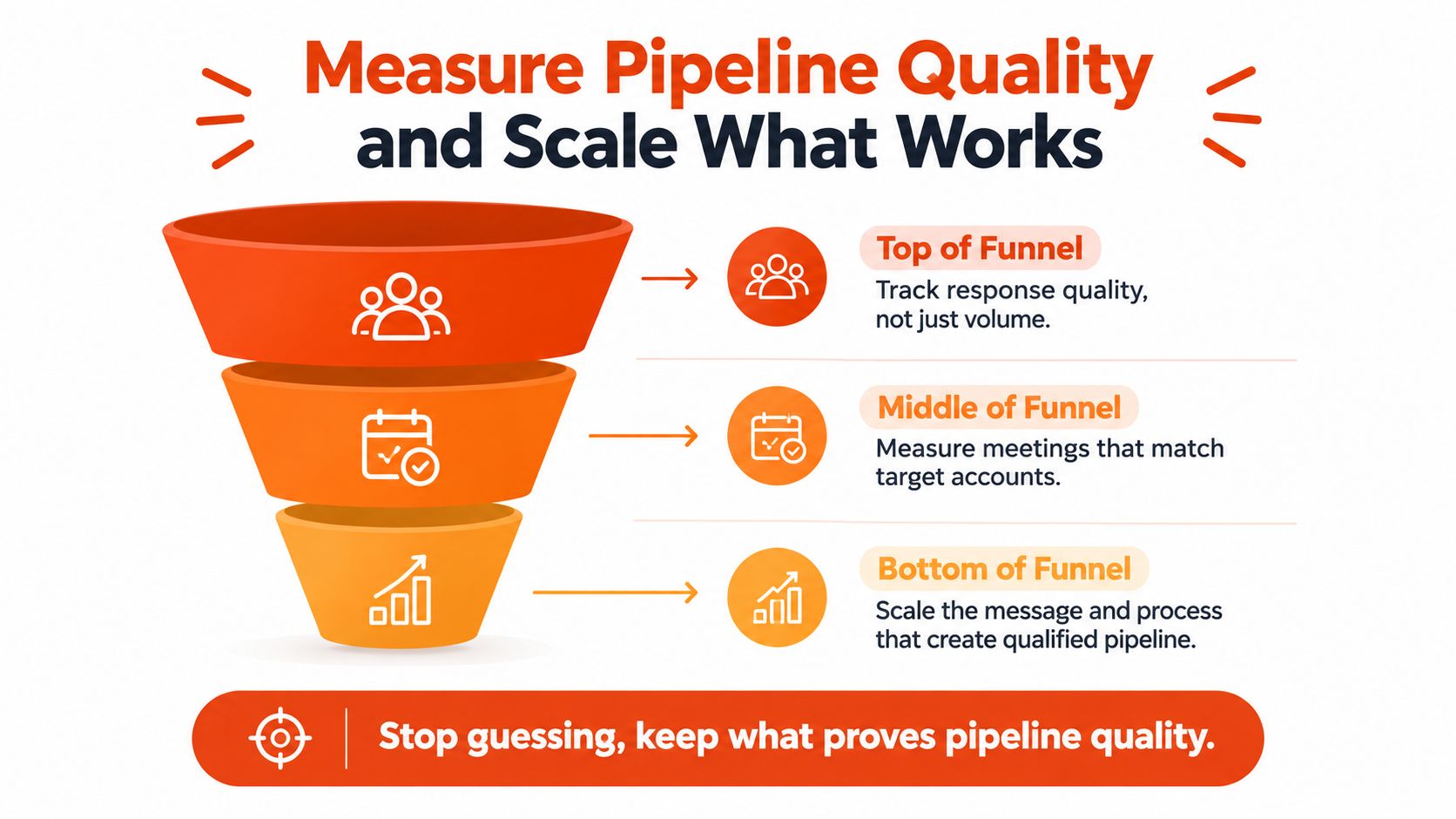
Scale by activated profile, not by list size
Add a partner or senior manager only when that profile's audience produces qualified conversations. Pause a profile whose meetings don't become opportunities. A busy poster with polite calls and no proposals is a cost, not a channel. Pricing that scales by activated profiles matches this rule. You pay to turn on a voice that can carry a meeting, not to rent another sending domain.
Run a quarterly review with sales. Three questions are enough.
- Which triggers produced meetings that the account team would take again?
- Which messages matched the website, and where did a seller improvise a different claim?
- Which accounts were contacted too early, before a recency check or a second role in the buying group?
Then scale the pattern, not the personality. If one director's notes convert because they cite a visible change, rewrite the other profiles around that standard. If a segment books meetings that never reach proposal, stop feeding it.
Start the pilot this quarter
- Agree success criteria for a 3-month pilot before the first profile goes live. Meetings that match the target account, opportunities created, and a proposal path. Not impressions.
- Pick the first profiles with real sector authority. Partners and senior managers the buyer might already know.
- Define the intent signals that may trigger contact, and the decay that retires old ones.
- Review pipeline, not impressions, at the end of the pilot. Keep the profiles that create opportunities. Pause the rest.
Outbound sales lead generation is a qualification system with a human voice. If the pilot can't show opportunity quality, don't buy more activity. Change the list, the trigger, or the person sending the note.
Ploot builds the LinkedIn audience of your partners, directors, and senior managers, detects buying intent in that audience, and contacts those people to book qualified meetings for long, high-ticket B2B cycles. If you want outbound sales lead generation judged by pipeline instead of sends, start with a 3-month pilot and success criteria you agree up front. Visit Ploot to see how activated profiles turn into meetings.