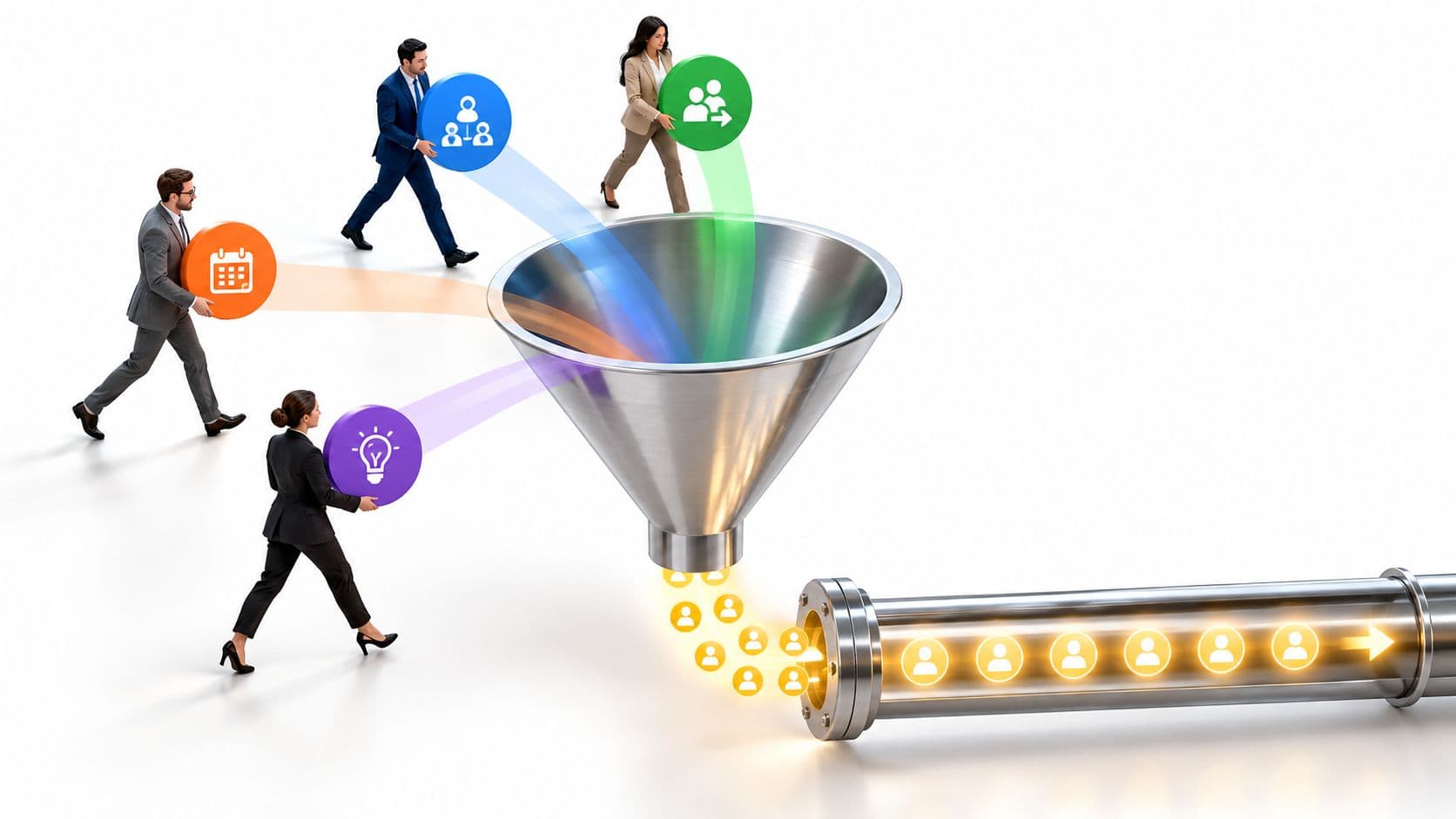

A modern B2B lead generation process should capture behavioral intent, score the account and person separately, and trigger a relevant conversation within minutes when the signal is strong. The old model of collecting form fills and sending cold outreach misses anonymous researchers while overwhelming sales with activity that looks like interest but isn't buying intent.
The problem isn't a lack of channels. Buyers now move between search, executive content, peer recommendations, events, websites, email, and conversations with sellers. The operating challenge is deciding which behavior deserves attention, who should make contact, and how quickly that contact should happen.
For consulting firms and B2B software companies selling in Spain's relationship-led markets, that judgment matters more than another lead list. A director who reads one article isn't equivalent to a high-fit account whose senior stakeholders return to your expertise after a commercial event. Treating them alike produces either missed demand or intrusive outreach.
Table of Contents
- Why the Old B2B Lead Generation Process Is Broken
- Defining Ideal Profiles and Capturing Real Intent Signals
- Scoring, Routing, and the Critical Response-Time Gap
- Moving From Anonymous Research to Qualified Conversations
- Building a Repeatable Lead Generation Workflow
- Measuring Pipeline Contribution Instead of Lead Volume
- Piloting a Smarter B2B Lead Generation Process
Why the Old B2B Lead Generation Process Is Broken
The traditional B2B lead generation process assumes that buyers move neatly from advertisement to landing page, from form fill to sales call, and from sales call to opportunity. That sequence is convenient for reporting, but it doesn't reflect how complex purchases happen. McKinsey found that B2B buyers used an average of 10 interaction channels in 2022, up from 5 in 2016, in research covering more than 3,800 decision-makers across 13 countries. The purchasing path has become wider and less linear, not merely longer. (McKinsey's B2B Pulse research)
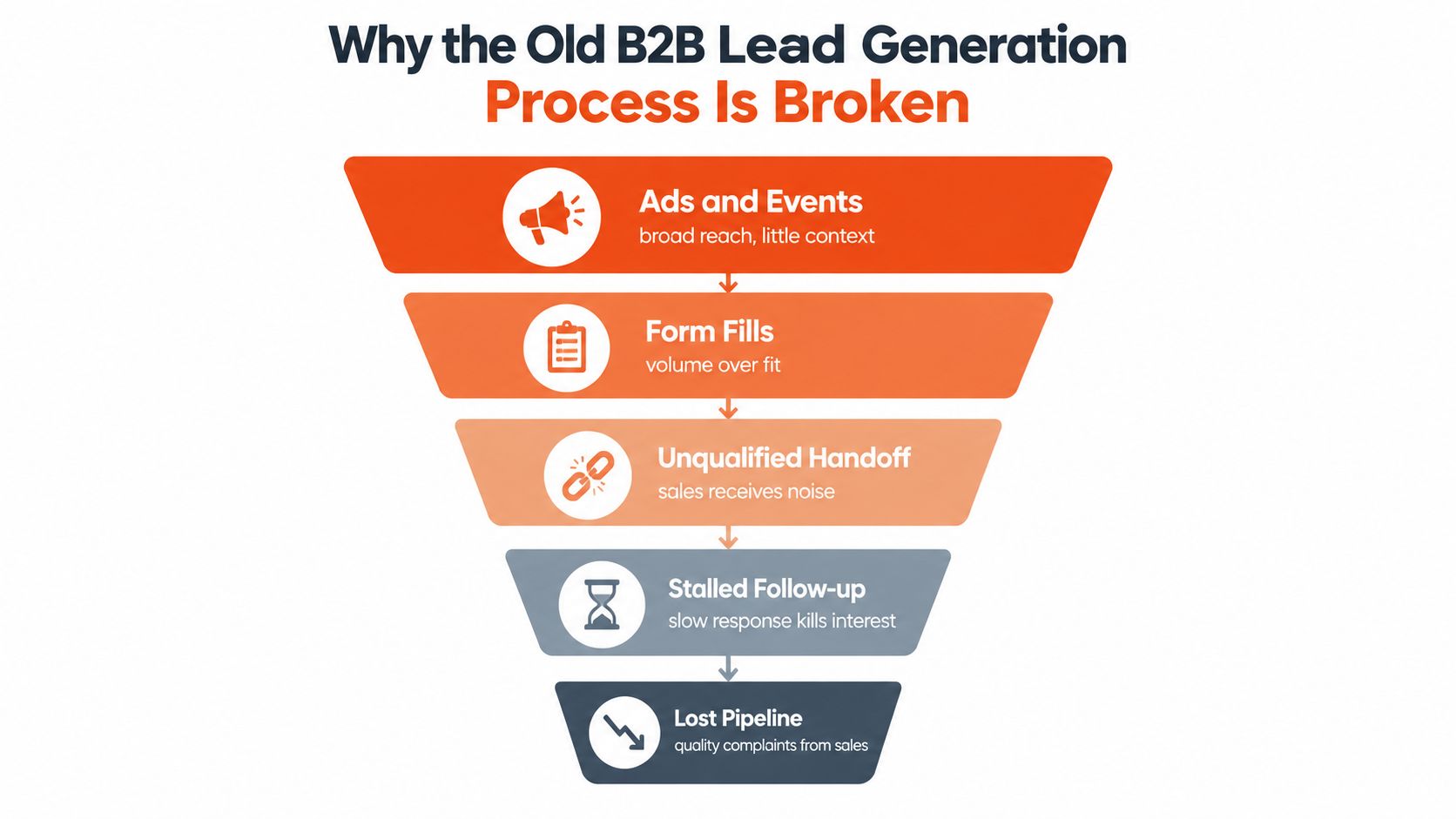
A volume-first system creates two forms of waste. It misses people who research anonymously, compare vendors through colleagues, or return through a different channel. It also sends sales teams contacts whose only meaningful action was downloading a broad guide or accepting a connection request.
Practical rule: A lead isn't qualified because your database can store it. It's qualified when fit, behavior, and buying context point in the same direction.
The handoff is usually the failure point
Marketing often optimizes reach, clicks, registrations, and form fills because those metrics are easy to collect. Sales then receives a spreadsheet without the prospect's triggering context, the relevant business problem, or a reason to contact the person now. The resulting message is generic, and the prospect experiences it as interruption rather than help.
Gartner reported that 61% of B2B buyers preferred an overall rep-free buying experience, while 73% actively avoided suppliers that sent irrelevant outreach. (Gartner's 2025 buyer survey) Buyers still want expert input when they need contextual judgment. They just don't want a seller inserted before that judgment is useful.
The better model treats lead generation as an engineered workflow. Content creates informed attention, behavioral data identifies patterns, account and person fit determine priority, and a credible seller enters when the buyer has shown enough evidence to make human involvement relevant.
Defining Ideal Profiles and Capturing Real Intent Signals
A lead generation process becomes useful only after the team defines two things precisely: which accounts deserve attention and which behaviors indicate a real problem. Start with an ideal customer profile that combines firmographics, technographics, role, and problem fit. Industry and location matter, but so do the systems the company already uses, the seniority of the person involved, the business change creating urgency, and the consequences of leaving the problem unresolved.
Map the buying committee rather than building a single buyer persona. A partner may provide authority, a marketing director may own the business case, a technical leader may assess delivery risk, and finance may challenge the investment. Their actions won't look identical, so a useful process records the relationship between people and the account.
For teams refining audience definitions, LinkedIn audience targeting offers a practical way to connect role, company, sector, and professional context before launching campaigns.
Separate browsing from buying evidence
A single page view is weak evidence. A broad content download is also weak unless it fits a wider pattern. The signal becomes more meaningful when behavior has relevance, repetition, and context:
- Relevance: The person engages with category-specific expertise, implementation risks, comparisons, or commercial questions rather than general awareness content.
- Repetition: The same person returns, consumes related material, or moves from educational content toward evidence that supports vendor evaluation.
- Account breadth: Multiple stakeholders from one company engage with related themes, suggesting internal research rather than isolated curiosity.
- Commercial context: Engagement follows an event, organizational change, leadership discussion, or other trigger that makes the problem more immediate.
Anonymous research makes this harder, not impossible. Account-level activity can reveal that a high-fit company is paying attention even when individual identity remains unclear. That shouldn't trigger a blind sales sequence. It should trigger better observation, relevant content distribution, and preparation for a trusted introduction.
Use a signal ladder
Classify activity into three practical levels:
- Weak signal: passive reach, one-off page views, or broad social engagement. Keep the person in education and avoid direct escalation.
- Developing signal: repeated engagement with a relevant subject, return visits, or interaction from several people at a target account. Increase relevance and monitor the account.
- Strong signal: a direct inquiry, a high-intent content interaction combined with strong account fit, or behavior immediately after a commercial trigger. Route it for prompt human review.
The point isn't to pretend that behavior proves readiness. It creates a defensible reason to choose the next action.
Scoring, Routing, and the Critical Response-Time Gap
Scoring fails when it reduces a complicated buying situation to one number attached to one contact. A better design maintains two views: account fit and person readiness. An interested individual at a poor-fit company shouldn't receive the same treatment as a senior decision-maker at a high-fit account.
Score the account and person independently
Account scoring should reflect the conditions that make your offer valuable. Consider sector, geography, technology environment, organizational complexity, and the business problem your firm solves. Person scoring should reflect role, authority, subject relevance, recency, and the depth of engagement.
You don't need false precision. A practical rule can classify accounts and people as high, medium, or low priority, provided the criteria are explicit and sales can challenge them. Teams looking to formalize the mechanics can use lead scoring in HubSpot as a reference point, then adapt the model to their own buying committee.
The handoff record should contain more than a name and a score:
- Fit: Why does this account belong in the target market?
- Trigger: What did the person or account do?
- Topic: Which business problem or category did the behavior indicate?
- History: What relevant interactions happened before the trigger?
- Next move: Which trusted person should contact them, through which channel, with what useful point of view?
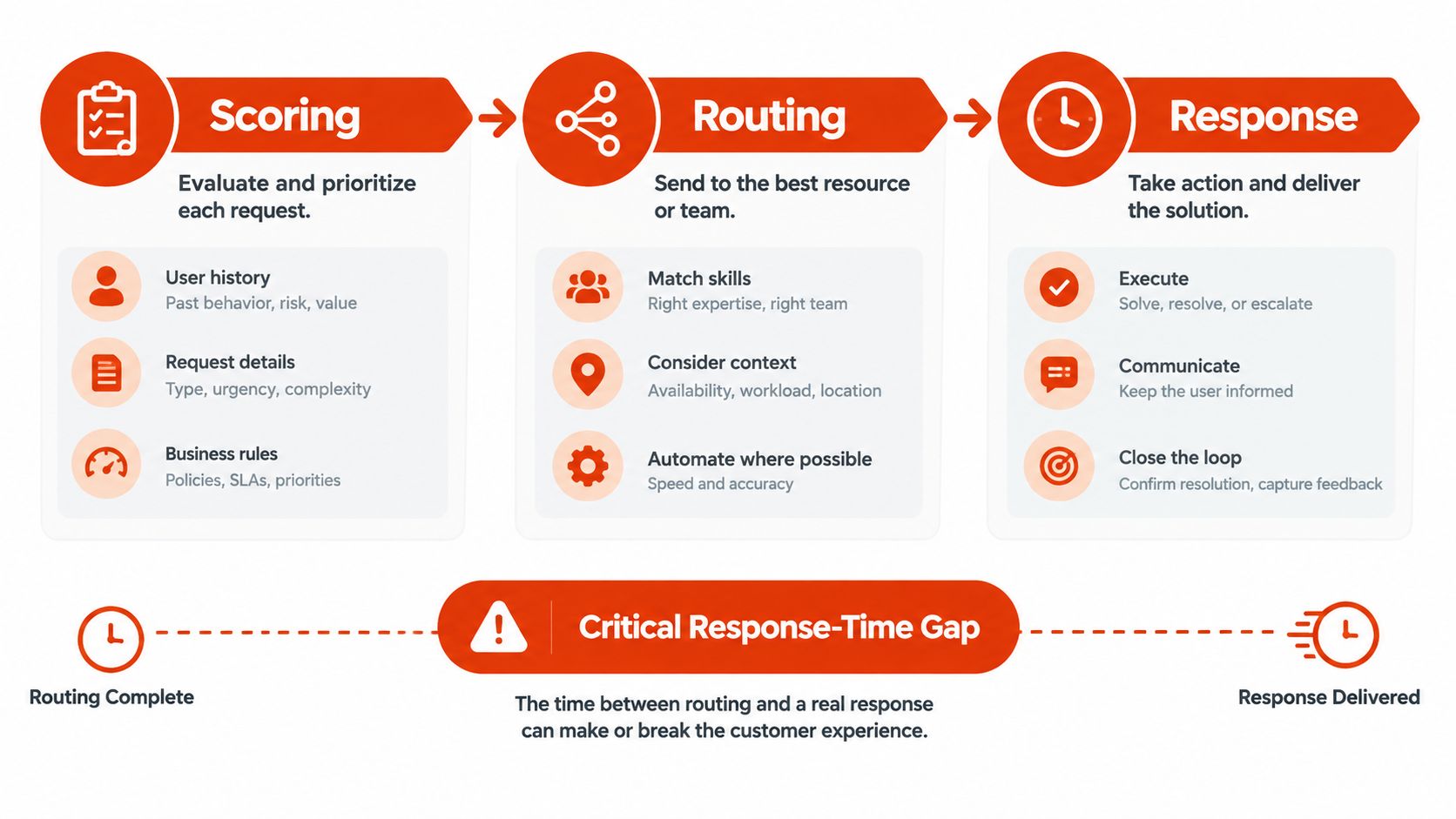
Speed matters once the signal crosses the threshold. A Harvard Business Review study of 2,241 U.S. companies found that organizations contacting an online lead within one hour were nearly seven times more likely to achieve a meaningful conversation with a decision-maker than those waiting an additional hour, and more than 60 times more likely than organizations waiting 24 hours or longer. (The speed-to-lead findings) For high-value consulting and software sales, that supports a response target measured in minutes, not days.
Make speed conditional on relevance
Fast outreach isn't automatically good outreach. A seller who contacts every active account with a generic pitch may increase activity while reducing trust. Set an operational SLA for strong signals, then require the seller to use the triggering context in the first message.
Track median time-to-first-touch, the share of high-intent signals contacted within five minutes, contact-to-meeting rate, qualified-meeting rate, opportunity creation rate, and pipeline per activated profile. Review speed and quality together. The objective isn't to win the race to send an irrelevant message. It's to reach the right person while the reason for contact is still current.
Moving From Anonymous Research to Qualified Conversations
High-value B2B buying rarely starts with a form fill. It starts with scattered, anonymous signals that only become useful when someone reads them in context. A senior partner at a target consulting account reads a report on a problem your firm solves. Weeks later, a marketing director from the same company engages with related expertise, and another stakeholder attends a relevant event. Any one action on its own is ordinary professional activity. The pattern across the account is what deserves a response.

Treat that moment carefully. Anonymous research is not consent to pitch. In practice, the best move is often to route the signal to the strongest credible messenger, not the fastest available rep. If a partner has real authority in that sector, that person can share a relevant observation, send a point of view tied to the issue, or invite a genuine exchange. The buyer keeps control of the pace, and your team still turns interest into a qualified conversation.
That is the trade-off many lead generation teams miss. Volume-based handling treats every signal like a hand raise. Good operators separate meaningful intent from background noise, then use people the account already trusts.
Match the response to the evidence
Three situations come up often:
- One relevant article from a low-fit account: keep the contact in education flows and watch for repeat activity. Seniority alone is a weak signal.
- Repeated engagement from a high-fit account by a manager: send a useful diagnostic, a sharp point of view, or a concise observation tied to the problem. Then monitor whether others at the account join in. The manager may shape the shortlist even without owning the budget.
- Several stakeholders engaging after a commercial event: route the account quickly to an authoritative person who can discuss the business issue in plain terms. Include the event context and the topic that connected those stakeholders.
This is also the practical difference between list building and real pipeline creation. A useful explanation of what prospecting really means frames it as finding and developing relevant opportunities, not interrupting everyone who loosely matches an ICP.
In Spain, this matters even more. Buyers in relationship-led markets often need to justify a vendor choice internally before they ever agree to a formal meeting. Reputation, sector credibility, and the messenger's standing all affect whether early interest turns into a live conversation. Done well, human involvement adds judgment at the right moment and through the right person.
Building a Repeatable Lead Generation Workflow
A reliable b2b lead generation process is a chain of decisions, not a collection of campaigns. Each stage should produce the information required by the next stage. If the team skips account definition, scoring becomes arbitrary. If it skips context during routing, speed produces generic outreach. If it skips measurement beyond lead volume, no one can tell which parts create pipeline.
Use this operating sequence:
- Define the target: Document the ideal account, buying committee, problem fit, exclusion criteria, and the people who can credibly represent the firm.
- Capture the signal: Record relevant content interaction, repeat visits, event engagement, direct inquiry, or account-level patterns. Preserve the subject and timing, not just the activity label.
- Evaluate two dimensions: Score account fit and person readiness separately. Use thresholds that sales understands and can review.
- Route with context: Assign the signal to the responsible seller or authority figure. Include the triggering behavior, account history, likely concern, and recommended opening.
- Respond while current: Start a personalized conversation through the channel and messenger that fit the strength of the signal. Keep self-service available for buyers who aren't ready to speak.
McKinsey's research shows why this workflow must coordinate channels. Buyers used an average of 10 interaction channels in 2022, compared with 5 in 2016, in research involving more than 3,800 decision-makers across 13 countries. (McKinsey's channel research) A website, executive profile, event, email, and seller conversation shouldn't present conflicting claims or disconnected handoffs.
Operational standard: Every routed signal should answer three questions before a seller acts: why this account, why this person, and why now?
Teams can document ownership, stages, and follow-up rules in a CRM or revenue orchestration system. For a broader view of how sales teams coordinate activity across the full cycle, GrowOutly for sales teams provides useful context. The tool matters less than the discipline. Marketing, sales, and senior experts need one definition of qualified interest and one visible record of what happened next.
Measuring Pipeline Contribution Instead of Lead Volume
Form fills answer a narrow question: did someone exchange contact information for something? They don't answer whether the account fits, whether the person can influence a purchase, or whether the interaction led to a qualified opportunity.
A pipeline view asks different questions. Did target accounts engage? Did the engagement create a qualified meeting? Did meetings become opportunities? Did the opportunity progress with the right stakeholders? Did marketing and expert-led activity contribute to pipeline or new ARR?
A 2025 attribution report found that only six in ten B2B marketers track pipeline generated, half measure opportunities created, and one in three report new ARR. (The 2025 marketing attribution report) The gap explains why marketing teams often defend activity while sales leaders question commercial impact.
Replace vanity metrics with decision metrics
| Metric | What it tells you | What it doesn't prove |
|---|---|---|
| Reach and impressions | Whether content was distributed | That target buyers cared |
| Form fills and downloads | Whether an offer generated a response | That the account is qualified |
| Qualified-meeting rate | Whether routed interest became a useful conversation | That the opportunity will close |
| Opportunity creation rate | Whether meetings contributed to active pipeline | That marketing caused the entire deal |
| Pipeline per activated profile | Whether trusted people generate commercial access | That last-touch attribution is complete |
| Sales-cycle velocity | Whether qualified opportunities progress efficiently | That speed can replace relevance |
Last-touch reporting is especially weak for relationship-led demand. A senior director may build familiarity through ongoing expertise, share a point of view internally, and influence a later inquiry that appears to come from direct traffic. The final click gets credit, while the trust-building work disappears.
Social publishing tools, including a Social Media Scheduler LinkedIn calendar, can help teams plan consistent activity. But the calendar isn't the outcome. Set pilot criteria around target-account engagement, qualified meetings, opportunity creation, and cost per opportunity before publishing begins. Review qualitative sales feedback alongside the dashboard, because a meeting that lacks a real business problem shouldn't count as success.
For a practical explanation of how marketing activity connects to commercial outcomes, see what pipeline generation means. The central discipline is simple: report the movement that finance and sales recognize, while preserving enough journey context to avoid false precision.
Piloting a Smarter B2B Lead Generation Process
Don't rebuild every campaign, channel, and CRM rule at once. A focused three-month pilot can test whether stronger signals, trusted messengers, and faster handoffs create better conversations than volume-led activity.
Begin by selecting a narrow group of high-fit accounts and a small set of credible professional profiles. Define the problems those accounts are likely to face, publish or distribute expertise around those problems, and record engagement at both account and person level. Keep weak signals in nurture. Route only patterns that combine fit with meaningful behavior.
Set the operating rules before launch
Write the rules in plain language:
- Target rule: Which sectors, roles, technologies, and problems qualify an account?
- Signal rule: Which combinations of repetition, relevance, stakeholder breadth, or commercial context justify review?
- Handoff rule: Who receives the signal, and what context must appear in the record?
- Response rule: How quickly must a high-intent signal receive a relevant first touch?
- Quality rule: What makes a meeting qualified, and which meetings don't count?
- Stop rule: When should outreach pause because the evidence is too weak or the prospect isn't receptive?
Review the pilot weekly with marketing and sales together. Examine account quality, signal strength, response time, message relevance, meeting quality, and opportunity progression. If sales rejects a signal, record the reason and adjust the criteria. Don't lower the threshold just to increase routed volume.
At the end of the pilot, compare the agreed success criteria with the evidence. Scale the workflow if it produces qualified conversations and credible opportunity movement. Refine it if engagement is strong but meetings are weak. Stop or reposition it if the audience, messenger, or problem definition is wrong.
The process should leave you with a documented signal model, clear ownership, consistent messaging, and a response habit that the team can repeat without relying on individual heroics.
Ploot helps B2B consulting and software teams activate the LinkedIn audiences of partners, directors, and senior managers, identify buying-interest signals, and route relevant prospects toward qualified meetings. If you want to test a signal-led workflow in a three-month pilot, visit Ploot and define the accounts, profiles, and success criteria with the team.