

A buyer may read your content, attend an event, and still not be ready to speak with sales. B2B demand generation is the coordinated work of creating interest, educating people involved in a purchase, and helping turn that interest into qualified pipeline before a proposal is requested. Buyers value easy access to digital information, while a sales representative can still help them assess options and make progress.
You may recognize the tension: your team publishes content, promotes events, and adds contacts to the CRM, yet sales still asks which accounts are moving toward a purchase. A download or a busy webinar shows attention, not necessarily an aligned buying group or a sales conversation. Those signals are like footprints: useful clues, but not proof of where the group is headed.
Measure whether your activity helps the right accounts progress toward qualified pipeline, rather than relying on reach or form fills alone. In a three-month pilot, track that contribution across the buying group and connect engagement to account progression and sales conversations. That gives you a clearer test of demand generation than a large contact count.
Table of Contents
- Defining B2B Demand Generation Marketing
- Demand Generation Versus Lead Generation and Brand Marketing
- Matching Content to the Long B2B Buyer Journey
- Reaching the Whole Buying Group in Consulting and Software Deals
- Channels and Tactics That Surface Buying Intent
- Pipeline KPIs That Prove Demand Generation Works
- Two Examples From Consulting and B2B Software
- Set Your Pilot Success Criteria Before Launch
Defining B2B Demand Generation Marketing
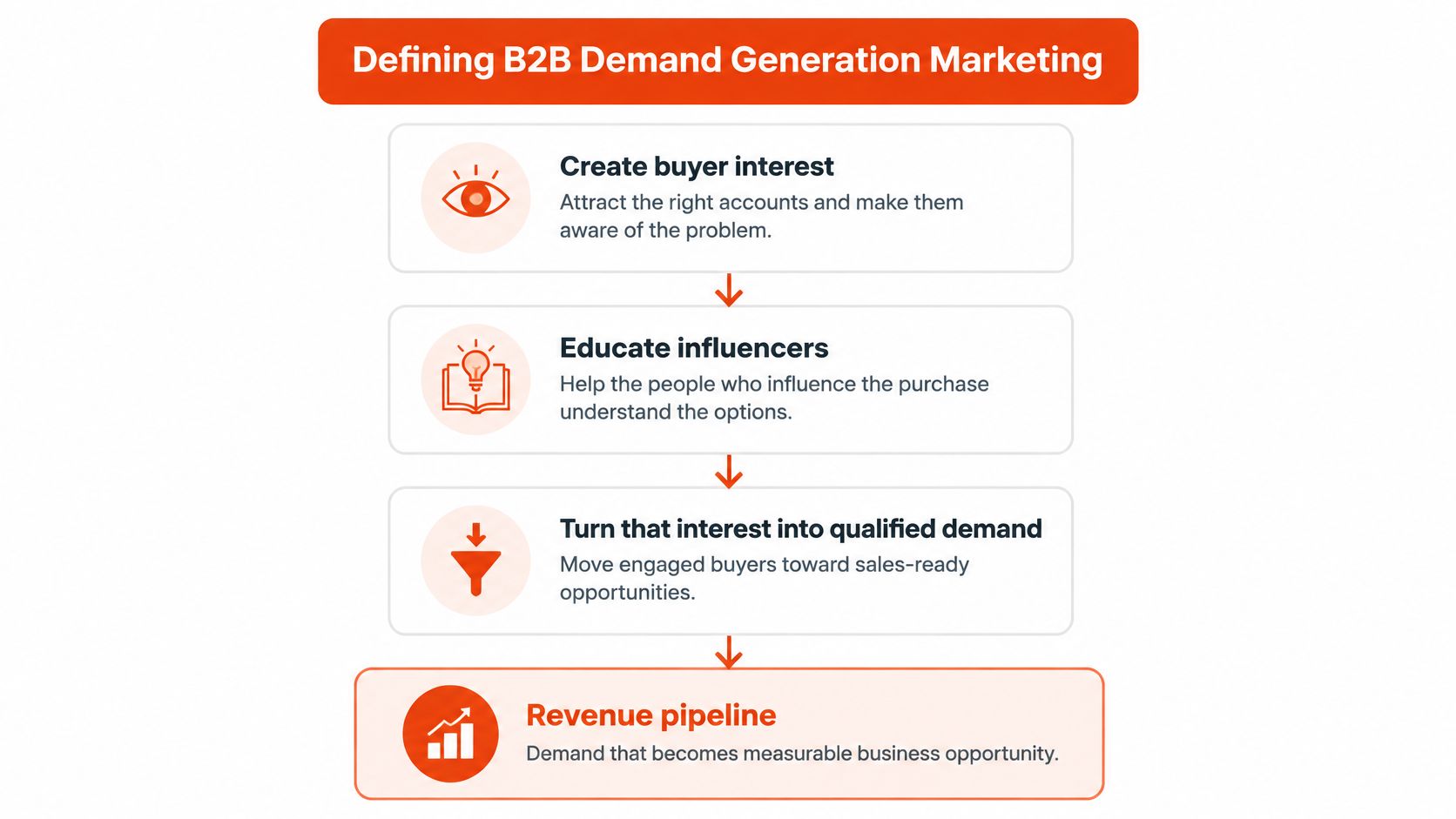
B2B demand generation marketing is the coordinated work of creating buyer interest, educating the people who will influence a purchase, and turning that interest into qualified pipeline before a buyer asks for a proposal.
Lead capture is like placing a net at the dock and waiting for fish. Demand generation is the upstream work: making the river worth fishing, understanding what kinds of fish are there, and knowing when they're likely to feed. The net still has a role, but it can't do the upstream work for you.
Buyers typically move through three broad layers. First, they become aware that a problem or opportunity exists. Then they explore categories of solutions and decide what kind of approach might work. Finally, they develop a preference for a specific supplier. In long B2B purchases, those layers overlap: a finance leader may compare suppliers while a colleague is only beginning to understand the problem.
Build a loop, not a one-off campaign
A practical demand generation loop starts with a named list of target accounts. Your team publishes useful content and distributes it through credible voices, then looks for signals that a need may be forming. When an account shows enough relevant activity, marketing gives sales the context to make a timely, useful approach. The team then measures whether that work contributed to meetings, qualified opportunities, or pipeline.
The handoff matters. A sales representative shouldn't receive only a name and a score. They need to know which account is active, which roles have engaged, what topics those people care about, and why a conversation makes sense now. That context lets sales open with a relevant question rather than a generic pitch.
Three conditions make this loop workable: a named target account list, one consistent message across channels, and an agreed rule for when sales should step in. Without those conditions, marketing and sales can use the same words, such as “engaged” or “qualified,” to mean entirely different things.
Demand Generation Versus Lead Generation and Brand Marketing
Brand marketing asks whether people remember you in the category; lead generation asks who raised a hand; demand generation asks which target accounts are moving toward a purchase and whether your activity helped.
| Dimension | Demand Generation | Lead Generation | Brand Marketing |
|---|---|---|---|
| Primary goal | Create buyer interest and qualified pipeline | Capture contact details from interested prospects | Build recognition and trust in the category |
| Audience | Target accounts and the wider buying group | Individuals who respond to an offer | Broad market, including people who aren't buyers yet |
| Time horizon | Months, tied to the buying cycle | Days to weeks, per campaign | Years, cumulative |
| Main metric | Engaged accounts, meetings, and influenced pipeline | Form fills and marketing qualified leads | Aided awareness and share of voice |
| Typical output | Account-focused content, distribution, and a sales handoff | Gated assets, webinars, and paid forms | Brand campaigns, thought leadership, and press |
| Common failure | Pipeline stays unproven without sales alignment | Volume with little buying intent | No link to revenue when results aren't measured |
A gated whitepaper can be a lead generation tactic inside a wider demand generation program. The distinction is what you do with the signal. Counting downloads tells you that people completed a form; it doesn't tell you whether the right account is considering a purchase, whether other stakeholders are involved, or whether sales has a useful reason to reach out.
Use lead generation when a product is transactional, the buying cycle is short, and one self-directed buyer can make the decision. Use brand marketing to build recognition before a buyer has an active need. Demand generation fits long, high-ticket purchases with several decision makers, where a single form fill rarely reflects the full decision.
To assess a campaign, ask three questions: Does it reach named accounts? Does it reach more than one role in those accounts? Would sales recognize its output as a conversation worth having? If you can't answer yes, the campaign may still have a role, but don't confuse its activity with proven demand.
Matching Content to the Long B2B Buyer Journey
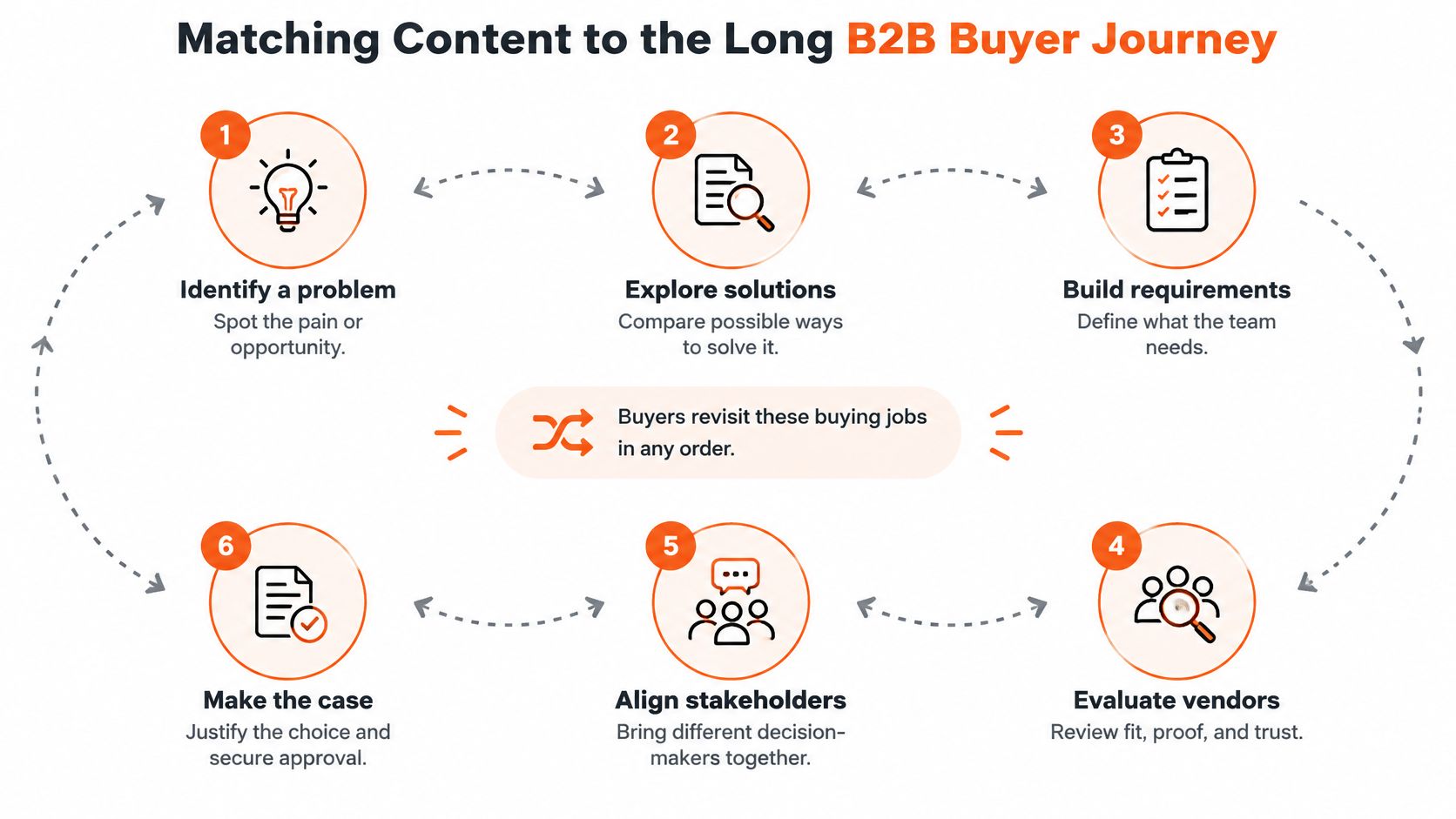
Buyers don't move neatly from awareness to purchase. Gartner describes B2B purchases as repeatedly moving among six buying jobs: identifying a problem, exploring solutions, building requirements, selecting suppliers, validating the choice, and creating internal consensus. It also reports that 99% of B2B purchases are driven by organizational changes, such as new leadership or strategic priorities, rather than by a simple, predictable funnel, according to Gartner's guide to the B2B buying journey.
A renovation is a useful comparison. You might research a drafty kitchen yourself, look at different heating or insulation options, collect quotes, and call a builder when you need someone to check whether your plan suits the actual house. B2B buyers do something similar: they often want useful information on their own before they're ready for a sales conversation.
Match a useful move to each buying job
- Identify a problem. Publish problem-framing research that helps buyers see the cost, risk, or missed opportunity in their current approach.
- Explore solutions. Use category explainers and solution primers to lay out different ways to address the issue.
- Build requirements. Offer checklists and evaluation frameworks that help the buying group decide what the solution must do.
- Select suppliers. Provide comparison guides and anonymized case studies so buyers can judge fit and evidence.
- Validate the choice. Make reference conversations and proof of delivery available when the team wants reassurance about execution.
- Create internal consensus. Give champions executive briefs and a clear return-on-investment logic they can share with colleagues.
Gartner reports that 75% of B2B buyers prefer a sales experience without a representative, and that 64% of buyers familiar with a product or service prefer a completely digital buying experience. Yet buyers are 1.8 times more likely to complete a high-quality deal when they use supplier-provided digital tools with a sales representative than when they use those tools independently. The practical implication is to make educational material easy to find, then bring in a person when buyers need help validating a choice, building consensus, or applying information to their specific business.
Practical rule: Make later-stage content easy for a new colleague to understand. Buyers loop back, and someone who joins the decision late may need the problem explained before they can assess the supplier.
Reaching the Whole Buying Group in Consulting and Software Deals
A hidden buyer is a colleague who shapes the problem or supplier decision without ever filling out a form.

In consulting and software purchases, the person who requests a demo may not be the person who signs the contract. A business sponsor may care about strategic results, while finance, IT, operations, HR, and procurement each assess a different risk. A plan based on one contact can therefore leave the account exposed, even if that contact is enthusiastic.
The 2025 Edelman–LinkedIn study of nearly 2,000 management-level professionals globally found that 63% of hidden buyers spend more than an hour each week consuming thought leadership. It also found that 81% say high-quality thought leadership helps them recognize previously unrecognized challenges or opportunities, while 71% say it demonstrates a vendor's potential value more effectively than traditional marketing or sales materials.
| Role | Main Concern | Content That Reaches Them | Signal to Watch |
|---|---|---|---|
| Business sponsor (CEO, managing director, or partner) | Strategic impact and risk | Executive briefs and peer thought leadership | Repeated engagement with strategy content |
| Technical evaluator (CTO or IT lead) | Integration and fit with current systems | Technical deep dives and architecture notes | Downloads of implementation material |
| Finance leader (CFO or financial controller) | Cost, payback, and budget ownership | ROI models, pricing logic, and cost-benefit cases | Visits to pricing or ROI pages |
| HR or talent lead | People impact, adoption, and capability building | Change-management case studies | Engagement with talent-related content |
| Operations or end-user manager | Day-to-day workload and process change | Process guides and how-to material | Comments and shares within the account |
| Procurement | Vendor risk and contract terms | Security, compliance, and contract overviews | Requests for vendor documentation |
For each target account, list the roles likely to shape the decision. Then check which roles engage and choose the next content gap to address. If you need a practical starting point for defining those roles and their concerns, use this guide to buyer personas for B2B marketing.
Don't treat every impression as evidence of buying intent. A broad post view is passive reach; repeated attention from a senior person to relevant strategy content is more meaningful. A smaller audience of credible voices may have more influence than broad exposure if it reaches hidden buyers while they're defining the problem. If only one role in a named account is engaging, the deal is still exposed.
Before choosing your next distribution move, consider the distinction between a one-off click and activity that meaningfully spreads through an account.
Channels and Tactics That Surface Buying Intent
Engagement is easy to produce; the harder task is distinguishing professional curiosity from a live commercial need. A single click shouldn't trigger an automated sales sequence. Better evidence comes from several signals working together: repeated engagement over time, a topic that matches a real business problem, seniority, account fit, activity from more than one role, and a timing trigger such as a leadership change or shift in strategy.
A useful guide to B2B buying signals can help teams think beyond isolated actions. The 2025 Edelman–LinkedIn thought leadership impact report highlights the practical challenge: marketing needs evidence for whom to contact, when to do it, and what message is relevant, without pretending that one post created demand.
| Channel | Journey Job It Serves | Intent Signal to Track | Limit |
|---|---|---|---|
| Thought leadership from senior staff on LinkedIn | Problem framing and internal consensus | Repeat engagement from target-account roles | Reach alone doesn't show a live need |
| Owned research and reports | Solution exploration and validation | Return visits and gated-asset downloads | Downloads can reflect curiosity only |
| Webinars and peer roundtables | Requirement building | Attendance and questions asked | Small audiences and high effort per attendee |
| Account-based advertising | Awareness within target accounts | Visits from engaged accounts | Hard to tie to named individuals |
| Events and trade shows | Preference and relationship building | Meeting requests after conversations | Costly, hard to scale, and slow to show pipeline |
| Outbound sales sequences | Supplier selection and validation | Replies and meeting bookings | Cold outreach without a signal damages trust |
| Partner and referral networks | Trusted introductions | Introductions from known contacts | Slow to build and hard to forecast |
Thought leadership works best when a trusted expert shares a useful point of view that a buyer can pass to colleagues. For teams building a LinkedIn program, these LinkedIn lead generation ideas for startups offer practical channel ideas to adapt for the audience and sales cycle. Owned research can help buyers explore an issue, while peer roundtables give a smaller group room to discuss requirements in more depth.
Use the channels that reach your target account first. Start outbound when the combination of account fit, relevant activity, and timing gives sales a credible reason to make contact. Treat the message as a response to a signal, not as a substitute for generating interest.
Pipeline KPIs That Prove Demand Generation Works
Content can create awareness and demand without making its commercial contribution obvious. In Content Marketing Institute's 2025 B2B benchmark, 74% of B2B marketers said content generated demand or leads, but only 29% rated their content strategy extremely or very effective. Fifty-six percent cited difficulty attributing return on investment to content, according to the institute's B2B content marketing statistics.
That gap is why reach and downloads aren't enough. Track whether activity reaches qualified accounts, spreads among the buying group, and contributes to sales conversations and opportunities.
| KPI | What It Measures | Review Cadence | Common Pitfall |
|---|---|---|---|
| Target accounts engaged | Share of named accounts with meaningful engagement | Monthly | Counting reach as engagement |
| Buying-group coverage | Distinct roles engaged within each account | Monthly | Counting one contact several times |
| Meetings booked from target accounts | Qualified first meetings | Weekly | Booking meetings that fail agreed criteria |
| Qualified opportunities created | Opportunities meeting agreed stage criteria | Monthly | Loosely defined stages |
| Influenced pipeline | Pipeline value where demand activity touched the account | Quarterly | Claiming sole credit for the deal |
| Time to first meeting | Days from first signal to first meeting | Monthly | Ignoring slow-moving accounts |
| Conversion by activated profile | Meetings and opportunities per active profile | Monthly | Comparing profiles with different audiences |
| Cost per qualified opportunity | Spend divided by qualified opportunities | Quarterly | Ignoring the lag between spend and pipeline |
Attribute contribution, not sole credit
Set a baseline using meetings, qualified opportunities, and influenced pipeline from the previous six to twelve months. Then compare target accounts that engaged with comparable accounts that didn't, while noting whether authoritative content increased exposure, accelerated an existing opportunity, or helped create a meeting with a previously unengaged buying group. That makes a more defensible contribution claim than assigning an entire deal to one post.
For broader thinking on how to connect channel choices to business outcomes, this guide to B2B marketing beyond channel tactics is a useful companion. Agree with sales on what counts as a qualified opportunity before a campaign launches; the label should mean the same thing to both teams. For practical guidance on setting those shared expectations, see this resource on B2B marketing and sales alignment.
Two Examples From Consulting and B2B Software
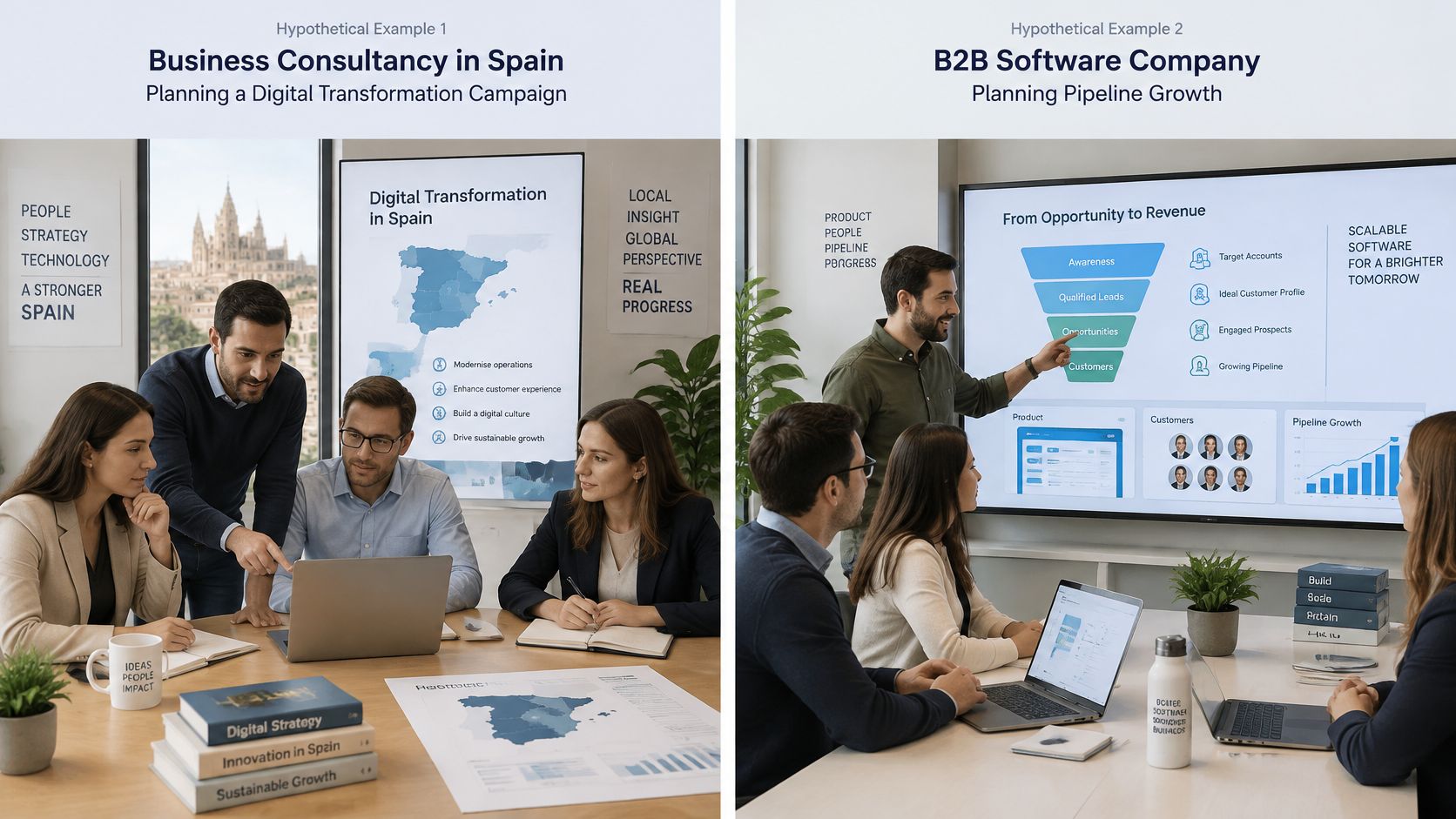
The scenarios below are illustrative, not client results. They show how a team can change its approach when it stops treating attendance or downloads as proof of buying intent.
Illustrative scenario for a consultancy
A mid-size business consultancy in Spain wants to build pipeline for its digital transformation practice. Its partners publish research on regulatory change, but event attendance mostly brings introductions to people outside the target market. Instead of running another broad event, the team selects named accounts and maps a business sponsor, finance leader, and operations director for each.
Marketing tracks whether several of those roles engage with the same topic over time. When three roles at one account are active, a partner makes a warm introduction. The first conversation focuses on the finance director's cost question rather than delivering a general pitch about digital transformation.
Illustrative scenario for a software vendor
A B2B software company sells HR tools to mid-size businesses. Its webinars attract a large audience, but many attendees are students and vendors, not likely buyers. The marketing director shifts attention to an ROI model, a peer case study, and a procurement FAQ, then tracks visits to pricing and security pages from target accounts.
The team gives sales context about which topics and roles are active before asking for outreach. For more examples of how B2B campaigns can be shaped around different business goals, explore B2B marketing campaign examples.
The shared lesson is simple: both teams prioritize buying-group coverage and clear stage definitions over volume. Attendance and content activity help guide the work, but a qualified opportunity still needs an agreed business need and a sales conversation that meets the team's criteria.
Set Your Pilot Success Criteria Before Launch
Before you fund a three-month pilot, decide what result would justify continuing. Write down the agreements below before the first campaign runs; otherwise, it's easy to change the definition of success after seeing the results.
Owner and capacity. Name one accountable marketing lead and confirm the time, budget, and support available to deliver the program. A pilot that nobody has time to operate won't produce a fair test.
Baseline. Record meetings, qualified opportunities, and influenced pipeline from the previous six to twelve months. Use consistent account and stage definitions so you can compare the pilot with existing performance.
Target accounts. Choose a named list and write down the fit criteria. For each account, identify the buying-group roles the team wants to reach.
Stage definitions. Agree on what counts as a qualified opportunity and who on the sales side confirms that it meets the criteria.
KPIs. Select three to five measures from the KPI table, then assign a review cadence and an owner for each.
Attribution. Agree on how you'll record marketing's contribution and choose a comparable group of non-engaged accounts where possible.
Set the decision rule in advance
Choose a go or no-go threshold the team can evaluate at the end of the pilot. For example, you might require a minimum number of qualified meetings from target accounts, engagement from at least two roles in a defined share of accounts, and a maximum acceptable time from first signal to first meeting. Set the actual thresholds from your own baseline and sales cycle, not from a generic benchmark.
Decide in advance what happens if the pilot misses the threshold. You might revise the target list, change the content, adjust the sales handoff, or stop the program. Judge the pilot on pipeline evidence, not reach alone, and make sure marketing and sales agree on how that evidence will be interpreted.
Ploot helps B2B teams build the LinkedIn audiences of partners, directors, and senior managers, detect buying intent, and contact interested prospects at the right moment to book qualified meetings. If you're evaluating a three-month demand generation pilot, visit Ploot to explore how the system can support your pipeline goals.