

65% of sales and marketing professionals said their organizations lacked alignment, while 82% of C-level leaders believed the two teams were working together effectively. That gap is why b2b marketing and sales alignment usually fails at the operating level, not in the strategy deck.
You can feel this split in the weekly meeting. Marketing points to lead volume, sales points to lead quality, and both sides are technically right, which is exactly why the problem keeps surviving quarter after quarter. The fix starts by measuring what happens after demand is created, not what leaders believe should be happening.
Table of Contents
- Why Most Alignment Efforts Fail Before They Start
- Building Shared Definitions and Service-Level Agreements
- Measuring What Actually Drives Revenue Growth
- Creating Closed-Loop Lead Handoff Workflows
- Turning Trusted Experts Into Measurable Demand Sources
- Designing Honest Measurement for Dark-Funnel Influence
Why Most Alignment Efforts Fail Before They Start
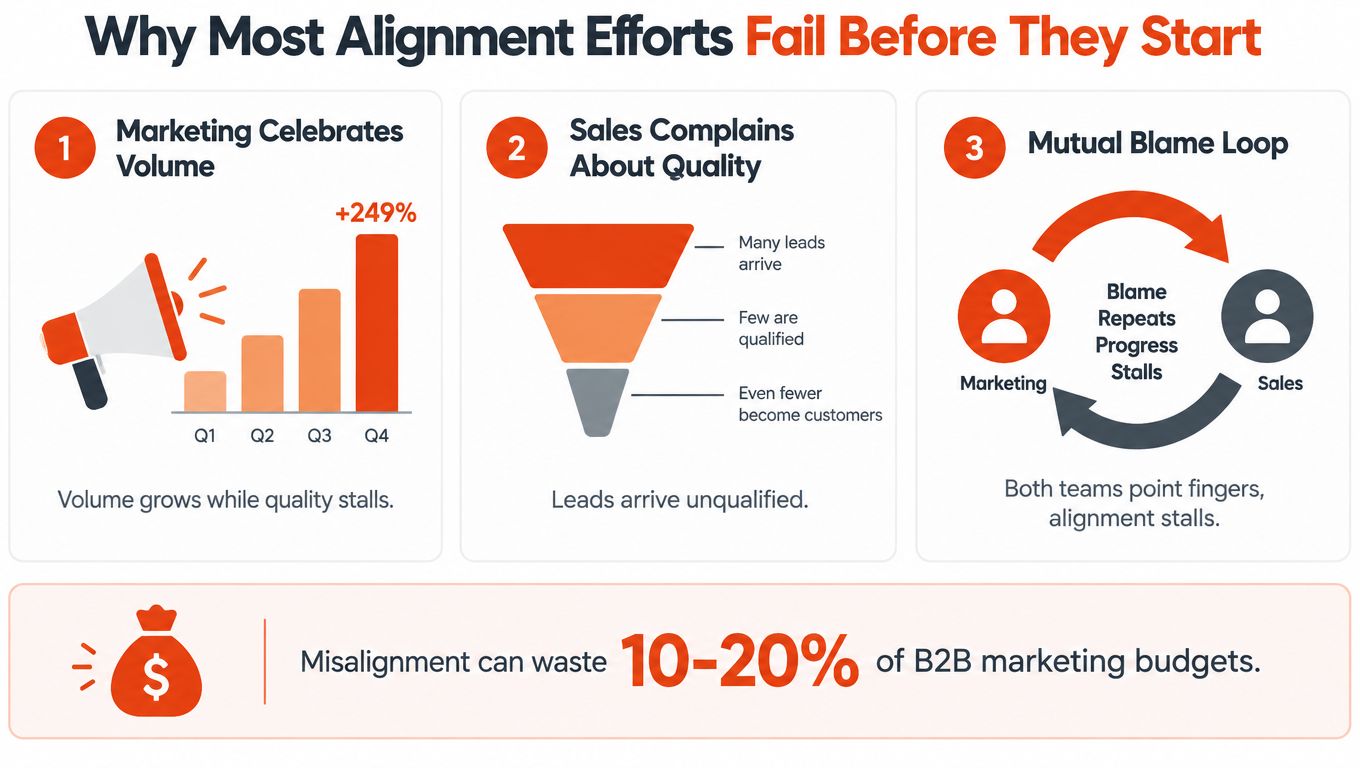
The usual story starts the same way. Marketing celebrates a healthy campaign, sales says the leads aren't ready, and RevOps gets pulled in to defend whatever dashboard is loudest that week. Everyone has numbers. Nobody has a shared view of the buyer.
That's the failure. Alignment cannot be inferred from executive confidence, and it can't be declared in a planning session. Forrester's Q2 2024 research showed the split clearly, 82% of C-level leaders thought sales and marketing were working effectively together, while 65% of frontline sales and marketing professionals said their organizations lacked alignment. That 47-percentage-point perception gap means collaboration has to show up in the work itself, not just in leadership language. The same Forrester research also makes the practical point that shared strategy only matters when it appears in shared definitions, handoff rules, and day-to-day execution. Forrester's alignment survey summary
What the executive view misses
A joint annual plan doesn't solve the handoff problem if the two teams still disagree on what counts as qualified demand. Marketing can generate reach, awareness, and activity all day long, but if sales doesn't trust the definition of readiness, that activity won't become pipeline. The reverse is also true, sales can chase accounts that look promising on paper but don't show active need.
Practical rule: if a lead can only be judged “good” or “bad” by opinion, the process is already broken.
That's why the most useful alignment signals are boring, operational, and visible. Shared account priorities. Shared qualification language. Shared feedback from sales conversations. Shared revenue outcomes. If those aren't present, then “we're aligned” is just a feeling, and feelings don't book meetings.
For teams that are fighting the same old blame loop, the first step is usually not a bigger meeting. It's a better system. The resistance to change is often cultural before it's structural, which is why internal adoption work matters as much as process design, as discussed in Ploot's note on resistance to change.
Building Shared Definitions and Service-Level Agreements
Shared revenue goals only help if both teams use the same language to move an account forward. If marketing calls something an MQL and sales treats it like a soft inquiry, the pipeline will stay noisy no matter how much reporting you add. The goal is to make every lifecycle stage observable, testable, and tied to an owner.
Start with the definitions, not the dashboard
The cleanest starting point is a shared definition set for MQL, sales-accepted lead, SQL, opportunity, and pipeline stage. Each one needs entry and exit criteria that can be checked in the CRM, not judged in hindsight. For example, a target account shouldn't move forward because someone “looks interested,” it should move forward because the agreed fit and engagement criteria are present.
Once those definitions are in place, split ownership clearly. Marketing owns the quality of the data delivered, the qualification fields, and the context attached to the lead. Sales owns response time, minimum contact attempts, disposition codes, and feedback timing. That separation matters because it removes the hidden argument over who was supposed to do what.
Make the SLA reciprocal
A good SLA isn't just “sales follows up fast.” It's a two-way operating agreement. Marketing commits to sending only records that meet the shared standard. Sales commits to acting on them inside the agreed window, documenting the outcome, and returning useful reasons when a lead is rejected or recycled.
One practical approach is to audit the last 200 MQLs. Measure time to first touch, acceptance rate, rejection reasons, conversion to opportunity, and marketing-sourced pipeline. The benchmark data says the median MQL-to-SQL conversion rate is 13%, 72% of inbound leads aren't dispositioned within 24 hours, and only 47% of B2B organizations operate with a single shared pipeline goal. Those numbers make one thing obvious, if response time and disposition discipline are weak, lead volume is just a vanity metric. Benchmark data on B2B alignment
Operational test: if sales can reject a lead, it should also have to say why in a structured field, quickly enough for marketing to act on the pattern.
A simple service-level agreement often beats a complex one. It doesn't need to be long. It needs to be enforceable. Marketing needs a clean handoff standard, sales needs a response standard, and leadership needs a shared scorecard that exposes where the process breaks.
Measuring What Actually Drives Revenue Growth
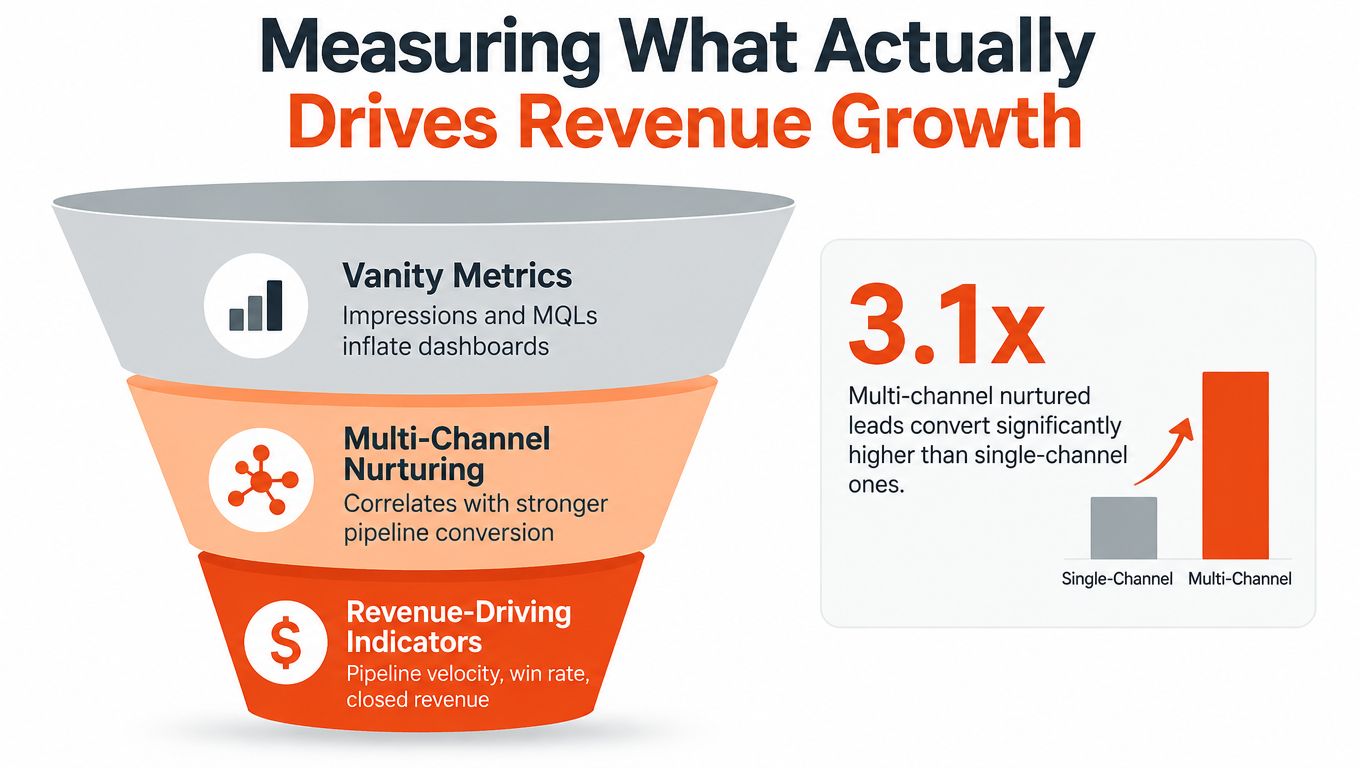
In audits of high-ticket consulting and software pipelines, teams often optimize for impressions, opens, and generic lead counts while pipeline stays flat. The common failure is counting reach without relevance. Real b2b marketing and sales alignment shows up in the movement from attention to conversation to qualified opportunity.
Track continuity, not just activity
LinkedIn's B2B buyer research found that 42% of salespeople who embraced multi-channel nurturing reported a well-aligned relationship with marketing. That does not prove causality, but it does show a practical truth: isolated campaigns rarely create enough momentum on their own. Coordinated activity across channels is what keeps a buyer moving from first touch to engagement to sales conversation. LinkedIn B2B buyer research
For high-ticket consulting and software sales, the useful metrics are the ones that reveal handoff quality and buying momentum. Track signal-to-contact rate, contact-to-meeting conversion, meeting-to-sales-accepted opportunity ratio, opportunity-to-win rate, and pipeline per activated profile. Then segment each metric by source profile, account tier, and market. Averages hide bad routing, weak persona fit, and seller behavior that looks fine at the top of the funnel but falls apart later.
Use the right reporting lens
If your team needs a clean way to inspect attribution and campaign movement, tracking campaign performance with AdManage.ai is a useful reference point because it keeps the conversation focused on how activity connects to outcomes rather than how many clicks the team collected. That standard should apply internally too. A report only matters when it changes what a marketer or seller does next.
What matters most: a smaller number of connected metrics usually beats a giant dashboard full of disconnected activity counts.
Teams count meetings, but not meeting quality. They count leads, but not the rate at which those leads become revenue-qualified opportunities. They count reach, but not relevance. If the metrics do not force both teams to look at the same downstream result, the alignment problem will show up again in a different chart.
Creating Closed-Loop Lead Handoff Workflows
Lead handoff is not complete when marketing sends the record. That's only the start of the process, and treating it as the finish line is one of the most common ways alignment fails. A closed-loop workflow turns the handoff into a measurable revenue process instead of a one-way dump into the CRM.

Build the loop around actions, not handoffs
A real workflow starts when a target-account signal is detected. Then the team validates fit and recency, routes the lead to the accountable seller, starts the SLA timer, records accepted or rejected status with a reason code, and feeds the outcome back into audience, content, and scoring rules. That loop is what keeps the system honest.
The performance upside is meaningful. Independent benchmark reporting says aligned organizations with documented sales-marketing alignment, including shared persona definitions, achieve 27% higher year-over-year revenue growth than misaligned peers. That's an association, not proof that alignment alone caused the result, but it's still a strong signal that closed-loop operating discipline matters. Benchmark reporting on alignment and growth
Avoid the three failure modes
The first failure mode is counting every engagement as intent. People click for many reasons, and not all of them indicate buying readiness. The second is letting sellers reject leads without structured reasons, which leaves marketing unable to improve the upstream model. The third is optimizing for meeting volume while ignoring opportunity quality, which usually creates busy teams and weak forecasts.
A practical qualification layer helps here. Resources like scoring and discovery questions can support a more disciplined qualification process, but they only work if the questions connect to actual handoff criteria and not generic curiosity. That's the difference between a workflow and a form.
Integración con CRM matters for the same reason. If routing, status updates, and feedback don't live inside the system sales already uses, the closed loop breaks in practice even if it looks good on paper.
Turning Trusted Experts Into Measurable Demand Sources
Most alignment discussions stop at lead definition, but the buyer often decides what's credible long before a lead exists. Forrester's buyer trust research shows that 82% of B2B buyers trust coworkers and management, while salespeople receive materially lower trust. That creates a clear operating challenge, because the people who can build early trust are often not the same people who own demand capture. Forrester on trusted information sources
Use authority as a demand channel
The practical answer is to treat trusted people as measurable demand sources. That includes partners, directors, consultants, subject-matter experts, and customers who already have credibility in the market. The mistake is to treat their personal audiences like a generic media buy. They're not. They're trust networks, and they need different governance.
Ploot's model is relevant here because it turns the LinkedIn audiences of partners, directors, and senior managers into a detectable source of buying intent, then contacts those people when they show interest. That approach only works if the team keeps the trust layer and the qualification layer connected. Employee advocacy on LinkedIn is useful precisely because it shows how personal credibility can be activated without losing measurement discipline.
Measure influence before the form fill
The metrics need to reflect that earlier stage of demand. Audience-qualified accounts matter. Repeat engagement from buying-group members matters. Signal-to-conversation rate matters. Meetings accepted by sales matter. Pipeline influenced by trusted profiles matters. Those measures tell you whether the expert-led motion is creating commercial movement, not just social engagement.
Long-cycle consulting and software sales usually gain an edge here. Buyers often research privately, compare vendors on their own, and only engage late. If your only measurement starts at the lead form, you're missing the part of the journey where trust was formed. A credible alignment model has to include that invisible work, because by the time a buyer raises a hand, most of the persuasion may already be done.
Designing Honest Measurement for Dark-Funnel Influence
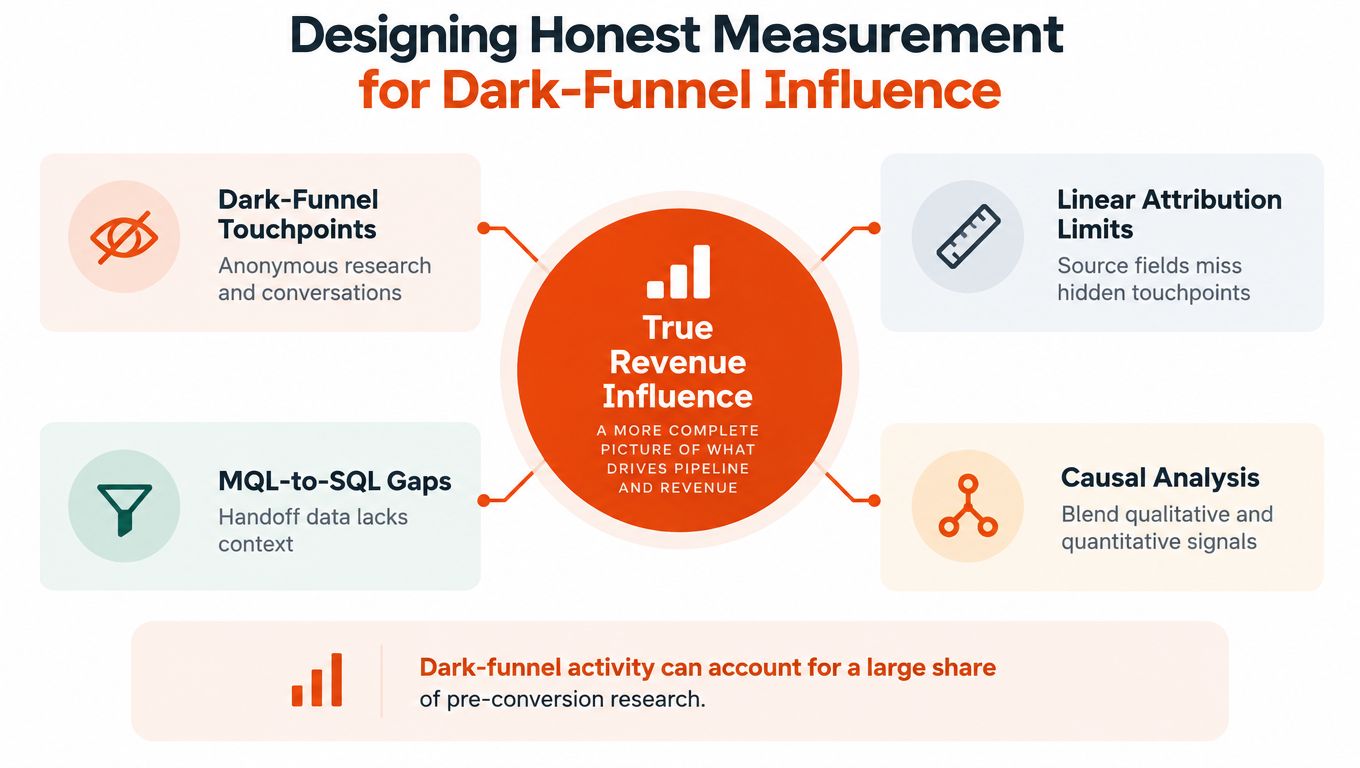
The hardest alignment problem is causality. Traditional attribution tries to force a linear story onto a buyer journey that's usually messy, multi-person, and partly invisible. That works for simple motions. It doesn't work well when people are reading executive LinkedIn content, talking to peers, visiting anonymously, and getting shaped by consultants before anyone fills out a form.
Compare attribution with influence evidence
The weak model is familiar. A source field gets assigned. A campaign gets credit. A later deal gets labeled influenced. The problem is that source fields can't reliably explain what happened before identifiable demand. They miss the hidden research, the peer validation, and the buying-group conversations that often shape the decision.
A stronger model blends account-level and person-level evidence. Track first-known engagement, buying-group coverage, profile exposure, high-intent actions, sales-contact timing, meeting quality, and lagged revenue outcomes. Recent research indicates that 38% of organizations have fully implemented buying groups, and those organizations report better alignment, win rates, and opportunity-to-revenue conversion. It also says 92% of B2B buyers begin evaluation with at least one vendor in mind, and 41% start with a single preferred vendor. Research on buying groups and vendor preference
Run the pilot like an experiment
A credible three-month pilot needs a comparison cohort and pre-agreed success thresholds. Otherwise, every later deal gets claimed as proof. That's not measurement, that's storytelling.
The useful question is simpler. Did the right accounts move faster, did the right meetings happen, and did the pipeline quality improve after the trusted-profile motion was introduced? If those answers are yes, you have a signal worth scaling. If not, the issue is probably in the targeting, the follow-up, or the trust source itself.
Ploot helps B2B teams close the gap between demand generation and revenue by detecting buying intent in trusted LinkedIn audiences, qualifying those conversations, and moving them into qualified meetings. If you're trying to turn b2b marketing and sales alignment into an operating system instead of a slogan, visit Ploot and see how it can fit a three-month pilot around pipeline, not impressions.