

The director has the expertise, the evidence, and a LinkedIn profile that barely reflects either. A project team solved a difficult client problem last quarter, but the details sit across a proposal, a slide deck, meeting notes, and someone's memory. When the director needs a post, the team starts from a blank document and produces another broad opinion about industry trends.
That process wastes the most valuable material a B2B company already owns. The higher-return job is often curating internal expertise, then packaging it into useful LinkedIn content that helps the right buyers recognize a problem, trust the team, and start a commercial conversation.
Table of Contents
- What Is the Curation of Content
- Why Content Curation Matters for B2B
- Turning Internal Knowledge into LinkedIn Assets
- The Role of AI in Modern Curation Workflows
- Measuring the Impact of Curation
- Conclusion and Implementation Roadmap
What Is the Curation of Content
A marketing director once described the weekly content process as “asking five consultants to remember what they learned, then hoping someone writes it down.” That's a familiar failure mode. The company has customer lessons, delivery frameworks, objections from sales calls, implementation decisions, and practical patterns from projects. None of it becomes visible because nobody has designed a reliable way to find, evaluate, structure, and reuse it.
Curation of content is that operating layer. It isn't random link sharing or a lighter version of content creation. It means filtering information, organizing it around a clear audience problem, and adding enough context for someone else to understand and apply it. In a B2B setting, the most valuable source is frequently the organization itself.
A useful starting point is the distinction between finding information and making it reusable. Record-level curation adds descriptive and provenance metadata so an asset can be located and identified. Documentation-level curation fills the context gaps that prevent reuse, such as the client situation, decision criteria, constraints, outcome, and people who can validate the lesson. The knowledge management practices described by Ploot are relevant here because LinkedIn publishing becomes much easier when expertise isn't trapped in scattered documents.
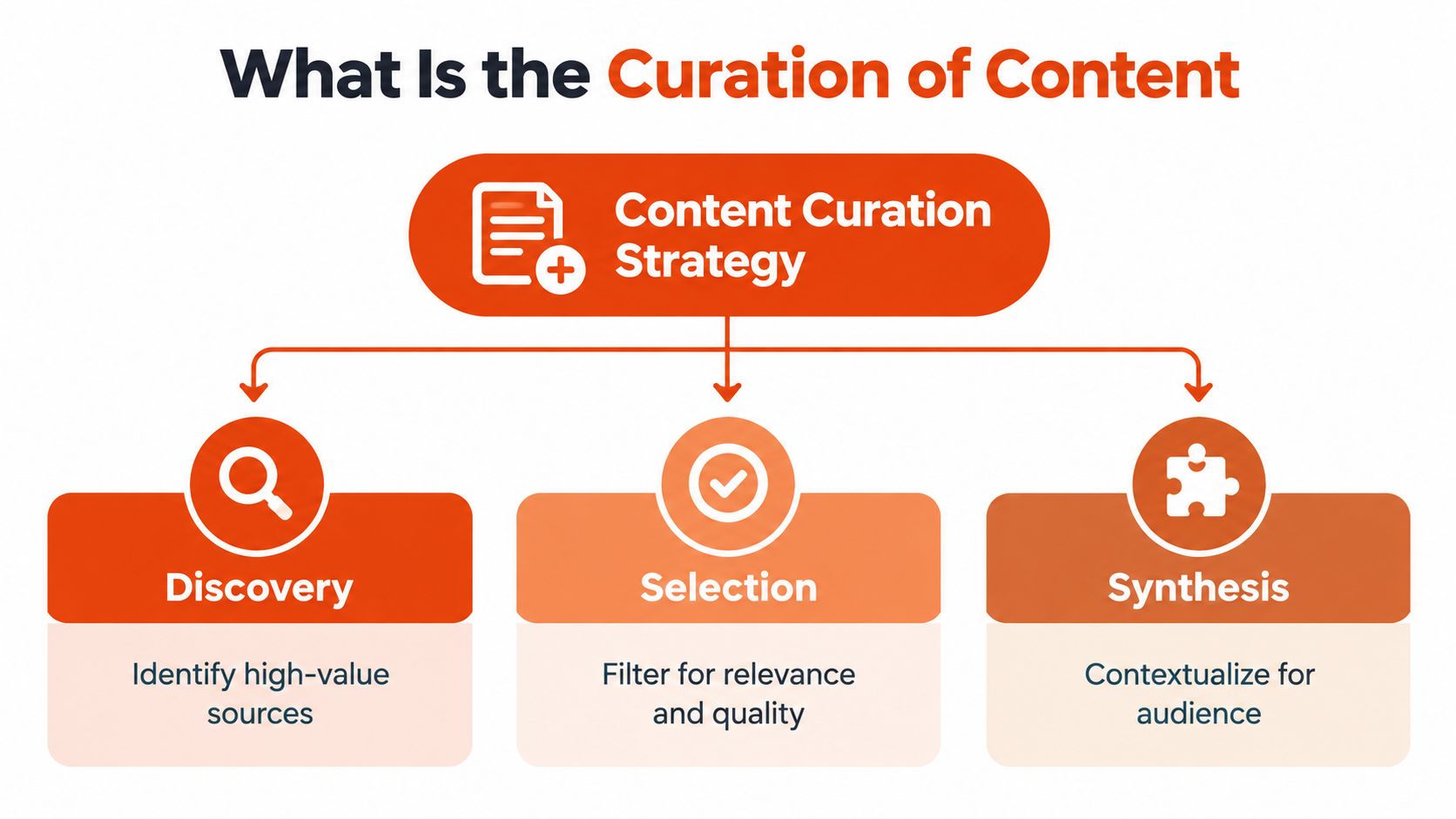
The internal curation hierarchy
Treat every potential insight as an asset that needs progressively better definition.
- Discovery: Find project documents, workshop recordings, sales objections, delivery retrospectives, and subject-matter experts with relevant experience.
- Selection: Choose material that matches a buyer problem, supports the company's positioning, and can be shared without breaching confidentiality.
- Synthesis: Turn separate fragments into a point of view, a practical framework, a diagnostic question, or a clear explanation for LinkedIn.
This approach prevents a common mistake, publishing an isolated fact without the conditions that make it meaningful. “We improved the process” tells a buyer very little. “The team changed the approval sequence because three functions were reviewing the same decision at different stages” contains a recognizable problem and a transferable lesson, even without exposing sensitive client details.
Curation also gives one strong idea a longer useful life. A framework can become a text post, a document carousel, a short video outline, a sales enablement note, and a conversation prompt. Teams exploring repurposing one blog post for weeks will recognize the same principle, but internal curation starts earlier, at the point where expertise is captured and classified.
The finished asset isn't merely a post. It's a discoverable, authoritative knowledge unit with an owner, an audience, a source document, a permission status, and a suggested distribution format. That structure makes consistent publishing possible without forcing experts to invent something from scratch every time.
Why Content Curation Matters for B2B
B2B buyers rarely need more generic commentary. They need evidence that a provider understands the operational detail behind a difficult decision. That evidence often exists inside delivery teams, but traditional marketing workflows leave it fragmented.
Curation creates a bridge between internal proof and external trust. It helps a company publish the reasoning behind its work, not only the polished outcome. For firms with long sales cycles and high-value offers, that distinction matters because prospects may encounter a senior consultant's post long before they agree to a discovery call.
Build authority from evidence
A reliable workflow starts with four questions:
- What buyer problem does this asset illuminate?
- What did the team observe, decide, or change?
- What can be shared publicly and what must remain confidential?
- Which expert can add the missing judgment?
The answer determines whether the material should become a diagnostic post, a contrarian opinion, a practical checklist, a mini case narrative, or a response to a recurring objection. The format follows the insight, not the other way around.
Content curation became a recognizable professional concept in 2009, when the term was formally popularized by the article Manifesto for the Content Curator. Academic usage then expanded from one occurrence in 2010 to 29 in 2018, with an average of 22 publications per year from 2013 to 2018, according to this content curation timeline and market summary. The important lesson for demand generation isn't the chronology alone. Curation developed into a discipline because selection without structure doesn't scale.
Use a tiered quality workflow
Simple selection asks, “Is this relevant?” Professional curation asks whether a buyer can find, understand, verify, and reuse the information.
- Record level: Label the asset by topic, buyer role, industry, source, author, date, and permission status.
- File level: Check whether the document, recording, chart, or image is usable and accessible.
- Documentation level: Add the business context, intended audience, explanation, and related assets.
- Data level: Where appropriate, inspect the underlying content for consistency, accuracy, and interoperability.
The tiered curation framework in the academic literature makes the trade-off explicit. Deeper quality control improves discoverability and reuse, but it requires more curator effort and better tooling. A small consultancy doesn't need to annotate every internal file at the deepest level. It does need enough structure to prevent valuable expertise from disappearing after publication.
Practical rule: If a post can't explain the situation, the decision, and the implication for the buyer, it isn't ready for distribution.
Algorithmic feeds complicate the job. Research on curated feeds found that users may encounter less novel content overall while engaging with more novel content than in peer-shared feeds, challenging the assumption that algorithms only reinforce familiar ideas (the study on novelty and engagement in algorithmic curation). For B2B marketers, this creates an opening. A human expert who adds judgment and context can make unfamiliar information relevant without reducing it to attention bait.
Turning Internal Knowledge into LinkedIn Assets
The practical workflow begins with an audit, not a content calendar. Search the places where work actually happens: project retrospectives, proposal libraries, implementation plans, recorded workshops, customer research, sales call notes, internal training, and subject-matter expert interviews.
Create an inventory with fields that make future selection fast. At minimum, capture the topic, buyer problem, sector, source owner, confidentiality status, evidence type, relevant expert, and possible LinkedIn format. This is metadata in operational form. Adding it early supports findability and reuse, which is the central technical argument in this repository curation guidance.
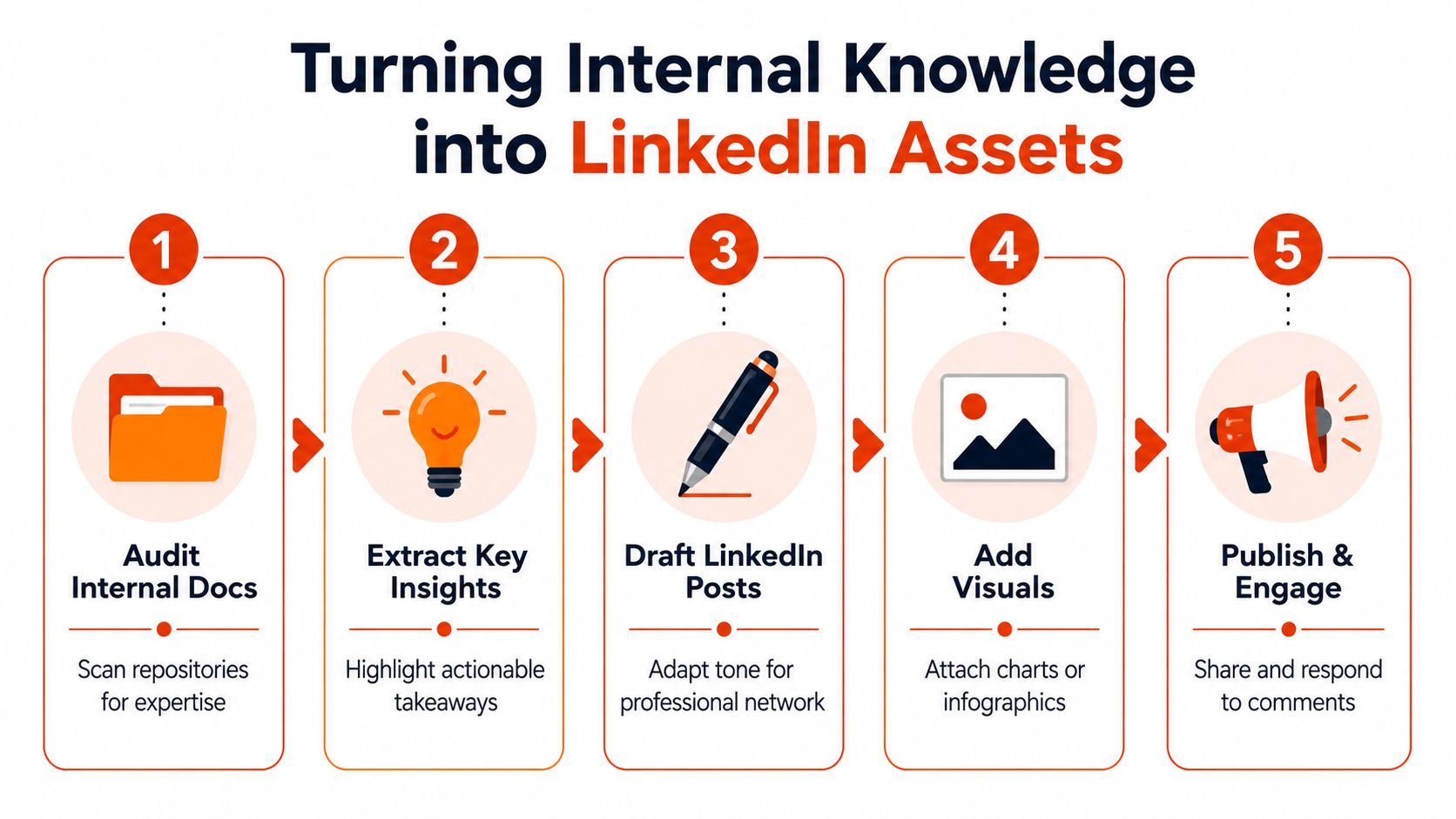
Extract the commercial insight
Don't ask an expert, “What should we post?” Ask questions that expose decisions:
- Where did the client or team initially misdiagnose the problem?
- Which assumption proved wrong?
- What choice created the biggest improvement in clarity, speed, risk, or coordination?
- What would you do differently on the next engagement?
- Which warning sign should a buyer notice earlier?
One answer can support several native LinkedIn assets. A project lesson might become a short text post with one clear argument. The underlying method can become a document carousel. A senior expert can record a video explaining the trade-off. A sales leader can use the same insight as a conversation opener with an account that faces the problem.
The commercial category behind these workflows is substantial. Independent market summaries estimate the global content curation software market at USD 551 million in 2022, with a projected value of USD 1.8 billion by 2032 and a 12.3% CAGR across the decade, while another estimate places it at USD 612 million in 2023 and projects USD 1.7 billion by 2032 at a 10% CAGR (the market overview compiled by MarketingProfs). The figures differ by methodology, but they point to sustained demand for systems that filter, organize, and distribute information.
Adapt the insight to LinkedIn
LinkedIn rewards clarity more than document completeness. Remove internal jargon, keep the useful tension, and write for the person who owns the problem.
A strong post usually contains:
- A specific observation: “The project stalled because every team approved the same decision twice.”
- A useful interpretation: Explain why the pattern appears and what it costs.
- A practical implication: Give the reader a test, question, or action.
- A credible voice: Publish from the expert who understands the decision, not from an anonymous brand account.
- A responsible invitation: Encourage discussion without turning every post into a pitch.
The LinkedIn content strategy guidance on converting leads is useful for thinking about the connection between content and commercial action. The post shouldn't force a meeting. It should make the right reader more willing to identify themselves, comment with context, visit the profile, or respond when the team follows up appropriately.
A shared system also matters. Teams that document and distribute expertise can use shared knowledge workflows from Ploot to reduce the gap between the person who learned the lesson and the person responsible for publishing it.
The Role of AI in Modern Curation Workflows
AI is useful when the bottleneck is volume. It can scan internal repositories, group documents by theme, identify repeated questions, suggest tags, extract candidate passages, and create a first draft. It can't decide whether a sensitive project detail is safe to publish, whether a conclusion is fair, or whether a post sounds like the actual expert.
The strongest workflow assigns different responsibilities to each side.
Let software handle structure
Start by giving the system a controlled source set. Include approved documents, recordings, transcripts, and frameworks. Exclude material that lacks permission or contains unreviewed client information.
Use AI to support mechanical tasks:
- Ingest: Collect approved source material in a searchable workspace.
- Classify: Apply fields such as topic, audience, industry, source, date, and publication status.
- Cluster: Group related lessons, objections, and examples.
- Extract: Pull candidate insights and supporting passages.
- Draft: Produce several LinkedIn-native angles, such as a lesson, checklist, or counterintuitive observation.
- Review: Ask the subject-matter expert to verify accuracy, nuance, and voice.
- Schedule: Publish only after the owner approves the final version.
Recent coverage of AI tools for content curation describes this shift toward hybrid workflows that combine text, video, images, predictive signals, and human judgment. The operational advantage is speed across formats. The risk is producing polished summaries that contain no distinctive interpretation.

Keep judgment with the expert
AI can suggest that five documents concern the same buyer issue. It can't reliably determine which detail changes the recommendation. It also tends to flatten disagreement, remove uncertainty, and make experienced practitioners sound interchangeable.
Ask the expert to approve three things: the factual core, the interpretation, and the boundary conditions. The last item is often missed. A useful post should say when a method works, when it doesn't, and what the reader should check before applying it.
For measurement and iteration, a MyMentions analytics framework can help teams think about content signals systematically. The tool should support editorial decisions, not replace them.
Ploot is one option for teams that want to turn a team member's knowledge into LinkedIn drafts, preserve that person's style, and organize recurring publication. Its role fits the middle of the workflow, between internal expertise capture and approved distribution. More broadly, content automation workflows from Ploot illustrate why automation is most useful when the source material and review process are already disciplined.
Measuring the Impact of Curation
A post can earn attention and still fail commercially. A prospect can also read several posts without liking or commenting. Measurement therefore needs to separate visibility, engagement quality, and pipeline contribution.
Start with a simple comparison between manual curation and AI-assisted synthesis:
| Dimension | Manual workflow | AI-assisted workflow |
|---|---|---|
| Discovery | People search documents and interview experts | Software scans approved sources and groups themes |
| Context | The curator interprets the material directly | The system proposes summaries for review |
| Voice | Usually distinctive when the expert participates | Can become generic without expert editing |
| Scale | Limited by researcher and reviewer time | Higher throughput, with review capacity as the constraint |
| Risk | Inconsistent tagging and missed source context | Confident errors, permission mistakes, and flattened nuance |
| Best use | Sensitive, strategic, or highly specific insights | Repetitive classification, extraction, and drafting |
The point isn't to choose a side. It's to measure whether the combined workflow produces better commercial conversations without weakening trust.
Track the path to a meeting
Use three layers of indicators:
- Attention quality: Look at meaningful comments, saves, shares, profile visits, and responses that refer to the actual idea rather than generic praise.
- Audience relevance: Record whether engaged people match target roles, industries, accounts, and seniority. A smaller audience with buying responsibility is more useful than broad visibility with no fit.
- Pipeline movement: Connect content interactions to replies, warm introductions, sales conversations, qualified meetings, opportunities, and eventual revenue where the CRM process permits it.
Don't claim that a particular post caused a meeting because the prospect viewed it. Record the sequence instead. The buyer engaged with a post, returned to the profile, replied to a relevant follow-up, and accepted a meeting. That evidence is more credible than treating impressions as pipeline.
Use post-level notes to capture the source asset, expert owner, theme, format, audience segment, and commercial outcome. Over time, you'll learn which internal knowledge produces useful conversations, which formats attract the wrong audience, and where editorial review changes performance.
Conclusion and Implementation Roadmap
The curation of content becomes commercially valuable when a company stops treating expertise as an occasional source of inspiration. Internal knowledge needs an operating system. Without ownership, metadata, permissions, context, and a publishing path, even excellent project learning remains invisible.
A practical rollout can start with a focused source set:
- Choose a buyer problem: Pick one issue that matters to your target accounts and fits the expertise of a senior team member.
- Audit internal material: Search project documents, proposals, workshops, retrospectives, and sales conversations for decisions and recurring patterns.
- Create an asset register: Record the source, owner, audience, confidentiality status, supporting evidence, and possible LinkedIn formats.
- Extract several angles: Develop a lesson, a diagnostic question, a practical framework, and a point of view from the same verified material.
- Review with the expert: Check accuracy, boundaries, client permissions, and whether the language sounds like the person publishing it.
- Publish consistently: Use a realistic rhythm that the expert and marketing team can sustain.
- Connect engagement to CRM activity: Track relevant audience interactions, replies, conversations, and qualified meetings.
AI can accelerate discovery, classification, synthesis, and drafting. It shouldn't decide what your company stands for or manufacture authority from thin material. Human experts supply the judgment that makes a post worth reading, while a structured workflow makes that judgment repeatable.
The strongest B2B LinkedIn programs don't ask experts to become full-time creators. They capture what those experts already know, turn it into clear evidence for a defined audience, and give sales a credible reason to begin a conversation. Measure the result by the quality of the opportunities created, not by how busy the feed appears.
Ploot can help turn a team member's knowledge into LinkedIn posts, schedule recurring publication, and identify buying intent among the people engaging with that audience. Visit Ploot to explore a content-to-meeting workflow for your B2B team.