

The most popular advice about employee advocacy tools is to make sharing effortless, recruit more employees, and celebrate higher engagement. That's useful advice for distributing content. It's incomplete advice for a marketing director who needs qualified sales conversations.
Most platforms are built to distribute content and count shares. Those capabilities help you manage reach, but they don't automatically explain which target accounts engaged, whether anyone followed up, or what happened in the CRM. A busy advocacy dashboard can coexist with an empty sales calendar.
The measurement gap is substantial. In a DSMN8 pulse survey of more than 100 CMOs, just 3.5% tracked pipeline and revenue, while 71% didn't currently measure impact. That's a reason to scrutinize reporting, not a reason to dismiss advocacy.
For B2B consulting and software firms, the useful comparison runs from expert content through audience engagement, contextual follow-up, qualification, and booked meetings. Scheduling, integrations, employee permissions, and compliance matter because they support that process.
Buying principle: Choose the workflow you need to operate, not the dashboard you'd like to present.
You can improve your LinkedIn social selling score while developing stronger profiles and relationships. But a platform score isn't evidence of pipeline. The tools below serve different operating models, and their vendor descriptions shouldn't be mistaken for independently verified commercial results.
Table of Contents
- 1. Ploot
- 2. Sociabble
- 3. Oktopost
- 4. Sharebee
- 5. DSMN8
- 6. EveryoneSocial
- 7. Ambassify
- 8. Haiilo
- 9. Sprout Social Employee Advocacy
- 10. Clearview Social
- How the employee advocacy tools compare on pricing transparency, trials, fit and measurement
- Choosing a Tool by the Meetings It Can Prove
1. Ploot
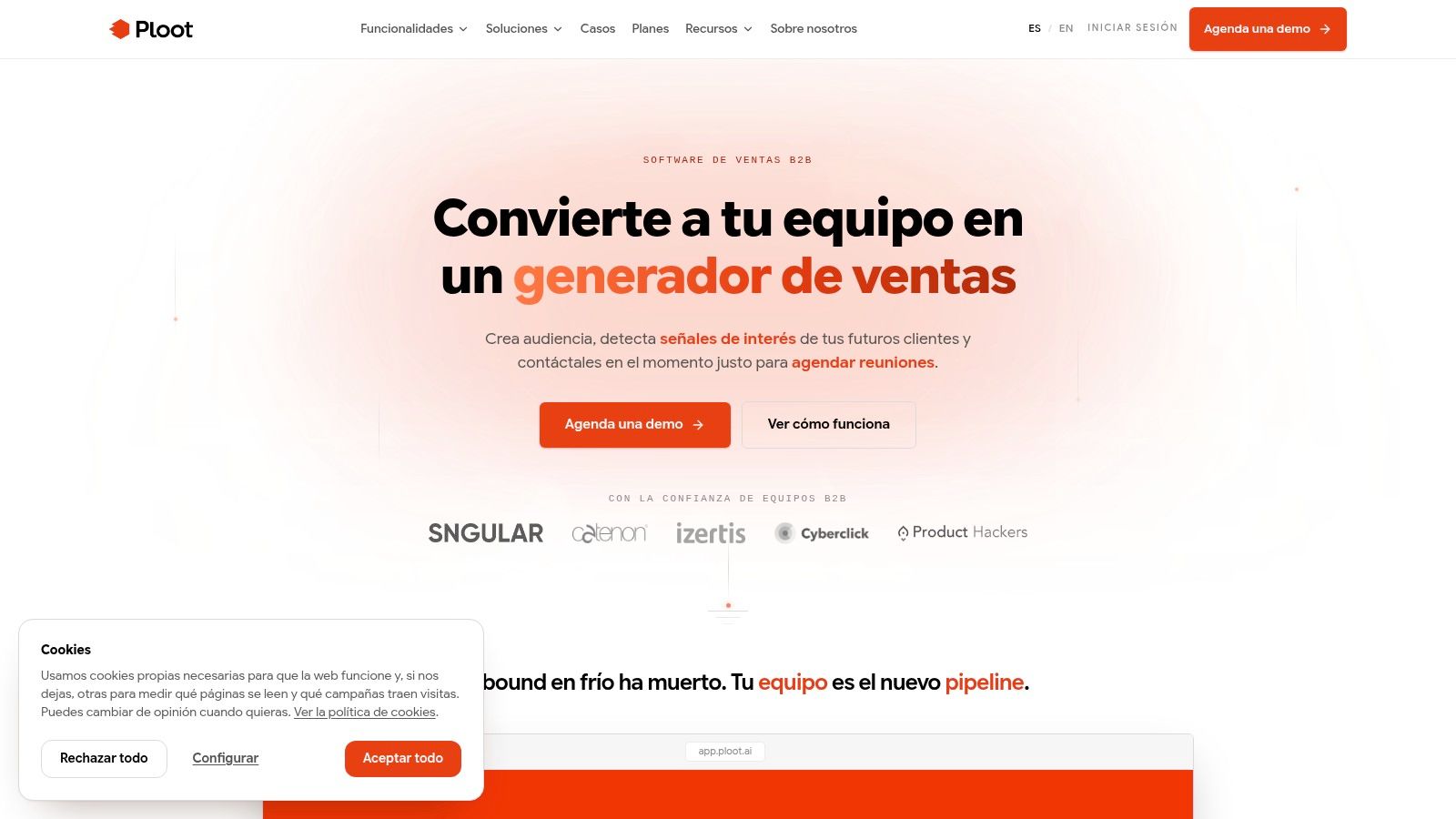
Best for B2B firms that want expert-led advocacy connected to sales activation. Our system combines LinkedIn content, audience development, buying-signal detection, and contextual messaging rather than stopping at employee publishing.
We position partners, directors, and senior managers around their sector, solution, and expertise. Prospects are filtered for ideal-customer fit and relevant signals, then contacted through LinkedIn or email from the team member's own profile, with that person's approval.
From expertise to qualified conversations
The practical distinction is who receives follow-up and why. A relevant interaction provides context for a message, rather than becoming another anonymous engagement in a monthly report. However, an interaction still needs qualification: someone liking a technical post isn't automatically evaluating a purchase.
Our employee advocacy platform guide explains the broader approach. The strongest fit is HR consulting, IT consulting, and B2B software, where credible expertise helps start conversations about complex services.
- Strength: Content creation, demand capture, signal-based messaging, and qualification sit within the same sales process.
- Employee control: Messages require the team member's approval. Employees retain ownership of their content unless an internal agreement says otherwise.
- Access control: LinkedIn publishing connects through OAuth, and users can revoke access from their account settings.
- Commercial trade-off: Plans differ by the number of active LinkedIn profiles, not by access to different parts of the system.
New clients can start with a three-month pilot with agreed success criteria. Set those criteria around held, qualified meetings and opportunity progression, not publishing activity.
The limitation is operational: credible profiles, useful expertise, and timely sales follow-up still matter. Signal-based outreach gives a salesperson context; it doesn't eliminate the need to establish buyer fit, urgency, and a meaningful next step.
2. Sociabble
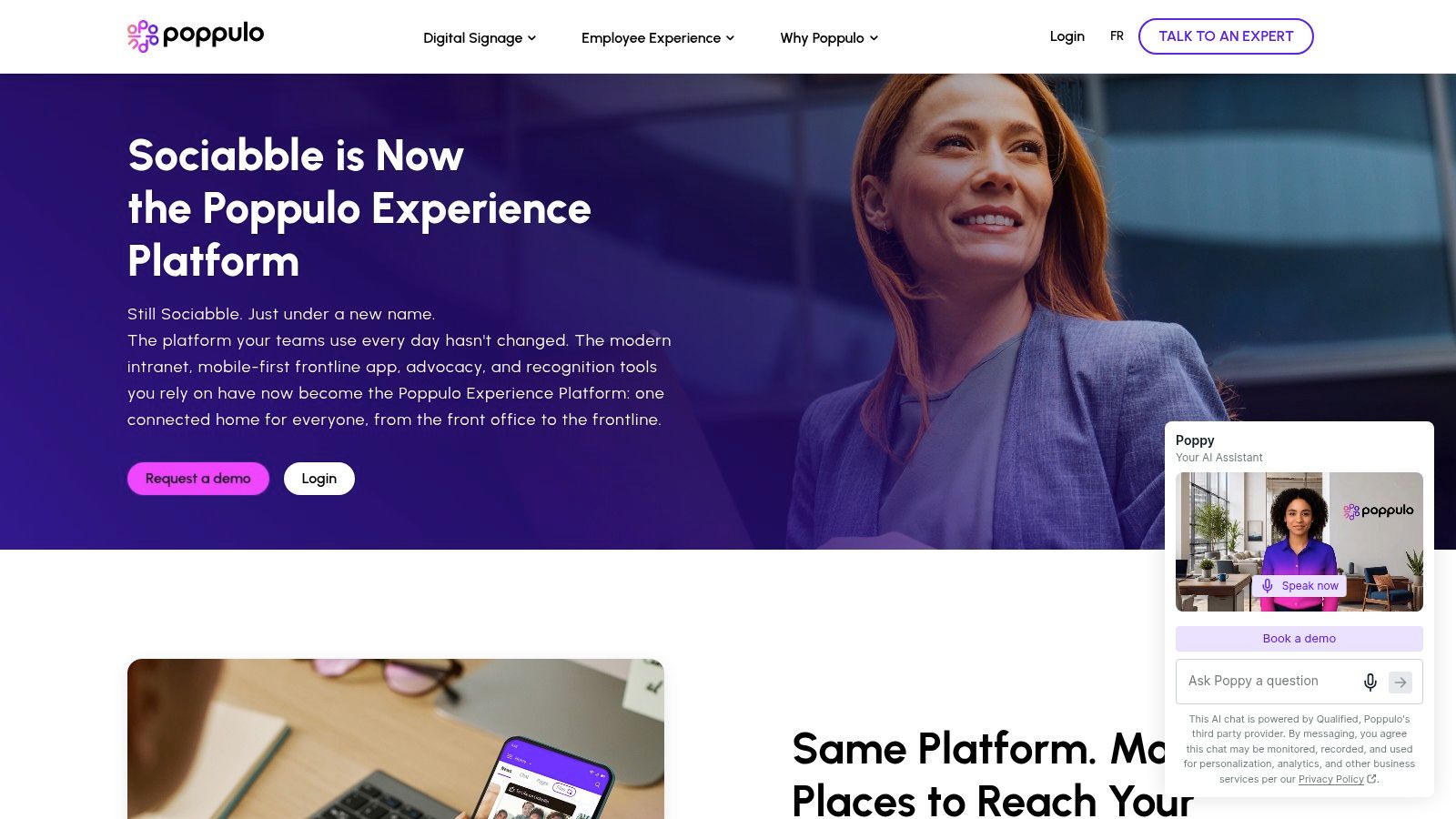
When internal communications and advocacy share an owner, Sociabble deserves consideration. Its proposition combines a content hub, employee communications, multilingual distribution, and social-selling capabilities rather than treating advocacy as an isolated marketing task.
The vendor describes AI-assisted captions and analytics covering reach, engagement, and LinkedIn audience interactions. For demand generation, the interesting capability is understanding which people and companies interact, not which employee shared the most content.
Where audience insight becomes useful
Say a consulting director publishes a perspective on application modernization. Knowing that relevant technology leaders engaged can help sales prioritize investigation. It doesn't establish that those people have an approved project or want an unsolicited pitch.
That distinction should shape your employee advocacy on LinkedIn process. Assign an owner to review relevant interactions, check account fit, and decide whether a reply, connection request, or sales conversation makes sense.
- Works well for: Organizations that need employee communications and advocacy in a shared environment.
- Main trade-off: The broader employee-experience scope may add administration that a senior-only advocacy program doesn't need.
- Pipeline test: Ask the vendor to demonstrate how an identifiable audience interaction becomes a usable sales record, including exports and permissions.
- Buying consideration: Pricing is quote-based, so scope the required modules before comparing proposals.
Sociabble is more compelling when adoption and internal distribution are genuine business requirements. If you only need a focused route from executive expertise to meetings, its wider scope needs a clear justification.
3. Oktopost
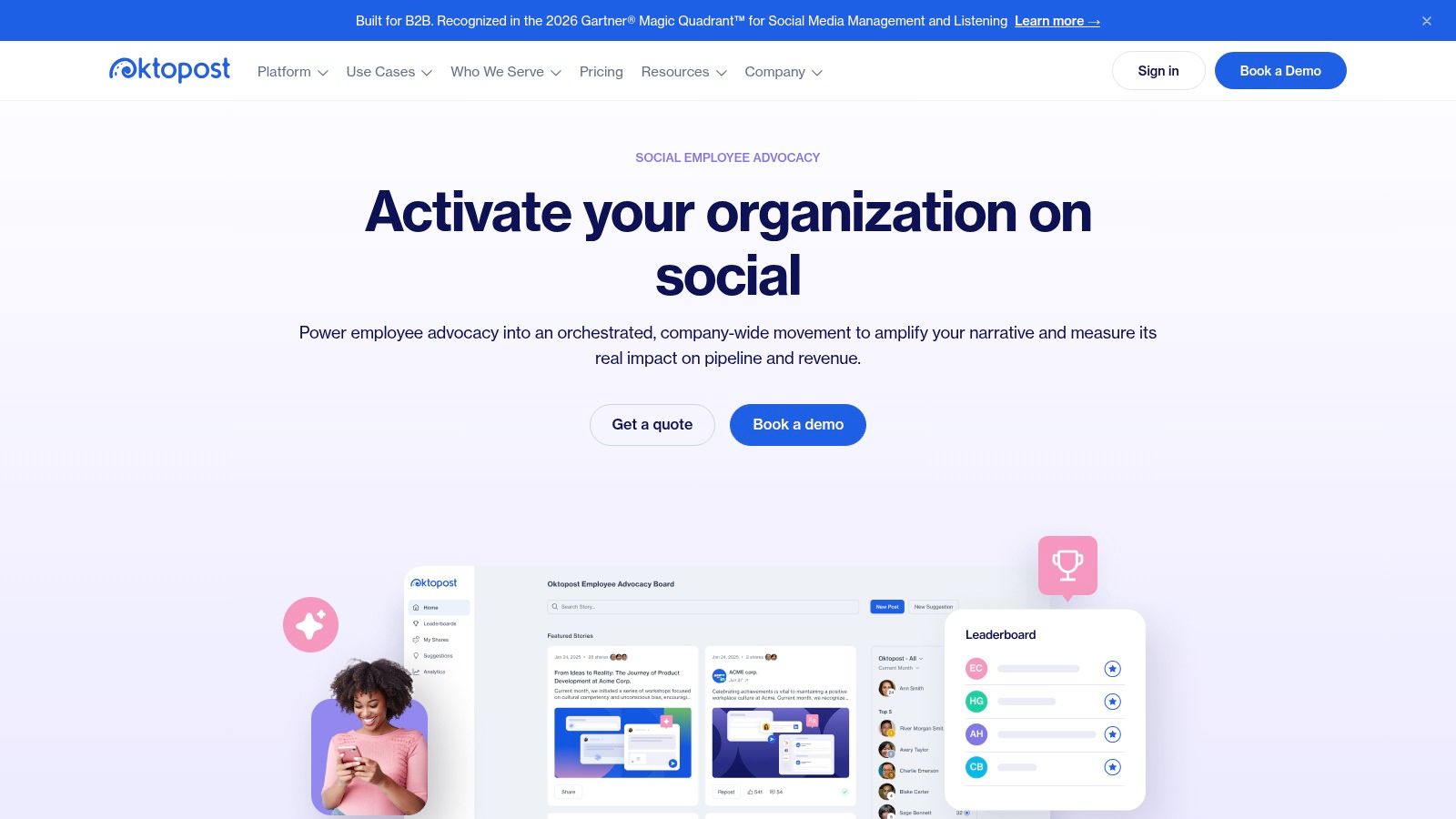
Oktopost is a logical candidate when advocacy needs to sit inside B2B social operations. Its employee advocacy product combines curated advocacy boards with employee segmentation, scheduling, and post-level analytics.
The platform's listed integrations include Salesforce, Slack, and Microsoft Teams. That makes it relevant to teams coordinating company publishing, employee distribution, and marketing reporting, but an integration logo alone doesn't prove opportunity attribution.
- Content operations: Separate boards can organize material by team, brand, or language.
- Governance: Approval workflows and banned-keyword controls support centrally managed programs.
- Personalization: The vendor describes an Advocacy Agent for drafts in an employee's personal voice, with advanced availability tied to Enterprise.
- Commercial caution: Confirm module access, implementation requirements, and plan restrictions in the proposal.
Test the CRM handoff
Ask for a demonstration using an employee post, an engaged contact, an account, and an opportunity. Establish which records transfer, whether the employee and campaign identifiers persist, and how duplicate contacts are handled.
Also separate influence reporting from sales activation. Showing that a contact interacted before an opportunity opened is useful; assigning someone to review and follow up on that interaction is a different workflow.
Oktopost's advantage is coordination across B2B social publishing and advocacy. Its trade-off is that teams satisfied with their existing publishing stack may introduce unnecessary overlap. Choose it for a connected operating environment, not merely because Salesforce appears on the integrations page.
4. Sharebee
A partner who understands their subject but avoids posting may need coaching more than another scheduling feature. Sharebee pairs its LinkedIn-oriented advocacy platform with workshops, employee education, and program support.
Its described capabilities include a content library, knowledge base, ambassador analytics, mobile access, reminders, gamification, and optional AI assistance. That combination suits teams whose bottleneck is turning willing experts into consistent participants.
Training is useful when it helps an employee express an informed opinion. It's less useful when it only teaches them to distribute marketing copy.
The vendor says it is a LinkedIn partner and uses LinkedIn's official API. Treat that as a vendor statement, then confirm which publishing actions, account permissions, and analytics apply to the proposed deployment.
Evaluate support alongside the software
For a consulting firm, a useful demonstration would start with a rough expert opinion and end with an employee-approved post. Include scheduling, editing, tagging, mobile review, and the resulting analytics.
- Main advantage: Software and program guidance are offered together, which can help teams without an established advocacy routine.
- Main trade-off: Workshops and participation support don't replace CRM instrumentation or a sales follow-up owner.
- Pipeline question: Can administrators distinguish engagement from target accounts from general ambassador activity?
- Pricing: Obtain a current proposal rather than building a budget around unofficial listings.
Sharebee is worth shortlisting when LinkedIn participation is the immediate constraint. Judge its commercial contribution separately from its ability to increase posting confidence.
5. DSMN8
DSMN8 suits organizations that want dedicated advocacy software with optional help maintaining the program. Its offering includes employee content distribution, executive influence initiatives, onboarding, training, and live support.
The listed integrations include Slack, Microsoft Teams, Salesforce, and Marketo. Optional modules and services broaden the scope, so compare the proposed configuration rather than assuming every capability belongs in the base package.
Buy the operating model, not every module
An executive-focused program and a workforce-wide sharing initiative have different needs. The former requires substantive editorial input and individual approval; the latter may place more weight on content curation, notifications, and participation management.
Clarify that distinction before agreeing on services. Our guide to employee advocacy fundamentals provides context for separating program goals from software features.
- Strong fit: Teams seeking advocacy infrastructure alongside onboarding and ongoing program support.
- Useful option: Managed services can help with curation and program activity when internal capacity is limited.
- Commercial limitation: Pricing is custom, and the vendor's pricing materials describe annual contracts.
- Measurement requirement: Specify how advocacy identifiers and campaign data will connect to CRM reporting.
The contract structure matters if employee adoption remains untested. Agree on activation responsibilities, implementation milestones, reporting access, and the services included before committing.
DSMN8 can support a substantial advocacy operation. The practical question is whether you need that operating breadth now, and whether your sales team has a defined process for turning relevant engagement into conversations.
6. EveryoneSocial
Employee activation is the central reason to evaluate EveryoneSocial. The platform focuses on helping employees and executives create, curate, and share content, with strategy support available alongside the software.
Its vendor-described capabilities include Slack and Microsoft Teams integrations, personalized content, analytics, and business-impact reporting on higher-tier plans. The important procurement detail is the last one: the reporting shown during a demonstration must match the plan you're buying.
- Advantage: Advocacy is the core product rather than a peripheral feature in a broad social suite.
- Operational value: Strategy support can help establish ownership, employee communication, and a repeatable publishing routine.
- Trade-off: Enterprise implementation and support may exceed the needs of a narrow partner-led pilot.
- Pricing consideration: Paid packages require a vendor conversation; confirm current entry-level availability and reporting restrictions.
Define business impact before the demo
Ask the vendor to unpack its reporting terminology. Earned media value, tracked website conversions, influenced accounts, and CRM opportunities are different measures, even when they appear under the same business-impact label.
A useful test is whether a demand generation manager can identify relevant account engagement and hand it to a salesperson with enough context to act. If that requires a separate process, include the work in your cost assessment.
EveryoneSocial is a credible shortlist option when consistent employee participation is the primary challenge. It should still be evaluated against a written definition of qualified engagement and the sales outcomes you intend to track.
7. Ambassify
Confidence is a real implementation issue. A technical leader may have valuable expertise but hesitate over what to publish, how personal to be, or whether a post sounds too promotional.
Ambassify addresses that problem with microlearning, role-based playbooks, and options for employees to write original posts. Its described features also include caption and image variations, scheduling, notifications, leaderboards, and rewards.
Better participation without identical posts
The attractive element is room for employee judgment. A library of approved material can support consistency, but employees need permission to add relevant experience, disagree constructively, or decline content that doesn't fit their audience.
For measurement, Ambassify describes UTM tracking, analytics, and configured conversion tracking, with advanced capabilities varying by plan. Those are useful for observable website journeys, but they won't capture every private message or offline referral.
- Best use case: Programs where employee education and posting confidence are major barriers.
- Reporting strength: Tracked traffic and configured conversions can provide more evidence than share counts alone.
- Commercial trade-off: Quote-based tiers organized around workforce size may not map neatly to a senior-only pilot.
- Sales requirement: Combine link tracking with CRM records and salesperson feedback.
Ask the vendor to demonstrate a conversion journey, including the employee identifier, landing page, form submission, and CRM handoff. Then test what happens when a prospect engages without clicking.
Ambassify is appealing for developing capable advocates. Its pipeline contribution depends on how deliberately you connect learning, publishing, conversion tracking, and sales follow-up.
8. Haiilo
Haiilo makes most sense when advocacy belongs within a wider employee communications program. Its platform addresses employees across roles, locations, and channels rather than concentrating exclusively on senior LinkedIn profiles.
The vendor describes mobile access, sharing through email, Slack, and Microsoft Teams, AI-guided content creation, and audience segmentation. Enterprise-oriented permissions, SSO, and integrations support organizations with more complex administration needs.
Scope warning: A broad communications platform is a sensible purchase when you need broad communications. It isn't automatically a better advocacy purchase.
Separate internal success from commercial success
Internal participation, external reach, and sales outcomes should have separate scorecards. An employee reading company news is not the same event as a target-account buyer engaging with an expert's post.
Haiilo's described advocacy analytics cover reach, impressions, content performance, and participation. Ask the vendor to show which external interactions can be identified and exported, and which remain aggregate metrics.
- Works well for: Distributed organizations combining employee communications with external advocacy.
- Governance benefit: Role and group segmentation can help administrators manage relevant content and access.
- Main limitation: The wider platform may be oversized for a focused LinkedIn demand-generation initiative.
- Buying consideration: Obtain a scoped quote covering the required advocacy functionality and integrations.
For a marketing director, the decision rests on shared requirements with internal communications. If those requirements are substantial, a common platform may be practical. If the objective is narrowly qualified meetings, avoid paying for unrelated infrastructure without a clear operational reason.
9. Sprout Social Employee Advocacy
An existing Sprout Social customer has a different decision from a team buying advocacy software from scratch. Sprout Social Employee Advocacy extends an established publishing environment with curated employee content and distribution workflows.
Employees can discover material through My Feed, newsletters, Slack, and mobile alerts. Administrators can use approved copy, tags, UTM parameters, and reporting to organize campaigns and track activity.
- Strongest fit: Teams already operating company social publishing through Sprout.
- Measurement value: Tagged links can connect advocacy distribution to observable website behavior.
- Commercial constraint: Employee Advocacy is a separately priced add-on requiring Standard or higher.
- Budget caution: A published social-management seat price isn't the complete advocacy cost.
Don't confuse tracked clicks with attribution
UTM tracking is useful when a prospect clicks through and converts within a measurable journey. It's less conclusive when someone reads a post, mentions it to a colleague, and later contacts sales through another route.
Ask the vendor to demonstrate the advocacy-specific reporting rather than general Sprout analytics. Confirm employee-level reporting, campaign exports, permissions, and how the data will reach your existing marketing and CRM systems.
For an established Sprout team, familiar workflows may justify the add-on. For everyone else, the base subscription and separate advocacy purchase need to earn their place.
The platform is strongest as a distribution extension to an existing social operation. You'll still need a qualification process if the commercial objective is conversations rather than content consumption.
10. Clearview Social
Busy professional-services employees don't always need a larger content workspace. Sometimes they need a straightforward way to review and share relevant material without adding another daily destination.
Clearview Social emphasizes that low-friction workflow through email, Slack, and Microsoft Teams. Its described capabilities include content queues, AI-assisted PeakTime scheduling, and content sourcing through RSS, URLs, Canva, and a media library.
Useful amplification, with a separate sales process
The vendor lists reporting for clicks, referrals, engagement, and earned media value, alongside integrations including Salesforce. Those capabilities support distribution oversight, but they don't establish that the platform identifies interested buyers or qualifies meetings.
A consultancy sharing expert articles may find this emphasis entirely appropriate. The important distinction is whether you're purchasing employee-driven amplification or expecting an integrated demand-generation workflow.
- Main strength: Employees can participate through communication tools they already use.
- Relevant use case: Professional-services teams distributing articles, commentary, and company expertise.
- Core trade-off: Sharing and amplification remain the emphasis, rather than buyer identification and contextual outreach.
- Commercial consideration: Request a current scoped quote and confirm what implementation and integrations include.
For the demonstration, have a non-marketing employee complete the actual sharing process. Then ask an administrator to explain what happened after publication and what a salesperson could act on.
Clearview Social belongs on a shortlist when participation friction is the main obstacle. If meetings are the primary objective, budget for the follow-up workflow and CRM measurement alongside the sharing platform.
How the employee advocacy tools compare on pricing transparency, trials, fit and measurement
Pricing and trial terms are unevenly disclosed, so treat quoted packages and pilot conditions as points to confirm directly. The more important comparison is what each platform measures: sharing activity, audience response, or progress toward qualified sales conversations.
| Item | Pricing transparency | Free trial or pilot | Best for | Measurement focus |
|---|---|---|---|---|
| Ploot | Custom pricing based on active LinkedIn profiles | Three-month pilot with agreed success criteria | B2B teams seeking expert-led outreach and qualified meetings | Buying intent, responses, qualified conversations, and booked meetings |
| Sociabble | Quote-based | No free trial reported | Teams combining employee advocacy with internal communications | Reach, engagement, and LinkedIn audience interactions |
| Oktopost | Pricing not publicly listed | Trial terms not publicly listed | B2B teams coordinating advocacy with social publishing | Post-level advocacy and social analytics |
| Sharebee | Pricing not clearly published | Trial terms not publicly listed | LinkedIn-focused advocacy programs needing training and support | Post performance and ambassador activity |
| DSMN8 | Custom, quote-based pricing; annual contracts | Trial terms not publicly listed | Organizations running employee and executive advocacy programs | Advocacy activity and content engagement |
| EveryoneSocial | Paid pricing not clearly published; free Starter tier reported | Free Starter tier reported | Organizations activating employees and executives at scale | Analytics and business impact on higher-tier plans |
| Ambassify | Quote-based; tiers organized by workforce size | Trial terms not publicly listed | Teams that want advocacy training and employee activation | Advocacy activity, tracked traffic, and configured conversions |
| Haiilo | Pricing not published; quote required | Trial terms not publicly listed | Enterprises combining advocacy with employee communications | Reach, impressions, content performance, and participation |
| Sprout Social Employee Advocacy | Separately priced add-on; requires Standard plan or higher | Trial terms not publicly listed | Teams already using Sprout Social | UTM-tracked results and earned media value |
| Clearview Social | Pricing not clearly listed; quote required | Trial terms not publicly listed | B2B and professional-services teams seeking easy content sharing | Clicks, referrals, engagement, and earned media value |
These measurement labels describe different stages of the commercial process. Reach, clicks, and engagement show that content circulated; they do not, on their own, establish buying intent or a qualified meeting. Ploot's stated focus extends from buying signals to booked conversations, while several other entries center on advocacy activity, audience response, or configured conversions.
Ask vendors to demonstrate how an interaction becomes a sales-ready conversation, and what evidence the reporting provides at each step. Confirm trial terms and pricing in the same discussion, since most entries do not publish trial conditions.
Choosing a Tool by the Meetings It Can Prove
Before shortlisting employee advocacy tools, establish content ownership, access control, and reporting entitlement. Confirm who controls employee-created content, what administrators can see, how LinkedIn authorization can be revoked, and which analytics belong to the quoted plan.
At Ploot, employees own their content unless an internal agreement states otherwise, administrators can manage users and permissions, and users can revoke LinkedIn access from their account settings. Those are concrete operating details that should be explicit in any platform evaluation.
Require a demonstrable commercial workflow
Ask each vendor to trace a relevant interaction through account identification, follow-up, a booked meeting, and an opportunity record. Where the platform stops, name the person or system responsible for the next step.
Contribution and attribution aren't interchangeable. In an older, self-reported survey summarized by Social Media Today, companies growing revenue by more than 20% were over twice as likely as other respondents to have an advocacy program. That association supports testing advocacy, not claiming it caused growth.
Use a reporting model that distinguishes:
- Qualified attention: Relevant people at target accounts engaging with appropriate expertise.
- Sales activation: Contextual outreach, replies, and accepted conversations.
- Meeting quality: Held meetings with suitable buyers and an agreed next step.
- Commercial progression: Opportunities created, stage changes, and eventual revenue.
Treat vendor-reported response rates, meeting totals, and media-value estimates as inputs to investigate. Ask how responses were defined, whether meetings were booked or held, what qualification criteria applied, and which costs were excluded. Don't compare figures with different denominators.
Start narrow and preserve employee judgment
I'd start with a small group of willing, credible senior profiles whose audiences overlap with your target accounts. Agree on a baseline and success criteria before launch, then record content production, relevant engagement, follow-up, held meetings, and opportunity progression.
Keep employee participation voluntary and preserve individual editorial judgment. In LinkedIn's marketing research resources, 77% of B2B marketing leaders say audiences vet brands through their networks rather than only company channels. Repetitive corporate captions work against the credibility you're trying to build.
Also decide which work should remain internal and which should be supported externally. The operating choice explored in outsourcing versus automating prospecting applies here: software, services, and sales ownership solve different problems.
Choose the platform that supports the missing part of your process. If employees already publish effectively, another content hub may add little. If engagement already exists but nobody qualifies it, prioritize the route to meaningful conversations.
Ploot turns your senior team's expertise into LinkedIn content, detects relevant buying signals, and supports approved, contextual outreach toward qualified sales meetings. Visit Ploot to discuss which profiles to activate and define a pilot measured against conversations and pipeline, not just shares.