

Executives often say they value thought leadership that challenges their assumptions. Yet partners tend to publish careful restatements of what buyers already believe, leaving executive content with little to prompt a useful conversation.
The failure is rarely effort. Directors and partners publish steadily, impressions look respectable, and nobody can name an account that moved. Thought leadership earns its budget when a buyer forwards an argument to the colleague whose agreement the deal needs.
That private sharing is the distribution channel to plan for: email threads, direct messages and work chats within buying groups. Judge the program by account progression, not reach or likes. Attribution is hard, so define how sales and marketing will record account movement before the first post ships.
Table of Contents
- A Five-Step Executive Thought Leadership Plan at a Glance
- Choose Executives and Viewpoints Buyers Will Use
- Build Content That Passes Four Quality Gates
- Distribute Content Where Buying Groups Share It
- Measure Account Progression Instead of Likes
- Pilot Go or No-Go Criteria for Your Team
A Five-Step Executive Thought Leadership Plan at a Glance
| Step | What it does | Owner | Output |
|---|---|---|---|
| 1. Segment buying groups | Lists the decisions, risks and constraints each priority group weighs | Marketing lead with sales | Buying-group map |
| 2. Assign viewpoints | Gives each executive one defensible point of view | Executive sponsor | Viewpoint brief |
| 3. Create problem-first content | Explains the problem and decision criteria before your solution | Content team | Asset that passes the quality gates |
| 4. Distribute privately | Places content in executive profiles and private channels | Marketing and executives | Shared-asset log |
| 5. Connect to CRM | Ties engagement to opportunities and pipeline progression | Revenue operations and sales | Account progression report |
The five steps run in that order, and each one ends with a file or a record another person can open and check. That's the difference between a program and a habit.
Treat the whole thing as a buyer-enablement system, which is how LinkedIn's research with Edelman on B2B thought leadership frames it. The buyer-side case is strong: 49% of decision-makers say thought leadership can influence their purchasing decisions, and 42% are more willing to pay a premium to organizations that produce it. The seller-side problem is just as clear. Only 23% of marketers in that study said they could tie thought leadership directly to sales and business results.
Why segmentation comes before anything is written
Buyers don't evaluate your product until they've settled how to think about the problem. A buying group still arguing internally about whether to replace a platform or extend it has no use for a comparison page. The map does two jobs at once: it tells you which decisions are live, and it tells you which of your executives is credible to the person who owns each one.
Why the CRM step sits at the end
It depends on every step before it. If nobody logged which asset a person consumed and in which role, there's nothing to connect, and building the tracking fields after the content exists means the first six weeks of engagement data evaporates.
The mistake is starting at step three. A calendar gets built, twelve posts get scheduled, and six weeks later the marketing lead is defending impressions in a board pack. I would delete the calendar and rebuild from step one.
If you have no buying-group map, that's this week's job. Pull the last five closed-won deals, list every person who touched them by role, and write down the three questions each role asked before signing. The content layer still needs a strategy underneath it, and this guide to building a content marketing strategy covers what has to exist before anyone briefs an executive.
Choose Executives and Viewpoints Buyers Will Use
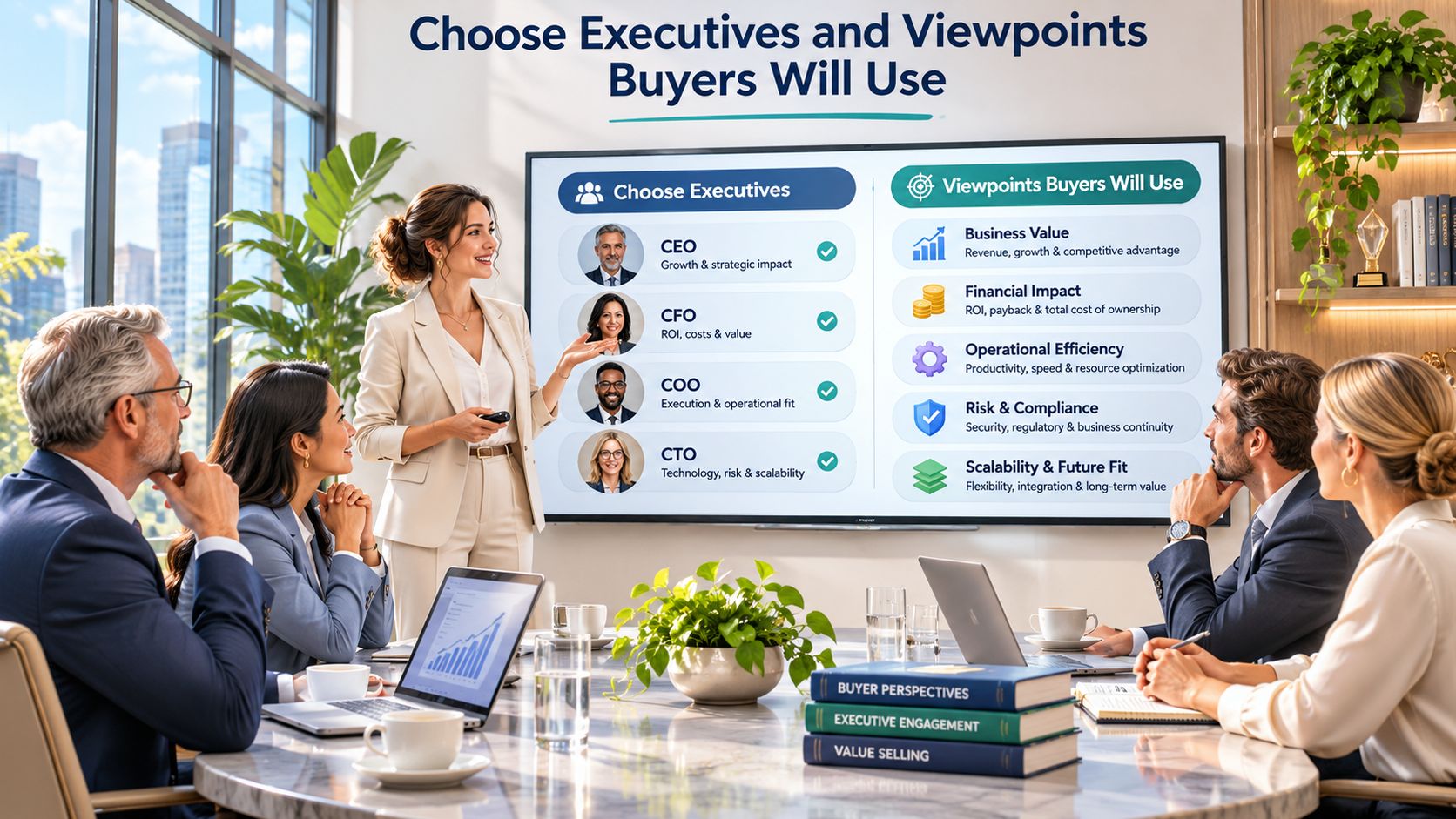
Pick the person before the topic. A viewpoint travels only when the reader believes the author has earned it, and that credibility comes from a specific operating role, not a title. A managing partner writing about client economics lands; the same person writing about AI adoption sounds like everyone else.
The size of the prize justifies the discipline. The 2024 Edelman-LinkedIn B2B Thought Leadership Impact Study, which surveyed 3,484 business executives across seven major markets, found that 75% of decision-makers and C-suite executives had used thought leadership to research a product or service they weren't previously considering. Of those, 23% went on to buy from or work with the organization responsible for the content.
The same study found 60% of decision-makers said high-quality thought leadership made them recognize a significant opportunity their organization was missing, and 29% became aware of a threat or vulnerability they hadn't previously understood. Every one of those outcomes describes a buyer reinterpreting a situation. None of them describes a supplier listing its capabilities.
What goes into a viewpoint brief
Keep it to a single page, and don't publish until it's agreed with the executive:
- Audience and decision: the exact buying role and the choice in front of them this quarter.
- The contrarian thesis: the conventional view in one sentence, the reversal in the next.
- Evidence: three to five proof points drawn from delivery work, customer data or original research, with the method stated.
- Decision to revisit: the specific conclusion the reader should reconsider after finishing.
Two executives, two different buyers
Say an IT consultancy sells legacy modernization. Its delivery director argues that most migration business cases fail because they price the move and ignore the run cost of the target architecture, which speaks to an operations director defending a five-year cost line. The same firm's partner argues the opposite side of a different question, that data residency requirements should reshape the target architecture before the vendor shortlist is drawn, which speaks to the security architect who can veto the deal.
Two executives, two audiences, one account. That's the roster logic worth copying, and it caps at one or two voices per priority buying group because the third voice always dilutes the second.
Profile hygiene runs in parallel. Fix the headshot, a headline naming role and sector, and a featured section holding the three assets you want forwarded. If you're standardizing portraits across a leadership team, AiHeadshots' tips for leadership portraits covers framing and consistency.
A short walkthrough helps when you're briefing a partner who has never written anything longer than a comment:
Then apply the test that kills weak viewpoints fast. If any competitor could make the same point with the same evidence, it isn't a point of view yet. It's a position paper with a logo on it.
Build Content That Passes Four Quality Gates
Strong executive content gives a specific buyer a useful reason to reconsider a decision. Its quality depends less on polish than on whether the argument is relevant, distinctive, supported and actionable.
| Gate | Pass test | Red flag |
|---|---|---|
| Audience and decision | Names one buying role and the decision that role faces | Addressed to senior leaders in general |
| Non-obvious thesis | Challenges a practice the buyer currently follows | Restates a best practice the buyer already knows |
| Evidence or method | Cites customer data, original research or a transparent method | Opinion with no source or method stated |
| Buyer implication | Ends with a specific next action the buyer can take | Ends with a product pitch |
Gate one, one role and one decision
Weak: "Digital transformation for mid-market manufacturers." Strong: "Why mid-market manufacturers should stop budgeting replacements as capital projects." The stronger version names a decision and takes a position. A finance leader can then test the argument against the budget in front of them.
Gate two, a thesis that costs you something
Write the conventional view in one sentence, then state what you believe it misses. A useful reversal should create a real trade-off, such as choosing a slower migration to reduce long-term operating costs. If the claim leaves every existing assumption untouched, it is probably too familiar to earn attention.
Gate three, evidence or a stated method
Support the argument with something a reader can examine: customer data, a benchmark, or a documented method with its limits stated. If the claim cannot be checked, narrow it or remove it. A clear method gives buyers a way to compare the argument with their own circumstances.
Gate four, an implication the buyer can act on
End with the decision the reader can take next, not a request for a demo. "Re-run your run-cost model before you shortlist" gives the buyer a concrete task. "Contact us to learn more" turns the conclusion into a pitch.
Score each gate from 0 to 2 before publication. Publish assets scoring 7 out of 8 or better, and work with the author on the lowest-scoring gate. Use an editorial strategy for keeping content coherent to connect each asset to a clear audience, argument and buyer action.
Distribute Content Where Buying Groups Share It
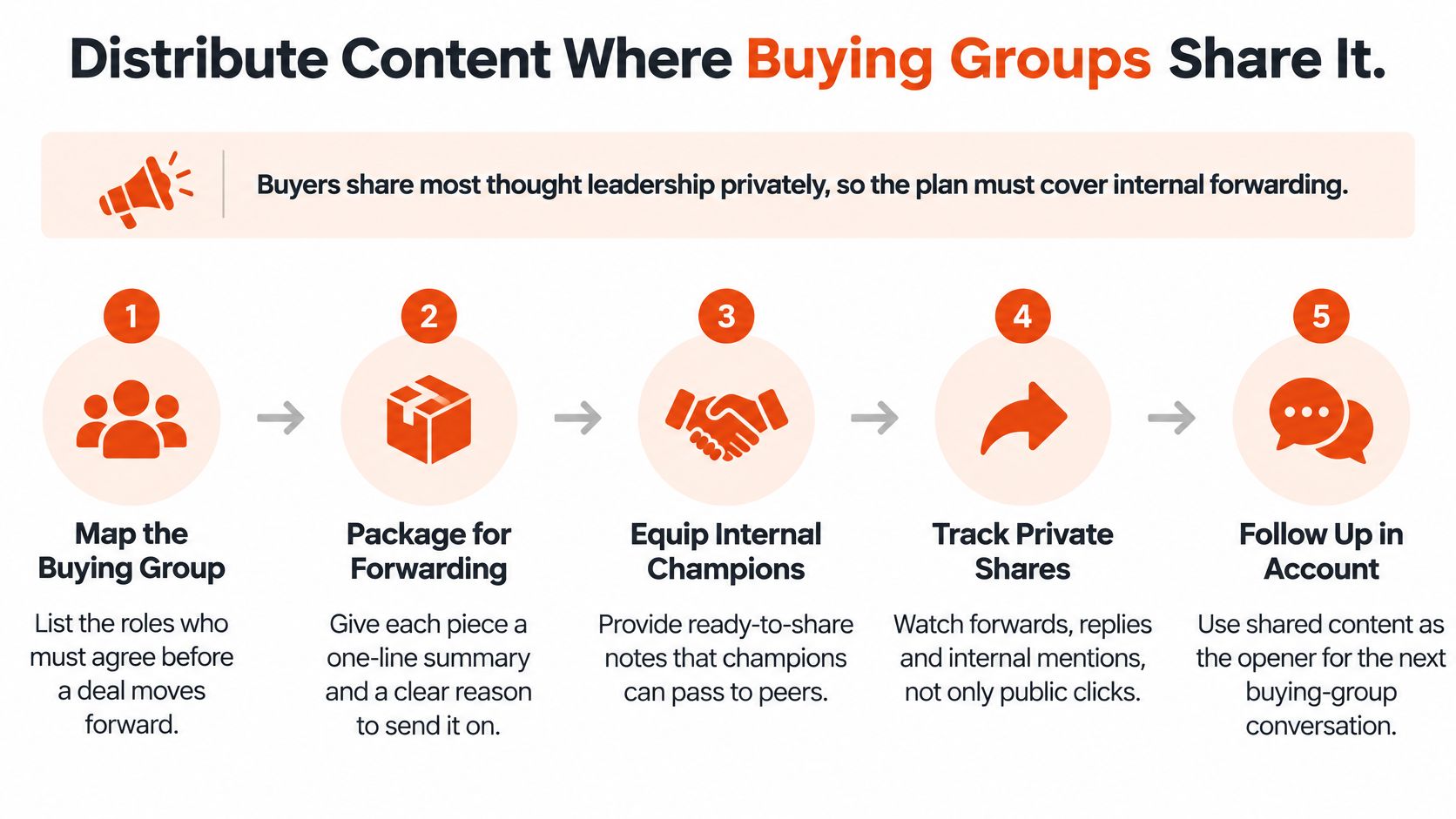
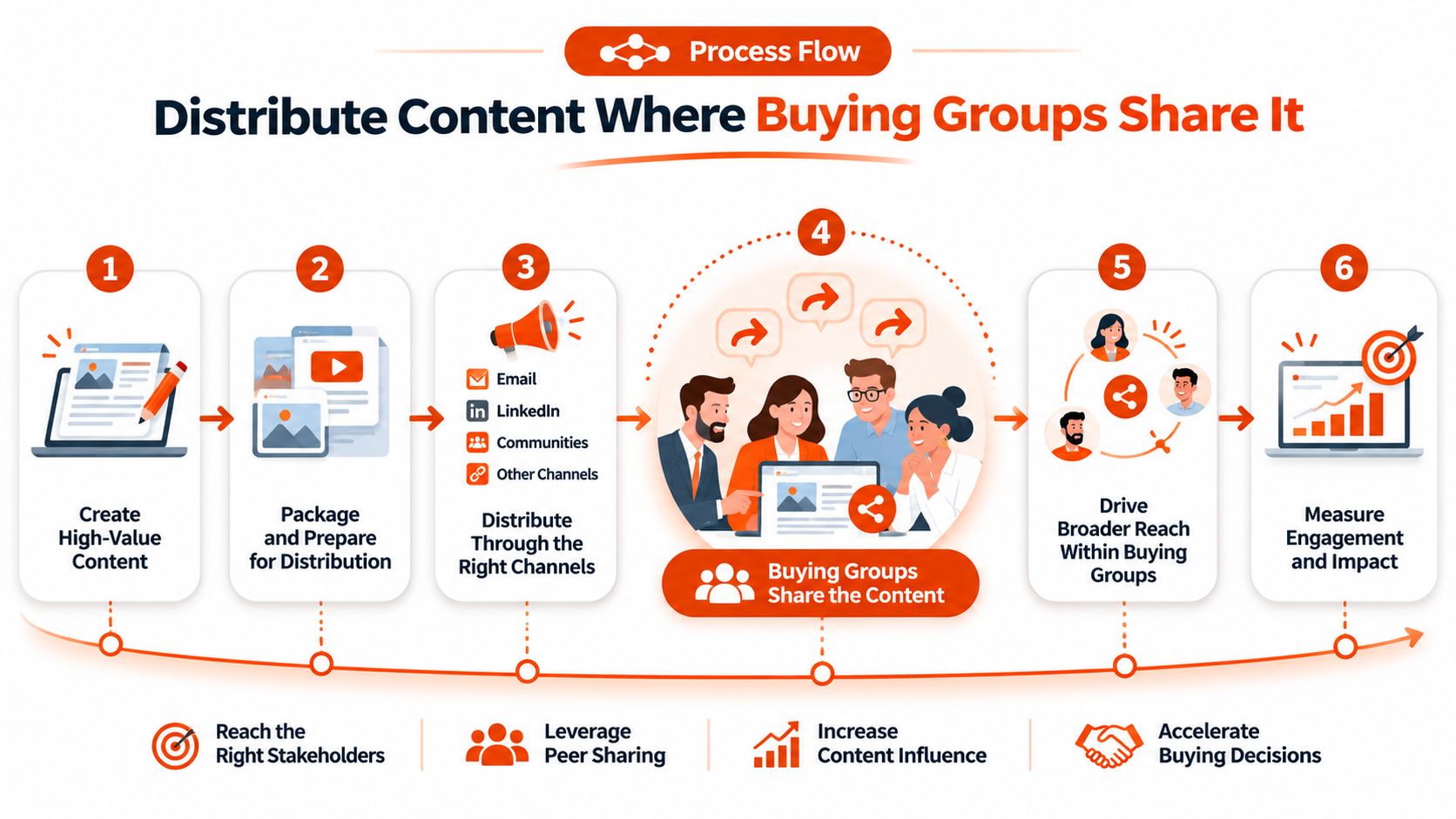
89% of decision-makers who shared thought leadership did so through private channels such as email, direct messages, work chats or meetings, compared with 67% who shared it publicly, according to Edelman and LinkedIn's B2B thought leadership findings reported by PPC Land. And 76% said thought leadership shared or discussed within their buying group helped them assess whether a vendor understood their organization's needs and priorities.
A public posting calendar cannot produce either result on its own. Distribution is a design problem, and it runs in five moves.
Build assets meant to be forwarded. Diagnostic frameworks, decision checklists, benchmark findings and risk perspectives travel because they give the sender a reason to send. A buyer forwarding your piece is lending their judgement to it, and they only do that when it makes them look useful to a colleague.
Publish from the executive's profile, not the company page. Authority sits with a named person who has shipped the work. A page post reads as marketing collateral, and the buying-group member who receives it has nothing to attach to a real human.
Seed the asset in the private channels the group already uses. One-to-one email, direct messages, internal work chats. The internal debate about your category takes place here, and a well-framed question from a peer outperforms any campaign.
Follow up by naming the asset, from a real person's profile. At Ploot, messages go over LinkedIn or email from team members' own profiles, mentioning what the person looked at. Nothing goes from a brand account, because a brand account asking a director what they thought of an article gets ignored.
Log every share and reply against the account record. The value of the log is the role column. When you can see that a finance director forwarded the run-cost piece and the security architect opened the residency note, sales knows who to talk to and what to lead with.
The risk is turning authority-building into surveillance-flavored outreach. Wait for a real signal, name the specific asset, and offer something useful, a worked example, a benchmark cut for their sector, a 20-minute call with the author. Asking for a demo the day after someone clicks a link burns the credibility the piece just built.
If your team is still fuzzy about who sits in the group, SignalVan's breakdown of B2B decision makers maps the roles that have to agree before a deal moves.
Measure Account Progression Instead of Likes
| Indicator type | Metric | Review cadence |
|---|---|---|
| Leading | Completion or dwell rate | Weekly |
| Leading | Repeat engagement from the same target account | Every two weeks |
| Leading | Shares into private channels | Monthly |
| Leading | Engagement by senior decision-makers | Monthly |
| Lagging | Sales-accepted meetings | Monthly |
| Lagging | Opportunity conversion | Quarterly |
| Lagging | Pipeline value from engaged accounts | Quarterly |
The attribution gap is the reason so many programs die in year two. Marketing can't prove the connection, finance asks the obvious question, and the budget goes to events where the spend at least looks countable. The fix isn't better dashboards. It's recording which asset each account consumed, and by which role, before you track meetings and pipeline.
Agree two definitions in writing before launch. Sourced pipeline means the executive content started the opportunity: someone engaged, then a meeting was booked with no prior sales contact. Influenced pipeline means the content appeared somewhere during an open sales cycle. Without agreement, you can argue about these definitions for a month and then discover you were measuring the wrong thing entirely, so pick them early and stop relitigating.
Set up the matched comparison
Comparing engaged accounts against last quarter's numbers proves nothing, because the sales cycle moved, the pipeline mix shifted and two reps changed territory. Compare engaged accounts with a matched non-engaged cohort of similar size, sector and entry point instead.
Say 40 accounts engaged with executive content over two quarters and 40 matched accounts didn't. Then compare opportunity conversion between the two groups at the end of the second quarter. If the engaged group converts better and the gap holds after you strip out accounts that already had an open opportunity, you have something defensible to show a CFO.
One warning worth pinning above the desk: a rise in senior engagement usually shows up weeks before meetings do. Review it over a longer window, monthly at minimum, or you'll cut a program that was two weeks from working. For a broader set of metrics to pair with these, see this guide to account-based marketing KPIs.
Pilot Go or No-Go Criteria for Your Team
Commit to a three-month pilot, and set four conditions before the first asset goes out: a baseline for senior engagement, sales-accepted meetings and pipeline on current accounts; sourced and influenced pipeline definitions agreed in writing; a matched non-engaged cohort of similar size and sector; and a named sign-off owner for every asset.
Then run the first week in this order.
- Confirm the buying-group map and the open decisions each group faces this quarter.
- Pick one or two executives and finish their viewpoint briefs, one page each, agreed with the author.
- Adopt the four-gate scorecard and name the person who approves every asset against it.
- Create the CRM fields that record which asset each account consumed and in which role.
- Write the success criteria down: the pilot scales only if engaged accounts show higher senior engagement, more sales-accepted meetings, and a rising share of opportunities against the matched cohort.
Our own process follows the same logic in four moves: the team becomes a reference voice, prospects are filtered by ICP fit and buying signals, messages go out from individual profiles, and the calendar fills with qualified conversations. Day one is spent defining the ideal customer profile and how each team member writes, which is why the pilot conditions above come before any content.
The go or no-go is blunt. If by day five you cannot name the executive, the buying group and the CRM field for the first asset, the answer is no. The pilot waits, and you've saved a quarter of activity that would have produced impressions and nothing else. If you want a structured way to frame that decision, this piece on go/no-go decision criteria sets out how to weigh it with your team.
Ploot turns your partners', directors' and senior managers' expertise into weekly LinkedIn content, detects who in that audience is showing buying intent, and contacts them from team profiles at the moment it matters, so the pipeline comes from authority rather than cold lists. If you're running a long, high-ticket sales cycle and need to show meetings instead of impressions, start with a three-month pilot with success criteria agreed up front. Visit Ploot to see how the system fits your team.