

Impressions aren't pipeline. Neither are follower counts, connection totals, or a busy notifications tab. They can indicate attention, but they don't prove that the right buying group understands your expertise, trusts your point of view, or wants a sales conversation.
That's where LinkedIn growth hacking needs a more useful definition. For senior B2B profiles, growth isn't about manufacturing activity through indiscriminate automation. It's a coordinated system that builds credible authority, attracts the right audience, detects meaningful engagement, and turns high-intent activity into qualified meetings.
The practical sequence is straightforward. First, make the profiles representing your business credible and searchable. Then publish content that addresses the problems your buyers discuss internally. Activate partners, directors, and senior managers so distribution comes from people with professional authority, not only from a company page. Finally, coordinate engagement and outreach around signals that suggest genuine interest.
This approach also changes what marketing measures. Reach still matters, but it's an input. The commercial outputs are relevant account engagement, buying-group coverage, sales conversations, qualified meetings, and progression through the pipeline. The following playbook focuses on the workflows that connect those outputs.
Table of Contents
- 1. Strategic Profile Optimization for Authority Building
- 2. High-Value Content Pillar Strategy
- 3. Employee-Driven Content Amplification Strategy
- 4. Strategic Partnership and Network Expansion
- 5. Vertical-Specific Account-Based Marketing Campaigns
- 6. Engagement-First Outreach with Social Proof
- 7. Intent-Based Audience Targeting and Engagement
- 8. LinkedIn Live and Interactive Events for Real-Time Engagement
- 9. Conversion Funnel Optimization with LinkedIn Ad Retargeting
- 10. Thought Leadership Positioning Through Industry Awards and Recognition
- LinkedIn Growth Hacking: 10-Point Strategy Comparison
- Turn LinkedIn Growth Into a Meeting System
1. Strategic Profile Optimization for Authority Building
A senior profile is often the first landing page a prospective buyer sees. If the headline only states a job title, the profile wastes an opportunity to explain whom the person helps, which problems they solve, and why their perspective deserves attention.
A technology consulting director, for example, should make digital transformation expertise visible in the language used by buyers. An HR consulting partner can position their profile around change management, workforce transformation, or another specific business challenge. An IT leader can describe cloud migration experience through the business outcomes they've helped clients pursue, provided those outcomes are accurate and supportable.
Use the profile as a message-matching exercise:
- Headline: Combine the audience, business problem, and area of expertise. “Partner at an HR consultancy” says little. A clear statement about helping growing organizations manage workforce change gives buyers a reason to continue reading.
- About section: Explain the situations that trigger a conversation, the approach you bring, and the next step you're open to. Avoid turning the section into a corporate biography.
- Experience descriptions: Replace responsibility lists with specific work, client context where permitted, and verifiable results. Don't add invented metrics just to make the profile sound more impressive.
- Search language: Choose a small group of buyer terms and use them naturally across the headline, About section, experience, and featured content.
- Team consistency: Partners and senior managers don't need identical profiles, but their positioning should reinforce the same market narrative.
A professional photo, relevant featured content, and a clear route to contact complete the authority layer. Teams can also use this guide to creating a LinkedIn profile as a practical reference while standardizing profile quality.
Practical rule: Optimize for the buyer's next question, not the executive's entire career history.
Review profiles quarterly against real sales conversations. If prospects repeatedly ask about a capability that isn't visible, update the positioning. Profile optimization isn't a one-time branding exercise. It's message maintenance based on what creates useful commercial conversations.

2. High-Value Content Pillar Strategy
Content works harder when it gives a senior profile a recognizable point of view. A consulting firm that publishes disconnected observations about leadership, technology, hiring, and productivity may appear active, but buyers won't know what expertise to associate with the people behind the posts.
Choose pillars where the team has genuine experience and a differentiated perspective. An IT consultancy might focus on the organizational risks of cloud migration rather than repeating broad cloud definitions. An HR consultancy might build authority around the practical adoption problems that follow a workforce transformation. A B2B software company could focus on the operational decisions its buyers face before they ever evaluate a product.
Each pillar should produce several content formats:
- Decision guides: Explain how a buyer can assess options, risks, and readiness.
- Operator perspectives: Share lessons from delivery, implementation, hiring, or change programs without disclosing confidential client information.
- Point-of-view posts: Take a defensible position on a recurring industry debate and explain the reasoning.
- Proof content: Use real research, anonymized lessons, or approved customer evidence. Generic claims don't create much confidence.
- Conversation prompts: Ask questions that reveal how the audience thinks, not questions designed only to collect easy reactions.
A strong system starts with substantial material, then adapts its ideas into posts, comments, short videos, and sales enablement. A product-led account intelligence blog can also provide useful inspiration for turning account insight into relevant content themes.
Measure more than engagement. Track profile visits, relevant connection requests, return engagement from target accounts, conversations initiated, and lead quality. LinkedIn's 2026 research context matters here because the platform has crossed 1.3 billion registered members, with around 310 million monthly active users and about 134 million daily active users, according to LinkedIn statistics for 2026. A large audience creates opportunity, but only a focused content system turns scale into useful attention.
3. Employee-Driven Content Amplification Strategy
Company pages provide a home for official announcements. They usually shouldn't carry the full burden of distribution. Buyers tend to connect more naturally with a partner, director, consultant, or technical leader who can explain why an issue matters in practice.
The evidence supports putting credible people at the center of distribution. A 2026 Metricool study summarized by Oktopost analyzed 673,658 posts from 63,108 accounts and found that personal profiles averaged a 2.60% engagement rate, compared with 1.74% for company pages. The same summary reported falling likes, comments, and shares even as total engagement increased through clicks, video views, and other actions. The details are available in B2B social media statistics from Oktopost.
That doesn't mean asking every employee to copy and paste corporate posts. It means building a participation model that respects individual expertise.
Make advocacy useful for the people sharing
Begin with a willing group of senior employees whose networks overlap with the ideal customer profile. Give them a content brief, not a rigid script. The brief should include the audience, the argument, the supporting evidence, and several ways to add a personal observation.
A practical editorial mix includes company insight, industry commentary, and firsthand perspective. The balance matters because an account that only promotes company assets quickly becomes a distribution endpoint rather than a trusted professional voice.
Create a lightweight operating workflow:
- Marketing prepares: Provide ideas, draft options, visual assets, and context.
- Subject-matter experts adapt: Each participant adds a genuine observation in their own voice.
- Leaders review risk: Check client confidentiality, regulated claims, and brand issues.
- Sales follows signals: Route meaningful comments and profile activity to the right owner.
- The team learns: Identify themes that produce useful conversations, not only reactions.
Recognition can encourage participation, but forced advocacy usually produces bland content. The strongest employee programs give people a reason to participate because the content helps them express expertise and build relevant relationships.

Teams can use this employee advocacy on LinkedIn resource to formalize participation without turning personal profiles into corporate billboards.
4. Strategic Partnership and Network Expansion
A narrow company network limits distribution, especially when the buyers you want already trust adjacent specialists. A cloud consultancy, for example, may reach more relevant technology leaders by collaborating with complementary providers, provided the relationship adds value rather than creating a disguised referral pitch.
The best partnerships are complementary, not merely popular. Look for organizations that serve similar buyers while solving a different problem. An HR consultancy might work with a benefits broker or payroll provider. A business consultancy could collaborate with a specialist technology vendor serving the same industry. A B2B software company might partner with an implementation firm that can explain the operational side of adoption.
Start with a contained collaboration:
- Shared audience: Confirm that both networks include the buyers you want to reach.
- Clear contribution: Agree on who brings research, speakers, customer context, or distribution.
- Useful format: Choose a joint briefing, webinar, interview, or practical guide with a defined audience.
- Mutual promotion: Decide how each partner will support publication and follow-up.
- Commercial boundaries: Clarify referrals, ownership, confidentiality, and any exclusivity before launch.
Warm introductions are generally more useful than generic partnership requests. A partner should be able to explain why the collaboration helps its audience, not only why it helps your reach.
Measure account quality and relationship progression. Did the collaboration attract relevant stakeholders? Did it create conversations in a target vertical? Did the parties identify opportunities for a referral or deeper content project? If the answer is no, more joint posting won't fix the underlying mismatch.
Partnerships also need an owner. Without someone responsible for planning, approvals, promotion, and follow-up, the initiative becomes a one-off content event. Treat the relationship as a small channel with an audience definition, operating agreement, and review point.
5. Vertical-Specific Account-Based Marketing Campaigns
Broad audience growth can hide weak commercial relevance. Account-based marketing gives the team a sharper question: which companies should recognize our expertise, and which people inside those companies need to encounter it?
Select a focused account set using fit and win probability. Then research each account's business model, public priorities, recent developments, leadership structure, and likely transformation pressures. The purpose isn't to collect trivia. It's to understand the context that should shape content and outreach.
Map the buying group rather than stopping at the most visible executive. For each account, identify the business sponsor, functional evaluator, technical or operational stakeholder, procurement influence, and potential internal champion where those roles are discoverable. Assign relationship owners across partners, directors, marketing, and sales.
Coordinate the account experience
An account should see a coherent sequence, not unrelated messages from several employees. Marketing can publish a relevant point of view, a subject-matter expert can add useful commentary, and a sales owner can follow up when the account shows meaningful interest.
Useful account-specific assets might include:
- Industry perspective: A post addressing a priority visible in the account's market.
- Relevant proof: An approved example involving a similar operating challenge.
- Executive conversation: A roundtable or briefing designed around the account's context.
- Practical resource: A guide that helps stakeholders assess the problem internally.
- Meeting path: A low-friction invitation connected to the issue, not a generic demo.
Track account engagement across profiles and channels. Look for repeated interaction, participation from multiple stakeholders, visits to relevant resources, and movement from awareness toward a commercial conversation. Don't judge the campaign by the connection count of one employee.
The handoff needs discipline. Sales should know why the account is being prioritized, which people engaged, what content they saw, and what conversation would be useful next. Marketing should receive feedback on whether the engagement reflected an active initiative or casual interest. That loop turns ABM from a list of names into a learning system.
6. Engagement-First Outreach with Social Proof
Generic connection requests fail because they ask for attention before earning relevance. A senior buyer who has never encountered your perspective has little reason to accept a message that begins with a pitch.
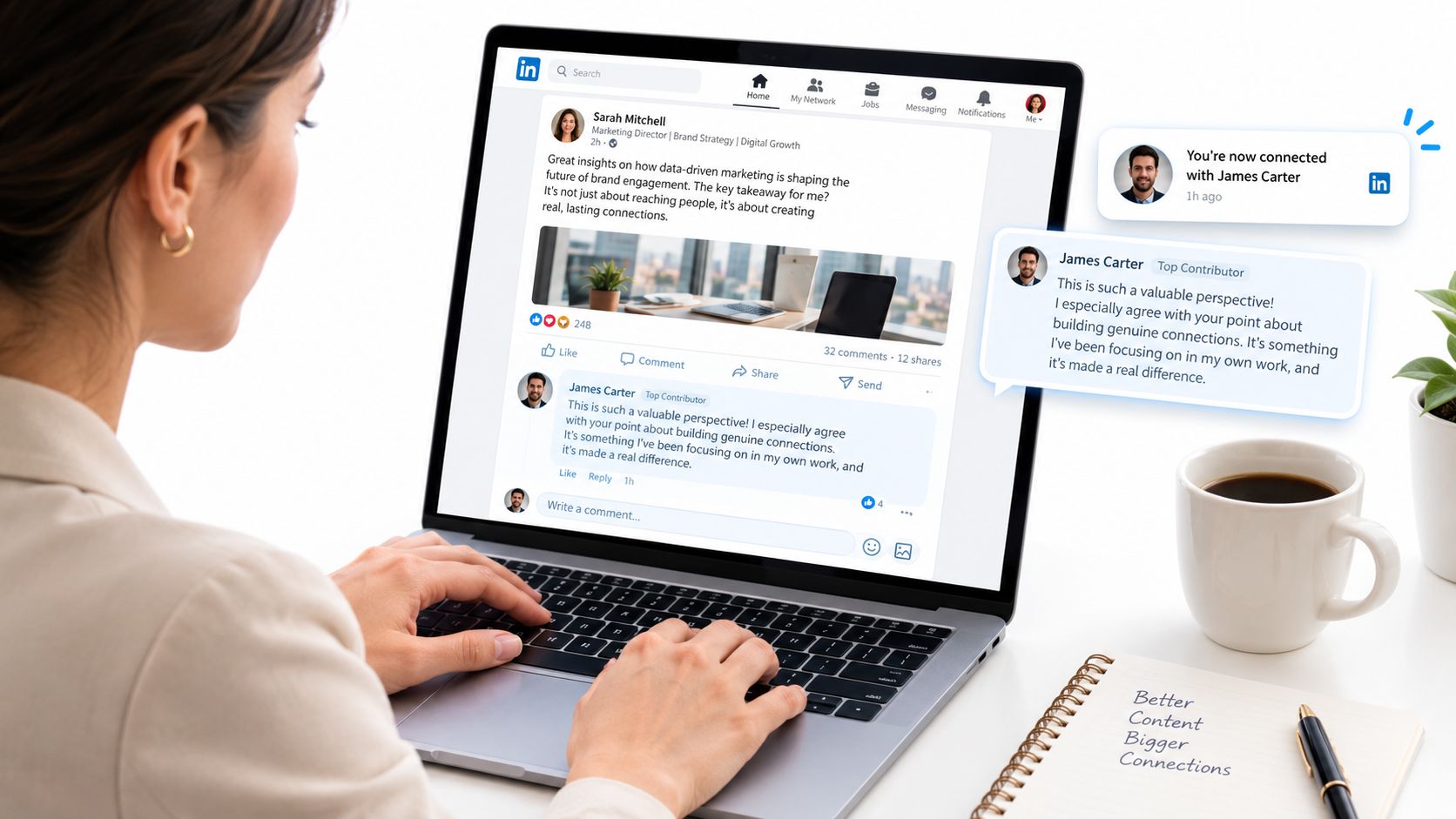
Engagement-first outreach starts earlier. Follow the prospect's public content, read it closely, and contribute something useful when you have a real point to add. A thoughtful comment on a finance leader's transformation post can demonstrate understanding. A relevant observation on an HR director's culture discussion can create recognition before anyone sends a private message.
The comment must stand on its own. “Great post” adds no value. A useful response might clarify a trade-off, introduce an overlooked implementation issue, or ask a question that moves the discussion forward. Don't manufacture disagreement for visibility, and don't use a comment as a disguised sales message.
A practical workflow looks like this:
- Select relevance: Prioritize prospects whose roles and published interests match the offer.
- Read for context: Identify the argument, evidence, and unanswered question in their content.
- Contribute publicly: Add a concise perspective that would help other readers too.
- Connect with context: Mention the specific topic that made the connection relevant.
- Continue the relationship: Share an insight, introduction, or resource before requesting time.
Social proof can also come from sharing a prospect's public work with appropriate context. That signals respect for their expertise, but it shouldn't imply endorsement or create pressure.
Measure the quality of the resulting conversations, not merely acceptance. Record which engagement themes led to replies, useful discovery, and qualified meetings. Over time, sales teams can distinguish between activity that creates familiarity and activity that indicates a real business problem.
“Warm” doesn't mean “ready to buy.” It means the outreach has earned a more relevant opening.
Automation should never replace judgment here. Tools can help surface activity and organize follow-up, but the comment, message, and timing still need to reflect the individual and the account.
7. Intent-Based Audience Targeting and Engagement
The most valuable audience isn't always the one that reacts most visibly. A prospect may read several relevant posts, visit a senior profile, return to a topic, or engage with a case study without leaving a public comment. Those quieter behaviors can matter more than a broad burst of likes.
Define intent for the specific offer. For a transformation consultancy, meaningful signals might include repeated interaction with transformation content, attention from several people at one target account, or engagement with a diagnostic resource. For a B2B software company, signals may include interest in comparison content, implementation material, or operational questions raised by multiple stakeholders.
Avoid treating one isolated action as proof of buying intent. Create a simple scoring model based on combinations of relevance and behavior:
- Role relevance: Is the person involved in the problem or buying process?
- Account fit: Does the organization match the target market and commercial profile?
- Topic relevance: Does the activity relate to the solution area?
- Recency: Is the behavior recent enough to guide timely follow-up?
- Depth: Did the person return, comment, ask a question, or engage with a substantive asset?
The sales response should match the signal. A public reaction may justify monitoring. A relevant comment can invite a useful exchange. Repeated engagement from several people at a target account may justify coordinated outreach from a senior profile.
Edelman and LinkedIn's 2025 global study highlights why this matters. More than 40% of B2B deals stall because of buying-group misalignment, while hidden buyers consume thought leadership at nearly the same rate as target buyers, 63% versus 64%, and use it in vendor evaluation at 55% versus 56%, as reported in LinkedIn's research on hidden buyers.
Intent detection should therefore expand the audience map. The person commenting may not be the economic buyer, but they may influence the shortlist, introduce the vendor internally, or reveal which question the buying group is trying to answer.
8. LinkedIn Live and Interactive Events for Real-Time Engagement
Live events create a different kind of evidence than static posts. A viewer who asks a detailed question, stays for a discussion, or returns to a follow-up session has given the team more context than an anonymous impression.
The format doesn't need to be elaborate. A consulting firm can host a market briefing with a partner. A software company can run a product discussion with an implementation specialist. An HR consultancy can convene a roundtable around workforce change. The subject should be narrow enough that the right audience immediately understands why attending would be useful.
Design the event around participation:
- Specific promise: State the business question the session will answer.
- Strong host: Use a credible senior profile, with a second person managing questions and logistics.
- Useful agenda: Combine a short point of view with practical examples and audience discussion.
- Clear next step: Offer a resource, assessment conversation, or relevant follow-up.
- Follow-up ownership: Record questions, attendee interests, and accounts for sales review.
Promotion should begin early enough for the intended audience to recognize the topic, but the posts shouldn't reveal the entire discussion. Invite relevant partners and encourage speakers to explain why the issue matters to their networks.
Use the event recording as source material for shorter posts, clips, written answers, and sales follow-up. Review where audience participation increased or dropped, which questions came from target accounts, and which attendees accepted a relevant next conversation.
Technical quality still matters. Review this LinkedIn video specifications guide before publishing supporting video assets.
The event is not the conversion. It's a structured opportunity to identify people and accounts that want to discuss the problem in more depth.
9. Conversion Funnel Optimization with LinkedIn Ad Retargeting
Paid distribution becomes more efficient when it follows earned attention. Retargeting people who have already visited relevant pages, engaged with content, or interacted with an event gives the campaign more context than starting with an entirely cold audience.
Build the funnel around the buyer's level of awareness. Early messaging can clarify the problem and introduce a point of view. Consideration messaging can offer a diagnostic guide, webinar, or practical framework. Conversion messaging can invite a consultation, assessment, or meeting when the audience has enough context to evaluate that request.
Keep each audience and message distinct. Someone who watched an event should not receive the same ad as someone who only encountered a broad industry post. Separate campaigns make it easier to understand which behavior preceded the conversion and whether the resulting leads fit the sales process.
Connect advertising to sales outcomes
Use native lead forms where reducing friction is appropriate, but don't confuse form completion with qualification. Pass submissions and source information into the CRM. Record the account, role, content interaction, campaign stage, meeting outcome, and opportunity progression.
Test creative based on a clear hypothesis. One ad might emphasize a business risk, another a diagnostic approach, and another a peer discussion. Review cost per qualified conversation rather than optimizing only for cheap form fills. A low-cost lead that sales can't use is an expensive distraction.
Organic and paid activity should reinforce each other. A senior profile can publish the insight, a company campaign can extend it to the relevant audience, and retargeting can provide a practical next step. Paid media should accelerate a credible message, not compensate for a weak one.
For teams building the organic-to-conversion workflow, this LinkedIn lead generation resource provides a relevant starting point. The operating principle is simple: advertise to help a buyer take the next useful step, not to inflate a dashboard.
10. Thought Leadership Positioning Through Industry Awards and Recognition
Awards and speaking invitations can strengthen authority because they provide third-party context. They don't replace useful expertise, but they give buyers an additional reason to investigate the person behind the profile.
Choose recognition that your target buyers respect. A well-regarded industry event, professional association, or specialist publication is usually more valuable than an obscure badge with no meaningful audience. The same principle applies to speaking. A session for the right practitioners can create better commercial context than a high-visibility appearance in front of an unrelated crowd.
Treat recognition as a content and relationship asset:
- Before the event: Explain the issue you'll address and invite relevant stakeholders to contribute questions.
- During the event: Capture ideas, audience questions, and useful disagreements with permission.
- After the event: Publish the practical lessons, not only a photograph of the stage.
- For sales: Identify attendees and contacts who engaged with the topic, then follow up with context.
- For the profile: Add accurate recognition, recordings, presentations, and supporting evidence.
Thought leadership has a downstream role in buying decisions. The 2025 Edelman and LinkedIn report says 79% of B2B decision-makers are more likely to champion a company during an RFP when it consistently produces high-quality thought leadership. It also reports that 95% of buyers are more receptive to vendor outreach when the company produces strong thought leadership, while 58% say it influenced willingness to pay a higher price. These findings appear in LinkedIn's overview of thought leadership in B2B.
Use the recognition to deepen the commercial narrative. A consulting partner who wins an award can explain the operating insight behind the work. A speaker can turn audience questions into a series of practical posts. That substance is what makes recognition useful after the announcement fades.
LinkedIn Growth Hacking: 10-Point Strategy Comparison
| Tactic | 🔄 Complexity | ⚡ Resources & Speed | ⭐📊 Expected outcomes | 💡 Ideal use cases | Key advantages |
|---|---|---|---|---|---|
| Strategic Profile Optimization for Authority Building | 🔄 Medium, one-time build + ongoing upkeep | ⚡ Low resources; slow compound (3–6 months) | ⭐⭐⭐ · Better discoverability, inbound connection growth | Senior leaders, B2B consulting firms building credibility | Builds authority; improves search visibility; low maintenance after launch |
| High-Value Content Pillar Strategy | 🔄 High, research, production, editorial discipline | ⚡ High resources; slow to moderate ROI (6–12 months) | ⭐⭐⭐⭐ · Strong thought leadership; qualified inbound traffic | Firms seeking long-term inbound and SEO-driven positioning | Deep expertise proof; repurposable assets; SEO gains |
| Employee-Driven Content Amplification Strategy | 🔄 Medium, coordination, governance needed | ⚡ Medium resources; scales quickly with team buy-in | ⭐⭐⭐⭐ · Large reach uplift (x8–10) and individual credibility | Companies with distributed teams aiming to amplify content | Multiplies reach; builds employee brands; authentic distribution |
| Strategic Partnership and Network Expansion | 🔄 High, relationship mapping and maintenance | ⚡ Medium resources; slow relationship timelines | ⭐⭐⭐⭐ · Expanded addressable market and co-branded credibility | Entering new verticals or expanding distribution through partners | Access partner audiences; shared credibility; referral pipeline |
| Vertical-Specific Account-Based Marketing (ABM) Campaigns | 🔄 High, multi-team coordination and research | ⚡ High resources; targeted, measurable results (months) | ⭐⭐⭐⭐⭐ · Higher close rates & deal sizes; clear ROI per account | High-value, long-sales-cycle accounts (20–50 named accounts) | Deep personalization; concentrated ROI; competitive moat |
| Engagement-First Outreach with Social Proof | 🔄 Medium, time-intensive, relationship-focused | ⚡ Low resources per prospect; slower initial outreach cadence | ⭐⭐⭐⭐ · Much higher acceptance/response rates (3–5x) | High-ticket sales where authenticity matters | Builds trust before outreach; increases reply rates; low friction |
| Intent-Based Audience Targeting and Engagement | 🔄 Medium–High, needs tooling + signal definitions | ⚡ High tech/resource need; fast conversion timing when signals appear | ⭐⭐⭐⭐⭐ · Very high conversion rates (5–10x) and efficiency | Warm prospecting for high-ticket B2B; platforms like Ploot core use | Targets active buyers; reduces wasted outreach; high ROI |
| LinkedIn Live and Interactive Events for Real-Time Engagement | 🔄 Medium, event production and moderation | ⚡ Medium resources; moderate speed, high engagement spikes | ⭐⭐⭐⭐ · Strong engagement, attendee lead capture | Community building, demos, Q&A, thought-leader sessions | Real-time interaction; captures engaged prospects; replayable content |
| Conversion Funnel Optimization with LinkedIn Ad Retargeting | 🔄 Medium–High, ad setup, tracking, optimization | ⚡ High budget; faster conversion of warm audiences | ⭐⭐⭐⭐ · Efficient conversion from awareness to meetings | Complement organic strategies to accelerate pipeline | Measurable conversions; native lead forms; sequential messaging |
| Thought Leadership Positioning Through Industry Awards & Recognition | 🔄 Medium–High, submissions, PR, speaker outreach | ⚡ Medium resources; slow payoff (3–6 months) | ⭐⭐⭐⭐ · Third-party validation and earned media lift | Senior partners seeking credibility and speaking opportunities | Third-party credibility; media exposure; long-lived proof points |
Turn LinkedIn Growth Into a Meeting System
LinkedIn growth hacking becomes commercially useful when every activity has a role in the path to a meeting. Profile optimization creates the authority layer. Content gives that authority something valuable to say. Employee and partner distribution place the message in relevant professional networks. Intent detection helps the team decide who deserves attention now.
Start with the profiles that represent the business in important conversations. Review the headline, About section, experience descriptions, featured content, and route to contact. Senior leaders should be recognizable for a specific problem and audience, not merely for a title. A profile that says what the person helps buyers accomplish gives content and outreach a stronger foundation.
Then narrow the audience. Choose the industries, account types, and buying roles where the company has a credible reason to participate. Map the broader buying group, including stakeholders who may not appear in the first sales conversation. The guide to building LinkedIn authority can support this work, but the operating standard should come from your own sales process and customer evidence.
Build a content system that reinforces the chosen positioning. Each post should make one useful contribution, whether it explains a difficult decision, challenges a common assumption, shares a delivery lesson, or helps a buyer evaluate options. Give partners, directors, and senior managers room to add their own perspective. A company page can support distribution, but it shouldn't flatten every expert into the same voice.
Next, define the signals that justify coordinated action. A relevant profile visit alone may be too weak. Repeated engagement with a problem, activity from several stakeholders at one account, a thoughtful question, or interest in a substantive resource may be stronger. Keep the model simple enough for marketing and sales to use consistently, then improve it with feedback from real conversations.
Outreach should follow the signal and come from the profile with the most credibility for that buyer. The message should acknowledge context, offer something useful, and make an appropriate request. It shouldn't pretend that every interaction is an urgent buying moment. Respectful timing protects the authority the team has worked to build.
Measure the system in stages:
- Authority: Are the right people visiting and engaging with senior profiles?
- Audience quality: Are relevant accounts and buying-group members appearing in the audience?
- Intent: Which behaviors reliably precede a useful conversation?
- Sales activity: Are engaged accounts receiving timely, coordinated follow-up?
- Pipeline: Do those conversations create qualified meetings and progress opportunities?
This measurement model prevents a common failure. Marketing can generate impressive activity while sales receives no context, no prioritization, and no reason to believe the outreach will work. The remedy is not just more posting. It's a tighter connection between audience building, intent interpretation, and sales execution.
Ploot is one relevant option for B2B teams that want to activate partners, directors, and senior managers while identifying audience members who show buying interest. Its platform combines LinkedIn content support, audience development, buying-signal detection, and outreach workflows. Visit Ploot for current platform details, since features and commercial terms may change.
Ploot helps B2B teams turn partners, directors, and senior managers into a coordinated LinkedIn sales channel, with content support, audience building, buying-signal detection, and relevant outreach. Visit Ploot to explore how the platform can connect senior-profile authority with qualified meeting generation.