

Your director's LinkedIn posts get comments from people you'd love to sell to. Your pipeline, though, still depends on trade shows, partner referrals and whoever a booth scanner captured last quarter. That gap isn't a content problem. It's an account problem, because visibility isn't tied to a named list, a buying committee or a rule for who gets contacted next.
Account based marketing lead generation fixes that by starting with the companies that matter, then judging every post, visit and reply against one question. Did this move a priority account closer to a qualified meeting? If it didn't, it's activity, not progress.
Table of Contents
- The Five Stages of ABM Lead Generation at a Glance
- How to Pick Accounts and Map the Buying Committee
- How to Detect Intent and Set Qualification Thresholds
- Personalize and Convert LinkedIn Engagement Into Meetings
- Measuring Account Progression and Pipeline Influence
- Confirm Your Pilot Criteria Before You Launch
The Five Stages of ABM Lead Generation at a Glance
Say a consulting firm has a confident partner posting twice a week, a decent website and a calendar of events. Leads still arrive in bursts from trade shows rather than from named accounts, so sales chase whoever scanned a badge while target companies research for months. The fix is a five-stage workflow where each stage produces a named output before the next one starts.
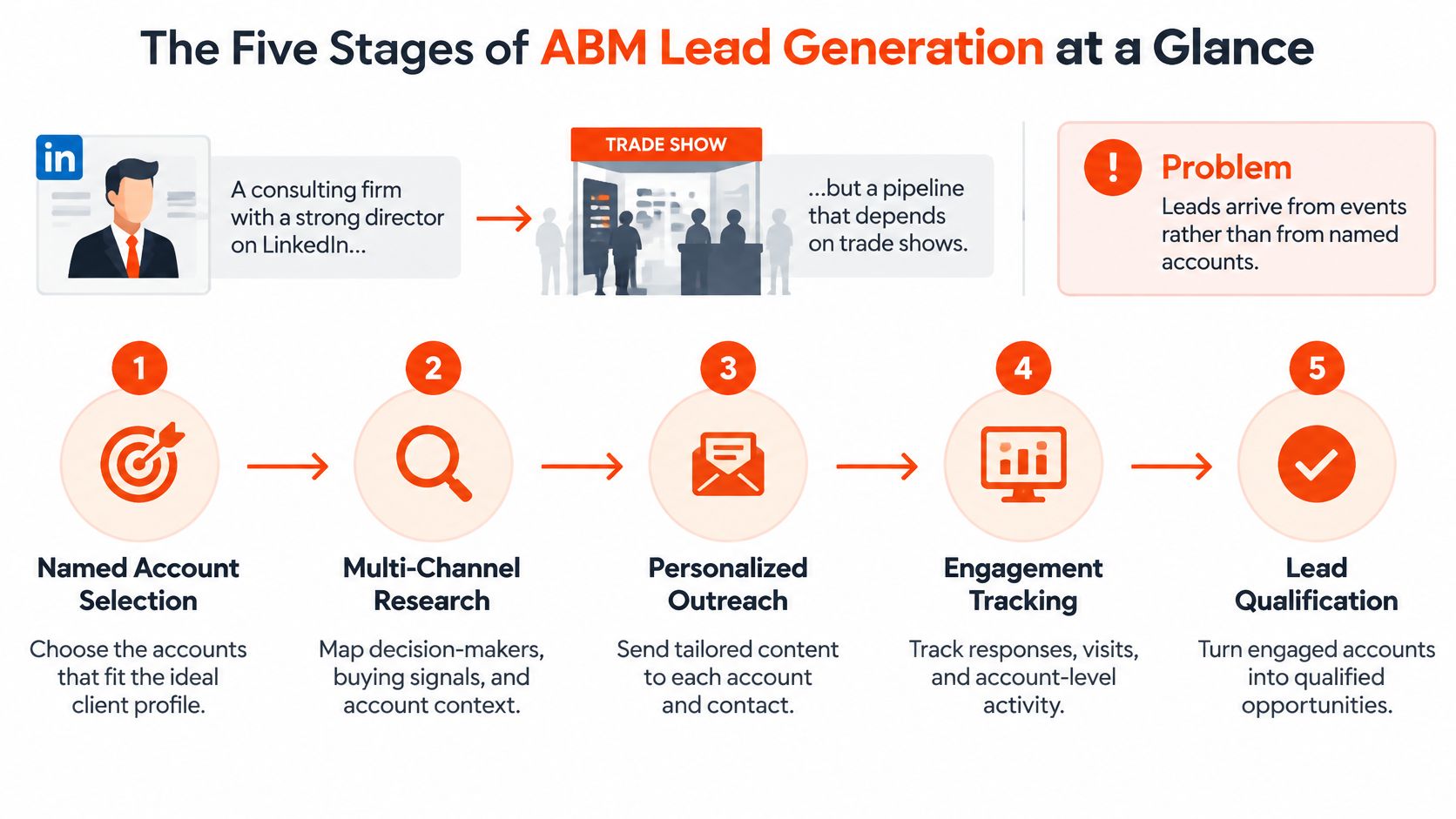
First, define and rank target accounts. The output is a list of named companies filtered by ideal customer profile criteria. Second, map the buying committee. The output is three to six roles per account, including the economic buyer, evaluators, users and likely blockers. Third, detect intent. The output is scored accounts that cross an agreed threshold. Fourth, personalize and engage, using personalized outreach to key accounts where email supports the same account-specific angle as LinkedIn. The output is active conversations with relevant people. Fifth, measure account progression. The output is a monthly view of meetings, opportunities and pipeline by account.
In 2025, 77% of organizations running account-based marketing reported increased pipeline, according to N.Rich's survey of 107 B2B go-to-market leaders. That figure means little if your stages have no outputs. Run one test before anything else. Can you name the accounts, the roles and the signal that triggers outreach? If you can't, don't launch yet.
How to Pick Accounts and Map the Buying Committee
Start with an ideal customer profile built from commercial fit, not wishful thinking. Filter by industry, employee count, geography, technology environment, estimated contract value and sales-cycle fit. A target that can't fund your typical contract or won't decide within your normal cycle shouldn't consume senior profiles, no matter how prestigious the logo looks.
Build and Tier the List
- List every fit: Pull every company that passes the filters, then cut anything where you can't name a plausible buyer.
- Rank what remains: Score by contract value and strategic fit, not by how easy someone is to reach.
- Assign a tier: Reserve one-to-one for the top few, group similar accounts one-to-few, and run the rest one-to-many on signals.
- Name five roles: For each account, identify the economic buyer, a technical evaluator, a user, procurement and one likely blocker.
- Mark existing warmth: Note who already engages with your team or your partners' content, since that's your opening route.
| Tier | Typical accounts | Contacts per account | Outreach style | Weekly effort guide |
|---|---|---|---|---|
| One-to-one | 5 to 10 | 4 to 6 | Custom research and executive-to-executive outreach | 2 to 3 hours per account |
| One-to-few | 15 to 30 | 3 to 4 | Shared sector or problem angle with tailored notes | 45 to 60 minutes per account |
| One-to-many | 50 to 150 | 2 to 3 | Signal-triggered sequences from team profiles | Automated, reviewed weekly |
Where Lists Break
The common mistake is treating one senior contact as the whole account. That person changes jobs, delegates evaluation or opposes you, and the account goes dark. For a high-ticket deal, a pilot list of 20 to 40 accounts with at least three active roles each beats 500 accounts with one contact each, because a real sales opportunity is a person in fit who's shown buying intent and reaches sales with context.
Data and reporting are a leading ABM challenge, cited by 35% of practitioners in the ITSMA and Demandbase benchmark study, which also found organizations with at least three years of ABM experience much more likely to report double their investment return than newer programs. That's why we don't do mass prospecting. We contact low volumes, and only people who've already interacted with the client, the client's company or its sector.
If you can't name the role and the reason it matters, the account doesn't go on the list yet.
Connect CRM opportunity data with marketing engagement and campaign exposure from day one. Otherwise you'll never tie anonymous activity to pipeline, and you'll argue about credit instead of fixing coverage.
How to Detect Intent and Set Qualification Thresholds
A single click from one person is the trap. It feels like momentum, so someone messages them, gets ignored, and sales concludes intent data doesn't work. Set a baseline for each account first, then combine signals so one curious employee can't trigger outreach alone.
Two definitions keep this honest. A marketing-qualified account, or MQA, is a target account that has crossed the agreed threshold and is ready for sales review. A qualified meeting is one where the contact named a problem, a timeframe or a budget owner. Everything below those bars is interest, not qualification.
Score Signals, Then Filter Them
Signals come from pricing and solution page analytics, LinkedIn engagement on posts, event and webinar registrations and questions, and any third-party intent feed. Log the source of each one, because we detect buying signals and write personalized messages based on them, and you can't trace false positives without provenance. Our guide to using B2B intent data without chasing noise covers the capture side in more depth.
| Signal | Example | Starting weight | Common false positive |
|---|---|---|---|
| Repeat visits to solution or pricing pages | 3 visits in 14 days from two people | 3 | Competitor or analyst research |
| Problem-specific content consumed | Two articles on a cost or compliance problem | 2 | Students or content hunters |
| Event or webinar questions | Asked about implementation timing | 2 | Vendors asking on behalf of others |
| Senior role engaged | Director or partner engages with a post | 2 | Recruiters or former colleagues |
| Multiple buying-group members | Three roles engage within 14 days | 3 | Internal staff testing content |
| Generic content interest | One like on a broad industry post | 1 | Almost always noise |
Test a starting rule rather than treating it as law. Multiply fit score by buying-stage score, require a minimum on both, and trigger only when at least two people from the account engage within 14 days. Before routing to sales, check recency, whether the contact is reachable, and whether the topic reflects a real business problem.
Integration decides whether scoring survives contact with reality. Demandbase's State of ABM benchmark reports MQA-to-pipeline conversion above 22% for organizations connecting CRM, marketing automation and predictive models, compared with 14% for teams with limited integration. If you're comparing tooling more broadly, this roundup of lead generation options for Latin American SMBs shows how much capture tools vary, and why none of them replaces a threshold you've agreed with sales.
Watch for stale account data, duplicate records and single-contact bias. Log every trigger with the signal, the contacted profile, response latency and the outcome, so a bad week tells you which weight to change.
Personalize and Convert LinkedIn Engagement Into Meetings
A director comments thoughtfully on your post about reporting failures. Two days later she gets a connection note saying you'd love to add her to your network. It mentions nothing she wrote. That's the failure most programs start with, and it burns the exact credibility the post created.
Personalization here means referencing a specific behaviour, not inserting a first name. On day one, we define the client's ICP and how each team member writes, so five people contacting one committee still sound like themselves and don't contradict each other. Messages go via LinkedIn or email from the team's own profiles, mentioning what the person looked at, not from a brand account.
Build the Message in Five Moves
- Name the behaviour: Reference the post, topic or page they engaged with.
- Tie it to their role: A talent director cares about hiring lead times. A CMO cares about pipeline reporting. Don't send both the same problem.
- Offer one observation: Share something useful from your sector work, not a product pitch.
- Ask one easy question: Something answerable in a sentence, ideally about how they handle it today.
- Give an exit: "Not a priority right now" protects the relationship and gets you honest answers faster.
Our notes on LinkedIn messaging best practices show message examples that follow this structure. Peer-to-peer messages earn replies that brand posts don't, because the reader can see a real person with a real point of view behind them.
Run a 30-Day Sequence With Stop Conditions
| Day | Channel | Action | Stop if |
|---|---|---|---|
| 0 | Comment on a relevant post from the target person | Never stop, this is the opening | |
| 2 | Connection request that names the post | Request declined or ignored | |
| 5 | Short insight message with one question | Reply names a problem or timeframe | |
| 9 | Note to a second committee member, referring to the same topic | Bounce or unsubscribe | |
| 14 | Meeting ask with two time options | Clear no or referral to another person | |
| 30 | LinkedIn or email | Recycle to nurture with a check-in date | Contact asks to be removed |
Trust explains why this works, but it doesn't prove pipeline. LinkedIn's 2025 benchmark of 1,500 senior B2B marketers across six countries found 94% consider trust important to B2B success, while 42% identify awareness and reputation among decision-makers as a leading priority. Reactions still don't equal intent. Filter out peers, recruiters, competitors and existing clients before any engagement counts as signal.
Qualification rule: A reply counts only when the person names a problem, a timeframe or a budget owner.
Qualified prospects move on to qualified meetings. People who reply "not now" go back into campaigns with a check-in date rather than getting chased weekly. Before sending anything, run the test. Would this message still make sense if you removed the company name? If yes, it's generic. Rewrite it.
Measuring Account Progression and Pipeline Influence
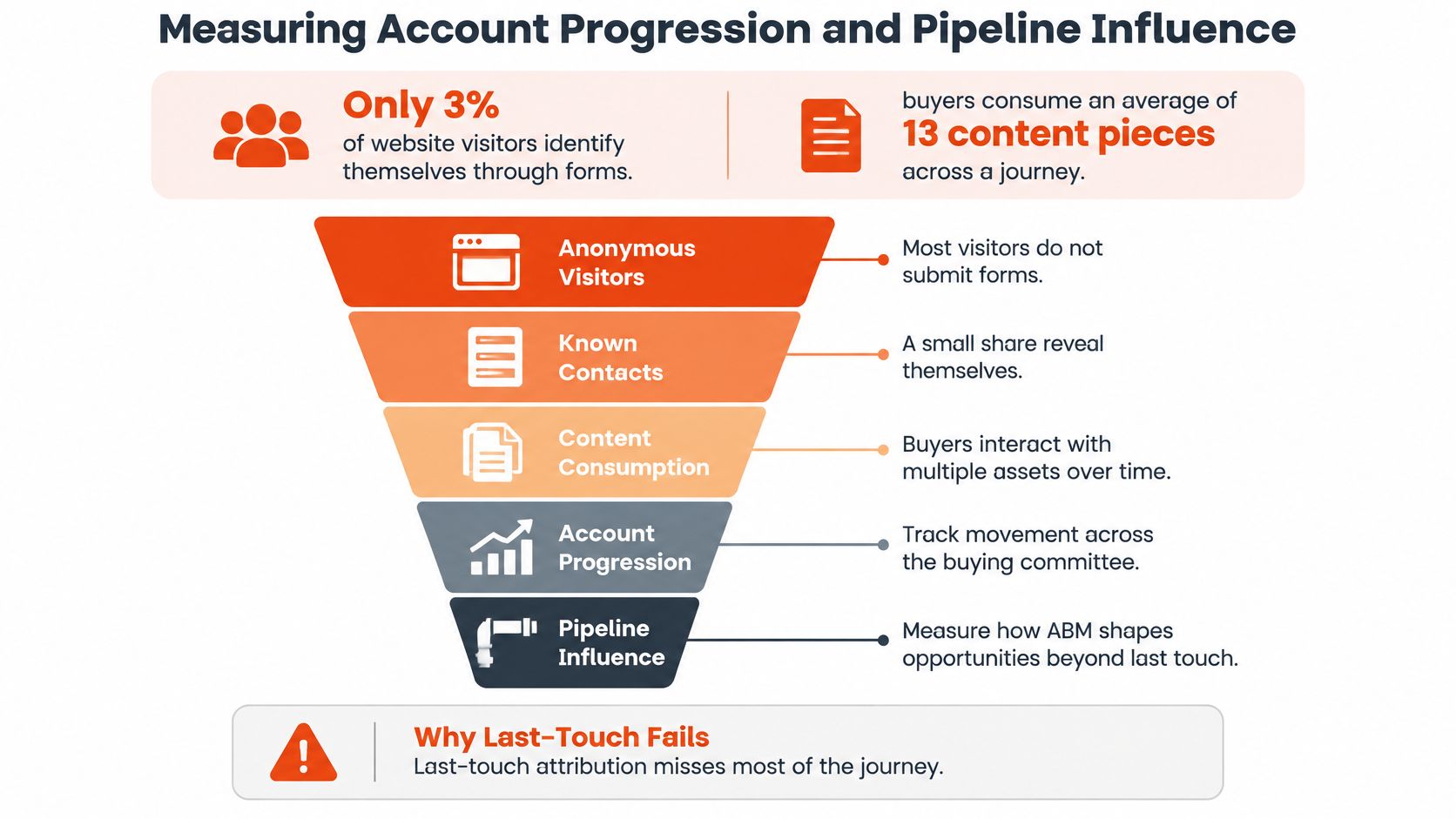
Only 3% of website visitors identify themselves through forms, while buyers consume an average of 13 content pieces across a journey, according to 6sense's buyer research guide, which also reports 82% of marketers use ABM but only 33% measure account-centric metrics. So last-touch attribution credits whichever junior researcher finally filled a form and ignores the committee that decided.
The funnel below shows what to measure instead of that final form fill.
Track Accounts, Not Touches
| Metric | Definition | How to record it | Weak reading means |
|---|---|---|---|
| Buying-group coverage | Share of target accounts with two or more engaged roles | CRM roles plus engagement log | Single-contact dependence |
| Qualified meetings per account | Meetings where the contact named a problem or timeframe | Meeting outcome field in CRM | Outreach reaching the wrong people |
| Sales-accepted accounts | Accounts sales agrees to work | Acceptance date and reason | Thresholds set too loosely |
| Opportunities sourced or influenced | Opportunities with an ABM touch in the prior 90 days | Campaign influence rules agreed in advance | Attribution is overclaimed |
| Pipeline value | Total value of opportunities from ABM accounts | Opportunity amount by account tier | Low fit or long cycle |
| Win rate and cycle length | Won share and days to close for ABM versus matched accounts | Matched control group | ABM not changing outcomes |
Read the funnel in order. Named accounts engaged, then accounts with two or more engaged roles, then accounts with a qualified meeting, then a sourced or influenced opportunity, then revenue. A drop between any two steps tells you exactly what to fix next month.
This walk-through shows how account progression reporting looks when it's built around the buying group rather than the last click.
Make the Pilot Credible
Set a baseline before launch and compare against a matched group of non-ABM accounts. Deduplicate contacts who appear in several accounts, and separate correlation from causation in every report. A sales opportunity here is a real person in fit who's shown intent and reaches the salesperson with context, so count that handover, not raw replies.
Agree stage definitions with sales before the first campaign, including sourced versus influenced. Report one page per account tier with coverage, meetings, opportunities and pipeline value, plus a short note on what the data can't yet prove. Directors trust that honesty more than a perfect attribution story.
Confirm Your Pilot Criteria Before You Launch
I'd start with a three-month pilot and agreed success criteria. It's long enough to judge signal quality and meetings, short enough that a weak account list doesn't eat a year. There's no waiting period either. Lead capture starts from day one while the audience builds in parallel, so the pilot tests the full motion, not just content.
Lock Five Items in Writing
- Account list and tiers: Named companies with mapped roles, frozen for the pilot.
- Threshold and control group: The scoring rule, plus matched accounts you won't touch.
- Sequence and stop conditions: Every touch and the event that ends it.
- Stage definitions: MQA, qualified meeting and opportunity, signed off by sales.
- Named owners: One person accountable for each stage, including data quality.
Set targets from your baseline, not from a vendor deck. Agree a number of qualified meetings per month, a minimum share of accounts with buying-group coverage and a sales acceptance rate. Our pilot success criteria template gives you the one-page format to record them.
Hold Three Checkpoints
Week two reviews signal quality and threshold hits. Week six reviews message response rates by role and tier. Week twelve reviews pipeline and opportunity stages against the matched group. If week two shows mostly recruiters and peers, fix the filters then, not at week twelve.
Evaluating channels side by side helps here too. Just as Podzone's podcast advertising platform comparison forces buyers to judge platforms on fit rather than reach claims, your checkpoints should judge ABM on meetings and coverage rather than impressions. Keep control of quality throughout. A named team member reviews and approves every AI-assisted draft before it's sent, and profiles and content stay under your team's control.
Write the pilot brief as a one-page document today. Name the owner for each stage, set the three targets against your baseline, and book the week two review before the first message goes out.
If your pipeline still depends on events while your directors build an audience that nobody converts, Ploot can help you turn that LinkedIn visibility into qualified sales meetings with people from your target accounts who've already shown interest. Start with a three-month pilot, agree the success criteria up front, and judge us on meetings and pipeline rather than impressions.