

You're staring at a martech stack that looks busy and sounds expensive, but still can't answer the one question your CEO cares about, did it create pipeline? That's the position most B2B marketing directors inherit, a pile of tools, a CRM full of half-clean data, and reporting that celebrates clicks while sales keeps asking for meetings.
The fix is not “more software.” It's a harder selection rule. Marketing SaaS software should earn its place by improving attribution, integration, and revenue visibility, or it's just another dashboard with a renewal date.
| Category | What It Actually Solves | Pipeline Stage Influenced |
|---|---|---|
| Marketing automation | Orchestrates nurture, routing, and follow-up | Lead to opportunity |
| CRM-integrated lead and account management | Connects contacts, accounts, and sales handoff | Opportunity creation |
| Content and SEO platforms | Builds demand and captures intent | Top to mid funnel |
| Analytics and attribution | Proves what drove the deal | Opportunity to revenue |
| Social and executive distribution | Turns trusted voices into measurable reach | Awareness to demand capture |
Table of Contents
- The Pipeline Accountability Problem Behind Every Martech Purchase
- Main Categories of Marketing SaaS Software
- Decision Criteria That Separate Strong Marketing SaaS Software
- ROI Logic for B2B Marketing SaaS Software
- Use Cases for B2B Consulting and Software Firms
- The Governance Gap in Partner and Executive-Led Distribution
- A 90-Day Pilot Framework and Final Recommendations
The Pipeline Accountability Problem Behind Every Martech Purchase
A marketing director inherits the stack, reviews the dashboard, and immediately sees the same old story. Opens look decent, a few nurture flows are active, content is going out, but sales still says pipeline is thin and leadership still wants a clear commercial answer. That's where most marketing SaaS software failures begin.
The mistake is treating software selection like a feature shopping exercise. A tool can schedule posts, send emails, and generate reports without ever improving the one thing that matters, the quality and traceability of revenue impact. In B2B, the buying group is bigger, the sales cycle is slower, and the connection between activity and revenue is easy to lose.
Practical rule: If a platform can't show how it affected an opportunity, it's not a revenue tool, it's an activity tool.
That's why the stack has to be judged by pipeline accountability, not by how many boxes the vendor can tick. A useful comparison is alignment between marketing and sales, because software only matters when both sides agree on what counts as real progress. If the commercial team can't see the path from campaign to account to opportunity, the software is working against you. This alignment guide is a useful companion if you're trying to clean up that handoff.
The operating question should be blunt. Does this tool create measurable pipeline outcomes, or does it only create activity? Everything else is noise.
Main Categories of Marketing SaaS Software
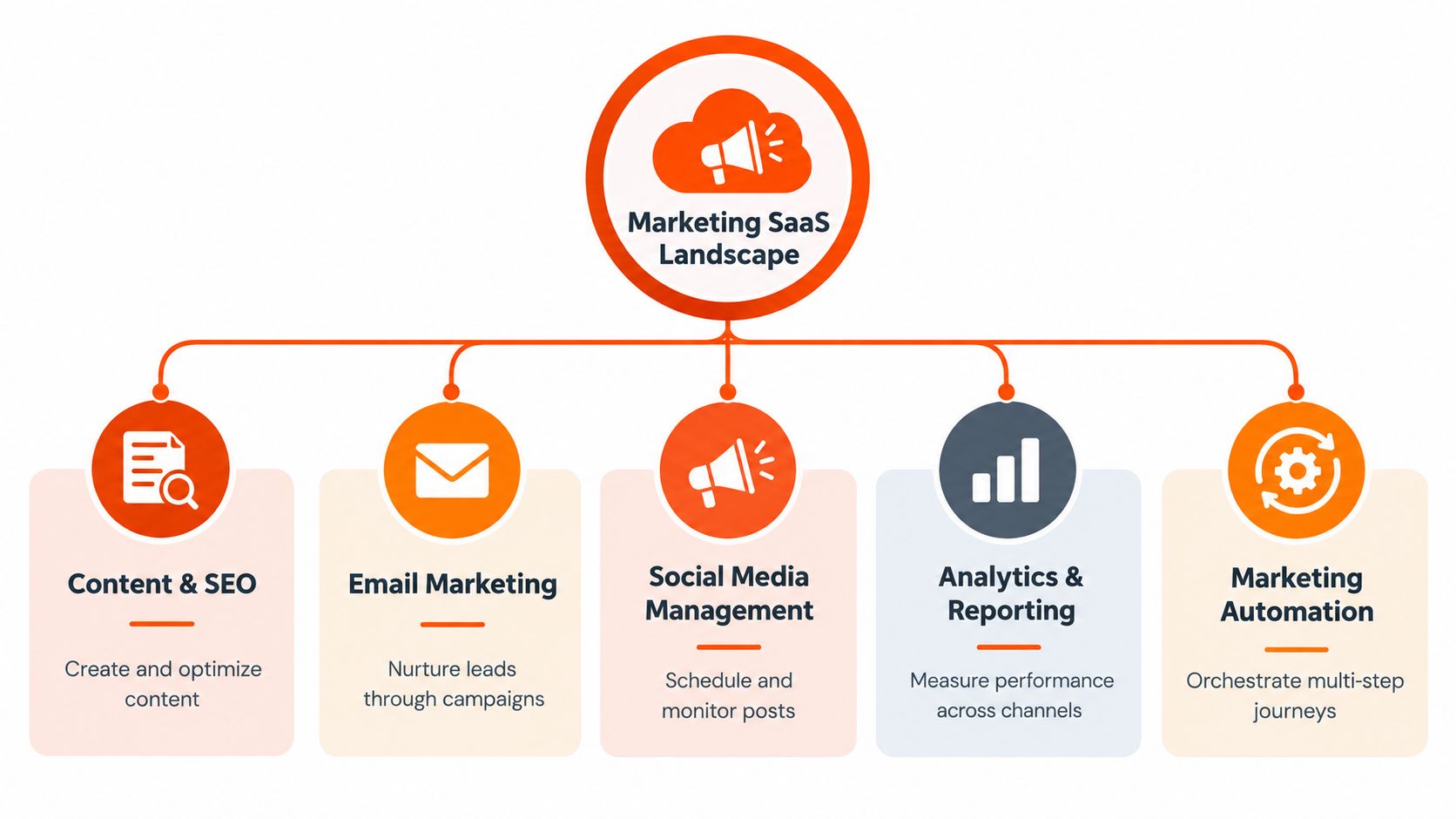
The cleanest way to map marketing SaaS software is by job-to-be-done, not by vendor type. That keeps you from buying overlapping tools that claim to “do everything” but only own a sliver of the workflow.
| Category | Primary B2B Use Case | Pipeline Stage Influenced |
|---|---|---|
| Content and SEO platforms | Capture demand, answer buying questions, and improve discoverability | Awareness and consideration |
| Email marketing | Nurture known contacts through sequenced campaigns | Lead to MQL |
| Marketing automation | Coordinate multi-step journeys and routing logic | MQL to SQL |
| Analytics and attribution | Tie campaigns to pipeline and revenue | Opportunity and closed-won |
| Social media management | Publish and monitor brand and executive content | Awareness and demand creation |
| Intent and account-based platforms | Surface target accounts showing buying signals | Opportunity creation |
| Sales enablement | Give sales usable context, assets, and follow-up support | Late-stage conversion |
Content and SEO platforms matter because buyers research early and often privately. If the platform can't help you ship useful content, organize it, and connect it to search demand, it's not helping revenue, it's just helping publishing. For broader SaaS positioning context, the SaaS positioning and pricing guide is a helpful reference when you're comparing how vendors frame value.
Email and automation sit closer to the handoff. Email handles known contacts, while automation manages sequencing, routing, and response logic. If these tools don't talk cleanly to your CRM, you'll end up with duplicate records, broken handoffs, and false confidence.
Use this split: content creates interest, automation manages motion, attribution proves value.
Analytics and attribution are essential if you report to leadership. Social and executive distribution are different from brand social because they rely on trusted human voices, not a corporate page. That distinction matters when the audience is already paying attention to people, not logos.
If you're comparing categories by operational need, not by hype, you can remove a lot of waste quickly. The stack gets smaller, but the reporting gets stronger.
Decision Criteria That Separate Strong Marketing SaaS Software
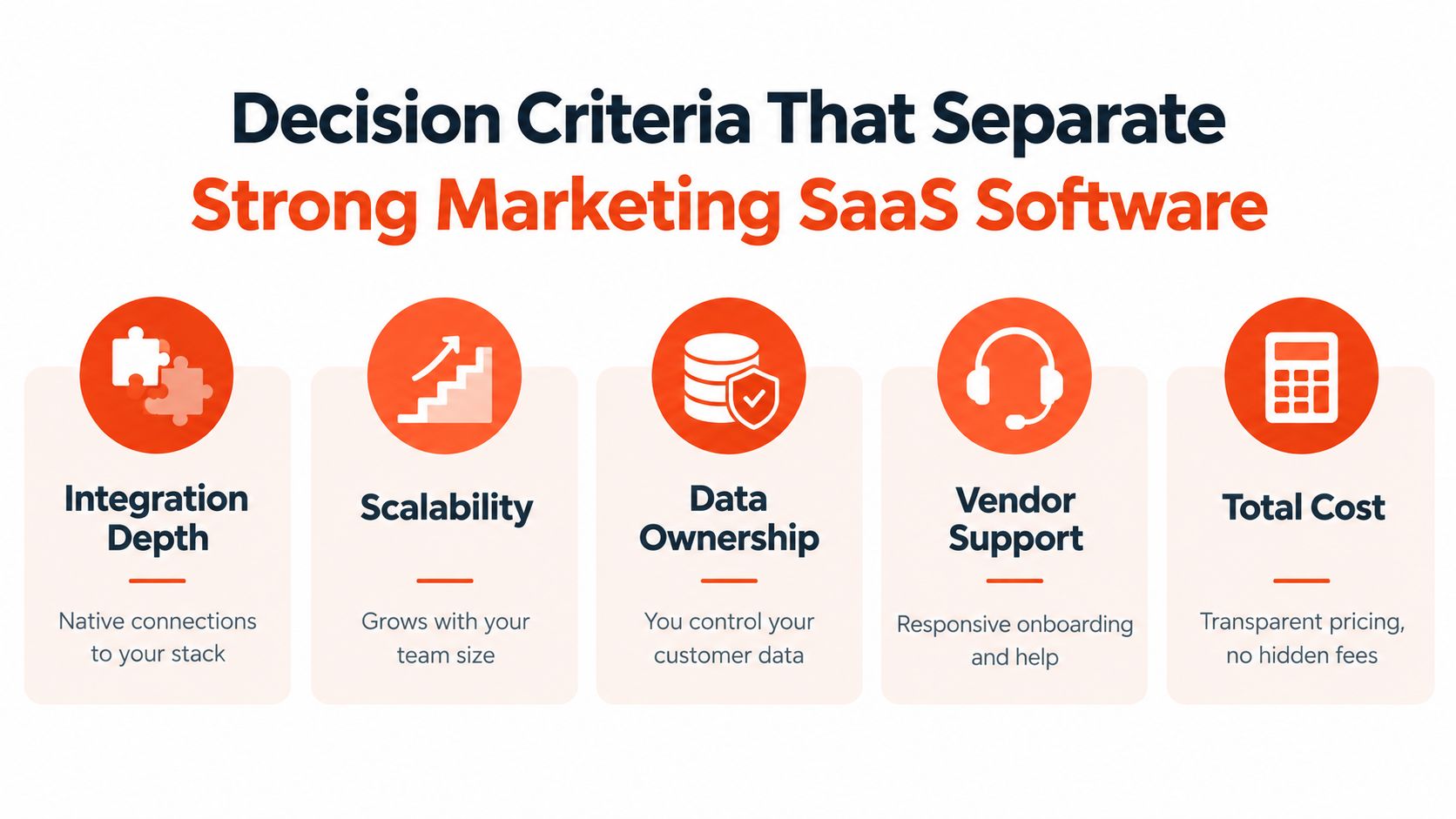
The strongest shortlist survives a ruthless test of how well it fits a B2B revenue motion, not a flashy demo.
Attribution depth
You need source-level and influence-level visibility tied to CRM opportunities. If a vendor stops at impressions, clicks, or generic MQLs, it is not built for serious revenue reporting. Only about 6 in 10 B2B marketers track pipeline generated, roughly half measure opportunities created, and only 1 in 3 report new ARR as reported in the CaliberMind attribution report.
CRM integration quality
This is where many stacks fail. The tool has to preserve campaign, contact, account, opportunity, stage, amount, and timestamp relationships without turning the CRM into a junk drawer. If that data model breaks, reporting becomes theater.
Workflow integration with sales
A platform that does not support handoff, follow-up, and sales visibility is incomplete. Sales should not need to guess why a lead appeared or which account suddenly became hot. The tool should move work, not just display it.
Data model fit for accounts and buying groups
B2B buying is not a solo sport. If the software only thinks in single leads, it will miss the account-level pattern. That is why some teams never move beyond superficial engagement reporting.
Governance and consent controls
This criterion gets skipped too often in vendor decks. If you plan to use employee or partner audiences as a channel, you need approval flows, opt-out handling, and clear signal thresholds. For a disciplined operating model, The OKR Hub's OKR software guide is useful because it reinforces what measurable ownership should look like before you buy anything.
You also need to treat partner-led personal distribution as a governed channel, not a loose growth tactic. That includes clear rules for who can post, what claims they can make, how consent is recorded, and what counts as a qualified signal. If you want a practical comparison point for demand capture tools, this lead-generation platform overview helps frame the category without dressing up basic functionality.
A simple way to score vendors is to ask whether each one improves pipeline visibility, sales usability, and governance. If it only improves convenience, that is not a reason to buy.
When teams compare marketing SaaS software, they usually overrate integrations and underrate trust controls. That is backwards, especially in high-ticket motions where bad routing or sloppy audience use can do more harm than no tool at all.
ROI Logic for B2B Marketing SaaS Software
A SaaS purchase should be justified by pipeline movement, not by dashboards that look busy. If the platform cannot keep the line from campaign to account to opportunity intact, it does not give you a credible ROI view.
Use three layers of measurement. Activity shows what launched. Funnel conversion shows what advanced. Revenue shows what mattered. A healthy mid-market funnel usually needs to be judged against outcomes like approximately 10–15% lead-to-opportunity and 25–35% MQL-to-SQL conversion from Sona's B2B reporting guidance.
Sourced pipeline versus influenced pipeline
Sourced pipeline is the opportunity the platform helped create. Influenced pipeline is the opportunity it shaped on the way to close. Both matter, because executive-led distribution, content, and account engagement do not produce the same kind of signal.
The attribution model should go beyond last-touch. Multi-touch or position-based attribution is the minimum if you want a serious review at leadership level. If the stack cannot preserve the relationship between audience, account, opportunity, and timestamp, the reporting will fall apart when finance or sales asks for proof.
Before launch, model the expected return with the ROI calculator so the success criteria are agreed on numbers, not opinions.
The right choice is the one that connects demand signals to sales outcomes. If you want to compare channels on that basis, compare performance marketing channels is a useful frame for judging contribution.
Rule of thumb: if you cannot explain how the software changed sales velocity or opportunity creation, the ROI case is weak.
The pilot needs a clear pass or fail line before it starts. Define pipeline sourced, pipeline influenced, opportunity creation rate, and closed-won revenue up front. Anything less gives too much room for storytelling.
Use Cases for B2B Consulting and Software Firms

A long-cycle consulting firm does not need the same stack as a mid-market software company. That sounds obvious, but a lot of teams still buy as if every motion were identical.
A consulting or services firm that sells through senior relationships and partner-led distribution needs tools that track trusted voices, target-account engagement, and meeting quality. The stack should favor CRM-connected routing, attribution, and governance over broad automation. A software company scaling demand generation needs more emphasis on content orchestration, email nurture, and attribution, because the motion depends on volume and repeatability.
A high-ticket consulting practice rebuilding around account-based marketing needs a different setup again. It should prioritize account identification, engagement depth, sales coordination, and stage visibility. In all three cases, the wrong move is stacking on another standalone tool just because it looks specialized.
For the long-cycle motion, the most important question is whether the platform can detect genuine intent without forcing a form fill too early. Recent research reports that 94% of buying groups rank preferred vendors before first contact, while the average buying cycle shortened from roughly 11 months in 2024 to 10 months in 2025 according to the Yahoo Finance summary of B2B buyer research. That makes early signal capture more valuable, but it also raises the bar for measurement.
The right stack shape is usually smaller than people expect. Most firms don't need twenty tools. They need a few that connect audience, account, and pipeline.
The Governance Gap in Partner and Executive-Led Distribution
Many marketing SaaS software debates get lazy. Tools can technically support partner and executive-led distribution, but that doesn't mean the channel is safe to scale without rules.
The biggest risk is trust erosion. A partner, consultant, or director has personal credibility that a brand account doesn't. If you start using that credibility like a batch-and-blast channel, you'll get short-term activity and long-term skepticism. The whole point of the channel is authority, not automation.
Practical rule: use personal audiences like a privileged channel, not a generic acquisition list.
The operational risks are easy to underestimate. You need profile access control, voice authenticity, message variety, consent rules for outreach triggered by audience activity, and frequency limits so people don't feel chased. If the team can't explain why someone got contacted and why now, the process is too aggressive.
AI makes this more urgent, not less. Google-related research cited in 2025 says 60% of B2B buyers use AI tools during the buying journey, and 84% say those tools speed up the process from NRGMR's buyer journey research. Faster research means signals arrive earlier and fade faster, so the response has to be precise, not spammy.
The governance model should define signal thresholds, human approval steps, opt-out handling, and attribution rules when the company is not the original publisher. That's the difference between a scalable channel and a reputational liability. If you get this right, personal distribution becomes measurable without turning people into automated ads.
A 90-Day Pilot Framework and Final Recommendations
Start with a tight pilot, not a full rollout. Pick one motion, one revenue owner, and one measurable outcome. Then force the software to prove it can improve pipeline visibility, not just activity reporting.
The pilot should define baseline metrics, integration requirements, governance rules, and exit criteria before launch. Use the stack only if it improves opportunity creation, sales follow-up, or attribution clarity in a way leadership can trust. Don't accept a tool that leaves the CRM harder to read than before.
The market already tells you where the risk is. Despite expansion in martech, only 31% of marketing organizations reported that their martech stack was well integrated, while 64% of marketing leaders said they struggled to track all the tools in their stack per Zylo's martech statistics summary. That's the warning sign. Integration and visibility are still the problem, not tool scarcity.
My recommendation is simple. Consolidate around a CRM-native automation suite when your stack is fragmented. Add an attribution layer when leadership wants proof of revenue impact. Introduce a partner-led distribution platform only when you're ready to govern audience use like a real channel, with consent, approval, and clear measurement.
Decision rule: buy the software that improves pipeline accountability first, then everything else second.
Ploot helps B2B teams turn trusted LinkedIn audiences into a measurable sales channel, with signal detection, content activation, and meeting qualification built into the workflow. If you're evaluating marketing SaaS software through the lens of pipeline accountability and governance, visit Ploot and see how it fits that operating model.