

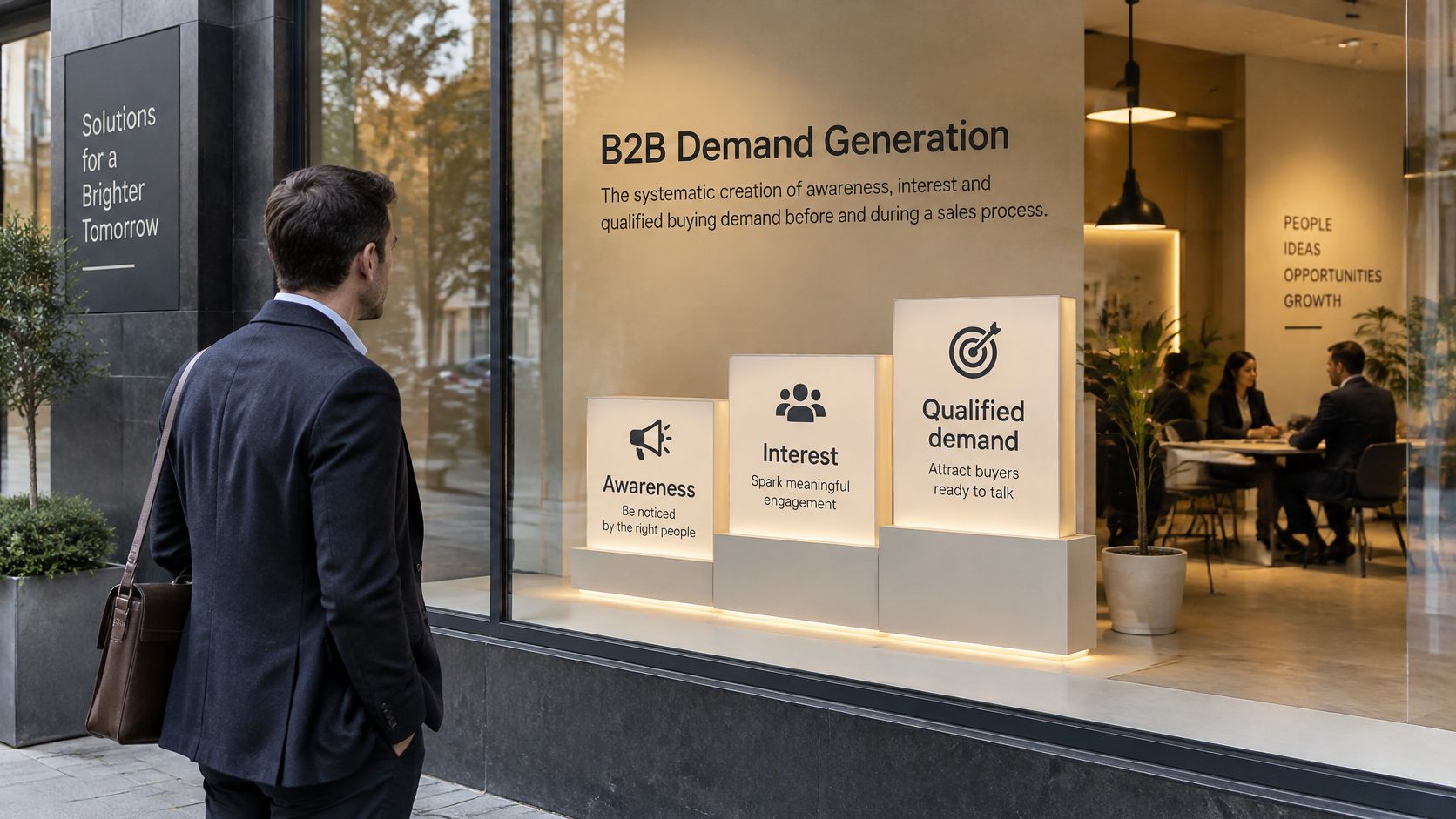
B2B demand generation is the systematic creation of awareness, interest and qualified buying demand before and during a sales process, and the research behind it starts earlier than most campaign reports admit: 71% of B2B researchers begin with a generic, non-branded search rather than a query for a specific supplier.
The practical version of that is probably happening in your market this week. A partner publishes a short post about a regulatory change. Someone at a target account reads it, forwards it to a colleague in another department, and five months later a meeting request arrives with no campaign source attached. Nothing in the monthly report explains the opportunity, and nobody on the team can name the activity that caused it.
The work isn't failing. The reporting model is answering a different question. Campaign dashboards were built for a buyer who arrives, clicks and converts inside one session, and high-ticket software and consulting purchases stopped looking like that years ago.
The concept itself is simple. Proving it is where marketing directors get stuck.
Table of Contents
- What B2B Demand Generation Means
- Demand Generation Versus Lead Generation
- Channels Buyers Use Before They Talk to Sales
- Buying Groups and the Stages Demand Generation Moves
- Trusted People and Private Conversations
- Measuring Demand Generation Beyond Lead Counts
- Confirm Your Scorecard Before Your Next Campaign
What B2B Demand Generation Means
A shop window explains it faster than any definition. A finance director walks past the same storefront every morning for four months and never steps inside. Then their current supplier misses a deadline, and they walk straight through the door, because they already know what's in the window and roughly what it costs.
That's the job. B2B demand generation is the systematic creation of awareness, interest, and qualified buying demand before and during a sales process, and it exists to put your company in that window while a buyer is still forming a shortlist. Think with Google's B2B research study shows why the window matters more than it used to: 89% of B2B researchers use the internet during the research process, and 90% of online B2B researchers use search to investigate business purchases. Most begin with a generic query about the problem, not with a supplier's name.
The shift is historical as well as practical. B2B revenue once depended on field sales, trade shows, referrals and purchased account lists. Those channels still exist, but they now sit alongside educational content, search visibility, digital distribution and measurable engagement. The internet became the place where B2B buying starts, which made a digital presence a precondition for influencing demand rather than a supplement to it.
For high-value services and software, this bites hardest. Early-stage prospects read, compare and form opinions without ever filling in a form or taking a sales call. If your only instrument for detecting interest is a form fill, the earliest and most influential part of the journey stays invisible.
So keep two definitions separate. Demand generation creates the conditions in which a buyer considers your company. Lead generation captures the buyers who raise a hand. A team that only does the second is competing for the small group already in market; a team that does both shapes the shortlist before anyone starts comparing vendors.
If you want to see the sequence on a calendar rather than in theory, Rebus has a 90-day demand generation plan that walks through the first quarter of a programme step by step.
Demand Generation Versus Lead Generation
Lead generation captures people who have already shown interest, while demand generation creates the interest and preference that later become leads. They run on different clocks, address different people and get judged by different numbers, which is exactly why blending them into one report causes so much confusion.
| Dimension | Demand generation | Lead generation |
|---|---|---|
| Primary goal | Create awareness, preference and buying-group interest | Capture contact details and qualify interested people |
| Starting point | The buyer's problem, often before any vendor is named | A visitor or prospect who has already shown interest |
| Who it reaches | The whole buying group across target accounts | Individual contacts who enter a form or campaign |
| Typical success measure | Engaged target accounts and pipeline influenced | Lead volume and marketing-qualified leads |
| Time horizon | Months, matched to a long sales cycle | Days to weeks per campaign |
| Typical channels | Thought leadership, search, peer-led content, LinkedIn, events | Gated downloads, paid search ads, webinar registration, forms |
The starting point row explains most of the daily confusion. Demand generation begins with the buyer's problem, often before any vendor has been named, and the first job is to be findable and credible at that moment. Lead generation begins later, when someone has already raised a hand.
The audience row is where reporting breaks down. Demand work addresses a buying group spread across departments, while lead capture addresses the individual who filled in the form. Treat those as the same unit and your data will keep telling you that one contact speaks for twelve colleagues.
The time horizon row sets expectations before anyone argues about results. Demand programmes run for months because that's how long a committee takes to form a shortlist and defend it internally. A single form campaign can be judged in days.
Two misconceptions are worth killing early.
- A gated download isn't demand generation by default. Offering a report in exchange for an email is lead capture with a content wrapper. It becomes demand work only if the content itself changes how the reader thinks about the problem and the category.
- A rising MQL count can coexist with flat pipeline. If your qualification rules reward volume, the number climbs while the deals stay put. Watch pipeline created alongside MQLs for two quarters before you trust either figure.
Buyer behaviour makes the gap visible. HubSpot's survey of 422 U.S. B2B purchasing decision-makers found that in 2024, 75% of B2B buyers preferred gathering product information independently, and 57% purchased a tool without meeting the vendor's sales team (HubSpot). A model that only records the moment someone volunteers an email will miss most of that.
The test to apply this month: if your reporting leads with form fills and nothing else, you're running lead generation with a demand generation label on it.
Channels Buyers Use Before They Talk to Sales
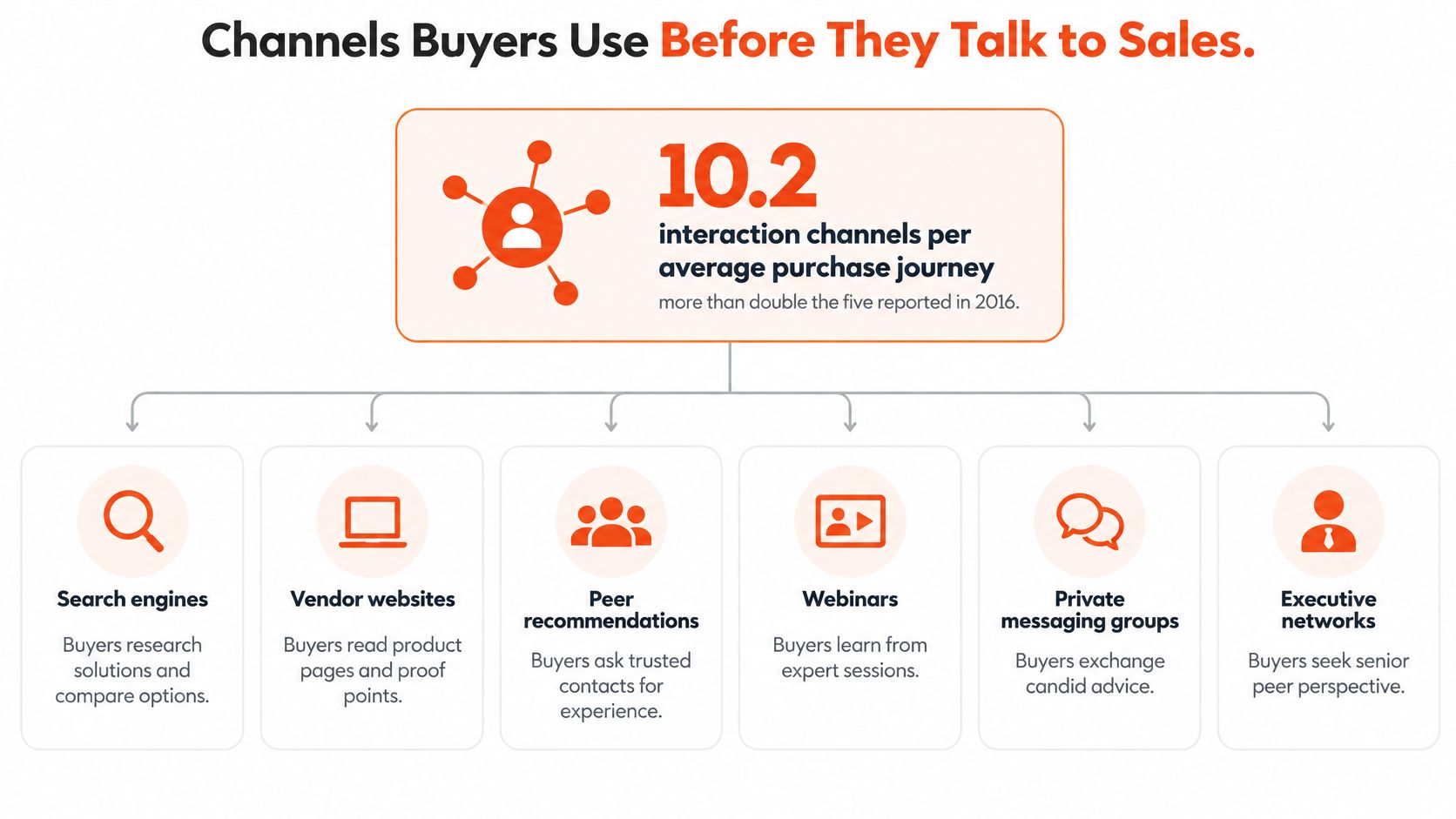
The first number to hold onto is the channel count. Omnibound's summary of B2B buying statistics cites McKinsey's 2024 B2B Pulse research, which found that buyers use approximately 10.2 interaction channels during an average purchase journey, more than double the five channels reported in 2016. Reported Forrester research on the same page indicates that 89% of purchases involve two or more departments, which is why one channel rarely closes a deal on its own.
The diagram below shows the families of channels that carry most of that activity, and the table after it gives each one a job and a signal.
| Channel family | Role in the buying journey | Measurement signal |
|---|---|---|
| Search | Makes the company discoverable on generic queries | Branded search growth and organic visits from target accounts |
| Owned website and content | Builds expertise and proof | Repeat visits from target accounts |
| Webinars and events | Deepens evaluation with several roles | Registrations and attendance by role |
| Social platforms | Earns attention from buying-group members | Engagement from target-account profiles |
| Peer recommendations | Creates trust before vendor contact | Inferred from patterns, not directly tracked |
| Sales conversations | Confirms fit and scope | Meetings accepted and opportunities created |
A worked example makes the sequence concrete. A finance director at a target account sees a partner's LinkedIn post about a regulatory change, reads the case study linked in the comments, searches the firm's name that evening, registers for a webinar on the new rules, and requests a meeting three weeks after the webinar ends. That's five touches across four months, and only the last one appears in a lead report.
The rule that keeps this from turning into noise is a sequence: educational content first, proof second, direct conversation last. Proof still means case studies more than anything else. 57% of demand-generation marketers identified case studies as their top content format in Demand Gen Report's 2025 benchmark survey.
Then sort your channels by what you can see.
- Measure directly: branded search volume, organic visits from target accounts, webinar registrations and attendance by role, meetings accepted, opportunities created.
- Infer from patterns: peer recommendations, private group conversations, executive networks. Their effect shows up in self-reported answers on the first call and in the shape of your win rates, not in a dashboard.
When you decide which queries deserve investment, this piece on commercial intent keywords separates research-stage searches from buying-stage ones.
Buying Groups and the Stages Demand Generation Moves
Long, complex deals are won by moving a group of people forward, not by converting one contact. Otrenix's compilation of B2B marketing benchmarks reports that buying committees can include roughly 11 to 13 stakeholders, that sales cycles extend from several months to more than a year in complex environments, and that marketing-sourced pipeline commonly represents about 18% to 28% of total pipeline, with top-quartile organisations reaching approximately 37% to 51%. Definitions vary enough that you should check what each benchmark counts before quoting it internally.
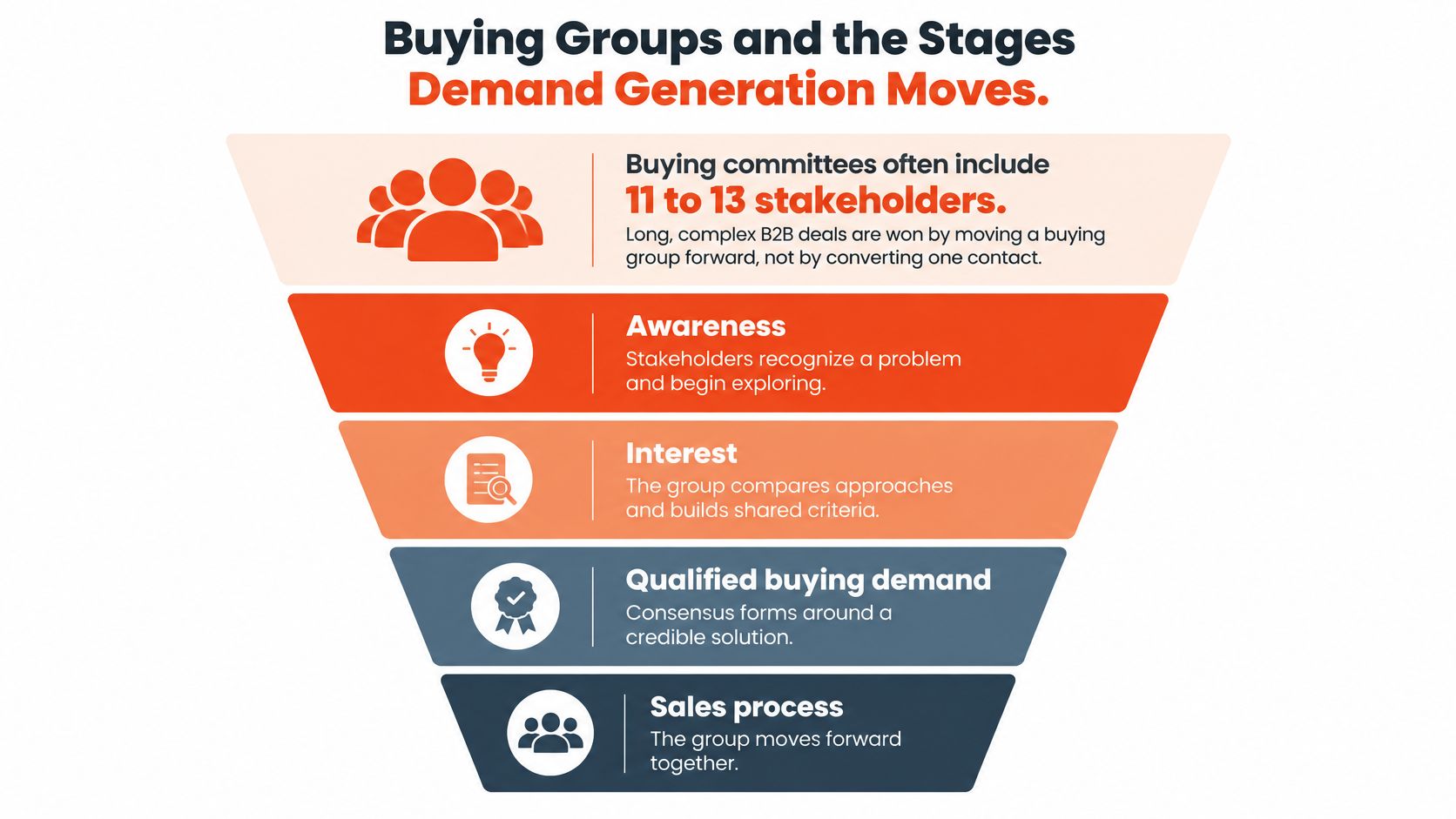
Take a software company that targets 300 accounts. Its team receives a form fill from a CFO at one of them and files it as a new lead. In practice the CFO is one of twelve people who will shape the decision: an operations lead who owns the workflow, an IT architect who vets integrations, a procurement manager who controls the vendor list, a compliance officer, and the CFO's own analyst. The form fill tells you one person is curious. It says nothing about whether the other eleven are ready.
Contact-level attribution then does something worse than miss detail. It rewards the channels that harvest demand already in motion and starves the ones that created it, because the touch that produced the form fill gets the credit.
What to instrument instead
Move the unit of analysis from contact to account, and record four things: which contacts belong to the same opportunity, what the first touch was, which later events influenced the decision, and how engagement scores by role and recency.
| Stage | What the buying group is doing | Signal to track |
|---|---|---|
| Awareness | Recognises a problem and starts naming a category | Target account reached by content or search |
| Engagement | Reads, shares or visits a profile | Repeat engagement from people in more than one role |
| Account intent | Several stakeholders engage around the same problem | Buying-group coverage across departments |
| Meeting | Accepts a conversation with sales | Qualified meeting accepted by sales |
| Opportunity | Scopes a project and confirms budget owner | Opportunity created with account context |
| Revenue | Signs the contract | Pipeline converted and revenue attributed to the account |
The practical rule: if a report can't tell you how many people in one target account have engaged, it's measuring a contact, not an account.
The progression in the table is the actual scoreboard. A pilot that can't show movement from target account to engaged account, then to a qualified buying group, a meeting, an opportunity and revenue isn't a demand programme. It's a content calendar with better branding.
Trusted People and Private Conversations
Much of the demand you benefit from is created where no dashboard can follow: peer recommendations, private messaging groups, executive networks, and the conversations that start after a webinar ends. The Starr Conspiracy's 2025 buyer-journey brief reports that 64% of B2B buyers regard peer recommendations in private "dark social" channels as their most trusted research source, ahead of analyst reports and vendor content, and that 61% of buyers prefer a rep-free experience.

Three activities get bundled together under the heading of employee advocacy, and only two of them build trust. Broadcasting is posting company news from a personal profile; it raises visibility and changes nothing else. Expert participation means a director answers a question inside a group, comments on a regulatory article with a specific point of view, or takes a position on a trend in a way a buyer finds useful. Intrusive prospecting is automated messaging to anyone whose profile matches a filter, and it burns credibility with the exact people you wanted to influence.
Treat personal distribution as a trust layer and the model becomes manageable. Authoritative people create familiarity. Observable engagement shows potential interest. A human follows up only when the context supports it, and never before.
An example of the sequence working: a partner comments on a regulatory article. A director notices the same CFO from a target account visiting their profile for the third time in two weeks. The follow-up message mentions the article the CFO read and asks one question about their timeline. It goes out from the director's own profile, not a brand account, and it refers to what the person looked at.
- Consent: know on what basis you're contacting someone, and make unsubscribing work in one click.
- Relevance: every message must reference something the person did.
- Frequency caps: set limits per person and per account so nobody receives three touches in a week.
- Escalation: anything ambiguous goes to a human reviewer before it goes out.
That combination is what separates a trust layer from automation with a friendlier tone. The underlying skill is old-fashioned relationship building applied to a new channel, and you can browse books on relationship-based selling from Expert Author Community if you want to go deeper. The content side has its own playbook, laid out in this guide to executive thought leadership strategy.
Measuring Demand Generation Beyond Lead Counts
Start with the uncomfortable number. Calibermind's 2025 State of Marketing Attribution report found that only 6 in 10 B2B marketers track pipeline generated, which means roughly 4 in 10 don't use the outcome closest to revenue. If your team sits in that group, no amount of campaign optimisation settles the budget conversation, because you're arguing about impressions in a room that cares about pipeline.
Most explanations of what B2B demand generation is stop at the definition and never reach the data model, the attribution limits, or the minimum evidence a board will accept. That's the missing piece, so build it in three layers: reach among the right buying committee, evidence of active interest, and progression to meetings, opportunities and revenue. Each layer answers a different question, and each is defensible on its own.
Four metrics worth replacing lead counts with
- Signal-to-action latency: the time between a buying signal appearing and a human responding. A short lag means your team is watching. A long one means the signal is decoration.
- Intent-qualified conversion: the share of engaged accounts that produce a qualified meeting, not the share of form fills that produce an MQL.
- Opportunity velocity: how quickly an account moves from first meaningful engagement to an opportunity, compared with your historical median.
- Pipeline created per activated audience: the pipeline generated for every hundred people you deliberately reached, which lets you compare a new profile launch against an event sponsorship.
Separating cause from correlation
Splitting credit across touchpoints by rule always produces a tidy chart and a shaky conclusion. Use a cohort comparison or a holdout group instead: hold back a matched set of target accounts from one activity, run the same period for both groups, and compare pipeline created. It's slower and less flattering, and it's the only version of the argument that survives a follow-up question.
Minimum evidence for a board conversation: a named target account list, buying-group coverage by role, pipeline created under a definition sales has signed off, and a review against the sales cycle rather than the month.
Three corrections to keep in mind. Impressions don't equal demand; they measure delivery. Last-touch attribution doesn't show what worked; it shows what happened last. No single channel owns the result, and any report claiming one does is describing its own data model, not the buyer's journey.
Track what you can, and name the limit. Similarweb's analysis of the B2B dark funnel notes that industry analyses commonly estimate 70% to 80% of the buying journey can occur before vendor engagement, while Gartner-related estimates place supplier interaction at only about 17% of total buying time. Some influence will never be traced directly. Say so, and show the cohort evidence for the part you can see. If you want to extend measurement to how your brand surfaces in AI-generated answers, the AnswerLion LLM measurement framework sets out a tracking approach worth reading alongside this.
Connect the account-level picture to the deals sales works on, using this explanation of marketing-influenced pipeline as the bridge.
Confirm Your Scorecard Before Your Next Campaign
Pipeline360's survey of more than 500 B2B revenue leaders across the U.S., Europe and APAC found that in 2025, 42% ranked revenue among their most important marketing performance priorities, nearly matching website traffic at 43%. That's the room you're walking into. Revenue is the ask, so the scorecard has to answer it.
Six steps, in order, before anything goes live.
- Define the ideal customer profile. Sector, company size and the roles that sign. A profile built on "anyone who could benefit" produces a large list and no meetings.
- List the target accounts and map the group. For each account, write down the budget owner, the technical evaluator, the procurement gatekeeper, the daily user and the executive sponsor.
- Record a baseline. Pipeline created and buying-group coverage per target account, captured before launch so nobody can attribute the starting position to the campaign.
- Choose three or four leading signals. Repeat engagement from more than one role in the same account, profile visits from a target account, webinar attendance by a committee member, or a direct inquiry.
- Agree the method and the definition with sales. Pick the cohort or holdout approach from the start, and write down the pipeline definition together in the same meeting, so nobody redefines a qualified opportunity in month three.
- Set the review date against the sales cycle, not the campaign calendar. A quarterly review that lands before deals close measures activity and nothing else.
A healthy first quarter looks quieter than many expect. Engaged accounts and meeting acceptance rise first, while the large pipeline number lags behind. That pattern is the leading indicator working, and judging it against a monthly lead target will make a good programme look like a failure.
Define the endpoint in terms everyone will use at review. A sales opportunity is a real person inside the ideal customer profile who has shown buying intent by interacting with content, visiting a profile or matching a signal, and reaches the salesperson with context. Our own process follows four steps: the team becomes a reference voice, prospects are filtered by ICP fit and buying signals, messages go out from team profiles, and the calendar fills with qualified conversations.
Confirm the scorecard with sales this week, before the first campaign goes live. A scorecard agreed after the results arrive is a negotiation, not a plan.
Ploot turns your team into a sales channel: we build the LinkedIn audience of your partners, directors and senior managers, detect who in that audience is showing buying intent, and contact them at the right moment to book qualified sales meetings. For IT consultancies, business and HR consultancies and B2B software companies running long, high-ticket cycles, a pilot starts with success criteria agreed in writing before anything goes live. Visit Ploot to see how the pilot and the buying-signal detection work.