

Stop training reps to chase a demo in week one. That advice built a generation of SaaS pipelines, and it's now the fastest way to waste one. Buyers don't want your discovery call before they've defined the problem, compared options, and built an internal case. If you're learning How to Sell Software as a Service today, you don't start with outreach volume. You start by earning a place on a shortlist you'll never see being made.
That shift changes everything for a marketing director. Your job isn't impressions, downloads, or booked meetings that sales rejects. It's qualified demand before a human conversation, then a sales motion that helps a buying group finish work they've already started.
Table of Contents
- Why Most SaaS Sales Playbooks Stop Working
- Positioning and ICP Before You Spend on Demand
- Building a Buyer-Led Sales Motion
- Demand Generation Channels That Actually Build Pipeline
- Choosing the Right Sales Motion by Deal Size
- Pricing, Pilots, and Reducing Procurement Friction
- A 90-Day Plan to Launch the Playbook
Why Most SaaS Sales Playbooks Stop Working
The old playbook assumes a rep creates demand. SDRs sequence, AEs demo, marketing feeds names, and persistence closes the gap. Buyers have opted out of that sequence.
Gartner reports that 75% of B2B buyers prefer a rep-free experience, and buyers who use digital self-serve tools together with a sales representative are 1.8 times more likely to complete a high-quality deal than those using either path independently. Read that carefully. Buyers aren't saying they never want a rep. They're saying they don't want a rep as a gatekeeper to basic information.

Two Shifts Broke the Funnel
First, research moved. G2 buyer behavior data shows 79% of software buyers say AI search has changed how they research, while 29% begin research with AI search more often than Google. Nearly two-thirds prefer speaking with vendors only in later buying stages. If your proof isn't structured, specific, and findable without a call, AI tools and peer sources will summarize competitors instead of you.
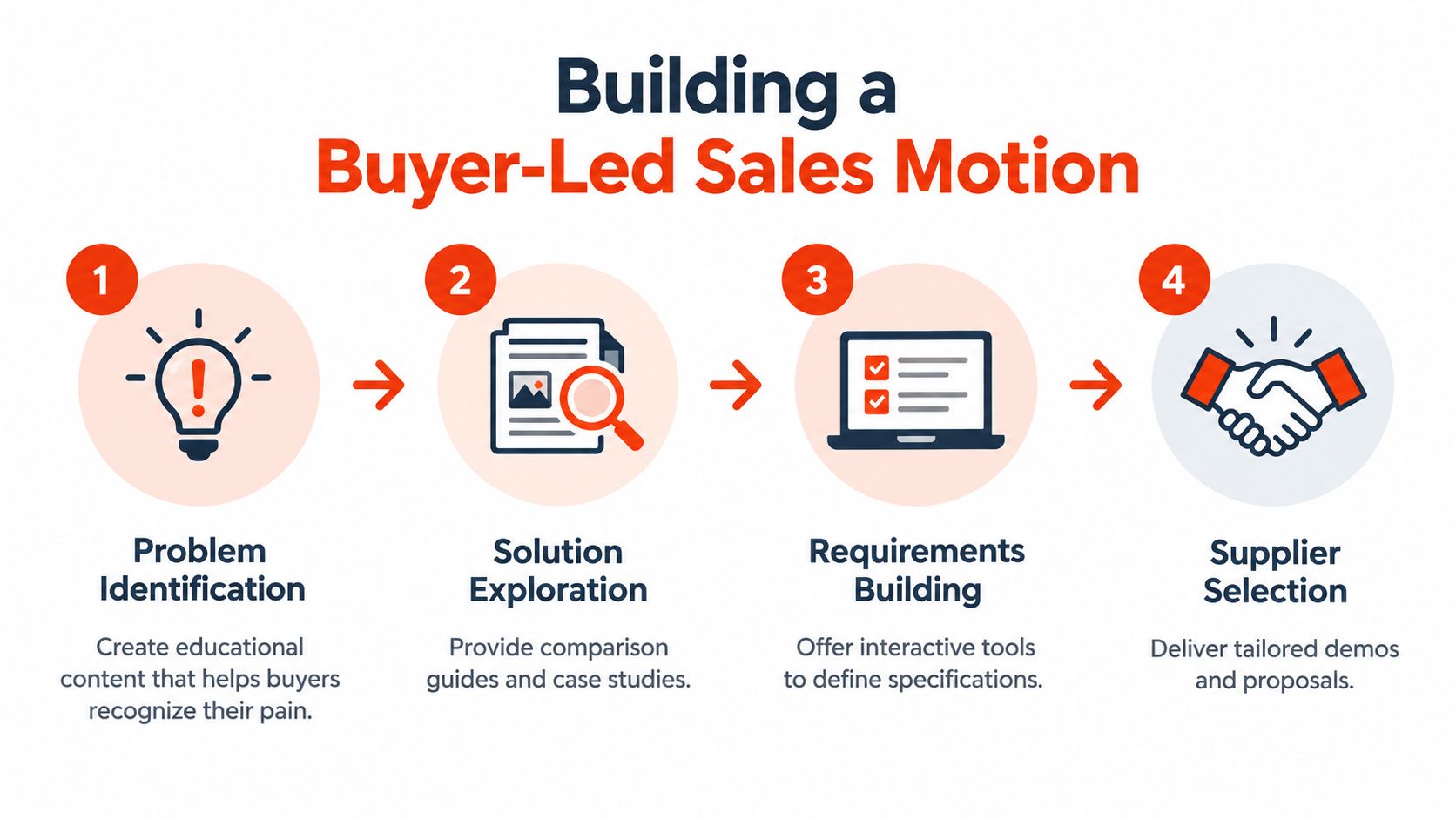
Second, buying isn't linear. Teams loop back through problem identification, solution exploration, requirements building, and supplier selection as new stakeholders join. A linear funnel with a demo at stage two can't serve a finance lead who enters at week six asking about payback, or an IT lead who reopens security after procurement gets involved.
Force a discovery call too early and you don't accelerate the deal. You teach a self-educating buyer to avoid you.
What you're feeling internally matches that external change. Cycles stretch, one enthusiastic champion can't carry consensus, SQL volume stays thin, and the CEO still asks for pipeline this quarter. More sequences won't fix a relevance problem.
The replacement is a buyer-led operating model. Publish the evidence each buying job requires, detect meaningful engagement from target accounts, and bring in sales when a buyer needs validation, customization, or help building consensus. That's not softer selling. It's stricter selling, because every human touch has to earn its place.
Positioning and ICP Before You Spend on Demand
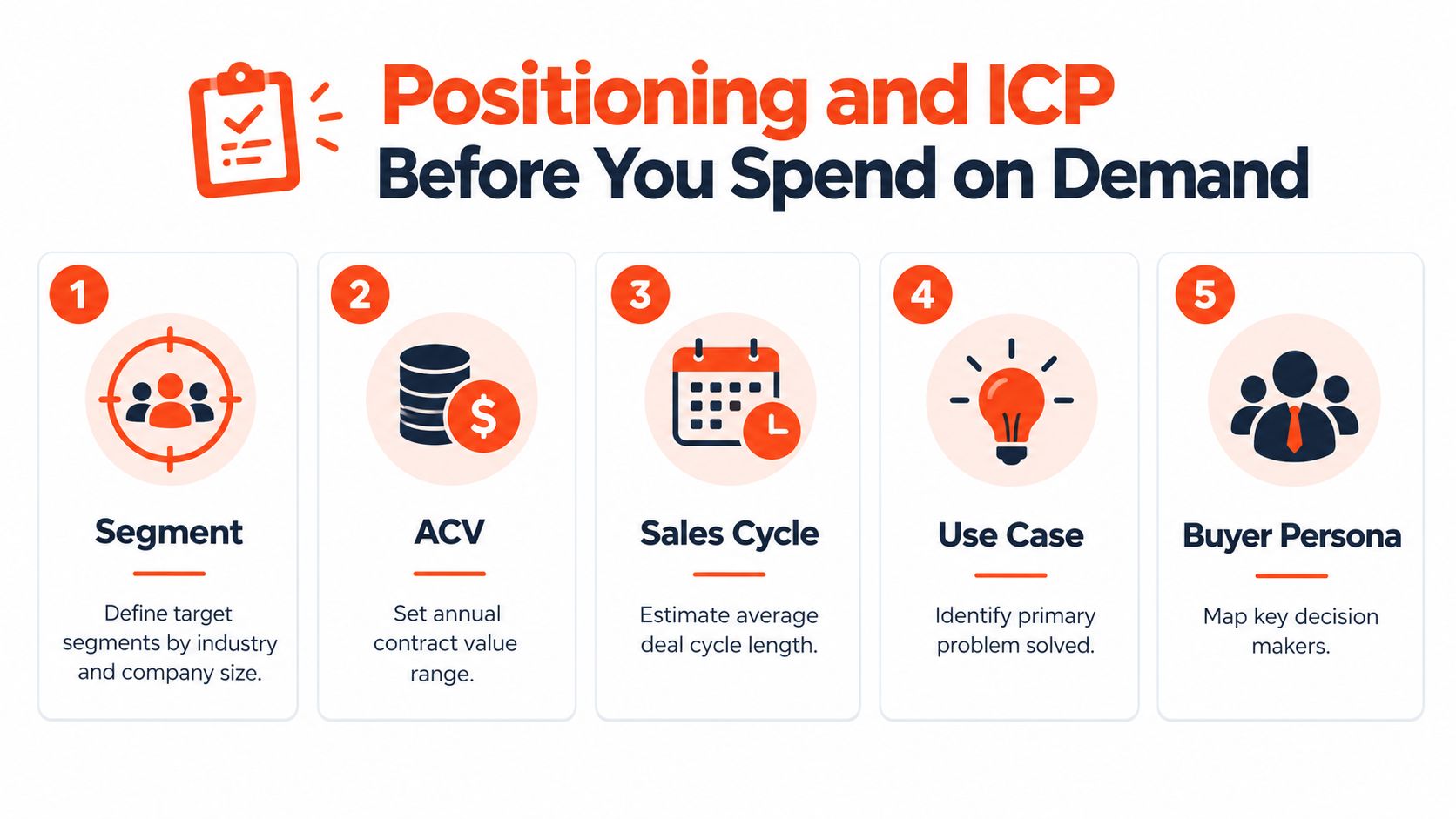
Don't fund demand generation until you can say, in one sentence, which specific problem you solve for a specific buyer in a specific window. Vague positioning produces expensive curiosity. Sharp positioning produces pipeline you can qualify.
A bad ICP sounds like this: mid-sized companies that want to grow. A usable ICP names segment, ACV range, expected sales cycle, primary use case, and buying committee. It also names exclusions. If implementation capacity, geography, tech stack, or regulatory fit will kill a deal later, disqualify it before marketing spends anything.
Build Qualification Rules Before Campaigns
Use a practical hybrid, not a framework poster. Take budget and timeline discipline from BANT, then add MEDDIC-style questions on economic buyer, decision process, and identified pain for larger deals. Write the rules into your CRM as required fields, not tribal knowledge in Slack.
- Identified business problem: The account has named a cost, risk, or revenue problem your product directly addresses.
- Buying group access: You can identify the economic buyer and at least one technical or operational evaluator.
- Decision window: There's a trigger, renewal, budget cycle, or project deadline that makes action plausible now.
- Explicit disqualifiers: No budget owner, no implementation owner, wrong stack, or a use case you serve poorly.
Map the people, not just the firmographics. A practical resource on building B2B buyer personas that reflect real buying committees can help you separate the end user who feels pain from the finance lead who approves spend and the IT lead who can block rollout.
Positioning That Survives AI Research
Write claims a buyer can verify without you. Name the workflow, the integration in Salesforce or HubSpot, the implementation constraint, and the outcome metric. Avoid category poetry. Every ICP choice then drives a channel choice, because a narrow enterprise segment needs account coverage and executive proof, while a broader mid-market segment can support search-led content and product trials.
If sales can't repeat your ICP and disqualifiers from memory, you don't have an ICP. You have a targeting wish.
Building a Buyer-Led Sales Motion
Organize your motion around the buyer's jobs, not your stages. CRM stages describe your forecast. Buying jobs describe the work a committee must finish to say yes, and they don't run in a straight line.
The infographic below maps those four jobs in sequence for clarity. In live deals, expect accounts to revisit earlier jobs whenever a new stakeholder joins.
Match One Asset to Each Job
For problem identification, publish a quantified problem brief that helps a leader size the cost of the status quo in their own terms. For solution exploration, provide honest comparison guides, architecture overviews, and proof from comparable deployments. Generic feature grids don't help a buyer eliminate risk.
For requirements building, give evaluators technical and security documentation, implementation requirements, integration notes for tools like Microsoft Entra ID or Snowflake, and a clear RACI for rollout. For supplier selection, deliver an ROI model, reference logic, and procurement-ready commercial material that a champion can forward without editing.
Timing matters because cycle length varies sharply by deal size. Benchmark reporting puts the median B2B SaaS sales cycle at 84 days, with sub-$15,000 ACV deals closing in 14 to 30 days, mid-market deals in roughly 30 to 90 days, and enterprise deals above $100,000 taking 90 to 180 or more days. One nurture cadence can't serve all three.
This short video is useful for pressure-testing whether your assets help buyers self-educate between meetings, rather than only promoting the next call.
Route by intent, not by form fill. Repeat visits to security and pricing material, multiple stakeholders engaging from one account, or a requirements document download signal a different job than a single blog view. Send the minimum useful asset first, then invite a conversation tied to that job.
As your motion matures, iterate your B2B sales strategy against stage conversion and cycle length, not activity counts. Sales should enter to validate fit, tailor requirements, and build consensus. If a rep is still the only source of basic product information, your digital motion has failed.
Demand Generation Channels That Actually Build Pipeline
Most channel plans fail because every channel is asked to produce meetings this month. That's not how high-ticket demand works. Some channels create future shortlist inclusion. Others convert existing intent. Judge each on the job it owns.
Bridge Group research across 172 B2B SaaS companies reports a median 33% of AE pipeline sourced by marketing, an average AE ramp of 5.3 months, and 65% quota attainment. Judge a new motion over a full ramp and against revenue outcomes. A channel that looks weak on week-three leads may be building the only pipeline that closes.
| Channel | Buyer job it serves | Primary KPI | Typical ramp |
|---|---|---|---|
| SEO and original research | Problem identification, solution exploration | Target-account engagement, assisted opportunities | Slow, compounding |
| Partner and executive LinkedIn | Problem identification, trust building | Qualified engagement from target accounts | Medium |
| Account-based marketing | Requirements building, supplier selection | Stakeholder coverage, sales-accepted opportunities | Medium |
| Intent-triggered outbound | Supplier selection | Meeting-to-opportunity conversion | Fast when intent is real |
Assign Each Channel a Non-Negotiable Metric
SEO and original research should own discoverability in Google and AI search. Publish quantified problem briefs, implementation guides, and comparison pages in Ahrefs-informed clusters, then measure target-account engagement and assisted pipeline in HubSpot or Salesforce.
Partner and executive LinkedIn demand owns trust before outreach. Senior voices publish specific operating lessons, buyers engage on their own terms, and only meaningful signals trigger contact. This is the model Ploot uses when it builds LinkedIn audiences for partners and directors, detects buying intent in that audience, and routes interested prospects into qualified meetings.
ABM owns stakeholder coverage inside named accounts. Use LinkedIn Campaign Manager, 6sense or Demandbase signals where available, and role-specific assets for finance, IT, and operations. Intent-triggered outbound owns speed to a relevant conversation, but only after an account shows behavior worth interrupting for.
If you're debating budget labels internally, compare growth marketing and demand gen before you fund experiments that optimize clicks while starving pipeline creation. Then map spend against a documented demand generation funnel with clear stage definitions so marketing and sales argue from the same numbers.
Pipeline rule: A booked meeting isn't pipeline. Pipeline starts when sales accepts an opportunity against written qualification criteria.
Kill channels that produce cheap meetings sales won't work. Keep channels that produce fewer, better-covered accounts that progress.
Choosing the Right Sales Motion by Deal Size
Copying a competitor's SDR team is not a strategy. Your motion has to fit ACV, buying group complexity, and how much human time a deal can support before acquisition cost destroys payback.
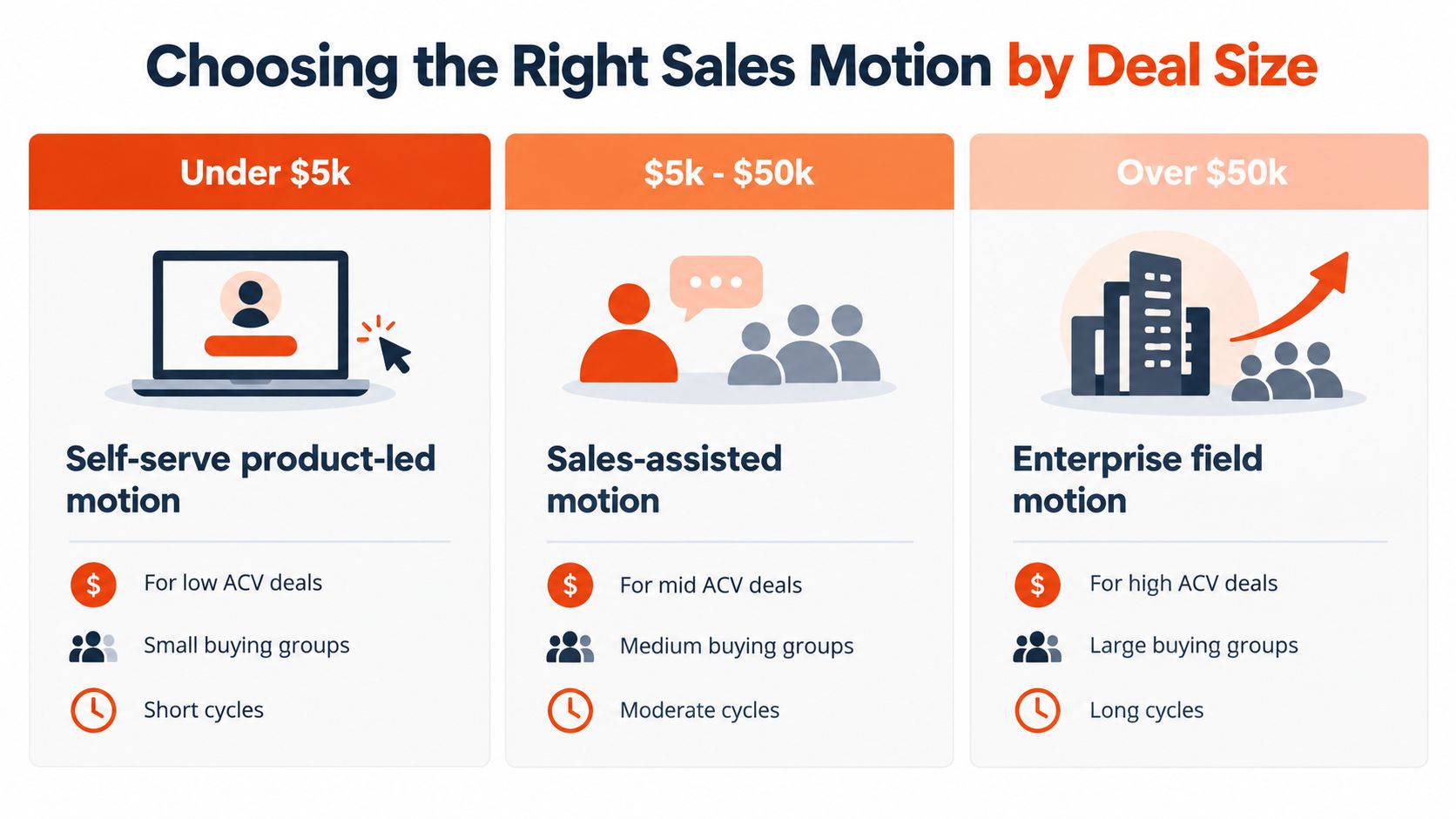
The comparison below separates three motions that teams often blur together. Blurring them is expensive, because you end up paying enterprise sales costs on deals that needed a product experience, or starving complex deals that needed multi-stakeholder work.
Three Motions, Three Economic Logics
A self-serve product-led motion fits low-complexity purchases where a small group can evaluate quickly, onboarding is light, and the product proves value without services. Your investment goes into trial design, in-product guidance, transparent packaging, and fast support through tools like Intercom or Zendesk. Adding mandatory sales calls here usually suppresses conversion.
A sales-assisted hybrid fits mid-market deals where buyers self-educate first, then need help with requirements, integrations, and internal justification. Marketing and product content carry early jobs, while AEs run focused validation and commercial structuring. For most B2B software and consulting-led software sales in Spain, this is the default worth testing, because buyers want senior credibility without a heavy enterprise process.
A sales-led enterprise motion fits high-value deals with broad stakeholder coverage, security review, procurement scrutiny, and implementation risk. You need account planning, executive sponsorship, solutions engineering, and role-specific proof for each function that can delay or veto the purchase. Cycle length will be longer, so stage progression and stakeholder coverage matter more than raw meeting volume.
Pick by Constraint, Not Fashion
Ask three questions before you hire. Can a buyer reach value without services? How many functions must approve? Does expected recurring revenue support repeated senior sales time across a long evaluation? If the answers point in different directions, split the motion by segment instead of forcing one process onto every account.
Don't let a low-ACV segment consume AE capacity needed for enterprise consensus building. Don't make enterprise buyers self-serve through a trial when their real risk is implementation and internal adoption. The profitable motion is the one that matches buyer work to your cost to serve.
Pricing, Pilots, and Reducing Procurement Friction
A high-ticket buyer rarely says no because your demo lacked one feature. They stall because the commercial risk feels larger than the proven value, and procurement can't defend the commitment internally. Fix that before you push for a signature.
Pricing transparency is the leading change requested by B2B technology buyers, cited by 45% globally, while 39% favor pay-as-you-go pricing and more than two-thirds would pay a premium for AI functionality only when vendors clearly demonstrate value. Hide your pricing logic and you don't create an advantage. You create homework for a champion who already has too much.
Design a Risk-Reduction Sale
Start with transparent commercial assumptions. State what drives price, what's included, what implementation requires from the customer, and what happens if usage grows. If you're evaluating how adjacent vendors package paid tiers, reviewing published AI-powered CRM rates is a useful reminder that buyers now expect to inspect commercial structure before a negotiation, not after it.
Then offer a time-limited pilot with mutually agreed success criteria when implementation effort or internal consensus is the actual blocker. A three-month pilot works when it has a named business owner, a defined user group, baseline metrics, and an expansion decision date. It fails when it's a discounted delay with no owner and no agreed evidence.
Use a documented pilot success criteria template to agree metrics before kickoff and make both sides sign the logic, not just the price. Good pilot metrics connect product use to business outcomes, such as qualified opportunities created, cycle time reduced in a named workflow, adoption by the intended team, or recurring revenue influenced. Bad pilot metrics count logins and hope finance is impressed.
A pilot accelerates a deal when it removes a specific unknown. It postpones a deal when it substitutes for a decision nobody wants to make.
Structure the commercial path in writing. Pilot scope, success threshold, review meeting, expansion terms, and annual contract ramp should sit in one procurement-ready proposal. Include security contacts, data processing terms, implementation milestones in tools like Asana or Jira, and the internal effort required from IT and operations. Your champion shouldn't have to assemble your business case from five email threads.
Treat Alignment as Pipeline Math
Marketing-sales alignment isn't a culture workshop. It's arithmetic with shared definitions. Work backward from bookings. Target bookings divided by win rate gives required opportunities. Required opportunities divided by meeting-to-opportunity conversion gives required qualified meetings. If those numbers exceed AE capacity, demand generation success becomes waste.
Instrument every transition in Salesforce or HubSpot. Separate marketing-sourced, SDR-sourced, partner-sourced, and AE-sourced pipeline so channel quality stays visible. Require disqualification reasons on every rejected meeting and stalled opportunity. Without them, marketing optimizes for volume and sales builds a private definition of quality.
Install three weekly rituals and protect them:
- Pipeline review: Inspect sales-accepted opportunities, stage movement, and next buyer job by account.
- Deal-stage inspection: Check stakeholder coverage, economic buyer access, and procurement blockers on late-stage deals.
- Disqualification review: Read rejection reasons together and change targeting, messaging, or routing within the week.
Narrate the pilot the same way. In week one, confirm baseline and owners. Mid-pilot, show progress against the agreed metric to the economic buyer, not only to daily users. At the decision review, present outcome evidence, remaining risks, rollout requirements, and expansion economics in one session. That sequence converts proof into revenue because finance, operations, and users hear the same case at the same time.
Don't offer annual discounts to compensate for unclear value. Reduce risk with scope, evidence, and a credible exit or expansion path. Buyers will pay for demonstrated productivity. They won't pay a premium for a promise, and procurement will make sure of it.
A 90-Day Plan to Launch the Playbook
Run this as an operating quarter, not a rebrand. You need definitions first, channel proof second, and a hard pipeline review before anyone declares the new motion a success.
Spendesk reporting on SaaS economics notes marketing and sales commonly consume at least 50% of SaaS-company revenue, so judge the plan on qualified meetings, opportunities, recurring revenue, and payback period. Impressions don't pay for that cost base.
Weeks 1 to 2 Lock the Definitions
Finalize ICP by segment, ACV, cycle, use case, and buying committee. Publish qualification and disqualification rules in the CRM, then record baseline conversion for meeting acceptance, opportunity creation, win rate, and cycle length. Assign one owner for target-account coverage and one for sales acceptance quality.
Weeks 3 to 6 Launch by Buyer Job
Ship the minimum asset set for each buying job, starting with the gaps that block late-stage deals. Activate executive and partner profiles for target-account trust building, launch ABM against named accounts, and restrict outbound to accounts showing meaningful engagement. Every channel gets one primary KPI and a named owner.
- Target-account coverage: Confirm named accounts, buying group contacts, and engagement criteria.
- Qualified engagement: Define which behaviors justify sales contact and which stay in nurture.
- Sales-accepted meetings: Count only meetings sales accepts against written criteria.
- Opportunity creation: Track pipeline value, stakeholder coverage, and stage progression weekly.
- Disqualification discipline: Review every rejection reason and fix targeting fast.
Weeks 7 to 12 Prove or Cut
Run the first full pipeline review against the documented baseline. Design pilot offers for qualified accounts where risk, not interest, is blocking progress. Hold a marketing-sales retro using CRM evidence, then cut channels that create accepted meetings without opportunities.
By day 90, you should know which segments progress, which assets buyers use in requirements and supplier selection, and where sales capacity constrains growth. You won't have perfect attribution. You'll have something better, an honest pipeline system that connects audience building to revenue and tells you what to stop funding.
If your senior team has authority buyers trust but that visibility isn't turning into accepted pipeline, Ploot can build your partners' and directors' LinkedIn audiences, detect buying intent among target accounts, and convert meaningful engagement into qualified sales meetings. Start with a three-month pilot with agreed success criteria, judge it on meetings sales accepts and opportunities created, and expand only on evidence your CFO can inspect.