

Nearly 8 in 10 B2B buyers ultimately purchase from their top-ranked vendor, according to buyer research summarized in a LinkedIn post on solution research. That single fact changes the job of account based marketing for B2B. If preference is formed before a buyer fills in a form, you can't build a program around capturing leads and call it done. You have to pick named accounts, earn credibility with several people inside each one, and judge progress by how the account moves toward a qualified conversation.
That is harder than buying a targeting tool. It's also why consulting and software firms keep returning to ABM when deal values are high and cycles are long. The work below is a practical operating model, with a scoring table, role maps, channel choices, and pilot metrics you can defend to sales and finance.
Table of Contents
- Why Account Based Marketing Fits Long B2B Sales
- How to Pick Target Accounts with a Scoring Model
- Mapping the Buying Group and Writing for Each Role
- Channel Mix and LinkedIn Partner Amplification
- Measuring Pipeline Without Overclaiming Attribution
- Execution Playbooks for Consulting and Software Firms
- Confirm a Three-Month Pilot Before You Scale
Why Account Based Marketing Fits Long B2B Sales
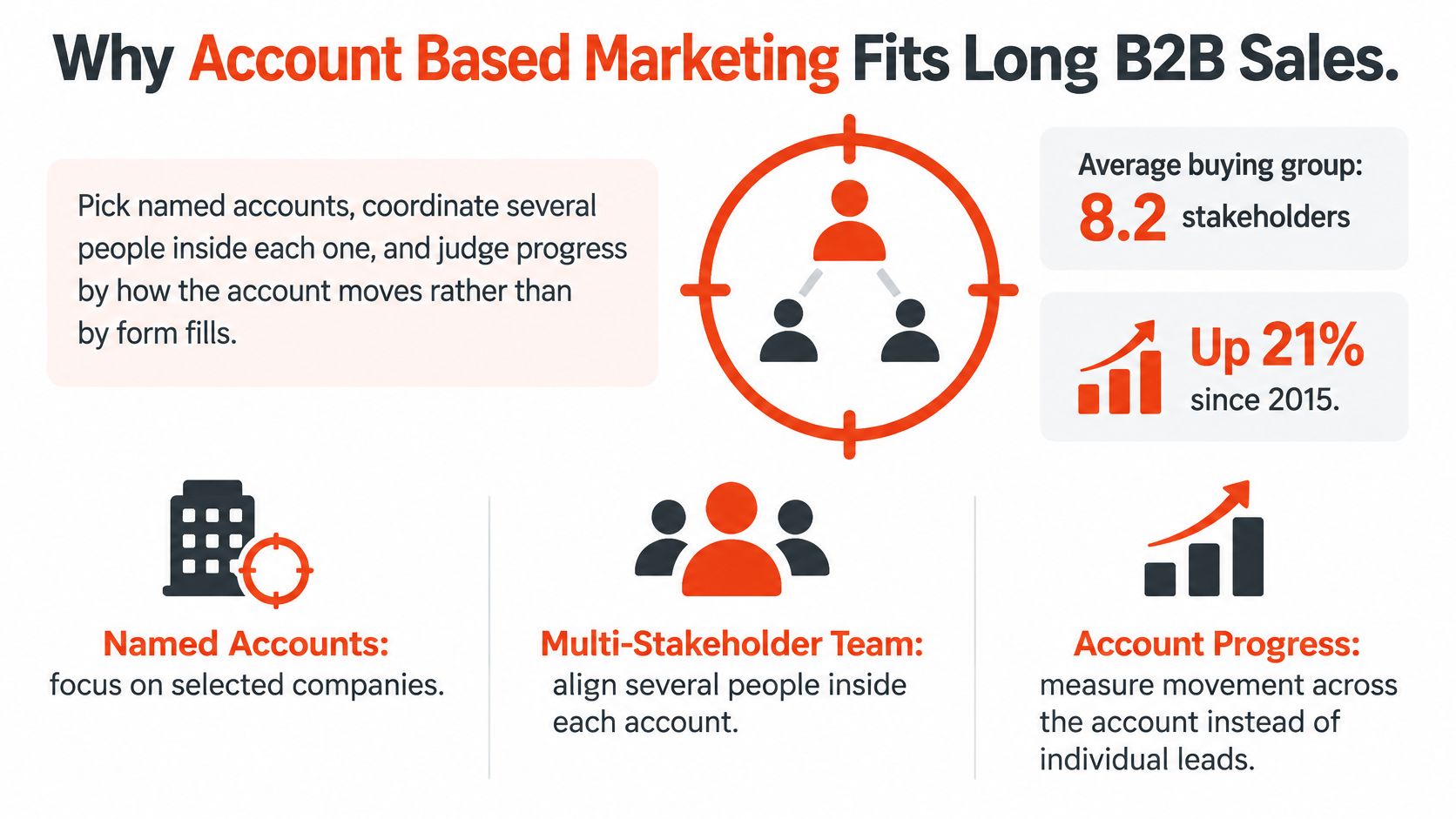
Account based marketing means you pick named accounts, coordinate several people inside each one, and judge progress by how the account moves rather than by form fills. A lead from one manager is a starting signal, not an opportunity. Your unit of work is the company, and your unit of progress is buying group movement.
That fits consulting and B2B software because a single deal can represent a large fee and months of evaluation. The buyer needs coordinated education before any sales conversation, often across business, technical, and financial questions. Broad campaigns can create awareness, but they rarely align those different concerns at the same account at the same time.
What Changes in Practice
If ABM is only a targeting label on your ads, nothing material changes. In a real program, marketing, sales, and senior experts work from one account plan with shared target accounts, named roles, agreed messages, and one definition of when an account is ready for outreach. Partners and directors stop posting generic thought leadership into a void. They speak to specific problems in specific sectors that target accounts already face.
Adoption data supports treating this as an operating model, not an experiment. In a 2024 study reported by Demandbase, 71% of B2B organizations were either already using ABM, testing it, or interested in adopting it. Maturity matters too. Among organizations using ABM for three or more years, 43% said it affected the entire funnel, compared with only 12% among those using it for two years or less.
If your reports count leads but your deals need consensus, you're measuring the wrong unit.
Run a quick self check before you commit budget. Pull your last ten open or lost deals and count how many had more than one decision maker involved. Then check whether your dashboard reports accounts or isolated contacts. If most deals involved several people and your reporting can't show account movement, ABM fits your sales cycle and your first step is account selection, not more content.
How to Pick Target Accounts with a Scoring Model
Start with the table, not with a wish list from sales. Every candidate account gets a score out of 100 points. The point isn't false precision. It's forcing account selection into the open so marketing, sales, and partners argue about evidence once, then work the same list for a quarter.
Target Account Scoring Criteria
| Criterion | What to check | Points | Passes when |
|---|---|---|---|
| Firmographic fit | Sector, headcount and revenue band against your ideal customer profile | 25 | Matches at least three of four criteria |
| Deal value | Expected contract value against your average | 25 | Above your average contract value |
| Sales-cycle economics | Typical cycle length and buying committee size | 20 | Cycle fits your team's capacity |
| Strategic relevance | Hiring, expansion or a new practice or product | 20 | A visible initiative in the last six months |
| Existing reach | Partners or staff already connected to the account | 10 | At least two connected profiles |
Score firmographic fit and deal value highest because they decide whether the economics can ever work. A perfect strategic story doesn't rescue an account that can't buy a contract large enough to justify senior expert time. Sales cycle economics protects capacity. An account that needs many committee meetings over a very long cycle may be valuable, but only if your team can sustain that effort without starving closer opportunities.
Strategic relevance captures timing without pretending you can predict purchase dates. Hiring, expansion, a new practice, or a product launch gives partners a legitimate reason to publish and to engage. Existing reach is worth fewer points, but it matters for LinkedIn led programs. If nobody in your firm is connected to anyone relevant, you'll spend the pilot building access instead of building preference.
Six Steps to Build the List
- List ICP matches first. Name every company that matches your ideal customer profile in sectors you already serve. Don't add aspirational logos from sectors where you have no proof.
- Score from evidence. Use CRM history, public announcements, and LinkedIn data. Record the source for each score so the quarterly review can challenge the number, not the memory.
- Sort and tier. Put accounts scoring 75 or more in Tier 1 for senior expert outreach, 50 to 74 in Tier 2 for role based content, and below 50 in Tier 3 for broad campaigns only. Tiering controls personalization cost.
- Check role coverage. Confirm each Tier 1 account has at least three relevant roles identified on LinkedIn before committing effort. One contact can't carry an ABM play.
- Remove no path accounts. Cut accounts with no credible route in, such as no connected partner and no shared network. Keep them in Tier 3 if the fit is strong, but don't burn pilot time on them.
- Lock the list for one quarter. Revisit only when a score changing event happens, such as a leadership change, acquisition, or major expansion. Weekly list changes destroy learning.
Intent data belongs inside step two, not as a replacement for fit. Our guide to using B2B intent data without chasing noise sets out how to separate research behavior from buying readiness. For the handoff question, turning intent signals into sales action is a useful companion because a signal only has value when someone acts on it with context.
Sanity check: A team of three to five people can work roughly 30 to 40 Tier 1 and Tier 2 accounts in a quarter. A much longer list usually means the scoring was too loose.
I would rather see 25 tightly scored accounts with named roles than 150 logos in a spreadsheet. The tighter list will tell you in one quarter whether partner content, messages, and sales follow-up create conversations. The loose list will produce activity reports and very little pipeline you can trust.
Mapping the Buying Group and Writing for Each Role
One contact never equals one account. In a 2025 B2B buyer statistics compilation citing research on complex buying processes, the average buying group involved 8.2 stakeholders, a 21% increase from 2015. That is the structural reason single lead generation underperforms for high value services. You can win enthusiastic engagement from one person and still lose because finance, technical evaluation, or an executive sponsor was never brought along.

Map these roles for every Tier 1 account before outreach begins. Treat the map as a working document in the CRM, not a persona deck.
- Executive sponsor. Needs business risk, return, and confidence that your firm won't create a political problem. Give this person a short view from a named partner and one proof point tied to outcomes.
- Business owner. Needs operational fit and a clear use case. Show how the service or software changes a process this person owns, with a sector example.
- Technical evaluator. Needs proof of integration, security, and delivery capability. Generic benefit copy fails here. Provide architecture, delivery method, or implementation detail.
- Finance and procurement. Need pricing logic and contract terms they can defend internally. Explain what's included, what drives cost, and how scope changes are handled.
- End users. Need to see that daily work improves. If users expect more admin, they'll block adoption even after a signature.
One Message and One Proof Point per Role
For each role, write one message angle and one proof point. The executive sponsor might get a partner post on cost of delayed hiring, backed by a client outcome in the same sector. The technical evaluator might get an integration note from a delivery lead, backed by security documentation. End users might get a short workflow example showing a task removed, not added.
This discipline stops a common failure. Teams create one strong asset and send it to everyone, then wonder why only the original contact engages. Different roles are not being difficult. They're answering different internal questions, and your content has to help each person answer theirs.
Use structured role definitions to keep the writing consistent. Our breakdown of B2B buyer personas for buying groups helps translate job titles into concerns, objections, and proof needs. Don't copy persona text into outreach. Use it to decide what each person should see first and what would be irrelevant noise.
Finding People and Flagging Gaps
Find named people through the account's LinkedIn company page, your partners' first degree networks, and job change signals. A new senior hire is often both a sponsor and a source of urgency. A long tenured business owner may be the actual evaluator even if the org chart points elsewhere.
Apply the gap rule. If a role has no named person, flag it as a coverage gap instead of guessing. Gaps are useful information. They tell sales where a referral is needed and tell marketing where paid reach or an event invitation should fill access.
Do the exercise this week for one Tier 1 account. Fill the map, attach one message and one proof point to each named person, and mark which roles have engaged so far. If you can't complete that sheet, the account isn't ready for personalized outreach yet, however strong its score looks.
Channel Mix and LinkedIn Partner Amplification
Assign each channel a job before you assign it a budget. Preference, conversation, and confirmation are different jobs. Mix them up and you pay for reach that never becomes a meeting.
Treat the mix as a coordination system for the buying group, scored on whether named people move into qualified conversations. A post that builds preference six weeks before a meeting will not carry a clean revenue credit. Count that early work as a condition for later pipeline, not as proof a channel caused the deal.
The visual below sets out how a channel plan should be debated, by job and audience rather than by vendor.
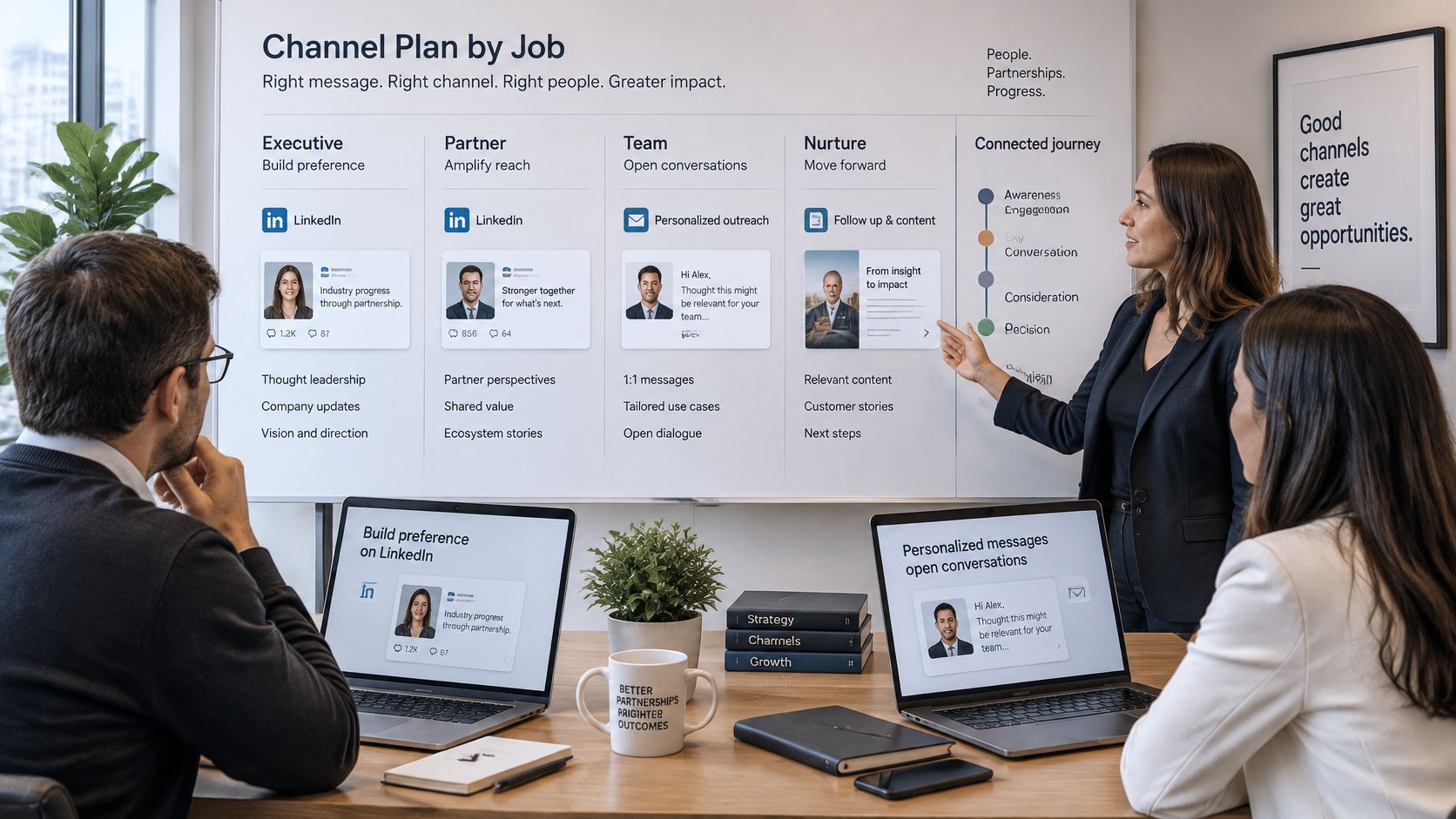
Channel Roles in an ABM Program
| Channel | Job in the program | Best used for | Watch out for |
|---|---|---|---|
| Executive LinkedIn posts | Build preference before contact | Showing sector expertise to senior buyers | Generic thought leadership with no account context |
| Partner and consultant posts | Amplify credibility through named experts | Reaching buying group roles that do not know you yet | Unwritten agreements on content ownership |
| Personalized LinkedIn messages | Open conversations from team profiles | Following up on content the person already viewed | Messaging people who never engaged |
| Email sequences | Keep the account warm between conversations | Nurturing Tier 2 accounts | Sending the same message to every role |
| Paid ads on target accounts | Reach roles with no prior contact | Filling gaps in the buying group map | Paying for reach that never becomes conversation |
| Events and trade shows | Confirm interest already created | Meeting accounts already in conversation | Counting attendance as account engagement |
Buyers often research solutions and form a shortlist before they contact sales. By the time an account enters a conventional scoring system, a preferred provider may already be set. Senior content has to be specific about sector, solution, and experience so it can be found, understood, and cited when buyers compare providers.
This short walkthrough shows how account focused content supports that early preference work in practice.
Running Partner Amplification Without Creating Problems
Aim for one to two posts per partner per week. Consistency beats a burst nobody can repeat. Partners will not sustain a daily publishing habit they do not own. Teams that need to keep that cadence across busy directors often schedule LinkedIn posts in advance so approval and timing do not collapse every Monday morning.
Agree the policy in writing before anyone publishes. In business accounts, the account administrator can manage users and permissions, and content created by employees belongs to the employee unless otherwise agreed internally. Skipping that conversation creates disputes when a partner leaves or a post performs well. Put ownership, approval, and reuse rights in a short internal agreement.
Outreach then has to sound human. Messages go via LinkedIn or email from the team's own profiles, mentioning what the person looked at, not from a brand account. A finance lead who viewed a pricing logic post gets a finance-relevant follow-up. A technical evaluator who engaged with integration content gets a technical proof point, not a generic meeting request.
Keep the volume low. Contact people who have already interacted with the team, the company, or the sector. A note to someone who never engaged is mass prospecting with a personal signature, and it wastes the preference the posts were meant to create.
Pick three channels for the first quarter and state what each must prove in conversations, not impressions. For most consulting and software firms, I would start with partner LinkedIn posts to build preference, personalized messages to open conversations with people who engaged, and email to keep Tier 2 accounts warm. Add paid ads only to fill mapped role gaps. Add events only when target accounts are already in conversation and a face-to-face meeting can move the account forward.
Measuring Pipeline Without Overclaiming Attribution
A synthesis citing Forrester research on B2B buying groups describes buying groups involving 13 internal people and 9 external participants, with buyers consulting 15 to 27 information sources during evaluation. You will not see most of that path. Analytics cannot reliably tie every source to a person or an account. A report that assigns precise revenue credit to every touch asks leadership to trust more than the data can support.
Treat ABM as a coordination system for the buying group, and measure it by pipeline movement rather than a perfect credit model. Intent signals are prioritization inputs, not conversion evidence. Anonymous visits, social engagement, and third party intent can justify coordinated outreach to the right roles. None of them should receive automatic revenue credit.
A signal earns you the right to act. It doesn't prove you caused the deal.
Define the commercial term before the pilot starts. A sales opportunity is a real person within the ideal customer profile who has shown buying intent by interacting with content, visiting a profile or matching a signal, and reaches the salesperson with context. That definition keeps a useful handoff distinct from a name scraped into a list.
Pilot Metrics for a Three Month ABM Test
| Pilot metric | Definition | Progress signal | Reported as |
|---|---|---|---|
| Account penetration | Share of Tier 1 accounts with at least one engaged contact | Rising each month | Percentage of target accounts |
| Engaged stakeholders per account | Distinct relevant roles active in the account | At least three roles in active accounts | Average per account |
| Qualified conversations | Replies from people in the ideal profile with buying intent | Growing volume from Tier 1 accounts | Count per month |
| Meetings sourced | Qualified meetings booked with a salesperson | Meetings with context attached | Count per month |
| Opportunities created | Pipeline records opened from ABM conversations | Created with named roles on the record | Count and value |
| Sales cycle progression | Movement of opportunities through sales stages | Faster stage movement than non ABM deals | Median days per stage |
Read the table in order. Coverage and conversations come before pipeline, because a three month pilot in a long cycle business can show real buying group progress before many opportunities close. Then check whether qualified conversations become opportunities and how fast those opportunities move through stages. Our detailed guide on how to measure account based marketing shows how to structure that reporting for leadership.
Clean the data weekly. Drop signals from competitors and job seekers. Log stakeholders you could not reach so a gap in role coverage stays visible instead of disappearing inside a healthy engagement total. Record the consent basis for each contact, especially when outreach moves from LinkedIn engagement to email.
Attribution breaks in a predictable place. Account-wide activity can rise in the same month an opportunity opens, and that timing is correlation, not proof that one post created the deal. Finish each monthly report with two columns. Confirmed influence goes in one column, such as a named stakeholder replying to a partner post and booking a meeting. Correlation goes in the other, such as account wide engagement rising before an opportunity opened. That split keeps leadership trust and stops the team from claiming every LinkedIn interaction caused pipeline.
Reporting can look mature while account ownership, content production, and sales follow up stay informal. ABM fails there. Whether the organization can run a new motion is a separate question from pipeline math. Bulby's guide to assessing innovation capability covers innovation capability, not ABM attribution, and it applies only to that narrower readiness question.
Execution Playbooks for Consulting and Software Firms
A mid-size consultancy working 60 Tier 1 accounts can treat the first six weeks as a coordination system for the buying group, scored on who is in motion. In week 1, a partner who is a director with credible sector posts starts two posts a week on the problems the HR director faces. In weeks 2 to 4, the partner engages the HR director, the CEO, and the finance lead with role specific content, one message angle each. In weeks 5 to 6, direct outreach goes only to people who already interacted, and the account moves to a sales conversation once two roles respond.
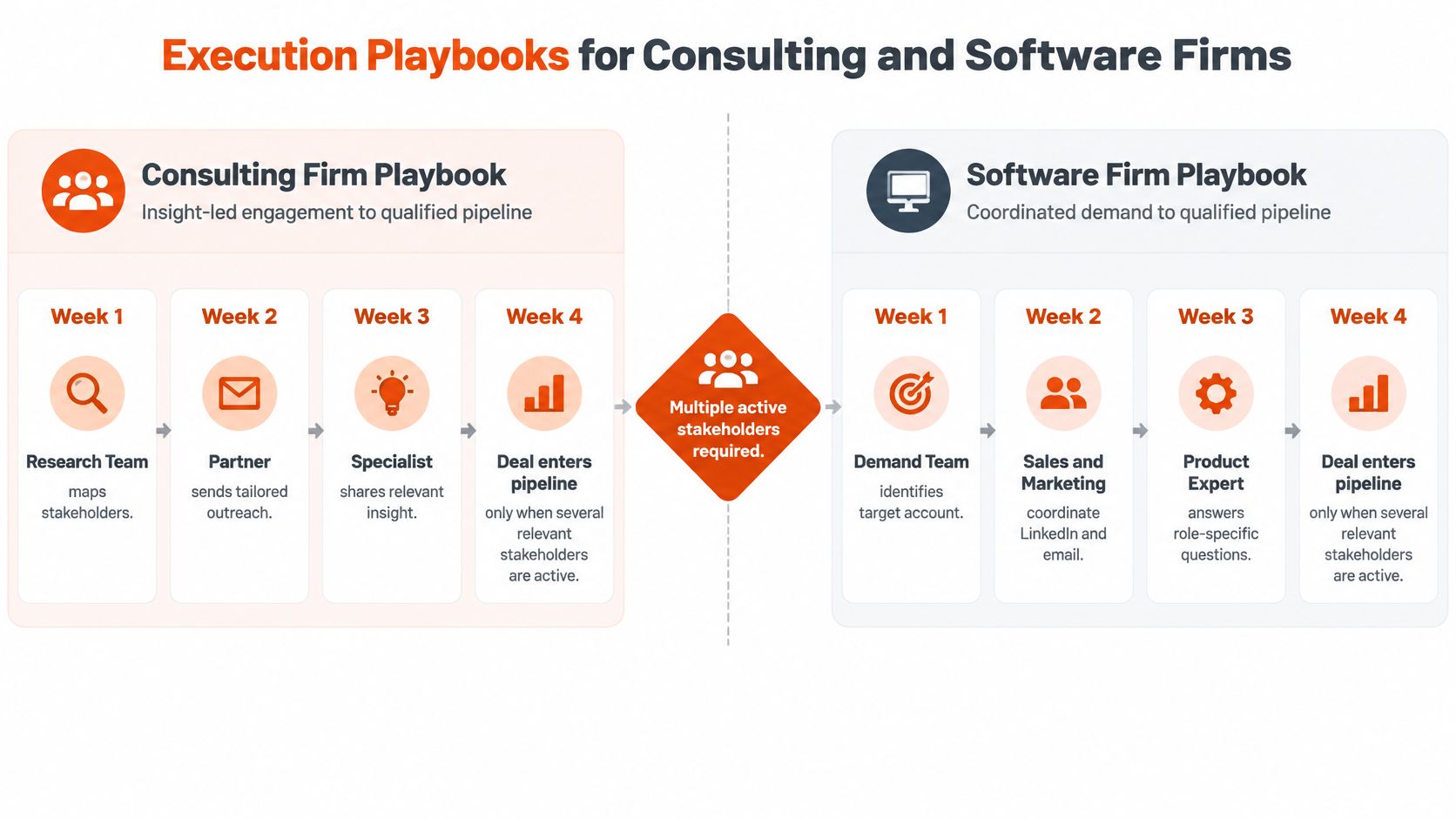
A B2B software company working 40 target accounts uses the same clock and a stricter handoff. In week 1, the technical evaluator and an end user champion are identified in each account, and integration and security proof is loaded into the sequence. In weeks 2 to 4, the evaluator and champion are activated with proof content, then the economic buyer is brought in. In weeks 5 to 6, the account passes to sales only when engagement spans at least three roles.
The Shared Gate
Both plays use the same gate. A deal enters pipeline only when several relevant stakeholders are active.
Buying-group execution is associated with higher win rates than a lead-centric motion, and covering more of the group lines up with better close rates. Treat that as directional. It is observed pattern, not a controlled experiment, so it supports the gate and does not guarantee the lift on your list. The number you report is still pipeline: qualified conversations and opportunities, not a claim that one post caused the deal. Attribution breaks as soon as several people and several touches sit on the same account, which is exactly when this motion is working.
The contact rule is identical in both plays. Volume stays low, and messages go only to people who have already interacted with the client, the client's company, or its sector. There is no mass prospecting.
The trade-off is the source of credibility. Consulting cycles depend on partner credibility, so the named expert has to be visible early, and that spends senior time before a meeting exists. Software cycles depend on proof and integration content, so technical confidence has to arrive before the economic buyer is asked for time, which delays the first commercial ask and cuts meetings that stall in security review.
Confirm a Three-Month Pilot Before You Scale
Don't scale a motion you haven't defined. A three month pilot works only if the list, roles, terms, metrics, and CRM structure are fixed before the first post is published.
Checklist for This Week
- Confirm the Tier 1 list. Record the score for each account under your scoring model and remove any account nobody can defend.
- Map every Tier 1 buying group. Mark coverage gaps by role. Don't start personalized outreach to accounts with unnamed sponsors.
- Agree partner posting terms in writing. Set ownership, approvals, and reuse before anyone publishes.
- Sign one opportunity definition with sales. Use the pilot metrics and agree what counts as a qualified conversation and a meeting.
- Instrument the CRM. Each opportunity should hold the account, its named roles, and the source conversation.
- Name one reporting owner. One person owns account level reporting and the influence versus correlation split.
Fix success criteria on day one, review at week six and week twelve, and make the go or no go decision on coverage, qualified conversations, and opportunities, not impressions. If LinkedIn activation is the bottleneck, outside providers can run it. Judge any proposal on how it moves from ideal profile definition to booked meetings, what weekly volume it commits to and how that's verified, who writes each message, how it reports influence separately from correlation, and how it handles consent.
Our own process has four steps. The team becomes a reference voice, prospects are filtered by ICP fit and buying signals, messages are sent from team profiles, and the calendar fills with qualified conversations. Plans include automated lead generation of at least 30 leads per week, but I'd still judge the pilot by account coverage and qualified meetings rather than lead volume alone.
Close the first call with one test question. Ask what happens when a prospect replies not now, whether that person returns to a campaign, and when. A provider that can't answer that clearly doesn't have a nurture motion. It has an outreach blast with better branding.
If your partners and directors need to become the credible voices that target accounts already trust before shortlists form, Ploot turns that team expertise into LinkedIn demand, detects buying intent inside your named accounts, and contacts engaged prospects from their own profiles to book qualified sales meetings. Start with a three month pilot with agreed success criteria, judged on buying group coverage, qualified conversations, and pipeline, not impressions.